Archive | December 2023

Agnes, Sanctissima

Agnes, Sanctissima

(Part III of S. Agnes of Rome VM)

The body is a sacred garment. It’s your first and last garment;

it is what you enter life in and what you depart life with,

and it should be treated with honor – Martha Graham

With the aid of history, it is related that S. Agnes, of long remembrance, was martyred in Rome where the ancient Stadium-Domitiani (Stadium of Domitian/ Circus Agonalis/Circus Alexandri, 81-96 AD) (1) existed. This is where Piazza Navona is presently located. A few years after Agnes’ martyrdom, Rome had turned into the cradle of her cult and her burial site on the left side of Via Nomentana became a prominent centre of pilgrimage. With time, a shrine in her honour, probably a private founding, originated at the place of her martyrdom at Stadium-Domitiani.

The survival of historical tradition in things and men exercises an indescribable charm on students of civilization. According to the Depositio Martyrum (part of early Philocalian calendar), since 366 the Feast-day of S. Agnes of Rome was celebrated on January 21 by Pope Damasus I (305-384, Reign: 366-384). Pope Damasus’s veneration for the tombs of the martyrs was commemorated in poetic compositions and also by the Christian community through the years that followed. From Italy, devotion to S. Agnes floated on saintly little wings all around France, spread over to the Netherlands, and to Germany, and so on… preserving S. Agnes in the minds of the populace with faith and trust. Alongside the Apostles and Evangelists, there is no saint whose effigy is older than S. Agnes whose images, with her name inscribed, are found on ancient glass and earthenware vessels used by the Christians in the early part of the 4th century.

The papal investment in her cult, enriched by the growing fame of S. Agnes in Europe, indeed inspired later Popes, especially those during 5th, 8th and 9th centuries. S. Agnes became one of seven women, together with the Blessed Virgin Mary, who are commemorated by name in the Canon of the Holy Mass.

It was precisely after 1050, that a number of popes expressed their hope to restore the past that had been lost so that the church will recapture the purity of the early Christianity. The Shrine of S. Agnes at the ancient Stadium-Domitiani was subsequently enlarged and transformed into a small basilica by Pope Callixtus II (1065-1124, Reign: 1119-1124). Callixtus II had consecrated this Basilica on 28 January 1123, few months after the Concordat of Worms (Pactum Calixtinum) in September 1122. (2) Pope Callixtus II not only rebuilt part of the Church of Saint Paul, but also restored many ancient monuments as well as construction of aqueducts for the accessibility of different quarters of the city. By the end of the twelfth century, Rome housed more than three hundred churches.

3) After centuries have passed, it was in 1652, during the pontificate of Pope Innocent X (1574-1655, Reign: 1644-1655) when the construction of the present Baroque church of Sant’Agnese in Agone (together with the Palazzo of Pamphili family) in Piazza Navona was started by architect/sculptor Francesco Borromini (aka. Francesco Castelli, 1599-1667). Borromini is generally considered the father of all modern abuses in architecture. Borromini undertook this project after completion of the extensive repair and modernization work on the basilica of San Giovanni in Laterano – thus having completed the works in time for the 1650 Jubilee.

The façade of Sant’Agnese in Agone is reputedly Borromini’s best work. This church houses a chapel dedicated to S. Agnes for the principal reason that the chapel is located closer to the site where Agnes was martyred in c. 304. Visitors can take the stairway to the right of the Chapel’s altar down to the Cemetery Crypt of S. Agnes (sacellum infimum) in the underground (3).

This Cripta which was built as a hypogeum (underground chamber) is the only surviving part of the ancient church. Since at least the 7th century, the Cripta, is venerated as the traditional site where young Agnes received the crown of martyrdom. Presently, it also has much significance for being the Shrine where her relic (skull of S. Agnes) is preserved – most likely brought here by Pope Honorius II (1060-1130, Reign: 1124-1130).

Other traditional account relate that during the 9th century, the skull of S. Agnes was shifted from her martyrium at the Catacombe di S. Agnese to the Papal Archbasilica of St. John Lateran (Arcibasilica Papale San Giovanni in Laterano) (4) outside of Vatican City. This 4th century highest ranking Archbasilica was founded by Constantine the Great at the instigation of Pope St. Sylvester I (285-335, Reign: 314-335). The Lateran was the historic seat of the Popes, bishop of Rome from the time of Constantine to the period of the return of the Holy See from Avignon in 1377 when Pope Gregory XI (1331-1378, Reign: 1370-1378), the seventh and last Avignon pope and a nephew of Pope Clement VI, transferred the papal residence to the Vatican thereby establishing Basilica Papale di San Pietro into an elevated position.  

Within the Lateran Palace was Sancta Sanctorum (5). It was an ancient oratory/private chapel of the Popes dedicated to S. Lawrence, which was in existence since earlier than the eight century. The relic (skull) of Agnes was preserved in a closed gallery over the sole altar of this Sancta Sanctorum along with a wealth of reliquaries, icon, and venerated relics. It was from this sanctified spacethat in 1124, the venerated skull was translated by Pope Honorius II (6)to the crypt of the newly consecrated Church of Sant’Agnese in Agone.

Fortunately, given that the translation of the relic of S. Agnes from Sancta Sanctorum had taken place in 1124, it had helped to prevent the relic from destruction for the reason that the old Lateran Basilica was nearly destroyed by the conflagration on the night of May 5th, 1308 during the pontificate of Clement V (1264-1314, Reign: 1305-1314). Although the Basilica was soon after rebuilt by the Romans with the aid of the pope, another disaster struck in 1360 while Innocent VI (1282-1362, Reign: 1352-1362) was the reigning pope when the entire roof fell down crushing the columns of the nave.

The name of S. Agnes is derived from the Greek adjective agnê which mean pure, chaste and should be spelled Agnê without the final‘s’. On the other hand, the Romans linked her name to the Latin word ‘agnus’ meaning ‘lamb’. And so, in the eyes of the faithful, S. Agnes of Rome, of course, is “Agna Dei” – the feminine personification of the Lamb of God.  

In 1662 the first statue of S. Agnes was installed amongst the hosts of saints on top of Gian Lorenzo Bernini’s imposing Doric colonnades at the square in front of the monumental Basilica Papale di San Pietro in Rome (7). Standing in the Piazza, and one can watch S. Agnes up there and contemplate in pious veneration of her memory.

Rome is a great repository of Christian relics. The souls of the saints are in the hands of God but their holy relics, and the truths of their history have been left with us as sacred deposits. S. John Chrysostom (c. 347 – 407) gave merit to this by a quote: “God beautifully has divided the martyrs with us; he has taken their souls and given us their bodies.”  And those precious remains, which God has entrusted to the guardianship of the church, to the pious veneration of the faithful, it is believed He will, one day, re-establish in glory.

(Concluded)

Jo                 

Notes:

  1. The entire Campus Martius and the Capitoline Hill had to undergo total reconstruction due to the disastrous fire of 80 AD. The task was carried out by Domitian (81-96), the third emperor of the Flavian dynasty. Apart from the restoration which ncluded the Pantheon, the Portico of Octavia, etc, Domitian built the Stadium (upon the remains of which the present-day Piazza Navona is established) for athletic sports and musical spectacles with a renewed interest in Greek culture.
  2. The Concordat of Worms was a compromise agreement between the Catholic Church and the Holy Roman Empire Henry V (1081-1125, Reign: 1106-1125) settling the Church-State investiture dispute peacefully and the acts were ratified at the first general Council of Lateran (ninth ecumenical council) on 18 March 1123, in the middle of Lent. Henry V’s grandmother (mother of Henry IV), elder sister as well as niece were named after S. Agnes.
  3. The Roman builders of the time endeavoured to rescue the remains of previous edifices, but preserved them to serve as foundations.
  4. It is here in the basilica of the Lateran that the Church places the first meeting between S. Francis and S. Dominic.
  5. An ancient and miraculous image of Jesus Christ, known as the Acheiropoeton was preserved in this Sanctorum. This image was believed not to have been created by human hand.
  6. Different dates are also given to indicate the translation of the skull of S. Agnes: common accounts indicate that it was done after the construction of the present Baroque church of Sant’Agnese in Agone in 17th Century while elsewhere it is mentioned that it was done during the reign of the “Rosary” Pope Leo XIII (1810-1903, Reign: 1878-1903). In fact, during the pontificate of Pope Leo XIII, the pope renewed the apse and rebuilt the presbytery of the Lateran Basilica where, in the Sancta Sanctorum, the relic of S. Agnes was kept since the 9th century.
  7. The statue was created by sculptor Lazzaro Morelli in c. 1661-62, one of Bernini’s two students along with their workshops.

(© Joseph Sébastine/Manningtree Archive)

S. Agnes VM: Dormit in pace

S. Agnes VM: Dormit in pace

(Part II of S. Agnes of Rome VM)

My life belongs to Him who has chosen me the first.” – S. Agnes

Christianity took a victory lap after Constantine the Great took over Rome in the wake of his successful victory at the Milvian Bridge in 312. The days when secrecy of faith and worship was a necessity for the Christians living in pagan Rome due to their fear of detention gradually changed. Apart from the ancient places of Christian worship at the altars and chapels of the catacombs, small congregations used to assemble in private houses of their better-endowed Christian brethren. The interior of such private houses progressively converted as the congregations grew but a communal style of architecture for the churches recognisable as such to the public took shape only by the fourth century. As for the acquisition of burial grounds, it was a process that started in Rome in the second half of the second century, when Christian congregations began to acquire burial grounds for their members, the oldest being the catacombs in the south of Rome on the Appian Way.

Following the martyrdom of S. Agnes in c. 304, her parents buried her on the left side of Via Nomentana in an area of the Catacombs which later became known as Catacombe di S. Agnese (Coemeterium Agnetis) in the Complesso Monumentale S. Agnese (1). The Complesso is located in Quartiere Trieste.

Off Via Nomentana was the Coemeterium Maius which was the burial site of a catechumen named Emerentiana (Emerenziana) (2), the foster-sister of Agnes who was stoned to death at the tomb of Agnes soon after her funeral. The details of Emerentiana’s life are swathed in the mists of legend but it is related that both Agnes and Emerentiana were brought up in Christian faith by their mothers who bound their family together with love, good food and discipline.

My late wife Carina Renate (of blessed memory) and I have enjoyed extended visits to the unique and wonderful city of Rome where on many occasions we had the pleasure to explore Christian edifices, religious antiquity, and monumental ruins. Hereunder I single out only three old churches at Rome related to S. Agnes as space precludes me from entering further into this subject.

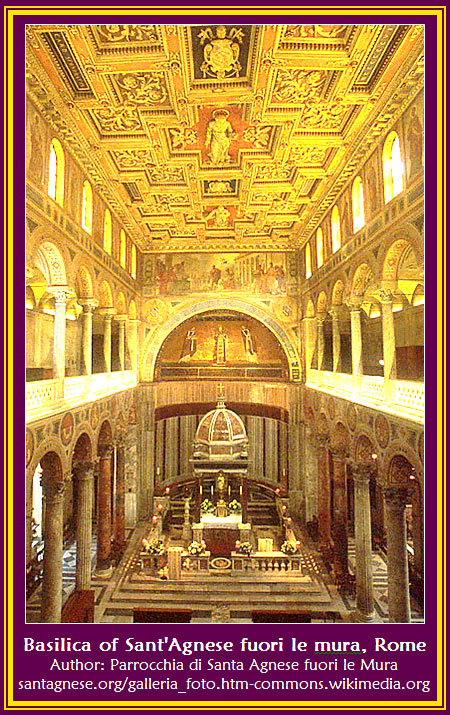
1) Basilica of St. Agnes Outside the Walls (Sant’Agnese fuori le Mura) is the present smaller basilica on the site of the saint’s grave at Catacombe di S. Agnese. Built and restored by Pope Honorius I (Reign: 625-638), Sant’Agnese fuori le Mura is partially below ground. It exists over the very spot of an older sacellum ad corpus (Chapel for the body) most likely erectedduring 337-366 when there was a rapid increase in the Christian community of Rome. That ancient shrine was subsequently restored by Pope Symmachus (498-514), a Sardinian convert who also built, among other edifices, the first papal residence next to S. Peter’s Basilica.

From the pontificate of Pope Paul V (Reign: 1605-1621) when the tomb of S. Agnes was exhumed to this day, the silver urn (given by Pope Paul V) containing the bones of S. Agnes is conserved beneath the high altar of Sant’Agnese fuori le Mura.

The same sarcophagus now contains the cache of bones of S. Emerentiana VM after her crypt (Chapel of the Chair) was discovered in a catacomb in the land gifted to the Christian community by the wealthy Ostorii family. The relics of S. Emerentiana were also noted during the archaeological excavations of Giovanni Battista de Rossi carried out in 1876 during the longest verified pontificate of Pius IX (1846-1878).  

2) A few meters from Sant’Agnese fuori le Mura is the once grandiose edifice erected to commemorate the spot where the lifeless body of Agnes was laid in c 304.  This edifice was founded by Roman emperor Constantine the Great (c. 274-337) (3) at the behest of Constantina (Flavia Valeria Constantia/Costantiniana/Costantia, c. 320-354), his daughter from Empress Flavia Maxima Fausta (c 293-326), his second wife.

In 337, following the death of her husband Flavius Hannibalianus (Annibalianus), Rex Regum, Constantina had sought the healing attributed to S. Agnes to cure her persisting skin ailment. Legend has it that S. Agnes appeared to Constantina in a dream entreating her to become Christian. The miraculous cure that took place the following morning turned Constantina into an ardent devotee of S. Agnes and before long, a basilica in the saint’s honour was built near Sant’Agnese fuori le Mura. Years later, when Constantina died at Bithynia (Asia Minor) in 354, her brother Emperor Constantius II (Flavius Julius Constantius, 317-361) took initiative to honour Constantina’s wish to repose by S. Agnes’ side. Her mortal remains were brought to Rome and interred in the (now well-preserved) Mausoleo di Santa Costanza (referred as Church of S. Costanza since 865. 4).

According to contemporary Antiochian historian Ammianus Marcellinus, six years after the passing of Constantina in 354, the lifeless body of Helêna, another daughter of Constantine and wife of Emperor Julian ‘the Apostate ’(Flavius Claudius Julianus, 331-363) (5), was brought from Gaul in 360 during the Quinquennalia Games and entombed in this Mausoleo.

From very early times S. Agnes was regarded as a singularly loved figure among the heroines of the days of persecution. Although portions of the catacomb of that area are of an older date than S. Agnes, out of devotion for S. Agnes, many noble Roman families chose these grounds for their sepulchre – to be nearer to the burial site of this celebrated saint. As years rolled on, that entire old burial area became known as the Catacombe di S. Agnese, one of the largest and most celebrated of Christian Rome.

Jo                                                  (Continued in Part III)

Notes:

  1. The Complesso Monumentale S. Agnese (current Sant’Agnese fuori le Mura) consists of the Catacombe Sant’Agnese, Sec. II-IV, Basilica Costantiniana Zona Archeologica Sec. IV, Mausoleo di Costanza Sec. IV and Basilica Onoriana Sec. VII. A trip to Rome is incomplete without savouring the fascinating ambiance of the Complesso Monumentale S. Agnese.  A real gem in Rome – not to be missed by those who love ancient paintings, beautiful mosaic, unmodified architecture and history of the first ages of Christianity.
  2. Sant’Emerentiana (Emerenzia/ Emérentienne) is presumed to be a sister or foster-sister of S. Agnes. She was most likely one of the helpers during the burial of S. Agnes. Emerentiana’s feast-day is celebrated on January 23 but in the Martyrologium Hieronymianum she is mentioned under 16 September, with the statement: In cemeterio maiore;
  3. Constantine the Great was responsible for building many Christian basilicas (S. Peter’s, S. Paolo, S. Lorenzo, etc). He is also associated with monuments outside city limits and also at the Catacombs where they are erected on the site of the tombs of the martyrs and saints.
  4. The 4th century Mausoleo di S. Costanza, a sepulchral basilica (used as a baptistery for Sant’Agnese basilica and a popular chapel for wedding) has circular form similar to the Hadrian’s Mausoleum (Castel Sant’Angelo) and the Temple of Vesta, the Virgin goddess of the hearth and home in the Roman religion. This funerary complex was probably intended for Constantine I but his daughter Constantina inherited it after he was buried at the Church of the Holy Apostles in Constantinople. Together with the monumental red porphyry sarcophagus of S. Helena (Flavia Julia Helena, c. 250-c. 330), the mother of Constantine, the red porphyry sarcophagus of Constantina (Costantia) is presently preserved in the Museo Pio Clementino of Museo Vaticano Roma and a cast replica is kept in the Mausoleo di S. Costanza.
  5. Helena’s death in Gaul in 360 was caused by the effects of poison, which, according to Ammianus Marcellinus, had been administered three years earlier in Rome, by Eusebia Augusta, the beautiful but jealous second wife of Emperor Constantius II. It was believed that this act was not so much to kill Helena but to prevent her from ever bearing an heir to the throne. The mystery concerning Helena’s death was used by the enemies of her husband Emperor Julian (Flavius Claudius Julianus) to tarnish his reputation at the time.

(© Joseph Sébastine/Manningtree Archive)

S. Agnes of Rome VM

S. Agnes of Rome VM

Lat. Sancta Agnes, Ital. Sant’ Agnèse, Spa. Santa Inèz,

Santa Ignes, Fr. Sainte Agnes, SS. Agnetis, Angl. Agnes

c 291 – c 304 – Feast: January 21

Part I (in 3 parts)

S. Agatha of Sicily (d. c 251), S. Cecilia (d. c 280), S. Agnes (d. c 304), and S. Lucia of Syracuse (d. 304) are the four great virgins of the Latin Church. Martyrs of early Christianity they are – the first and last being Sicilians and the remaining two Romans.

Since the time of Roman emperor Constantine the Great (C., Flavius Valerius Constantinus, c. 274-337), a basilica stood beside Via Nomentana in Rome in honour of the Roman maiden S. Agnes who followed Christ from her infancy. Upon wearing the crown of martyrdom in c. 304 when she was twelve or thirteen years of age, she was buried in a cemetery named after her which has close proximity of this basilica.

A special patroness of maidens and chastity, and named in the first Eucharistic prayer, S. Agnes is one of the most popular of saints and patron saint of Roman virgins. Earlier writings tells us that S. Agnes, whose name signifies lamb in Latin and chaste in Greek, was born in an illustrious Roman patrician family in c. 291 and baptised at a very early age.

Through the years that followed, Agnes became renowned for her tender beauty and also for her enthusiastic piety to lead a life of purity. At the age of twelve, she was denounced as a Christian to Symphronius, the Roman prefect of the city. Her accuser was the prefect’s own son Procop, an unsuccessful suitor to whom Agnes refused matrimony alleging that she was already dedicated to Christ.

During that primitive age of the Church, Caesar had many, many ears that listened for him.

Persecution of Christians under the iron hand of imperial Rome spanned a space of three hundred years when many innocent Christians were tormented to convert. If that does not work, the process was to line them all up. Behead the first one, and if the next does not renounce his faith in Christianity, work one’s way to the very end. Nevertheless, such persecutions did not annihilate the believers but enflamed the faith of the martyrs instead.

How could Agnes be an ardent believer of a man who had been executed by a Roman governor of Judea? In a word, she was deemed guilty of blasphemy against the Roman gods. The accusation against Agnes during Emperor Diocletian’s fierce continuous persecution of Christians (303-305) (1) resulted in her detention and interrogation following which she was subjected to different stages of torture. However, Agnes’ saintly bearing had helped her to retain her consecrated virginity after she was forcefully confined to a house of infamy in Circo Agonale (2), Rome.

In such circumstances the imperial Roman persecutors will always have to win. But here they have failed in their efforts to compel Agnes’ recantation of the Christian faith and also to coerce her to worship goddess Vesta (3). With their anger ignited, Agnes was subjected to an ordeal by fire but the outcome was that she remained untouched by the scalding hot flames. Soon after, at the orders of Pro-prefect Aspasius, she was publicly decapitated by the sword of a lictor (4).

Later writings on S. Agnes reveal that she was the focus of praises by great Christian scholars such as S. Jerome (Eusebius Hieronymus, c. 342-420); S. Ambrose of Milan (c. 339-397 – detailed in his treatise de Virginibus addressed to his elder sister, S. Marcellina V (330-398)); Pope S. Damasus I (Reign: 366-384); and Latin Christian poet Marcus Aurelius Prudentius (c. 348-413) in his 4th century hymn, The Passion of Agnes in Liber Peristephanon (Crown of Martyrs).

By S. Agnes’ martyrdom, she had only gone beforehand ‘in the sign of faith.’ The lives of saints are an exposition of the faith of Jesus Christ. The fairness of Christianity is that women are regarded as equally gifted with holiness as men are and all true, without prejudice, both are evenly loved by God. When a list of the Roman church martyrs perished during the great persecution of Diocletian was compiled around 336, it marked the first inscription of Sancta Agnes, the fair Roman maiden with an air of saintly dignity blended with the most benign sweetness.  

Jo                                                                                (Continued in Part II)

Notes:

  1. We do not know with certainty in which persecution Agnes won the martyr’s crown. This incident is variously placed during periods of severe persecution under: Caius Trajanus Decius (249-251); Publius Licinius Valerianus (257-260); Gaius Valerius Diocletian (303-305).
  2. Circo Agonale: The Agonale Circus (Stadium Domitiani) was built on the site of the great circus of Tarquin the elder. In the course of time, the area fell into ruins. Under Pope Callixtus II (1065-1124), the Church of Sant’Agnese in Agone was built there and consecrated on 28 January 1123.
  3. Vesta (Hestia in Greek) is the Virgin goddess of the hearth and home in the Roman religion. She is one among the 12 superior Roman divinities (Dii majorum gentium) collectively known as Dii Consentes – the others being: Jünõ, Minerva, Cërês, Diana, Vënus, Mars, Mercürius, Diovis, Neptünus, Vulcanus, Apollõ. The worship of Vesta survived to the last days of paganism before it was abolished by pious Roman Emperor Gratian (Augustus Grãtiãnus, 359-383) in 382 A.D, a year prior to his assassination for his enmity to the Pagan superstition.
  4. The source of this account relates to the Latin ‘Acts‘ and the Ambrosian hymn.    

(© Joseph Sébastine/Manningtree Archive)