Recently some of my posts featured Attila the Hun and Jesus Christ, among other subjects. They both in the end conquered the World. Attila did it by force – evoking the violence of hordes of Huns. Christ attained it by love. Indeed, Christianity of Christ is a faith for all occasions. It not only teaches one to be courageous in darker times but also to be happy wisely.
At this fag-end of the year 2024, I appreciatively focus on this Christmastime and the brotherhood and some festivities associated with it. In fact, one of the great vital principles of Christianity is the brotherhood of all humanity. As I write this now, it’s the Christmas Eve – by and large, a time of gaiety and good cheer. Only few hours remaining for the event made known by the Bible, viz. Virgin Mary brought forth her first-born son and wrapped him up in swaddling clothes and laid him in a manger… ushering in the Christmas Day!
There existed a custom which exalted a child born at Christmas as fortunate in life and never see a ghostie as long as that child lived. At the same time, there was another belief that those born on a Christmas Eve cannot see spirits to the end of their days and do not require holly and mistletoe as guardians against evil. On the whole, majority of superstitions and omens related to Christmas belong to a happy nature.
Born on January 18, I qualify as a Capricornian (those bornbetween December 22 and January 20). I have heard that Capricorn is related to the most elevated point in the heavens and perhaps the best known sign of all those in the Zodiac. Part of the reason is based on the statistic that it is during the reigning period of Capricorn; millions of people all over the world could avail the opportunity to pay homage to the most famous birthday of all — the glorious birthday of the Baby Jesus on December 25 – born in Bethlehem of Judah, in the days of King Herod.
Perchance, it is this affinity which explains the innate religious trait in most Capricornians even though oft-times such a trait is unrealised or unconscious.
In general, Christmas is a grand time for getting together, for meeting new ones and greeting old friends. Behind all the merriment, there’s an inherent significance in Christmas: Peace on Earth — Goodwill to Men. Such is the message of Jesus, and that is the spirit that underlies a genuine Christmas celebration. Jo
A charming feature of the present festive season is the decorated evergreen Christmas tree, ablaze with tiny lights, which represents the spirituality of Christmas. In Europe and elsewhere, pine and fir are species grown as fresh Christmas trees. At times, when they were not readily available potted, a similar species of conifer, perchance, Norfolk Island pine (star pine, Araucaria Heterophylla) is acquired as a substitute.
The topic of substitution brings to my mind a letter I came across in an old edition of an Australian magazine. It was written by a woman about her great-grandmother who was a colonist passenger in a ship sailing from England bound for Australia more than 165 years ago. In 1851, there was a gold rush in Australia when gold had been discovered at Ballarat, closer to Melbourne which caused such an on-rush of emigration that during 1852-57 about 225,000 people arrived in Australia. In fact, the urge for emigration has been gathering momentum much earlier due to the 1845 blight that ruined the potato crop, the staple diet of Ireland. As a result of that Irish Potato Famine, about one million Irish citizens died from disease and starvation; while another million emigrated; mostly to America.
At that time, the ship building sector was also undergoing a transitional period when sailing ships were changing from wood to steel although some ships were made from iron. The subject ship had an auxiliary steam engine for use when the wind was calm or contrary. While her engine was only capable of 200 horse power, I reckon, it took about 60 days to reach Australia from England.
As the narration goes, everyone in that ship was looking forward to spend Christmas in the new land and ladle great helpings of Aussie hospitality. But, on the Christmas Eve, all passengers were disheartened to learn that the ship was still hundreds of miles away from the seashore which meant – no Christmas tree. But when the children gathered in the ship’s saloon for their gifts, they were surprised to find a little tree with real leaves. That tree, adorned with tinsel ornaments and white sugar for ‘snow,’ was already lighted with tiny candles.
Assuming that the ship will be delayed and Christmas would be spent at wintry sea, the ship’s carpenter, a “rough diamond” but a “very smart man” and a stickler to the “Englishness” of Christmas, took the task to make the tree. Upon sailing from Cape Town, he sowed parsley seeds in a box filled with sand (from ship’s ballast) and sawdust. While it was kept out of reach of salt spray, the crew took turns to water it using their daily allowance of drinking water. As Christmas neared, the parsley had grown luxuriantly. From the firewood the carpenter carved out the stem and the branches on which the parsley leaves were tied. Thus, a Christmas tree was born!
True to the Christmas ideal, how thoughtful of the ship’s carpenter to use his skill to create and decorate the Christmas tree and share it to swell the hearts of friends and strangers. Just as it always does, Christmas invites us to throw open the doors of our hearts and homes for child Jesus and love to come in. Are you decorating your Christmas tree today? – Jo
Images of Christmas tree courtesy: Sharon Grace Martinez
PARIS, the capital of elegance and art is renowned for its central landmarks and points of identification viz. the Arc de Triomphe, The Avenue des Champs-Élysées, Sacré-Cœur, Palais Garnier (Opéra de Paris), The Louvre, Mona Lisa, Cathédrale of Notre-Dame, the houseboat on the Seine – all of which has been absorbed into the tradition of Paris. Then there is the Eiffel Tower which seemed to sway in the wind. One could see the panorama from its top as it pointed upward into space as if seeking to escape from the earth.
During the three hundred years between 1050 and 1350, 80 cathedrals, 500 large churches and hundreds of small parish churches were built in France which reflected the wealth and variety of the country’s history and architecture. Following the construction of the abbey of Saint Denis (now Basilique cathédrale de Saint-Denis) north of Paris on the grave of Saint Denis in 1144, there was strong plea for a cathedral much longer and upward looking than Saint-Étienne’s in the Île de la Cité.
The new cathedral had to be worthy of the great demographic expansion and economic dynamism of Paris. With the low hills region such as Butte Saint-Jacques, nearby Bagneux, Arcueil, and Montrouge dispersed with great beds of granite and limestone, there was hardly any shortage for building materials. And so, without totally destroying the existing two churches, Maurice de Sully (elected Bishop of Paris on October 12, 1160 – died in 1196) commenced to build a new edifice on the same site. It is generally held that Pope Alexander III laid its foundation stone in 1163 and the construction was done by professional workers organized in accordance with the traditions and rules of the guilds and the powerful Chapter of Notre-Dame.
Cathédrale Notre-Dame de Paris is the heart of Paris. It is an historical, as well as an ecclesiastical and architectural landmark. It was on the apocalyptic west façade of the Cathédrale Notre-Dame, on the pavement of the great plaza called Parvis de Notre-Dame – Place Jean-Paul II, that the official centre of Paris is landmarked with a bronze star on an embedded plaque – proclaiming the central place conferred on Notre-Dame in the country’s life. This bronze star (placed by André Jules Michelin) is the point-zero (Point-Zéro des routes de France) for measuring distances from Paris. The local cue is that: a) if you stand on this bronze plate, you will return to Paris; b) if you stand on it with your lover and share a kiss, your love will last forever.
Five years after the devastating fire in April 2019, presently, the extensive restoration/rebuilding work of the Cathédrale as well as the subsidiary work have almost been completed. The French has slain the ghost of that fire. Cathédrale Notre-Dame de Paris is officially scheduled to reopen partially to the public on December 08, 2024 (although some of the work will continue beyond this date until Sunday, June 08, 2025 coinciding with the Feast of Pentecost). Church bells will be ringing out in Paris on the official inauguration on December 07, 2024 (not open to the public) and on December 08, 2024. On both days, grand liturgical ceremonies at the cathedral, as well as spectacle befitting this glittering occasion, is expected (a).
It is the civilization we betray when we do not care for our great monuments of the past. By loving these monuments, relating the stories behind their construction, understanding the masters who build them, we comprehend the high-values reached by civilization. One of the cathedral’s ablest restorers, Eugène Viollet-le-Duc, rightly said that, if the pillars of Notre-Dame could speak, they could recount the annals of France from the days of Philip Augustus (Philip II of France, 1165-1223) to our own. It is with continuous love and care, Notre-Dame de Paris will stand perpetually in its rightful grace and grandeur. Vive la France. Jo
Note:
Subject to change;
Refer to my posts of December 2016 for a fuller version on Notre-Dame de Paris
Part III of The Flower and The Nettle (in 3 parts)
“A word or a smile is often enough to put fresh life in a despondent soul.” – St. Thérèse of Lisieux
Although few names are listed in the Bible from Adam to Noah, it is estimated that even before the murder of Abel around 130 years after Adam’s creation, through the human reproductive process, there were upwards of four hundred thousand male descendants of Adam, in addition to women and children. If a tradition of Abyssinia speaks truly, they were descended from Shem, the son of Noah.
One legend that engaged the minds of the ancients of Abyssinia asserts that the devil or Satan, the head hunter from the garden, was not yet done with just the fall of Eve and Adam. That episode in the garden was only the beginning – a foretaste. Hiding in the serpent for that first time, the devil’s initial attempt was to attribute the prohibition on the fruit of the tree of knowledge in the midst of the garden to envy. Thus, by planting the seeds of doubt in the mind of the woman, the evil one had secured a sparkling victory by inducing disobedience in Adam through Eve which led to their punishment.
Thereafter, God had questioned Adam and his woman but didn’t question the devil: because it’s a non-issue. The devil is confirmed as who he is. He doesn’t just act evil for he is the evil one, at times a fire out of control. The devil cannot be other than he is. His success in this episode, no doubt, had opened the pathway for the evil one to continue with his fiendish stratagem.
In spite that Adam and Eve realised that the Satan impersonated as a serpent had deceived them at so great a price, yet with a singleness of purpose, the devil had ventured to deceive those human mortals once again with his deceptive ways. As we believe, his satanic force of will favoured special and privileged footing in terms of continuity and high advantages in exercising his misdemeanours which was his known forte since a constant endeavour to do evil always exhales and ascends from hell.
The devil is not a literary invention. The Abyssinian version of the Fall of Man of the Old Testament was that jealousy is the prevailing root of all evil and it descended with other sins from our first parents. And so, there are temptations everywhere. The devil will always do his best to tempt you into sin until you get to that place where you fall in love with sin, ungodliness and worldly lusts. He wants you down there with him – like his everlasting inheritance.
One day, Eve was in the cave waiting for Adam to return from the field. At the set of sun, the devil, the hater of all good, decided to approach her.
Eve spent most of her time in their dwelling place in a cave in a rock on the western border of the garden where the earth was very broad. She often thought about how very peaceful and distinct their charmed life of comfort, as they knew it, having lived in that Garden. She knew of the values of that period, of life that knows no Death; and an important lesson about loss.
Unlike their times inside the Garden of Eden when a certain glory rested on them, the punishment inflicted by God on them to work on the uninhabited expanse of land surface for agricultural crop yields to meet their daily bread, often kept Adam away from the presence of Eve. Besides, Adam used to visit a sacred place for his daily prayer – part of his normal course of activities on any given day.
The dusk was falling and Eve, while working with her spindle, wondered what kept Adam away such long time. Even though the devil had picked her lonely moment to take advantage of her, he didn’t expect Eve’s mind would be a strange hard shell to infiltrate.
When Eve came to the mouth of the cave and to the delicious outside air, the evil one, disguised as the accursed serpent, made his apparition, “sorrowfully licking the dust, wiggling on its breast on the ground and venomous, by reason of God’s curse,” which implied that originally the serpent’s physical form walked erect.
With its eyes blood-red, it swelled its head and stood on its tail near the mouth of the cave because the devil could not enter into the cave due to their prayers. With a display of pomp, he said that he hoped what he was going to tell her would meet with her approbation.
The insidious tempter asserted that Eve was a deceived wife and nothing could make him so miserable as to find her unhappy. Adam merits much greater attention from her – for he could be seeing another woman elsewhere during his absence from Eve.
So far, she had no reason to be suspicious of Adam even though, after their expulsion from the Garden, many things have changed. Adam was not the similitude of his Creator – the man of original state of innocence and happiness which he was when God breathed the breath of life into him and pronounced him good.
As devil’s words, warm and sympathetic, set the dogs onto her mind, the tempter craftily proposed to show to her the other woman if only Eve would give credit to his words. He had vouched that she could ask the leaves of the trees for the truth, ask the stars of the night sky, or ask the calmness of the universe, carefully avoiding any mention of the Sun, now about to set, but which dazzles and beautifies.
Heeding to Eve’s request, the devil went ahead of her to the river bank. She followed him until they came to the still waters of the river, the place where he had declared Eve could see her rival. Looking down into the fresh waters of the sun-flecked mountain watercourse, Eve could make out the woman staring back at her – the life in the water. Eve felt dashed and low.
Although the devil didn’t give her to know at that time, her own reflection was sufficient to corroborate her of the other woman’s existence. Although the devil had started out with zeal, now finding himself unable to keep still looking severe, the evil one, animated by infectious evil spirits, eased out of the serpent and hid away from Eve.
His spirit soared at his devil’s luck in deceiving her. He could hardly contain his satanic laughter. That is all that matters and that is always the case. Then, as now, mankind had not been free from the wiles of the devil – the cause of many troubles.
It is difficult to clothe in adequate illustration the ghastly attributes with which painting and writings have invested this horrendous evil character – the devil or Satan. Years later, the Africans of the Guinea Coast would come to an understanding on the issue at hand – learn how to tame the evil, a cognitive achievement that is properly creditable to a legend of their ancestors.
The influences of such a legend have been subject of various interpretations. However, it is not a competition. It asserted that the only defence one would require against the hideous devil and his minions unnumbered, is a mirror. If anyone will keep a mirror beside the Devil, he must see himself in it, and he at once rushes away in terror of his own ugliness.
Seek not outside yourself, heaven is within – Mary Lou Cook
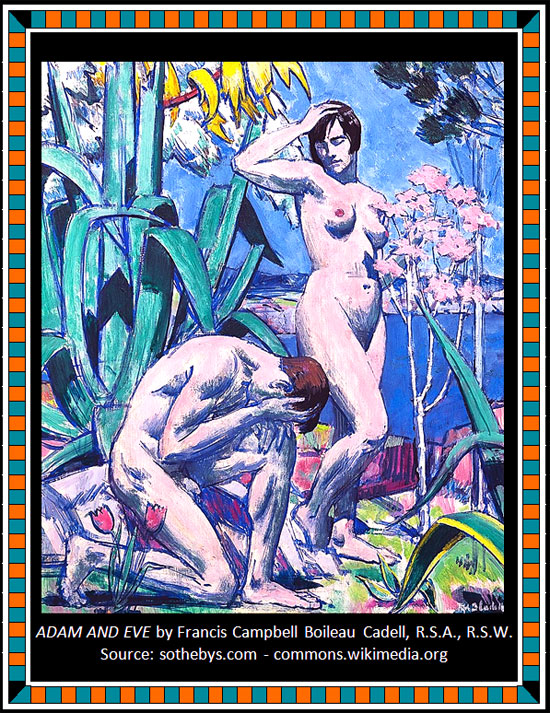
Happiness is a living emotion. It was in the Garden of Eden with its magnificent vegetation, plentiful fauna, and teeming population of many other species wherein Adam, his woman and the animals happily occupied the same plane of existence. It was in this garden that the Creator, who is the foundation of all good, established the union of those first two human beings – which occasioned the beginning of the human family and birth of society. It was in this garden where, both Adam and the woman ate only the abundant fruits of the trees and lived in their state of pristine innocence.
This is also where the first punishment for disobedience was meted out against these two frail creatures who had sinned through pride – for by consuming the forbidden fruit man knew the good he had fallen from, and the evil he had fallen into.
As regards the vexed question of banishment from Eden as a consequence, the respective punishments enforced on Adam and his woman, the couple who originally enjoyed immortality and “walked with God”, brought upon them sickness and death; with the necessity of working for a living, Adam will struggle in pain so much of his further earthly span to prepare the ground fertile to cultivate; and the woman, who was every way perfect and bearer of life, is to suffer multiplied pain during childbirth.
God always intended for human beings to work for a living and for work to be a joy. In the beginning, work was meant as a gift. In the beautiful garden where Adam lived with the woman, no doubt, they didn’t fritter their life away but oft-times occupied themselves tending to that garden. One could think of the time when Adam studied all living things and engaged in the act of naming them – something more than a passing notice but a very important symbol.
The chastisements imposed by God also made them discover their nakedness and awakened in them a sense of shame in contrast to their prevailing state wherein they were unashamed of being naked.
They hid behind the loincloths made of fig-leaves gathered probably from the tree whose forbidden fruit Adam and the woman had eaten (1) in defiance of the commandment of their God the Creator.
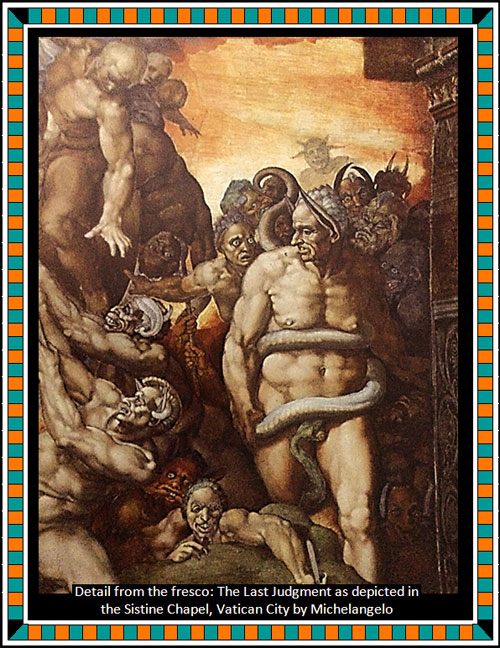
The fact remained that, the mixture of mercy and wrath and expulsion from the Garden of Eden they had incurred was the aftereffect of the crafty exploit of a devious sinner in a serpent’s form. That demonic sinner was none other than the devil. As the Prince of Evil, he is also called Satan, the fallen and lost, but a hero of his own story, who had employed jealousy as a seductive weapon with the utmost subtlety to entice the guileless and unsuspecting woman by praising the alluring beauty of the tree and the seeming benefits which it might confer.
The devil had accosted the woman in the absence of Adam. Perhaps she had only heard the terms of the covenant from Adam. To seduce the woman into disobedience, the evil one had made use of the serpent (chivja). If anything, by his prevarication, the first man Adam not only sinned himself by his disobedience to God and obedience to the devil, but entailed misery on his whole posterity as the blood of the first human stock flows in the veins of every living human being.
The spell of trustworthiness the devil created to seduce the woman into disobedience was no simple feat but craftily attained by him by employing a methodical and deceitful approach for which this evil creature would later become world renowned for.
From the earliest years, painters around the world, while depicting the Fall of Man, have illustrated the devil’s impersonation as a serpent and accentuated the cunningness of this evil snake creature when it engaged Adam’s woman (2) in conversation that led to the Fall of Man, an episode which formed part of the inspired history of the great events of 2369 years depicted in the Book ofGenesis of the Old Testament which started with the first ten words: “In the beginning God created the heavens and the earth.”
Jo (Continued in Part III: Lessons from The Garden)
Note: (1) A fable would later on gather popularity as “Adam’s apple” (Latin: Pomum Adami) in relation to the protuberance in the forepart of the throat, so called from the supposition that a piece of the forbidden fruit stuck in Adam’s throat.
(2) Later, Adam would call his woman Eve – the word Eve is “Chavah/Hawwah” in Hebrew, means “Life, lifegiving“)
“Let us make man in our image, after our likeness” (Genesis 1:26)
Time is always on the run. As for now, let me take the privilege to rewind it to take you to the very infancy of the world – to that ancient time when the first parents who stood at the head of the human race lived care-free in the majestic Garden of Eden, that sacred place stated in the Book of Genesis, the first book of the Bible which is the Book of all beginnings. Purportedly written by Moses, the Book of Genesis tells about how the world came into existence and life actually began.
Predominantly evergreen, the colour that represented hope and new life, the Garden of Eden was reputedly the terrestrial paradise that God planted eastward from Canaan, in Eden. An emblem of the heavenly state, this garden probably lay not far from the ancient Babylon, where the rivers Euphrates on the west, and Hiddekel, or Tigris (which goes toward the east of Assyria) on the east, joined into one and watered it. These waters, after running a little southward, parted into the two streams of Gihon (extent the whole land of Ethiopia) on the east, and onto Pison (extent the whole land of Havilah, where there is gold) on the West. However, the abundant literature on the subject does not lead to a definite answer to the garden’s location.
Human race certainly had a beginning. Science tells us about the evolution of man in variations such as: First Primate (Forerunner of Man); Java Man (about 1,000,000 B.C); Peking Man (about 750,000 B.C); Heidelberg Man (about 500,000 B.C); Neanderthal Man (about 100,000 B.C) with whom our cultural history begins and the formation of Homo sapiens (about 50,000 B.C) which is our own species. In all likelihood there was a first of the species Homo sapiens of the earth, earthy, who once stood at the head of the human race. Adam or whatever his name was, his blood flows in the veins of every living human being belonging to the same species on earth today, as the Bible clearly expresses it.
According to the Book of Genesis, God formed man’s body of the dust of the ground with most exquisite art and skill and breathed into his nostrils the breath of life; and man became a living rational soul. This being our Creator’s greatest achievement, His creation was a human person from the earth, capable of exercising the functions of all sorts of life, although he lacked the Holy Spirit. It was in the very Paradise of God where the Bible says, the first man Adam was graciously placed.
Based on the Old Testament, it is uncomplicated to fathom how the garden of Eden’s image is subliminally imbued in the minds and hearts of the Christians at large. The Bible disclose that, this well-watered Garden of Eden which had a luxuriant natural vegetation, where grew every tree that is pleasant to the sight, was decked and enriched with every choice of precious fruits good for food – the inference being Garden of Eden is a magical place – peaceful.
Amidst the garden stood the principal tree of life, so called because of the invigorating nature of its fruit; and it was made a sacramental pledge of man’s eternal life in heaven, provided he kept the covenant which God made with him. Besides the tree of life, therein was the tree of knowledge of good and evil, so called because, by its fruit God, manifesting his supreme authority, tried Adam’s perfect obedience: for in the day that he eat from it, he shall surely die.
On the word of the Bible, God knew that a help meet for man is essential, since it is not good that the man should be alone. The intended female must be suitable to his nature, useful on all occasions for their mutual comfort, and the propagation of their species.
God caused a deep sleep to fall upon Adam, and as he slept, a female was brought forth from one of the ribs of Adam. He endowed her, as He did Adam, with power of thought, speech and endless life. Once brought her to Adam to honour the institution of marriage, to Adam she was the bone of his bones and flesh of his flesh. He called her ‘Woman’ (îsshâh), because she was taken out of Man.
Jo (Continued in Part II: Speak of The Devil…)
Dedicated to my late wife Renate Elisabeth Simeon (Carina) who took me out of the woods and showed me the trees.






 Manningtree Archive
You must be logged in to post a comment.