Archives

Irène Papas for Remembrance

Everyone in your life will have a last day with you and you don’t even know when it will be…

In 1973, Irène Papas acted in the Biblical TV miniseries Moses the Lawgiver (Moses, 1974). A co-production of Sir Lew Grade’s British ATV-ITC consortium and Italy’s RAI (Radiotelevisione Italiana) Television, it was made at a cost of about $6 million.

This episodic biopic of the Old Testament Hebrew prophet and lawgiver Moses (Hebrew: Môsheh – c. 12th century BC) (1), well-written by British novelist Anthony Burgess (A Clockwork Orange) along with Vittorio Bonicelli and its director Gianfranco de Bosio, starts with the rescue of infant Moses while afloat on the Nile, by Princess Bithia (meaning: daughter of God), one of Pharaoh’s daughters.

The familiar story then chronicles the period Moses was brought up in the corrupt brilliance of the Pharaoh’s Court; his eventual encounter with the voice of the Lord in the Burning Bush; the Exodus when Moses led the people of Israel from slavery to freedom out of Egypt by way of Sinai; the iconic event when Moses received the tablets of the Ten Commandments from Yahweh (Jehovah) on Mount Sinai; and Moses’ death after setting his eyes on the Promised Land.

Zipporah (Sephora, meaning little bird), Irène’s character in this Teleplay series, is one of seven daughters of Jethro (Raguel/Reuel), a priest of the Midianite tribes, that Moses married and adapted to a quiet life of a shepherd. As I write this, I could particularly recall that scene when Moses bids goodbye to wife Zipporah and his son, before he returned to lead his people from bondage in Egypt.

Fifty-nine year old Burt Lancaster dominates the role of the title character with supporting turns by Anthony Quayle (Aaron), Ingrid Thulin (Miriam), Marina Berti (Eliseba), Mariangela Melato (The Princess Bithia), Laurent Terzieff (Pharaoh Mernefta), etc. Burt’s son by Norma Anderson, 25 year old William “Bill” Lancaster was tasked with the role of young Moses. Under director Gianfranco De Bosio, the filming which started in August 1973 at Rome’s Cinecittà Studio went on to continue on location in Israel which was briefly interrupted by the outbreak of Yom Kippur War, the 1973 Arab-Israeli War fought from 06 to 25 October and ended in an Israeli victory. After the war, some of the cast and crew returned to Israel from Rome and the shooting resumed.

It took a total of six months for entire filming to complete and the theatrical version of Moses the Lawgivercame out in March 1976. As part of the production crew was Mario Bava, a visionary always worth watching, who provided the special effects. The music was composed and orchestrated by Ennio Morricone with additional music, songs and dances by Dov Seltzer.

The two movies of director Moustapha Akkad in which Irène Papas starred are epics in scale, set in highly traditional cultures. Irène took on the role of Hind bint Utbah, wife of Abou Sufyan in The Message (Mohammad, Messenger of God/Al Risalah, 1976). Take note of Irène’s introductory scene in which she walks in the market with a gypsy swing of her hips.

Shot in Panavision on location in Morocco and Libya by Jack Hildyard, the spectacular film about the birth of the Muslim religion was filmed devoutly and with sensitivity by Syrian-American film producer/director Moustapha Akkad. The screenplay by H.A.L. Craig written from the point of view of Mohammed’s uncle Hamza, imparted more emphasis to action than religious angles. Anthony Quinn turns in a powerful, screen-filling performance as Hamza struggling to win religious freedom for Mohammad.

According to title credits, the film’s accuracy and fidelity have been approved by scholars and historians of Islam. In addition, as per Islamic tradition, the impersonation of the Prophet offends against the spirituality of Mohammad’s message, hence, the person of Mohammed is never shown although the audience see the world through his eyes as he sits high in the saddle of his camel as it strides into Mecca. The holiest shrine, Kaaba, was recreated for the film.

The Message was made in two versions with almost separate casts: one in English with well-known actors (3); and the other version in Arabic with actors of the same rank in the Egyptian/Syrian film world. Michael Ansara, Johnny Sekka, Michael Forest co-starred in the English version. Music was composed and conducted by Maurice Jarre.

Iphigenia (Ifigeneia, 1977), a stunning film interpretation of Iphigenia in Aulis by Euripides produced by Greek Film Center recounts the Greek legend of Agamemnon’s attempt to sacrifice his young first-born daughter Iphigenia on the altar of Artemis to obtain a fair wind for one thousand ships and also as atonement for having offended Artemis by killing her favourite stag. As Agamemnon prepares to sacrifice his daughter, Artemis at the last moment snatched her from the altar and carried her to heaven.

Billed as Eirini Papa in Iphigenia, Irène chewed the scenery as Clytemnestra, the faithless wife of Agamemnon and wounded mother. Directed by Michael Cacoyannis with eye-popping visuals by Giorgos Arvanitis, Irène’s principal scene-partners in Iphigenia included: Kostas Kazakos as Agamemnon, leader of the Greeks at the siege of Troy; young Tatiana Papamoskou/Papamoschou in an impressive performance as Iphigenia, daughter of Agamemnon and Clytemnestra; and Panos Mihalopoulos as Achilles, the hero of the Iliad, who, in this movie, is to be a match for Iphigenia. The film featured powerful music score by Mikis Theodorakis.

Iphigenia played at Cannes and Chicago International Film Festivals in 1977, and it won Best Film and Best Actress (Tatiana Papamoschou) awards at 1977 Thessaloniki Film Festival. Nothing was too great or too small to escape Cacoyannîs’ attention.

In an interview, Cacoyannîs once commented about Irène’s portrayal of Clytemnestra – that he “had identified Clytemnestra with her (Irène) before I made the film. She wasn’t really cast, she was part of the decision to make the him. I’d had no other image of Clytemnestra in my head. It’s that extraordinary physique of hers, and the power that goes with it. When Irène cracks, it’s like a stone that cracks. There is no sentimental self-pity. Her cries are not hysterical; they are defiant cries against the order of things….”

Although Iphigenia (Greece) was nominated for Oscar for the Best Foreign Language Film in the 50th Academy Awards 1978, it lost out to Israeli film director Moshé Mizrahi’s Madame Rosa (La vie devant soi, 1977, France) starring Simone Signoret and Samy Ben-Youb. At that time Irène was in the middle of a lawsuit initiated by her against the producers of The Greek Tycoon (1978) which starred Anthony Quinn and Jacqueline Bisset, and directed by J. Lee Thompson of The Guns of Navarone.

As per reports, initially, Irène was cast in The Greek Tycoon for a fee of US$55,000/- and she had kept herself free for its filming while the preproduction period stretched to a year during which her name was extensively used to attract investors to the movie. But when the production finally started rolling in the summer of 1977, another actress took over and portrayed the role meant for Irène. A book relates that her lawsuit for the contract amount was settled out of court. During this time, the dark-haired beautiful Irène was seeing Greek actor Nikos Verlekis, her young boyfriend.

Irène Papas was cast as Simonetta Palazzi in American writer Sidney Sheldon’s Bloodline (1979). With Terence Young of James Bond movies holding its directorial reins, this thriller told the story of Heiress Elizabeth Roffe (Audrey Hepburn). Neither daft bairn nor a silly-headed lassie, the protagonist Elizabeth was the smart head of the large Zurich-based Roffe & Sons Pharmaceuticals conglomerate who, mind now, finds her life endangered after inheriting the firm. Rated for graphic sex scenes, the movie is a tossed salad of international talent viz. Ben Gazzara, James Mason, Omar Sharif, Romy Schneider, Michelle Phillips, Claudia Mori, Beatrice Straight, Gert Fröbe, Wolfgang Preiss, etc. Music was by Ennio Morricone.

Irène took the role of Mabrouka in the historical epic, Lion of the Desert (El león del desierto, 1981) which recounts the last years of the real-life Omar Mukhtar (Anthony Quinn), the leader of Libyan rebels who resisted Italian rule and Mussolini’s forays into Libya between 1911 and 1931 to create a new Roman Empire.

A Libyan-British production directed by Moustapha Akkad (who began his cinema career as director Sam Peckinpah’s production assistant), and filmed by Cinematographer Jack Hildyard in Libya, it was funded by the assassinated Libyan leader Muammar Gaddafi (1942-2011).

Besides the talents of Quinn and Irène, the film also featured an impressive star-cast of Oliver Reed, John Gielgud, Raf Vallone, with Rod Steiger as Benito Mussolini (2). Maurice Jarre (Doctor Zhivago; Jesus of Nazareth) wrote the music score. Out of the three costume designers who did noteworthy costumes for this movie, it was Orietta Nasalli-Rocca who costumed Anthony Quinn as Pope in English director Michael Anderson’s The Shoes of the Fisherman (1968) based on novel by Morris L. West.

Eréndira, released in 1983, featured a cruel fable involving a wealthy but tyrannical grandmother Amadis who loses everything owing to a fire accidently set by her sleepwalking granddaughter Eréndira, an innocent, obedient maiden. To recoup Amadis’ losses worth over $1 million, she forced Eréndira to sell her virginity to the highest bidder in Mexico. The casting is exemplary. Irène Papas surpasses herself as Grandmother Amadis and Cláudia Ohana as heroine Eréndira, while Michael Lonsdale, Oliver Wehe, co-starred in this disturbing black comedy directed by Ruy Guerra. The screenplay is by Colombian novelist Gabriel García Márquez (4) from two of his own stories.

In The Assisi Underground (1985), Irène is the courageous Madre Maria Giuseppina Biviglia (1897-1991), the Mother Abbess of Monastero di San Quirico (le Clarisse, the cloistered Poor Clares), Assisi. It is adapted from the 1978 book, The Assisi Underground: The Priests Who Rescued Jews as told by Padre Rufino Niccacci to Alexander Ramati who also directed the movie. The film depicts true events occurred in 1943-44 during WW2 when Catholics in Assisi, Italy, gave refuge to Italian Jews in the city’s Franciscan monastery/convent, from Nazi Anti-Semitism. This Menahem Golan/Yoram Globus-The Cannon Group production co-stars: Ben Cross, James Mason, Maximilian Schell, etc.  

The Assisi Underground is the second collaboration of Irène with director Alexander Ramati. Nearly two decades ago, Irène starred as Ajmi in the Spanish-American production, The Desperate Ones (1967). This chase melodrama was scripted and directed by Alexander Ramati based on his novel, Beyond the Mountains, the title by which The Desperate Ones is sometimes known.

As the story goes, two Polish brothers, imprisoned in a Siberian labour camp escape and heads for Uzbekistan in Asiatic Russia where they contact smugglers who will guide them over the mountainous border to Afghanistan. During their onward progress, their various encounters include the suspicious head (Theodore Bikel) of the local N.K.V.D; a stunning blonde beauty Marusia (Maria Perschy); their benefactor’s wife Ajmi (Irène Papas), etc. Maximilian Schell, Raf Vallone, Fernando Rey, etc, co-starred. Despite the film’s exotic settings, costumes of Asian Russia and the impressive line-up of stars, adverse elements such as faulty scripting, uninspired direction, and soporific editing, badly affected the film’s success.

Irène portrayed the role of Penelope in the romantic comedy, High Season (1987) about a talented British photographer named Katherine residing in Rhodes, Greece and her involvement with obnoxious tourists, a spy, smugglers, etc. The film, with brief nudity and adult themes, marked the directorial debut of Clare Peploe (once married to Italian filmmaker Bernardo Bertolucci) and starred Jacqueline Bisset, James Fox, Kenneth Branagh, among others.

The year 1990 marked the release of TV movie, Un Bambino di Nome Gesù (A Child Called Jesus), directed by Franco Rossi. This life of Jesus is an Act of Faith. It compels attention and interest as an attempt to figure out Jesus’ missing years from age 3 to 12. Besides Irène in the role of old Maria, the film centred on Matteo Bellina as Jesus, María del Carmen San Martin as Maria and Bekim Fehmiu as Joseph. Vittorio Bonicelli co-wrote the script of Un Bambino di Nome Gesù which was mainly filmed in Yugoslavia.

Italian TV audiences may recall Yugoslavian actor Bekim Fehmiu (who flaunted shades of Porfirio Rubirosa in Harold Robbins’ The Adventurers) in the role of Ulysse (Ulysses/Odysseus), the wisest of the heroes, and Irène Papas as his faithful wife Pénélope (5) in Dino De Laurentiis production of the 1968 RAI TV Series, Odissea (L’Odyssée/Odyssey), based on Homer’s epic poem. This Teleplay featured an impressive array of popular beauties namely, Marina Berti (Arété), Marcella Valeri (Euryclée), Scilla Gabel (Hélène), Barbara Gregorini/Barbara Bach (Nausicaa), Juliette Mayniel (Circé), Kira (Kyra) Bester (Calypso), Michèle Breton (Athéna), Stefanella Giovannini (Cassandre), etc.

According to Messaggero Veneto, Irène’s last feature film was Portuguese director Manoel de Oliveira’s Um Filme Falado (A Talking Film) released in 2003. However, Ecuba, an Italian language film jointly directed by Giuliana Berlinguer and Irène Papas, was released subsequently in 2004.

Many lives progress in a more or less predictable path. Irène Papas’ journey has been different. Irène was never supposed to be what she became. Should her parents have succeeded to convince her to study architecture; her life would have been different. We all have our stories. The celebrity status of Irène Papas survives and prospers because the world still believes in the mystique of this austerely beautiful stage/movie/TV actress/singer for her talent and versatility. Theatregoers were equally impressed by her repertoire – by the wealth of her stage productions – adaptations and revivals. There really was something for everyone’s appetite. Like Irène, there were not many all-rounders who could sing, dance and act. She was one such trailblazer.

On 07 August 1998, Irène presented her first musical stage show as director of “Apocalipsis, voz de mujer” (Apocalypse, Woman’s Voice) at the International Music Festival at Castell de Peralada, Girona, Spain. Written by Greek author Yorgos Jimonás, the theme of this liturgical scenic act was reflection on the Mediterranean cultural tradition and the history of religions based on Apocalypse of St. John. The event was attended by Queen Sofía of Spain, her exiled brother Constantine II (1940-2023, former King of the Hellenes) and his Queen Anne-Marie of Denmark, Princess Irene (Queen Sofía’s younger sister), and other eminent dignitaries.

In 2018, there were media reports that Irène had been suffering from Alzheimer’s at least since 2013. For this reason she was not seen in public for some time. As her condition worsened with the passing of time, on one occasion, Constantine II, expressed his wish to visit Irène, who, I understand, was a close friend of the Royal family and also a board member of the Anna-Maria Foundation as of 2003. Such sociable visits had to be put on hold amidst fears that Irène might be unable to recognize visitors due to her illness.

Having been established herself securely in the popular imagination, and upon the strength of her national identity, Irène Papas was undoubtedly a source of admiration and inspiration to Greeks. The media wrote about her years in home care at her niece’s residence in Kifissia, a well-to-do green oasis in the northern shadow of Athens. Then again, nothing stays the same forever for there was sadness as the Alzheimer’s intensified towards the end of her life. Her last few years were spent in Chiliomodi, the place she always wanted everyone to remember she originated.

As the autumn of 2022 drifted into Greece and the nature gradually started to change the make-up, it was all suddenly over. Sadly, Irène Papas passed away on Wednesday, September 14, 2022 at the age of 93. Following a well-attended religious service at the Holy Church of Agios Georgios in Chiliomodi, Irène was buried in the village cemetery, next to her beloved parents. Death is emptiness. Antío, agápití mou Eiríni (6).        – All for now, Jo  

    Notes:

  1. The story of the Hebrew patriarch starring Charlton Heston as Moses is told in The Ten Commandments, the 1956 remake of director Cecil B. DeMille’s 1923 silent version of the story of Exodus. Read the book: Moses The Lawgiver by Thomas Keneally;
  2. This is the second time Rod Steiger portrayed Benito Mussolini. The first appearance was in the Italian war film, The Last Four Days (Mussolini Ultimo Atto/Last Days of Mussolini (1977)) co-starring Franco Nero and Irish-Italian beauty Lisa Gastoni;
  3. In March 1977, showings of this film were cancelled when a Muslim sect took nearly 150 people hostage in Washington, D.C. For more details on this hostage crisis: American Caliph by Shahan Mufti;  
  4. Gabriel García Márquez (1927-2014) was awarded the Noble Prize for Literature in 1982. Erendira was remade as Erendira Ikikunari (2008)
  5. Iliad, the epic poem attributed to Greek poet Homer, that master of energy of expression and fertility of invention, who lived in 8th century BC, recount the fall of Troy. Odysseus/Ulysses is a mythical king of Ithaca and one of the leading chieftains of the Greeks. He is the hero of Homer’s epic poem, Odyssey and therein he is depicted as wise, eloquent, and full of artifices. Penelope, the daughter of Icarius and Periboea of Sparta, is, according to Homer, the chaste and faithful wife of Odysseus, a model of all the domestic virtues. Some writers allege her being the reverse.
  6. Goodbye, my dear Irène.
  7. Due to constraints of space, the data compiled had to be chopped to keep the full text at a manageable size. I regret what has been left out and mean no disrespect to the subject of this 6-part episodic tribute. Irène Papas appeared in over 85 movies. The summary of movies stated herein relate only to those movies which are part of my collection;
  8. Up to now, the sources of reference for this concluding part of the tribute to Irène Papas are archives of the past including printed publications and visual media. DVD/Blu-ray of most of the movies mentioned in this write-up is available with some leading dealers.
  9. DVD sleeves/images shown here are only for promotional purpose. Source: Wikipedia, amazon.com, imdb, and from DVD sleeves.
  10. This illustrated article is an affectionate nosegay to the actress and movies referred above. Please refer to “About” of my webpage for more details.

 (© Joseph Sébastine/Manningtree Archive)

Irène Papas – A Diamond Forever

Since we cannot change reality, let us change the eyes which see reality – Nikos Kazantzakis

Produced, scripted and directed by Michael Cacoyannis, Zorba the Greek (1964) featured Irène Papas as an unapproachable widow. Anthony Quinn starred in the title role of Alexis Zorba – a wise, sensual, compassionate man in a tiny Greek village on the island of Crete. The film carried forward along his relationship with a too-intellectualized young English writer (Alan Bates).

This B&W film was based on the best-selling novel by Nikos Kazantzakis which Alan Bates later admitted that he hadn’t read the book before he filmed it. One of the highlights of the film is the scene where Anthony Quinn danced the syrtaki shoulder to shoulder with Alan Bates at the beach (near the village of Stavros).

Originally prepped as a United Artists project, the production of Zorba the Greek was taken over by 20th Fox which was a bit surprising at that time since director Cacoyannis had done his acclaimed Electra for UA couple of years ago and was preparing for his second outing for them. The two factors that was attributed as cause for this move could be that UA was well stocked on current and upcoming product; and secondly, with Anthony Quinn’s stop date clause to start 20th Fox’s period drama, A High Wind in Jamaica (1965, Dir: Alexander Mackendrick (1)) in June, 1964, UA may have deemed it ideal to allow 20th to take over Zorba the Greek to safeguard their side in case Zorba’s production went over schedule.

 In due course, the film initiated seven Oscar nominations at the 37th Annual Academy Awards (1965) including Best Leading Actor nomination for Anthony Quinn. Russian actress Lila Kedrova received the Oscar for Best Actress in a Supporting Role for her poignant role as the dying prostitute Mme. Hortense, uplifting her reputation as the first actress of Russian origin to win an Oscar.

Besides Best Art Direction-Interior Decoration (Black-and-White) for Vassilis Photopoulos, Berlin/German-born Walter Lassally won the Best Cinematographer (Black-and-White). Later Lassally commented as having thought earlier that his work in this film was “easier to do” than some of the other films he shot for director Michael Cacoyannis.

Earlier, in April 1964, the media reported that French actress Simone Signoret amicably took her exit from the cast of Zorba for which she had gone over to the isle of Crete and did tests for the small English-speaking role of the rather frilly, oldish, leftover French courtesan in Greece. Several actresses were brought to Crete for tests to fill the role vacated by Signoret while she joined the production unit of director Stanley Kramer’s Ship of Fools (1965) (2) to portray the role of La Condesa. As a result, Signoret was honoured with nominations for: Academy Award 1966 for Best Actress; BAFTA Award for Best Foreign Actress and Golden Globe Award for Best Actress in a Motion Picture – Drama.

By the end of 1963, Irène Papas was back in the Isle of Crete for location shoot for Walt Disney’s production of The Moon-Spinners (1964). The location shoots in different parts of Europe was not unusual for Irène’s movies since many of her American films were European co-productions. Upon wrap at the location at Crete, the film unit moved to Pinewood Studios in England for the final eight weeks of production. Complimenting Irène’s performance as villager Sophia in The Moon-Spinners were co-stars Hayley Mills, Eli Wallach, Pola Negri, Peter McEnery and Joan Greenwood. Composer Mikis Theodorakis, from Electra, provided the music.

It was during the production of Zorba, the Greek when Irène Papas first associated with her Greek co-star Yorgo Voyagis (billed in Zorba as George Voyadjis). Cinema audiences may recall Voyagis as El Lobo in Harold Robbins’ The Adventurers (1970); as Joseph in Franco Zeffirelli’s Jesus of Nazareth (1977); as the kidnapper in Roman Polanski’s Frantic (1988), etc. On an intimate note, in consonance with a report in Diario Crónica, their relationship advanced to a brief period of closeness with each other.

Director Franco Zeffirelli initially intended to cast Irène Papas in the role of elderly Virgin Mary in his TV movie, Jesus of Nazareth (1977), Indeed, Zeffirelli had even launched a campaign and auditioned dozens of young girls in Athens, Greece to find a girl who would have all the features of Irene Papas at fifteen years. However, that cast slot finally fell on Buenos Aires-born actress Olivia Hussey who was finalised over Irène.

As for Irène’s stage appearances, besides performances with the Greek Popular Theatre in Athens, she did career outings as a singer and a dancer in variety shows in Greece, she performed her Broadway debut in 1967 in That Summer, That Fall; followed by Inherit the Wind; Iphigenia in Aulis; Journey’s End; title role in Medea (January-May 1973); The Bacchae (1980); Orpheus Descending (1984), etc.

After Zorba the Greek for which Irène made for only $10,000/-, she didn’t work for a year and a half. In A Dream of Kings (1969) which showcased a powerful performance by Anthony Quinn as Matsoukas and Inger Stevens (3) as the young widow Anna he has an affair with, Irène appeared as Matsoukas’ Greek wife Caliope.

Directed by Daniel Mann, and based on the best-selling novel by Greek-American Harry Mark Petrakis, the film’s protagonist was Greek immigrant Matsoukas who has a passion for gambling but trying to raise money to send his dying son to Greece.

Then Irène’s threw herself into the job of portraying Katherine of Aragon (1485-1536), the Queen of England and first wife of Tudor King Henry VIII (1491-1547) for 24 years. Being the daughter of King Ferdinand II of Aragon and Queen Isabella of Castile, Katherine of Aragon was also the mother of Queen Mary I (1553-8) who brought Roman Catholicism back to England. Katherine was lauded for her piety, dignity, and strength of character whose marriage with future Henry VIII in 1509 aligned England with Spain, France’s enemy.

A well-acted historical but often inaccurate drama of English history, Anne of the Thousand Days (1969) (4) starred Richard Burton as Henry VIII of England and Geneviève Bujold in a well-balanced performance as the beautiful Anne Boleyn, lusty Henry VIII’s second wife he married in 1533 and mother of Queen Elizabeth I.

The film explored the life and times of Henry VIII and his pursuit and conquest of the beautiful Anne Boleyn that changed the course of English history. A big-budget Hal Wallis production largely shot in period interiors re-created at Shepperton Studios, it was directed by Charles Jarrott and co-starred Anthony Quayle, John Colicos and Michael Hordern. Look for the beautifully designed costumes by Margaret Furse who won the Academy Award for Best Costume Design 1970 for her brilliant talent.

Irène’s portrayal of Katherine was appropriate as a queen lovely in person and in mind – truly gentle and feminine in her manners as Katherine of Aragon is reputed for. So captivating was Irène’s image as Katherine that it prompted some wisecracks to remark that her head belonged on a Roman coin;

Irène Papas played as Hélène (representing: Roula, bereaved widow of slain Grigoris Lambrakis) in Z released in 1969. A Franco-Algerian thriller by director Constantine Costa-Gavras, with some violence and coarse language is based on the 1966 political novel by Greek author Vassilis Vassilikos – a thinly fictionalized account of the May 1963 political assassination in Thessaloniki, Salonika of Grigoris Lambrakis, a Greek socialist legislator whose extreme popularity and advocacy of peace shook the stability of the government in power.

Z plainly points its finger at the Colonels’ regime in Greece. This 42nd Academy Award winner for Best Foreign Language Film and for Best Film Editing; and nominations for Best Picture, Best Director, and Best Adapted Screenplay was filmed in Algeria and France with Yves Montand (The Deputy) and Jean-Louis Trintignant (The Examining Magistrate). The film roles of Montand and Trintignant hinge on Grigoris Lambrakis and Christos Sartzetakis, respectively;

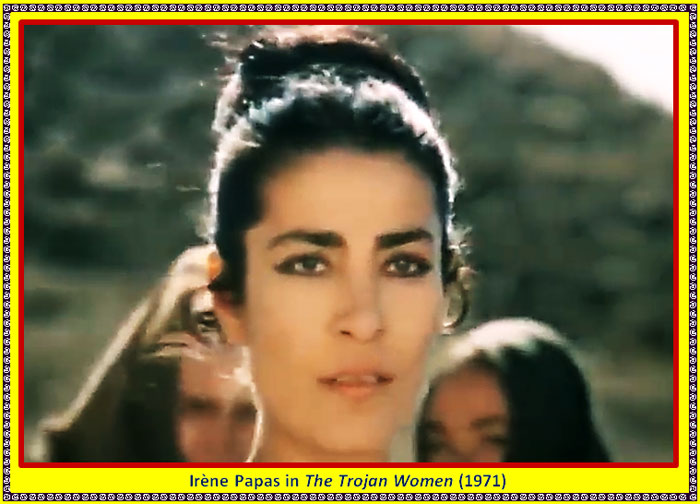
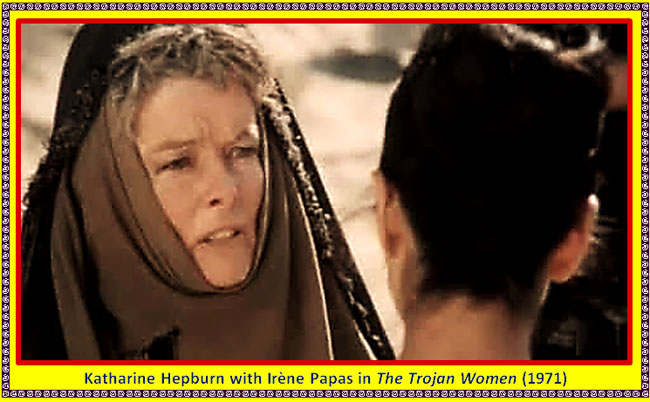
In the Greek-American film The Trojan Women (Les Troyennes, 1971) Irène Papas interpreted the part of the beautiful Helen of Troy, the daughter of Zeus and Leda, and wife of Menelaus (King of Sparta) who eloped with Paris and thus brought about the siege and destruction of Troy. For this role, Irène was honoured with the Best Actress Award from the National Board of Review of Motion Pictures in the USA. Besides Irène, the principal actresses in The Trojan Women included Katharine Hepburn (as Hecuba, second wife of Priam and mother of 19 children, including Hector, and Queen of Troy); Vanessa Redgrave (as Andromache, wife of Hector); and Geneviève Bujold (as Cassandra, daughter of Priam and Hebuca. She was the Trojan prophetess who was never believed).

Adapted and directed by Michael Cacoyannîs and filmed in Spain in mid-1970 with very high-minded notions, in the central core of this film is the Euripides tragedy concerning the defeat of the Tory army and the resultant plight of its women. For the English version, the text was masterly translated by Edith Hamilton. In an interview published in the Australian Women’s Weekly, Katharine Hepburn spoke of Euripides: “In the sense that what counts in Euripides is the text – the naked, cold word. Euripides doesn’t describe, he states, specifies, informs. The complete opposite of Shakespeare. Euripides makes one think of the great primitives. Euripides writes the text, the rest is done by the audience…”

The year 1971 also saw the release of Italian director Umberto Lenzi’s trippy sexploitation thriller, Oasis of Fear (aka. Un posto ideale per uccidere / Dirty Pictures) in which Irène Papas played middle-aged Barbara Slater. Produced by Carlo Ponti, the cast of this psycho killer movie included Ray (Raymond) Lovelock, Ornella Muti and Salvatore “Sal” Borgese.

British man Richard “Dick” Butler (Lovelock) and Dutch girl Ingrid Sjoman (Muti) are young sexually free hippie couple. While touring Italy, they land themselves in trouble over illegal sale of naked pictures of Ingrid they used to finance their travels. On the run from the law for having been arrested and ordered to leave Italy, the free-spirited couple seek refuge in Barbara’s seemingly isolated large villa, but little did they know that Barbara has murdered her husband and they are drawn into a deadly scheme being framed as the guilty suspects. Set to a toe-tapping catchy pop score by Bruno Lauzi, this intriguingly sexy giallo race head-on into a suspense-ridden climax. Italian Umberto Lenzi was the writer/director of giallo movies such as Paranoia (1969); Knife of Ice (1972); Spasmo (1974), etc, featuring Carroll Baker, Colette Descombes, Ida Galli, Suzy Kendall, and such other appealing womankind of marquee value of that time.

In the role of Dona Aurelia Avallone, Irène Papas was part of the star-cast of Lucio Fulci’s Don’t Torture A Duckling (Non si servizia un paperino, 1972). Of the title, I have heard movies called many things, but not that. With Tomas Milian (as reporter Andrea Martelli), Barbara Bouchet (as hooker Patrizia) and Florinda Bolkan (as Maciara, a Gypsy witch), the movie is about young boys found mutilated and killed in Accendura, a Sicilian mountain village where many locals falls under suspicion.

Reputedly Fulci’s most favourite film shot in the suburbs and town of Monte Sant’Angelo in Southern Italy, it also features the song: Quei giorni insieme a te interpreted by Ornella Vanoni.

Tito: Sutjeska, The Fifth Offensive (Sutjeska/Battle of Sutjeska, 1973) recreates the 1943 mountain battle of the Sutjeska in WWII between Tito’s Partisans and German forces. While Richard Burton acts as Marshal Tito, (born Josip Broz, (1892-1980), President of Yugoslavia (1953-80)); Irène Papas portrayed Boro’s mother. The Embattled Mountain by Frederick William Dampier Deakin (1913-2005) is particularly suited for more information on this subject. The music score was by Mikis Theodorakis.   

As featured in The Fifth Offensive, the National Liberation Army of Yugoslavia headed by the Supreme Commander Marshal Tito was creating a new, liberated territory. Convinced that the Allies would land right on the Balkans, Hitler ordered two of his generals, Alexander Löhr and Rudolf Lüters, to initiate a new offensive against the Yugoslav Partisans forces. To deal with the critical conditions on the fronts and to prepare the Forces for future battles in the Balkans and in Europe, it was necessary to immediately surround and destroy the main Yugoslav Partisans combat units and their leader Tito and once and for all eliminate the dangerous Balkan battlefield. Made in Yugoslavia on an expensive budget, and directed by Stipe Delić, this movie features that subject operation (15 May 1943 to 16 June 1943), codenamed “Schwarz” or “Case Black.”     Jo                                        

Notes:

  1. Director Alexander Mackendrick was replaced in The Guns of Navarone. A High Wind in Jamaica is interesting as a curio for its score composed by the famous harmonica virtuoso Larry Adler (1914-2001). The film marks the second outing of Russian actress Lila Kedrova with leading man Anthony Quinn after Zorba the Greek;
  2. Ship of Fools (1965) is based on the acclaimed 1962 novel by Pulitzer Prize-winning American writer Katherine Anne Porter. It is also the last film to feature British actress Vivien Leigh;
  3. A Dream of Kings marked the final appearance of Swedish-American actress Inger Stevens who committed suicide in April 1970 at the age of 35. 
  4. My review on Anne of the Thousand Days was posted on January 07, 2020 in this webpage;
  5. Up to now, the sources of reference for this 6-part tribute to Irène Papas are archives of the past including printed publications and visual media. DVD/Blu-ray of most of the movies mentioned in this write-up is available with some leading dealers.
  6. DVD sleeves/images shown here are only for promotional purpose. Source: Wikipedia, amazon.com, imdb, and from DVD sleeves.
  7. This illustrated article is an affectionate nosegay to the movies referred above. Please refer to “About” of my webpage for more details.

 (© Joseph Sébastine/Manningtree Archive)

Irène Papas – The Fabulous Greek

My mind, sound by nature, was my teacher. I need no more.

I offered my husband a silent tongue and gentle looks.

I knew when to have my way and when to let him have his.

– Euripides The Women of Troy (642-651)

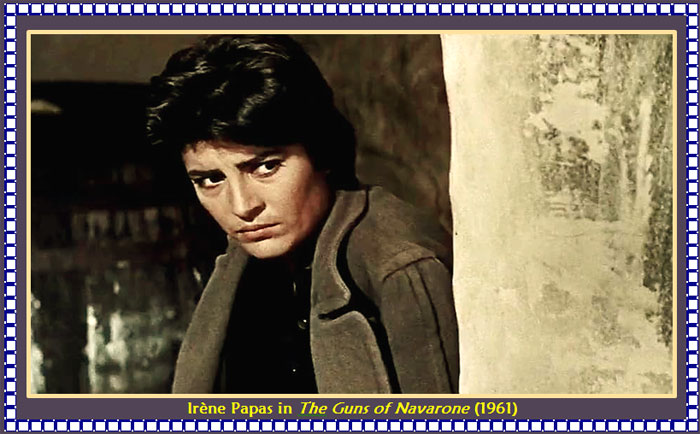
Irène Papas was finally placed under the direction of the Bristol-born filmmaker J. Lee Thompson (1914-2002) to play the role of Maria Pappadimos in The Guns of Navarone (1961). Her role is of a hardened Greek partisan fighter who develops a liking for fiery Andrea, a character played by Anthony Quinn in this film about a Nazi big-gun stronghold overlooking the Mediterranean.

American film producer and scriptwriter Carl Foreman’s The Guns of Navarone was a motion picture “event.” Being the first of Alistair MacLean’s pulsating novels to be turned into a movie, it’s a high-powered action movie by Highroad Films, an Anglo-American firm (1). Magnificently filmed in Cinemascope and Eastmancolor by Pathe, and set in 1943 during WW2, it dealt with Allied commandos and Greek resistance fighters assigned to destroy two huge newly-designed radar-controlled guns on the German-held Aegean Sea island of Navarone. These guns prevented the vital Aegean Sea channel from being used by the Allies in World War II.

Director J. Lee Thompson, who was a last minute replacement of Alexander “Sandy” Mackendrick (1912-1993), was by that time one of the most flamboyant writer-producer-directors, with Ice Cold in Alex (Desert Attack, 1958), North West Frontier (Flame Over India) and Tiger Bay (both in 1959) to his credit to which, he would later on add a string of noteworthy movies such as Cape Fear, Taras Bulba (both in 1962), Kings of the Sun (1963), Mackenna’s Gold (1969), etc.

Irène was to be part of an impressive stellar cast who have carved a prominent niche for themselves in the motion-picture world: Gregory Peck, David Niven, Anthony Quinn, Stanley Baker, Anthony Quayle, James Robertson Justice, Richard Harris, Bryan Forbes, etc. For the required amount of feminine appeal, besides Irène, Gia Scala portrayed Anna, another fighter.

James Darren (who sadly passed away at the age of 88 on September 02, 2024) played Spyros Pappadimos, a Greek-American boy skilled with a machine gun, who also performs a Greek folk song called “Yassu (Wedding Song)” in the movie.

Even though Cypress and Yugoslavia were initially considered for production possibilities, the final choice for on-location shoot fell on the Island of Rhodes, in the heart of the Aegean Sea. It’s not that the choice for filming the motion picture of this dimension didn’t face any difficulties in Greece. During that time, the local processing of the film was unpredictable; and the local sound systems were based on 17 ½ mm. tape, rather than the 35 the crew were used to. The only projection facilities that could be used were in a large hall at the local police station. The acoustics defied anyone to understand the dialogue. Then again, undeniably, the people were warm and hospitable, and willing to do superhuman feats in order to please. The government, the airlines, the hotels, etc, all contributed more in the way of service, material and personnel.

In mid-1960, as part of promotion of the movie, a stalagmite (an incrustation formed on the floor of a cavern) from the Luray Caverns of Virginia was despatched to Greece where it was swapped with a stalagmite from the Petralona Caverns of Greece and sent to Luray. These stalagmites were officially exchanged in Greece between Gregory Peck and Irène Papas.

In the course of almost seven months of shooting in Greece and England, the final stage of filming was completed in the studio in England – in one of the largest outdoor sets which took five months to construct using tubular steel, timber and about 14 miles of cable. Set-making has always been a big part of a film’s budget but it goes in phases. More than 160 workmen on a seven-day-a-week basis were involved. The outcome was the enormous guns and cave fortress towering over 140 feet into the air and stretched over an area of almost two acres, to represent the German-occupied base on the Greek island. Despite the collapse of this fantastically expensive set at Shepperton Studios as well as the continuously mounting budget, the filming had a wrap by mid-October 1960.

The movie turned out to be a blockbuster hit and not only racked up in box-office grosses but wide acclaim including royal treatment around Europe via galas before crowned heads. Special showings were attended by late Queen Elizabeth II and Prince Philip of Great Britain; Princess Grace and Prince Rainier III of Monaco; then newly-wed King Baudouin and his Queen Fabiola of Belgium; and the King Paul and Queen Frederica of Greece. King Paul conferred the Order of Phoenix and rank of Brigadier of the Greek Army on Carl Foreman for his services to Greece through the filming of The Guns of Navarone. The film netted 1962 Academy Award nominations which included Best Motion Picture, Best Directing, Best Writing (Screenplay – based on material from another medium), Best Music (Music Score of a Dramatic or Comedy Picture), Best Film Editing, etc., and the film won for Best Special Effects in the 34th Academy Awards.

Sometime earlier Irène Papas top-lined in the title role of director Georges Tzavellas’ Antigone (Antigoni, 1961) – a B/W movie (with English subtitles) of such profound dimension that it helped fortify Irène’s reputation as a fine interpreter of Greek classics on movies.

The screenplay by Tzavellas was adapted in its classical form from Sophocles’ poetic parable of the Greek tragedy of Oedipus, King of Thebes though with a modernized Greek text in the name of poetic licence. Set in the ancient Greek city of Thebes, Irène’s dramatic beauty dominates as Antigone who is condemned to death for defying King Creon by burying her two brothers killed in a quarrel over their succession to the throne of Thebes.

The shooting schedule at Alfa Studios, Athens, stretched to 58 days and the production cost ran in excess of $200,000/- which was believed to be a record high for a film made by the Greek film industry at that time. The production, which regrettably suffered delays, was carried out by Greek talent throughout; also featuring Greek performers: Manos Katrakis, Maro Kontou, Nikos Kazis, Ilia Aibikou as Eurydice, etc. Part of the cast were soldiers and horsemen of the Royal Greek Guard and Army and 500 actors of the Greek theatre and cinema. Arghyris Kounadis provided the music score.

While Antigone movie project was initiated by a Connecticut exhibitor through his Norma Film Productions, he had every expectation that the movie will eventually earn a profit due to its special qualities in relation to the cultural heritage of Greece. As a matter of fact, all the financial backing was made by American investors of Greek descent from “outside the industry” who were motivated by a pride in their Greek heritage and a desire to dispel the notion that Greece exports nothing but restaurateurs. Furthermore, this Greek heritage lining the theme of the movie was a profitable aspect the filmmakers believed helped Antigone in its promotion for its distribution to schools, colleges, libraries, cinema clubs, etc.

Distinguished productions of the classic Greek tragedies dealing with highly charged subjects as revenge, retribution and matricide, are rare owing to elevation of concept and nobility of performance. As the title character in Finos Films’ Electra (Elektra/Ilektra, 1962), the Greek classical tragedy of yore, Irène Papas finally got the chance to show off her acting chops.

As the story goes, Electra is the daughter of King Agamemnon (Theodore Demetriou) and Clytemnestra (Aleka Katselli). Upon his victorious return from the Trojan War, Agamemnon was killed during his bath by his wife Clytemnestra and her paramour Ægisthus (Fivos Razi/aka. Phoebus Rhazis), while the children Orestes (Petros Ampelas) and Electra (Elsie Pittas) waited outside. Following the murder, the boy Orestes is taken away to safety outside of the country by an old retainer whilst his sister Electra remained at the palace a virtual prisoner. In the euphoria of victory, Clytemnestra and Ægisthus married and at a subsequent time, Electra was married off to a poor farmer who respected her.

It was not until years later Orestes (Giannis Fertis) returned with a friend, and the siblings united. They plot to avenge their father Agamemnon whose murder had taken place following his return from Troy with his lover, Cassandra, one of the 50 children of King Priam of Troy and his principal wife Hecuba. In due course, Orestes killed Ægisthus during a celebration. Orestes also gained the support of the followers of the dead king whose valour was imprinted on their minds. However, Electra (Papas) urges her older brother Orestes to kill their mother Clytemnestra as well. Her contention was vengeance for the murder of their father. Orestes duly complies with Electra’s wishes. Be that as it may, shocked by the killing of Clytemnestra, the great majority of followers of the brother and sister turned against them and drove them away from the land.

Written and directed by Michael Cacoyannîs based on Euripides trilogy (The Trojan Women, 1971 and Iphigenia, 1976 followed) this United Artists’ movie version contained murder, adultery, vengeance and matricide. Purportedly made for a budget of about US$70,000/-, Electra which received plenty of art house attention in theatres world over, was shot on location in Mycenae and Argos in Greece with excellent direction, production values including dramatically powerful score by quite musically knowledgeable left-wing composer Mikis Theodorakis. The visual beauty of cinematography was by English cameraman Walter Lassally who will be back in Greece couple of years later to lens there another Greek feature, Zorba the Greek, under direction of Michael Cacoyannîs. According to Walter Lassally, Cacoyannîs pre-planned his scenes down to the last detail although he didn’t actually make sketches and his scripts were written in shots, not in scenes.

Irène’s noble beauty, facial features and performance as Electra were so appropriate that a writer once quoted in a magazine feature: “What a superb face Papas has for Greek tragedy. She is, almost, for Michael Cacoyannîs what Liv Ullmann is for Ingmar Bergman.” The admirable hairdo Irène featured in Electra was specifically created under the inspiration of Cacoyannîs which Irène retained long enough to sport at the Festival de Cannes in May 1962.

In fact, UA took precautions to ensure that no one confuses their Electra at the 15th Cannes Film Festival 1962, with the Greek-sponsored Electra, which was a filmed version of the Greek National Theatre presentation of the Sophocles version staged at the ancient Theatre of Epidaurus. Importantly, the UA version, a prize-winner of Best Cinematic Transposition (as best play-based film) is by Euripides.

Around that time, the German-born Austrian actor Karlheinz Böhm (1928-2014) planned to write and direct a modern version of Electra, set in post-war Germany with all contemporary fads and fashions, to be called “Trial of Orestes”. However, that project did not materialize. In early 1964, Electra won the Best Foreign Picture Award at the annual Cleveland Critics’ Circle prize luncheon while Irène Papas took honours as Best Foreign Language Actress.   Jo                                 

Notes:

  1. Something like 80% of the film’s budget was spent in sterling which qualified the film for the Eady Plan/Fund, a British film aid scheme which was, at that time, the envy of most other European film producing nations. The Eady Fund, which gets its income from a slice of box-office takings, is divvied out to producers of British Quota pictures. Anyone who makes a film in the UK can qualify for this aid, provided that the Quota laws are observed and that the film is made by a British company. The side-effect of this measure was an increase in the number of films Hollywood made in England. For instance, $1,000,000 plus went from the Eady kitty to The Guns of Navarone. The Eady Plan, named after British diplomat Sir Wilfred Griffin Eady, was terminated in 1985;
  2. Up to now, the sources of reference for this tribute (in 6 parts) to Irène Papas are archives of the past including printed publications and visual media. DVD/Blu-ray of most of the movies mentioned in this write-up is available with some leading dealers.
  3. DVD sleeves/images shown here are only for promotional purpose. Source: Wikipedia, amazon.com, imdb, and from DVD sleeves.
  4. This illustrated article is an affectionate nosegay to the movies referred above. Please refer to “About” of my webpage for more details.

(© Joseph Sébastine/Manningtree Archive)

Irène Papas Makes An Entrance

Screen actress Irène Papas became synonymous with world-class Greek stage/screen performers in the category of Katina Paxinou (Katina Konstantopoulou, 1900-1973), Melina Mercouri (Maria-Amalia Mercouri, 1920-1994), Eva Kotamanidou (1936-2020), etc, irrespective, to few critics, some may be of dark complexion or with language fluency issues.

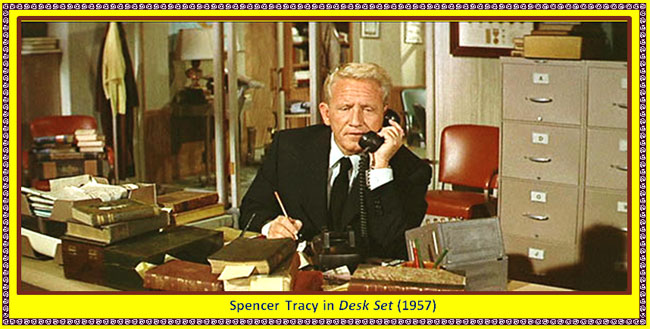
One of Irène’s bad experiences came from actor Spencer Tracy during the production of the Western movie, Tribute to a Bad Man (1956) which Tracy never finished because director Robert Wise (1914-2005) fired him. A book describes how Tracy derided co-star Irène because she was too clumsy and too tall (big raw-boned five feet ten inches in her bare feet, as tall as Tracy) and her English didn’t suit him because she was from Greece.

Greece which is domicile to Greek, one of the world’s oldest written languages, as well as to minority languages and Greek dialects, English together with German, French and Italian were the most common foreign languages spoken. Apart from her native Greek and competence in English, Irène also spoke German and Italian. As a matter of fact, Irène had been in London where she made effort to perfect her almost fluent English.

In those days, foreign-language features showed an increase in bookings and according to top players in U.S. movie circles, besides A-List performers such as Sophia Loren, Gina Lollobrigida, Simone Signoret, Alec Guinness and Maximilian Schell, the other foreign film personalities whose names became familiar to U.S. audiences during 1962 included Alain Delon, Claudia Cardinale, Marcello Mastroianni, Jeanne Moreau, Elsa Martinelli, Melina Mercouri, Horst Buchholz, Maria Schell, Irène Papas, Romy Schneider, Alida Valli, Jean-Paul Belmondo, Alberto Sordi and Christian Marquand.

These best-known of the foreign stars were considered marquee names capable enough to draw patrons to the box-office, and almost all of them have either made pictures in Hollywood or appeared in English-language pictures filmed in Europe by American show business companies.

To a great extent, those who are famous stay that way because the press keeps them in the public eye. As for the gifted Irène Papas whom many have waxed poetic in praise of her, upswing on her career also gifted her ample occasions to meet a number of influential people in the film industry, some of them veritable volcano of knowledge and inspiration. It would have been completely in character that her career also brought her time to socialize with the prettiest people, most of them exceedingly rich and ripe, not boors or bores. Then again, one also had to good-naturedly tolerate a great deal of unprofessionalism, too. She was once bestowed with the title “Europe’s Woman” for her efforts to bolster European civilization.

As an award-winning actress who personified Greek female beauty on the cinema screen and on the stage, Irène Papas starred alongside fashionable Hollywood stars of the time such as Anthony Quinn, Gregory Peck, James Cagney, Kirk Douglas, etc. With Kirk Douglas and Alex Cord, she co-starred (as Ida Ginetta) in director Martin Ritt’s The Brotherhood (Mafia, 1968), an excellent Godfather predecessor produced by Kirk Douglas, one of the best paid actors in Hollywood during that time.

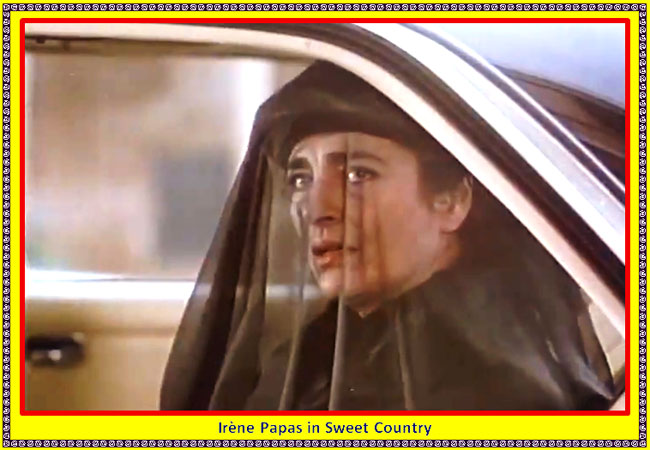
It was Irène’s association with Michael Cacoyannîs (1922-2011) that paved way for Irène’s brilliant performances in the title role in Electra (1962); in Zorba the Greek (Alexis Zorbas, 1964); in The Trojan Women (1971) and also in Sweet Country (Glykeia patrida, 1986), a forceful drama filmed in Greece. These are part of a clutch of films rightly considered as the high point of Irène’s film career. Cacoyannîs is the Greek Cypriot theatre/film director who introduced actress Melina Mercouri (as a good femme fatale) through his 1955 film, Stella.   

Audiences across the world who have seen Zorba the Greek may remember Cacoyannîs’ treatment of Irène Papas in the role of the widow when the viewer first saw glimpses of her face as she hung her immaculate sheets on the clothesline while it flapped in the wind.

Sweet Country, based on a novel by Caroline Richards, is about the emotional turmoil that befalls an American expatriate couple, Anna Willing (Jane Alexander) and professor husband Ben (John Cullum) while living under military rule following the September 1973 Rightist military coup led by General Augusto Pinochet Ugarte after the assassination of Chile’s first socialist President Salvador Allende (1908-1973). The film is an indictment of conditions that existed at that time when lead character Anna is drawn into the resistance against Pinochet as she attempt to get the torture victims across the border.

In 1968, Irène had an on-going contract to star in director John Huston’s epic production of The Madwoman of Chaillot (1969), based on the 1943 classic play La Folle de Chaillot by French novelist (Hippolyte) Jean Giraudoux. The film featured an all-star cast of Katharine Hepburn, Charles Boyer, Yul Brynner, Giulietta Masina, Edith Evans, Danny Kaye, John Gavin, Paul Henreid, Margaret Leighton, Richard Chamberlain, Donald Pleasence, and Nanette Newman.

The production of The Madwoman of Chaillot was not all smooth sailing. Few days before the production began in Nice, France, the Producers had profound reservations about director Huston who had difference of opinion on the modernization of the movie’s theme. They clinched a deal with British director Bryan Forbes to take over direction of the movie at very short notice. Furthermore, days into the shooting at the Studios de la Victorine, Nice, France, Irène opted out of her role which went to English stage actress Edith Evans DBE. Irène too had not been in a good frame of mind with the characterisation of the role of Josephine she was portraying. All this put-downs were newsworthy in the show business circles.

More a proven actress than a glamorous star alone, Irène Papas has starred in numerous movies, some of them forgettable except for her presence in them. Nonetheless, there are enough significant movies she has done that became the consuming interest to her celebrity status. Listed below, in order of year of release, are some of Irène’s movies in my collection (1):

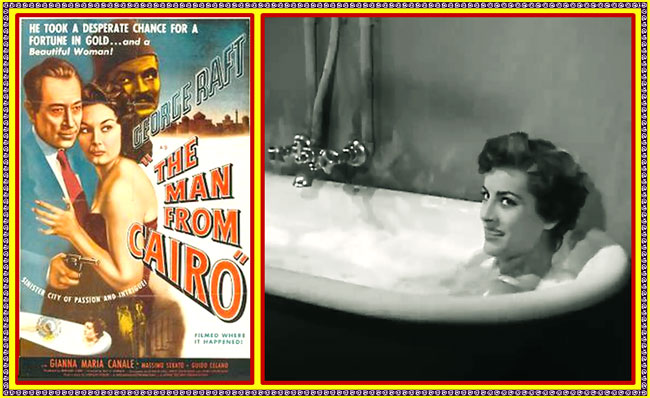
Irène Papas acted as Yvonne Lebeau, a dancer at Cote Bleu, a little nightclub in downtown Algiers in The Man from Cairo (Crime Squad/Dramma nella Kasbah, 1953). Based on story by Hungarian novelist Ladislas Fodor and directed by Ray H. Enright (and Edoardo Anton – uncredited), it was filmed on location in Algeria and Italy. The movie center upon a fortune in gold, lost on the North African desert, which lures a variety of wealth-seekers. After many twists and turns, an American tourist and General Dumont solve the mystery of the lost gold. Although Irène only had a short spell in the earlier part of the movie, George Raft, Gianna Maria Canale, and Massimo Serato in prominent roles had better scope to display their acting talents;

Irène did the starring role of Faidia in Theodora, Slave Empress (Teodora, Impératrice di Bisanzio, 1954), an Italian production by Lux Film with a cast of hundreds, massive sets and in dazzling Pathécolor directed by Riccardo Freda. Stunningly beautiful Gianna Maria Canale, the director’s better half, played the role of Teodora, the daughter of a bear feeder at the amphitheatre who rose to become empress of Byzantium, the celebrated consort of the handsome Emperor Justinian/Giustiniano (Georges Marchal). Teodora champions the causes of the common people, to the displeasure of the prime minister, Giovanni Cappodocia (Henri Guisol), the chief troublemaker who breeds conspiracy. The film marked the second co-starring role of Irène with Gianna Maria Canale, the first being The Man from Cairo.

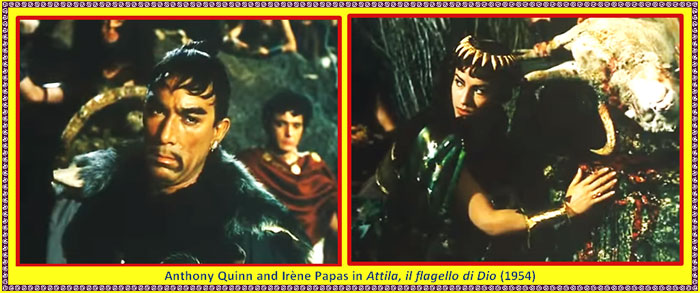
In 1954, Attila (Attila, il flagello di Dio/Attila, Hombre o Demonio/Attila, fléau de Dieu) was released with Irène in the role of Grune. The film featured the cult of the most ruthless conqueror of all time – the barbarian Attila the Hun who, with sword and flame, swept across the civilised world in the year 450 A.D. Even the mighty Roman Empire was marked for his conquests. A Dino De Laurentiis and Carlo Ponti production for Lux Film, directed by Pietro Francisci (1906-1977), Anthony Quinn gave the title role pure savagery while romancing Sophia Loren in the role of Attila’s woman Honoria. Jo                                        

Notes:  

  1. The listed reviews in this tribute is limited only to those films in my personal collection;
  2. DVD/Blu-ray of most of the movies mentioned in this write-up is available with some leading dealers.
  3. Up to now, the sources of reference for this tribute to Irène Papas are archives of the past including printed publications and visual media. DVD sleeves/images shown here are only for promotional purpose. Source: Wikipedia, amazon.com, imdb, and from DVD sleeves.
  4. This illustrated article is an affectionate nosegay to the movies referred above. Please refer to “About” of my webpage for more details.

(© Joseph Sébastine/Manningtree Archive)

Irène Papas – Greece Comes to LA

You can be important to someone but not all the time….

The pretty Greek actress Irène Papas’ cinematic debut took place in Hamenoi Angeloi (Fallen Angels, 1948, credited as Eirini Papa) directed by Egyptian-born Nikos Tsiforos. This could be true in keeping with the date of release even though elsewhere in the media it is also mentioned that her debut big screen performance (as Eirini Pappa) was in Nekri politeia (Dead City), the directorial debut of Frixos HeIiades (Phryxos Iliadis). That movie in which Irène had a short spell playing a girl named Lena was released in December 1951, the year she separated from her husband, director Alkis Papas.

Nekri politeia was exhibited at the 5th Festival de Cannes held in Southern France from 23 April to 10 May 1952 where Irene was an invitee. For someone who was learning her craft and gaining confidence she was being courageous and had started to look the popular conception of a star. Her face was beautiful with an almost perfect bone-structure, black hair, dark expressive eyes, and she moved with a natural inborn elegance – with the grace of the dancer in her.

While attending the Film Festival, the late Prince Aly Khan, then husband of American screen actress Rita Hayworth, chose Irène as his partner for the dance that would open the prestigious reception of the film exhibition. “That meeting with Aly Khan set me back ten years,’ a biography (1) had quoted Irène as saying at that time. According to a book on Aly Khan, it was Irène’s name which was most persistently linked with Aly’s by the end of that film festival. As a result, her photograph and life story soon flashed in newspapers around the world. But then again, according to The Courier-Mail, Brisbane, Irène brushed away the rumours as “Nice flirtation. Although we had a nice flirtation, reports of a possible marriage are ridiculous. I am separated from my husband, but I am still married, and have not asked for a divorce.”

Impressed by Irène’s performance in Nekri politeia, the Italian international producers of Ponti-De Laurentiis Cinematografica immediately offered her an acting contract. Although she did not perform in the film they initially proposed since it was decided to do not cast her in it for the one reason that the role featured a simple and voluptuous vampire. Instead, the producers cast her in the role of Mrs. Luisa Azzali in Le infedeli (The Unfaithfuls / Escándalo en Roma, 1953, dir: Mario Monicelli & Steno) which was a vehicle for Gina Lollobrigida and May Britt.  

It was Irène Papas’ collaboration with Italy’s Lux Films (2) that paved way for her to appearance in noteworthy movies of 1954 such as Attila, il flagello di Dio starring Sophia Loren and Anthony Quinn in principal roles; and Theodora, Slave Empress featuring Gianna Maria Canale and Georges Marchal.

By then, the long gaze of Hollywood had already fallen on Irène Papas. I read somewhere that director Elia Kazan also took an interest in casting her. Anyhow, going over to Hollywood should be quite fun for her.

Arriving in America in the fall of 1954, her first film-test was done by film producer Sol C. Siegel (1903-1982) of movies such as: A Letter to Three Wives (1949), Gentlemen Prefer Blondes (1953), Three Coins in the Fountain (1954), etc. Upon his proposition, Irène was given the kind of reception the film studio reserved for the more obvious gold-runners – and as it turned out, following her screen test, it only took the studio just three days to sign her up in a long-term contract. The producers had taken her acting talent very seriously, at which point, it gave her no small pleasure to be hailed on the lot as a “beautiful Anna Magnani”. There was talk that she will have the leading feminine role (3) in the 1959 remake of Ben-Hur which was to have all the ingredients that translate into great popular appeal.  

Irène Papas made her Hollywood-produced film debut in the role of Jocasta Constantine (4), a former dance-hall Greek emigrant in the Western, Tribute to a Bad Man (1956). Complimenting Irène in the movie was James Cagney’s vigorous acting as the Wyoming horse rancher Jeremy Rodock. Directed by Robert Wise with music by Miklós Rózsa (1907-1995), it was filmed in CinemaScope in Colorado in August 1955.

By then she had met actor Marlon Brando who had won rave notices for his performance in director Elia Kazan’s A Streetcar Named Desire, the 1951 melodrama based on Tennessee Williams’ play. It was only with the passing of time, she revealed that Brando was chryso mou (my darling), the love of her life. Although they never married, instead, her second marriage became a reality in 1957 when she wed film producer José Kohn. That nuptial also hit difficult times and didn’t last longer.

Irène Papas might not have liked working in Hollywood forever because she decided to return to Greece. Before that became a reality, she appeared in few TV sitcoms as well as in series of classical and modern stage presentations including: Fyodor Dostoevsky’s The Idiot; William Shakespeare’s The Merchant of Venice; etc. Moreover, she also endeavoured to step forward into boosting her talent. She went to New York City and enrolled in an acting course by Artistic Director Lee Strasberg at the reputed Actors Studio, founded in 1947. That was an appropriate move on her part on the light of the perception that what is taught reaches through to minds that, once set right, have a chance of staying right.

Back in Greece, Irène didn’t fancy much interest to perform in the Greek theatre. Obviously, she was introspective for having met with negative criticisms during earlier shows. Following appearance in The Lake of Sighs (I limni ton stenagmon, 1959) written and directed by Grigoris Grigoriou, Irène was pleased to avail the opportunity to portray Laskarina Bouboulina (Laskarina Pinotsis) in Greek film director Kostas Andritsos’s Bouboulina (1959), a B&W movie about the heroic exploits of Greece’s first naval commander – in skirts, who historically defeated the Ottoman Empire and liberated Greece.

Laskarina was born in May 1771 inside the prisons of Constantinople (Istanbul) where her mother, Skevo, the daughter of a prominent family of the island of Hydra, was visiting her dying husband Stavrianos Pinotsis who was a prisoner there for his part in the Peloponnese revolution of 1769-70 against the Turks. Shortly after Pinotsis’ death, she lived with her mother at the island of Hydra for four years before moving to Spetses Island. In 1788, she married a Spetsiot skipper and upon his early death, she wed another Spetsiot captain named Dimitrios Bouboulis who also commanded his own ship. In May 1811, Bouboulis too lost his life in sea battle with Algerian pirates off Lampedusa in the Mediterranean Sea.

As a widow, she inherited considerable fortune and undertook to boost the strength of her fleet. To safeguard herself from the attempt of Ottoman authorities to confiscate her fortune, she became an active member of the secret organisation, Filiki Etaireia (Friendly Society). Her efforts in preparations for the impending Greek War of Independence (1821-29) included buying arms and ammunition from foreign ports, as well as creation of her flagship, the Agamemnon, a 33-metre corvette armed with 18 heavy cannons. Upon the outbreak of hostilities, among other things, she commanded her own fleet and fought with great enthusiasm and incredible heroism. The gallant Laskarina Bouboulina was consequently transformed into a legendary figure correlated to the siege of Nafplio and synonymous with female courage and heroism of later Greek history. Killed in May 1825 connected to a family feud, she was posthumously honoured (5). Koula Agagiotou, Andreas Barkoulis and Miranda Myrat also co-starred in the movie Bouboulina.

It was Irène Papas’ impact as a dramatic performer that won her worldwide acclaim with her brilliant performances in the title role in director Michael Cacoyannîs’ Electra (Elektra, 1962). Over the years, in a career spanning about 60 years, Irène Papas starred in over 70 films. Featured in Greek, French, Italian and Hollywood movies, Carl Foreman’s The Guns of Navarone (1961), Michael Cacoyannîs’ Zorba the Greek (1964), Costa-Gavras’ Z(1969) and Francesco Rosi’s Christ Stopped at Eboli (Eboli/Cristo si è fermato a Eboli, 1979) are some of the many movies that catapulted her fame beyond Greece to Italy, Spain, France, England and across the Atlantic Ocean and beyond. Jo

Notes:

  1. Life of the Party: The Biography of Pamela Digby Churchill Hayward Harriman by Christopher Ogden;
  2. Italian film producers Carlo Ponti (1912-2007) and Dino De Laurentiis (1919-2010) joined the Lux Films soon after the Company’s relocation to Rome in 1940;
  3. The role of Esther in Ben-Hur (1959) went to beautiful Israel actress Haya Harareet. The film when made was a successful achievement by MGM and for the exhibitors.
  4. According to imdb: this role was previously offered to A-list actresses: Grace Kelly, Eva Marie Saint and Jennifer Jones.
  5. Upon death of Laskarina Bouboulina on May 22, 1825, she was buried at the cemetery of Agia Anna Church up on the mountain. Her bones were later shifted into the family vault at the Church of Aghios Ioannis (The Church of St. John) below, built in 1822 and fully funded by Laskarina. In 1938, the casket was donated to the Museum of Spetses upon its inauguration. The Bouboulina museum was established much later in 1991.
  6. Up to now, the sources of reference for this tribute to Irène Papas are archives of the past including printed publications and visual media. DVD/Blu-ray of most of the movies mentioned in this write-up is available with some leading dealers.
  7. DVD sleeves/images shown here are only for promotional purpose. Source: Wikipedia, amazon.com, imdb, and from DVD sleeves.
  8. This illustrated article is an affectionate nosegay to the movies referred above. Please refer to “About” of my webpage for more details.

 (© Joseph Sébastine/Manningtree Archive)

Can This Be Irène Papas?

Part I (in 6 parts)

Taking joy in life is a woman’s best cosmetic. – Rosalind Russell

A best-seller book on the relationship between Maria Callas and Aristotle Onassis refer to a conversation that took place aboard the Golden Greek’s opulent 325-ft seaworthy mansion, the Christina in early days of 1960. To perpetuate soprano Callas’ celebrity status which was floundering at that time due to inconsistency of her voice, the Anatolian shipping tycoon was apprehensive of her future and seriously sought ways to prolong her celebrity status.

On that particular day, Onassis’s guest aboard the Christina was the American Screenwriter/Film Producer Carl Foreman (1914-1984) who also held his share of admiration for the opera diva Maria Callas. Foreman suggested casting María Callas opposite actor Anthony Quinn in his up-coming production of The Guns of Navarone which will have everything a war movie should have. Theoretically, almost seven to eight months of filming was envisaged for this movie: four months, April to July, 1960, on location at the town of Lindos on the island of Rhodes, Greece and rest of the filming utilizing the good facilities at Shepperton Studios which is nicely situated in Surrey, England. To finalise the film’s production procedures, Foreman was scheduled to visit London shortly – at a time when London was abuzz with the ensuing engagement in February of Princess Margaret, sister of Queen Elizabeth II, with Antony Armstrong-Jones, and nuptials at Westminster Abbey scheduled for May 1960.  

For the moment, Onassis was delighted when Foreman broached his offer (1). Foreman’s proposal was a stroke of strategic chance. The billionaire Greek shipowner who exuded power and wealth had a reputation of working hard and had great faith in the guiding principle of chance. However, Maria Callas lost courage and declined the part of the Greek resistance fighter, Maria Pappadimos. The role finally went to Greek-born stage and screen star Irène Papas.

One of the most talented and strikingly photogenic stars whose first name is pronounced as “Ee-ree-nee,” Irène Papas was only an upcoming actress at that time. Her celebrity status was only gathering momentum, even though, as an actress she was not unpopular to the motion picture audiences as well as to moviemakers throughout Europe and also in Hollywood where she starred in a movie opposite James Cagney in 1955. Indeed, she was not a stranger to Anthony Quinn. In one of his books, Quinn described their long association as a love-hate relationship which originated from September-November, 1953 during the making of Carlo Ponti-Dino De Laurentiis production of Attila. It was the first feature movie of Irène Papas that I saw.

According to Quinn, in total, he made nine pictures with Irène Papas which includes Attila, Flagello di Dio (1954); The Guns of Navarone (1961), Zorba the Greek (1964); A Dream of Kings (1969), El asesinato de Julio César  (1972); The Message (1976), Omar Mukhtar, Lion of the Desert (1980) while some publications state the true count as seven films. Quinn also related in his book that Irène is one of the later stars like Paul Newman, Joanne Woodward, among others, who attended and absorbed the lessons from the free acting classes for students arranged by Quinn during the latter half of the 1950s in a rented space above a retail store in Hollywood.

Irène Papas was born Eirini/Irini/Irène Lelekou on September 03, 1929 to Stavros (a teacher of classical drama) and Elini Lelekou (née Prevezanou, a school teacher), in the semi-mountainous village of Chiliomodi (Chiliantari), located 21km away from the Greek city of Corinth, gate-way to the Peloponnese (2). According to a publication of 1863, the name “Chiliomodi” presumably originated from the nearby Monastery of Panagia Faneromeni Chiliomodi which was built in the 13th century upon an area of land equal to a thousand “modi”. When the founder of this monastery, St. Simeon, came to build here, the measure of beans he sowed had brought forth a thousand fold: hence the name Chiliomodi or Chilia Modia or a thousand measures. Gradually, the word became corrupted into Chiliantari.

According to Irène herself, her vocation for art was born out of jealousy. One of four daughters of her parents, as a teenager there were times when Irène had to stand aside and watch other girls being harassed by boys while no one even looked at her. At the Balls, she was the only one who was never asked to dance. The turning point came on the day a friend from her school came to visit her at home and began to recite a scene from Johann Wolfgang von Goethe’s Faust in which the improvised actor had to cry.

Irène who was 12 years old at that time, observed her friend’s act and decided that she could do much better in that performance. It was at that juncture she realized that she wanted to become an actress. Besides, this could also be a way she could attract people’s attention to herself. No sooner had she informed her parents her wish to enrol in a drama course, her plea was met with their opposition as they encouraged Irène to study architecture. They decided that their Irène koukla (doll) is not crazy but just crazed over to become an actress. To prevent Irène’s wish without winning her eternal resentment, an idea was mounted, probably half-heartedly.

Through their colleagues at the school who taught Irène, they intervened to induce Irène to concentrate in her studies so that she would engross herself to flower in her studies and give up pursuing an acting career. However, Irène must have loved such a play of her parents. She enrolled in the Royal School of Dramatic Art in Athens and devoted herself to studying classical theatre (3). There she was also regaled by the subject of Greek legends.  

During the waning days of World War II, the country was caught up in the violence of the Greek Civil War erupted in end of 1944 between the Royalists and the communists. In 1948, after graduation, she presented her stage debut with a joyful performance by singing and dancing in a variety show which earned her first 30 drachmas (about a US dollar). That remuneration would, no doubt, suggest that in her performance she was lithe and intense; and caught up with the spirit of the dance, she had moved with grace, expression and agility.

A period of vocation into printed magazine sector and dramatic theatre transpired early in Irène’s acting career. During that time, in the sunshine and optimism of young love, she walked down the aisle with Greek actor/writer/director Alkis Papas (1922-2018). The marriage was short-lived but his surname “Papas” stuck to become a permanent part of her identity. Years later, she starred in Alkis Papas’ directorial debut, Hey, Girls! (Psit… koritsia!, 1959) – the first Greek movie to be shown on Greek television.

Jo                                     (Continued in Part II: Irène Papas – Greece Comes to LA)

Notes:

  1. In 1963, Italian producer Dino De Laurentiis wanted to cast María Callas as Sarah, the barren wife of Abraham, in his blockbuster biblical epic, THE BIBLE in the Beginning… (1966) while director-actor John Huston wanted American actress Ava Gardner who eventually portrayed that role;
  2. In 1960, actor Gregory Peck and his French-born wife Veronique Passani visited Corinth while Peck was filming The Guns of Navarone on location in the Greek Isles. A special “Navarone” poster highlighting the visit of Mr. & Mrs. Gregory Peck at Corinth was brought out by the American Society of Travel Agents in tie-in with the film’s promotion campaign stressing the slogan, “Vacation in Greece, The Country Where “Navarone” was Filmed,” which was sent at that time to its member agencies throughout the country;  
  3. She was christened Irène possibly in honour of St. Irene, the Great Martyr whose life holds some conspicuous similarities to the life of Irène Papas. Originally named Penelope, St. Irene was born in the city of Magedon in Persia to the pagan king Licinius. During her young days, St. Irene was kept isolated in a high tower by her father to avoid her exposure to Christianity she longed to be part of. Enlightened by her special reverence for the Christian Faith as well as to the Christian virtues taught by her private tutor a great deal of the time, she actively proclaimed Christianity and brought thousands of people to Jesus Christ. This led to her persecution and eventually, St. Irene was beheaded.
  4. Up to now, the sources of reference for this tribute to Irène Papas are archives of the past including printed publications and visual media. DVD/Blu-ray of most of the movies mentioned in this write-up is available with some leading dealers.
  5. DVD sleeves/images shown here are only for promotional purpose. Source: Wikipedia, amazon.com, imdb, and from sleeves of movies in my collection.
  6. This illustrated article is an affectionate nosegay to the actress and movies referred above. Please refer to “About” of my webpage for more details.
  7. To the illustrious memory of my late wife Renate Elisabeth Simeon (Carina) who forever bloom in my heart where she is planted.

(© Joseph Sébastine/Manningtree Archive)

The Orbit of Laura

The Orbit of Laura

Remembering the Italian actress Laura Antonelli (Laura Antonaz, November 28, 1941 – June 22, 2015). Once a desired icon of male gaze, her final withdrawal from filming and public had elicited her view: “Earthly life no longer interests me.”

Here are some of her feature films which I have seen:

Notes:

  1. Some of the DVD/Blu-ray of the movies referred to in this article is available with leading dealers.
  2. DVD sleeves/posters credits: Wikipedia, amazon, imdb and from my private collection. Please refer to “About” of my webpage for more details.
  3. In memory of Laura Antonelli who left for her heavenly abode on June 22, 2015.

(© Joseph Sébastine/Manningtree Archive)

A Day of Grace

May 8th marks the death anniversary of four eminent personalities – each of them recognized specialists in their respective fields.

(1) Gustave Flaubert (December 12, 1821 – May 8, 1880), French novelist. Especially famous for his “Madame Bovary” (debut novel: Madame Bovary: Mœurs de province, 1857), “Salammbô” (1862), etc.

Film adaptations of Madame Bovary includes: 2000 BBC version and 2014 version, etc. A sword and sandal film Salambô (The Loves of Salammbo) was released in 1960.

(2) George Peppard (October 1, 1928 – May 8, 1994), American actor and producer.

Featured in movies such as: Breakfast at Tiffany’s (1961), How the West Was Won (1962), The Carpetbaggers (1964), Operation Crossbow (1965), The Blue Max (1966), Tobruk (1967), Cannon for Cordoba (1970), etc.

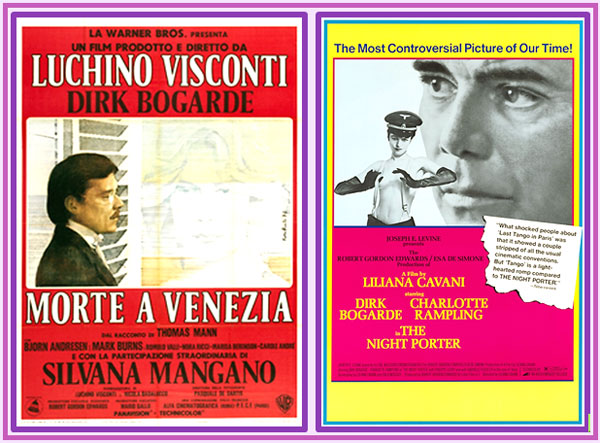
(3) Sir Dirk Bogarde (March 28, 1921 – May 8, 1999), English actor, novelist and screenwriter.

Acting credits include: The Servant (1963), Darling (1965), Accident (1967), Death in Venice (1971), The Night Porter (1974), A Bridge Too Far (1977), etc.

(4) Bryan Forbes CBE (John Theobald Clarke, July 22, 1926 – May 8, 2013), English actor, director, producer, novelist and screenwriter.

Acted in movies such as: The Million Pound Note (1954), The Key (1958), The Guns of Navarone (1961), etc and his directorial venture includes: The Wrong Box (1966), International Velvet (1978), etc.

Although the above personalities are featured in various movies, their movies referred herein are limited to some of those forming part of our private collection.  

Jo

Notes:

  1. DVD/Blu-ray of most of the movies mentioned in this write-up are available with some leading dealers.
  2. DVD sleeves/images shown here are only for promotional purpose. Source: Wikipedia, amazon.com, imdb, and from DVD sleeves.
  3. This illustrated article is an affectionate nosegay to the movies referred above. Please refer to “About” of my webpage for more details.
  4. To everyone mentioned in this write-up this post is dedicated.

(© Joseph Sébastine/Manningtree Archive)

S. Agnes of Rome VM

S. Agnes of Rome VM

Lat. Sancta Agnes, Ital. Sant’ Agnèse, Spa. Santa Inèz,

Santa Ignes, Fr. Sainte Agnes, SS. Agnetis, Angl. Agnes

c 291 – c 304 – Feast: January 21

Part I (in 3 parts)

S. Agatha of Sicily (d. c 251), S. Cecilia (d. c 280), S. Agnes (d. c 304), and S. Lucia of Syracuse (d. 304) are the four great virgins of the Latin Church. Martyrs of early Christianity they are – the first and last being Sicilians and the remaining two Romans.

Since the time of Roman emperor Constantine the Great (C., Flavius Valerius Constantinus, c. 274-337), a basilica stood beside Via Nomentana in Rome in honour of the Roman maiden S. Agnes who followed Christ from her infancy. Upon wearing the crown of martyrdom in c. 304 when she was twelve or thirteen years of age, she was buried in a cemetery named after her which has close proximity of this basilica.

A special patroness of maidens and chastity, and named in the first Eucharistic prayer, S. Agnes is one of the most popular of saints and patron saint of Roman virgins. Earlier writings tells us that S. Agnes, whose name signifies lamb in Latin and chaste in Greek, was born in an illustrious Roman patrician family in c. 291 and baptised at a very early age.

Through the years that followed, Agnes became renowned for her tender beauty and also for her enthusiastic piety to lead a life of purity. At the age of twelve, she was denounced as a Christian to Symphronius, the Roman prefect of the city. Her accuser was the prefect’s own son Procop, an unsuccessful suitor to whom Agnes refused matrimony alleging that she was already dedicated to Christ.

During that primitive age of the Church, Caesar had many, many ears that listened for him.

Persecution of Christians under the iron hand of imperial Rome spanned a space of three hundred years when many innocent Christians were tormented to convert. If that does not work, the process was to line them all up. Behead the first one, and if the next does not renounce his faith in Christianity, work one’s way to the very end. Nevertheless, such persecutions did not annihilate the believers but enflamed the faith of the martyrs instead.

How could Agnes be an ardent believer of a man who had been executed by a Roman governor of Judea? In a word, she was deemed guilty of blasphemy against the Roman gods. The accusation against Agnes during Emperor Diocletian’s fierce continuous persecution of Christians (303-305) (1) resulted in her detention and interrogation following which she was subjected to different stages of torture. However, Agnes’ saintly bearing had helped her to retain her consecrated virginity after she was forcefully confined to a house of infamy in Circo Agonale (2), Rome.

In such circumstances the imperial Roman persecutors will always have to win. But here they have failed in their efforts to compel Agnes’ recantation of the Christian faith and also to coerce her to worship goddess Vesta (3). With their anger ignited, Agnes was subjected to an ordeal by fire but the outcome was that she remained untouched by the scalding hot flames. Soon after, at the orders of Pro-prefect Aspasius, she was publicly decapitated by the sword of a lictor (4).

Later writings on S. Agnes reveal that she was the focus of praises by great Christian scholars such as S. Jerome (Eusebius Hieronymus, c. 342-420); S. Ambrose of Milan (c. 339-397 – detailed in his treatise de Virginibus addressed to his elder sister, S. Marcellina V (330-398)); Pope S. Damasus I (Reign: 366-384); and Latin Christian poet Marcus Aurelius Prudentius (c. 348-413) in his 4th century hymn, The Passion of Agnes in Liber Peristephanon (Crown of Martyrs).

By S. Agnes’ martyrdom, she had only gone beforehand ‘in the sign of faith.’ The lives of saints are an exposition of the faith of Jesus Christ. The fairness of Christianity is that women are regarded as equally gifted with holiness as men are and all true, without prejudice, both are evenly loved by God. When a list of the Roman church martyrs perished during the great persecution of Diocletian was compiled around 336, it marked the first inscription of Sancta Agnes, the fair Roman maiden with an air of saintly dignity blended with the most benign sweetness.  

Jo                                                                                (Continued in Part II)

Notes:

  1. We do not know with certainty in which persecution Agnes won the martyr’s crown. This incident is variously placed during periods of severe persecution under: Caius Trajanus Decius (249-251); Publius Licinius Valerianus (257-260); Gaius Valerius Diocletian (303-305).
  2. Circo Agonale: The Agonale Circus (Stadium Domitiani) was built on the site of the great circus of Tarquin the elder. In the course of time, the area fell into ruins. Under Pope Callixtus II (1065-1124), the Church of Sant’Agnese in Agone was built there and consecrated on 28 January 1123.
  3. Vesta (Hestia in Greek) is the Virgin goddess of the hearth and home in the Roman religion. She is one among the 12 superior Roman divinities (Dii majorum gentium) collectively known as Dii Consentes – the others being: Jünõ, Minerva, Cërês, Diana, Vënus, Mars, Mercürius, Diovis, Neptünus, Vulcanus, Apollõ. The worship of Vesta survived to the last days of paganism before it was abolished by pious Roman Emperor Gratian (Augustus Grãtiãnus, 359-383) in 382 A.D, a year prior to his assassination for his enmity to the Pagan superstition.
  4. The source of this account relates to the Latin ‘Acts‘ and the Ambrosian hymn.    

(© Joseph Sébastine/Manningtree Archive)

S. Cecilia (Sancta Caecilia)

S. Cecilia (Sancta Caecilia) VM 2nd-3rd century

(Martyred circa A.D. 280. In all the Calendars. Sarum Ep. and Gosp. : Ecclus. xli. 9-12; St. Matt. xiii. 44-52.)

As early as the 4th century, S. Cecilia (of Rome) was considered as one of the most famous of martyred Roman maidens. Born of distinguished lineage, she was eminent for her piety, and had vowed virginity. In those days, martyrdom was always a possibility. But to the one who practiced, with perfect fidelity, the maxims of Christianity ,‘To die for Christ is not to lose youth but to renew it.’ 

Martyred for proclaiming faith, and God, and Christianity, and Jesus Christ, this reputed patroness of music and musicians, was initially entombed in a cypress coffin in the cemetery of S. Callistus (Catacombe di San Callisto) on the Appian Way in Rome. Even though the cemetery bears his name, Pope S. Callistus I (217-222) himself is interred elsewhere, in the cemetery of Calepodius on the Via Aurelia.

In 821, Pope S. Paschal I (817-24) initiated the transfer of the relics of Cecilia from the Catacomb to the Basilica di Santa Cecilia in Trastevere in Rome. For five weeks all Rome streamed to the Basilica to venerate her body; and it was not until S. Cecilia’s Day that it was again sealed up in its coffin and marble sarcophagus.

The splendid Basilica di Santa Cecilia, rebuilt in 822, is believed to have been erected by Pope S. Urban I (222-30) on the spot where Cecilia lived and died. To this day, notwithstanding various rebuilding, it bears traces of its origin. It was in this old Basilica that on November 22, 545 while celebrating the Feast of S. Cecilia when Pope Vigilius (537-555) was arrested on the order of Empress Theodora of Constantinople.

Ever since 1599 (during the reign of Pope Clement VIII (1592-1605)) to this day, S. Cecilia’s alleged relics rest in the crypt beneath the high altar of this basilica in Trastevere. Feast: November 22.

I am a gentlewoman born,’ Cecilia had said; ‘among men Iam called Caecilia, but my noblest name is Christian.’

  1. Image source: commons.wikimedia.org: Top) Guercino – St. Cecilia, Google Art Project, Dulwich Picture Gallery; Middle) Carlo Saraceni – The Martyrdom of St Cecilia, Los Angeles County Museum of Art; Bottom) Orazio Gentileschi and Giovanni Lanfranco, Saint Cecilia and an Angel, National Gallery of Art, Washington, D.C.
  2. In memory of my beloved wife Renate Elisabeth who left for heavenly abode on August 24, 2023

(© Joseph Sébastine/Manningtree Archive)