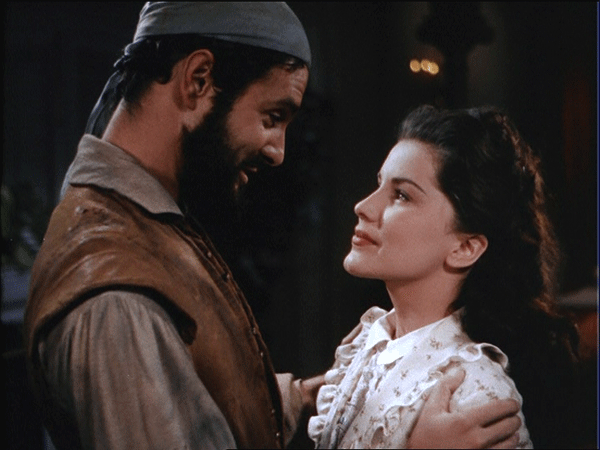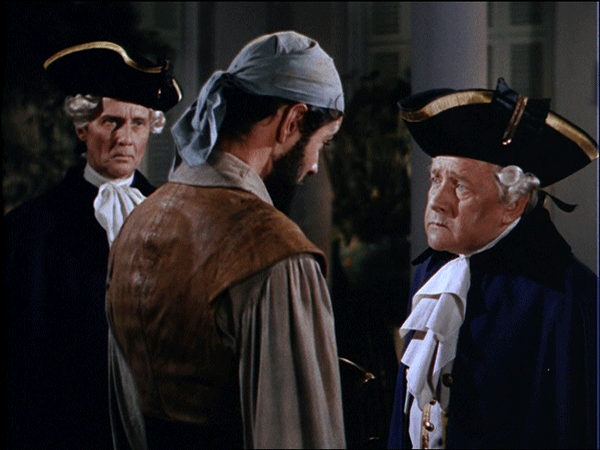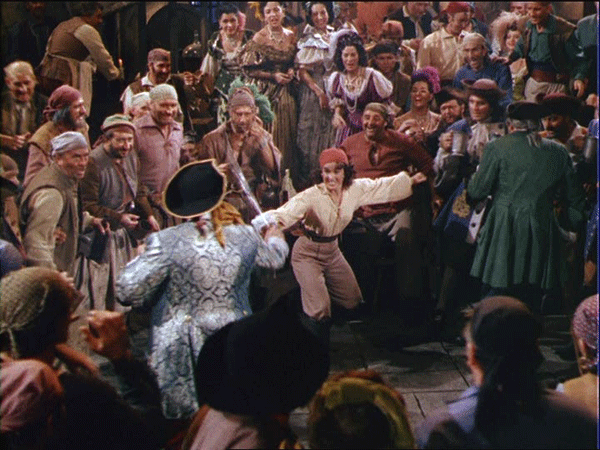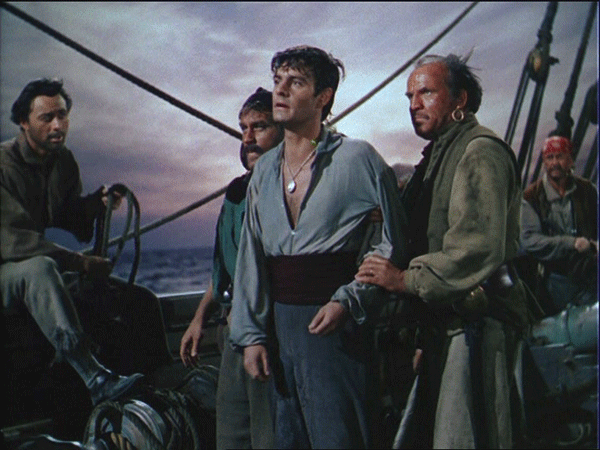
Archives

StarChoice 18: The Brides of Dracula – (Part 2 of 2)

1

2

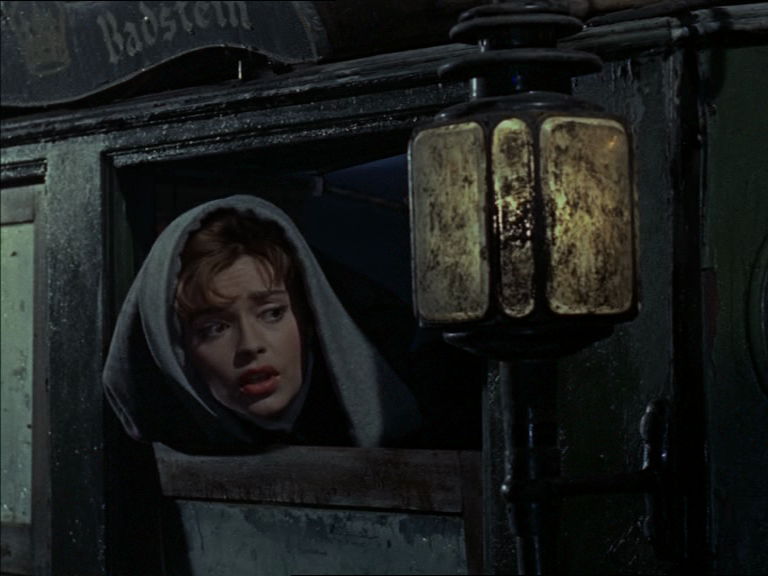
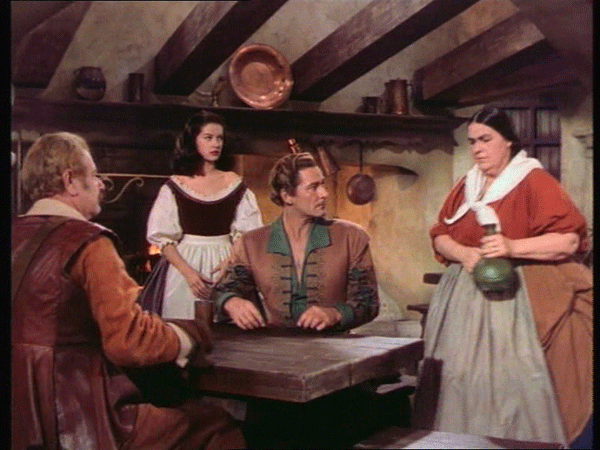
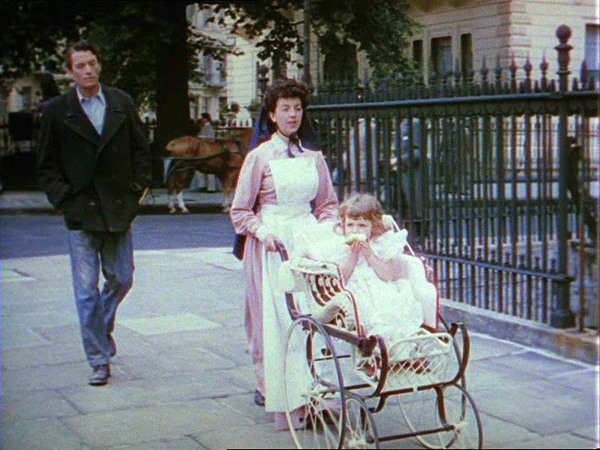
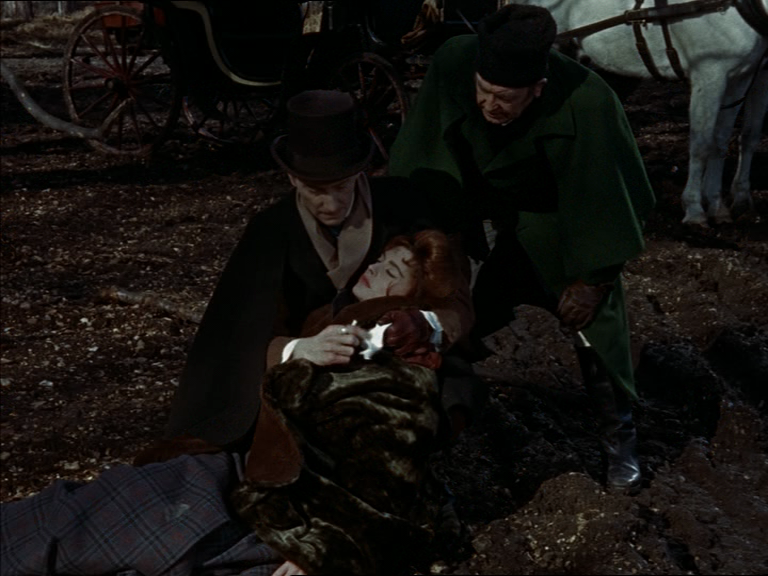
The morning has broken when Dr. Van Helsing’s carriage chanced upon Marianne lying unconscious in the forest. After reviving her, the doctor and his driver Carl took her to the “Running Boar Inn” where Father Stepnik had booked his boarding. From Johann, the landlord, he came to know of the death of a village girl whose wake is being held there now by few male relatives.

3

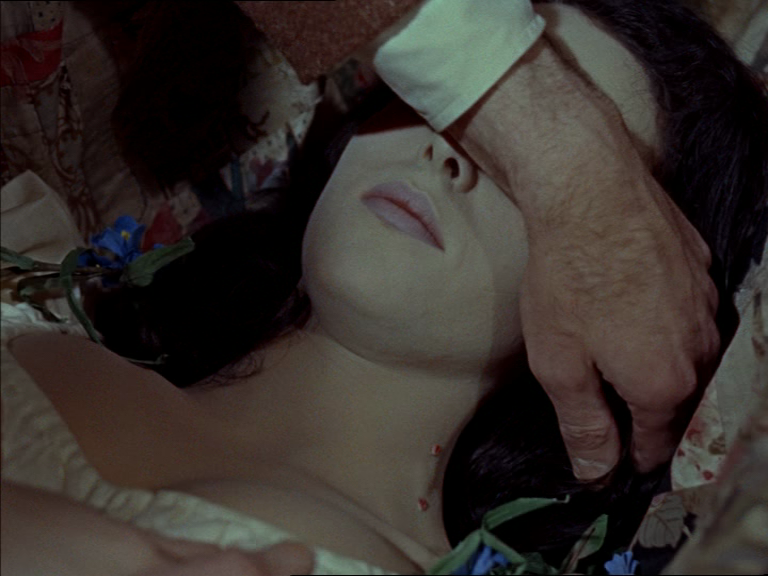
The deceased maiden, attired in a clean beige satin gown, lay on a patterned sheet inside the wooden coffin. It is the custom that the men related to the deceased are bound to spend the night, short of sleep, keeping watch over the corpse. This is called the privegghia*.
4

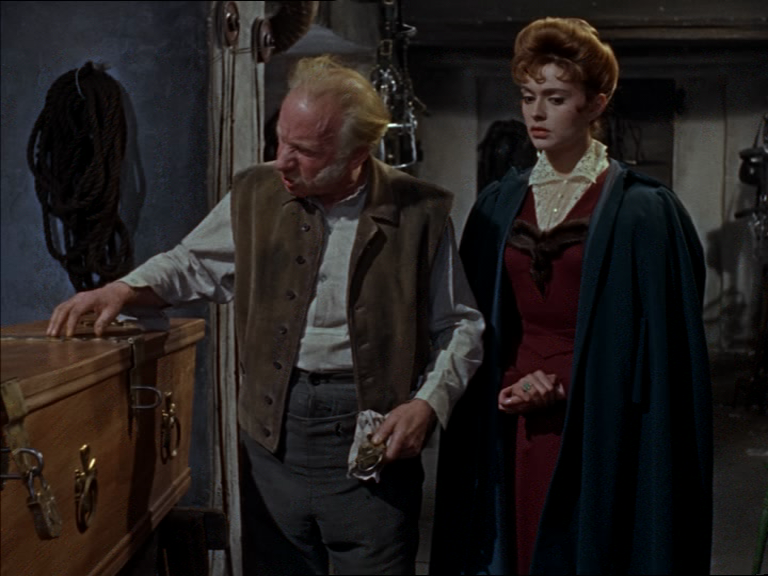
Although no one knows how she died, a brief look at the girl’s bitten throat was enough for Dr. Van Helsing to know the reason. He found a garland of wild garlic flowers # around the girl’s neck, placed there by the superstitious Transylvanian villagers as a precaution against evil. (# It is also very usual to lay a thorny branch of wild-rose bush across the body to prevent it leaving the coffin).
5

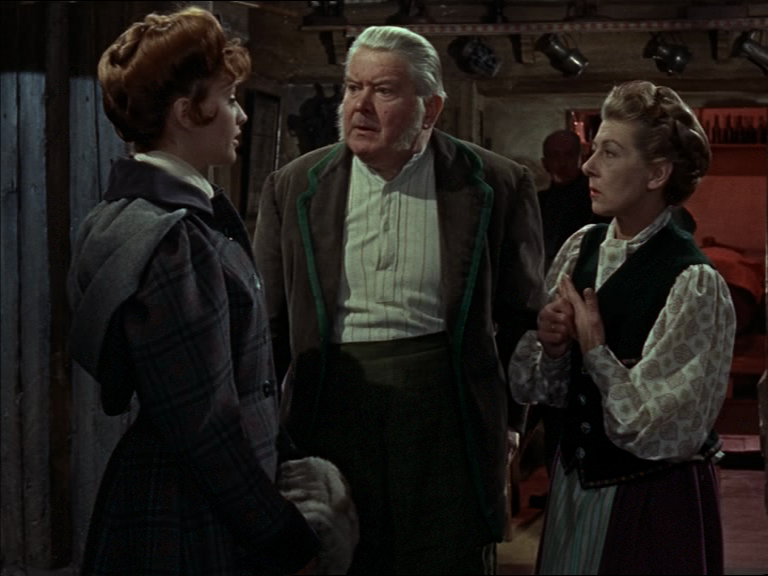
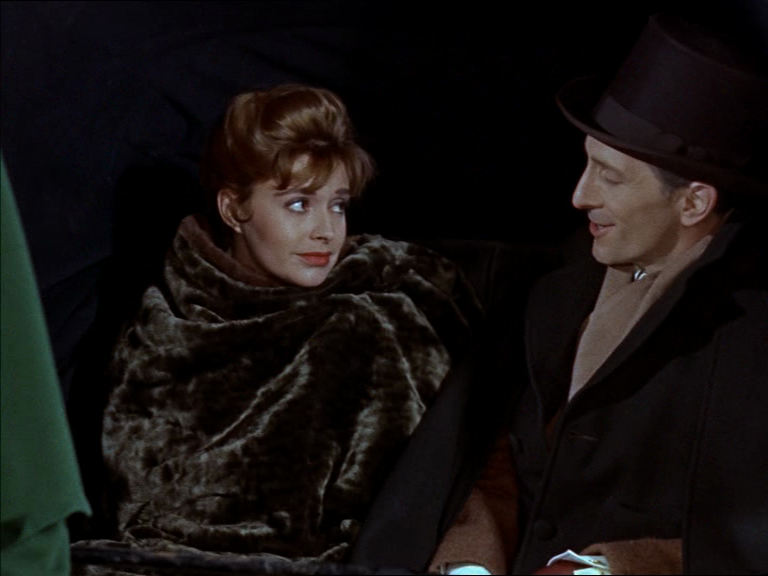
Sometime later, finding Marianne fit to travel, he took her to the Lang School. En route, Marianne related the events at Castle Meinster to him. At the school, they were happily received by the principal’s wife, Frau Helga Lang, a jovial woman.

6

Although the principal was initially annoyed by her late arrival, upon realising the identity of the eminent Dr. Van Helsing, a Doctor of Philosophy, Theology, and Professor of Metaphysics, he was impressed enough to forgive Marianne.
7

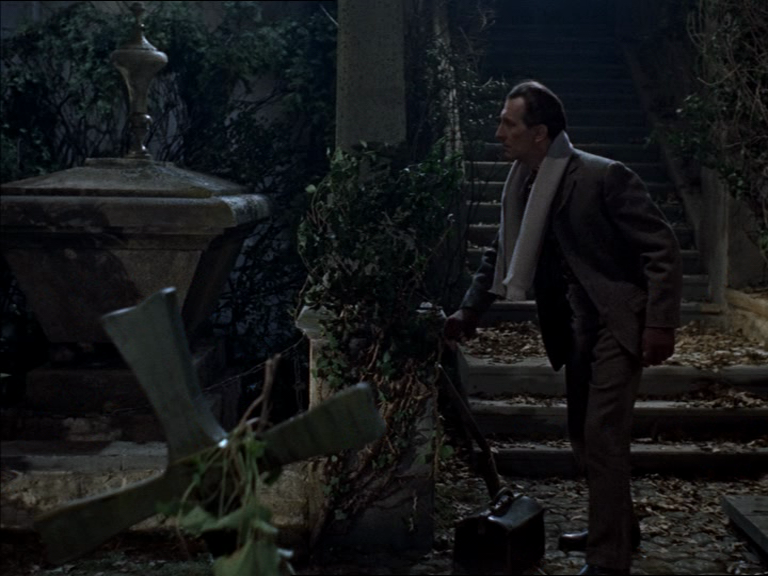
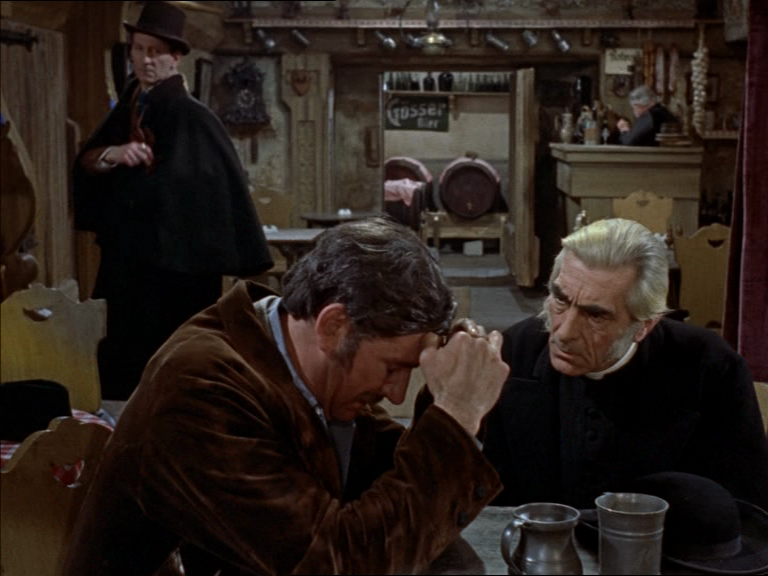
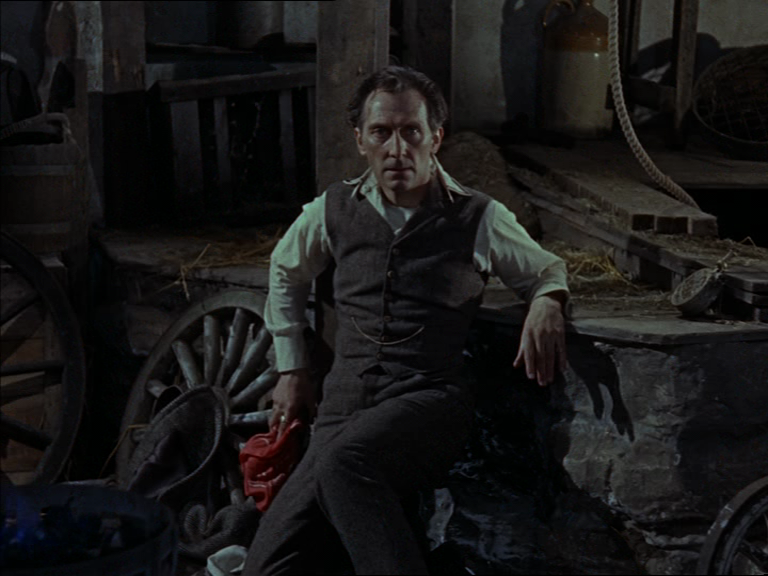
When Dr. Van Helsing returned to the Inn, he learned that Hans, the dead girl’s father, a casualty of hard times, had buried his daughter in the churchyard which Fr. Stepnik had objected because he had inkling that she is not at all like the rest of the others*. Having met Fr. Stepnik who had send for Dr. Van Helsing to investigate the local nefarious activities, the doctor decided to seize the initiative and visit the girl’s grave to ensure that she will not rise as undead and become bound to this earth, which would initiate a new cycle of evil.

8

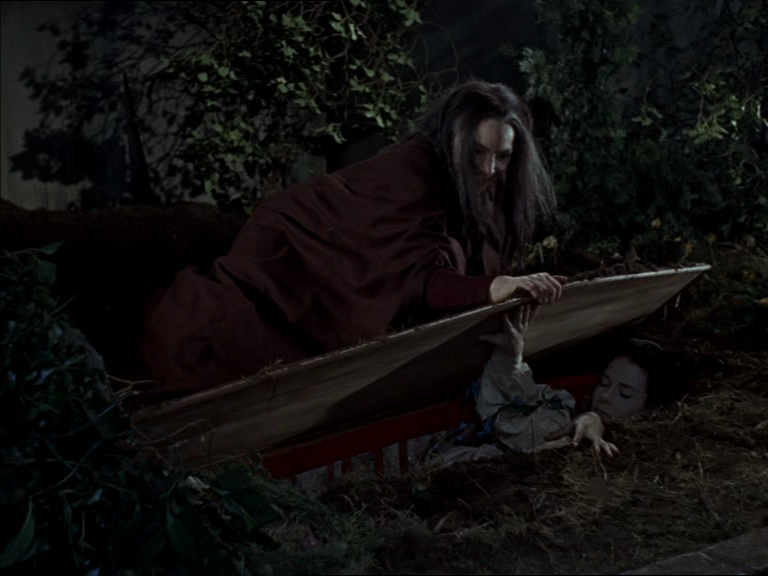
Later into the evening, at the girl’s grave, he was horrified to find Greta lying above it, gently tapping on the loose ground, urging the dead girl to wake up to go for her ghastly business. With constant prodding from Greta, encouraging to push from underneath, the ground finally broke and a feminine hand came out. No sooner the lid of the coffin opened and the girl sat up, the hysterical Greta reached over and flicked the garland of wild garlic flowers off the girl’s neck. The reign of terror of the vampire has reached its full zenith. – (rest on the screen…..)
9

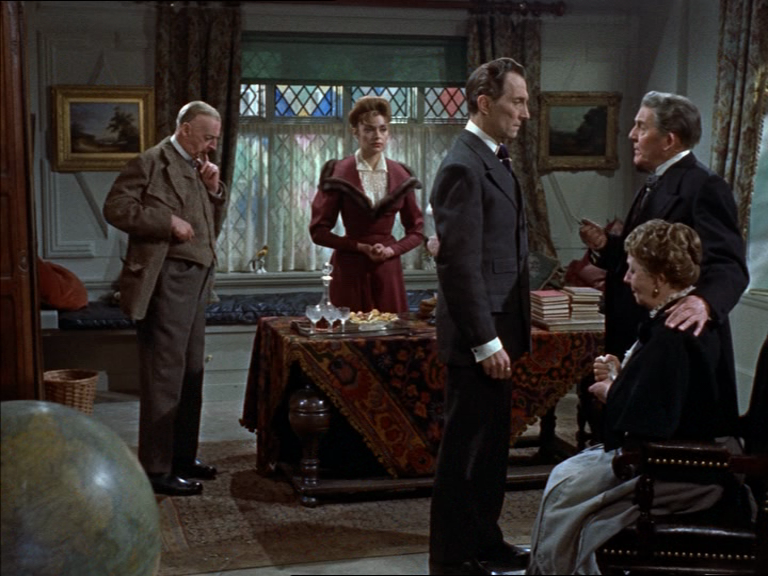
10What is so ground-breaking about this horror film with elements of fear that has made some followers going gaga over it? “The Brides of Dracula” with its devilish violence and sexuality follows the formula of most of the classic Hammer horror films of the 1950s and 60s, a time when the vampires were elegantly dressed unlike someone displaying his buff biceps and abs in an ad of Paco Rabanne. Those spooky films were noted for their eerie storyline, good characterisation, inexpensive sets and gorgeous costumes (that appeared more lavish and expensive than they actually were), sharp and kinetic editing. The action is kept close to its original period and the climax always featured the triumph of the good over evil, despite the occasional dominance of the evil.

Most of these Hammer movies were of low-budget nature, created  in the family atmosphere at Bray Studios using the same producers, directors, writers, cinematographers, production designers, set/costume designers, including sets, costumes, etc.
12

Veteran Hammer director Terence (Terry) Fisher (1904-1980), an astonishing visionary, helmed the direction with an intuitive and decisive flair. A former editor in films from 1933, Fisher had directed “The Curse of Frankenstein”, “Dracula”, and “The Hounds of the Baskervilles” (1959) to impressive results. Born in London, Fisher began his career in 1928 as a clapper boy from which he worked his way up to become an apprentice editor (for Gainsborough Studios) before progressing to a trainee director with the Rank Organisation. Having been invited by Anthony Hinds to direct “The Last Page” (1951) for Exclusive/Hammer, his unique, laid-back style in gothic horror started to develop with “The Curse of Frankenstein”. Reportedly, Fisher always insisted that the script came before all else in film-making, although he chose not to follow the original outline of Jimmy Sangster for the destruction of the vampire woman in “Dracula”. Staying within that framework and using minimal resources, Fisher was able to fashion up many horror creations with such power and conviction.

13

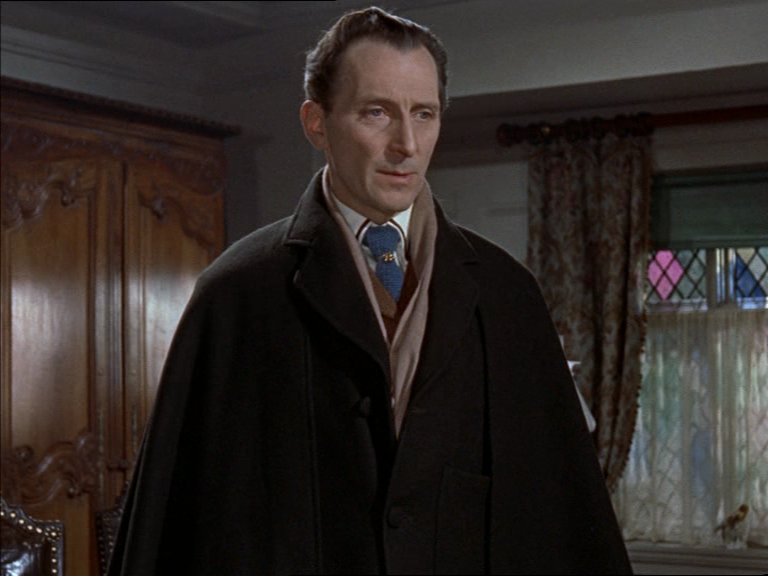
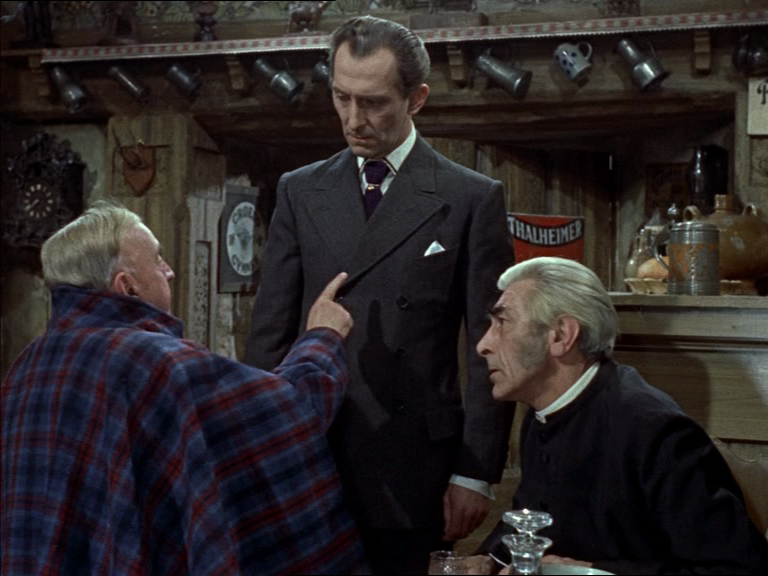
The cast is led by Peter “Wilton” Cushing (1913-1994), one of my favourite actors. Cushing had left the English theatre and moved to Hollywood’s “dream factory” in 1939 to commence his film career. Soon after his arrival there, on September 1, 1939, Germany invaded Poland. In March 1942, he was back in England, fell in love with his future wife actress Helen Beck in April of that year. Cushing joined the Hammer horror school in 1956 to star in “The Curse of Frankenstein” which brought him instant international fame and set him on a course to confront an assortment of monsters in films.
14

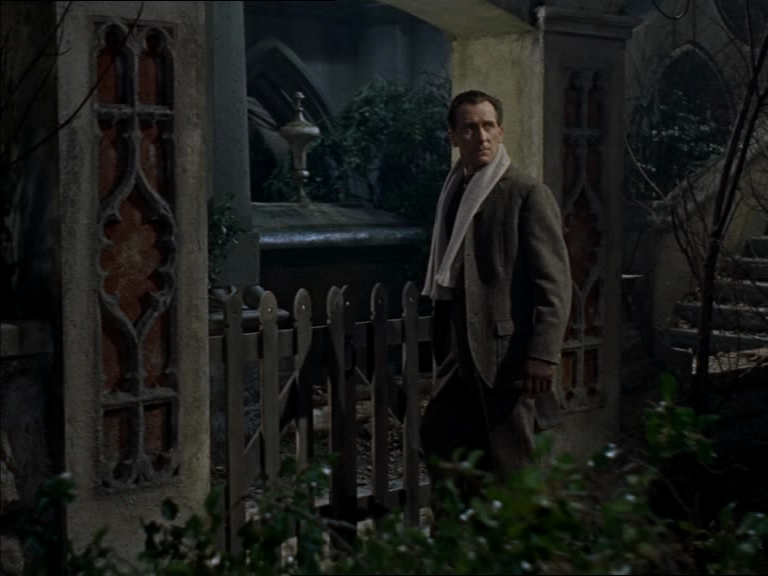
A great persona of humour, Cushing reportedly enjoyed learning not only his lines but his co-stars’ as well. Cushing gives a charismatic and commendable performance as the renowned vampire hunter whose strength is rooted in his knowledge, generosity, honour, discipline, and courage. A noteworthy scene that easily comes to my mind is the one in which Cushing perfectly conveys the learned man’s physical and mental agony upon his realization that he had been bitten by a menacing vampire and should instantly muster up a life-prolonging intervention to get rid of the curse, which he does with the help of a white hot poker from a brazier.

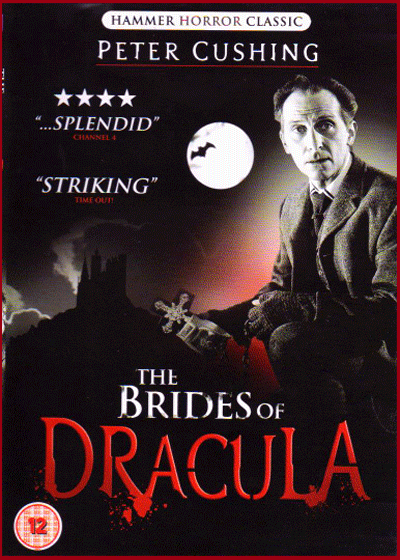
16 English actor David Peel (1920-1981), once a student of the Royal Academy of Dramatic Art, was known to Cushing since their days in the 1954 BBC adaptation of “Beau Brummell”. In his last major role as Baron Meinster, Peel is particularly convincing as the evil imprisoned in the castle.

17

19Although Peel had restrained from aping the mannerisms of Dracula, at times his depiction lacks the presence and menace of the vampire who recharges his batteries on young blood. This deficiency is understandable since, to the audience, the character of Baron Meinster is just a small fish compared to the animalistic ferocity of the chief Transylvanian Count Dracula who is successfully anchored in the public mind by the portrayal of Bela Lugosi and Christopher Lee. Dracula depicted by Lugosi and Lee appeared effectively menacing and sexy even when he gently approached the woman and forced his will on her, brushing his lips lightly on her cheek before sinking his teeth into the throbbing vein of her neck.

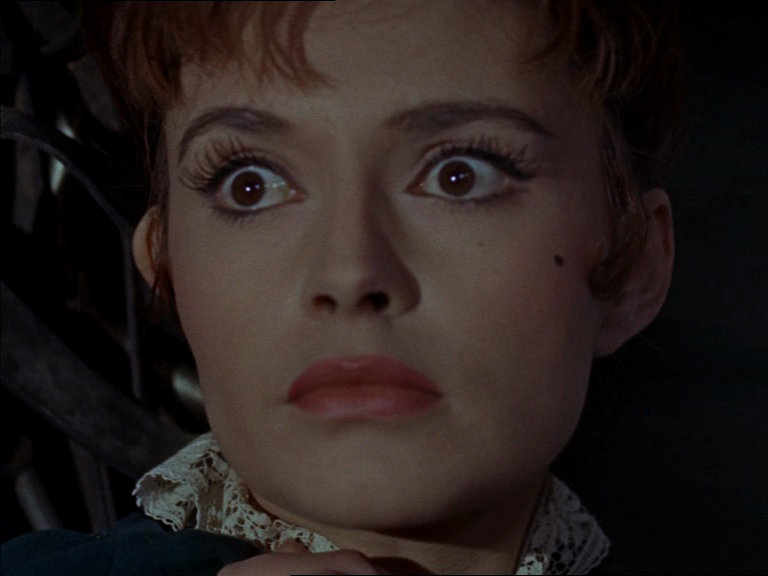
Actress Yvonne (Bèdat de) Monlaur (born 1939) is the daughter of a Russian count and his ballet dancer wife. It was her performance in “Avventura a Capri” that drew the attention of Anthony Hinds to her. After Monlaur’s arrival in England, she had much to be glad about since she could not only act in TV series but also  in three films in quick succession – “Circus of Horrors” (1960), “The Brides of Dracula” and “The Terror of the Tongs” (1961), a low-budget Hammer film starring Christopher Lee. Known mainly for her roles in Hammer Film horrors, Monlaur also did a screen test for the role of Dominique “Domino” Derval in the James Bond vehicle “Thunderball” (1965) though the role eluded her since the producers eventually cast French actress Claudine Auger.
20

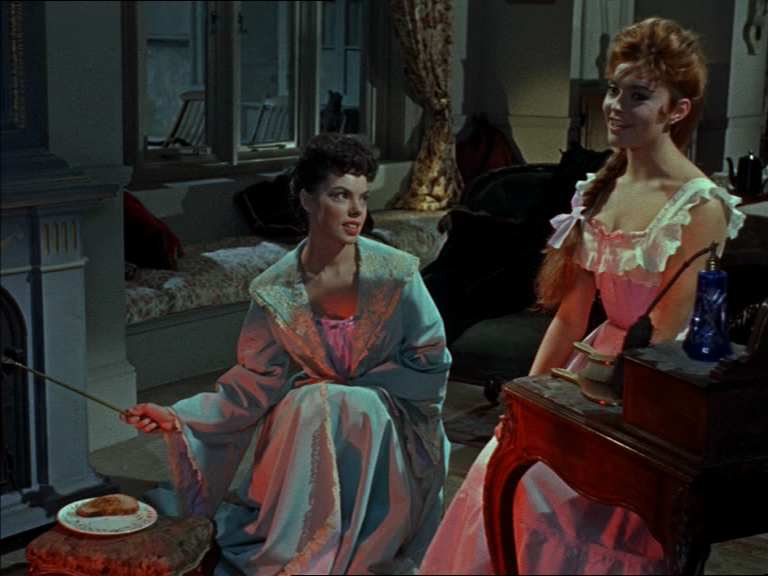
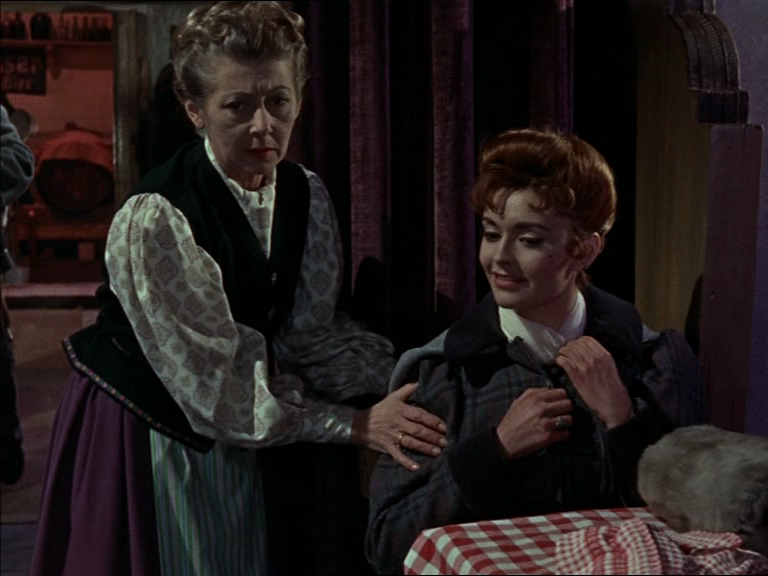
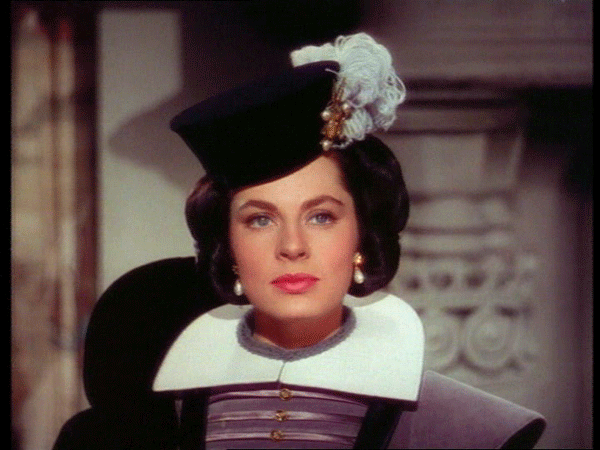
As student teacher Marianne Danielle, alone and new to the surroundings, everything from the way she dresses and does up her hair to the way she talks reveals the movie’s personality of a naïve young woman with good upbringing. However, the range of emotions Monlaur goes through needs refinement, while, in fact, her energy and beauty gleams throughout the movie.
22

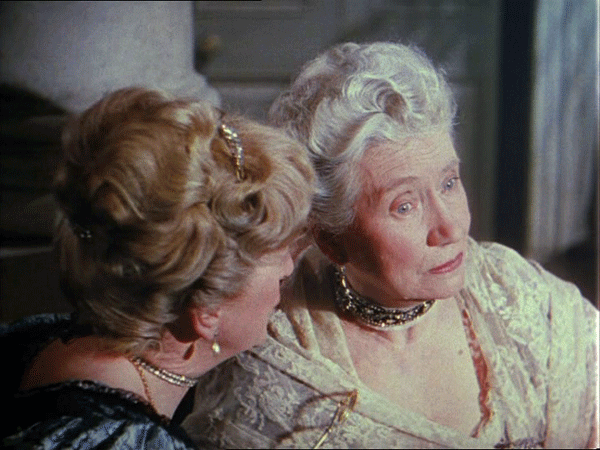
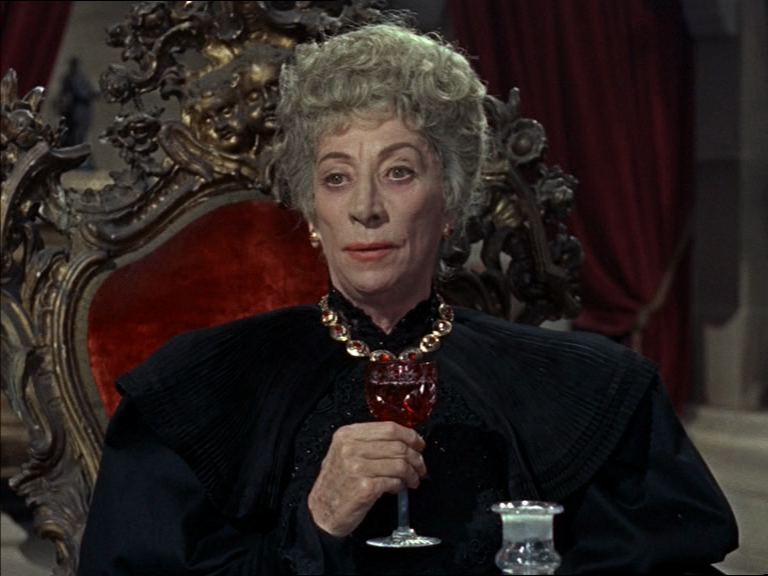
British theatre and film actress Martita Hunt (née Burnett) (1900–1969), was reportedly trained as an actress under Dame Geneviève Ward and Lady Benson. She graduated from roles of spinsters to grande dames one of which is her role as Baroness Narbonne Meinster. She is noted for her role as Baroness Elena von Livenbaum in director Anatole Litvak’s Ingrid Bergman and Yul Brynner starrer “Anastasia” (1956) and as Grand Duchess Elise Lupavinova in director Charles Walters’ “The Unsinkable Molly Brown” (1964).

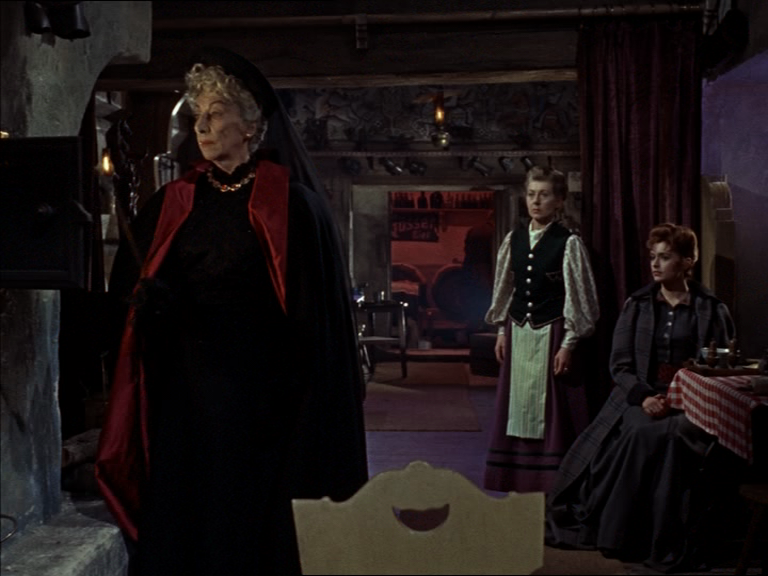
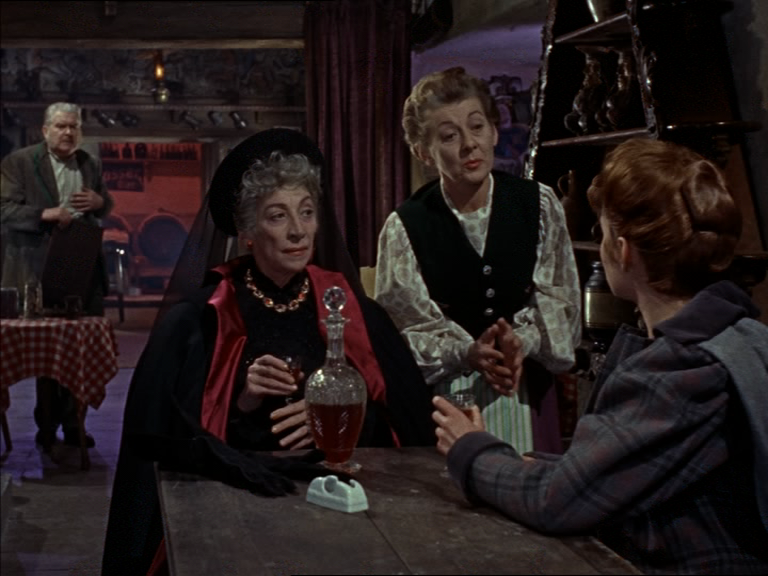
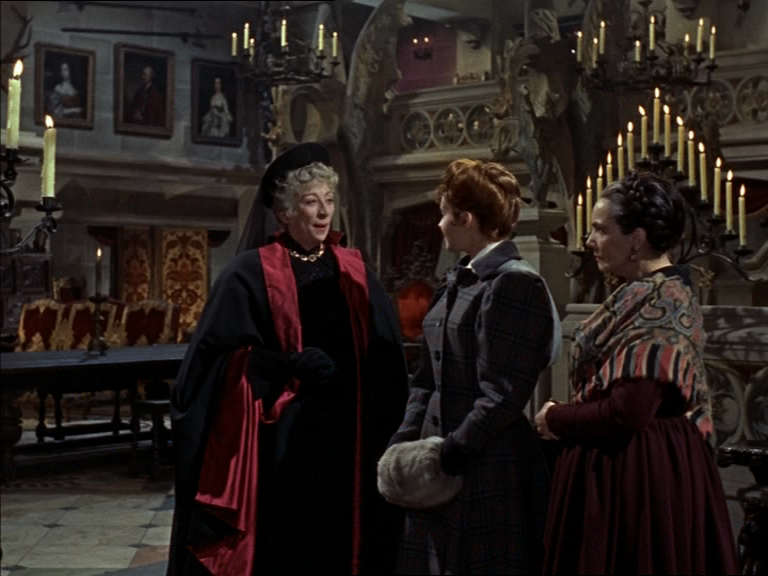
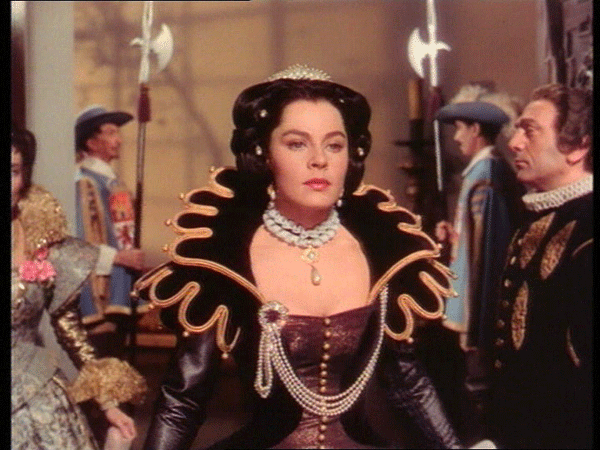
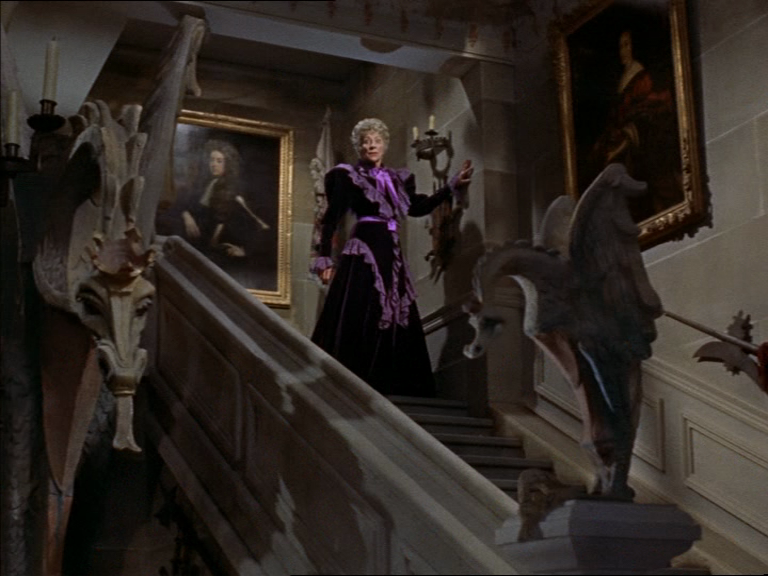
As the mysterious Baroness dressed in glorious black and red, (folds flowing downwards in soft easy lines, sleeves full and bulging while on her head was a dark, embroidered filmy veil floating down the back like a Spanish mantilla), Hunt’s looks and mannerisms, highlighted by lights and camera angles, projects the intended fear factor which in the initial scenes leaves us with doubt whether it is she or her son who is the vampire. Her scenes at the Inn where the Baroness gains the confidence of Marianne and entices her to the castle are well acted.
23

There follows a scene of the Baroness’ encounter with Dr. Van Helsing when, looking pale and morbid, she bares her fangs but does not show the animalistic signs of nosferatu (described as a Romanian word for vampire) in spite the fact that the Baron had initiated his mother into the realm of the “flesh of my flesh, blood of my blood” – creating a “little death” that gave her the gift of immortality (essential aspect of the vampire) and an eternal demonic bond with her son. Hunt’s depiction of the vampire here is noteworthy for her acting as well as its deviation from the general perception of the characteristic of a vampire.

24

Even with limited screen time, we cannot help but notice the fine performance of the British actress Freda Jackson (1909-1990) as the eccentric housekeeper/nurse of the Baron – especially, the eerie scene when the hysterical Greta coax the young girl to “push and push” (suggesting parturition) to emerge from her grave.

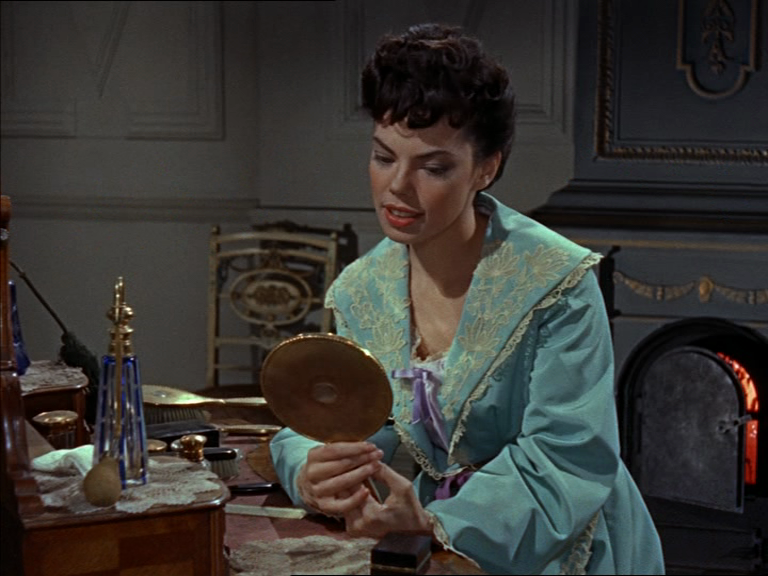
As much as Bram Stoker wished to demonise his female vampires, he did not create them with decomposing faces and bodies. Likewise, Hammer’s female vampires had beautiful but spitfire eyes, fair skin, voluptuous bodies clad in flimsy negligée, and pearly white fangs.
26

Beautiful English actress Andrée Melly (born 1932) acts in the role of Marianne’s roommate Gina who was initiated as a bride of the vampire.

27

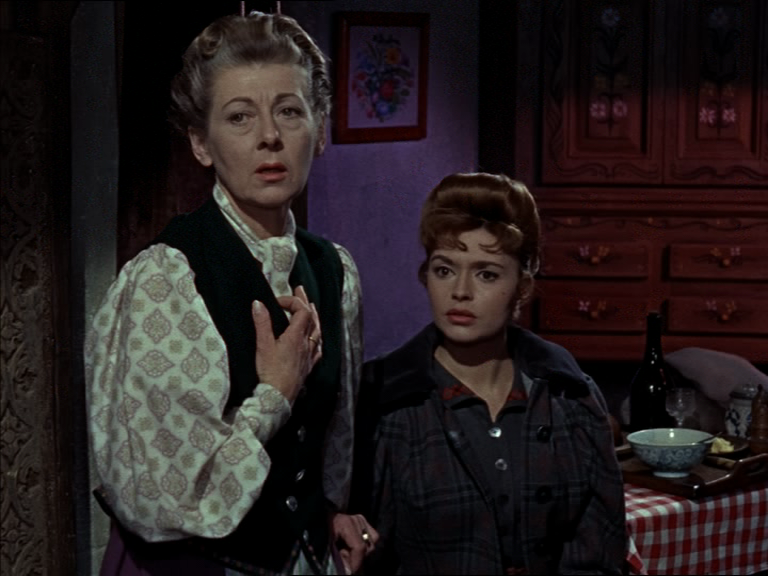
Mona Washbourne (1904-1988) as the round and roly-poly Frau Helga Lang, the Principal’s wife, is a joy to watch. Her part, though minuscule, provides a fresh air of breath amongst the dark undertones of the movie.

28

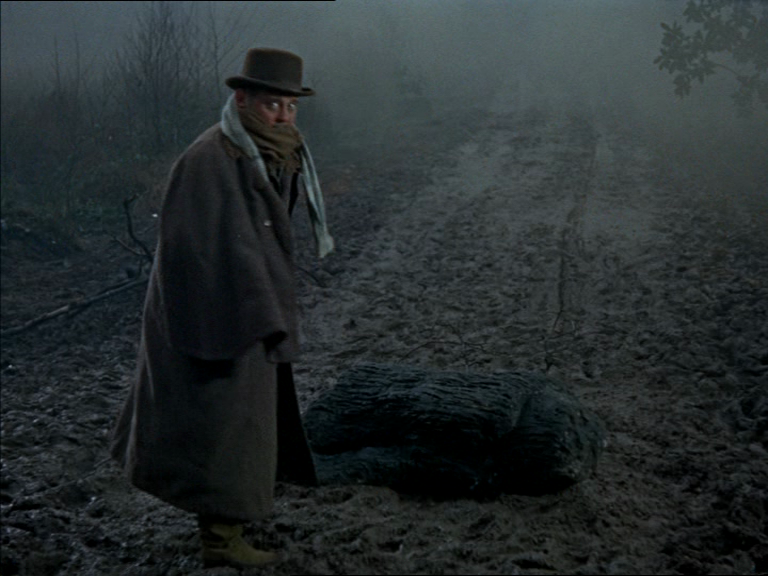
Although obscured by a muffled scarf, hat and top coat, Michael “George” Ripper with his wide staring eyes and controlled mannerisms in a cameo role as the coachman of Marianne, is instantly recognisable.

29

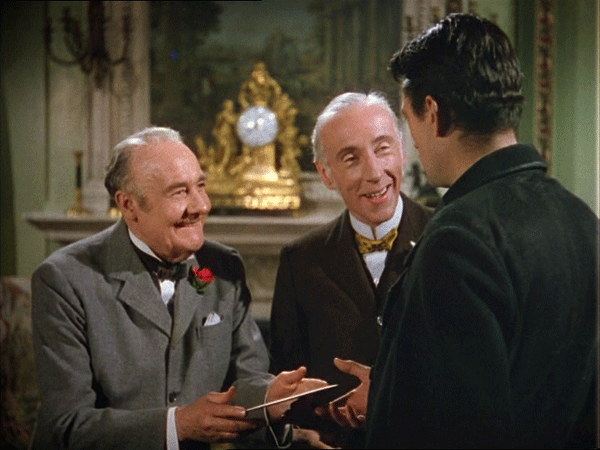
The supporting characters in pivotal roles are represented by Norman Pierce (Johann, Landlord), Vera Cook (Landlord’s wife), Miles Malleson (Dr. Tobler), Henry Oscar (Herr Otto Lang, Principal), Fred Johnson (The Cure, Father Stepnik), Victor Brooks (Hans, Villager), Marie Devereux (Village girl), Harold Scott (Severin, stable-keeper), Michael Mulcaster (Mysterious man), etc.
30

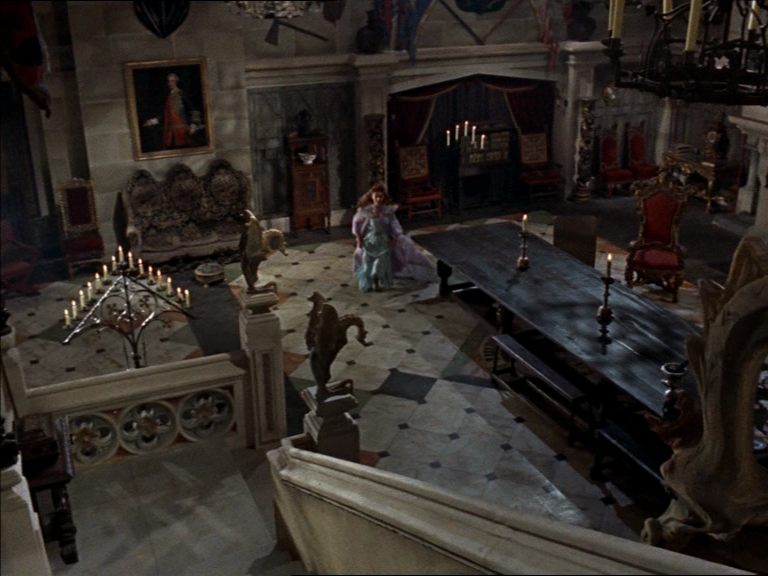
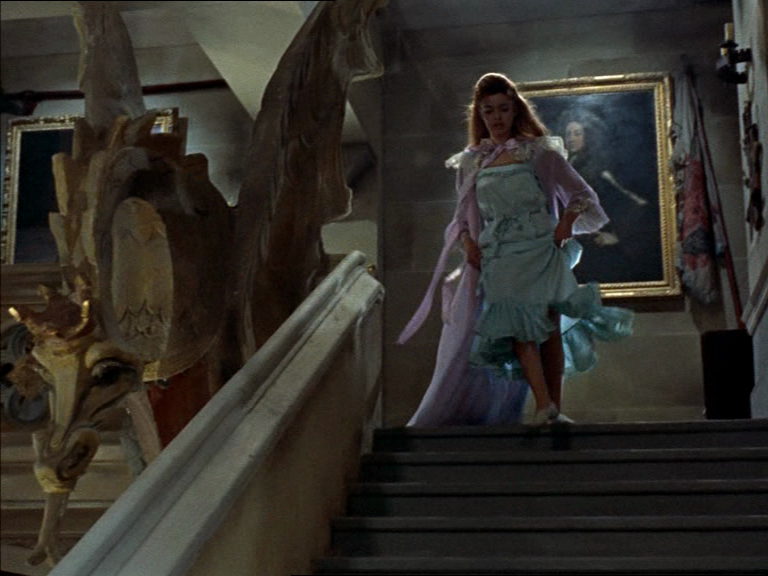
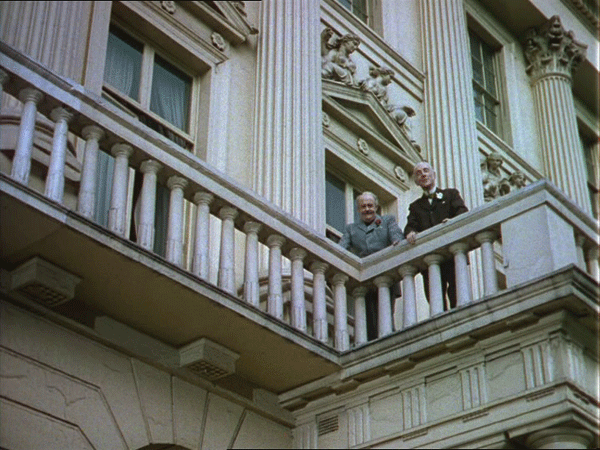
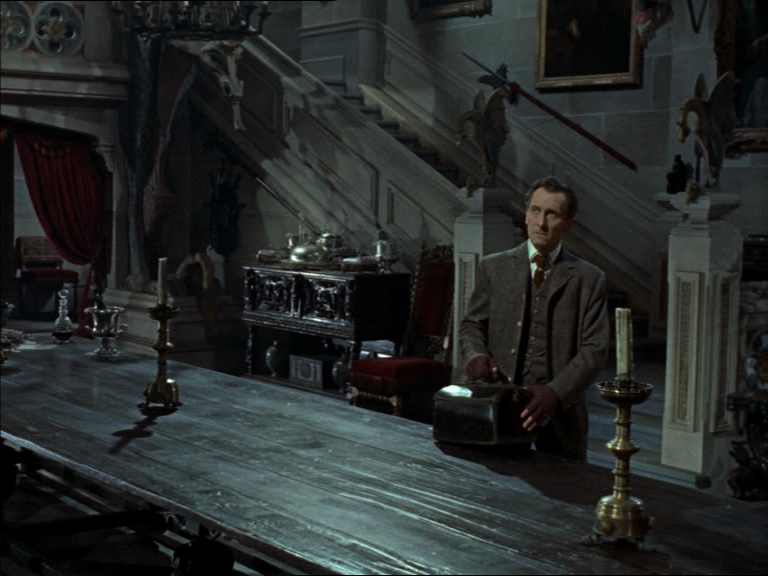
The marvellous sets created by Production Designer Bernard Robinson, who enriched more than forty films for Hammer, provides a wonderful gothic feel of the period, namely, the splendidly furnished castle at “the land beyond the forest” featuring a grand staircase, spiral pillars, the griffins, candelabras, wooden furniture, etc.

31

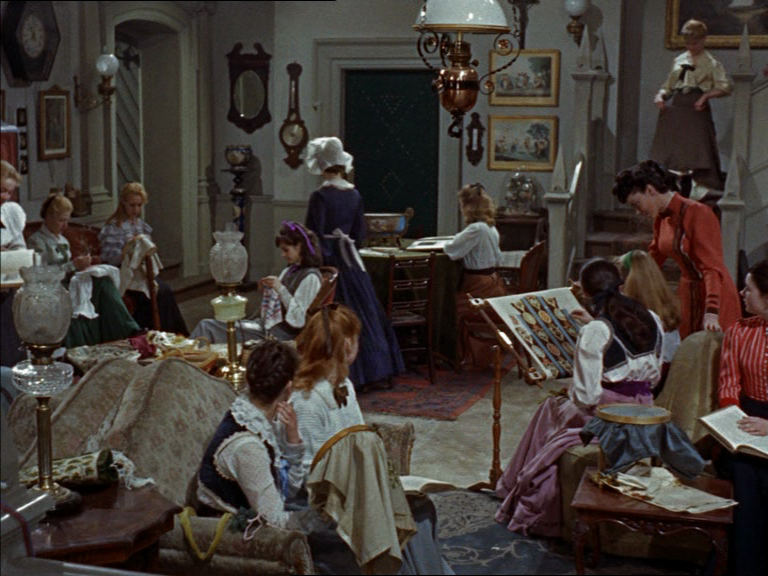
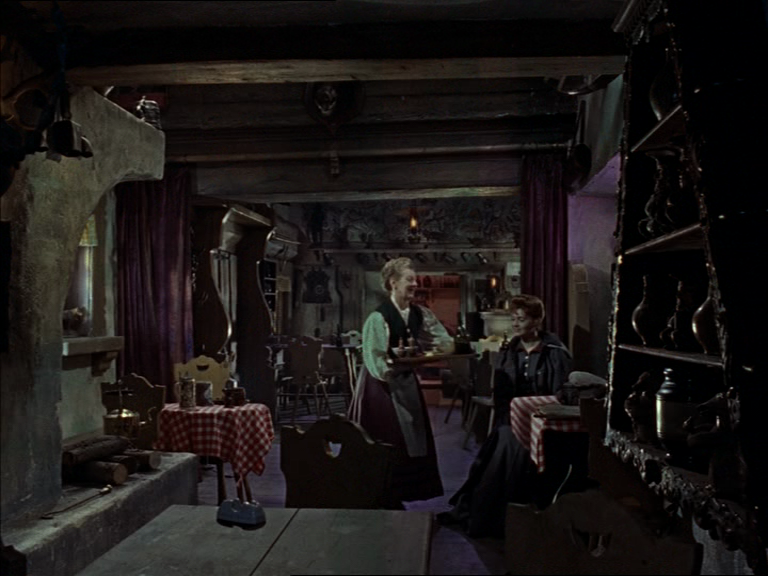
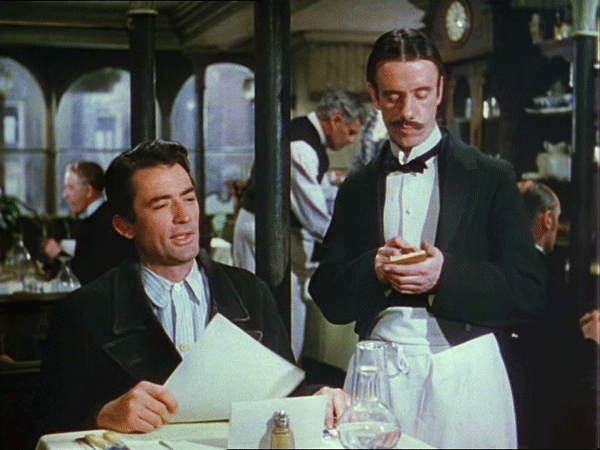
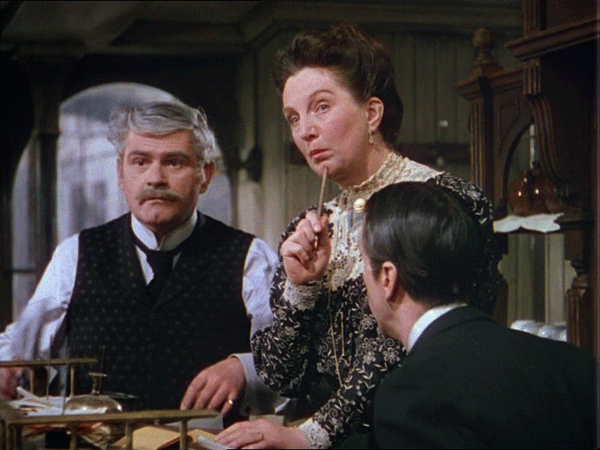
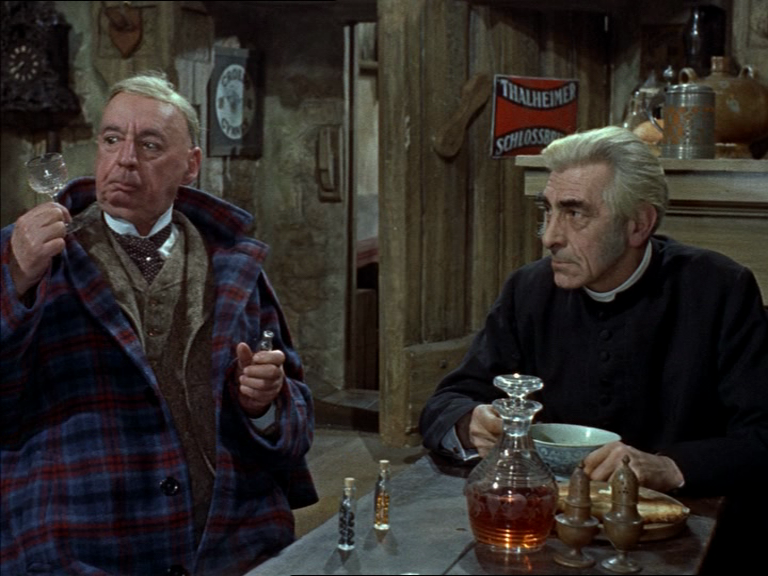
Likewise, the old Transylvanian Inn with its old-fashioned wooden furniture, stone fireplace, wicker lamps, metal utensils on walls and cupboards, old clock, antique table glasses, wooden walking sticks, a coat-hanger that appeared like the branch of a tree, framed thread-works of flowers on the walls, etc, provides the traditional appearance of an Inn that is customary in Hammer horrors. All of this was set up at Bray Studios.

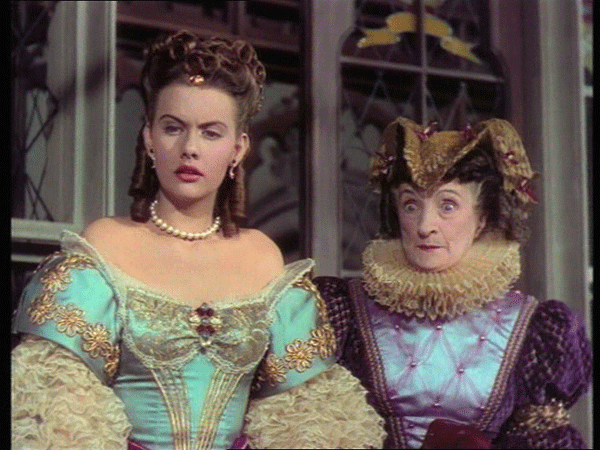
The costumes were executed by Hammer Wardrobe mistress Molly Arbuthnot (1908-2001) who discharged the same assignment for “Dracula”. The film is well pieced together by Film Editor Alfred Cox (“The Revenge of Frankenstein,The Mummy”, etc).

33

The celluloid canvas of the movie was illustrated by master Cinematographer Jack Asher (1916-1991) whose immense talents in what is essentially a visual medium, was evident from his initial Eastman colour photography of “The Curse of Frankenstein”. His crisp photography created a sharp, eerie, and visceral look.

34

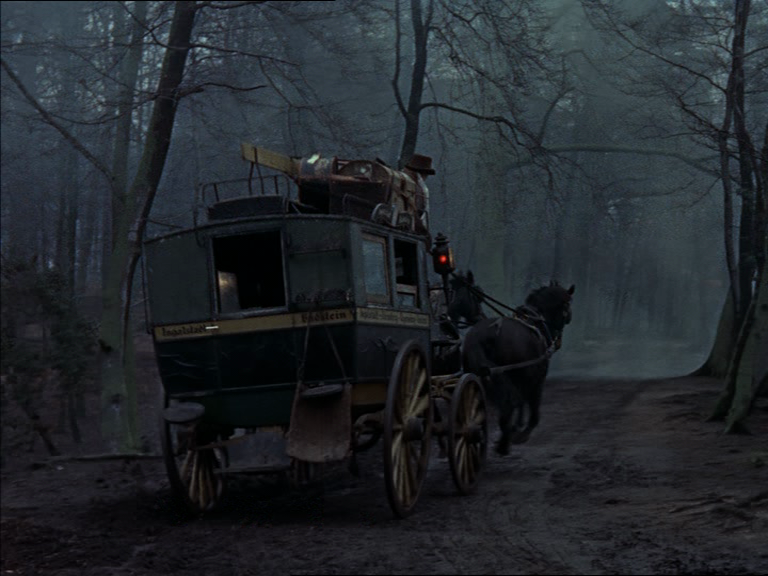
The horse-driven coaches, the gothic castle, the haunted cemetery, the simple Transylvanian woods and Inn are all beautifully photographed in glorious Technicolor in superb lighting which has a rich illuminating flavour.

Hairstylist Freda (Frieda) Steiger’s ingenuity is evident in David Peel’s look which was emphasised by a blond wig. You can identify a similar look on the blond character of Herbert von Krolock in Roman Polanski’s “Dance of the Vampires (1967 – “The Fearless Vampire Killers or: Pardon Me, But Your Teeth Are in My Neck”) which also feature a wonderful set of a Transylvanian Inn. Roy Ashton’s make-up appears a bit topped up, especially relating to Andrée Melly and Marie Devereux.
36

The other members of the crew are: Anthony Nelson-Keys (Associate Producer), Michael Carreras (Executive Producer), John Hollingsworth (Musical Supervisor), John Peverall (Assistant Director), Len Harris (Camera Operator), Sidney Pearson (Special Effects), etc.

The soundtrack dominated by organ, is composed by Australian-born prolific composer Malcolm “Benjamin Graham Christopher” Williamson (1931-2003). Though repetitive, it is nevertheless romantic and genuinely suits the tone of the movie. Being his first film score, Williamson would go on to compose scores for several Hammer productions. A former nightclub pianist whose music maintained a touch of the jolliness and forthrightness of his native Australia, he was the first non-Britain appointed as Master of the Queen’s Music (in 1975) whose duties include composing appropriate music for state events. In 1976, he was appointed CBE., and an officer of the Order of Australia in 1987.
38

Even if you will not miss Dracula or Christopher Lee, “The Brides of Dracula” does have few flaws. It does not offer any explanation about the motive or connection to the castle of the mysterious man who coerced the coach-driver to ditch Marianne at the Inn. Besides, he never turns up after his initial appearances in which he could be sometimes mistaken for Christopher Lee from the distance. In another instance, Marianne had left her luggage at the Inn and miraculously, it was waiting for her inside the room assigned for her in the castle. The garland of wild garlic flowers does not appear to be an impediment to the dead village girl to rise from the grave.
40

However, Terence Fisher maintains the suspense while keeping the film well-structured with taut narrative, visually impressive – the atmosphere top notch. As an added incentive, here is Peter Cushing, the great perfectionist and believer in politeness, at what he does best – positive aspects that had won this movie a cult following.
41

By the sixth year after the release of “The Brides of Dracula”, once again Christopher Lee donned the long dark cloak and appeared as the Count in director Terence Fisher’s “Dracula: Prince of Darkness”. That was another reincarnation which would subsequently spawn various horrific and brutal sequels. Though the subject matter would not be necessarily attractive to just anybody, there are many who sought and welcomed the appearance of this abhuman entity. Bram Stoker wrote in his novel: “He may not enter anywhere at the first, unless there be some one of the household who bid him to come, though afterwards he can come as he please.” Are you very warm and welcoming? Until next time, Ciao, Jo

42

PS:

1)   The DVD of this movie is available with main dealers such as amazon.com, TCM Shop, etc. Reportedly, the Blu-ray version is scheduled for release on July 22, 2013.

2)    In “Chapter XXV: The Roumanians: Death and Burial – Vampires and Were-wolves” (Page 318) of “The Land Beyond The Forest: Facts, Figures & Fancies From Transylvania” (published in 1888), its author Emily Gerard recounts: “In the case of a (man) who has died a violent death, or …..without a light, such a (man) has neither right to bocete, privegghia, mass, or pomeana (funeral feast), nor is his body laid in consecrated ground…..”.  Gerard’s book had quite an influence on Bram Stoker’s Dracula.

3)    Scene of the Wake: Although we can see a man standing in the back of the room who could be leading the wake, the film shows only chanting of prayer and omits “Bocete”, the mourning songs usually sung over the corpse by paid mourners. According to Gerard’s book: “Bocete is sung as a “last attempt by the survivors to wake the dead to life by reminding him of all (he) is leaving, and urging (him) to make a final effort to arouse his dormant faculties, – the thought which underlies these proceedings being that the dead man hears and sees all that goes on around him, and that it only requires the determined effort of a strong will in order to restore elasticity to the stiffened limbs and cause the torpid blood to flow anew in the veins.”

4)    When Gina’s corpse was watched over in the night as instructed by Dr. Van Helsing, it is kept in the stable inside a closed coffin. According to Gerard’s book, the corpse must remain exposed a full day and night. Maybe the film-makers kept the lid closed in order to dramatize the following scene.

5)    Listen closely for the faint notes of “Hallelujah” in the climax scene.

6)    A movie tie-in novel “The Brides of Dracula” by Dean Owen is available in some bookstores including amazon.com.

7)   This illustrated article is meant for the promotion of this movie. Please refer to “About” for more details.
43

 (This review is dedicated to the memory of Peter Cushing, OBE, one of the finest British actors whose 100th birthday falls on May 26, 2013)

 (Text: © JS/Manningtree Archive)
StarChoice 18: The Brides of Dracula (Part 1 of 2)

(aka. “Le spose di Dracula”, “Les maîtresses de Dracula”, “Dracula und seine Bräute”, “Dracula – blodtörstig vampyr”, “As Noivas de Drácula”, “De bruiden van Dracula”, “Las novias de Drácula”, “Las novias de Drácula”   – 1960 – Colour)

1a

Few of my friends have expressed their interest in film reviews of a particular genre which British actor Peter Cushing always referred to as “fantasy” instead of its much common adjective “horror”. When I thought about selecting such a movie from my collection for review, my criteria was to stick to the old masters of horrors: Hammer Films – which led me to the rarest of the Hammer horror Draculas, “The Brides of Dracula”, even though that film is devoid of the chief Transylvanian Count and Christopher Lee.

1b

During the final years of my school days in the Seventies, one of my classmates had a steadfast knack of narrating stories of occult and superstitions which are folklore in his native place. Those were the days when television was on its slow trek to Cochin and the only visual entertainment for us was the movies though accessing them had its limitations due to lack of time from studies and that ever missing essential called pocket money.

2

Although, my friend’s knowledge on the subject of the undead was limited to a certain religious perspective, whenever time permitted, he carried on entertaining us over and over with the same ancient folklore, each time improvising and adding more spice to it. Despite the scant narration about the dualistic principle of the offsetting of good by evil, his stories often emphasised the use of ritual magic for personal gain or lust.

3

But then, what is the truth behind the legends of all this? The existence of Satan as the centre of evil is part of the teaching of both Old and New Testament and accentuated in catechism classes to elucidate the righteousness. Whilst the various phenomena related to this subject are difficult to explain, to us teenagers, the twilight world of the unseen seemed fascinating and mysterious.

4 5 6

Horror stories and films have always been popular even though lot of people won’t admit they like such genre. But the fact is that, if you ask about “Cimarron” which won the Academy Award for Best Picture in 1931, it is doubtful that it is remembered. On the other hand, it’s unlikely that you have not heard of “Frankenstein” and “Dracula” which came out in the same year. How can one forget the image of Christopher Lee when he first appeared as the starkly, statuesque and satanic Count Dracula at the head of the stairs in Hammer’s “Dracula” (USA: “Horror of Dracula”)? How can one forget those welcoming words of Dracula in Bram Stoker’s 1897 novel: Welcome to my house! Enter freely. Go safely, and leave something of the happiness you bring!”?

7

Count Dracula has followed us through the years – remaining either a reincarnation or undead – regularly making his various onscreen appearances in many manifestations, speaking different languages. His recent outings were in movie creations titled “Dracula 3D” by Italian director Dario Argento and in two movies by Indian directors: in Vinayan’s “Dracula 2012” (in which he came to our State to taste its “bountiful local winepress” and spoke Malayalam!) and in Rupesh Paul’s “Saint Dracula 3D”. Evidently, the interest in him has remained undiminished to this day. And I suspect it always will be. How could such an undead beast be so romantic as to catch the popular imagination, although, most likely, blended with fear?

8

When I think about the ghoulish tradition of “Frankenstein” and “Dracula” started by Bela Lugosi, Boris Karloff and Basil Rathbone, how could I resist from thinking about that wonderful British production company, “Hammer Film Productions” who revived Frankenstein and Dracula myths, and gained fame and fortune from their cycle of horror films?

9

Shot in Bray Film Studios, Berkshire, England and in real old houses, the classic horror movies of Hammer, with rampant blood and gore, not only gave the audience graphic violence and sex but also created a feeling of gothic horror amidst purely British atmosphere. Triggered by the tremendous impact of Hammer horrors, those wonderful people earned a massive audience base around the world.

10

In the wake of the success of Hammer’s “Dracula”, produced by Anthony Hinds in 1958 based on characters in Bram Stoker’s (1847-1912) novel “Dracula”, a surge of confidence spread across Hammer prompting them to press ahead with a sequel which would also be produced by Hinds.

11

After all, Hammer had already released “The Revenge of Frankenstein” (1958), a sequel to “The Curse of Frankenstein” (1957) which had resurrected the horror genre and had started its race to become the most profitable film ever to be produced in England by a British studio, a position it would retain for some time.

13

14According to a publication, by early 1959, British horror screenwriter Jimmy Sangster, an associate of Hammer, was commissioned by Anthony Hinds (who would write screenplays under the name of “John Elder” from 1961 onwards) to prepare a treatment titled “Disciple of Dracula” which revolved around Baron Menister, a disciple of Dracula, who terrorized a couple of visiting English girls and feasted on the blood of few ladies of a nearby girl’s school. Having been fed up with Baron’s notorious activities, Latour, the hero of the script, calls for the spirit of Count Dracula to put an end to his disloyal disciple.

Christopher Lee knew that the character of Dracula has become the object of popular entertainment and he is unlikely to lie down for long. After his appearance in “Dracula”, the audience has started to consider him the personification of Dracula. Lee wanted to disengage himself from being typecast as the Count. In a desperate attempt to rope in Christopher Lee to the project, Hammer prepared another treatment to suit him which they named as “Dracula the Damned”.

Once the studio realized that Lee didn’t wish to be associated entirely with one part and intend to expand his area of creative endeavour, the options left for Hammer was either to recast the role which could possibly adversely affect the character in their future sequels or else, base the story solely around the character of Dr. Van Helsing, the vampire hunter.

15

Opting for the second option, a revision was made on “Disciple of Dracula” by writer Peter Bryan wherein the character of Dracula was replaced to bring in Dr. Van Helsing. By now, the script has acquired the misleading title of “The Brides of Dracula”, as a marketing strategy.

16

Then again, when they tried to hire Peter Cushing to reprise the role of Dr. Van Helsing, Cushing sought further modification on the draft and suggested it be done by Edward Percy (Member of Parliament from 1943 to 1950), known to Cushing from his days with theatre. In spite of the minor facelift to the draft by Percy, the script underwent yet another modification as a precaution to avoid any scissor-work from the British Board of Film Classification (BBFC).

17

Slated for production under the alternative working title “Dracula 2”, the principal shooting began on January 26, 1960 (7 days after my birth) and came to an end by mid-March*. It was shot on locations in England: at Black Park (Iver Heath, Buckinghamshire); Oakley Court, (Windsor Road, Oakley Green, Windsor); and Bray Studios, (Down Place, Oakley Green, nestled beside the silver Thames). The post-production work was precipitated to meet the delivery date of Universal and the movie was premièred on July 6, 1960 at the Odeon, Marble Arch, London. I read somewhere that actress Yvonne Monlaur, the leading lady of the film, made a regal appearance for the Premièr in one of the horse-drawn carriages used in the movie.

18

Not far into its general release, the film’s earnings showed progressive improvement which encouraged Hammer to initiate talks about an outing of the Count in Dracula 3. This headway is hardly surprising since, on all fairness, Dracula was not missed in the movie as all the usual ingredients of a Hammer horror was in place – and then, there is the ever distinguished presence of Peter Cushing to keep the audience’s mind alive with the existence of Dracula.

19

Synopsis for those who have not seen it yet:

After the credits are shown, the movie opens when a horse-driven carriage is rattling and shaking its way through a muddy track cutting across the wet and misty Transylvanian forest. The carriage’s route-board showed: “INGOLSTADT-ABENSBERG-REGENSBURG-BADSTEIN”*. A voice-over narration is heard:

20

Transylvania, land of dark forests, dread mountains and dark unfathomed lakes. Still the home of magic and devilry as the nineteenth century draws to its close. Count Dracula, monarch of all vampires, is dead, but his disciples live on, to spread the cult and corrupt the world

21

Inside the carriage was Marianne Danielle a naïve young Frenchwoman from Paris on her way to her first appointment as a students’ teacher at Langs School, a girls’ teaching centre at Badstein.

22

After the driver stopped his carriage to clear the log that was blocking the road and resumed the journey, a mysterious stranger who had appeared from the woods, jumped onto the back of the carriage and hung on, unseen by the others. It was dark when the carriage finally pulled into the courtyard before the Running Boar Inn*. While Marianne went into the comfort of the Inn, the mysterious man in black, approached the scared coach-driver and gave him some money.

23

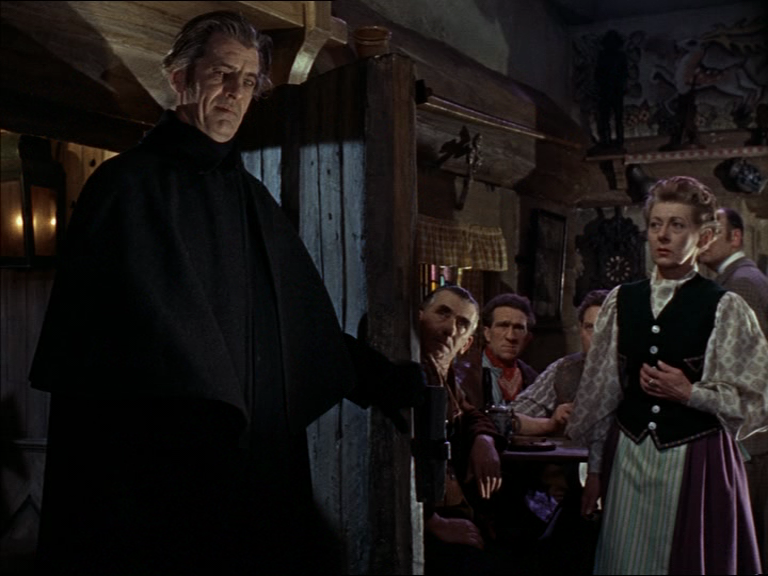
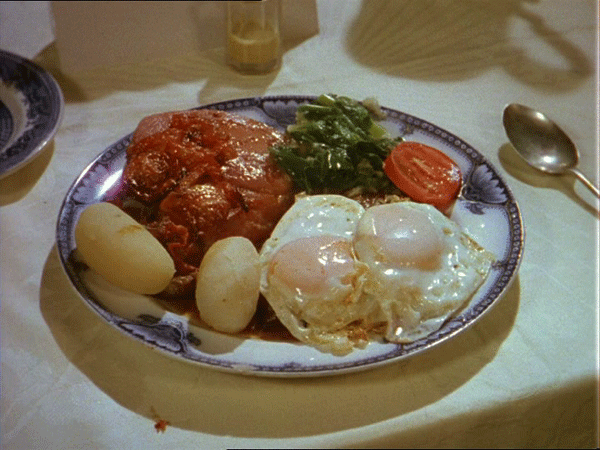
The Inn was crowded at that time of the night by village people and Transylvanian folk music can be heard, accentuated by the tones of cimbalom. Johann, the landlord, offered her hot Goulash, a dish of sauerkraut and red wine from the valley. Marianne told him that she would be eating alone and would leave quickly since she must reach Badstein latest tomorrow. At that moment, the mysterious man suddenly appeared before the doorway and stood glaring at her. The gay mood inside the Inn suddenly changed. The music and conversation came to a quick stop. As abruptly as he appeared, he was gone a moment later, closing the door behind him.

24

There was a scurry amongst the customers as most of them started to leave. Johann expressed his advice to her to leave immediately on grounds that she was alone, and he didn’t want the coach to leave without her. It so happened that the minute he finished talking, they heard her coach leaving. Running out into the courtyard, they were in time to catch sight of the coach disappearing beyond the gate. Her luggage had been left behind, neatly stacked by the entrance to the Inn.

25

Stranded at the Inn, Marianne’s attempt to spend the night there was not successful since Johann and his wife stressed that none off the rooms were vacant. Nevertheless, the compassionate wife soon sent her husband away to the nearby farm to ask for their cart while she would get something for Marianne to eat.

26

By the time Johann returned, Marianne had a wooden tray full of hot soup, bread and a bottle of wine set in front of her.

27

Johann had the cart ready in the back and there was no time to loose. She must leave now. Just then, they heard a carriage pull up before the inn.

28

Shortly, the local Baroness Narbonne Meinster came in and ordered wine. When Marianne was invited to join the noblewoman, she happily complied leaving her food untouched. The Baroness claims that the Tokaji (Slovakia: Tokaj) wine she ordered is twin brother to the best in the emperor’s cellar – rather different from the wine of the valley Marianne was drinking.

Hearing of Marianne’s futile endeavour to get round her untoward situation and report for duty at the school tomorrow without giving bad impression by arriving late, the Baroness expressed her inability to take her to Langs School that night, but she could see to it that the young teacher gets there early in the morning. Marianne doesn’t need to stay in a poor place like this.

29

She would be welcome to stay at the Baroness’ castle in the hills just above the village. She’s a lonely woman who often longed for the company of a woman with a little breeding – a rare thing in these parts. Marianne graciously accepted the offer, ignoring the landlord’s wife’s discreet intervention with an offer of a room for her stay which was denied earlier due to mistake of her husband. Soon their carriage departed for the castle, and we could catch a glimpse of the mysterious man stepping out from behind it.

30

At the Castle Meinster, she was left under the care of housekeeper Greta with instructions to Marianne to be ready for dinner in ten minutes.

32

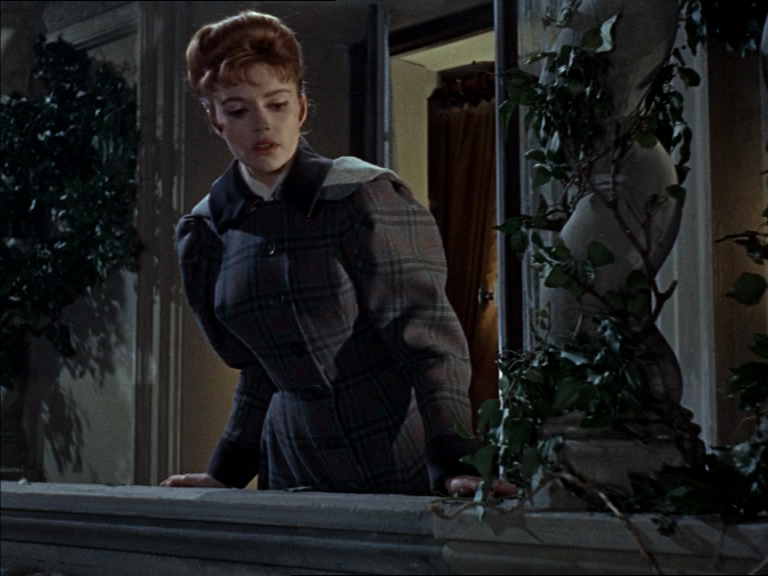
Before long, she was out on the balcony of her room, enjoying the breeze when she caught sight of the dark figure of a man on the lower stone balcony.

33

Moments later, when Greta came to fetch her, she didn’t provide Marianne with a proper explanation about the man who didn’t look like a servant. But at the dining table, the Baroness brought up the subject and let her know that she is not living alone. She has a son who is ill. She never sees him, but Greta, his old nurse, looks after him.

34

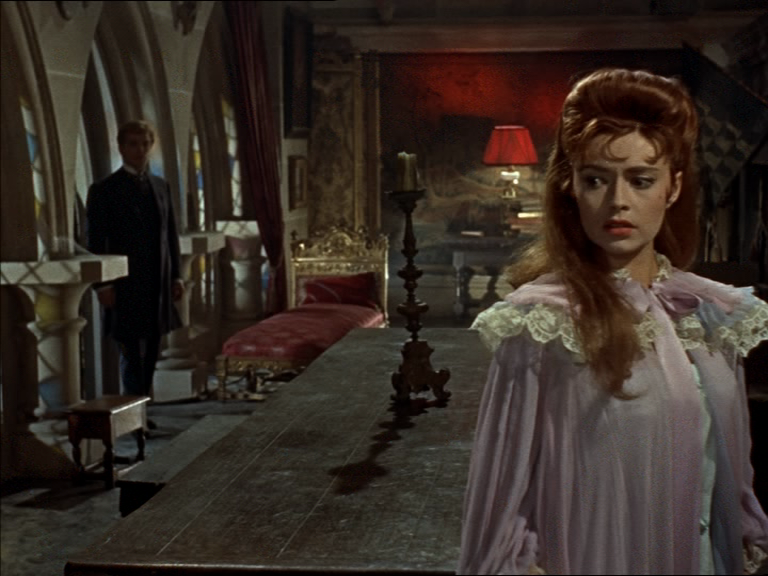
Soon after, with the evening meal out of the way, having retired to her room, Marianne was lying on the bed when she heard sounds, similar to knocking, from outside. From the vantage point of her balcony, she saw the young man again, this time, bracing up to jump off the balcony. Horrified, she abruptly shouted at him to stop, drawing his attention to her. Bidding him to wait, she ran down the rough-hewn steps of the grand stairs to the lower room and over to the dashing young man.

37

Obviously surprised to see her in the castle, he assured her that he can’t throw himself out of the balcony because his mother had shackled him, keeping him a prisoner. His is Baron Meinster and this castle, the mountains, the dark acres of forest, even the valley below belongs to him – his inheritance. His mother is a vicious evil, a jealous woman. She has made the villagers think that he is dead. Wouldn’t Marianne be kind enough to find the key that fits his iron shackle and free him? According to Greta, it is inside the locked drawer of the bureau in his mother’s bedroom, next to Marianne’s.

38

It didn’t take her much longer to locate the key and before the Baroness could find her, she tied the key to her handkerchief and threw it down to the Baron on the lower balcony. As he hastily unlocked his shackle, he told her to hurry up and meet him outside.

39

When the Baroness had gone to look for Marianne in her bedroom earlier and found her missing, she was inclined to expect for the worst. Returning to Marianne’s bedroom, she found the Frenchwoman getting ready to dress.

40

Instantly, she demanded to return the key which she knew Marianne had taken from her room. Denying any knowledge of the key, Marianne ran out of her room, down the stairs and straight into the arms of the Baron. By now, the Baroness had come to the top of the stairs. Having assured Marianne that his mother can’t harm her now, the Baron sent her back to her room to wait. As she left him, he commanded his mother to come down to him. As if hypnotised, she meekly obeyed him. Clearly under his sway, she moved down the stairs, resigned to face the dread that is to befall on her soon. Marianne ran up and disappeared into her room.

41

Cut to Marianne’s bedroom. She had changed into travelling clothes when she heard the hysterical cries of Greta from the lower floor. No other noise followed from below. Rushing down, she found Greta on her knees, holding the iron shackle and lamenting that the devil is free to roam the night.

42

She showed her the lifeless body of the Baroness, lying on a cushioned chair, the wound on her throat clearly visible – the bite of the vampire.

43

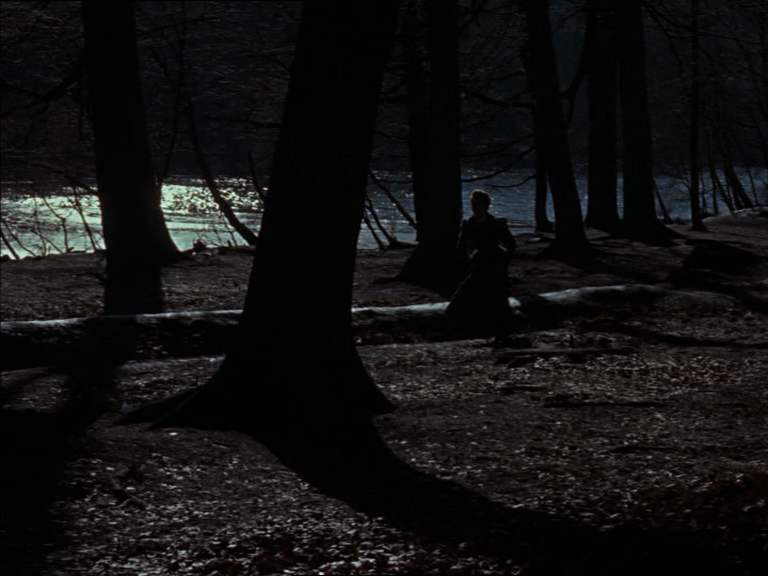
At the sight of the horrible scene, Marianne ran out of the room, down the stairs and out of the castle into the cold night and dark woods.

44

Inside the castle, Greta was mumbling to her mistress about how truly she had kept faith with the Baroness for twenty years. She accused that the Baroness had spoiled the boy, who was always self-willed and cruel. It is the Baroness who encouraged him and the bad company he kept too, laughing at their wicked games until, in the end, one of them took him and made him what he is. The Baroness had kept him supplied with hot blood of young girls* to appease his unquenchable thirst for it – to prolong her son’s existence of life in death. But the powers of darkness are too strong and they have beaten her.  …………….. Continued in Part II

45

PS:

1)             The DVD of this movie is available with main dealers such as amazon.com, TCM Shop, etc. Reportedly, the Blu-ray version is scheduled for release on July 22, 2013

2)            Some reports have indicated the dates of principle photography as January 16 to March 18, 1960.

3)            Ingolstadt, Abensberg, and Regensburg are all Bavarian cities, but Badstein could be contrived.

4)            A comic series of the movie name the Inn as “Running Bear Inn” instead of “Running Boar Inn

5)            Look for a red board with caption “THALHEIMER SCHLOSSBRUNN” inside the “Running Boar Inn”.  This relates to the water from the springs of the “THALHEIMER SCHLOSSBRUNNS” (Thalheim castle well), still in use since 1578, which comes from one of the oldest Styrian springs.

6)            Also look for the symbol of “Gösser Bier” which is the main brand of the Göss brewery in the Styrian city of Leoben, in central Austria, located by the Mur River.

7)            Prescribed by both doctors and witches, the blood, especially of virgins, was an important cure for ailments in the eleventh century.

8)           Photo of Bram Stoker from Wikipedia.

9)           This illustrated article is meant for the promotion of this movie. Please refer to “About” for more details.

10)        The reduced posts in my blog is resultant of a troubling eye which is being sorted out.

46

(Text: © JS/Manningtree Archive)

StarChoice 17: Anne of the Indies

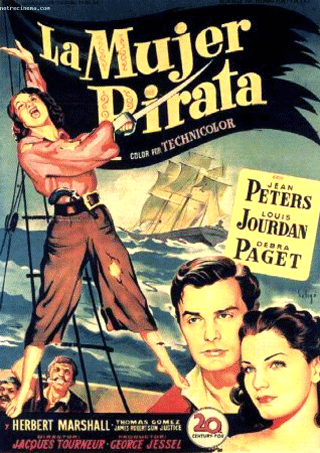
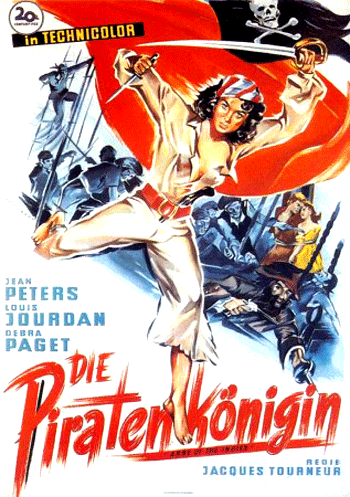
(Aka: La Mujer Pirata – La Regina dei Pirati – A Raínha dos Piratas – Die Piraten Königin – Technicolor – 1951)

1

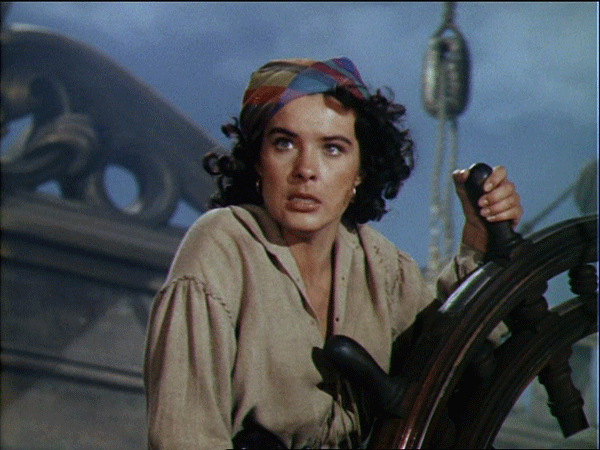
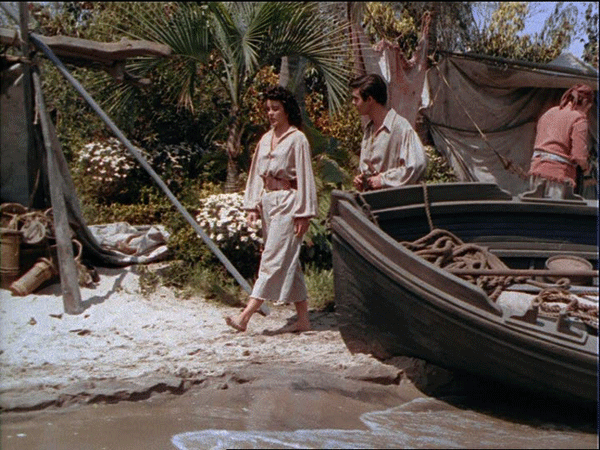
Ahoy, landlubbers! Come abroad the good ship “Sheba Queen” and lend an ear to Anne of the Indies

So much has been written about the buccaneers of the high seas. Even though the deplorable activities of pirates are rightly condemned by the humanity, world literature has nonetheless romanticised them with stories depicting the daredevil deeds of pirates such as Sir Henry Morgan, Blackbeard, etc and correspondingly lionised them in many movies produced in the Americas and Continental Europe.

The West Indian buccaneers were initially hunters of pigs and cattle on the islands of Hispaniola and Tortuga until they became pirates after being driven off by the Spaniards. Long before Johnny Depp flashed on screen as Captain John Sparrow doing his rounds with the “Pirates of the Caribbean” series, swashbucklers in the kinds of Elliott Dexter, Douglas Fairbank, Errol Flynn, Burt Lancaster, Gregory Peck, Louis Hayward, etc. ruled the high seas. This doesn’t mean that the period was devoid of dashing females wielding deadly swords and thrived in the sunshine. Historians tell us that a significant minority of historical pirates have been female, who were acclimatized to the wild ways and conquered the seas.

2

The 1945 film, “The Spanish Main” by director Frank Borzage (The Big Fisherman) featured the fictionalized account of the real-life cross-dressing buccaneer Anne Bonny (1698-1782), a daring Caribbean femme fatale who joined the crew of pirate John “Calico Jack” Rackman after having an affair with him. Reputed to be the first film of RKO Radio in the Technicolor, starring Paul Henried, Maureen O’Hara and Binnie Barnes in the role of Anne Bonny, it told the story of Dutch sea Captain Laurent “The Barracuda” Van Horn. Shipwrecked on the coast of Spanish-governed Cartagena, he escapes from the hangman’s noose and takes up piracy for revenge against Spain. The film registered impressive profit in the box-office and won George Barnes an Academy Award nomination for Best Colour Cinematography.

3

In 1946, a short story by Herbert Ravenel Sass titled “Queen Anne of The Indies”, appeared in the Saturday Evening Post which generated enough excitement amongst the New York publishers and Hollywood studios prompting Sass to draw up a movie treatment of the story in 1948. Originally slated to be a Walter Wanger (Walter Feuchtwanger – 1894-1968) project starring the indestructible redhead Susan Hayward, this fictionalised treatment failed to generate necessary enthusiasm in independent producer Wanger due to its larger budget that he sold the story rights to 20th Century-Fox. (Some confusion prevails here regarding the different treatments of the story prepared for Wanger). At that time, Wanger was also busy with a grand project for the comeback of Greta Garbo who was on long retirement. But when “Anne of the Indies” was finally released in 1951, Wanger was in the “cooler” for having shot and wounded his wife Joan Bennett’s agent Jennings Lang when he found them together in the MCA (Music Corporation of America) parking lot.

4

In early 1950, at Fox’s instance, a new script was prepared by Romanian born screenwriter/playwright Arthur Caesar incorporating unused footage shot for “The Black Swan” (1942) starring Tyrone Power. The studio assigned George Jessel to produce while tests were done with Patricia Neal and Valentina Cortese for the title role.

However, Darryl F. Zanuck, Vice-president in charge of production for 20th Century Fox was still unsatisfied with the script that a revision was done on it by Philip Dunne, a contract writer at Fox since 1936, sprucing up the character of Anne. When the film would finally appear on screen, Philip Dunne and Arthur Caesar are given credit for the screenplay.

5

Naïve, darkly sensual actress Linda Darnell was also considered for the role of Anne before it finally went to American actress Jean Peters (Oct 15, 1926 – Oct 13, 2000). Hailing from East Canton in Ohio, Elizabeth Jean Peters grew up on a small farm, majored in literature and won a screen test with 20th Century-Fox as prize for winning the Miss Ohio State Pageant title in the fall of 1945. Owing to a contract with Fox, Jean moved to Los Angeles and later acquired a small part in “I Wonder Who’s Kissing Her Now” (1947). However, it would be her role as Catana Perez (replacing Linda Darnell) in director Henry King’s “Captain from Castile” (1947) that will bring her star treatment and public attention though the film grossed net loss because the studio spent more for it than the market could afford.

6

After a brief slump in her popularity, the 5’ 5” (166cm) Jean had pursued the studio and convinced them to cast her as “Anne of the Indies”. It was a down to earth, unglamorous role– exactly what she preferred since sometime earlier the studio had put her on her first suspension owing to her refusal to don sexy roles. However, being the current romantic interest of the legendary billionaire Howard Hughes, beautiful Peters with brown hair and green eyes must have found it easy to step over that suspension. Even though she had a celebrated romance with Hughes in 1947, their marriage will take place only in 1957 after living with him off and on for a decade.

7

Jacques Tourneur was given the director’s hat for the project in January 1951. Essentially a small-budget director with a penchant for the macabre, Tourneur had a reputation to direct movies on various genres since he always accepted all the scripts offered to him.

37mHaving finished directing “The Flame and the Arrow” (1950) starring Burt Lancaster and Virginia Mayo, Tourneur was in the right mood for yet another swashbuckler. With a secured contract with Fox and devoid of interference from producer George Jessel, the film went into production at the 20th Century-Fox Studios in Los Angeles.

Synopsis: Once the credits flashed over the screen, an establishing note on the state of affairs of the 17th century Indies is shown: “Less than two hundred and fifty years ago, the last of the great pirates wrote their names in blood and fire across the pages of maritime history. This is the story of a buccaneer Captain whose name for one short year struck terror in the hearts of seafarers and merchants, from the ports of the Caribbean to the great trading houses of London….”

9

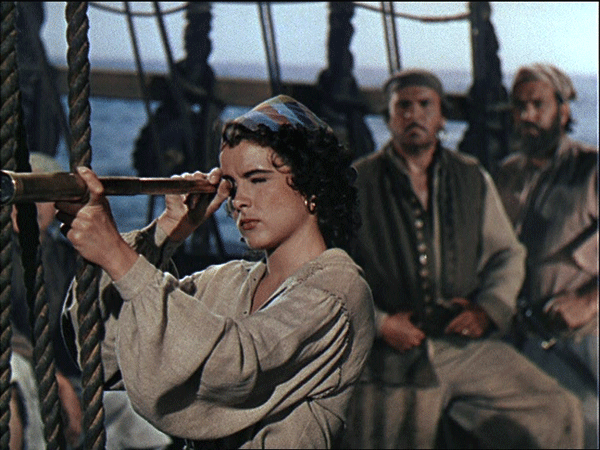
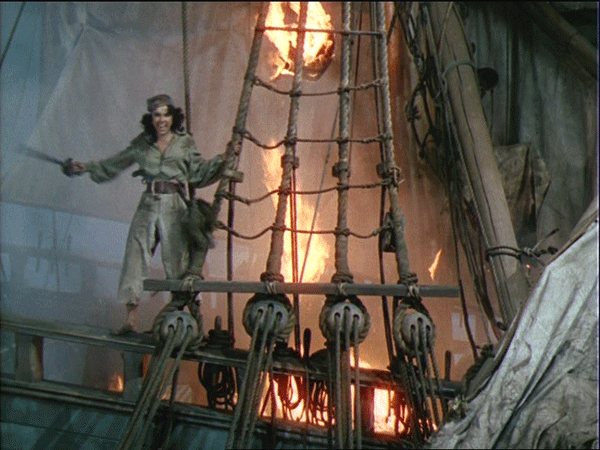
As the movie begins, we are shown the names of two English ships, Royal Charles and Sea Lady are being stricken off a register of ships for having been destroyed or sunk by the notorious Captain Providence. We then cut to: the deep ocean off Antigua where the English vessel Gemini is preparing to repel the attack of Anne’s flagship Sheba Queen. As the two ships draw nearer and the canons started firing, Anne suddenly appears on the deck of her ship while her men valiantly fought the English, their swords flashing in fierce combat. Even Anne joined her men in the fight. Before long, the English Captain had surrendered.

10

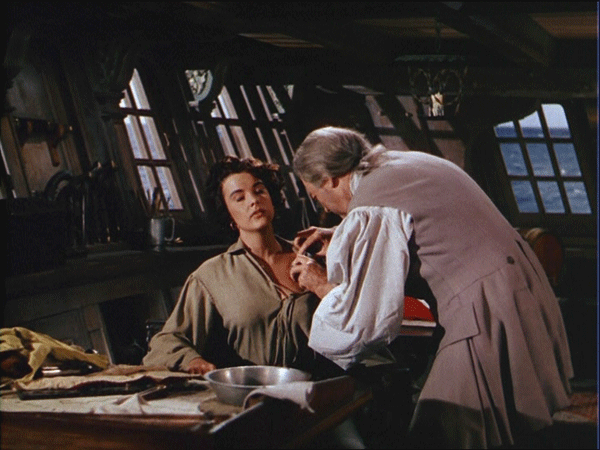
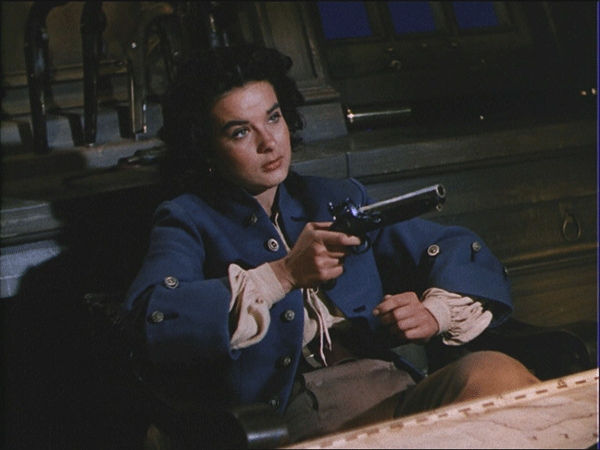
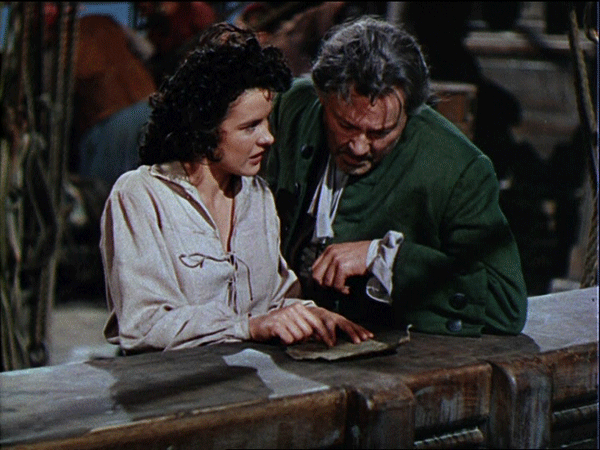
Inside her cabin, Anne threw the enemy’s flag on top of the wooden desk and was pleased to learn from Dr. Jameson that he had attended to all the wounded. At this time he wanted to tend to Anne’s wound which he was sure would leave a scar on her beauty. Anne was not unfamiliar to scars most of which she had received from the English. But she is not a wench to brood over her scars, has chosen not to show her pain, even now, at her moment of glory though the fact remained that she had lost her sailing master in this assault.

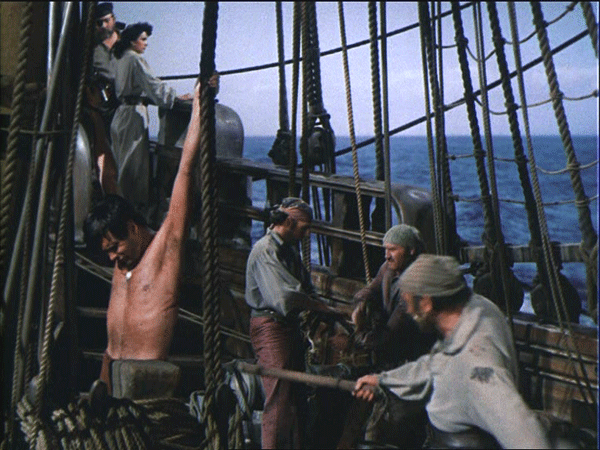
She invited the doctor, her confident, to the deck where her crew were making the prisoners walk the plank – a sight, she was certain, would put some iron in the alcoholic doctor’s soul. The Captain of Gemini was grumbling that he had struck his flag hoping to receive some water. He protested to Anne about the merciless treatment meted out to the prisoners by her men. Anne retorted that she had learned such mercy from the English. Did they show mercy to her brother? They had hanged him in chains in the wharf of Port Royal with all the English just spitting on his face – she snapped at him.

11

The hatred towards the English that had grown in her heart for the death of her brother, was one of the many scars Anne accumulated in her life that made her reject her femininity. The Captain was given the opportunity to express his last words. All he had to say was that, her brother was a pirate and he deserves the end that he got as Anne will deserve hers. But Anne knew that she had chosen to live with that. “By the veins of your nose you have drunk your king often in wine, now drink him in salt water” With that reply, she ordered the Captain to walk the plank.

12

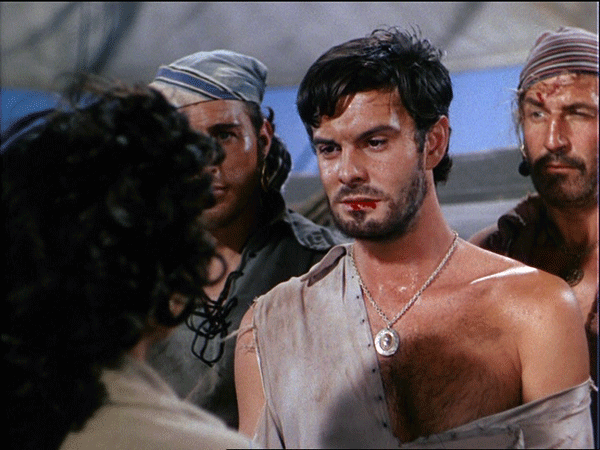
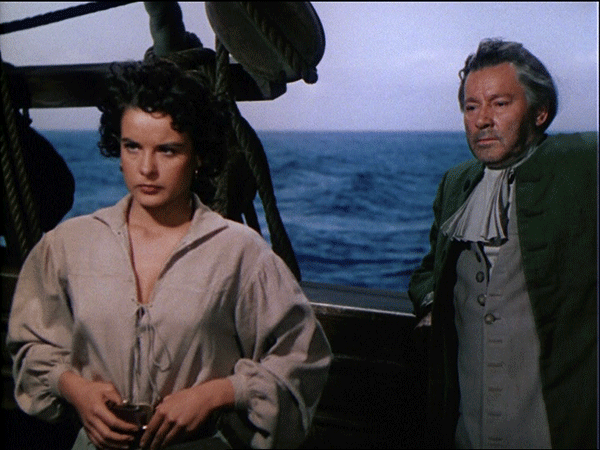
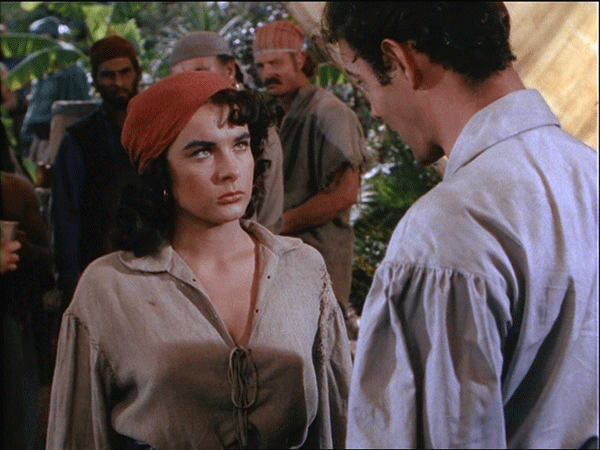
It was then she noticed the handsome man in irons being led to the plank, the upper part of his body exposed. They have found him imprisoned in the English vessel which meant he is not a friend of the English. Questioning him, she learned that he is a Frenchman named Pierre François. When she introduced herself to him, it was a revelation to him. Caught in the propaganda that surrounded Captain Providence, Pierre had never expected the buccaneer Captain to be a woman. Furthermore, he had least expected it when her palm cracked on his face for having disrespectfully addressed her as “mademoiselle” rather than in her proper title of “Captain” which displayed the forcefulness of the identity she had chosen.

13

It was revealed that Pierre was the owner/master of the Bordeaux registered Irish privateer, Molly O’Brien, captured by the English. He is being sent to England to stand trial for having captured too many English ships. Anne had allowed her men the pleasure to make their prisoners walk the plank except for Pierre. Being sea-smart, Anne knew that Pierre, a sea artist, would make a suitable replacement for the navigator she had lost and that was what she did to the displeasure of her Scottish first mate Red Dougal, who had been delegated by Blackbeard to protect her. As for Pierre, who is fond of life, it was not a hard choice to make when his choice was between joining the buccaneers or walk the plank.

When the booty from the Gemini was shared with her crew, Pierre was permitted to choose something for himself. While Pierre decided a woman’s dress, Anne laid her claim on a sword with a long blade, the virility of which reflected on her authority. However, Pierre’s choice had kindled her curiosity to make her enquire if he has a wench somewhere. Pierre would only reply that he is a Frenchman. Anyhow, she let him know that the sword was selected for Captain Teach, Blackbeard, a great sea-rover of a soul whom she is certain she would find in Nassau where they plan to get the supplies. The Sheba Queen headed for Nassau.

14

Anne is a protégée of the notorious English pirate Captain Edward Teach (aka. Blackbeard ca. 1680–1718). Since childhood, he was father, mother and schoolteacher to her and her half-brother. Although she knew that her father was English, his name never passed the lips of her mother who succumbed to death when Anne was young. She was called Anne Providence owing to her birth on New Providence Isle, a night to Nassau town.

15

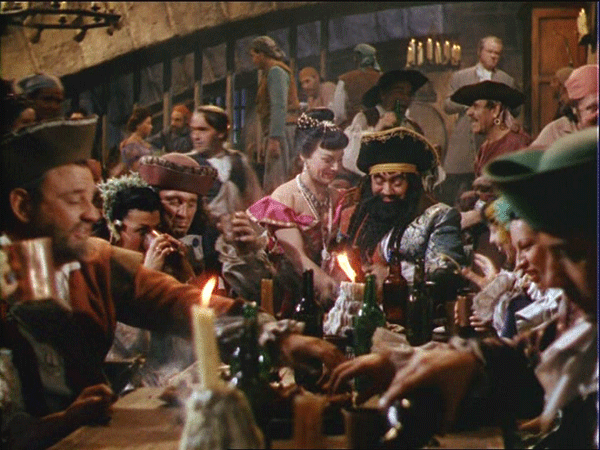
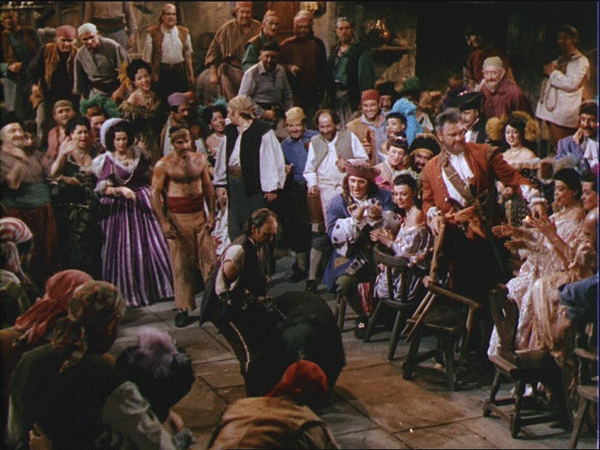
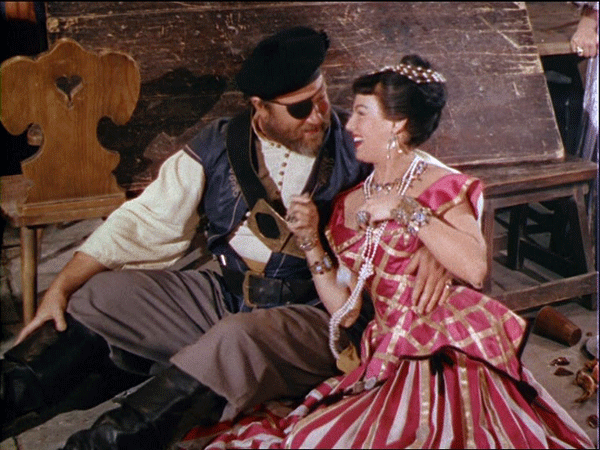
The Black Anchor Tavern in Nassau looked a beehive of boisterous merriment. Apparently, the tavern was taken over by Blackbeard and his men and their women for partying and their idea of fun appeared to be to laugh, shout, fight, bear-wrestle, break things, get drunk, etc in the dreadful manner possible. The enormous figure of Blackbeard sat at the head of a wooden table with a woman on his lap, drinking heavily and having a great time.

16

It was during the bear-wrestling that Anne and her entourage walked in. At the sight of Blackbeard, Pierre had tried to excuse himself to go off for some business in Nassau, but reluctantly stayed when Anne assured him of her protection. So excited was Blackbeard to see her there, that he said she’s like a Northeaster after a calm.

17

Although Blackbeard had doubts about Pierre which was also intensified later by Dougal, his main interest was focused on Anne and the sword she presented him. When all of his men shied away from being a willing partner to the impulsive Blackbeard to help try the new sword, Anne was ready to let him try to carve her. A fierce but friendly duel of swords broke out between Anne and Blackbeard in which Anne displayed some playful but competent skills of swordsmanship but it was pretty obvious that he could have won over Anne easily. However, when Blackbeard was momentarily distracted, Anne grabbed the chance to win; a trickery which Blackbeard merely laughed off in a fatherly manner. Then again, Anne’s glory was short-lived when she learned from Dougal that Pierre had slipped out of the Tavern while the duel was on. The confidence she had placed in him has been displaced.

18

Later, confronted by Anne in her cabin, Pierre didn’t provide her with a proper explanation about his absence, to satisfy her doubt about his loyalty. He had neither gone to see a wench, nor is he a spy because he knows nothing of her plans. All Nassau knows that she’s in the port. Suspicious that he is hiding a secret, she ordered Dougal to put him in irons. Subsequently, he was tied up on the deck and mercilessly flogged until Dr. Jameson convinced her to stop.

19

Dr. Jameson was evidently dismayed for having been ordered by Anne to search Pierre’s cabin where he had found half of a map tucked inside his mattress. Though Anne cannot read, she can read from patterns. Assisted by Dr. Jameson, she finally figures out that the map is a link to Captain Henry Morgan’s treasure. When Morgan (ca. 1635-1688) captured Panama City, he had taken a king’s ransom which has not been accounted for.

20

Having matched the piece of map with her main map, she questioned Pierre, now lying on the wooden floor of her cabin, drained from “the taste of the cat”. Pierre had no qualms in telling her that he had bought it five years ago from an inn-keeper on the Bordeaux waterfront who found it in the body of a lodger of his. Once Anne assured him to make him equal partner with her, Pierre opened up further and related to her that his men in Porto Bello had told him of a Portuguese in Nassau trusted by Henry Morgan, In fact Pierre had been taken prisoner by the English while he was heading to Nassau to meet the Portuguese. At Nassau, Pierre had learned from the Portuguese man that a man called Pedro Mendoza living in Port Royal in Jamaica possessed the other half of the map.

21

It was then Dr. Jameson remarked to her that since she now knows what Pierre knows, she could very well kill him and go after the treasure on her own. But Anne would have none of that, for she had given Pierre her word. And that counts.

22

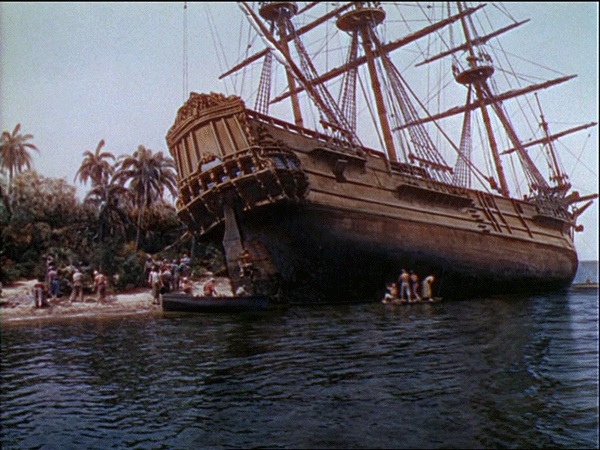
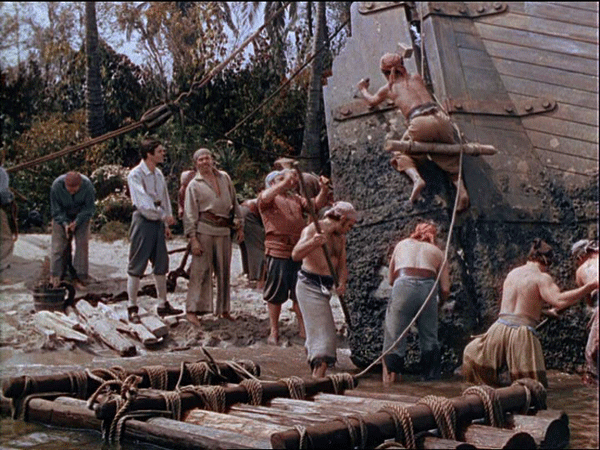
Port Royal was the lion’s den – the Headquarters of England’s Caribbean Squadron. That’s where they will go once they careen the hulk of Sheba Queen encrusted with hardened barnacles, to restore the ship to its proper speed. Dr. Jameson confirmed that the parchment and the ink of the map looked authentic to him.

23

As Blackbeard had taught her, Anne had carefully docked her ship in a secret cove, known only to Blackbeard and Anne, ideally positioned to cannon and command the passage through the reef while her ship lay inoperable.

24

Later, while she was walking along the beach with Pierre, she was surprised to learn that he was born in Paris. Anne advocated that he can take her there as a partner after they have lifted the treasure. But overriding this subject was her curiosity to know for whom he had chosen that yellow dress.

25

He had obviously noted the anxiety in her question and told her that it is for no one in particular – perhaps for a woman he hoped someday to meet. Having caught with her guard down, she quickly pulled herself up to her rank, but her sudden change in manner essentially gave away the tell-tale sign of affection for him that was growing in her heart.

26

The following day, Pierre walked into his make-shift cabin and found Anne trying on the yellow corseted dress he had chosen from the booty. This is the moment for which that dress was made for. She looked like a breath of spring. Even though her face looked unaffected from his sudden intrusion, the thoughtful Frenchman knew that he had awakened the feminine side of this ruthless pirate queen.

27

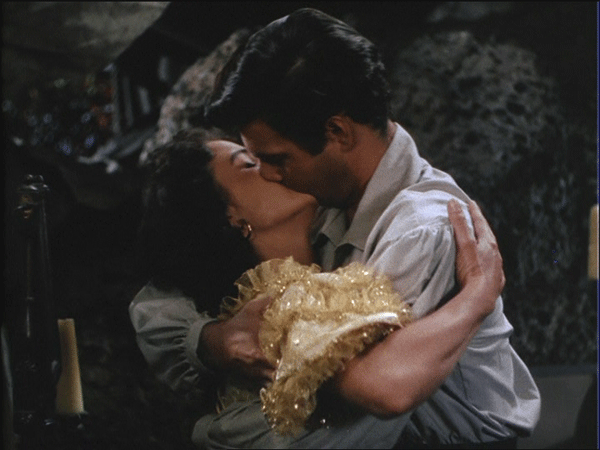
Well, she can’t underestimate his ability to get through to her heart and to melt away her defences. But he would use his power responsibly. Pierre helped her tie the back ribbons of the dress, an act which acted as the precursor to a conversation that stirred the woman inside her, exposed her inner feelings she was silently weaving around Pierre. She dared him to tell her “how a Frenchman, a gentleman, made love?” knowing that it would draw him to her. Soon, they merged into a passionate kiss.

28

It seems all good things in life are not meant to last. The expression of their “burning” desire turned out to be short-lived and frustrating as Dougal suddenly walked in and caught them in the act.

29

On hearing the news about an approaching ship, Anne’s spyglass confirmed the arrival of Blackbeard’s flagship “(Queen Anne’s) Revenge”. How happy she appeared in welcoming Blackbeard with Jamaican rum. She listened to him saying that he had looked for her in Tortuga and had realised that she’s docked here to careen.

30

Without losing much time, Blackbeard accused that Pierre is a traitor. He is Lieutenant Pierre François La Rochelle of the French Navy. He had seen Pierre at Martinique when the French hanged his colleague Sam Austine from a yardarm. Confronted once again by Anne, Pierre explained that everything which Blackbeard told was true. He merely neglected to mention about the commission because the memory of that chapter was painful to him. He was cashiered from the navy in disgrace. He had witnessed the hanging only because the entire officers were ordered to be present. Anne is in command here, and he is not on Blackbeard’s deck. She can be assured that he will serve her loyally.

31

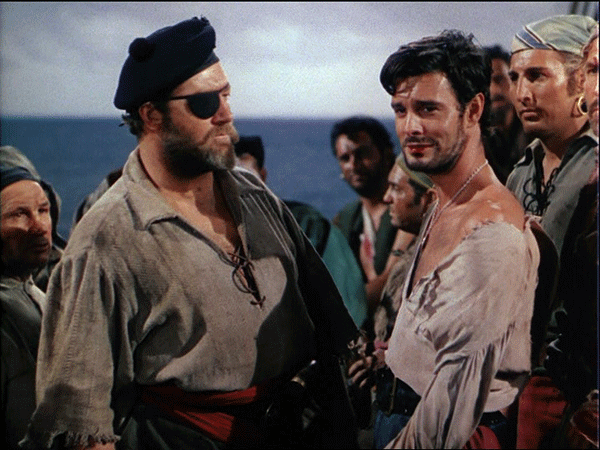
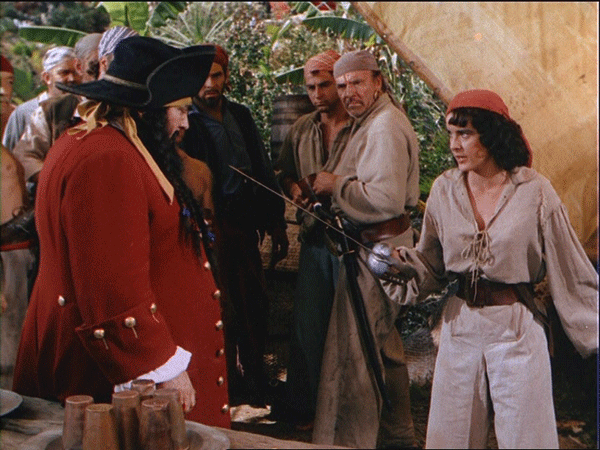
Disregarding her support for Pierre, Blackbeard’s sword struck out at Pierre. Abruptly, Anne’s sword lashed out at Blackbeard with dynamic forcefulness. During the angered spat of words that followed, Anne slapped his face- in front of his men. She ordered him and his men off the island. The line has been crossed. Blackbeard never forgets an insult. Now there will be war between them.

32

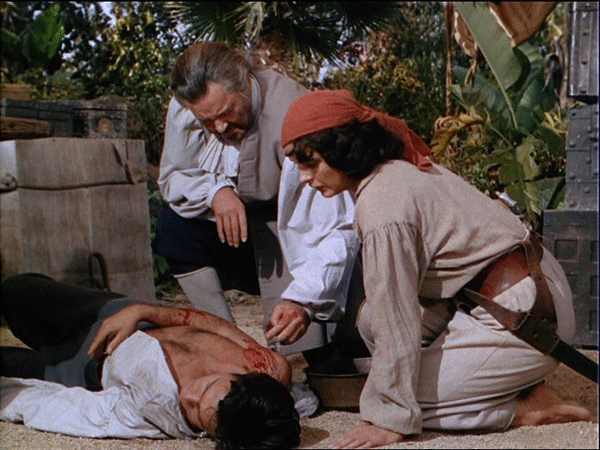
As Blackbeard and his men left the island, Anne ordered Dr. Jameson to care for Pierre lying unconscious on the ground. Before she moved off from Pierre, she couldn’t resist planting a kiss on his forehead.

The Sheba Queen was safely anchored off the coast of Jamaica. Given that Anne was denied from going to the island in his place to obtain the other half of map from Petro Mendoza, she arranged with Dougal to take Pierre on a row boat to leave him ashore at the Portland Point and wait for him on the beach. She gave Pierre some English Guineas to pay the man and advised him to offer Mendoza a share of the treasure if he insists for more.

33

At Port Royal, Pierre went straight to “The Governor’s Tavern” where the English Aristocrats were engaged in smoking, drinking, playing table games or other things such men usually do in such places. Pierre was recognised as “Captain La Rochelle” by the Maitre d’ and promised to arrange the people whom Pierre wanted to meet urgently.

34

In a dark room upstairs, he met a pretty woman we soon discover to be his wife Molly La Rochelle. He confirmed to her that their plan has succeeded and that the legendary Captain Providence is a woman. They seal their reunion with a kiss before he was called downstairs to meet up with the English Naval officers who have engaged him to entrap the pirates.

35

The English were rejoiced at the news that the Sheba Queen was anchored off Portland Point and will remain there till daybreak. And, of course, they appreciate that Captain Providence suspects nothing though they were rather surprised to learn that the notorious pirate is a female. With this information in hand, the English attack Anne of the Indies …..

36

As Darryl Zanuck once said, “Success in movies boil down to three things: story, story, story.” The final climax of the film was subject of deliberations since Zanuck was not satisfied by the motive provided for Anne. The result was that Dunne suggested shooting the climax in different ways. However, after the shooting was completed, having found that the present ending was unsatisfactory to the audience, the ending was again modified with further retakes. According to Tourneur’s contract which stipulated that the production was to be completed within fifteen weeks, the production of “Anne of the Indies” must have been wound up before May, 1951 since by then Tourneur was supposed to be in Argentina for the production of “Way of a Gaucho”.

38

Adventure movies call for a directorial and an acting style which is well known to adventure directors such as Raoul Welsh, Howard Hawks, John Huston, Richard Fleischer, Henry Hathaway, Michael Curtiz, and Jacques Tourneur. Shot in Technicolor by Cinematographer Harry Jackson and ably edited by Robert Fritch, director Jacques Tourneur’s film features restraint and admirable performances of his stars in well made up sets, lighting and studio locations.

39

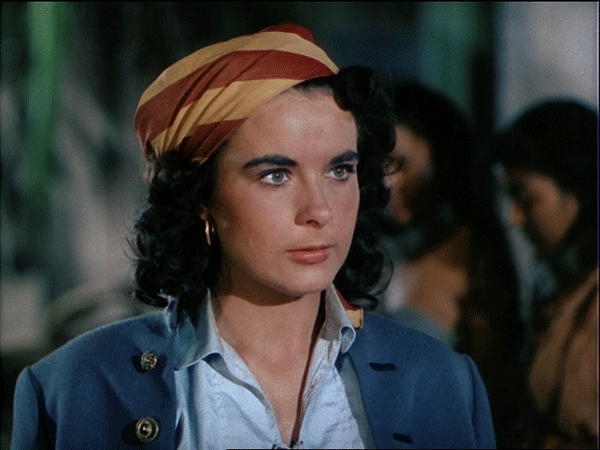
The film truthfully portrays Anne as a ruthless pirate who has denied her femininity and doesn’t know what it means to be a woman, or to be loved. In order to illustrate Anne’s crisis of identity, Tourneur used a scene in the beginning of the film to establish Anne’s strong heart and the softness of her bosom when Dr. Jameson tends to her wound. Despite Jean Peters’ cute and pretty looks which occasionally subdue her efforts to make Anne look dangerous and ruthless, her performance with an athletic agility is flawless though, couple of times, her cheerful countenance has appeared rather teasing.

40

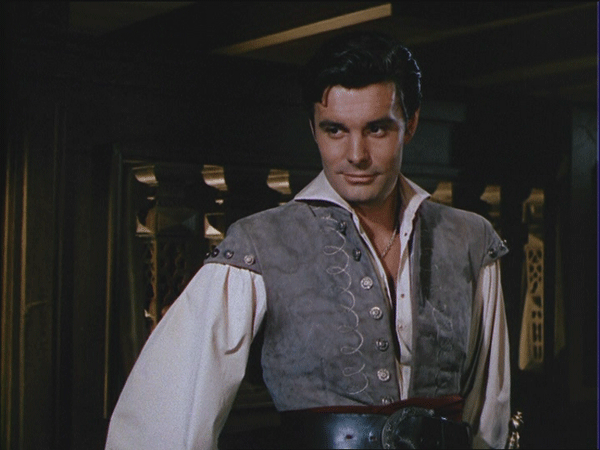
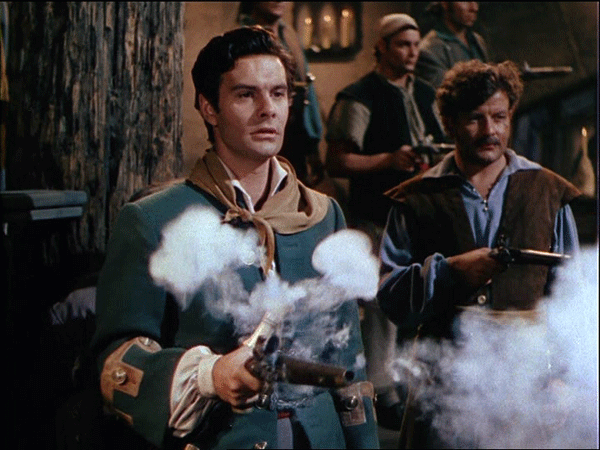
Louis Jourdan’s performance in the role of Frenchie merited critical acclaim. Ever since Zanuck had that terrible polo ball accident in late December 1941, he had switched his interest in sport to croquet which he used to arrange on the lawn of his house in Palm Springs. Frequented by a cross-section of Hollywood society, international celebrities, etc, his lawns became the croquet capital of California. Jourdan who was a contract star of Fox and best of the regulars to Zanuck’s house, was found to be perfect fit for the role of Pierre.

41

Louis Jourdan’s movies conjure up an image of him as a suave, dashing, romantic charmer. In spite of this, the Marseilles born Jourdan (aka Louis Gendre) had also managed to appear in villainous roles. Beginning his acting career in the French film “Le Corsaire” (1932), Jourdan became a star after producer David O. Selznick cast him in Alfred Hitchcock’s court room drama “The Paradine Case” (1947) for which Franz Waxman was the music director. But his finest performance before he acted in “Anne of the Indies” was in Max Ophuls’ “Letter from an Unknown Woman”.

42

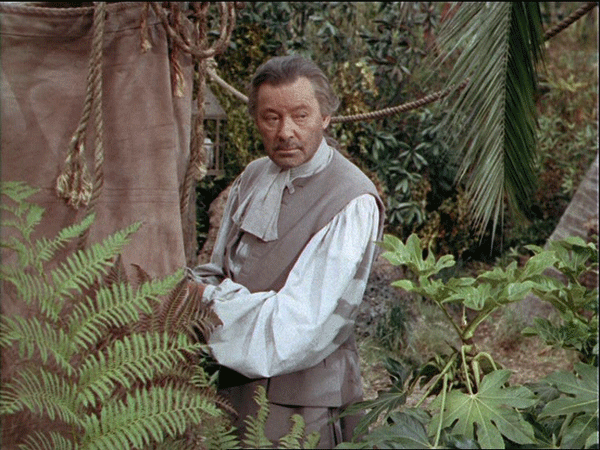
British actor Herbert Marshall (1890-1966) with considerable stage experience acts as the alcoholic Dr. Jameson who helplessly hovers around watching Anne trapped in her crisis of identity. The mannerism of the wise and philosophical Dr. Jameson in the scenes where Anne displays her determination to acquire the respect she deserves; when she is in conflict with her human emotions; is well portrayed by Marshall.

43

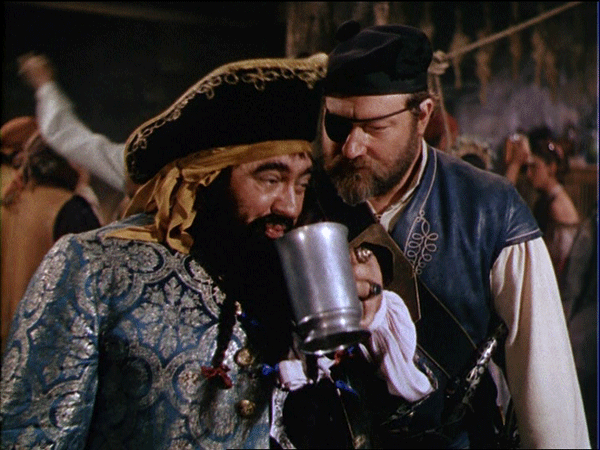
In the role of the boisterous Blackbeard, the heavyset, stage character actor Thomas Gomez (Sabino Tomas Gomez – 1905-1971) made use of the opportunity to drink, laugh, turn tables, and swash his sword to realistically portray the larger-than-life of the renowned pirate.

44

Gomez was a member of the Alfred Lunt and Lynn Fontanne theatre group before he ventured into movies. An aficionado of gourmet dining and a close friend of Jean Peters, he had co-starred with her in “Captain from Castile

45

Tall and hefty, England born actor James Robertson Justice (James Norval Harald Robertson Justice – 1907-1975) with whiskers and booming voice had completed a series of films, viz. “The Black Rose” and “The Magnet” (1950), “Blackmailed”, “Pool of London”, “Captain Horatio Hornblower” and “David and Bathsheba” (1951) prior to his role as Red Dougal.

46

The mannerism of Dougal when Anne chose Pierre as her sea artist when she knew nothing of him; his confidential talks with Blackbeard and Dr. Jameson; his ever watchful eyes on Anne; the suppressed outrage on his face when he caught Anne and Pierre kissing – have all been perfectly portrayed by Justice.

47

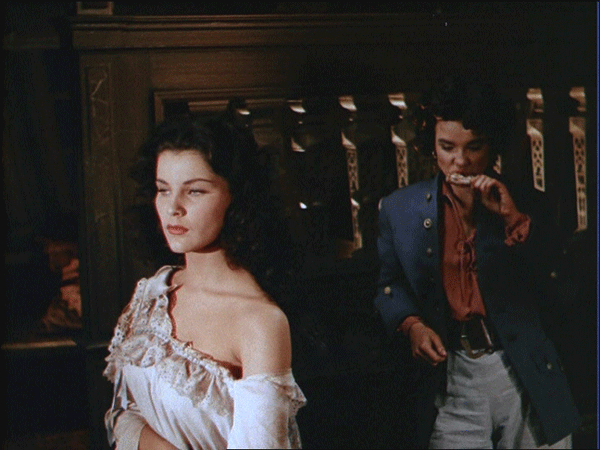
Hailing from a show biz family, the 5’ 2” (157cm) Debra Paget (Debralee Griffin) obtained an acting contract from 20th Century-Fox at the age of 14, debuting in “Cry of the City” (1948). Having earned proficiency in speaking from Helena Sorrell, the dramatic coach of 20th Century-Fox, and fairly active in movies at that time, she co-starred with Louis Jourdan and Jeff Chandler in director Delmer Daves’ “Birds of Paradise” which also hit the screens in 1951.

48

Although Paget’s role in “Anne of the Indies” is confined to few dark scenes, her effervescent beauty lights up the darker scenes which are rampant in many of Tourneur’s films. Appearing pale and innocent, Paget has nothing much to do except look distressed and wear a few moments of brave face when she antagonizes Anne over Molly’s rights over her husband.

49

Other members of cast are Francis Pierlot (Herkimer), Sean McClory (Hackett), Holmes Herbert (British sea captain), Byron Nelson (Bear handler), Douglas Bennett (Bear wrestler), Mario Siletti (Auctioneer), etc.

50

Notwithstanding the lesser budget, the film features sets and props with truthful authenticity, there are Naval cannons, antique swords, males’ earrings and some of the guns used by the pirates and the English are even Flintlock pistols.

51

The artistic and talented art directors Lyle Wheeler (1905-1990) and Albert Hogsett have faithfully created the set pieces, though standard and familiar, with the expertise of set decorators Thomas Little and Claude Carpenter.

52

Lynn had started his career at M.G.M when David Selznick hired him to work under production designer William Cameron Menzies on “Gone with the Wind” following which he ran the art department of Twentieth Century-Fox from 1944 to 1960. Lynn won five Academy Awards for Best Art Direction after having been nominated twenty-nine times, four of which in 1951.

53

While the makeup is by Ben (Benjamin Emmet) Nye, the film’s wardrobe is directed by American Costume designer Charles Le Maire (1897-1985) who ran the Wardrobe department of 20th Century-Fox from the early 1940s. For this film he had collaborated with Costumes designer Edward Stevenson (1906-1968) who himself started in Hollywood from 1922 and became the chief designer at RKO from 1936-49.

54

Although most of the costumes are standard pirate and navy gear which kept up the atmosphere, the feminine costumes for Jean Peters and Debra Paget and for some extras are very minimal. Apart from the yellow dress Anne wears inside the make-shift cabin, the other one is a white nightgown shown in very dim lighting as she gazed at the glittering sea.

55

German composer Franz Waxman (Franz Wachsmann – 1906-1967) with orchestration by Edward Powell have provided a rousing score that blend well with the romantic nature of the story. Other than montage, music is one of the two most “invisible” contributing arts to cinema and Waxman is renowned for his very close understanding of when music should appear in the narrative.

56

Arriving in America in 1934, Waxman provided his first original score for “Bride of Frankenstein” (1935) after which he worked for two years with Universal Studios, before moving to M.G.M and later onto Warner Bros until he won the Academy Award for “Sunset Boulevard” (1950) and “A Place in the Sun” (1951).

57

Years and years later, this routine swashbuckler evoked some deliberations in seminars and conferences because of the identity crisis of the lead character. There were also some writings including an essay titled “Femininity and the masquerade: Anne of the Indies”.

58

Considering the lack of depth in the psychological density of the main characters and also in the thinly plotted story, I would think this movie was just another job for Tourneur.

59

I would also like to think that Tourneur made this film without any alternative agenda other than to make a simple pirate tale – some 81 minutes of entertainment which has all the virtues of the genre: sea-battles, swashbuckling, adventure and drama with a twist showcasing the protagonist as a female dressed in male attire to suit the environment of the buccaneers of the story; and also, to differentiate this film from a series of swashbuckler films featuring male leads various studios were chucking out during 1940s and 50s.

60

Anne of the Indies cannot be compared to a lively, colourful period film featuring a protagonist with the lighter-than-air agility of Douglas Fairbanks or an extrovert, acrobatic hero portrayed by Burt Lancaster. Nevertheless, this old-fashioned harmless family movie has an underlining story of Anne going through her identity crises, searching for love which is quite unfamiliar to her.

61

Anne’s love is her weakness and to us it has made her human, even though she is riddled with faults. By making Anne endearing to us, lovely Jean Peters leaves a memory of a breed of heroines long gone from our screens. Until next time, Ciao, Jo.

62

63

(This review is dedicated to the memory of lovely Jean Peters)

(Text: © JS/Manningtree Archive)

StarChoice 16: ARABESQUE

(Aka:  Arabeske, Arabeska, Arabeski – Colour – 1966)

1a

When American director Stanley Donen decided to cast debonair actor Cary Grant (born Archibald Alexander Leach – 1904-86), his co-partner of Grandon Productions, in the romantic comedy-thriller “Charade” (1963), Donen sought a helping hand from its leading actress Audrey Hepburn to rope in Grant since he was a bit conscious of his 25 years age difference with Hepburn. Although Grant had long wanted to work with Hepburn, it would be only after certain modifications were effected in the original script of Peter Stone from his own novel, that Grant would be suitably convinced to accept the role. The film would be his third collaboration with Donen, seventieth movie and 30th anniversary of his entry into movies. Grant’s 59th birthday also fell during the filming and he had a new love in actress Dyan Cannon.

2a

Set in Paris, Peter Joshua’s (Grant) help is sought by Reggie Lampert (Hepburn) to locate $250,000 in gold stashed away by her murdered husband while three sinister men are also on the look out to recover it. In the process, Joshua and Lampert fall in love. When the audience saw Hepburn’s doe-like eyes gazing at Grant, the age suddenly ceased to matter.

Donen had directed Hepburn in “Funny Face” back in 1957 which featured a plot notably different from that of its Broadway musical version. Hepburn had acted in that with 58 year old Fred Astaire, 30 years her senior whom she had expressly insisted to cast as her leading man by using it as a precondition to her participation in that movie.

3aCasting men of higher age with Hepburn would become a regular case in her career, being one of the reasons Grant originally refused to act with her in “Charade”. Anyhow, “Funny Face” brought Donen nomination for “Outstanding Directorial Achievement in Motion Pictures” by the Directors Guild of America and for a “Golden Palm” at the 1957 Cannes Film Festival.

“Charade” was fervently made by Donen in tune with his close friend Alfred Hitchcock’s “North by Northwest”, one of his favourite movies and when it was released in December 1963, two weeks after the assassination of President J. F Kennedy, it turned out to be a huge financial success. The film also spawned a series of stylish thrillers, that even in 2002, director Jonathan Demme remade it under the title “The Truth About Charlie”.

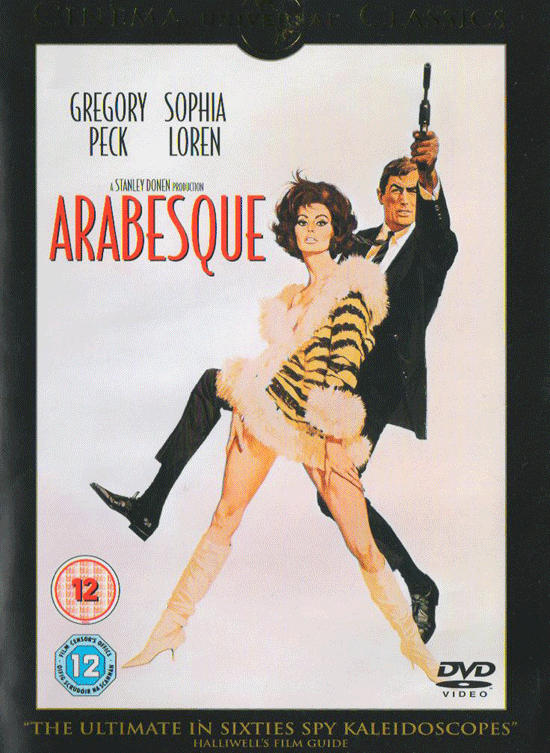
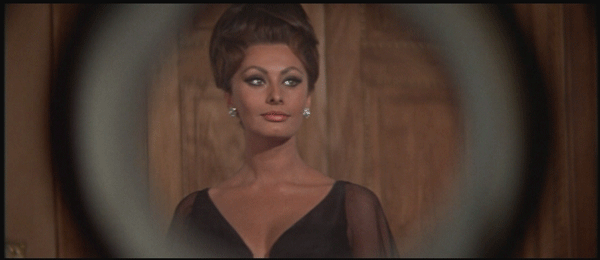
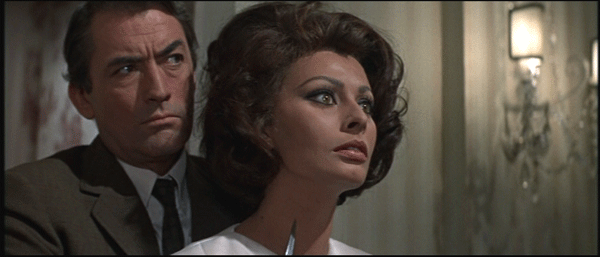
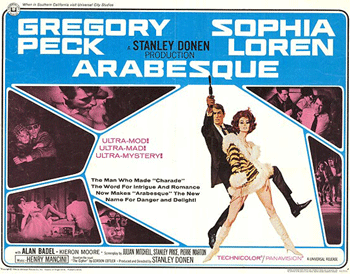
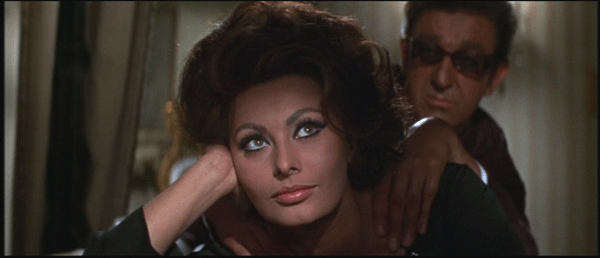
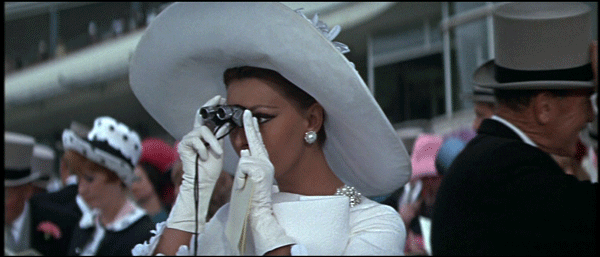
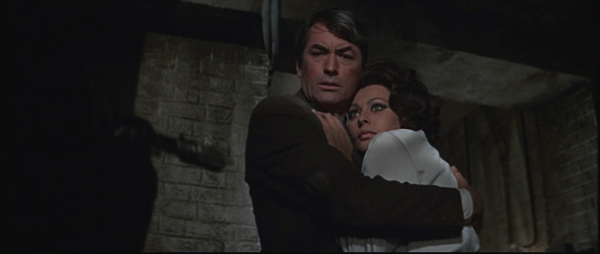
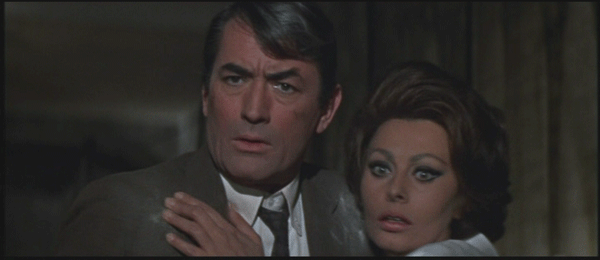
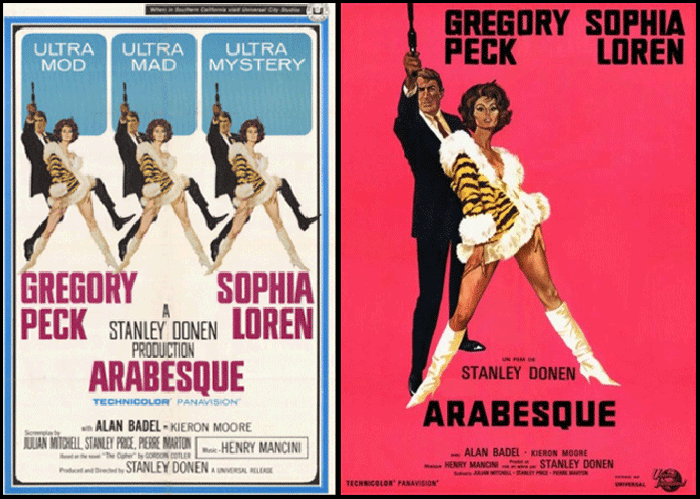
4bThe film’s success inspired Donen to make yet another breezy, romantic thriller in 1966 titled “Arabesque” with Cary Grant in the leading role. Understandably, Grant flatly refused the role, well aware that he was of the tender age of 62 by then. He wouldn’t have minded acting with Loren, lined up for the movie, even though their brief affair during the 16 weeks they were in Spain in 1956 filming director Stanley Kramer’s “The Pride and the Passion”, according to a biography of Grant, didn’t lead to the altar. The search for a leading man ended when Grant himself recommended the casting of 50 year old, 6’ 3” Gregory Peck in the role of Oxford professor of languages with Italian siren Sophia Loren as the leading lady.

5

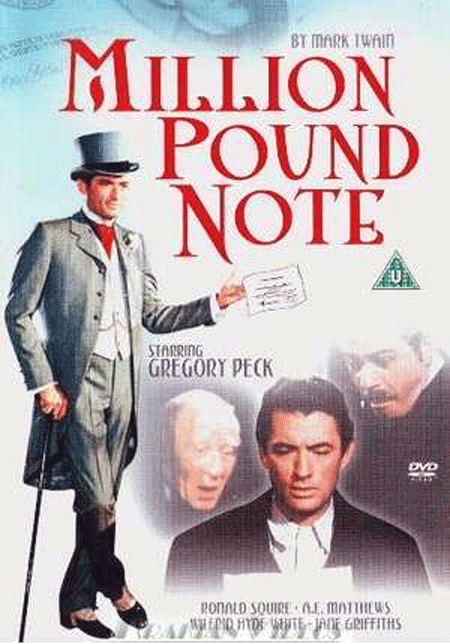
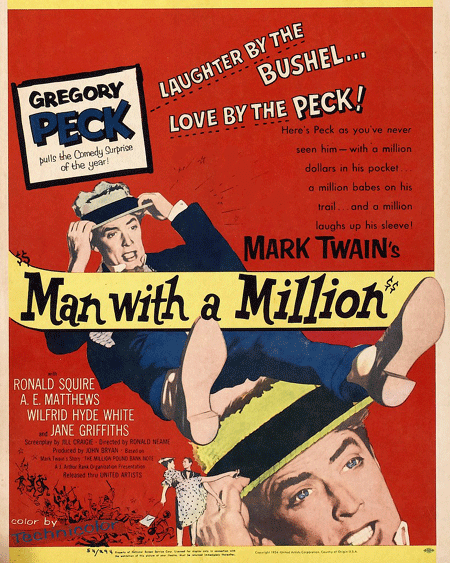
Gregory Peck (more details ref. my review of “StarChoice 14: The Million Pound Note”) had completed his performance as David Stillwell, a New York accountant suffering from amnesia in director Edward Dmytryk’s black and white suspense thriller “Mirage” (1965), and was available for the filming of “Arabesque”. “Mirage” was based on the novel “Fallen Angel” by Walter Ericson (aka. Howard Fast who wrote “Spartacus”). The script of “Mirage” written brilliantly by Peter Stone as a follow-up to “Charade”, helped the casting of Peck in “Arabesque” easier for Donen.

5a

Unlike in “Mirage” in which Peck with his distinctive low-pitched voice was trying to figure out his past, in “Arabesque” which is shot in Technicolor, Peck would appear as Professor David Pollock, a man on a clock trying to decipher a secret inscription.

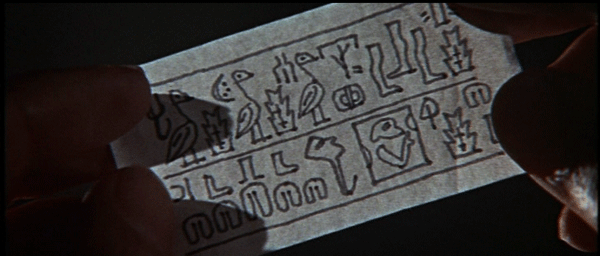
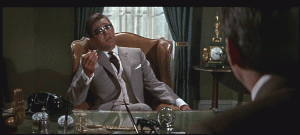
6aProduced by Donen under the banner of Stanley Donen Enterprises, Ltd and presented through Universal Pictures, “Arabesque” opens with the arrival of Professor Ragheeb to keep up with his appointment with Mr. Saeed for an eye check up. Ragheeb was surprised to learn from Sloane that Saeed has taken to flu and Sloane is looking after his appointments. Even though Ragheeb’s eyes were found to be in good order, Sloane went ahead to put drops into his eyes to dilate the pupils. Moments later, Ragheeb was dead. Sloane extracts a piece of paper hidden inside one of the temples of his spectacles which had a series of signs inscribed on it.

7a

Cut to: a class room at the Oxford University. David Pollack, the visiting American professor, was explaining about Hieroglyphics from a display sign that could be from the reign of the great Pharaoh Ramses II. In the dark room, we could make out the figure of Sloane watching the professor conclude his lecture and inform the class that Professor Ragheeb will be back tomorrow.

8b 9b

Sloane introduces himself to Pollack as “Major Sylvester Pennington Sloane of Her Majesty’s 42 Highland Fusiliers”. Now retired, he is the private secretary to Mr. Nejim Beshraavi – yes, “The Nejim Beshraavi” of the shipping lines, who would like to meet Pollack in London for which a car is now waiting.

10b 11b

Having refused to go with Sloane for keeping up with the routine of his Wednesdays, Pollack was later jogging through the park when he was forcibly pulled into a mysterious black Rolls Royce inside which he meets up with His Excellency, Mr. Hassan Jena, the Prime Minister of a Middle Eastern country whom Pollack admired. Apart from the driver, the other passenger who made the introductions was Mohammed Lufti, Jena’s Ambassador to Great Britain.

12b

Necessary apologies were offered to Pollack by Jena for having used unorthodox method for making his acquaintance. He had two requests for Pollack. Officially, Jena is not supposed to be in England and has not seen Pollack. His visit is to be kept a secret. Jena believes that his fellow countryman, Nejim Beshraavi, the richest and the most powerful citizen, has reasons to approach Pollack with a business proposition. Pollack confirms this and adds that he had already turned him down. Having established that, Jena confirms that Pollack’s association with Beshraavi could be valuable to the cause of freedom since Beshraavi is opposed to Jena’s programmes and could create violent oppositions to it in the near future.  As for his second request, Jena would like Pollack to re-establish contact with Beshraavi to find out what his intentions are and when he intends to act. Since the assignment carries a certain amount of risk; Beshraavi respects no one’s life but his own, Pollack was offered the choice to simply walk away from this proposal. However, Pollack elects to shoulder the job for Jena.

13a

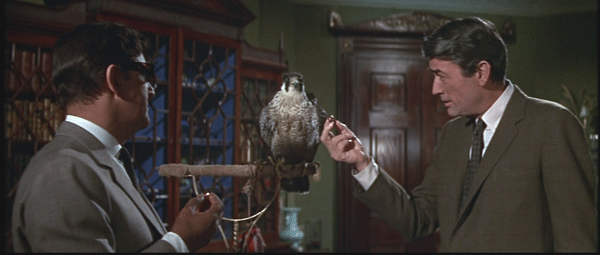
Pollack meets up with Beshraavi in the library of a house in London near the Zoological Gardens where Beshraavi also introduces to Pollack his “excessively loyal” Peregrine falcon called Hassan, named after his beloved Prime Minister Hassan Jena since Jena and the falcon share so many sterling qualities.

14a 15a

Producing the piece of paper he had obtained belligerently through Sloane from Professor Ragheeb, he asks Pollack to decipher it. At a glance, Pollack expresses his opinion that it is a copy of a Hittite inscription dating back to the Second Millennium.

16aPollack being an expert in deciphering messages written in Egyptian hieroglyphics (ancient languages), Beshraavi is prepared to pay $30,000 to him to stay in his house and decipher it by 8 pm. When Pollack was attempting to decipher the inscription while enjoying the famous Quality Street twist wrap sweets, he meets up with the exotic Yasmin Azir, the mistress of Beshraavi who is a captive in her own house.

17a

Yasmin’s attempt to lead the conversation to the cipher was shortlived. Still in a sociable frame of mind, her further conversation was cut short by the arrival of Beshraavi who asserts to Pollack his proprietary interest in Yasmin.

18a 19a

During dinner that night with Pollack, Beshraavi, and his friend, the banker Beauchamp, Yasmin, in an adventurous mood, secretly slipped a note into Pollack’s hand which was discovered by all, due to the sloppiness of Pollack.

21a

22 23

24

Explaining to Beshraavi with a cool exterior that it’s just a prescription, he manages to retire to his room. Once Yasmin had also left the dining room, Beauchamp shares a gossip with Beshraavi which he had heard at the Exchange that when Prime Minister Jena arrives in London the day after tomorrow, he will sign a treaty which specifies Anglo-American finance in return for a promise that Jena’s country uses only English and American tankers.

25aEven though this would mean that Beshraavi’s ships will be laid up for good, Beshraavi was confident that there will be no treaty signed.

Meanwhile, David finds that Yasmin had slipped into his hand not one, but two papers: one was a newspaper clipping about Professor Ragheeb’s death due to “fall from eighth floor window”, while the other was a handwritten note directing him to meet up with her at the “first room top of the stairs.”

26aWhen Pollack finally meets up with her, having disposed of the papers, Yasmin informs him that Ragheeb was murdered by Beshraavi’s men and they would kill him too if he didn’t keep out of this. Once again, their conversation was interrupted by the arrival of Beshraavi.

27a 28a

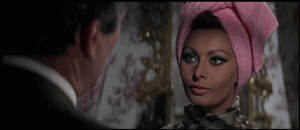
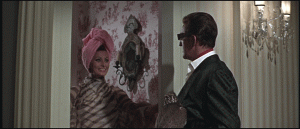
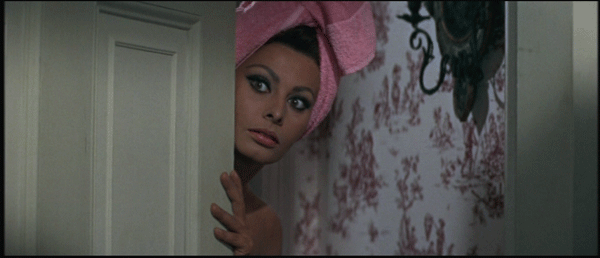
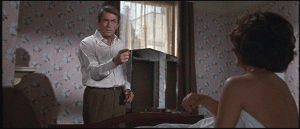
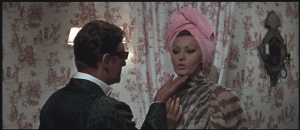
With Beshraavi inside the bedroom, Yasmin was forced to take a shower despite the masculine compliments of Pollack who was hiding behind her.

29a 30a

31

32

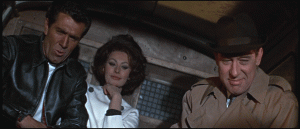
Soon a chase was on to locate the missing Pollack during which Pollack escapes with Yasmin on the pretext that he had kidnapped her. They were chased by Beshraavi’s thug Mustafa to the Zoological Gardens, down the Monkey House, past the caged animals into the aquarium wing where a fight eventually ensues between Pollack and Mustafa. Pollack was saved by the timely intervention of a man in trench coat and hat who later identifies himself as Inspector Webster, CID whose department had been watching Yasmin’s house since Beshraavi started staying there. Then again, when a zoo official demands to see his identity card, Webster shoots him with a silenced gun. Pollack’s mind always travelling, was now perplexed: Whose side is Webster on? He is not with the authorities, or with Beshraavi. He can’t be with Prime Minister Jena. Then Webster clarifies that he is with Yasmin and they all want the cipher. The chase is on……

33aLoosely based on the novel “The Cipher” by Gordon Cotler and screenplay by Julian Mitchell, Pierre Marton (Peter Stone) and Stanley Price, ”Arabesque” would provide Stanley Donen with his second box office success in a row. Before Donen diversified into chic comedies and thrillers when musical films lost popularity by the end of the 1950s, Donen was a dancer/choreographer. Once hailed as “the King of the Hollywood musicals”, he had tried to create a direct continuation from the Fred Astaire-Ginger Rogers musicals. During the course of an illustrious career, he would co-direct “On the Town”, “Singin’ in the Rain” with Gene Kelly, helm sole directorship of movies such as “Royal Wedding”, “Seven Brides for Seven Brothers”, “Funny Face”, “The Pajama Game”, “The Grass is Greener”, etc. The last surviving reputable film director from Hollywood’s Golden Era, Donen had shifted his home base from America to England after the production of “Indiscreet” in 1958, where he will remain until the early 1970s.

34a 35a

With Peck’s talent in “Arabesque”, Donen was able to bring out good characterization of the protagonist Pollack and used the antagonists and the plot to challenge Pollack at a greater pace, even though Peck falls short from the comic charisma of Cary Grant. In shooting action scenes, mainly during the run through the cornstalk field, Peck also had difficulty due to an old leg injury from a horseriding accident.

36a

Donen has expertly dealt with the shower scene limiting the frames showing Peck staring at Loren’s body parts too long that would create the risk of Pollack crossing the line of decency and become interpreted as a pervert. Peck also seems to know that casual glances are more sexy than staring.

37

In 1966 when “Arabesque” came out, having been elected the National Chairman of American Cancer Society, Peck would take a three year break from acting to devote his time on humanitarian causes. His next appearance would be in director J. Lee Thompson’s “Mackennas’s Gold” in 1968, a role reportedly offered to Clint Eastwood who turned it down to make his “Hang ‘Em’ High”, co-produced by Eastwood’s Malpaso Productions.

38 39a

Apart from Sophia Loren, this rollicking adventure film also stars Alan Badel, Kieron Moore and George Coulouris. British stage/screen actor Alan Badel of “Salome”, “Magic Fire”, “Children of the Damned”, stars as the sinister Beshraavi.

40a

41a

Born in Rusholme, near Manchester in September 1923, Badel had graduated from the Royal Academy of Dramatic Art in 1939 winning a Bancroft Gold Medal. Moore began his stage career with the Abbey Theatre in Dublin were he displayed his ability to speak Gaelic. His portrayal of Romeo to Claire Bloom’s Juliet at the Old Vic Theatre in London in 1952-53 was well noted. Badel’s performance as the sinister Negim Beshraavi in this film conveys the perfect subdued menace the role calls for.

42aOnce described as “handsome in a slightly eccentric fashion”, Irish stage and television actor Kieron Moore (Kieron O’Hanrahan – 1924-2007) of “Anna Karenina”, “David and Bathsheba”, “The Green Scarf”, “The Thin Red Line”, with his dark Latin looks and brawny build, stars as Yussef Kasim. He was discovered by Sir Alexander Korda who whisked him out of the cast of Sean O’Casey’s Irish play “Red Roses for Me” in London.

43b

While acting in American films from 1930 to 50, British character actor George Coulouris (1903-89) was often cast in explosive roles. He had gained his training in acting at London’s Central School of Speech and Drama along with fellow students Laurence Olivier and Peggy Ashcroft.

44aHaving performed in movies such as “Hotel Berlin”, “King of Kings”, it would be after his performance in “The Skull” that he would be cast in “Arabesque”, in the role of Professor Ragheeb. Coulouris won a National Board of Review “Best Actor” award in 1941 for his performance in “Citizen Kane”.

The other supporting actors are: John Merivale (Major Sloane), Duncan Lamont (Webster), Carl Duering (Prime Minister Hassan Jena), Ernest Clark (Beauchamp), Harold Kasket (Lufti), Gordon Griffin (Fanshaw), Larry Taylor (Mustafa), etc.

45a

The film is photographed in Panavision by Kensington born Christopher (George Joseph) Challis (1919-2012), a good friend of Donen who would use Challis on six of his films during Donen’s British period in the 1960s. Challis was a technician on early British colour movies such as “The Drum”, “The Four Feathers”, before he became second unit cameraman on “The Thief of Bagdad”. He owes his knowledge in cinematography mainly to Georges Périnal and Jack Cardiff and would later become an essential member of the Archers production company of directors Michael Powell and Emeric Pressburger which enabled him to experiment with creative cinematography. Although Challis received several nominations for BAFTA award for Best British Cinematographer, including for “Those Magnificent Men in Their Flying Machines” (1965), he finally won it in 1967 for “Arabesque”.

46a 47a

To heighten the mystery of this thriller Challis’s camera work is full of dazzling styles that played with focus and disorienting camera angles, especially during the scenes when Pollack was in a drugged stupor. Very often images are shown through reflections on the body of the Rolls Royce, on glass of the low table, on the round side panel, through the aquarium glass, etc.

48a 49a

Apparently, Challis’ camera angles consistently favoured Sophia Loren, focusing attention on her chiseled facial features and statuesque figure looking luscious in gorgeous outfits of tailored cuts and rich materials.

50a

51a

While the Art direction is done by (George) Reece Pemberton (1914-77) who specialized on TV series; make-up for the movie is carried out by British make up artist William (Bill/Billy) T. Partleton (1911-75) of “Christopher Columbus”, “The Prisoner”, “Sink the Bismarck!” fame. The film is edited by Frederick Wilson (“The Prisoner”, “Sword of Lancelot”). You may note the replica of a golden palm on Beshraavi’s desk – which could have acted as a perfect model for one of the prosthetic hands of the evil drug-lord Han of Bruce Lee’s “Enter the Dragon”.

52

53aAmerican composer and songwriter Henry Mancini (Enrico Mancini – 1924-94) who had provided music for Donan’s “Charade” repeats his stylish music in this movie, as well. Educated at the Juilliard School of Music, Mancini was the arranger and pianist with the post-war Glenn Miller Band before coming over to Universal in 1952. He had composed music for “Touch of Evil”, “Days of Wine and Roses”, “Hatari”, “The Pink Panther”, “A Shot in the Dark”, “What Did You Do in the War, Daddy?”, etc. Audrey Hepburn’s song “Moon River” in “Breakfast at Tiffany’s” was composed by Mancini to the lyrics of Johnny Mercer which won the Oscar for Best Song.

54a

55a

For the opening music of this movie, Mancini has provided a continuous procession of tones in a time honoured way laced with Middle Eastern tones to the stylish James Bond-ish title theme. There are several other themes, one of them is a powerful dotted rhythm, and another full of graceful charm, including the rapid running passages of the solo violin notes during the chase scenes to the Zoological Gardens, which are quite noteworthy.

56a

During the 1960s, Italian screen goddess Sophia Loren (Sofia Villani Scicolone) was basking in international stardom for sometime. She was avidly sought after by film makers such as Alfred Hitchcock, Joseph Levine, even, Arthur Miller, to the intense promotion by Carlo Ponti (1912-2007), her romance in blossom. Prior to her appearance in “Arabesque”, Loren had appeared in director Michael Anderson’s “Operation Crossbow” (aka: The Great Spy Mission – 1965), Daniel Mann’s “Judith” and Peter Ustinov’s “Lady L” (both in 1966) and was slated to appear with Marlon Brando in Charles Chaplin’s “A Countess from Hong Kong”. Chaplin had seen Loren in “Yesterday, Today and Tomorrow” and was enthralled by her.

57a

Even though, both “Judith” based on an unpublished (later published) novel by Lawrence Durrell modified according to Loren’s suggestions, in which she acted as an Austrian Jewess Judith Roth who, after surviving Nazi concentration camps, visits Israel in 1948 to track down her Nazi husband who had betrayed her; as well as, “Lady L”, in which she acted with Paul Newman and David Niven, both had fizzled out at the box office. However, for movie audiences, the statuesque Italian leading lady Loren whom writer Lawrence Durrell once described as “A sweet creature, great dignity and style”, symbolized Latin female sexuality.

58a

Although the 5 foot 8.5 inches tall Loren is one of the most beloved and recognizable actresses of the movie world who had worked with a long string of reputed directors and actors. But naturally, there is a small catch.

59a

Actresses like Elizabeth Taylor, found the “Italy’s sensuous beauty” as their competitor. According to biographies of Liz Taylor and Richard Burton, being scared of “Miss-what’s-her-name” acting with Burton in “The V.I.P.s”, Elizabeth had pulled strings to have herself cast in the role. On another occasion, when Burton told Liz Taylor that Loren might take a role in “The Comedians” which offered a few numbers of love scenes with him, that picture was released with Liz in the role intended for Loren. Liz had even agreed to act in it, her seventh film with Burton, for half of her customary salary of $1 million thus enabling Burton to receive more salary than Liz for the first time, i.e. $750,000. In 1959,

60a

Peter Sellers had fallen head over heels in love with Loren when they acted in “The Millionaires” though Loren’s fundamental choice was Carlo Ponti, her keeper of the flame.

61a

62a

When Donen approached Loren for “Arabesque” which scheduled to start production in England by the end of April, 1965, he did not have a script ready to show her. However, Loren was well aware of the works of Donen and furthermore, she always wanted the opportunity to work with Gregory Peck.

63a

64a

65aBesides, Loren would be available in London after finishing her work in her second film for M.G.M “Lady L” by late April. For Loren and Ponti, January 1965 had brought fresh happiness when the French Premier Georges (Jean Raymond) Pompidou (1911-74) granted them with French citizenship which automatically enabled Ponti’s then estranged wife Giuliana to sue for divorce under French Law after six months of being a French citizen. Measuring up to the new citizenship, the 31 year old Loren was only happy to star as Lady Louise Lendale in “Lady L” shot in Paris, Nice, Monte Carlo with some scenes in Switzerland and England under the direction of Ustinov with whom Loren had worked as an uncredited extra in director Mervyn LeRoy’s epic film “Quo Vadis” (1951) starring Robert Taylor and Deborah Kerr.

66a

67a

Following the completion of “Lady L”, Loren was put up in a Georgian country house in Berkshire near Ascot for the shooting period from May to August in order that she has easy access to the locations at Ascot, Oxford, Pinewood Studios in London and other locations in the English countryside including at the Crumlin Viaduct, Caerphilly in South Wales while it was being dismantled. Caerphilly is, of course, amongst other things, famous for its cheese.

68a

69a

Sophia Loren has carried off the role of Beshraavi’s mistress Yasmin Azir with a quite charm and verve as Yasmin plays all the sides against each other, while her real loyalties will be revealed only at the end of the movie.

70a

71a

One time driving a Mercedes-Benz 230SL, she breezes through the movie as a Femme Fatale with her breath-taking beauty and stunningly alluring body elegantly attired exclusively by Christian Dior’s Marc Bohan who prepared a stylish wardrobe and related footwear (all of which would add to Loren’s personal wardrobe after the filming) on generous funding from Universal. In 1961 Marc (Roger Maurice Louis) Bohan had succeeded Yves Saint Laurent, who was called up for military service, at Dior where he would continue till May 1989 when he was replaced by Italian Gianfranco Ferrè setting stage for Ferrè to parade his exquisite flair for fashion.

72a

73a

With Sophia Loren’s taste usually excellent, if a bit expensive, Bohan wouldn’t have found a more willing patron than Loren who knew what it takes for star build up.

74aArabesque” was nominated for BAFTA Award 1966 for Best Costume Design (Colour) but lost to Julie Harris of “The Wrong Box”.

While Cinematographer Challis was very much impressed by the professionalism of Sophia Loren, she can also be game for fun. One of her biographies related an incident during the shooting of the shower scene when Peck had to hide next to her while she took the shower.

75

To put her at ease, Peck had told her not to feel embarrassed, that it’s all in the game. With her unflinching beautiful hazel eyes, Loren asked him what makes him think she would be embarrassed, then readily took the shower naked to Peck’s regal silence.

76Ironically, both “Arabesque” and “Lady L” were released in May 1966 while Loren’s “Judith” was still in its release screening. Serious moviegoers found “Arabesque” a bit imperfect, and Loren was at the receiving end of resentment for adverse characterization of the Arabs in the movie.

77

Nevertheless, with the presence of an impressive star cast consisting of Peck, Loren, Badel and production crew of Donen, Challis, Mancini and of course, James Bond title designer Maurice Binder’s psychedelic visuals gracing the main titles, “Arabesque” is still fun to watch. Put your feet up and enjoy. Until next time, Ciao, Jo

78a

79

ar (PS: The DVD of this movie is available with main dealers such as amazon.com, TCM Shop, etc)

(Text: © JS/Manningtree Archive)
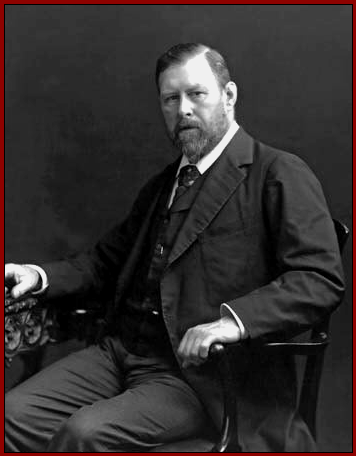
StarChoice 15: Adventures of Don Juan


(Aka: “The New Adventures of Don Juan”, “El Burlador de Castilla”, “La Avventure di Don Giovanni”, “Die Liebesabenteuer des Don Juan”, “Les Aventures de Don Juan” – Technicolor – December 24, 1948)

Back in 1944, Samuel Goldwyn productions released a romantic comedy titled “The Princess and the Pirate”, starring Bob Hope and Virginia Mayo which told the story of a distressed princess who travelled incognito on the high seas and was rescued by the most unlikely of the knights. The production of this swashbuckler was made with utmost secrecy to protect its ending which naturally caught the curiosity of certain studio heads in Hollywood.


At that time, the situation was ripe for a diversion from war movies which the audiences were getting tired of since the middle of 1943. Taking into account the major interest of the audience in the glitz and glamour of the movies of historical-romantic fiction set during 17th & 18th century, Jack (Jacob) Warner, the president of Warner Brothers Studios, decided to bring in some power of his own to such movies by casting Errol Flynn in a big-budget swashbuckler film he had kept in the wings for some time.


Back in 1926, Warner Brothers had made a silent version of Don Juan with legendry actor John Barrymore in the lead. Jack Warner had noted the parallels that connected the character of Don Juan de Maraña with John Barrymore and his fellow-drunk Errol Flynn whom Warner Brothers had initially employed at their Teddington studio. Warner draw up an action-filled script centered on the romantic exploits of Don Juan with Flynn as the title character. However, this version does not in anyway correlate to the drama, literature, poetry, or music of the Don Juan legend portrayed in earlier presentations. As an alternative to the youthful, morally righteous hero, the new Don Juan will be a distinct ladies’ man who would cut a dash on a horse and wield a sword even though he would be a tad more jaded and fickle.

The studio immediately swung into action and roped in director Raoul Walsh to start shooting in May, 1945, nearly four months prior to the end of World War II on September 2. The shooting dates were set up since few sets were already prepared. Then everything went topsy-turvy. An industry-wide strike of studio set designers that broke out in March, 1945 paved way to a bloody riot in front of the main gates of Warner Brothers studios in California on October 5, 1945 (known as Hollywood Black Friday). Although the strike came to an end one month later, it soon brewed up into another strike which lasted some 13 months before matters were somewhat sorted out. Several attempts by the studio to reorganize the cancelled dates of the project (initially with non-strikers/replacement workers) in the next two and a half years were met with failure.

Being the period following the end of the war when the box office receipts were slumped, in order to make the production economical, producer Jerry Wald (1911-1962) started taking steps to revise and embellish the script (based on the original story by Herbert (Addison) Dalmas (1902-1989)), with the help of a series of writers, including “Max Brand” (aka: Frederick Faust) and William Faulkner. Aside from the use of props and scenes from “The Adventures of Robin Hood” and “The Private Lives of Elizabeth and Essex”, a sequence relating to a great ball was definitely removed from the final screenplay that would be at last credited to screenwriters George Oppenheimer (1900-1977) and Harry Kurnitz (1907-1968). Some people in the field of film-making have an innate ability to turn screenplays into star-studded blockbusters.

Director Vincent Sherman and George Oppenheimer were two of them. Oppenheimer who was the co-founder of the Viking Press, was often used to improve the scripts of others.

In 1948, “Adventures of Casanova” produced by Bryan Foy who had long association with Warner Brothers came out to good reviews. Starring Mexican actor Arturo de Cordova, this swashbuckler devoid of historical accuracy, was packed with first-rate swordplay about an 18th-century Casanova returning to Palermo, Sicily to help overthrow the tyrannical rule of the king of Naples. This is the first movie that was shown on WCBS-TV’s Channel 2 which would become the legendry late-night movie channel “The Late Show” in 1951. The film would act as a suitable precursor for Warner Brothers-First National Picture’s new Errol Flynn vehicle.

Adventures of Don Juan”, does not follow the basic storyline of a great lover’s entanglements with the Italian Borgia family, as featured in John Barrymore’s version. On the contrary, Flynn’s Don Juan de Maraña, living in 17th century Spain, is concerned with spoiling the dastardly schemes of the lovely Queen Margaret’s first minister, Duke of Lorca and wooing her.

Synopsis: Outskirts of London. The night had fallen now. We see a dark figure stealthily climbing a tree which was leaning towards the balcony of a villa. We can see a beautiful young lady anxiously looking down at the figure lifting himself up through the branches to keep up the secret rendezvous with her. The narrator had already started to explain the state of affairs of the period:

In Europe, as the 17th century dawned, mankind was lifting itself from ignorance and superstition. The old frontiers of the mind were rolling back. New books, new methods were aiding man in his time taught knowledge and wisdom. In the laboratory, in the arts, in every field of endeavour, man was lifting himself, hand over hand, climbing onward, ever upward. And on the outskirts of London, on a summer night, another man was lifting himself, hand over hand, climbing upward, ever onward toward his objective” – Count d’Orsini’s wife, Catherine.

Having climbed onto the balcony and into the arms of robust, rosy-cheeked Catherine, she demands to know what took him so long. Don Juan explained that no power on earth would have kept him away from her. In this entire world there has been only one image in his heart, one vision for his eyes. He had loved her since the beginning of time. Now Catherine was confused: She had only met him yesterday! Don Juan was ready for that: Yes, yesterday was when time began. After they surfaced from a kiss rooted in flowering passion, he tenderly assured her that he is hers alone – 101%. Yet Catherine could not believe him – he has made love to countless women. Once again his smile flashed. “Catherine, an artist may paint a thousand canvases before achieving one work of art. Would you deny your love the same practice?” He had apparently developed some wonderful poetic skills. When Catherine implored him to let her know how long he will love her, he decided to release her from her emotional chains. “Sweet lady, love is not measured in terms of time, but only in ecstasy.”

Don Juan found some ground for solace when she told him that even though she is married, she is unattached to her husband, Cecil, who is now on a hunting trip to satisfy his extreme fondness for grouse. Inside the privacy of her bedroom, their amorous exploits were abruptly cut short by the arrival of Catherine’s elderly husband. Vanity is fair in love and hate. Her wrathful husband promptly challenged Don Juan to a valiant duel of swords which Cecil was inevitably set to loose. Disappointments have taught Don Juan to be realistic. Don Juan de Maraña took the trouble to advise Cecil that he should be ashamed of himself to leave a beautiful young woman alone neglected while he indulged in his selfish pleasures – grouse hunting! When did he last tell her that she is beautiful? The man appeared to have a mental block when it comes to admitting he is wrong. Cecil should remind her of her beauty every day of her life. Write poetry, send her flowers (to which Catherine added: “and jewelry”) When he put her back into her lovely mood, she is such an exquisite delight. No argument there.

Though Don Juan departed from the balcony with a carefree smile, he and his faithful servant Leporello, were given chase by the guards of Count d’Orsini. On the road, they came across a cavalry of Queen Elizabeth of England who were waiting for the Duke of Cordoba to arrive by dawn to escort him along the road to London. Having been taken for the Duke of Cordoba, Don Juan and Leporello were accorded royal escort to London and to his bride.


They were led in a pageant parade through the streets of London town teeming with its populous. Though Lady Diana was reluctant to her betrothal to the Duke of Cordoba which ensured a new cycle of prosperity for England, having found the imposter to be Don Juan, she was over the moon that he had found her again.


She edgily poked his mind to remember of their secret tryst four months ago at the garden of a Countess in Paris. How could he forget those pleasantries and pleasures? As she bolted the door, a thin smile flickered on her lips, and there was a malicious glitter in her eyes. This time she will not let him forget her. It didn’t take much longer for the paramours to drift into a kiss which was broken by the arrival of the real Duke of Cordoba. Though Don Juan and Leporello were immediately imprisoned, they were soon paroled to the custody of His Excellency Count de Polan, the Ambassador of Spain.


With his release from the English jail, Don Juan seemed headed for the Spanish prison since having returned to Madrid, the Duke of Cordoba had complained to the weak and feckless King Felipe III and Queen Margaret of Spain about the series of amatory escapades of Don Juan de Maraña who had damaged the prestige of Spain and messed up the marriage of convenience shaped expressly for the purpose of peace between Spain and England. There is a fair chance of hanging. Count de Polan, who is a friend of Don Juan’s father, told him to leave London and return to Madrid to present himself before the Spanish Court for Her Majesty’s judgment.


The Count had written to the Queen urging that she deal gently with Don Juan. Though Don Juan claimed he knew nothing of matters such as court intrigue, the ambassador had maintained that he devote his time to help the heartbroken Queen to attain peace in her country ruled by the subservient sovereign King Felipe III under the influence of his first minister, who has been plaguing her of late. His loyalty to the Queen would help her to face the cunning Duke of Lorca who is hatching a ruthless plot to elevate himself as a power behind the throne. Don Juan and Leporello rode across the midlands into the city of Madrid….and so the future began….


The shooting of ”Adventures of Don Juan” started in October, 1947 under Vincent (Vince) Sherman (born Abram Orovitz – 1906-2006), a former American stage actor who joined with Warner Brothers in 1938 where he was assigned to their B-picture unit. Sherman who had associated with chubby dynamo Jerry Wald since “All Through the Night” (1941), had launched his directorial career with the horror movie “The Return of Doctor X” (1939). Owing to his experience in numerous Theatre Guild productions on Broadway, reworking of scripts and finally directing movies, Vince Sherman became an expert in film making: in its continuity and cutting and progression. He made films relishing in the love and devotion of his wife Hedda Comorau who turned a blind eye to, according to IMDB, his occasional romantic flings with actresses Bette Davis, Joan Crawford and later with Rita Hayworth. Being a good friend of Errol Flynn who was the big white hope of Warner Brothers, Sherman had no qualms when Flynn asked to direct him in ”Adventures of Don Juan” which he did with his customary efficiency.

1944 was a period when the Tasmania born Errol Leslie Thomson Flynn was spawning lot of publicity from his off-screen feats, especially the foul smell derived from his rape trial of 1943. Flynn had been an English repertory theatre actor before obtaining a contract with Warner Brothers and would become rated as the best swashbuckler of the sound cinema – an image created with the help of director Michael Curtiz with whom he finally quarreled and split.

Keeping up with the image of the daringly gallant and dashing swashbuckler, Errol Flynn maintained an appetite for a delightful and hard life. He had his own dedicated group of drinkers and keeping him within the production schedule was one heck of a job for director Sherman and unit manager Frank Mattison. The “Singing Cowboy” Gene Autry once said, “(Flynn) spent more time on a bar stool, or in court, or in the headlines, or in bed, than anyone I knew.” He was once described by David Niven as “a magnificent specimen of the rampant male.” The frivolous, sardonic, and rather witty initial scenes of Don Juan wooing an enamoured Catherine and the inevitable encounter with her enraged husband is a spoof of the personality of Don Juan and of star Flynn himself.

While the burden to carry the film focused on the title character is loaded on the star performer; few weeks into the production, Flynn disappeared out of town for a few weeks, possibly for one of his major binges, leaving the artistic collaborators in the enterprise to shut the unit down and wait it out until he returned. When he finally positioned himself before the camera, he appeared sodden with alcohol which was consumed from mid-afternoon onwards, forbidding him from going on with a scene for long. This is despite Flynn’s famous trick of spending half hour in the steam room to get the booze off him. However, all this resulted in a good deal of additional set ups, retakes, editing rhythms and extra time though Sherman once said that this happened only once.


Despite the studio’s endeavor to wink at Flynn’s age, there was some concern about the roughened state of his face from his hard living.  In spite that Flynn sometimes failed to generate the excitement of the performance of Douglas Fairbanks or Burt Lancaster, I think he had great personal style and that the flamboyant Flynn’s physic was tailor-made for the swashbuckling roles. Being a great natural athlete, it was Flynn’s lighter-than-air agility, light-hearted seriousness, a degree of grace and style, and pure English-speaking voice which turned out “Adventures of Don Juan” to be a good film.

The role of Spanish Queen Margaret was portrayed by the Uppsala born 28-year old Swedish actress Viveca Lindfors (Elsa Viveca Torstensdotter Lindfors – 1920-95). Before she was imported to Hollywood by Warner Brothers in 1946, she was appearing on stage and in films having been trained at The Royal Dramatic Theatre School in Stockholm like her fellow Swedish actresses Greta Garbo, Signe Hasso, Mai Zetterling and Ingrid Bergman.

Queen Margaret would be Lindfors’ first appearance in a Warner/Hollywood movie. I have a strong feeling that the appearance and mannerism of Lindfors in the role of Queen Margaret had influenced in formulating Sophia Loren’s character of Doña Jimena in “El Cid

The role of the subservient King Felipe III is played by Romney Brent (1902-76), the dapper Mexican actor/director also known as Romulo Larralde.

Buckinghamshire born stage actor Robert Douglas (Robert Douglas Finlayson – 1909-99) was a student of the Royal Academy of Dramatic Art and appeared on British stages before he moved to Hollywood after the war and specialized in roles of suave and arrogant villains. Douglas stars as the king’s illusory minister, the Duke de Lorca who had his heels on the king’s neck. This role was originally meant for Claude Rains and later for George Coulouris. Well versed in swordplay, Douglas had studio experience in having dueled with the likes of Stewart Granger, Robert Taylor, Burt Lancaster, etc. Douglas’ stylish daredevil duel with Flynn on the grand staircase in the king’s palace, though at times not totally fair, has by now attained cult status.

Burly Alan Hale Sr. (Rufus Edward MacKahan – 1892-1950) was a cheerful actor who played heroes in silent action films and similar to his role of Leporello, was often cast as a jovial sidekick of Errol Flynn. Having acted in period films such as “The Last Days of Pompeii”, “The Man in the Iron Mask”, “The Sea Hawk”, his career would see him acting as Little John in three movies, viz., “Robin Hood”, “The Adventures of Robin Hood” and in “Rogues of Sherwood Forest”. Interestingly, innovations such as the folding theatre-seats and hand fire extinguisher are credited to him.

The lady in the coach at the end of the movie is played by none other than  Nora Eddington (1924-2001), the second wife of Errol Flynn whom the nineteen year old Nora had met in 1943 while working at the courthouse where Flynn was undergoing trial for statutory rape from which he was acquitted. Unfortunately the couple who married in 1944 at Mexico will be divorced in 1949.

The former child stage star/leading lady Ann Rutherford (Donna Elena), character actor Robert Warwick (aka: Robert Taylor Bien – Count de Polan), British actor Aubrey Mather  


(Lord Chalmers), former child actress Helen Westcott (aka: Myrthas Helen Hickman – Lady Diana), dwarf actor Jerry Austin (Don Sebastian), Douglas Kennedy (aka: Keith Douglas – Don Rodrigo), Jeanne Shepard (Donna Carlotta), Mary Stuart (Catherine), G.P. Huntley, Jr. (Count d’Orsini), Spanish Opera singer Fortunio Bonanova (Don Serafino), Irish character actress Una O’Connor (Duenna), heavily-built Canadian actor Raymond Burr (Captain Alvarez), etc rounded off the supporting cast.


The film features impressive photography by English Cinematographer/actor Elwood (Bailey) Bredell Sr. (1902-1969), a former lab technician who would, while working with Universal Studios during the period 1937-46, reveal his cinematographic skills in films of genre: thrillers and film noir. Bredell’s chance to picture big-budget movies came after his shift to Warner Brothers in 1947, when his sumptuous visual style attained a new dimension in filming that resulted in richly textured images which embellished movies such as “Adventures of Don Juan”, “Female Jungle”, and “Journey into Light”, the latter of which also offered him occasion to work with Viveca Lindfors once again. For “Adventures of Don Juan”, Bredell and his team not only took care of the artistically and dramatically expressive angles, but generated a mixture of shadows and diffused lighting that would provide a memorable atmosphere of sinister visions to the frames.

The film is edited by Alan Crosland, Jr. (1918-2001), the son of Alan Crosland who directed “Don Juan”, the 1926 silent film of Warner Brothers starring John Barrymore. Crosland. Jr’s expert editing patterns can be noted in the brisk pace as the duel heightens, as well as in the smooth flow of scenes he had put together from the asymmetrical frames occasioned by disruptive filming.

Though the location filming was done in West Hills, Providencia Ranch (Hollywood Hills) and Warner Ranch (Calabasas), the interiors were mostly shot in semi-Expressionist sets at Stages in Warner Brothers Studios in Burbank, California, under the direction of Art Director Edward Carrere and Set Decorator Lyle B. Reifsnider.


The specially constructed magnificent sets of the king’s palace and the grand staircase adds colour and dynamism to the expertly choreographed duel between the heroic Flynn and scoundrel Douglas which takes place to the splendour of Max Steiner’s rousing score. The initial scene at the balcony gives a richly coloured texture, the streets of 17th century London and Madrid, the entire palace including the dungeon were all arranged to provide a picture-book-look by providing due consideration to the minute details. Edward Carrere justly received an Academy Award for the Art Direction for this movie.


The characters were dressed up beautifully by Costume designers Leah Rhodes, Marjorie Best (uncredited) and William (Billy) Travilla. The costumes that express authenticity, especially of delectable Viveca Lindfors, are befittingly designed, the influence of which is evident in the costumes worn by Sophia Loren in “El Cid” and “The Fall of the Roman Empire”. The black band around Flynn’s head during the final scenes conjures up the flair and grace of Douglas Fairbanks. The film would win the Academy Award for Costume Design. Dress designer Billy Travilla (1920-90) was an employ of Columbia Pictures from 1941 to 43 before he was brought to Warner Brothers by actress Ann Sheridan, where his first work is for this movie. He would later become famous for his dresses designed for Marilyn Monroe one of which is the snow white ivory halterneck cocktail dress blowing in the breeze in Monroe’s “The Seven Year Itch”.


Perc Westmore who handled the make-up for this movie is the son of George Westmore, the head of the famous family of Hollywood make-up artists who had earned their reputation during a period when none of today’s popular creams like Diors’ “Capture Totale”, or Lancôme’s “Génifique” to name a few, were available.

The enthralling dueling sequences were staged with a tongue-in-cheek approach by the team of Assistant Director Richard Mayberry, Fencing Master Fred Cavens and special-effects men William McGann and John Crouse blended together by maestro Sherman by casting doubles. The duel scenes in the dungeon, in the halls of the palace and on the grand staircase were aptly staged, even though Don Juan’s spectacular leap from the stairs during the duel was performed by Jock Mahoney (1919-89), the only stuntman who was willing to do that dangerous stunt and was paid S1,000 for it.


The film is laced with the romantic and richly melodious score of Austrian composer Max Steiner (Maximilian Raoul Walter Steiner – 1888-1971) with orchestrations by Murray Cutter. One of Hollywood’s most prolific film score writers, Steiner had provided music for “Gone With the Wind”, “Casablanca”, “The Treasure of the Sierra Madre”, “The Jazz Singer”, to name a few. It was Max Steiner who first came up with the potentiality of scoring films with original compositions, convincing the producers about the important role music can play in conveying the mood, character and pace of a film. Originally, fellow Austrian Erich Wolfgang Korngold (1897-1957) was assigned to score for “Adventures of Don Juan” but was reassigned to Steiner since Korngold had left Warner Brothers by the time the filming was wrapped up.

To provide score for an action film like this is a complicated art requiring tremendous skill in precision timing which Steiner has fulfilled by providing the most enjoyable accompaniment to the pageantry and stylish scenes of the movie.


To promote the movie, Warner Brothers even reissued “The Adventures of Robin Hood” and “The Sea Hawk” in America which performed very well in spite that they lacked Technicolor photography. Though “Adventures of Don Juan” did thriving business in Europe, it put up only a reasonable success in the U.S box office – a clear indication that Flynn’s golden days were not going to have resurgence and this expensive, but generally entertaining swashbuckler would be Flynn’s last big-budget extravaganza.

Every movie leaves something to the imagination. “Adventures of Don Juan” has a safe corner in the memory as a film created with the involvement of great talents who had impeccably crafted wonderful sets, high-end action scenes, colorful period costumes, a harmony of melodious, rousing score dominated by violins, trumpets, and drums – all that and more…

Take your pleasures where you can. The curious are urged not to miss it. Ciao, Jo.

(PS: The DVD of this movie is available with main dealers such as amazon.com, TCM Shop, etc)

(Text: © JS/Manningtree Archive)

StarChoice 14: The Million Pound Note

(Aka: “Man with A Million”, “Big Money”, “L’homme aux million”, “El millonario”, “Il forestiero”, “Sein größter Bluff – Colour – 1954) 

A true Englishman doesn’t joke when he is talking about so serious a thing as a wager”, wrote Jules Verne in “Around the World in Eighty Days”. This brings to my mind the high-profile bet the Virgin boss, British billionaire Sir Richard Branson made with Tony Fernandes, the group chief executive of Air Asia. By way of passing, I also remember a wager struck up between a couple of my friends during their recent shopping spree at an upper-class boutique in Madrid, when they came across a middle-aged Indian lady admiring the bridal gowns par excellence by prestigious wedding dresses designers displayed there. As for the subject of their bet, one maintained that the lady is looking for a wedding gown for her daughter while the other one heldthat it is for herself. Mind you, as it turned out, none of them were right. The salesman known to them from previous visits later told them that while seeing her off at the door, he had courteously complemented her that he is sure the bridal gown she just purchased would be lovely for her daughter.  Right away, she had given him a baffled look and retorted: “For my daughter?! This is for me to wear at a high society party back in Bombay!” That said, she walked out in a huff.

It is not hard to make a decision when you are firm in your belief as to its objective. Apparently, it is Victoria Beckham’s belief in her sense of style that earned her the Womenswear Designer of the Year award at the 2012 WGSN Global Fashion Awards. Quite similarly, the success in a wager is related to the belief in the standpoint of the bettor. However, to play safe from gamble, a better way to triple the money is to fold it thrice and stash it inside the wallet.

Today I am writing about a wager set by two Englishmen which is the theme of British director Ronald Neame’s “The Million Pound Note”, a film which is rated in a guide as “Witty, intelligent and charming”. Assessing the four main elements of movie making – script, acting, cinematography and editing, I have no reason at all to disagree to this rating.

The Million Pound Note” was released in the United Kingdom in January 1954. This Ronald Neame and John Bryan production was produced at Pinewood Studios in England in 1953 when the film industry and exhibitors were striving to curb the menace and progress of television against box office. It was during this year that 20th Century Fox released their initial CinemaScope film, “The Robe” and also when drive-in theatres sprang up across America. The year saw the release of “Bwana Devil”, the first film on Polaroid’s dual projector 3D system, the precursor to 3-D or three dimensional films. A string of high quality movies hit the screen during 1953: “Julius Caesar”, “Stalag 17”, “From Here to Eternity”, “Gentlemen Prefer Blondes”, and William Wyler’s “Roman Holiday”, catapulting its leading star Gregory Peck to greater heights.

The tall, principled and handsome Gregory Peck was 37 years old when he was cast in the role of Henry Adam which was perfected for him. It is a jolly good treat to watch Peck’s unpretentious seaman going through the experiences goaded by a million pound note as he gained wisdom from the fascination it created in the London society. Born Eldred Gregory Peck, he had attended Sanford Meisner’s Neighborhood Playhouse School of Theater in New York where performers like Grace Kelly, Geraldine Page, Steve McQueen, et al had attended, following which Peck performed on stage till the early 1940s. Actor Eli Wallach remembers him as “tall, slim, almost regal and very shy”, while his contemporary Karl Malden in his memoirs sums up Peck’s days as a stage actor as: “I knew right away that he was going to be a big star. He had a resonant voice and a winning, relaxed manner on stage.”

Peck’s opportunity came when Hollywood was experiencing the absence of romantic leading men due to the war, debuting with 1944’s “Days of Glory”. Having become an instant star with “The Keys of the Kingdom”, Peck was rated as a downright decent leading man. He had worked with Hollywood legends such as Alfred Hitchcock, John Huston, William Wyler, Elia Kazan, etc, though some of his best films were under the direction of Henry King. His considerable charm had been put to effective use in comedies such as Stanley Donan’s “Arabesque” or Vincente Minelli’s “Designing Woman”, but Peck is least interesting when he is portraying straightforward integrity. Ever the gentleman, Peck was a “straight arrow, who took the job of acting seriously and analytically.” While acting, he maintained that anyone standing around in his eye line had to be moved off out of the way.

Esteemed as one of the great screen actors with a string of outstanding performances in movies, Peck went on to win five Academy Award nominations and won the Best actor Oscar in 1963 for his performance as the courageous small-town lawyer Atticus Finch in “To Kill a Mocking Bird”. He was also awarded with the Jean Hersholt Humanitarian Award.

He would become the first actor-president of the Academy of Motion Picture Arts and Sciences for three years from 1967 to 1970, a period known for his efforts to rejuvenate the organization and its image by trying to bring in younger stars into its membership.

In 1953 when the pre-production work on “The Million Pound Note” was about to begin, Gregory Peck was in Italy acting in “Roman Holiday”. He was also going through a patch of despair due to separation from his Finnish wife Greta Kukkonen (née Eine Matilda Kukkonen), which was soon reversed when he fell in love with Paris-born journalist Veronique Passani, whom he met when she interviewed him for the French daily newspaper France Soir. Peck would marry her soon after his divorce from Kukkonen in 1955.

The Million Pound Note” starts with a display of the company logo of J Arthur Rank Organisation of a golden gong being struck by the gong man’s familiar slow-motion swing of arms. The man you see there is the English heavyweight boxer, Bombardier William “Billy” Thomas Wells, the first of Rank’s gong men. The credits are shown with melodious classical music with stirring effectiveness and snippets from instrumental version of the patriotic British song “Rule Britannia”.

According to the narration at the beginning of the movie, the story starts at a time when Britain was very rich, and deep in the vaults of England there was more gold than anywhere else in the world. Safe, people used to say, safe as the Bank of England. In this time, there lived two elderly and superbly wealthy brothers named Oliver and Roderick Montpelier at their grand mansion at Belgrave Square. Being a bit oddball in nature, they entertained different opinions regarding people’s attitudes to the symbol of wealth. Having decided to play a wager to prove this, the brothers acquired a single currency note for a million pounds issued on June 20, 1903 by the Bank ofEngland.

Oliver Montpelier thought that the note felt good and maintained that such is people’s attitudes to the symbol of wealth that by merely possessing this scrap of paper, without ever cashing it, you could have everything you wanted. On the contrary, Roderick found the note quite unique, an exquisite thing of beauty and believed that it would be quite useless if you were denied the right to cash it.

For now, we are introduced to the leading character of the movie, a penniless and friendless young seaman named Henry Adams from New England who was stranded in London. He was at his wit’s end for having failed in his efforts to find a job. As a last resort, he had even approached the Consulate of the United States of America where he encountered a display board which discouraged American citizens from approaching the Consulate for monetary help:

“This Consulate is not provided with funds by the U.S Government

for the assistance of needy Americans in London”


It was when he was trying to pick up a discarded pear from the pavement that he was invited by the two brothers to their mansion. Though Adam was expecting to find work from them, he was given a letter in a sealed envelope informing him that everything will be explained once he opened the envelope at two o’clock, exactly one hour and ten minutes from then.


On the strength of the assumed fortune in the envelope, Adam went into a decent restaurant and ordered a wonderful, long over due meal which explains the bill:

“Ham, eggs, steak, potatoes, beans, carrots, twice.

Trifle, cheese, coffee, two quarts of ale. Three and ten pence.”

On the threshold of being thrown out of the restaurant for non-payment of the bill, the envelope was opened to discover the note of the enormous value of One Million Pounds! The instant transformation in the attitude of all those around him owing to the gargantuan value of the note was evidently amusing.


Taken for an eccentric millionaire, the red carpet was rolled out for him. He is most welcome to come in anytime he wanted, and to have whatever he wanted. As for his present bill, he doesn’t need to pay it – just forget it, it’s of no consequence at all.

Upon rushing back to the mansion of the brothers to return the note, Adam learned from James, the butler that the brothers were unavailable, having gone abroad for a month. At this point, sitting on the stairs to collect his thoughts, he learned from the letter in the envelope that:

As his mind brooded over the contents of the letter, the note accidently flew off his fingers, the retrieval of which creates a series of funny sequences. In a while, the note again does the grand-work for him at the tailoring shop of Jonathan Reid who, upon seeing the note, takes it as their pride and glory to see His Eminence properly attired for the season.


From here, Adam is referred to as an admiral of the seas to the prestigious Hotel Bumbles, the very place to stay – quiet, modest and discretion itself. Having gone through further complications on arrival at the hotel, and after a good deal of Yes-my-lord-ing and Very-good-my-lord-ing, Adam was elegantly accommodated in the Bridal Suite after the current occupant, the Duke of Frognal, was instantly chucked out.


With his social status realigned, Adam started to move in exclusive social circles of the British aristocracy aided by the American Ambassador. This provided him with the opportunity to meet lovely Portia Lansdowne, niece of the toothy Duchess of Cromarty to whose reception at her Hampshire House he was invited to attend.


Some people will tell the world anything they know about everything. Maybe that’s not a bad thing. Given that the sugar-coated rumour mills started to roll about his mere acquaintance with Lord Lloyd Hastings, the shares of Hasting’s company shoot up – a rather happy moment at the Stock Exchange.

Whilst Adam was all set to soar and score, things unfortunately started to look pretty foul when the Duke of Frognal pulls a prank and hides the note with the help of Renie, the hotel chambermaid. It was a wake up call for Adam. As Adam started to scale down the heights he had climbed, it began to dawn on him that he would have to actually spend the money if he wishes to live like a Lord….


Produced by Ronald Neame and British production designer turned producer John Bryan, the film features an array of British crew and technicians though a good number of the casts are not credited. The screenplay founded on an updated version of a short story by Mark Twain called “The Million Pound Bank Note” is by expert British documentary director and writer (Noreen) Jill Craigie.

The characters of the two brothers being integral to the structure of the film are joyously portrayed by two brilliant British actors. Trained at the Royal Academy of Dramatic Art, jovial Ronald Squire from the Liverpool Repertory Theatre had acted in many light comedy roles before he appeared in the role of Oliver Montpelier. Wilfrid Hyde-White’s role as Roderick Montpelier, marks one of the various comedies he made before shifting to America in the 1960s. An impeccable character actor of stage and screen who had often acted opposite Sir Laurence Olivier and Vivien Leigh, and is best remembered for his role as Col. Hugh Pickering in George Cukor’s “My Fair Lady” (1964) in which he sets up a wager with Prof. Henry Higgins (Rex Harrison) challenging him to transform flower girl Eliza Doolittle (Audrey Hepburn) into a lady.

Joyce Grenfell (born Joyce Irene Phipps) who portrays the Duchess of Cromarty was initially a radio critic columnist who went on to debut on the London stage before she made entertaining the troops her principal work during World War II, a period which she described as “The Time of My Life*. After the war Joyce, along with Viola Tunnard, her accompanist who was a gifted musician and able pianist, went for one more tour to “Re-Joyce” the troops, starting at Benghazi in December 1952 and finishing off in Malta by January 1953. Following this, she acted in a movie called “Genevieve” before her appearance in “The Million Pound Note”, which her mother approved since she was appalled of the number of unattractive characters her daughter played in films.

A.E. (Matty) Matthews in the role of the hard hit Duke of Frognal who repeats his title as a form of bragging about his “wealth” but is a lot poorer is perfectly cast. Matthews is popular for a crack he once made, “I always wait for “The Times” each morning. I look at the obituary column, and if I’m not in it, I go to work”. The film also stars Wilbur Evans (American Ambassador), Jane (Mary) Griffiths (Portia Lansdowne), bald-headed American actor Hartley Power (Lord Lloyd Hastings), Maurice Denham (Jonathan Reid), Reginald Beckwith (Rock), Brian Oulton (Lloyd), John Slater (Parsons), Hugh Wakefield (in his last role, Duke of Cromarty), Bryan Forbes (Todd), George Devine (Chop house/Restaurant proprietor), Hugh Griffith (Potter), etc.


The music is provided by prolific post-Romantic English composer William Alwyn and conducted by the Scottish conductor/composer (James) Muir Mathieson. Once a professor (from 1926 to 1955) at the Royal Academy of Music in London, Alwyn had progressed from scores for World War II documentary films  for the British Ministry of Information to scores for feature movies such as “Svengali”, “Zarak”, “Swiss Family Robinson”, etc. He has decorated the movie with classic symphonies; music that is both melodic and eminently accessible. At times, his tunes are both subtle and profound, dominated by violin notes, atmospheric waltzes, snippets from popular British music and he even used bits from the Yankee Doodle.


One of the greatest of British cinematographers, Geoffrey Unsworth is a recipient of an OBE (Officer of the Order of the British Empire), and winner of two Oscars, among others. Unsworth has done a wonderful workmanlike job here, assisted by camera operator Jim Bawden. With a long string of superb films behind him, among them “A Night to Remember” (1958), “Cabaret” (1972), “Superman” (1978), etc, he died of a heart attack at the age of 64 on the set of Roman Polanski’s “Tess” (1979).

Production designer Jack Maxsted (“The Adventurers”, “Diamonds are Forever”, etc) together with John (Allan Hyatt) Box did the Art Direction for the film. Though Box’s career got an upshot with David Lean’s “Lawrence of Arabia” (1962), he was known for recreating exotic locations in unlikely places. He had effectively constructed Chinese city walls in Wales for “The Inn of the Sixth Happiness” (1958) when the unit was denied permission to shoot in China. When a Russian country house in snowy landscape had to be replicated in Spain for “Doctor Zhivago” (1965), he would accomplish that by using white plastic sheets and marble dust. (For references on John Box and William Alwyn, you may read my review of August 23: “StarChoice 9: Zarak”)

The Costume design is by Margaret Furse, the Academy Award Winner for Best Costume for “Anne of the Thousand Days” who also did costumes for “Oliver Twist”, “The Crimson Pirate”, “Mary, Queen of Scots”, etc. If one looks closely at Furse’s costumes in the movie, we can find out how the small details which would normally go unnoticed make an impact on the overall effect in the frames.

Make up and Hair styles are done by George Blackler and Biddy Chrystal respectively. Blackler had headed the make-up department for “Black Narcissus”, “Operation Crossbow”, “Dracula A.D. 1972”, “The Satanic Rites of Dracula”, etc; while the renowned hairstylist Chrystal (aka. Eileen Chrystal) has enough feathers to line her nest for having worked on movies such as “The Sword and the Rose”, “Sword of Lancelot”, “The Fearless Vampire Killers”, “11 Harrowhouse”, etc. While the set dressing is by Dario Simoni, editor Clive (Stanley) Donner cuts it all together.

As for director Ronald Neame, he was born in 1911 in London to beautiful silent film actress Ivy Close, Neame was the producer of British filmmaker David Lean’s (1908-1991) early British films “Great Expectations” (1946), and “Oliver Twist” (1948). Like director George Stevens, Victor Fleming, Phil Rosen, he was an outstanding cinematographer, before becoming an expert director at light, frothy comedies. Although Neame was uncredited, he was an assistant cameraman on Alfred Hitchcock’s “Blackmail” (1929), the first sound-on-film British talkie.

As in every movie, there is a price dictated by the subject matter, the content and the showmanship values. “The Million Pound Note” is a fairly pleasing comedy which aptly displays the Edwardian atmosphere, flavour and local colour of England. You could see the muffin seller walking down the street, the family picnic on the green grass, uniformed school children lined up for outing, etc.


With a witty, well-written screenplay by expert writer Jill Craigie, Neame didn’t have to run to the hull every other minute to check for leaks. The meal at the restaurant leading to the discovery of the note is beautifully staged and ably photographed by Geoffrey Unsworth while Alwyn’s pleasant music flutters all around it. Another amusing scene is the incident at Jonathan Reid’s tailor shop.


The scenes of Portia Lansdowne which ends with a pop at matrimony, provides the emotional quotient. In all fairness, the movie is nicely ornamented and acted under the graceful direction of Ronald Neame. Being a comedy, everything works out happily though the movie will set us thinking about the extraordinary way some people’s attitudes change by the symbol of wealth and also why some regard the rich as superior to the poor. “The Million Pound Note” is a classic comedy which can be watched by the whole family.


(Text: © JS/Manningtree Archive)

StarChoice 13: SADDLE THE WIND

 (Aka:“Lo sperone insanguinato”, “Más rápido que el viento”, “Libre comme le vent”, “Vom Teufel gerittenColour – 1958)

Freddie Mercury, the lead lyricist and vocalist of Queen once said, “When I’m dead, I want to be remembered as a musician of some worth and substance.” Today, October 18, I remember Hollywood actress Julie London, who took to heavenly abode in 2000 and rests in peace at Forest Lawn, Hollywood Hills, Los Angeles, California, I think of her not only as a beautiful actress but also as the girl with the “come hither” voice who was voted one of the top female vocalists of Billboards in 1955, 1956, and 1957.

Born on Sept 26, 1926 in Santa Clara, California, the gorgeous Julie (aka. Julie Peck) with flaxen hair and eyes as blue as the South Sea Lagoons, was discovered by talent agent Sue Carol, wife of actor Alan Ladd. She made her first appearance in Nabonga (1944) and would go on to capture the attention of movie audiences over a career spanning about 35 years – starring in movies and TV series such as “The Return of the Frontierman”, “Voice in the Mirror”, “Man of the West”, “Emergency!” . Always radiating charm and friendliness, Julie was once married to TV executive Jack (Dragnet) Webb and later to composer/Jazz musician/actor Bobby Troup. She had led an unscandalous life raising five children (Stacy, Lisa, Kelly, Jody and Reese) from both marriages.

When we think of great ballads and love songs by some of the finest singers of the 50s and 60s, the “Liberty Girl” Julie, with her husky, intimate and sexy voice, stands up to the likes of Dean Martin, Frank Sinatra, Peggy Lee, June Christy, etc, with songs such as “Cry Me A River”, “In The Middle of A Kiss”, “I’ll Remember April”, “My Heart Belongs To Daddy”, “Can’t Help Loving That Man”,… all those wonderful songs which came one after the other. Those songs with the musical accompaniment of Barney Kessel (guitar) and Ray Leatherwood (bass) exemplified the intimacy and warmth of Julie’s voice and style, appealing to a legion of music lovers, though she never felt her sensual voice special and always endeavored to demote her talent and professionalism.

Sometimes I’d like to saddle the wind

And ride to where you are.
We may meet in a valley or on a green hill.
Will I be yours? You know I will!…

In particular, many would remember the above lyrics (written by Jay Livingston with his chief musical collaborator Ray Evens) as the title song of a western movie called “Saddle the Wind” in which Julie sang to the melody of Elmer Bernstein. She remains uncredited for that song in this  movie in which she had performed as the saloon singer Joan Blake.

A Metro-Goldwyn-Mayer production, directed by Robert Parrish (John Sturges who is said to have directed segments of the film is uncredited), “Saddle the Wind” is a western melodrama based on a screen story written by Thomas Thompson and adapted by Rod Serling (Novelist and Academy Award Screenwriter Daniel Fuchs’ (“Love Me or Leave Me”) contribution is uncredited).


Synopsis: A lush, picturesque western valley in the Colorado rockies (presented by cinematographer George J. Folsey in CinemaScope and Metrocolor) was shared by the Sinclairs of Double S Ranch and another cattle ranch owner Dennis Deneen, the undisputed law in that valley. Healthy and handsome Steve Sinclair is a man of rectitude and stability. Having retired from the life of a ruthless gunslinger, he had returned to the valley to settle down and lead a peaceful life on his ranch. Steve’s younger brother Tony, a charming but restless hot-blood, believed he’s the fastest draw in the town which inevitably sets off a series of tensions for Steve. Hopeful that he could lift his kid brother above the low height of the waist holster of his gun, Steve had tried to “bend that kid”. But despite his efforts to make the young extrovert, Tony was not cut that way – and would not accept anyone’s definition of his life. He would rather define his life himself.


One marked thing in Tony was that he adored his elder brother Steve, whom he considered numero uno. Steve has been his father and mother since the age of four. But that doesn’t mean Tony would be a kid brother much longer, rather a full-partner with a thirst for gun play – to make a name for himself. Things get trigger-happy complicated when gunfighter Larry Venables comes to the quiet community of ranchers seeking Steve, who is accused as the killer of Larry’s brother. Although Tony knew about Steve’s gunslinger days, he doesn’t believe that Steve is still a faster draw in protecting himself. As for Tony himself, he is of age and no one will bully him into silence.


On the home front a problem had started to brew when Tony returned after selling their herd at the market in Jewelton – with beautiful Joan whom he wished to marry. He had also brought a six-shooter which Steve didn’t approve of. It would soon dawn on Joan that Tony is not the kind of man she hoped to marry and start a new life with. Further problem presented itself when Yankee squatters Clay Ellison and family popped up in the valley, and asserted their right on a strip of land, pitting Tony against them to tragic consequences.

Keeping the film in the traditional pitch of the genre, director Robert Parrish obviously elected to illustrate the psychological aspects of the characters through visual communication, though Rod Serling’s colourful and exciting script revolves around a good measure of derisive and thoughtful dialogue. With seldom a dull moment to blur the sparkle, Parrish’s conscientious direction also brings out moments of inspiration by his ease and panache in handling both action and characterization ably assisted by assistant directors, Robert (Bob) Saunders & Mickey McCardle (uncredited).

Parrish (Bob Parris) who had won an Academy Award for film editing for Robert Rossen’s “Body and Soul” (1947), was known as a “nice gentleman” and never rose to the “front ranks” in Hollywood. A lover of big Macaws he kept with his wife Kathie, Parrish had directed “Fire Down Below” (1957) starring Rita Hayworth and Robert Mitchum, and went on to direct another western titled “The Wonderful Country” (1959) pairing Julie London with Robert Mitchum. In between those movies, he directed “Saddle the Wind” with the “good two shoes”: Robert Taylor and young dynamic John Cassavetes.

The performance of Robert Taylor gives the essential ruggedness to the role of Steve who, despite intense provocation, refused to revert to his past life of violence. The reason Robert Taylor came into “Saddle the Wind” has something to do with the state of M-G-M at that time. Trouble had started for M-G-M with the enactment of the government antitrust law allowing the cinemas to show any film they liked, unlike the earlier law which allowed them to show only material produced by their sponsoring studio. This change also altered the way films were produced, distributed and exhibited. As the studio system failed and the number of audience decreased, Hollywood’s output naturally dwindled. Meanwhile a change took place in the preference of the audience as the popularity of television captured them through cheaper imitations. The studio’s attempt to recover their position with smart moves such as releasing movies to television companies, or making sci-fi movies to cater to the increased number of teenage audience, did not bring a satisfactory profit. As a result, the studio was heading towards their first ever loss they will suffer in 1957, the year Louis B. Mayer, the legendary force behind M-G-M, died.

Determined as ever to get back into the top position and save themselves from the path towards the loss, they wisely turned to their brightest stars – the creations of the star-makers of M-G-M who exalted in their motto “….more stars than there are in heaven” (MGM publicity slogan coined by Howard Dietz). Like all major Hollywood studios, M-G-M was juggling around their contract performers, directors, writers and other technicians in different productions. They decided to use their leading stars more effectively to pull in the crowds.

By the early 1956, there were only few stars on long-term contracts with M-G-M: Robert Taylor, Leslie Caron, Elizabeth Taylor, Ava Gardner, Grace Kelly, Debbie Reynolds and Cyd Charisse of which Grace Patricia Kelly was getting ready to quit to prepare for her marriage to Prince Rainier III of Monaco, an event that would be called “the Wedding of the Century”. It was at this juncture that M-G-M decided to cast Robert Taylor, the most romantic reigning star of Metro whom Louis B. Mayer once told “the son I had always wanted”, as the leading man in “Saddle the Wind”, a decision that would prove right as the movie would become a box-office sensation. Ever subservient to Mayer who guided him for 17 years, Taylor never refused to star in a picture his father figure Mayer personally asked him to do.

Robert Taylor (1911-1969) (aka. Spangler Arlington Brugh) was a “punk kid” (according to Taylor himself) from Filley, Nebraska. When he joined with M-G-M and signed for a seven-year contract, he was the lowest-paid actor in the history of Hollywood with $35/- a week. Though he had acted in some memorable roles, it is “Magnificent Obsession” that would make him a prolific leading man. As he had turned to middle-age, Taylor’s boyish looks had turned sulkily handsome, sending aching shivers through the hearts of female viewers while his gay audience found his pretty boy looks fascinating.

Married to actress Barbara Stanwyck and later to Hamburg born German actress Ursula Theiss, he went through a string of romantic liaisons including actress Eleanor Parker but not as notorious as Frank Sinatra about whom his contemporary Dean Martin once remarked: “When Sinatra dies, they’re giving his zipper to the Smithsonian*.

In an era where all leading stars like Cary Grant, Tyrone Power and Robert Taylor had black hair, shining with brilliantine, many believed that it would be the durable and hardworking Taylor who would shoulder the mantle of Valentino but that honour would fall on Tyrone Power who would have a more meteoric streak of success than Taylor.

No sooner than Taylor finished Richard Thorpe’s “Tip on a Dead Jockey”, he (together with his wife Ursula Theiss) went to film location at Rosita (little rose in Spanish), a silver mining town founded in late 1872 (now a ghost town) in Custer County in Colorado, where “Saddle the Wind” will be shot through July 1957.


Julie London, looking younger than springtime, had arrived at the Colorado location with her daughter Stacy and fiancée Bobby Troup while the media was abuzz with speculation over the question if Julie really will be Troup’s altar candidate.


New York based method actor John Cassavetes (1929-89) who later became an experienced director, looks a bit odd in the western settings. Given that Taylor’s and Cassavetes’ acting styles provide an interesting contrast to the film, Cassavetes bequeath a human touch to the interesting role of Tony Sinclair who, despite his reckless ways, is still cared for by Steve.


British screen actor Donald Crisp (1880-1974) who performed in the role of Dennis Deneen, the undisputed law in the valley, had been working in Hollywood since 1906 with D.W. Griffith and had directed some silent movies, before he decided to become an actor in 1930.

RKO stock player “hellraiser” Charles McGraw, as Larry Venables, is aptly menacing as the gunslinger out to kill Steve but meets his fate from the bullet from Tony’s gun. Other supporting actors with familiar faces are:  Royal Dano, Richard Erdman, Douglas Spencer, Ray Teal, etc. All of the cast in the main roles, including those in main supporting roles, have provided commendable performances.

The film is produced by Armand Deutsch and the crew included: Film Editing: John McSweeney Jr.; Art Direction: William A. Horning & Malcolm Brown; Set Decoration: Henry Grace & Otto Siegal; Makeup: William Tuttle; Hair stylist: Sydney Guilaroff; Costumes: Helen Rose (for Julie London) and Stunts: Henry Wills & Jack N. Young.

The score for “Saddle the Wind” was originally provided by M-G-M’s staff composer/arranger Jeff Alexander (Jailhouse Rock). This score was not used when M-G-M subsequently subjected the movie to a number of post-production pickup shots and recuts. As a result, Elmer Bernstein’s (1922-2004) superior score was used for the movie. Bernstein had experimented in several genres such as: jazz (The Man with a Golden Arm), comedies (Airplane!), epics (The Ten Commandments), action (The Great Escape) and westerns, of which his score for “The Magnificent Seven” in 1960 would earn him his first “Western Heritage Award”. He would also receive several Academy Award Nominations for Best Original Score during his life time.


Even though the final climax set in the high country could have been improved, all the same, “Saddle the Wind” is an intelligent, well-written and well-acted movie that will keep your ears chasing the dialogue and keep you fervently involved in the colourfully portrayed story content. It is one of the worthwhile western entries of the 50s. Undeniably, this fatalistic oater is very much a picture of Robert Taylor and John Cassevetes since Julie London’s part, being auxiliary, is underdeveloped. Nevertheless, it offers a good opportunity to reminisce Julie in her youthful beauty and husky voice when she render that song two times in different styles.

Dearest one,my place in the sun
Is by your side, I know;
So if I could I’d saddle the wind.
Some starry night I’ll saddle the wind,
And straight to your arms I’ll go!…


There is something in that voice so sweet, the words so tender that it clings to us long after the DVD (available now with major dealers) is removed from the player….. like a memory of past happiness. Ciao, Jo


(*Read: ”The Fieldson Guide to American History for Cynical Beginners: Impractical Lessons for Everyday Life” by Jim Cullen – Page: 132)


(Text: © JS/Manningtree Archive)
StarChoice 12: The Wrath of God

(Aka: La ira de DiosZum Teufel mit Hosianna – La collera di Dio – La colère de DieuColour – 1972)

A woman’s dress should be like a barbed wire fence: serving its purpose without obstructing the view”. That is a quote attributed to Italian actress Sophia Loren. Anyhow, that citation does not categorically affect the Hollywood sex symbols of the Forties: Hedy Lamarr, Lana Turner, Betty Grable, Jane Russell, Gloria Grahame, Ava Gardner and Rita Hayworth. These exotic women were personification of beauty of that era and did not need nudity to further their glamour. However, by the mid-Fifties, theywere challenged by tough competition from another set of actresses who, though active and having a mind of their own, flaunted the “lady” look – a combination of beauty with breeding, elegance and a tinge of Hauteur. It was a challenge Hayworth took head on.

Rita Hayworth (born Margarita Carmen Cansino) was groomed by her first husband Edward C. Judson (1937-42). He willfully made her lose weight, change the colour of hair and presented her to Harry Cohn, the head of Columbia Studios. I have read in the autobiography of Debbie Reynolds, about how Cohn told aspiring actress Joan Perry who was signed to Columbia during the same time as Hayworth, that he is going to make Joan his wife and Hayworth a star.  Once a replacement for actress Dolores Del Rio, and often cast in tempestuous roles, Cohn’s intense promotions would broaden Hayworth’s horizon and uplift her to superstardom earning her the sensual label: Love Goddess.

Remember, remember, Rita Hayworth “hot babying” in Charles Vidor’s film noir “Gilda” (1946), while singing the sizzling “Put the Blame On Mame”(originally sung by Anita Ellis)? After her enormous success in the role of the ultimate femme fatale, she had commented “Every man I knew had fallen in love with Gilda and wakened with me”. From the popularity of “The Lady from Shanghai” (1947) made by her then husband Orson Welles (1943-48), she would be eventually idolized as Hollywood’s first Royal Princess when she married Prince Aly Khan (1949-53). She was simple, unsophisticated, coupled with an intense desire to please others. Then again, she would become notorious for her romantic relationships with the likes of Victor Mature, Gary Merrill, Anthony Quinn, David Niven, Howard Hughes, Porfirio Rubirosa…. Before long her life was riddled with personal problems, encouraging her to hit the bottle and propelled her sliding down the slippery path into the gray twilight of downfall. This was further instigated by Alzheimer’s disease, symptoms of which had surfaced in early 1970 but was not diagnosed until 1980.


Hayworth had finished acting in director William Grefe’s “The Naked Zoo” (1971) when her friend actor Robert Mitchum, with whom she had co-starred in “Fire Down Below” (1957), well aware of the pathetic condition of a star that once immortalized beauty and sensuality, suggested that Hayworth be cast in “The Wrath of God”. Though Mitchum was not aware of her undiagnosed sickness, director Ralph Nelson (1916-1987) wouldn’t have minded having the presence of “Rita Hayworth” to top up the appeal of his movie. Seeing that her house behind Beverly Hills hotel was rented out due to financial difficulties, Nelson had to locate her in a low-cost rented Brentwood home where the discussion of the movie script was held with her in the dark of the room. However, none of this would deter him from casting her in the movie.

Ralph (Leo) Nelson (“Requiem for a Heavyweight” (1962), “Lilies of the Field” (1963)) had a history of conceding to special factors for the betterment of his movies. Actress Candice Bergen’s memoirs touch upon an incident related to the pre-production of “Soldier Blue” (1970) directed by Nelson. In order to retain Bergen in the role of the strong-willed, busty and lusty Cresta (according to the script), Nelson had sought the help of make-up men to make flesh-coloured rubber breasts to glue onto Bergen’s bosom so that she could measure up to the physique of busty actresses like Jane Russell and Jayne Mansfield. Fortunately, in the last moment she was saved from frontal nudity due to modifications of the script.

While Nelson set about putting together the cast and crew for his movie, Mexican locations were considered appropriate allowing for the generous budget and the theme of the story that revolved around a Revolution. Mexico was not unfamiliar to Hayworth. At the age of fourteen she had gone there with her family to surmount the liquor law that prevented underage girls like her from employment in American nightclubs. Similarly, Nelson was also familiar with Mexico for having shot location scenes for “Soldier Blue” in which he was also a supporting actor. As for Robert Mitchum, it was not only one of his favourite locations for many films, but also a place where he used to take off with his friends for days of drinks and fun.

Co-produced by Metro-Goldwyn-Mayer with Cineman Films, Ltd and Rainbow Productions, Inc, “The Wrath of God” is based upon the novel by James Graham(pseudonym of prolific British novelist Harry Patterson who also wrote as Jack Higgins and Hugh Marlowe). It was written for the screen by Nelson.

As the story goes: The Mexican Revolution literally came to an end in 1920 when the one-armed revolutionary general Álvaro Obregón Salido was elected the president of Mexico, the first stable presidency since the beginning of the Revolution in 1910. However, Mexico would suffer another decade of violence and the story of “The Wrath of God” is set during November, 1922.

The movie opens in a Mexican town where executions of three counter-revolutionaries by the firing squad were taking place in the courtyard of the military barracks, while the townsfolk joyously celebrated the “Day of the Dead” (Día de los Muertos). Emmet Keogh, an Irish vagabond, impatiently waited before Hotel Casa Grande for the proceedings to finish. As the bodies were being cleared, he rushed over to the ticket counter in the railway station to book a ticket to anywhere there is peace. A toss from his coin settled the destination he would take  – up North!


Moments later, joyous for having obtained the ticket out of this hellhole, Keogh danced merrily down the cobblestoned streets with a fairy-tale charm. Meanwhile, melodious Latin American music played as accompaniment to the credits of the movie that flashed one after the other onscreen. Presently, he stumbled upon soldiers bringing up another three men into the courtyard in preparation for one more execution which has sadly become a regular affair here. He saw a black, dusty Mercedes car with hood down pull up before La Cabaña and a priest in a shovel hat and dirty Cassock step out of it. Inquisitive about other people’s affairs, Keogh went over to check the automobile. He was well pleased to strike up a match and help the priest light his long black cigarillo, an act that would institute an acquaintance between them.

Upon seeing the priest, all at once, one of the condemned men ran over and knelt before him. Keogh watched in amusement when the priest restrained a soldier who tried to interrupt and led the condemned man back to the line up in order to provide absolution to all the three men. Just before Keogh turned to leave, he saw the priest bless the three men after they were shot down.

Back in the patio of Keogh’s hotel, he was invited for drinks by Jennings, a fat jovial businessman who owned the hotel. Jennings was interested to persuade Keogh to wheel a truckload of good Scotch whisky about 100 miles north to Huila since his driver was shot dead that morning. The pay will be 200 dollars which Jennings promptly raised to 250 at the first sign of disinterest from Keogh who considered the job very risky. Given that Keogh appeared a trifle busy in getting out of this bloody country, Jennings dubious mind was already exploring ways to convince Keogh to shed his contagious enthusiasm and happily run his cargo up-country to meet his business obligations. His solution was simple: arrange with his mestizo to steal Keogh’s passport and other valuables while he took his bath. The plan went smoothly until Keogh, lying in the worn out bathtub filled with brownish water✺, caught the mestizo in the act. Stark naked and wet he was, giving chase to the thief, he shot at and wounded his leg though the culprit managed to escape into the crowd outside. It didn’t take long for him to realize that Jenning’s ploy had worked. To Jennings great relief, Keogh grudgingly agreed to transport the consignment for 500 dollars and the return of his valuables. Jennings was sure that they would get along famously.

Later, driving the truck-laden bootleg whisky down the rocky trail, Keogh was surprised to chance upon the priest standing next to his car parked by a rocky patch. Apparently, his car had a flat and hit the rock. Keogh was only happy to fix it for him and shortly they pushed the car off the rock, ready to roll. The priest happily introduced himself as Father Oliver Van Horne of the Boston Diocese, down here on a fund raising trip for the authorities back home. He shared the priest’s whisky and decided to meet up at the way-station in Huerta, some 40 miles away. It was there Keogh was supposed to coordinate with Gomez vis-à-vis the delivery of the cargo, which unbeknown to Keogh, was a consignment of rifles, pistols and grenades intended for the Counter-Revolutionary forces.

The night had worn on when Keogh’s delivery truck pulled into the courtyard of the way-station. He could hear the sound of laughter and someone merrily singing to the strums of guitar…“Humpa, humpa…..”✽Suddenly, he was accosted from the back by a stranger and was taken inside the inn. Luis Delgado, the singer and the leader of the rurales (the country police) assembled there, checked his papers and politely invited the señor for a drink. From Delgado, Keogh learned that Gomez of Huila to whom he is suppose to deliver Jenning’s letter has “committed suicide”, but Colonel Santilla, the leader of the Revolutionary Forces, would be interested in that letter.


All at once, the groups’ attention was diverted by a native Indian girl the rurales had found on the upper floor. Despite objections by Tacho, the frightened old man at the bar who claimed that she is dumb, the fascination for their object of amusement set off a string of merriment and abuse by the rurales led by Delgado which was ineffectually thwarted by the girl until Keogh interfered. But his challenge was short-lived, only long enough for the girl to move over to his side. Once again he was accosted from the back by yet another rurale. Keogh was soon roped and hung up on the wooden beam above. It was then the priest came in with his Gladstone bag, and put up one hell of a defense in a homicidal manner. God works in mysterious ways.


Violence resides every where in the world and arises at unexpected moments. Having decided to leave the place quickly to avoid soldiers who are sure to be informed by the sole survivor of the massacre who had escaped; it was decided to let Chela, the Indian girl, accompany them. She too was on the run and wanted to rejoin with her “aimara” (Aymara: an indigenous ethnic tribe) on the other side of the mountain. Tacho had confided to Keogh that Chela had stopped talking when she was a kid, when she witnessed her parents being killed.


Driving towards Huila up the bad roads running through the rugged range of mountains and waste land, they accidently stumbled upon an encampment of the Federal cavalry who eventually captured them after a breakneck chase. At this point, Van Horne and Keogh were provided with adequate torture by the lieutenant of the federales before, charged with the offense for dealing in arms with counter-revolutionaries, they were imprisoned in Col. Santilla’s prison in the small town of Hulia. In here, they would meet Jennings, already locked up and awaiting the firing squad. But Santilla, the military governor of the region, had other plans.


Given that Col. Santilla intended to prepare them for a mission he had in mind, the following day they were subjected to further humiliation before a mock-up firing squad, only to be saved in “the nick of time” by the Colonel who invited them to enjoy his hospitality. The Colonel’s knowledge about the “unholy trinity” he now held “in the hollow of his hands” was very creditable. Firstly, he knew that the totally corrupt Jennings, formerly Capt. Jennings, was censured by the British army for the misuse of regimental funds. Earlier he had assumed the role of Jameson, an informant for the Black and Tans (Irish: Dúchrónaigh) in Ireland, a paramilitary unit formed to suppress the Irish Republic Army but also attacked the civilian population.

While Emmet Keogh has a price on his head in Ireland for being a member of The Squad (a special intelligence unit created by Irishman Michael Collins, the originator of modern urban terrorism) and performed political assassinations; the good shepherd Padre Oliver Van Horne (a defrocked priest), is more interested in robbing banks, payrolls, rich. Curiously, he carries an automatic machine gun in one compartment of his Gladstone bag while the other section holds a princely treasure of 53,000/- American dollars in assorted currencies. Santilla had selected them for one particular reason: to kill a psychotic named Tomas de la Plata, who had created a reign of terror over Mojada and its inhabitants some 40 miles from his headquarters.

A deeply troubled man with a frenzied state of mind wrought from having to witness the atrocities committed to his family, De la Plata had banned the Catholic religion from his land. Jennings had more than a foggy idea about De la Plata due to business dealings done through agents, and only knew too well that he had been trying to raise money. De la Plata had been venturing to wheedle mining companies in the idea of working the old silver mine outside Mojada on a partnership basis. In consideration of that, Santilla had already written to him, on behalf of Jennings, informing that, being a representative of Herera Mining Company of British Honduras, Jennings would be arriving in Mojada tomorrow with two mining engineers to inspect the drift mine that hasn’t worked for years.

Most importantly, the people of Mojada are in desperate need of a priest since the last one sent by the church was hanged by De la Plata and the one before that was found wandering in the desert, stripped of his clothes, quite out of his mind. Van Horn will take with him the wooden statue of San Rafael de los Mineros, the patron saint of Mojada, which was rescued before De la Plata desecrated the church. Tomas de la Plata is a man who never allowed a challenge to his power to go unpunished, and his death will collapse his empire and free the people from repression. The remuneration for their work, if they survive, would be their lives and equal shares in 53,000 dollars in the priest’s bag.


That night, Chela secretly met up with Keogh and placed a silver amulet around his neck, symbolically laying her claim on him as per the custom of her tribe. As Keogh was getting used to their passionate encounters, Chela was concerned of Keogh’s knack of running into trouble. Through her chieftain Nacho, she vainly tried to stop the stony Irishman from going to “a bad end”.

Three lives for one. But survival has become something of a habit for Keogh. He would be part of the unholy trinity going to Mojeda to kill Tomas de la Plata who hates the sight of priests……

Robert Charles Durman Mitchum (1917-1997) had tried his hand as an author, composer and singer before he became the No: 23rd greatest male American screen legends of all time – a position he earned by mainly starring in roles of anti-heroes. Even though Mitch got $150,000/- for his role in Joseph Losey’s “Secret Ceremony” (1968) in which he co-starred with Mia Farrow and the million-dollar star Elizabeth Taylor,  by the late sixties, his heroic style had started to take the plunge even though, now and then, he had portrayed good acting.


Mitch’s Van Horn is assertive, aggressive, yet tender and moral. A role initially offered to Trevor Howard, it is similar to the one Mitch had played as a preacher with a gun hidden in his Bible in the 1968 movie “Five Card Stud”. He not only sports a casual acting style (especially the scenes when he couldn’t resist playing the priest awaiting direct confrontation with De la Plata) and his trademark drooping, bedroom eyes but also carry a machine gun and a switchblade cross, that also contributes to the action scenes.


Rita Hayworth had to struggle in her role of Senora de la Plata, which is a variation from the characters in the novel. At the doorstep of Alzheimer’s disease, her face had turned into that of a matured woman who had gone through many hardships in her life. Supportive to Hayworth, Mitch had considered her casting as an opportunity to renew their friendship. When Hayworth strived to remember her lines, the crew believed her to be in a state of intoxication from alcohol intake, and they were helpful to her, especially hairstylist Lynn Del Kail. But none of that could assuage her memory lapses, or reading from large cue cards, which is common practice in Hollywood. Even experienced actors like Marlon Brando (maybe due to dyslexia) frequently used them, albeit director Bernardo Bertolucci refused to have it written on actress Maria Schneider’s back for Brando to read conveniently during filming of “Last Tango in Paris”.

At this point, with Hayworth frequently caught in the “drift”, nervous and phobic, even refusing to do normal things, eventually, certain scenes had to be either shot from behind her head or with doubles and piece it together effectively by editors J. Terry Williams, Richard Bracken, Albert Wilson. Unfortunately, Hayworth couldn’t help but to turn in a feeble performance that would be an unfortunate finale to a great career in Hollywood. Anyhow, the marigold will lose its yellow, spring will not last forever – that’s life.


American leading man Frank Langella, an experienced stage actor, carries out a commendable performance as Tomas de la Plata, the psychotic who hated priests. He came into feature movies with “Diary of a Mad Housewife” which earned him a nomination for 1970 Golden Globe Award for New Star of the Year (Male). He did two further movies (“The Twelve Chairs” and “The Deadly Trap”) before he was cast in “The Wrath of God”. The Bulky character actor Victor Buono, a good friend of Mitchum, stars as the white suited businessman Jennings.


Scottish born actor Ken Hutchison, a Robert de Niro look-alike, starred as Emmet Keogh, the Irish patriot who is loved by Chela. Keogh’s love for the native Indian girl reflects his inner desire to attain peace with Mother Earth and to mend his aimless life of violence. Wonderful actor that Hutchison was, his career reached nowhere due to his incoherent lifestyle. His reputation suffered when, the previous year, consequent to a heavy drinking bout with him, director Sam Peckinpah was hospitalized while filming the movie “Straw Dogs” (1971).

Sexy Paula Pritchett as Chela, the Indian girl who had not spoken for 20 years, will make you long to kiss the air near her cheeks. Apart from this film, Paula had acted in only two more films: “Chappaqua” (1966) and “Adrift” (1970) though she would be in popular media when her nude pictorials appeared in the July 1972 edition of the Playboy magazine.

Greek-Canadian stage actor John Colicos (1928-2000) as the cultured Col. Santilla displays an aura of importance about him. His performance effectively portray a man vested with immense power but was compelled to begrudge a civilian who inadmissibly brandishes enormous power. Colicos came over to regular movie acting with “Anne of the Thousand Days” (1970) which did not tap his potentiality.  Three of his movies released in 1971, including “Raid on Rommel”, would set the trend for his brief appearance as Col. Santilla.

The film also features a good number of Mexican actors, known to Nelson for their supporting roles in “Soldier Blue”. Associate producer William S. Gilmore. Jr was also the co-producer of “Soldier Blue” and “Flight of the Doves” The film’s cinematography (in Panavision and Metrocolor) is done by Alex Phillips Jr., son of Canadian cinematographer Alex Phillips who went to Mexico to shoot that country’s first sound film after working in Hollywood in the 20s. Phillips. Jr. learned his trade from being an assistant to his father, and would become the official photographer of Adolfo Lopez Mateos, the president of Mexico from 1958 to 1964. While Hollywood occasionally sought his services, Central American locations such as Mexico, Puerto Rico, Dominican Republic were his main field of operation. Being very active in his work, six of his films were released in 1972 itself including Sergio Olhovich’s “Queen Doll” (Muñeca reina) and his friend Sidney Poitier’s directorial début “Buck and the Preacher”. His classic camera work for Sam Peckinpah’s “Bring Me the Head of Alfredo Garcia” (1974) is a noteworthy contribution which elevated that film to a cult classic.

The interiors where shot at Estudios Churubusco Azteca in Mexico City, the venue forsome sequences of movies such as “Kings of the Sun” (1963), “Licence to Kill” (1989), etc. On location shooting was done in different places in Mexico: Cuernavaca, Morelos (“The Magnificent Seven” (1960), “The Butch Cassidy and Sundance Kid” (1969), “Clear and Present Danger” (1994)); Guanajuato (“Guns for San Sebastian” (1968)), Los Órganos and Taxco (Guerrero) and La Luz.

Western location shoots had a men’s club ambiance that offered opportunities to enact childhood games of Cowboys and Indians and their hell-fire tactics. These high-adventure westerns featured hard-drinking macho men with guns holstered at crouch level and the fastest draw always rode off triumphantly with the woman into the sunset. According to a biography of Mitchum, Ralph Nelson ran a loose ship as the production was plagued by trouble. Riddled with many problems, mainly rooted in the indulgence of hard-drinking and drugs, Nelson was in a terrible turmoil. Aside from Rita Hayworth, Victor Buono’s behaviour proved to be anomalous. But none of these were severe enough to grind the production to an indefinite halt caused by a freaky accident suffered by Ken Hutchison about one and half months into filming. His arm was cut open from elbow down to the wrist by some broken glass and he had to be hospitalized for an indefinite period throwing the production schedule into total disarray. The situation also brought in the control of the insurance company and took away the equilibrium of the movie which shows in the final product.

Notwithstanding the above issues, the movie features many exciting action scenes staged by action coordinator Everett Creach together with assistant directors, Mario Cisneros and Jerry Ziesmer. The panoramic scenes shown with sweeping helicopter shots that emphasize the expansive spaces of the Mexican sierra when the cavalry sped in hot pursuit of Van Horn, Keogh and Chela, as well as the final battle scenes are notable. The interiors festooned with local colour, by production designer John S. Poplin, Jr. and Set decorator William Kiernan, look genuine and impressive.

Argentinean composer Lalo Schifrin (“Kelly’s Heroes”, “Dirty Harry”), winner of five Grammys and twenty-two nominations was once the concert-master of the Philharmonic Orchestra of Buenos Aires at the Teatro Colon. Schifrin provides an admirable score evoking melodies of his Latin American background mixed with traditional Hispano-American regional forms and rhythms. It features an instrumental ensemble of quena (a rustic flute), charango (a five-stringed guitar), siku (Bolivian panpipes), piano/organ and a wide variety of regional percussion instruments. The action scenes are augmented with rousing score noteworthy for musical tones that would elevate Schiffrin’s future soundtrack for director Robert Clouse’s “Enter the Dragon” starring Bruce Lee and sexy Ahna Capri.

For the Requiem Mass scene, Schifrin had used excerpts from Ariel Ramirez’s “Misa Criolla”✣ with Liturgical texts adapted in Spanish. “Gloria” is the Argentine variety of the carnaval, which is one of the most widespread dances of the high plains of north-west Argentina, Bolivia, and Peru. “Molly Malone” (aka “Cockles and Mussels”, “In Dublin’s Fair City”), a popular Irish song which has become the unofficial anthem of Dublin City, is presented by Schifrin at the beginning of the movie:

In Dublin’s fair city, Where the girls are so pretty, I first set my eyes on sweet Molly Malone, As she wheeled her wheel-barrow, Through streets broad and narrow…….

Yet another folksong is featured for the rurales leader Luis Delgado at the way-station inn:

“Humpa, humpa… We like to kill each other, We love to hate our mother, But there is still my brother, He always wish to hop on, hop on – humpa, humpa..

My father was a midget, My mother was too tall, As far as I remember,…………humpa, humpa…”

Despite the flaws of the film, “The Wrath of God” is full of memorable moments and simple one-liners. It is all about the restoration of order and faith while focusing on power and powerlessness.

The film was released simultaneously with German director Werner Herzog’s cult film “Aguirre, the Wrath of God” starring Klaus Kinski. Nelson’s film may not be confused with the Italian-Spanish production “Wrath of God” (L’ira di Dio – 1968) by director Alberto Cardone (as Albert Cardiff) starring Montgomery Ford and Fernando Sancho.

(The sleeve of our copy of the novel “The Wrath of God” shown here is a Grafton 1972 edition)

(Ariel Ramirez’s “Misa Criolla” in our possession is a version by Spanish Catalan tenor José Carreras recorded in the Santuario de la Bien Aparecida, Cantabria, Spain in July 1987.The CD sleeve is shown above)
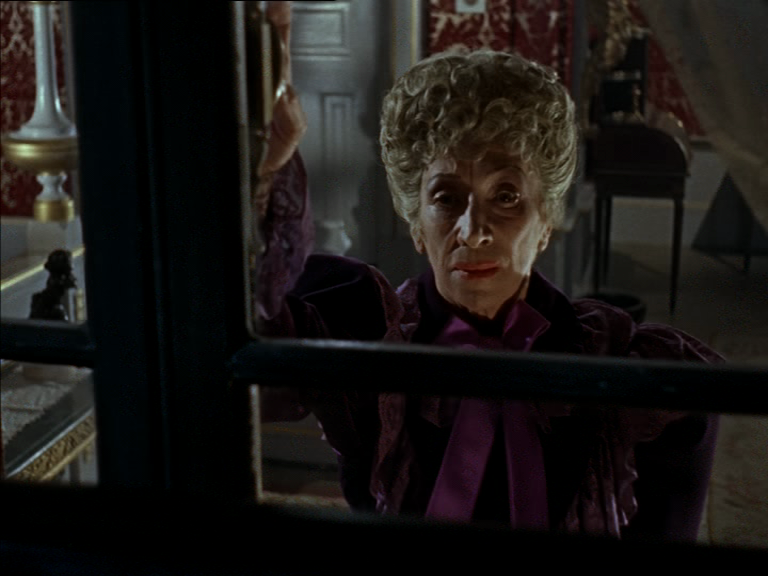
(This review is dedicated to director Quentin Tarantino for his relentless efforts to promote the movies of the past.)
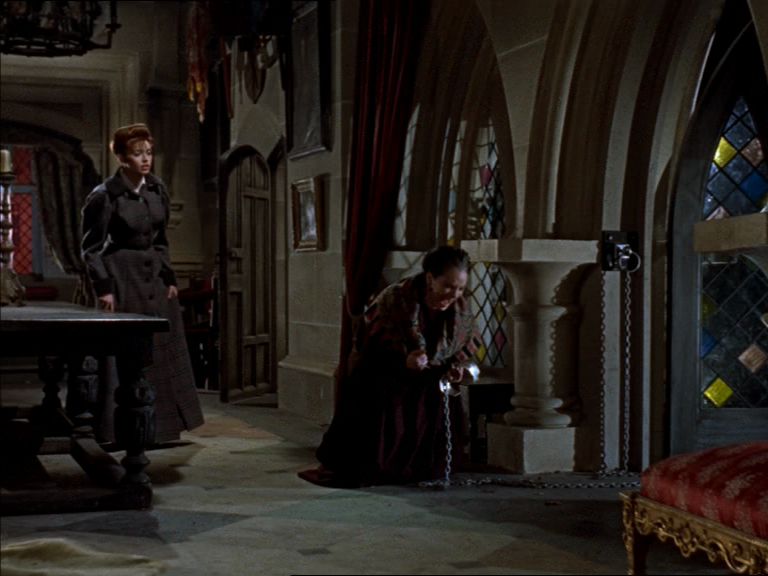
(Text: © JS/Manningtree Archive)