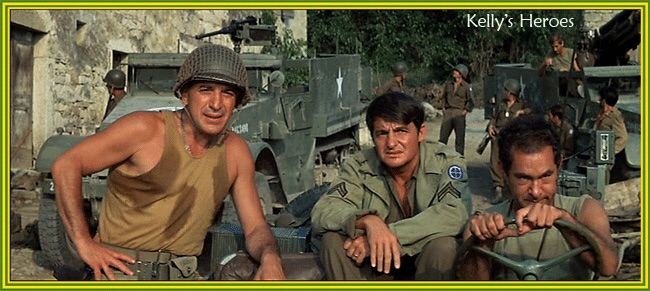
Tag Archive | Claudia Cardinale

Irène Papas Makes An Entrance

Screen actress Irène Papas became synonymous with world-class Greek stage/screen performers in the category of Katina Paxinou (Katina Konstantopoulou, 1900-1973), Melina Mercouri (Maria-Amalia Mercouri, 1920-1994), Eva Kotamanidou (1936-2020), etc, irrespective, to few critics, some may be of dark complexion or with language fluency issues.

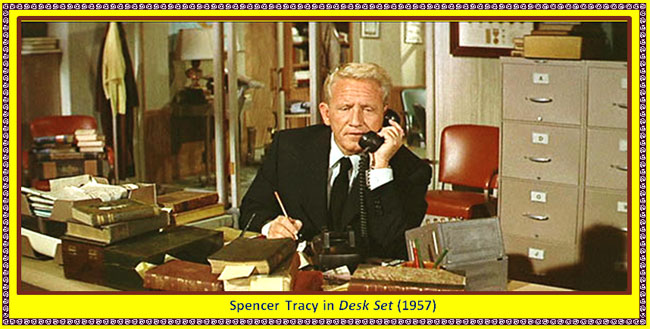
One of Irène’s bad experiences came from actor Spencer Tracy during the production of the Western movie, Tribute to a Bad Man (1956) which Tracy never finished because director Robert Wise (1914-2005) fired him. A book describes how Tracy derided co-star Irène because she was too clumsy and too tall (big raw-boned five feet ten inches in her bare feet, as tall as Tracy) and her English didn’t suit him because she was from Greece.
Greece which is domicile to Greek, one of the world’s oldest written languages, as well as to minority languages and Greek dialects, English together with German, French and Italian were the most common foreign languages spoken. Apart from her native Greek and competence in English, Irène also spoke German and Italian. As a matter of fact, Irène had been in London where she made effort to perfect her almost fluent English.

In those days, foreign-language features showed an increase in bookings and according to top players in U.S. movie circles, besides A-List performers such as Sophia Loren, Gina Lollobrigida, Simone Signoret, Alec Guinness and Maximilian Schell, the other foreign film personalities whose names became familiar to U.S. audiences during 1962 included Alain Delon, Claudia Cardinale, Marcello Mastroianni, Jeanne Moreau, Elsa Martinelli, Melina Mercouri, Horst Buchholz, Maria Schell, Irène Papas, Romy Schneider, Alida Valli, Jean-Paul Belmondo, Alberto Sordi and Christian Marquand.

These best-known of the foreign stars were considered marquee names capable enough to draw patrons to the box-office, and almost all of them have either made pictures in Hollywood or appeared in English-language pictures filmed in Europe by American show business companies.
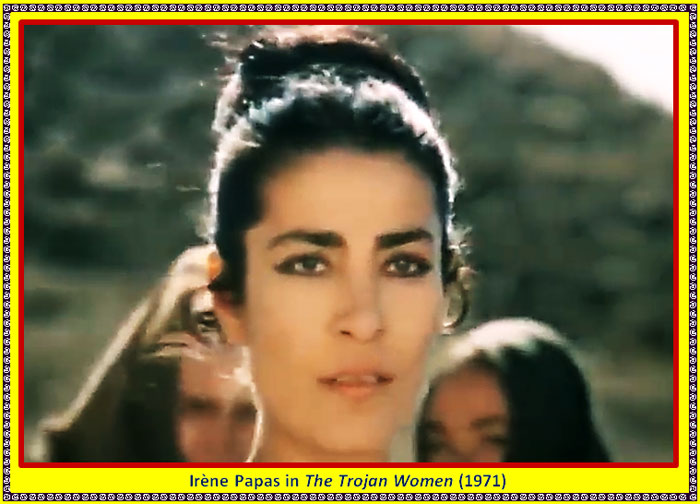
To a great extent, those who are famous stay that way because the press keeps them in the public eye. As for the gifted Irène Papas whom many have waxed poetic in praise of her, upswing on her career also gifted her ample occasions to meet a number of influential people in the film industry, some of them veritable volcano of knowledge and inspiration. It would have been completely in character that her career also brought her time to socialize with the prettiest people, most of them exceedingly rich and ripe, not boors or bores. Then again, one also had to good-naturedly tolerate a great deal of unprofessionalism, too. She was once bestowed with the title “Europe’s Woman” for her efforts to bolster European civilization.

As an award-winning actress who personified Greek female beauty on the cinema screen and on the stage, Irène Papas starred alongside fashionable Hollywood stars of the time such as Anthony Quinn, Gregory Peck, James Cagney, Kirk Douglas, etc. With Kirk Douglas and Alex Cord, she co-starred (as Ida Ginetta) in director Martin Ritt’s The Brotherhood (Mafia, 1968), an excellent Godfather predecessor produced by Kirk Douglas, one of the best paid actors in Hollywood during that time.

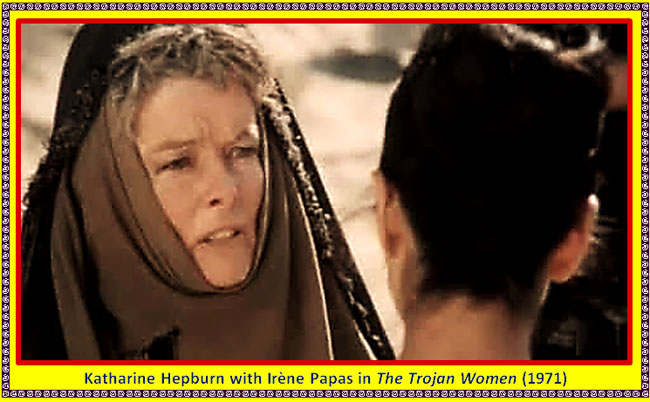
It was Irène’s association with Michael Cacoyannîs (1922-2011) that paved way for Irène’s brilliant performances in the title role in Electra (1962); in Zorba the Greek (Alexis Zorbas, 1964); in The Trojan Women (1971) and also in Sweet Country (Glykeia patrida, 1986), a forceful drama filmed in Greece. These are part of a clutch of films rightly considered as the high point of Irène’s film career. Cacoyannîs is the Greek Cypriot theatre/film director who introduced actress Melina Mercouri (as a good femme fatale) through his 1955 film, Stella.   
Audiences across the world who have seen Zorba the Greek may remember Cacoyannîs’ treatment of Irène Papas in the role of the widow when the viewer first saw glimpses of her face as she hung her immaculate sheets on the clothesline while it flapped in the wind.
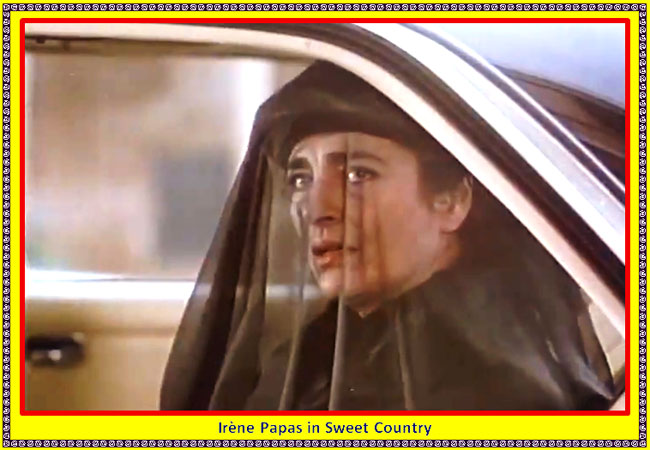
Sweet Country, based on a novel by Caroline Richards, is about the emotional turmoil that befalls an American expatriate couple, Anna Willing (Jane Alexander) and professor husband Ben (John Cullum) while living under military rule following the September 1973 Rightist military coup led by General Augusto Pinochet Ugarte after the assassination of Chile’s first socialist President Salvador Allende (1908-1973). The film is an indictment of conditions that existed at that time when lead character Anna is drawn into the resistance against Pinochet as she attempt to get the torture victims across the border.

In 1968, Irène had an on-going contract to star in director John Huston’s epic production of The Madwoman of Chaillot (1969), based on the 1943 classic play La Folle de Chaillot by French novelist (Hippolyte) Jean Giraudoux. The film featured an all-star cast of Katharine Hepburn, Charles Boyer, Yul Brynner, Giulietta Masina, Edith Evans, Danny Kaye, John Gavin, Paul Henreid, Margaret Leighton, Richard Chamberlain, Donald Pleasence, and Nanette Newman.

The production of The Madwoman of Chaillot was not all smooth sailing. Few days before the production began in Nice, France, the Producers had profound reservations about director Huston who had difference of opinion on the modernization of the movie’s theme. They clinched a deal with British director Bryan Forbes to take over direction of the movie at very short notice. Furthermore, days into the shooting at the Studios de la Victorine, Nice, France, Irène opted out of her role which went to English stage actress Edith Evans DBE. Irène too had not been in a good frame of mind with the characterisation of the role of Josephine she was portraying. All this put-downs were newsworthy in the show business circles.

More a proven actress than a glamorous star alone, Irène Papas has starred in numerous movies, some of them forgettable except for her presence in them. Nonetheless, there are enough significant movies she has done that became the consuming interest to her celebrity status. Listed below, in order of year of release, are some of Irène’s movies in my collection (1):
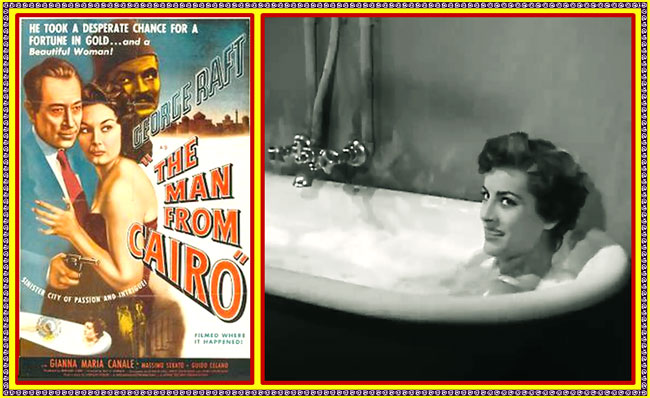
Irène Papas acted as Yvonne Lebeau, a dancer at Cote Bleu, a little nightclub in downtown Algiers in The Man from Cairo (Crime Squad/Dramma nella Kasbah, 1953). Based on story by Hungarian novelist Ladislas Fodor and directed by Ray H. Enright (and Edoardo Anton – uncredited), it was filmed on location in Algeria and Italy. The movie center upon a fortune in gold, lost on the North African desert, which lures a variety of wealth-seekers. After many twists and turns, an American tourist and General Dumont solve the mystery of the lost gold. Although Irène only had a short spell in the earlier part of the movie, George Raft, Gianna Maria Canale, and Massimo Serato in prominent roles had better scope to display their acting talents;

Irène did the starring role of Faidia in Theodora, Slave Empress (Teodora, Impératrice di Bisanzio, 1954), an Italian production by Lux Film with a cast of hundreds, massive sets and in dazzling Pathécolor directed by Riccardo Freda. Stunningly beautiful Gianna Maria Canale, the director’s better half, played the role of Teodora, the daughter of a bear feeder at the amphitheatre who rose to become empress of Byzantium, the celebrated consort of the handsome Emperor Justinian/Giustiniano (Georges Marchal). Teodora champions the causes of the common people, to the displeasure of the prime minister, Giovanni Cappodocia (Henri Guisol), the chief troublemaker who breeds conspiracy. The film marked the second co-starring role of Irène with Gianna Maria Canale, the first being The Man from Cairo.
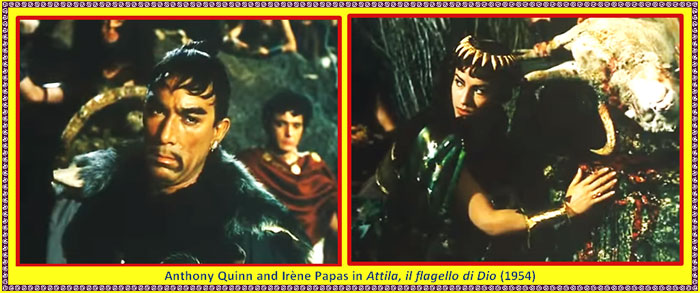
In 1954, Attila (Attila, il flagello di Dio/Attila, Hombre o Demonio/Attila, fléau de Dieu) was released with Irène in the role of Grune. The film featured the cult of the most ruthless conqueror of all time – the barbarian Attila the Hun who, with sword and flame, swept across the civilised world in the year 450 A.D. Even the mighty Roman Empire was marked for his conquests. A Dino De Laurentiis and Carlo Ponti production for Lux Film, directed by Pietro Francisci (1906-1977), Anthony Quinn gave the title role pure savagery while romancing Sophia Loren in the role of Attila’s woman Honoria. Jo                                        

Notes:  

  1. The listed reviews in this tribute is limited only to those films in my personal collection;
  2. DVD/Blu-ray of most of the movies mentioned in this write-up is available with some leading dealers.
  3. Up to now, the sources of reference for this tribute to Irène Papas are archives of the past including printed publications and visual media. DVD sleeves/images shown here are only for promotional purpose. Source: Wikipedia, amazon.com, imdb, and from DVD sleeves.
  4. This illustrated article is an affectionate nosegay to the movies referred above. Please refer to “About” of my webpage for more details.

(© Joseph Sébastine/Manningtree Archive)

Telly Savalas in the Limelight

001

Part II of Mr. Telly Savalas, Back to the Limelight…., Please!

Kojak hoisted the 49 year-old Savalas to superstardom, bestowing on the Greek the status of a sex-symbol, whose trademark quip in his Graeco-Yiddish-Brooklyn accent: “Who loves ya, baby?” engaged wide attention. The title role also brought the actor with a mole on his left cheek an Emmy and two Golden Globes. (Telly revived Kojak in some TV episodes during 1985-1990.) image

As film after film came his way, his commitment to his career not only remained progressive, but Telly had also acquired a taste for wealth and the lifestyle that went with it – savouring the attention his fans bestowed on him. They fed his ego, reaffirming the appeal of Savalas the Star. Like in all aspects of his life, his self-indulgent lifestyle reflected on his stylish images, airbrushed to perfection, on the cover of glossy magazines to the licence plate of his car which flashed “Telly S”.

image

He met friendly receptions wherever he went for shooting movies or not. He had a great time in southwest Africa in 1975 shooting Killer Force (aka. The Diamond Mercenaries, D: Val Guest, 1976). Likewise, the German fans were happy to see him in West Berlin for the location work of Inside Out (aka. Hitler’s Gold/The Golden Heist, D: Peter Duffell, 1975). In Berlin, the children rolled up their sleeves to have their arm autographed by him while the girls greeted him with fresh red roses and handful of lollies which he often gave away.

image

Keeping up with the then trend in Hollywood for racehorses, Telly ventured into horse racing when actor Walter Matthau turned down an offer to invest in a racehorse. With producer/director Howard W. Koch taking half interest, Telly acquired the other half at $3000 in an American thoroughbred racehorse whom he named Telly’s Pop (either after the lollipops he devours or his late-father who took him to his first horse race as a boy in New York).

image

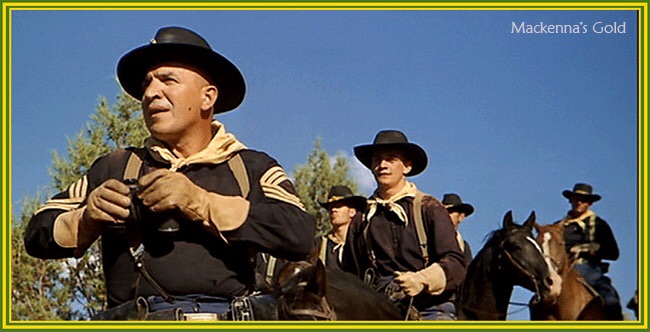
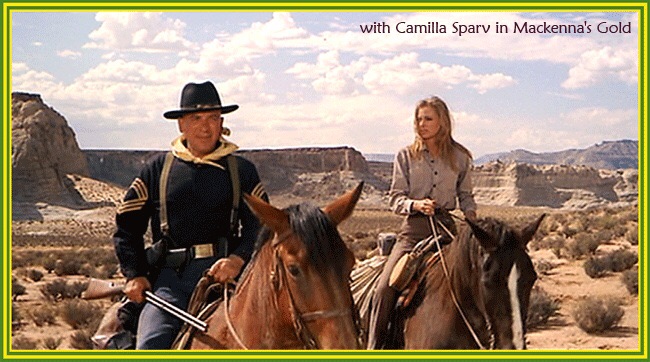
Although Telly later admitted on his CBS-TV show that he does not know anything about horses, audiences who had seen The Scalphunters, Mackenna’s Gold, etc, know that he could handle a horse.

image

Telly dipped his toes into championship gambling and promotion of brand products. Lifting himself into the line-up of singing stars of stage and screen such as Mae West, Ethel Merman, Noel Coward, Robert Mitchum, Jayne Mansfield, Harry Belafonte, Christopher Lee, he forayed into the music industry and had some chart success – tunes that would make Duke Ellington tap his shoes seven-feet under.

image

By the age of 54, Telly had won over audiences with his nightclub act in Lake Tahoe and Las Vegas where one of the highlights was a bouzouki dance he performed with his brother Constantine. In November 1975, at the wish of Her Majesty Queen Elizabeth II, Telly sang at her Royal Command Palladium concert where celebrities like Count Basie, Charles Aznavour, etc performed in spite of the bomb scare that autumn. During that time, the media reported him playing golf with world’s top golfer Tom Weiskopf on the Ailsa golf course at Turnberry in Scotland.

image

image

Often things in life simply don’t go according to set decisions. Telly never forgot the break he got from Burt Lancaster into movies which he reciprocated to the career of others. A 1975 newspaper reported actor Gene Hackman talking on the Douglas show about how Telly, while preparing to move from New York to start out his acting career in Hollywood, suggested to Hackman to “get his skates on” and head for the West Coast where the real action is – which resulted in Hackman’s entry into films on the Coast. Like Telly, the film Mad Dog Coll also marked the debut of Gene Hackman. Telly also played an active part in philanthropy and philhellenism. However, as always, there are different perspectives about Telly bordering on arrogance and rudeness I have also come across during my research.

image

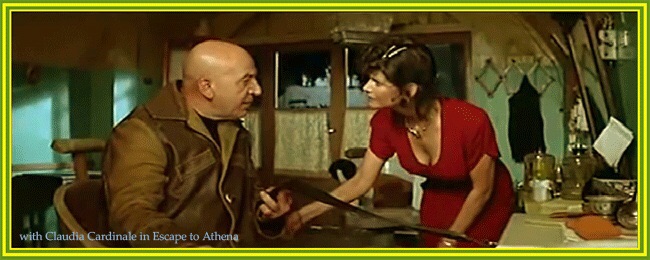
For the Greek-American icon who once said that he carried his Hellenism like a badge of merit, the opportunity to play a real Greek on Greek soil came in 1978 in the WW2 POW adventure film, Escape to Athena (D: George Pan Cosmatos, 1979) which had an all-star cast including Roger Moore, David Niven, and Claudia Cardinale.

image

In his autobiography, actor Roger Moore wrote about his location days for Escape to Athena on the isle of Rhodes when he brushed up on his gambling at the tables of the local casino which were also frequented by Telly. Stuntman Vic Armstrong’s autobiography also contains interesting pieces about the location shooting of this movie – about how, in the early hours, a bored Telly would phone him to play a game of poker.

image

Telly visited Greece again in early 1982 for location shoot in Laconia for My Palikari (American Playhouse, D: Charles Dubin). He turned this into a family affair and had his young son Nicholas from Los Angeles christened at the church in the village of Anogia, the birthplace of Telly’s mother.

image

Meanwhile, his career progressed with movies including Capricorn One (D: Peter Hyams, 1977), Beyond the Poseidon Adventure (D: Irwin Allen, 1979), Border Cop (aka. Blood Barrier, D: Christopher Leitch, 1979), Hellinger’s Law (D: Leo Penn, 1981), Fake-Out (aka. Nevada Heat, 1982), Alice in Wonderland (D: Harry Harris, 1985), The Dirty Dozen: The Deadly Mission (D: Lee H. Katzin, 1987), The Dirty Dozen: The Fatal Mission (D: Lee H. Katzin, 1988), Mind Twister (D: Fred Olen Ray, 1994), Backfire! (D: Dean Bell, 1995), etc.

image

Augmenting his taste for the international high life, he was regularly featured in forgettable European movies shot across the Atlantic. Some of them were as dull as a wet Good Friday but made pots of money. Having worked with European moviemakers earlier, Telly was at ease with the European way of shooting schedules and locations all over Europe. In the movie business, one gets to work closely with a lot of people. His further outings into Continental productions also gained him good rapport with more moviemakers as well as with industry professionals and eminent personalities.

image

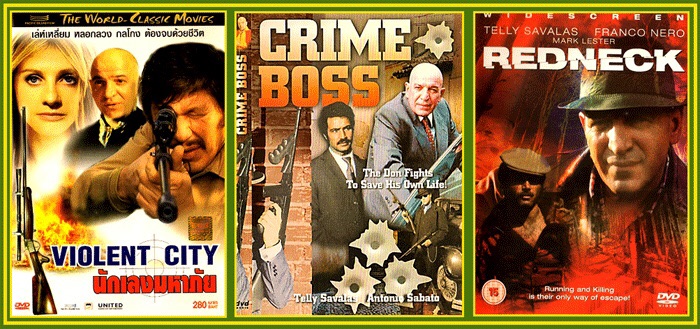
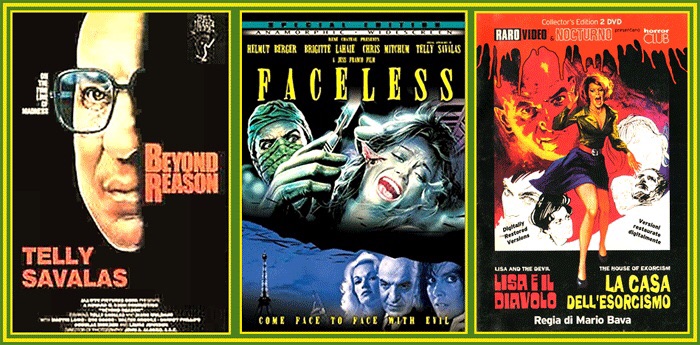
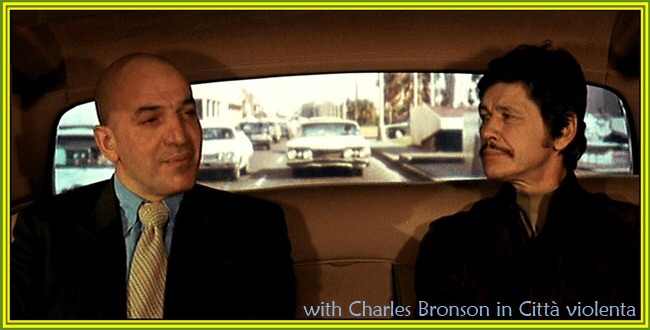
A Town Called Hell (D: Robert Parrish, 1971) and A Reason to Live, A Reason to Die (D: Tonino Valerii, 1972) were shot in spaghetti film locations in Almeria and Madrid. His repertoire of European productions also included the Charles Bronson-Jill Ireland vehicle Città violenta (aka: Final Shot/The Family/Violent City, D: Sergio Sollima, 1970), Crime Boss (D: Alberto De Martino, 1972), Senza Ragione (aka Redneck, D: Silvio Narizzano, 1973), Faceless (aka. Les prédateurs de la nuit, D: Jesús Franco, 1987).

image

Besides Telly’s appearance in Horror Express (1972), Italian director Mario Bava and producer Alfred Leone cast him in Lisa and the Devil (Lisa e il Diavolo, 1973 – re-edited into The House of Exorcism (1975)) as the devious butler Leandro, the Devil who lured Lisa (Elke Sommer) into the Spanish villa of a blind Contessa and her deranged son. It is in this masterpiece of Mario Bava, mainly shot during the latter half of 1972 in Toledo, outside Madrid and Barcelona that Bava showed the lollipop sucking Telly to great effect, and the sucker became Telly’s trademark in Kojak by late 1973.

image

While his continuous interest in Continental filmmaking extended to the 1991-93 TV series  Ein Schloß am Wörthersee shot in Austria and Italy, Telly had also appeared in faraway locations like Australia where he shot Rose Against the Odds (D: John Dixon, 1991).

image

Hollywood Boulevard’s Walk of Fame awarded him his Star in 1983. The following year, Telly and his third wife Julie Hovland were married. Having promised to be together for richer, for poorer, in sickness and in health, they remained married until his death.

On Saturday July 23, 1988, the tragedy struck. Christina Savalas, Telly’s mother and a leading American artist whose “Picassolike” work received local and international exhibitions, died of heart failure at age 84 at Providence Saint Joseph Medical Center, Burbank, California.

image

On Saturday, January 22, 1994, one day after his 72 birthday, surrounded by wife Julie Hovland and family, Telly died of Prostate cancer at the suite he kept at the Sheraton Universal Hotel, Universal City. According to the death certificate, the cause is stated as Renal Failure/Metastatic Disease/Transitional Cell Cancer of Bladder.

image

After services at St. Sophia Greek Orthodox Cathedral in Los Angeles, Telly was buried at Forest Lawn Memorial Park, Hollywood Hills, Los Angeles, on January 25, 1994. The large marker on the lawn of his grave contains the header “Telly Aristotle Savalas” (a) followed by the quote from Aristotle:

The hour of departure has arrived,

and we go our ways –

I to die and you to live.

Which is better God only knows.

image

Telly has gone. Has he fulfilled his aims and ambitions? The question brings to mind a letter the French novelist and playwright Honoré de Balzac, when quite a young man, wrote to his sister about his aims and ambitions: “….. I have two and only two passionate desires – to be famous and to be loved. Will they ever be satisfied?”  As for Telly, maybe none may dispute that he had fulfilled both the desires Balzac was referring to.

Until next time, Jo

image

Notes:

  1. The spelling of the middle name on the marker and the Certificate of Death: 39419004248 dt. 22-1-1994 shown in a website differs.
  2. This article owes its source to various newspapers, books, magazines, visual media, etc.
  3. Films forming part of the collection of Manningtree Archive are marked in bold.
  4. Most of the movies and books referred to in this article are available with amazon.com, amazon.co.uk and other leading dealers.
  5. DVD sleeves credits: amazon.com, en.wikipedia, imdb and from my private collection.
  6. This illustrated article is an affectionate nosegay to the movies and performers of the past. Please refer to “About” of my webpage for more details.

001

(©Joseph Sébastine/Manningtree Archive)