

My mind, sound by nature, was my teacher. I need no more.
I offered my husband a silent tongue and gentle looks.
I knew when to have my way and when to let him have his.
– Euripides The Women of Troy (642-651)
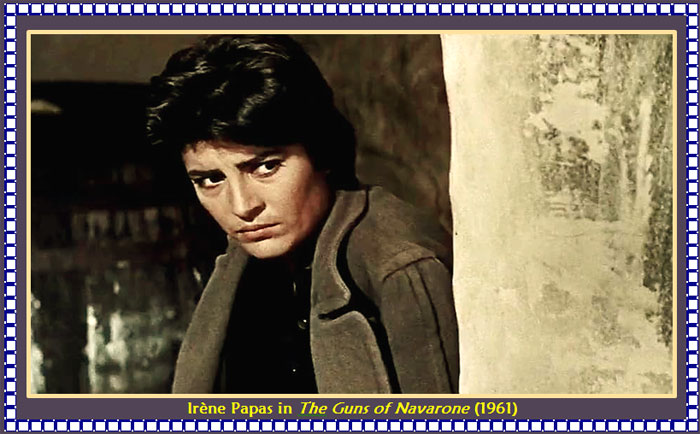
Irène Papas was finally placed under the direction of the Bristol-born filmmaker J. Lee Thompson (1914-2002) to play the role of Maria Pappadimos in The Guns of Navarone (1961). Her role is of a hardened Greek partisan fighter who develops a liking for fiery Andrea, a character played by Anthony Quinn in this film about a Nazi big-gun stronghold overlooking the Mediterranean.

American film producer and scriptwriter Carl Foreman’s The Guns of Navarone was a motion picture “event.” Being the first of Alistair MacLean’s pulsating novels to be turned into a movie, it’s a high-powered action movie by Highroad Films, an Anglo-American firm (1). Magnificently filmed in Cinemascope and Eastmancolor by Pathe, and set in 1943 during WW2, it dealt with Allied commandos and Greek resistance fighters assigned to destroy two huge newly-designed radar-controlled guns on the German-held Aegean Sea island of Navarone. These guns prevented the vital Aegean Sea channel from being used by the Allies in World War II.


Director J. Lee Thompson, who was a last minute replacement of Alexander “Sandy” Mackendrick (1912-1993), was by that time one of the most flamboyant writer-producer-directors, with Ice Cold in Alex (Desert Attack, 1958), North West Frontier (Flame Over India) and Tiger Bay (both in 1959) to his credit to which, he would later on add a string of noteworthy movies such as Cape Fear, Taras Bulba (both in 1962), Kings of the Sun (1963), Mackenna’s Gold (1969), etc.

Irène was to be part of an impressive stellar cast who have carved a prominent niche for themselves in the motion-picture world: Gregory Peck, David Niven, Anthony Quinn, Stanley Baker, Anthony Quayle, James Robertson Justice, Richard Harris, Bryan Forbes, etc. For the required amount of feminine appeal, besides Irène, Gia Scala portrayed Anna, another fighter.

James Darren (who sadly passed away at the age of 88 on September 02, 2024) played Spyros Pappadimos, a Greek-American boy skilled with a machine gun, who also performs a Greek folk song called “Yassu (Wedding Song)” in the movie.

Even though Cypress and Yugoslavia were initially considered for production possibilities, the final choice for on-location shoot fell on the Island of Rhodes, in the heart of the Aegean Sea. It’s not that the choice for filming the motion picture of this dimension didn’t face any difficulties in Greece. During that time, the local processing of the film was unpredictable; and the local sound systems were based on 17 ½ mm. tape, rather than the 35 the crew were used to. The only projection facilities that could be used were in a large hall at the local police station. The acoustics defied anyone to understand the dialogue. Then again, undeniably, the people were warm and hospitable, and willing to do superhuman feats in order to please. The government, the airlines, the hotels, etc, all contributed more in the way of service, material and personnel.
In mid-1960, as part of promotion of the movie, a stalagmite (an incrustation formed on the floor of a cavern) from the Luray Caverns of Virginia was despatched to Greece where it was swapped with a stalagmite from the Petralona Caverns of Greece and sent to Luray. These stalagmites were officially exchanged in Greece between Gregory Peck and Irène Papas.

In the course of almost seven months of shooting in Greece and England, the final stage of filming was completed in the studio in England – in one of the largest outdoor sets which took five months to construct using tubular steel, timber and about 14 miles of cable. Set-making has always been a big part of a film’s budget but it goes in phases. More than 160 workmen on a seven-day-a-week basis were involved. The outcome was the enormous guns and cave fortress towering over 140 feet into the air and stretched over an area of almost two acres, to represent the German-occupied base on the Greek island. Despite the collapse of this fantastically expensive set at Shepperton Studios as well as the continuously mounting budget, the filming had a wrap by mid-October 1960.

The movie turned out to be a blockbuster hit and not only racked up in box-office grosses but wide acclaim including royal treatment around Europe via galas before crowned heads. Special showings were attended by late Queen Elizabeth II and Prince Philip of Great Britain; Princess Grace and Prince Rainier III of Monaco; then newly-wed King Baudouin and his Queen Fabiola of Belgium; and the King Paul and Queen Frederica of Greece. King Paul conferred the Order of Phoenix and rank of Brigadier of the Greek Army on Carl Foreman for his services to Greece through the filming of The Guns of Navarone. The film netted 1962 Academy Award nominations which included Best Motion Picture, Best Directing, Best Writing (Screenplay – based on material from another medium), Best Music (Music Score of a Dramatic or Comedy Picture), Best Film Editing, etc., and the film won for Best Special Effects in the 34th Academy Awards.

Sometime earlier Irène Papas top-lined in the title role of director Georges Tzavellas’ Antigone (Antigoni, 1961) – a B/W movie (with English subtitles) of such profound dimension that it helped fortify Irène’s reputation as a fine interpreter of Greek classics on movies.
The screenplay by Tzavellas was adapted in its classical form from Sophocles’ poetic parable of the Greek tragedy of Oedipus, King of Thebes though with a modernized Greek text in the name of poetic licence. Set in the ancient Greek city of Thebes, Irène’s dramatic beauty dominates as Antigone who is condemned to death for defying King Creon by burying her two brothers killed in a quarrel over their succession to the throne of Thebes.

The shooting schedule at Alfa Studios, Athens, stretched to 58 days and the production cost ran in excess of $200,000/- which was believed to be a record high for a film made by the Greek film industry at that time. The production, which regrettably suffered delays, was carried out by Greek talent throughout; also featuring Greek performers: Manos Katrakis, Maro Kontou, Nikos Kazis, Ilia Aibikou as Eurydice, etc. Part of the cast were soldiers and horsemen of the Royal Greek Guard and Army and 500 actors of the Greek theatre and cinema. Arghyris Kounadis provided the music score.

While Antigone movie project was initiated by a Connecticut exhibitor through his Norma Film Productions, he had every expectation that the movie will eventually earn a profit due to its special qualities in relation to the cultural heritage of Greece. As a matter of fact, all the financial backing was made by American investors of Greek descent from “outside the industry” who were motivated by a pride in their Greek heritage and a desire to dispel the notion that Greece exports nothing but restaurateurs. Furthermore, this Greek heritage lining the theme of the movie was a profitable aspect the filmmakers believed helped Antigone in its promotion for its distribution to schools, colleges, libraries, cinema clubs, etc.

Distinguished productions of the classic Greek tragedies dealing with highly charged subjects as revenge, retribution and matricide, are rare owing to elevation of concept and nobility of performance. As the title character in Finos Films’ Electra (Elektra/Ilektra, 1962), the Greek classical tragedy of yore, Irène Papas finally got the chance to show off her acting chops.
As the story goes, Electra is the daughter of King Agamemnon (Theodore Demetriou) and Clytemnestra (Aleka Katselli). Upon his victorious return from the Trojan War, Agamemnon was killed during his bath by his wife Clytemnestra and her paramour Ægisthus (Fivos Razi/aka. Phoebus Rhazis), while the children Orestes (Petros Ampelas) and Electra (Elsie Pittas) waited outside. Following the murder, the boy Orestes is taken away to safety outside of the country by an old retainer whilst his sister Electra remained at the palace a virtual prisoner. In the euphoria of victory, Clytemnestra and Ægisthus married and at a subsequent time, Electra was married off to a poor farmer who respected her.

It was not until years later Orestes (Giannis Fertis) returned with a friend, and the siblings united. They plot to avenge their father Agamemnon whose murder had taken place following his return from Troy with his lover, Cassandra, one of the 50 children of King Priam of Troy and his principal wife Hecuba. In due course, Orestes killed Ægisthus during a celebration. Orestes also gained the support of the followers of the dead king whose valour was imprinted on their minds. However, Electra (Papas) urges her older brother Orestes to kill their mother Clytemnestra as well. Her contention was vengeance for the murder of their father. Orestes duly complies with Electra’s wishes. Be that as it may, shocked by the killing of Clytemnestra, the great majority of followers of the brother and sister turned against them and drove them away from the land.

Written and directed by Michael Cacoyannîs based on Euripides trilogy (The Trojan Women, 1971 and Iphigenia, 1976 followed) this United Artists’ movie version contained murder, adultery, vengeance and matricide. Purportedly made for a budget of about US$70,000/-, Electra which received plenty of art house attention in theatres world over, was shot on location in Mycenae and Argos in Greece with excellent direction, production values including dramatically powerful score by quite musically knowledgeable left-wing composer Mikis Theodorakis. The visual beauty of cinematography was by English cameraman Walter Lassally who will be back in Greece couple of years later to lens there another Greek feature, Zorba the Greek, under direction of Michael Cacoyannîs. According to Walter Lassally, Cacoyannîs pre-planned his scenes down to the last detail although he didn’t actually make sketches and his scripts were written in shots, not in scenes.

Irène’s noble beauty, facial features and performance as Electra were so appropriate that a writer once quoted in a magazine feature: “What a superb face Papas has for Greek tragedy. She is, almost, for Michael Cacoyannîs what Liv Ullmann is for Ingmar Bergman.” The admirable hairdo Irène featured in Electra was specifically created under the inspiration of Cacoyannîs which Irène retained long enough to sport at the Festival de Cannes in May 1962.
In fact, UA took precautions to ensure that no one confuses their Electra at the 15th Cannes Film Festival 1962, with the Greek-sponsored Electra, which was a filmed version of the Greek National Theatre presentation of the Sophocles version staged at the ancient Theatre of Epidaurus. Importantly, the UA version, a prize-winner of Best Cinematic Transposition (as best play-based film) is by Euripides.

Around that time, the German-born Austrian actor Karlheinz Böhm (1928-2014) planned to write and direct a modern version of Electra, set in post-war Germany with all contemporary fads and fashions, to be called “Trial of Orestes”. However, that project did not materialize. In early 1964, Electra won the Best Foreign Picture Award at the annual Cleveland Critics’ Circle prize luncheon while Irène Papas took honours as Best Foreign Language Actress. Jo

Notes:
- Something like 80% of the film’s budget was spent in sterling which qualified the film for the Eady Plan/Fund, a British film aid scheme which was, at that time, the envy of most other European film producing nations. The Eady Fund, which gets its income from a slice of box-office takings, is divvied out to producers of British Quota pictures. Anyone who makes a film in the UK can qualify for this aid, provided that the Quota laws are observed and that the film is made by a British company. The side-effect of this measure was an increase in the number of films Hollywood made in England. For instance, $1,000,000 plus went from the Eady kitty to The Guns of Navarone. The Eady Plan, named after British diplomat Sir Wilfred Griffin Eady, was terminated in 1985;
- Up to now, the sources of reference for this tribute (in 6 parts) to Irène Papas are archives of the past including printed publications and visual media. DVD/Blu-ray of most of the movies mentioned in this write-up is available with some leading dealers.
- DVD sleeves/images shown here are only for promotional purpose. Source: Wikipedia, amazon.com, imdb, and from DVD sleeves.
- This illustrated article is an affectionate nosegay to the movies referred above. Please refer to “About” of my webpage for more details.
(© Joseph Sébastine/Manningtree Archive)












 Manningtree Archive
You must be logged in to post a comment.