

Screen actress Irène Papas became synonymous with world-class Greek stage/screen performers in the category of Katina Paxinou (Katina Konstantopoulou, 1900-1973), Melina Mercouri (Maria-Amalia Mercouri, 1920-1994), Eva Kotamanidou (1936-2020), etc, irrespective, to few critics, some may be of dark complexion or with language fluency issues.

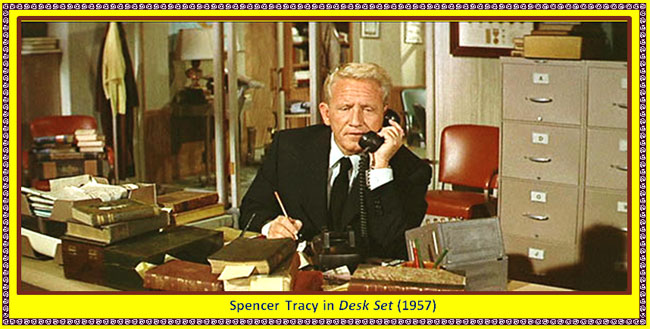
One of Irène’s bad experiences came from actor Spencer Tracy during the production of the Western movie, Tribute to a Bad Man (1956) which Tracy never finished because director Robert Wise (1914-2005) fired him. A book describes how Tracy derided co-star Irène because she was too clumsy and too tall (big raw-boned five feet ten inches in her bare feet, as tall as Tracy) and her English didn’t suit him because she was from Greece.
Greece which is domicile to Greek, one of the world’s oldest written languages, as well as to minority languages and Greek dialects, English together with German, French and Italian were the most common foreign languages spoken. Apart from her native Greek and competence in English, Irène also spoke German and Italian. As a matter of fact, Irène had been in London where she made effort to perfect her almost fluent English.

In those days, foreign-language features showed an increase in bookings and according to top players in U.S. movie circles, besides A-List performers such as Sophia Loren, Gina Lollobrigida, Simone Signoret, Alec Guinness and Maximilian Schell, the other foreign film personalities whose names became familiar to U.S. audiences during 1962 included Alain Delon, Claudia Cardinale, Marcello Mastroianni, Jeanne Moreau, Elsa Martinelli, Melina Mercouri, Horst Buchholz, Maria Schell, Irène Papas, Romy Schneider, Alida Valli, Jean-Paul Belmondo, Alberto Sordi and Christian Marquand.

These best-known of the foreign stars were considered marquee names capable enough to draw patrons to the box-office, and almost all of them have either made pictures in Hollywood or appeared in English-language pictures filmed in Europe by American show business companies.
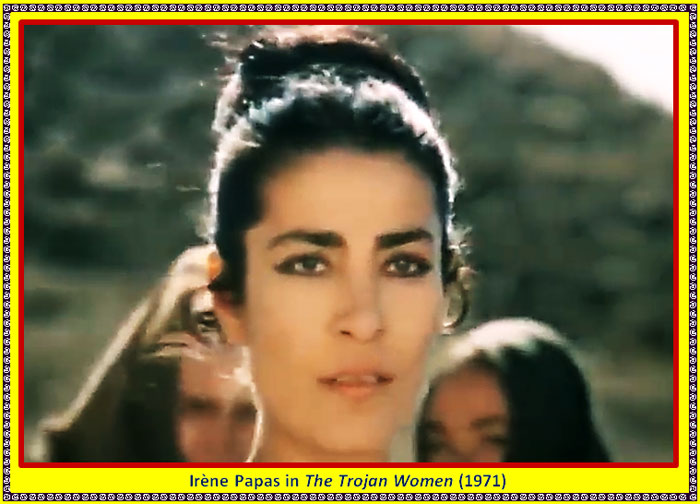
To a great extent, those who are famous stay that way because the press keeps them in the public eye. As for the gifted Irène Papas whom many have waxed poetic in praise of her, upswing on her career also gifted her ample occasions to meet a number of influential people in the film industry, some of them veritable volcano of knowledge and inspiration. It would have been completely in character that her career also brought her time to socialize with the prettiest people, most of them exceedingly rich and ripe, not boors or bores. Then again, one also had to good-naturedly tolerate a great deal of unprofessionalism, too. She was once bestowed with the title “Europe’s Woman” for her efforts to bolster European civilization.

As an award-winning actress who personified Greek female beauty on the cinema screen and on the stage, Irène Papas starred alongside fashionable Hollywood stars of the time such as Anthony Quinn, Gregory Peck, James Cagney, Kirk Douglas, etc. With Kirk Douglas and Alex Cord, she co-starred (as Ida Ginetta) in director Martin Ritt’s The Brotherhood (Mafia, 1968), an excellent Godfather predecessor produced by Kirk Douglas, one of the best paid actors in Hollywood during that time.

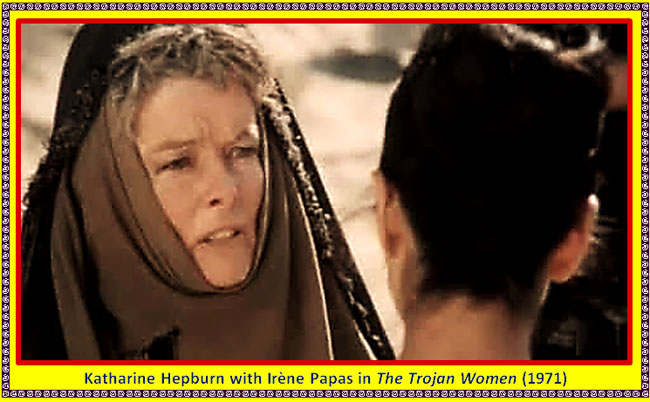
It was Irène’s association with Michael Cacoyannîs (1922-2011) that paved way for Irène’s brilliant performances in the title role in Electra (1962); in Zorba the Greek (Alexis Zorbas, 1964); in The Trojan Women (1971) and also in Sweet Country (Glykeia patrida, 1986), a forceful drama filmed in Greece. These are part of a clutch of films rightly considered as the high point of Irène’s film career. Cacoyannîs is the Greek Cypriot theatre/film director who introduced actress Melina Mercouri (as a good femme fatale) through his 1955 film, Stella.
Audiences across the world who have seen Zorba the Greek may remember Cacoyannîs’ treatment of Irène Papas in the role of the widow when the viewer first saw glimpses of her face as she hung her immaculate sheets on the clothesline while it flapped in the wind.
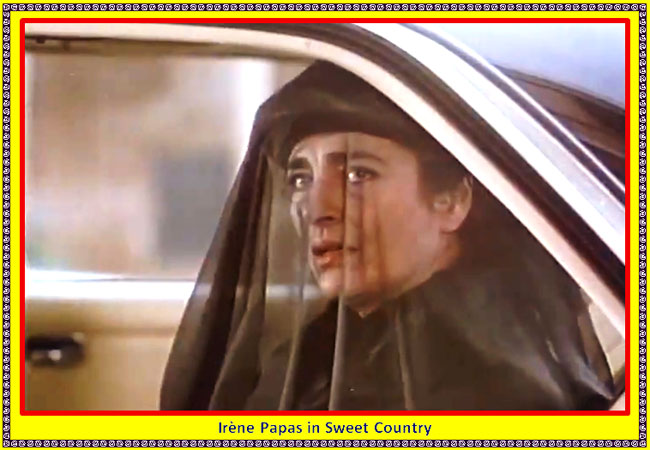
Sweet Country, based on a novel by Caroline Richards, is about the emotional turmoil that befalls an American expatriate couple, Anna Willing (Jane Alexander) and professor husband Ben (John Cullum) while living under military rule following the September 1973 Rightist military coup led by General Augusto Pinochet Ugarte after the assassination of Chile’s first socialist President Salvador Allende (1908-1973). The film is an indictment of conditions that existed at that time when lead character Anna is drawn into the resistance against Pinochet as she attempt to get the torture victims across the border.

In 1968, Irène had an on-going contract to star in director John Huston’s epic production of The Madwoman of Chaillot (1969), based on the 1943 classic play La Folle de Chaillot by French novelist (Hippolyte) Jean Giraudoux. The film featured an all-star cast of Katharine Hepburn, Charles Boyer, Yul Brynner, Giulietta Masina, Edith Evans, Danny Kaye, John Gavin, Paul Henreid, Margaret Leighton, Richard Chamberlain, Donald Pleasence, and Nanette Newman.
The production of The Madwoman of Chaillot was not all smooth sailing. Few days before the production began in Nice, France, the Producers had profound reservations about director Huston who had difference of opinion on the modernization of the movie’s theme. They clinched a deal with British director Bryan Forbes to take over direction of the movie at very short notice. Furthermore, days into the shooting at the Studios de la Victorine, Nice, France, Irène opted out of her role which went to English stage actress Edith Evans DBE. Irène too had not been in a good frame of mind with the characterisation of the role of Josephine she was portraying. All this put-downs were newsworthy in the show business circles.

More a proven actress than a glamorous star alone, Irène Papas has starred in numerous movies, some of them forgettable except for her presence in them. Nonetheless, there are enough significant movies she has done that became the consuming interest to her celebrity status. Listed below, in order of year of release, are some of Irène’s movies in my collection (1):
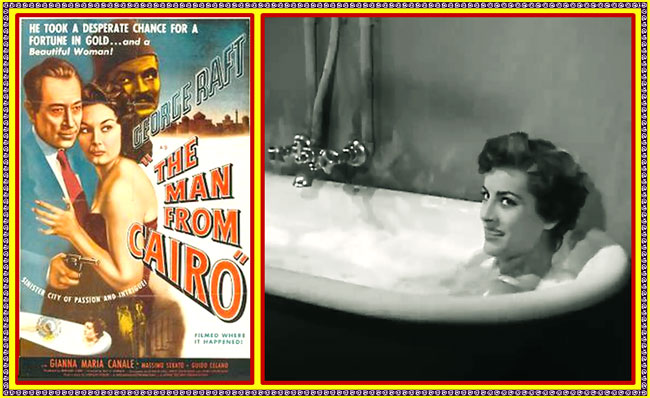
Irène Papas acted as Yvonne Lebeau, a dancer at Cote Bleu, a little nightclub in downtown Algiers in The Man from Cairo (Crime Squad/Dramma nella Kasbah, 1953). Based on story by Hungarian novelist Ladislas Fodor and directed by Ray H. Enright (and Edoardo Anton – uncredited), it was filmed on location in Algeria and Italy. The movie center upon a fortune in gold, lost on the North African desert, which lures a variety of wealth-seekers. After many twists and turns, an American tourist and General Dumont solve the mystery of the lost gold. Although Irène only had a short spell in the earlier part of the movie, George Raft, Gianna Maria Canale, and Massimo Serato in prominent roles had better scope to display their acting talents;

Irène did the starring role of Faidia in Theodora, Slave Empress (Teodora, Impératrice di Bisanzio, 1954), an Italian production by Lux Film with a cast of hundreds, massive sets and in dazzling Pathécolor directed by Riccardo Freda. Stunningly beautiful Gianna Maria Canale, the director’s better half, played the role of Teodora, the daughter of a bear feeder at the amphitheatre who rose to become empress of Byzantium, the celebrated consort of the handsome Emperor Justinian/Giustiniano (Georges Marchal). Teodora champions the causes of the common people, to the displeasure of the prime minister, Giovanni Cappodocia (Henri Guisol), the chief troublemaker who breeds conspiracy. The film marked the second co-starring role of Irène with Gianna Maria Canale, the first being The Man from Cairo.
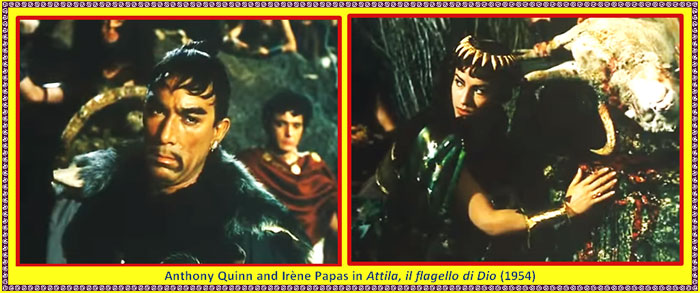
In 1954, Attila (Attila, il flagello di Dio/Attila, Hombre o Demonio/Attila, fléau de Dieu) was released with Irène in the role of Grune. The film featured the cult of the most ruthless conqueror of all time – the barbarian Attila the Hun who, with sword and flame, swept across the civilised world in the year 450 A.D. Even the mighty Roman Empire was marked for his conquests. A Dino De Laurentiis and Carlo Ponti production for Lux Film, directed by Pietro Francisci (1906-1977), Anthony Quinn gave the title role pure savagery while romancing Sophia Loren in the role of Attila’s woman Honoria. Jo

Notes:
- The listed reviews in this tribute is limited only to those films in my personal collection;
- DVD/Blu-ray of most of the movies mentioned in this write-up is available with some leading dealers.
- Up to now, the sources of reference for this tribute to Irène Papas are archives of the past including printed publications and visual media. DVD sleeves/images shown here are only for promotional purpose. Source: Wikipedia, amazon.com, imdb, and from DVD sleeves.
- This illustrated article is an affectionate nosegay to the movies referred above. Please refer to “About” of my webpage for more details.

(© Joseph Sébastine/Manningtree Archive)
 Manningtree Archive
You must be logged in to post a comment.