Tag Archive | John Huston

Irène Papas Makes An Entrance

Screen actress Irène Papas became synonymous with world-class Greek stage/screen performers in the category of Katina Paxinou (Katina Konstantopoulou, 1900-1973), Melina Mercouri (Maria-Amalia Mercouri, 1920-1994), Eva Kotamanidou (1936-2020), etc, irrespective, to few critics, some may be of dark complexion or with language fluency issues.

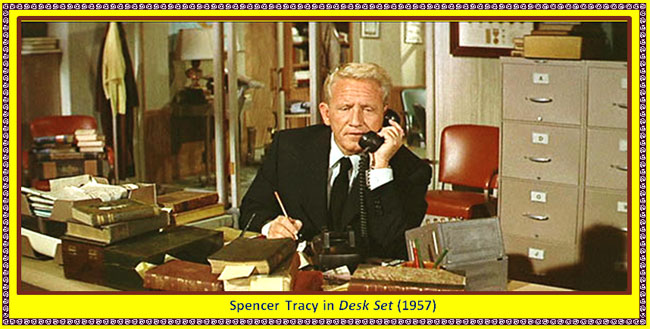
One of Irène’s bad experiences came from actor Spencer Tracy during the production of the Western movie, Tribute to a Bad Man (1956) which Tracy never finished because director Robert Wise (1914-2005) fired him. A book describes how Tracy derided co-star Irène because she was too clumsy and too tall (big raw-boned five feet ten inches in her bare feet, as tall as Tracy) and her English didn’t suit him because she was from Greece.
Greece which is domicile to Greek, one of the world’s oldest written languages, as well as to minority languages and Greek dialects, English together with German, French and Italian were the most common foreign languages spoken. Apart from her native Greek and competence in English, Irène also spoke German and Italian. As a matter of fact, Irène had been in London where she made effort to perfect her almost fluent English.

In those days, foreign-language features showed an increase in bookings and according to top players in U.S. movie circles, besides A-List performers such as Sophia Loren, Gina Lollobrigida, Simone Signoret, Alec Guinness and Maximilian Schell, the other foreign film personalities whose names became familiar to U.S. audiences during 1962 included Alain Delon, Claudia Cardinale, Marcello Mastroianni, Jeanne Moreau, Elsa Martinelli, Melina Mercouri, Horst Buchholz, Maria Schell, Irène Papas, Romy Schneider, Alida Valli, Jean-Paul Belmondo, Alberto Sordi and Christian Marquand.

These best-known of the foreign stars were considered marquee names capable enough to draw patrons to the box-office, and almost all of them have either made pictures in Hollywood or appeared in English-language pictures filmed in Europe by American show business companies.
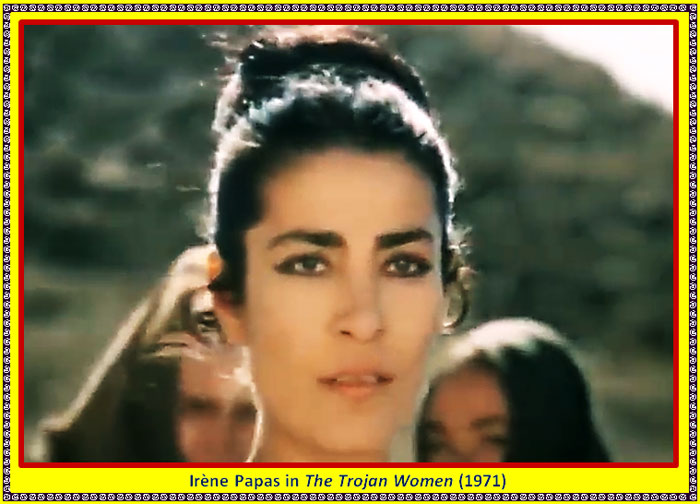
To a great extent, those who are famous stay that way because the press keeps them in the public eye. As for the gifted Irène Papas whom many have waxed poetic in praise of her, upswing on her career also gifted her ample occasions to meet a number of influential people in the film industry, some of them veritable volcano of knowledge and inspiration. It would have been completely in character that her career also brought her time to socialize with the prettiest people, most of them exceedingly rich and ripe, not boors or bores. Then again, one also had to good-naturedly tolerate a great deal of unprofessionalism, too. She was once bestowed with the title “Europe’s Woman” for her efforts to bolster European civilization.

As an award-winning actress who personified Greek female beauty on the cinema screen and on the stage, Irène Papas starred alongside fashionable Hollywood stars of the time such as Anthony Quinn, Gregory Peck, James Cagney, Kirk Douglas, etc. With Kirk Douglas and Alex Cord, she co-starred (as Ida Ginetta) in director Martin Ritt’s The Brotherhood (Mafia, 1968), an excellent Godfather predecessor produced by Kirk Douglas, one of the best paid actors in Hollywood during that time.

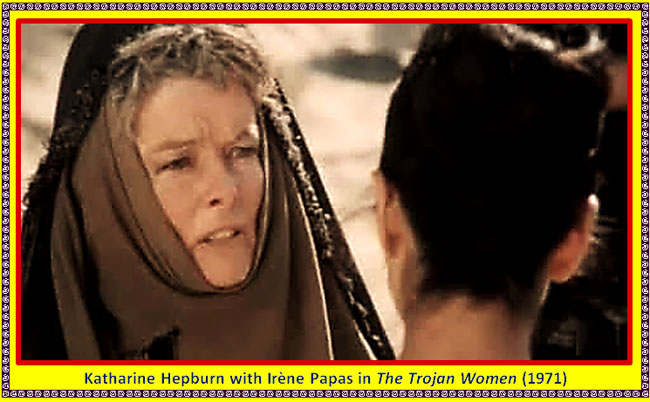
It was Irène’s association with Michael Cacoyannîs (1922-2011) that paved way for Irène’s brilliant performances in the title role in Electra (1962); in Zorba the Greek (Alexis Zorbas, 1964); in The Trojan Women (1971) and also in Sweet Country (Glykeia patrida, 1986), a forceful drama filmed in Greece. These are part of a clutch of films rightly considered as the high point of Irène’s film career. Cacoyannîs is the Greek Cypriot theatre/film director who introduced actress Melina Mercouri (as a good femme fatale) through his 1955 film, Stella.   
Audiences across the world who have seen Zorba the Greek may remember Cacoyannîs’ treatment of Irène Papas in the role of the widow when the viewer first saw glimpses of her face as she hung her immaculate sheets on the clothesline while it flapped in the wind.
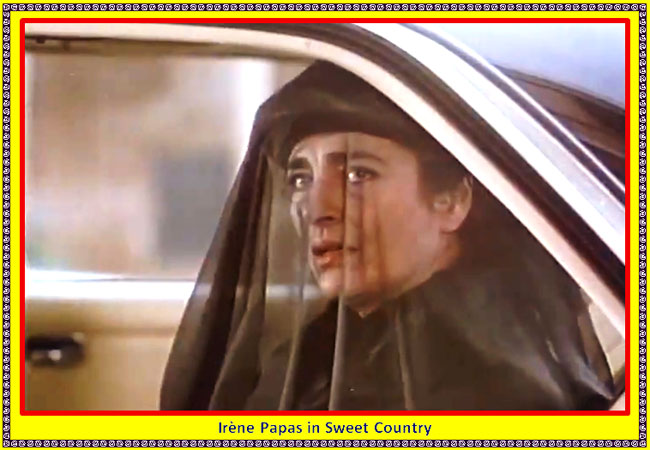
Sweet Country, based on a novel by Caroline Richards, is about the emotional turmoil that befalls an American expatriate couple, Anna Willing (Jane Alexander) and professor husband Ben (John Cullum) while living under military rule following the September 1973 Rightist military coup led by General Augusto Pinochet Ugarte after the assassination of Chile’s first socialist President Salvador Allende (1908-1973). The film is an indictment of conditions that existed at that time when lead character Anna is drawn into the resistance against Pinochet as she attempt to get the torture victims across the border.

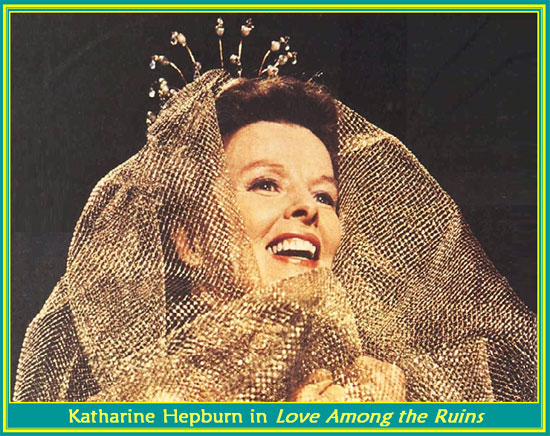
In 1968, Irène had an on-going contract to star in director John Huston’s epic production of The Madwoman of Chaillot (1969), based on the 1943 classic play La Folle de Chaillot by French novelist (Hippolyte) Jean Giraudoux. The film featured an all-star cast of Katharine Hepburn, Charles Boyer, Yul Brynner, Giulietta Masina, Edith Evans, Danny Kaye, John Gavin, Paul Henreid, Margaret Leighton, Richard Chamberlain, Donald Pleasence, and Nanette Newman.

The production of The Madwoman of Chaillot was not all smooth sailing. Few days before the production began in Nice, France, the Producers had profound reservations about director Huston who had difference of opinion on the modernization of the movie’s theme. They clinched a deal with British director Bryan Forbes to take over direction of the movie at very short notice. Furthermore, days into the shooting at the Studios de la Victorine, Nice, France, Irène opted out of her role which went to English stage actress Edith Evans DBE. Irène too had not been in a good frame of mind with the characterisation of the role of Josephine she was portraying. All this put-downs were newsworthy in the show business circles.

More a proven actress than a glamorous star alone, Irène Papas has starred in numerous movies, some of them forgettable except for her presence in them. Nonetheless, there are enough significant movies she has done that became the consuming interest to her celebrity status. Listed below, in order of year of release, are some of Irène’s movies in my collection (1):
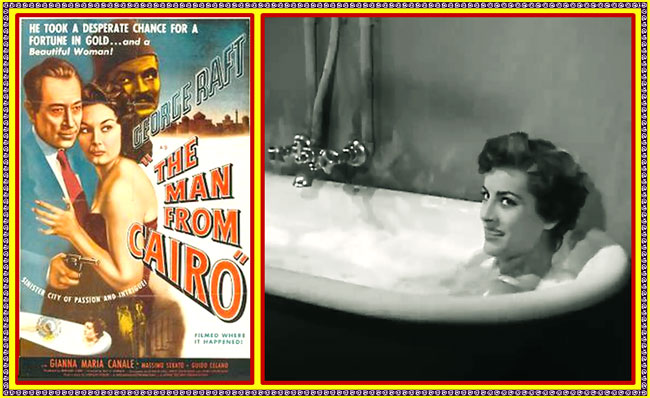
Irène Papas acted as Yvonne Lebeau, a dancer at Cote Bleu, a little nightclub in downtown Algiers in The Man from Cairo (Crime Squad/Dramma nella Kasbah, 1953). Based on story by Hungarian novelist Ladislas Fodor and directed by Ray H. Enright (and Edoardo Anton – uncredited), it was filmed on location in Algeria and Italy. The movie center upon a fortune in gold, lost on the North African desert, which lures a variety of wealth-seekers. After many twists and turns, an American tourist and General Dumont solve the mystery of the lost gold. Although Irène only had a short spell in the earlier part of the movie, George Raft, Gianna Maria Canale, and Massimo Serato in prominent roles had better scope to display their acting talents;

Irène did the starring role of Faidia in Theodora, Slave Empress (Teodora, Impératrice di Bisanzio, 1954), an Italian production by Lux Film with a cast of hundreds, massive sets and in dazzling Pathécolor directed by Riccardo Freda. Stunningly beautiful Gianna Maria Canale, the director’s better half, played the role of Teodora, the daughter of a bear feeder at the amphitheatre who rose to become empress of Byzantium, the celebrated consort of the handsome Emperor Justinian/Giustiniano (Georges Marchal). Teodora champions the causes of the common people, to the displeasure of the prime minister, Giovanni Cappodocia (Henri Guisol), the chief troublemaker who breeds conspiracy. The film marked the second co-starring role of Irène with Gianna Maria Canale, the first being The Man from Cairo.
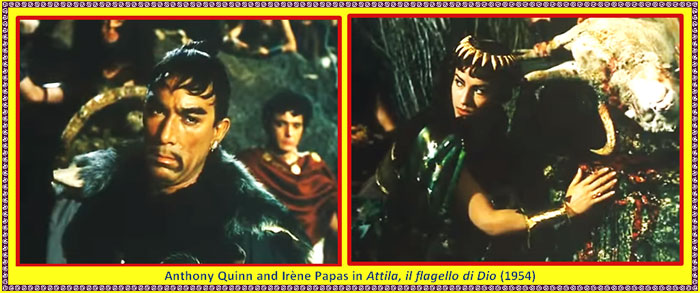
In 1954, Attila (Attila, il flagello di Dio/Attila, Hombre o Demonio/Attila, fléau de Dieu) was released with Irène in the role of Grune. The film featured the cult of the most ruthless conqueror of all time – the barbarian Attila the Hun who, with sword and flame, swept across the civilised world in the year 450 A.D. Even the mighty Roman Empire was marked for his conquests. A Dino De Laurentiis and Carlo Ponti production for Lux Film, directed by Pietro Francisci (1906-1977), Anthony Quinn gave the title role pure savagery while romancing Sophia Loren in the role of Attila’s woman Honoria. Jo                                        

Notes:  

  1. The listed reviews in this tribute is limited only to those films in my personal collection;
  2. DVD/Blu-ray of most of the movies mentioned in this write-up is available with some leading dealers.
  3. Up to now, the sources of reference for this tribute to Irène Papas are archives of the past including printed publications and visual media. DVD sleeves/images shown here are only for promotional purpose. Source: Wikipedia, amazon.com, imdb, and from DVD sleeves.
  4. This illustrated article is an affectionate nosegay to the movies referred above. Please refer to “About” of my webpage for more details.

(© Joseph Sébastine/Manningtree Archive)

Can This Be Irène Papas?

Part I (in 6 parts)

Taking joy in life is a woman’s best cosmetic. – Rosalind Russell

A best-seller book on the relationship between Maria Callas and Aristotle Onassis refer to a conversation that took place aboard the Golden Greek’s opulent 325-ft seaworthy mansion, the Christina in early days of 1960. To perpetuate soprano Callas’ celebrity status which was floundering at that time due to inconsistency of her voice, the Anatolian shipping tycoon was apprehensive of her future and seriously sought ways to prolong her celebrity status.

On that particular day, Onassis’s guest aboard the Christina was the American Screenwriter/Film Producer Carl Foreman (1914-1984) who also held his share of admiration for the opera diva Maria Callas. Foreman suggested casting María Callas opposite actor Anthony Quinn in his up-coming production of The Guns of Navarone which will have everything a war movie should have. Theoretically, almost seven to eight months of filming was envisaged for this movie: four months, April to July, 1960, on location at the town of Lindos on the island of Rhodes, Greece and rest of the filming utilizing the good facilities at Shepperton Studios which is nicely situated in Surrey, England. To finalise the film’s production procedures, Foreman was scheduled to visit London shortly – at a time when London was abuzz with the ensuing engagement in February of Princess Margaret, sister of Queen Elizabeth II, with Antony Armstrong-Jones, and nuptials at Westminster Abbey scheduled for May 1960.  

For the moment, Onassis was delighted when Foreman broached his offer (1). Foreman’s proposal was a stroke of strategic chance. The billionaire Greek shipowner who exuded power and wealth had a reputation of working hard and had great faith in the guiding principle of chance. However, Maria Callas lost courage and declined the part of the Greek resistance fighter, Maria Pappadimos. The role finally went to Greek-born stage and screen star Irène Papas.

One of the most talented and strikingly photogenic stars whose first name is pronounced as “Ee-ree-nee,” Irène Papas was only an upcoming actress at that time. Her celebrity status was only gathering momentum, even though, as an actress she was not unpopular to the motion picture audiences as well as to moviemakers throughout Europe and also in Hollywood where she starred in a movie opposite James Cagney in 1955. Indeed, she was not a stranger to Anthony Quinn. In one of his books, Quinn described their long association as a love-hate relationship which originated from September-November, 1953 during the making of Carlo Ponti-Dino De Laurentiis production of Attila. It was the first feature movie of Irène Papas that I saw.

According to Quinn, in total, he made nine pictures with Irène Papas which includes Attila, Flagello di Dio (1954); The Guns of Navarone (1961), Zorba the Greek (1964); A Dream of Kings (1969), El asesinato de Julio César  (1972); The Message (1976), Omar Mukhtar, Lion of the Desert (1980) while some publications state the true count as seven films. Quinn also related in his book that Irène is one of the later stars like Paul Newman, Joanne Woodward, among others, who attended and absorbed the lessons from the free acting classes for students arranged by Quinn during the latter half of the 1950s in a rented space above a retail store in Hollywood.

Irène Papas was born Eirini/Irini/Irène Lelekou on September 03, 1929 to Stavros (a teacher of classical drama) and Elini Lelekou (née Prevezanou, a school teacher), in the semi-mountainous village of Chiliomodi (Chiliantari), located 21km away from the Greek city of Corinth, gate-way to the Peloponnese (2). According to a publication of 1863, the name “Chiliomodi” presumably originated from the nearby Monastery of Panagia Faneromeni Chiliomodi which was built in the 13th century upon an area of land equal to a thousand “modi”. When the founder of this monastery, St. Simeon, came to build here, the measure of beans he sowed had brought forth a thousand fold: hence the name Chiliomodi or Chilia Modia or a thousand measures. Gradually, the word became corrupted into Chiliantari.

According to Irène herself, her vocation for art was born out of jealousy. One of four daughters of her parents, as a teenager there were times when Irène had to stand aside and watch other girls being harassed by boys while no one even looked at her. At the Balls, she was the only one who was never asked to dance. The turning point came on the day a friend from her school came to visit her at home and began to recite a scene from Johann Wolfgang von Goethe’s Faust in which the improvised actor had to cry.

Irène who was 12 years old at that time, observed her friend’s act and decided that she could do much better in that performance. It was at that juncture she realized that she wanted to become an actress. Besides, this could also be a way she could attract people’s attention to herself. No sooner had she informed her parents her wish to enrol in a drama course, her plea was met with their opposition as they encouraged Irène to study architecture. They decided that their Irène koukla (doll) is not crazy but just crazed over to become an actress. To prevent Irène’s wish without winning her eternal resentment, an idea was mounted, probably half-heartedly.

Through their colleagues at the school who taught Irène, they intervened to induce Irène to concentrate in her studies so that she would engross herself to flower in her studies and give up pursuing an acting career. However, Irène must have loved such a play of her parents. She enrolled in the Royal School of Dramatic Art in Athens and devoted herself to studying classical theatre (3). There she was also regaled by the subject of Greek legends.  

During the waning days of World War II, the country was caught up in the violence of the Greek Civil War erupted in end of 1944 between the Royalists and the communists. In 1948, after graduation, she presented her stage debut with a joyful performance by singing and dancing in a variety show which earned her first 30 drachmas (about a US dollar). That remuneration would, no doubt, suggest that in her performance she was lithe and intense; and caught up with the spirit of the dance, she had moved with grace, expression and agility.

A period of vocation into printed magazine sector and dramatic theatre transpired early in Irène’s acting career. During that time, in the sunshine and optimism of young love, she walked down the aisle with Greek actor/writer/director Alkis Papas (1922-2018). The marriage was short-lived but his surname “Papas” stuck to become a permanent part of her identity. Years later, she starred in Alkis Papas’ directorial debut, Hey, Girls! (Psit… koritsia!, 1959) – the first Greek movie to be shown on Greek television.

Jo                                     (Continued in Part II: Irène Papas – Greece Comes to LA)

Notes:

  1. In 1963, Italian producer Dino De Laurentiis wanted to cast María Callas as Sarah, the barren wife of Abraham, in his blockbuster biblical epic, THE BIBLE in the Beginning… (1966) while director-actor John Huston wanted American actress Ava Gardner who eventually portrayed that role;
  2. In 1960, actor Gregory Peck and his French-born wife Veronique Passani visited Corinth while Peck was filming The Guns of Navarone on location in the Greek Isles. A special “Navarone” poster highlighting the visit of Mr. & Mrs. Gregory Peck at Corinth was brought out by the American Society of Travel Agents in tie-in with the film’s promotion campaign stressing the slogan, “Vacation in Greece, The Country Where “Navarone” was Filmed,” which was sent at that time to its member agencies throughout the country;  
  3. She was christened Irène possibly in honour of St. Irene, the Great Martyr whose life holds some conspicuous similarities to the life of Irène Papas. Originally named Penelope, St. Irene was born in the city of Magedon in Persia to the pagan king Licinius. During her young days, St. Irene was kept isolated in a high tower by her father to avoid her exposure to Christianity she longed to be part of. Enlightened by her special reverence for the Christian Faith as well as to the Christian virtues taught by her private tutor a great deal of the time, she actively proclaimed Christianity and brought thousands of people to Jesus Christ. This led to her persecution and eventually, St. Irene was beheaded.
  4. Up to now, the sources of reference for this tribute to Irène Papas are archives of the past including printed publications and visual media. DVD/Blu-ray of most of the movies mentioned in this write-up is available with some leading dealers.
  5. DVD sleeves/images shown here are only for promotional purpose. Source: Wikipedia, amazon.com, imdb, and from sleeves of movies in my collection.
  6. This illustrated article is an affectionate nosegay to the actress and movies referred above. Please refer to “About” of my webpage for more details.
  7. To the illustrious memory of my late wife Renate Elisabeth Simeon (Carina) who forever bloom in my heart where she is planted.

(© Joseph Sébastine/Manningtree Archive)

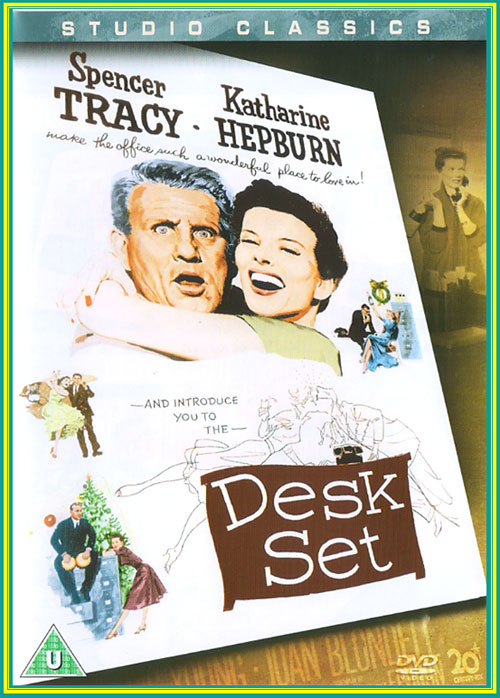
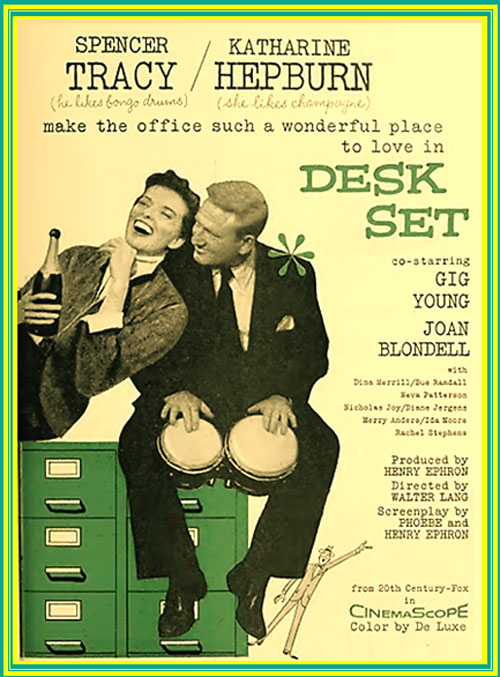
DESK SET

1957 – CinemaScope – Color by De Luxe – 20th Century-Fox

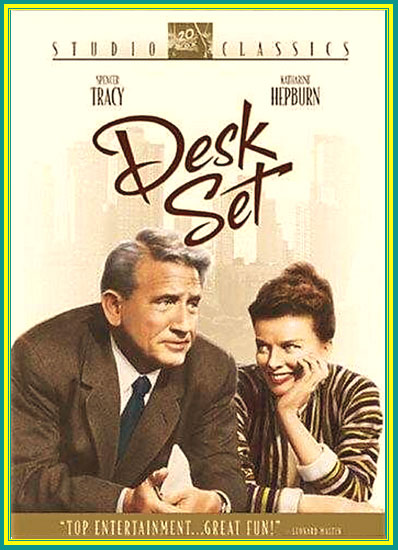
A couple of days ago, we had the pleasure to watch Desk Set, a crackling comedy which scored a genuine acting triumph for the romantic team of Katharine Hepburn and Spencer Tracy.

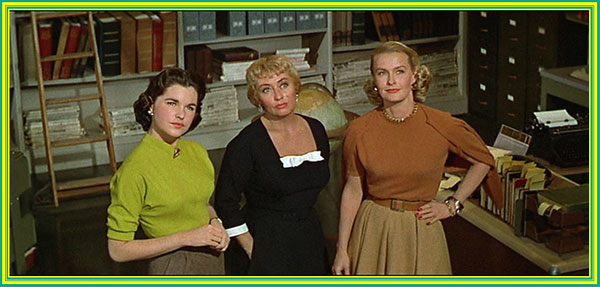
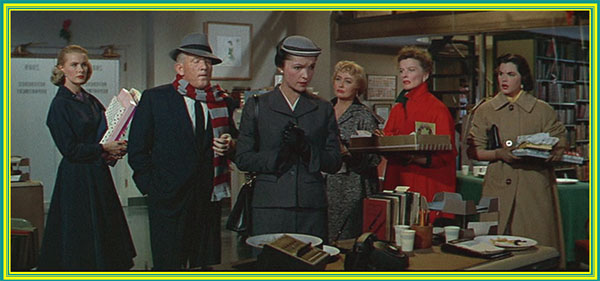
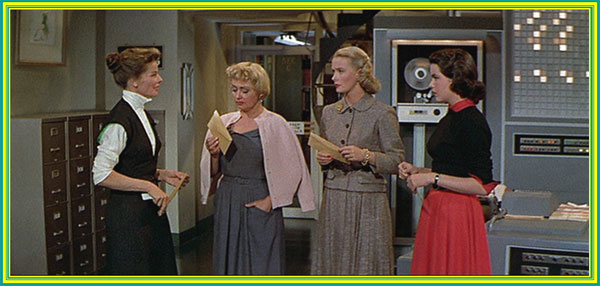
One of the newly acquired DVDs to our archive, Desk Set invites one to the Research and Reference Department of the fictitious Federal Broadcasting Company in New York. Located on the 28th floor, this department is run by the self-assured, and regretfully unmarried, Bunny Watson (a newly rejuvenated Katharine Hepburn) who works congenially with smart, clean appearing co-workers: Bunny’s breezy ally and sturdy supporter Peg Costello (comedienne Joan Blondell, chosen over actress Thelma Ritter); Sylvia Blair (dashing Dina Merrill, daughter of billionaire Marjorie Merriweather Post, in her début role); and Ruthie Saylor (Sue Randall, aka. Marion Burnside Randall in her youthful freshness).

Equipped with a library containing a wide range of informative data for their manual reference, their responsibility in that corporate environment was to answer almost any query for information covering a wide field. Their motto: Be on time, do your work, be down in the bar at 5:30. As often as not, the kind of abstruse questions they encountered goes like: “What is the highest lifetime (baseball) batting average?”; “I’m trying to find out the truth about the Eskimo habit of rubbing noses. Do they rub noses, or don’t they?”….

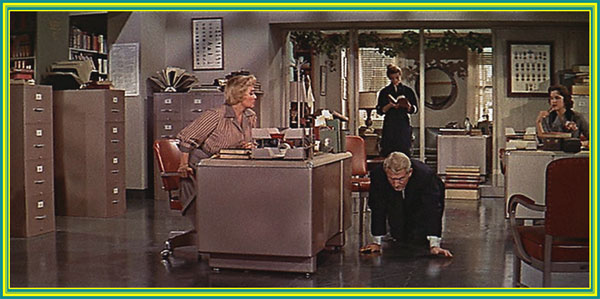
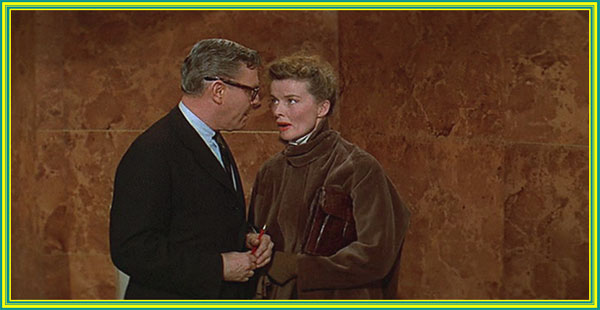
Into their cheerful work place walked in a strange character who identified himself as Richard Sumner (Spencer Tracy). His face appeared stern, mask-like, almost as though he was trying to keep his feelings hidden. No sooner had he appeared, for reason initially unbeknown to these girls, he looked around the office and started measuring the layout with a tape measure – at one stage, seeking assistance of the girls for this purpose. Maybe he’s an interior decorator assigned to redecorate their department? – or to build a Midget golf?, or is it going to be a Snack bar?, or maybe they are getting an air-conditioning unit, finally? But he didn’t look anything like an interior decorator – rather like one of those men who’s just suddenly switched to vodka.

When Bunny met Richard upon her arrival back from an appointment at IBM and a small shopping at Bonwit’s, she had wondered if he is from the story department. But that was soon cleared when he revealed he’s a methods engineer – adding that every time he mentioned what he does, people go into a panic. Before she could extract further information, Richard was called upstairs to meet the company’s boss Mr. Azae at his office.

In fact Richard is the efficiency expert assigned there on secret orders of Mr. Azae (Nicholas Joy) to investigate ground setup to install an ingenious electronic brain which Richard has invented. The machine is to be initially activated at Bunny’s reference department. For that reason, Richard intends to hang around that department for a couple of weeks, maybe a month, to get a comprehensive picture of its working. According to Mr. Azae, it’s vital that this be kept a secret from everyone, especially the girls in Research. Of course, it’s almost impossible to keep anything a secret around there.

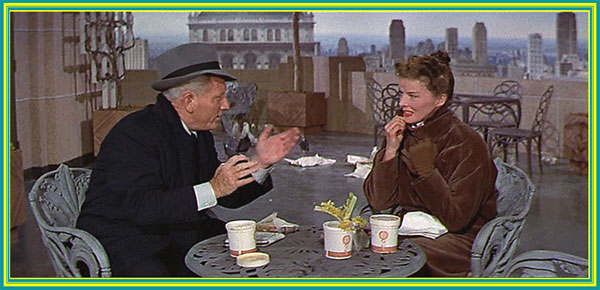
When Bunny accepted Richard’s invitation for lunch, Peg in her wisdom suggested she try the chicken with truffles, Poularde truffée, expecting Richard would take her to the marvellous Le Pavillon, the finest French restaurant in New York. In all sincerity, Richard’s idea of place for lunch was the rooftop of their building in that grey, chilly weather. What an ideal place for concentration where they can cheerfully banish thoughts of waiters, people, telephones, central heating – save for some pigeons up there – so what?

At the rooftop, a table was soon set. Bunny’s face looked as if she had suffered some bereavement. She noted that he had brought along roast beef, ham, cheese and plenty of hot coffee for a square meal. Their lunchtime conversation illuminated him about the little research she undertook on him and she showed off her knowledge that he is one of the leading exponents of the electronic brain in USA. Richard was just ahead of his time. He is the creator of an electronic brain machine called EMARAC…. the Electromagnetic Memory and Research Arithmetical Calculator – an electronic information retrieval system which offered quick access to enormous amount of detail – the machine she had seen at its demonstration at IBM earlier.

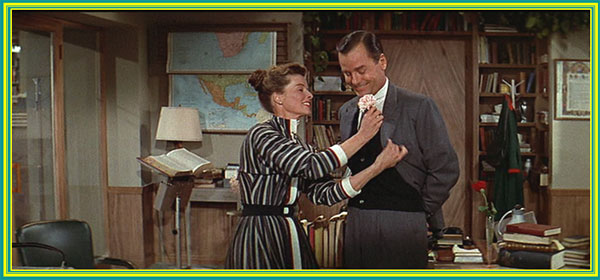
Of late, Peg was the first one to fear from the mistaken notion that the electronic brain will replace them sooner or later. Indeed, the electronic brain in the Payroll of their Federal Broadcasting Company was designed by Richard and no sooner had it installed there to perform tasks faster than the staff, half the department had disappeared. Worries about their jobs proved to be a persistent cloud over the heads of Sylvia and Ruthie while Bunny found herself drifting closer to Richard in spite of her affection for her conceited paramour Mike Cutler (Gig Young), the in-charge of her Reference Department, who found his relationship interfered by the intrusive methods engineer.

The wise-cracking, adorable Peg was trying to encourage Bunny to resist setting her heart on the elusive Mike who, having declared his love, isn’t proposing but even so, the starry-eyed Bunny seemed too willing to give it all up to become Mrs. Mike. In Peg’s book, Mike will certainly take romance but just isn’t the domestic type – he was running at least two horses.

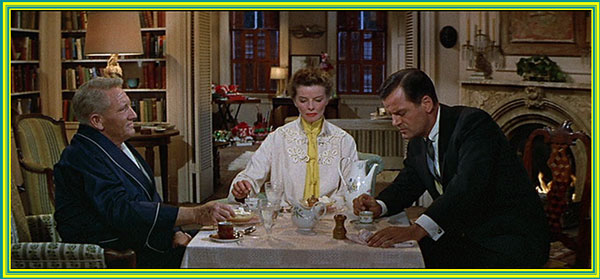
At one instance, Bunny invited Richard to her apartment during a storm. She suggested he dine with her – well aware that the very fact they were dropped at her apartment by the office grapevine Mr. Smithers himself who had too lively a mind, would set tongues wagging soon. Inside the apartment, Richard kicked up his heels and made himself cosy in the man’s robe she lend him to replace his wet cloths and other accoutrements. This should be the starting point of a real relationship between them. But then before the dinner was over, they were taken by surprise when Mike suddenly turned up and in Mike’s amorous temperament, Richard’s mere presence in her apartment was enough to trigger misunderstanding.

Just as the girls feared, the machine was soon set up in their Reference department where a prim and officious Miss Warriner (Neva Patterson) from the lab arrived to run the EMARAC’s operation. Miss Warriner didn’t look like Dracula’s sister but, no doubt, was there to suck out their jobs. Then came the pink slips in their pay envelops bolstering their suspicion that they are to be canned – replaced by the electronic brain EMARAC or “Emmy”……

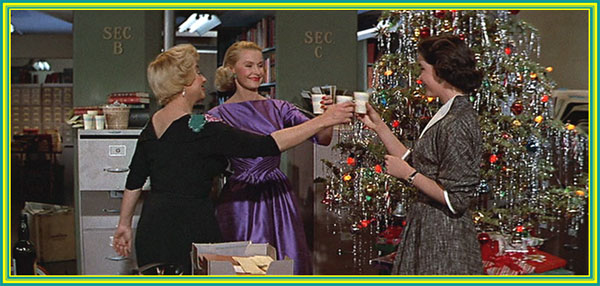
Known in UK under the alternate title “His Other Woman”, this lightweight comedy yarn produced by Henry Ephron is typical in having a sense of anxiety in an enclosed place where automation and love clash. Filmed at the 20th Century-Fox Studios lot and Rockefeller Center, Manhattan, New York City, director Walter Lang (King and I) blend the pace and the rhythm, the overtones and meaning of the screenplay as a whole. Desk Set teems with clever and witty dialogue, coffee break, 5 0’clock cocktail, rooftop luncheon, fabulous Xmas party, love affairs, few bars of songs, a good deal of tomfoolery, and that ever reigning universal compulsion called office gossip….before the happy finale.

The screenplay by Phoebe and Henry Ephron (parents of writer Nora Ephron) is based on the play Desk Set by playwright William Marchant. Before writing the screenplay, the Ephrons had gone to New York to make note of the spots where the laughs came in its Broadway stage production produced by Robert Fryer. The play had opened at the Broadhurst Theatre, New York on 24 October 1955 and starred Shirley Booth (Bunny Watson), Dorothy Blackburn (Peg Costello) and Byron Sanders (Richard Sumner). As of the closing date of 7 July 1956, it did 297 satisfactory performances.

Spirited actress Katharine Hepburn’s volatile style as Bunny Watson contrasts beautifully with the steady unpretentiousness and shrewd underplaying of Spencer Tracy as Richard Sumner – a role Spence had initially refused.

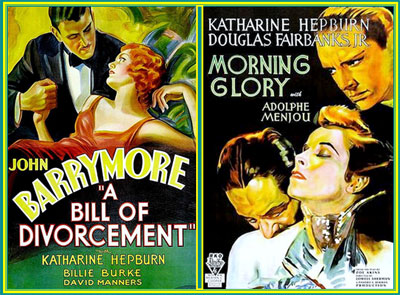
A whizz in biology, Katie wanted to be a surgeon but her fascination with acting led her to an acting career on Broadway in 1929. The Connecticut-born Katharine came over to Hollywood with aspiring actress Laura Barney Harding, and launched a magnificent career with her screen début in director George Cukor’s adaptation of Clemence Dane’s play A Bill of Divorcement (1932).

According to Cukor, Katie was quite unlike anybody he had ever seen and although she had never made a movie, she had a very definite knowledge and feeling right from the start. A Bill of Divorcement was soon followed by remarkable performance in Morning Glory (1933) based on Zoe Akins play. The movie brought her an Oscar for Best Actress – Katie’s first Oscar.

However, Katie’s public appeal was beset by her unspectacular looks and astringent quality of acting in her early films. Not unlike Greta Garbo and Marlene Dietrich who ignored what people thought, she too was gathering up reams of attention for wearing men’s clothes before it was acceptable. A magazine quoted her liking for dresses: “I do have a dress or two. I wear a dress only when it would look conspicuous to wear these clothes.”

Although at that time she was gracelessly branded box-office poison who emptied a theatre faster than a fire, she relentlessly worked her way to the threshold of glory through movies of some of the world’s renowned directors including John Ford, John Huston, George Cukor, David Lean, Stanley Kramer, Sidney Lumet, etc.

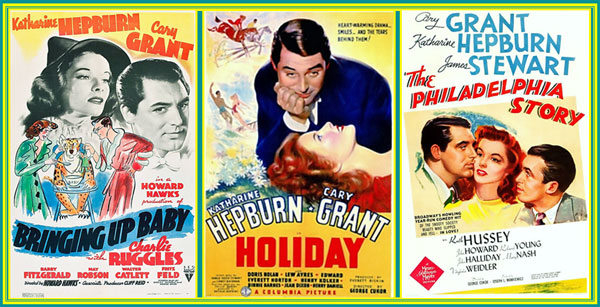
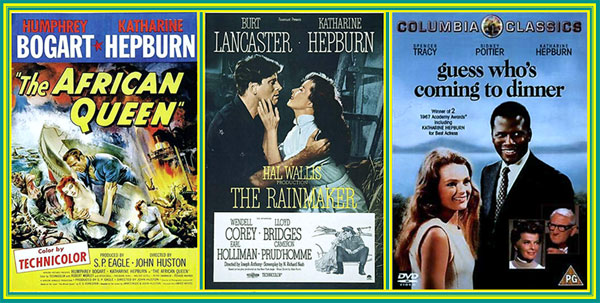
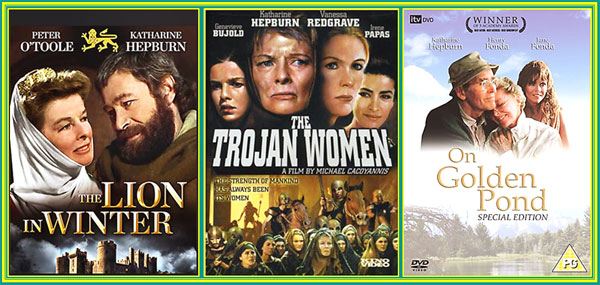
She is best remembered for Bringing Up Baby (1938) Katie’s first comedy; Holiday (1938); The Philadelphia Story (1940) all the above three with Cary Grant; The African Queen (1951) one of Katie’s favourite films; The Rainmaker (1956) with Burt Lancaster; and later in the screen version of Tennessee Williams’ short play,  Suddenly, Last Summer (1959) with Elizabeth Taylor; besides Guess Who’s Coming to Dinner? (1967 – Oscar for Best Actress); The Lion in Winter (1968 – Oscar for Best Actress); The Trojan Women (1972) with Geneviéve Bujold; On Golden Pond (1981 – Oscar for Best Actress), etc.

The teaming of life partners Katie and Spence brought forth nine movies – starting their first pairing with the gentle sex-comedy, Woman of the Year (1942 – Oscar-winning screenplay by Michael Kanin and Ring Lardner, Jr.); Adam’s Rib (1949) and Pat and Mike (1952) – both films written by Garson Kanin and wife Ruth Gordon); Guess Who’s Coming to Dinner? (1967) which was Spence’s last film appearance and Oscar-winning story/screenplay by William Rose; besides Desk Set, their eighth teaming and first film together in colour.

In Desk Set, Spence as efficiency expert Richard creates a sympathetic, complex character in spite of the initial suspicion of the reference department girls.

Milwaukee, Wisconsin-born Spencer Bonaventure Tracy had initially believed he might become a plastic surgeon. But following military service, he had taken up acting on stage. According to a magazine article attributed to MGM stock player Selena Royle, it was Selena who recommended Spence for a leading stage role when she was a star of a stock company in Grand Rapids, Michigan. Once when her company was to open, the show’s producer was distressed over the sudden departure of the leading actor. A replacement could not be arranged immediately from New York. At that time, a boy had walked in asking for a job. He had no experience but wanted to be an actor. Just as the boy started to walk away, Selena had suggested that he be allowed to read for the role. That boy, Spencer Tracy, was then accepted for the role which marked his entry into the profession. Shortly afterwards, Selena’s faith and helping wand worked again for Spence when she, on hearing that her friend George M. Cohan was preparing to produce a play called Yellow, obtained a copy of the play and rehearsed Spence secretly in the lead role. In the audition she managed to arrange for him, they knew he had a natural talent for acting. The final win-out for Spence was the lead role in Yellow – an ample qualification to graduate out of stock and to a grade-A Broadway play. Furthermore, it led him to the lead role in The Last Mile.

It was Spence’s performance in John Wexley’s successful powerful prison drama The Last Mile (initial title: All The World Wondered) which opened on Broadway in February 1930 that caught the attention of veteran director John Ford. He advised Fox Film Corporation to hire Spence who earlier had un-credited appearances in two short films of Warner Bros.

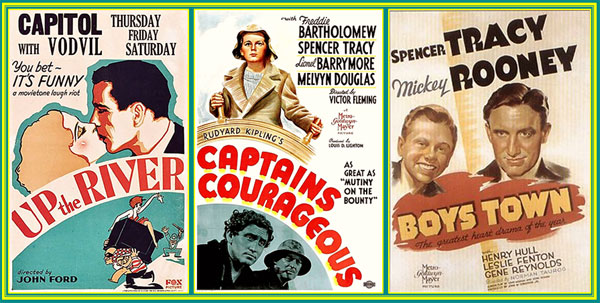
Coming over to Hollywood for a one-picture contract, he shared début feature-film roles with Humphrey Bogart in John Ford’s Up the River (1930). Then again, when Nunnally Johnson suggested casting him in the role of notorious gunman Jesse James’ brother Frank in Jesse James (1939), an unconvinced Darryl Zanuck had said “Tracy will never make a star. ….Just lacks the juice for a star.”

On the other hand, a book quotes director Stanley Kramer’s observation “….(Tracy) remains to me probably the world’s greatest moving picture actor. No one was more talented – it was the chemistry of his roles that made him so good.” That appeared more truthful since Spence’s talent was honoured with Oscars for Best Actor for two consecutive years for the role of Portuguese fisherman Manuel Fidello in director Victor Fleming’s Captains Courageous (1937) adapted from the 1897 novel of Bombay-born Rudyard Kipling; and for director Norman Taurog’s Boys Town (1938), a semi-biographical movie based on the charitable activities of Father Edward J. Flanagan. It was couple of years later during the formative days for the production of director George Stevens’ Woman of the Year when Spence and Katie met for the first time and became romantically involved.

The capable supporting cast of Desk Set includes: Ida Moore as the tiny old “trademark” woman who gets one cracking with her silent walk in appearances. Harry Ellerbe (office grapevine lawyer Mr. Smithers), Nicholas Joy (Mr. Azae), Diane Jergens (Alice), Merry Anders (Cathy), Rachel Stephens (Receptionist), Sammy Ogg (Kenny), and others…

The crew: Leon Shamroy (Cinematography), Robert Simpson (Film Editing), Cyril J. Mockridge (Music), Lyle R. Wheeler/Maurice Ransford (Art Direction), Hal Herman (Asst. Director), Charles LeMaire (Executive Wardrobe Designer), Ben Nye (Makeup), Helen Turpin (Hair styles). The credits also acknowledge the cooperation and assistance of the International Business Machines Corporation.

Broadway designer and three-time Academy Award for Best Costume Design winner Charles LeMaire’s outfits in this movie are versatility personified, the kind of tailored sophistication for the modern girl who wants to look chic on the job, for daytime dates, luncheons, and for dinner. Master costumer LeMaire who would leave his job at Fox in 1959 for freelancing had a track record of dressing just about every major movie star – among others Jean Peters, Gene Tierney, Susan Hayward, Anne Baxter, Celeste Holm, Thelma Ritter, Sophia Loren, Jennifer Jones, Marilyn Monroe,…,.

Following the world premiere engagement of Desk Set at the Roxy, New York attended by a goodly number of celebs, LeMaire’s original fashions conforming to the cinematic environment in the movie arose wide spread interest, especially among those working women who couldn’t resist new fashions or to look tailored and neat. As a toast to them, he had appearances at Bon Marché, and Strawbridge & Clothier store for style-shows to show off his outfits in Desk Set.

An amusing comedy that generates steady excitement to all types of audiences, Desk Set is rich in delights for all those who love office ambiance.  Until next time/Jo

Notes:

  • DVD/Blu-ray of most of the movies mentioned in this article is available with leading dealers.
  • For promotional purpose, DVD sleeves/posters are shown here. Source: Wikipedia, amazon.com, imdb and from my private collection.
  • This illustrated article is an affectionate nosegay to the movie reviewed above. Please refer to “About” of my webpage for more details.

(© Joseph Sébastine/Manningtree Archive)

The Importance of Being Kirk DOUGLAS

I think of my life like a stone thrown into a calm pool.”

                                – Kirk Douglas, The Ragman’s Son

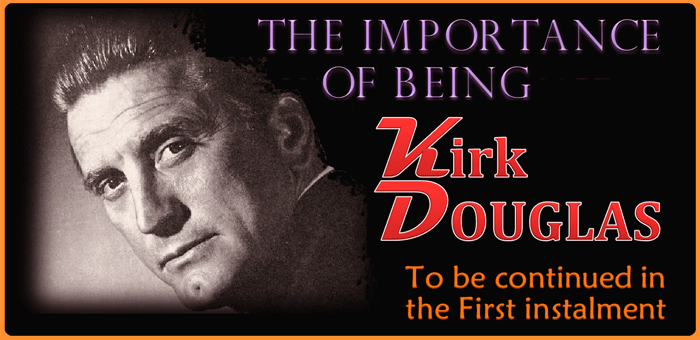
This tribute to Hollywood actor Kirk Douglas is truly accidental than most of my posts, in the sense that this never followed the carefully visualised course I planned at its inception – which was to create a 1,200-word write-up. But as my research evolved over the last many months, I chanced upon a profusion of representational materials about Kirk that my endeavour to piece together the salient landmarks in his life finally brimmed to the expanse of dimension you will come across in the text below.

Kirk Douglas is one of the last remaining great male movie stars of the studio era, even though certain cinematic greats like Clint Eastwood who came close behind Kirk cannot be ignored. Back in the good old days when movies had little competition and the moviegoers were devoted and regular, Kirk emerged from obscurity to turn into an established star on the strength of combining toughness with an acute intelligence in his choice and interpretation of the parts he played. Amongst the many directors he had the privilege to work with are the best of the crop such as Joseph L. Mankiewicz, William Wyler, Billy Wilder, Vincente Minnelli, John Sturges, John Huston, Burt Kennedy, etc.

As with all stars, the glamour and publicity surrounding Kirk is part of his work and charisma. Kirk Douglas once wrote, “When you become a movie star, you create an image for the public.” This perfectly complemented the dialogue Kirk’s character Jonathan Shields spoke to Georgia Lorrison (Lana Turner) in a scene in The Bad and the Beautiful (1952), “When you’re on the screen, no matter who you’re with, or what you’re doing, the audience is looking at you. That’s star quality.”

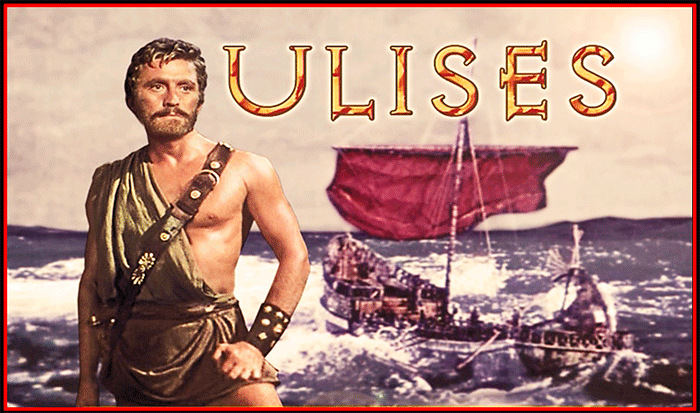
Kirk Douglas came into my life when I first saw a movie during its re-run in a local theatre two decades after its release. I could recall it as Ulysses (1954). Watching it, Kirk had come across to me as a versatile star – vibrant, handsome, virile – all rolled into one. In those teenage days, I was taken by the ease and punch of his portrayal in the title role, and since then, whenever possible, I had tried to follow his career which, over the years, grew in stature gaining brilliant achievements.

Now, how many millions around the world have seen Kirk’s movies? How many were liked or disliked or earned moviegoers to his films owing to Kirk’s acting and/or celebrity factor? What screen or personal stories perpetuated his legend in the public’s mind?

Many years ago, a magazine featured an interview with one of Kirk’s secretaries of the late 1960s. She fondly remembered him as “a very demanding person to work for, and works at a frantic pace himself. He has many businesses apart from films…. He is a very nice person…. I found him very attractive and virile – a real man’s man.”

Think of it. There is a tremendous amount of the past in all our presents. I have not met Kirk personally. Although I would love to, it is most unlikely that I will ever meet him. But I have always nurtured that curiosity to find out specifically how Kirk earned the reputation of a self-made man, a legendary hardworking American stage/screen actor, producer, director, author, millionaire, humanitarian, philanthropist, art collector, winner of awards/honours for achievements both on and off screen, and a family man with a beautiful wife called Anne Buydens sheltered in a solid marriage now nearing its 64th year on May 29th.

My growing film archive of about 6,500 movies gives primacy to films released up to early 1980s – most of which are now historic milestones of the movie industry. Thus far, it contains almost three dozen movies featuring Kirk Douglas. No doubt, that three dozen would be much lesser compared to the numerous hardbound volumes of scripts of all of Kirk’s movies which, according to Kirk’s memoirs, are arranged in chronological order on the top shelf at his house.

Likewise, I feel lucky that I was born during a period when I could enjoy those just-released films on a large theatre screen – maybe with a lesser quality presentation, but enough to be content in those happy days. And at the close of the movie, to walk out into the Lobby amidst the excited, arguing, impressed viewers. It’s no fun if one happens to see those movies now on TV – greatly edited and, like in our part of the world, interrupted by numerous (but necessary) persistent and disparate commercials that pounce on your senses like rapid gunfire from an AK47; or shown either during the work days or too late into the night.

At length, this compilation is derived from a trail of information that lay scattered in innumerable books, magazines, media interviews, movie documentaries or whatever sources I could possibly access – to all of which this write-up is thankfully and humbly indebted. This is neither a scholarly compilation of biographical data nor could it be free of possible errors – mainly whereas the schedule of production of movies is subject to re-takes, fillers, etc. This is just my personal attempt to recapture the great events, and some minor ones, of Kirk’s life – primarily up to the period before early 1980s.

To minimalize the content, some finer details about Kirk and his movies, readily available in numerous books, websites, visual media, etc., are left out. Keeping in par with the good old times Kirk’s films captured, I must honestly add that, the theory I have adopted for this write-up is to overlook any broken fence and admire the flowers in the garden. As you read further on, I hope you will chance upon the many pleasant factors that inspired me to write about – Mister Kirk Douglas.

(The First instalment of this series follows)

Jo

Notes:

  • DVD/Blu-ray of the movies referred above is available with leading dealers.
  • Picture credits: Please refer to “About” of my web page for more details.
  • It would be factual to endorse that the year-long delay in my posts occasioned from a string of turbulence of personal nature that thrashed on the cruising path of my life during the last so many months and yet, the ducks are not in a row. I dedicate this tribute with love and gratitude to: 1) Renate Elisabeth (Carina), my wife and oracle of love for her support, wisdom and unfailing vigilance; and to 2) Carolyn Page, the sweet spot who fondly lit a fire under you-know-where to turn the heat on me to accelerate the publishing of this post.

(© Joseph Sébastine/Manningtree Archive)