Tag Archive | Katharine Hepburn

Irène Papas – A Diamond Forever

Since we cannot change reality, let us change the eyes which see reality – Nikos Kazantzakis

Produced, scripted and directed by Michael Cacoyannis, Zorba the Greek (1964) featured Irène Papas as an unapproachable widow. Anthony Quinn starred in the title role of Alexis Zorba – a wise, sensual, compassionate man in a tiny Greek village on the island of Crete. The film carried forward along his relationship with a too-intellectualized young English writer (Alan Bates).

This B&W film was based on the best-selling novel by Nikos Kazantzakis which Alan Bates later admitted that he hadn’t read the book before he filmed it. One of the highlights of the film is the scene where Anthony Quinn danced the syrtaki shoulder to shoulder with Alan Bates at the beach (near the village of Stavros).

Originally prepped as a United Artists project, the production of Zorba the Greek was taken over by 20th Fox which was a bit surprising at that time since director Cacoyannis had done his acclaimed Electra for UA couple of years ago and was preparing for his second outing for them. The two factors that was attributed as cause for this move could be that UA was well stocked on current and upcoming product; and secondly, with Anthony Quinn’s stop date clause to start 20th Fox’s period drama, A High Wind in Jamaica (1965, Dir: Alexander Mackendrick (1)) in June, 1964, UA may have deemed it ideal to allow 20th to take over Zorba the Greek to safeguard their side in case Zorba’s production went over schedule.

 In due course, the film initiated seven Oscar nominations at the 37th Annual Academy Awards (1965) including Best Leading Actor nomination for Anthony Quinn. Russian actress Lila Kedrova received the Oscar for Best Actress in a Supporting Role for her poignant role as the dying prostitute Mme. Hortense, uplifting her reputation as the first actress of Russian origin to win an Oscar.

Besides Best Art Direction-Interior Decoration (Black-and-White) for Vassilis Photopoulos, Berlin/German-born Walter Lassally won the Best Cinematographer (Black-and-White). Later Lassally commented as having thought earlier that his work in this film was “easier to do” than some of the other films he shot for director Michael Cacoyannis.

Earlier, in April 1964, the media reported that French actress Simone Signoret amicably took her exit from the cast of Zorba for which she had gone over to the isle of Crete and did tests for the small English-speaking role of the rather frilly, oldish, leftover French courtesan in Greece. Several actresses were brought to Crete for tests to fill the role vacated by Signoret while she joined the production unit of director Stanley Kramer’s Ship of Fools (1965) (2) to portray the role of La Condesa. As a result, Signoret was honoured with nominations for: Academy Award 1966 for Best Actress; BAFTA Award for Best Foreign Actress and Golden Globe Award for Best Actress in a Motion Picture – Drama.

By the end of 1963, Irène Papas was back in the Isle of Crete for location shoot for Walt Disney’s production of The Moon-Spinners (1964). The location shoots in different parts of Europe was not unusual for Irène’s movies since many of her American films were European co-productions. Upon wrap at the location at Crete, the film unit moved to Pinewood Studios in England for the final eight weeks of production. Complimenting Irène’s performance as villager Sophia in The Moon-Spinners were co-stars Hayley Mills, Eli Wallach, Pola Negri, Peter McEnery and Joan Greenwood. Composer Mikis Theodorakis, from Electra, provided the music.

It was during the production of Zorba, the Greek when Irène Papas first associated with her Greek co-star Yorgo Voyagis (billed in Zorba as George Voyadjis). Cinema audiences may recall Voyagis as El Lobo in Harold Robbins’ The Adventurers (1970); as Joseph in Franco Zeffirelli’s Jesus of Nazareth (1977); as the kidnapper in Roman Polanski’s Frantic (1988), etc. On an intimate note, in consonance with a report in Diario Crónica, their relationship advanced to a brief period of closeness with each other.

Director Franco Zeffirelli initially intended to cast Irène Papas in the role of elderly Virgin Mary in his TV movie, Jesus of Nazareth (1977), Indeed, Zeffirelli had even launched a campaign and auditioned dozens of young girls in Athens, Greece to find a girl who would have all the features of Irene Papas at fifteen years. However, that cast slot finally fell on Buenos Aires-born actress Olivia Hussey who was finalised over Irène.

As for Irène’s stage appearances, besides performances with the Greek Popular Theatre in Athens, she did career outings as a singer and a dancer in variety shows in Greece, she performed her Broadway debut in 1967 in That Summer, That Fall; followed by Inherit the Wind; Iphigenia in Aulis; Journey’s End; title role in Medea (January-May 1973); The Bacchae (1980); Orpheus Descending (1984), etc.

After Zorba the Greek for which Irène made for only $10,000/-, she didn’t work for a year and a half. In A Dream of Kings (1969) which showcased a powerful performance by Anthony Quinn as Matsoukas and Inger Stevens (3) as the young widow Anna he has an affair with, Irène appeared as Matsoukas’ Greek wife Caliope.

Directed by Daniel Mann, and based on the best-selling novel by Greek-American Harry Mark Petrakis, the film’s protagonist was Greek immigrant Matsoukas who has a passion for gambling but trying to raise money to send his dying son to Greece.

Then Irène’s threw herself into the job of portraying Katherine of Aragon (1485-1536), the Queen of England and first wife of Tudor King Henry VIII (1491-1547) for 24 years. Being the daughter of King Ferdinand II of Aragon and Queen Isabella of Castile, Katherine of Aragon was also the mother of Queen Mary I (1553-8) who brought Roman Catholicism back to England. Katherine was lauded for her piety, dignity, and strength of character whose marriage with future Henry VIII in 1509 aligned England with Spain, France’s enemy.

A well-acted historical but often inaccurate drama of English history, Anne of the Thousand Days (1969) (4) starred Richard Burton as Henry VIII of England and Geneviève Bujold in a well-balanced performance as the beautiful Anne Boleyn, lusty Henry VIII’s second wife he married in 1533 and mother of Queen Elizabeth I.

The film explored the life and times of Henry VIII and his pursuit and conquest of the beautiful Anne Boleyn that changed the course of English history. A big-budget Hal Wallis production largely shot in period interiors re-created at Shepperton Studios, it was directed by Charles Jarrott and co-starred Anthony Quayle, John Colicos and Michael Hordern. Look for the beautifully designed costumes by Margaret Furse who won the Academy Award for Best Costume Design 1970 for her brilliant talent.

Irène’s portrayal of Katherine was appropriate as a queen lovely in person and in mind – truly gentle and feminine in her manners as Katherine of Aragon is reputed for. So captivating was Irène’s image as Katherine that it prompted some wisecracks to remark that her head belonged on a Roman coin;

Irène Papas played as Hélène (representing: Roula, bereaved widow of slain Grigoris Lambrakis) in Z released in 1969. A Franco-Algerian thriller by director Constantine Costa-Gavras, with some violence and coarse language is based on the 1966 political novel by Greek author Vassilis Vassilikos – a thinly fictionalized account of the May 1963 political assassination in Thessaloniki, Salonika of Grigoris Lambrakis, a Greek socialist legislator whose extreme popularity and advocacy of peace shook the stability of the government in power.

Z plainly points its finger at the Colonels’ regime in Greece. This 42nd Academy Award winner for Best Foreign Language Film and for Best Film Editing; and nominations for Best Picture, Best Director, and Best Adapted Screenplay was filmed in Algeria and France with Yves Montand (The Deputy) and Jean-Louis Trintignant (The Examining Magistrate). The film roles of Montand and Trintignant hinge on Grigoris Lambrakis and Christos Sartzetakis, respectively;

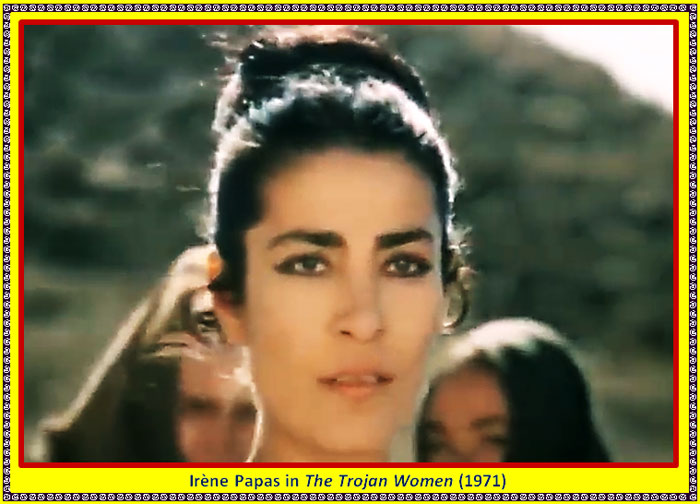
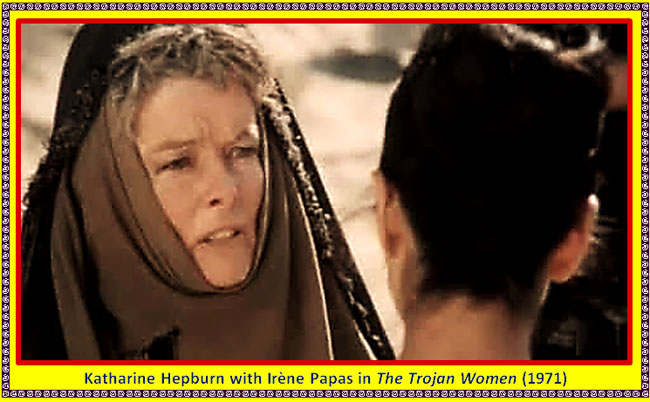
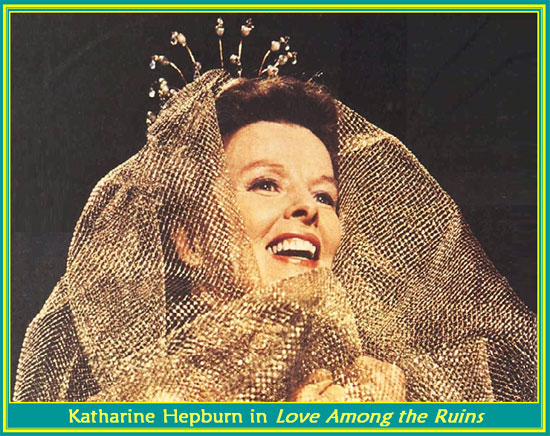
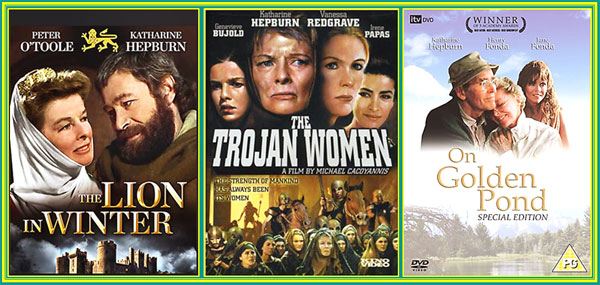
In the Greek-American film The Trojan Women (Les Troyennes, 1971) Irène Papas interpreted the part of the beautiful Helen of Troy, the daughter of Zeus and Leda, and wife of Menelaus (King of Sparta) who eloped with Paris and thus brought about the siege and destruction of Troy. For this role, Irène was honoured with the Best Actress Award from the National Board of Review of Motion Pictures in the USA. Besides Irène, the principal actresses in The Trojan Women included Katharine Hepburn (as Hecuba, second wife of Priam and mother of 19 children, including Hector, and Queen of Troy); Vanessa Redgrave (as Andromache, wife of Hector); and Geneviève Bujold (as Cassandra, daughter of Priam and Hebuca. She was the Trojan prophetess who was never believed).

Adapted and directed by Michael Cacoyannîs and filmed in Spain in mid-1970 with very high-minded notions, in the central core of this film is the Euripides tragedy concerning the defeat of the Tory army and the resultant plight of its women. For the English version, the text was masterly translated by Edith Hamilton. In an interview published in the Australian Women’s Weekly, Katharine Hepburn spoke of Euripides: “In the sense that what counts in Euripides is the text – the naked, cold word. Euripides doesn’t describe, he states, specifies, informs. The complete opposite of Shakespeare. Euripides makes one think of the great primitives. Euripides writes the text, the rest is done by the audience…”

The year 1971 also saw the release of Italian director Umberto Lenzi’s trippy sexploitation thriller, Oasis of Fear (aka. Un posto ideale per uccidere / Dirty Pictures) in which Irène Papas played middle-aged Barbara Slater. Produced by Carlo Ponti, the cast of this psycho killer movie included Ray (Raymond) Lovelock, Ornella Muti and Salvatore “Sal” Borgese.

British man Richard “Dick” Butler (Lovelock) and Dutch girl Ingrid Sjoman (Muti) are young sexually free hippie couple. While touring Italy, they land themselves in trouble over illegal sale of naked pictures of Ingrid they used to finance their travels. On the run from the law for having been arrested and ordered to leave Italy, the free-spirited couple seek refuge in Barbara’s seemingly isolated large villa, but little did they know that Barbara has murdered her husband and they are drawn into a deadly scheme being framed as the guilty suspects. Set to a toe-tapping catchy pop score by Bruno Lauzi, this intriguingly sexy giallo race head-on into a suspense-ridden climax. Italian Umberto Lenzi was the writer/director of giallo movies such as Paranoia (1969); Knife of Ice (1972); Spasmo (1974), etc, featuring Carroll Baker, Colette Descombes, Ida Galli, Suzy Kendall, and such other appealing womankind of marquee value of that time.

In the role of Dona Aurelia Avallone, Irène Papas was part of the star-cast of Lucio Fulci’s Don’t Torture A Duckling (Non si servizia un paperino, 1972). Of the title, I have heard movies called many things, but not that. With Tomas Milian (as reporter Andrea Martelli), Barbara Bouchet (as hooker Patrizia) and Florinda Bolkan (as Maciara, a Gypsy witch), the movie is about young boys found mutilated and killed in Accendura, a Sicilian mountain village where many locals falls under suspicion.

Reputedly Fulci’s most favourite film shot in the suburbs and town of Monte Sant’Angelo in Southern Italy, it also features the song: Quei giorni insieme a te interpreted by Ornella Vanoni.

Tito: Sutjeska, The Fifth Offensive (Sutjeska/Battle of Sutjeska, 1973) recreates the 1943 mountain battle of the Sutjeska in WWII between Tito’s Partisans and German forces. While Richard Burton acts as Marshal Tito, (born Josip Broz, (1892-1980), President of Yugoslavia (1953-80)); Irène Papas portrayed Boro’s mother. The Embattled Mountain by Frederick William Dampier Deakin (1913-2005) is particularly suited for more information on this subject. The music score was by Mikis Theodorakis.   

As featured in The Fifth Offensive, the National Liberation Army of Yugoslavia headed by the Supreme Commander Marshal Tito was creating a new, liberated territory. Convinced that the Allies would land right on the Balkans, Hitler ordered two of his generals, Alexander Löhr and Rudolf Lüters, to initiate a new offensive against the Yugoslav Partisans forces. To deal with the critical conditions on the fronts and to prepare the Forces for future battles in the Balkans and in Europe, it was necessary to immediately surround and destroy the main Yugoslav Partisans combat units and their leader Tito and once and for all eliminate the dangerous Balkan battlefield. Made in Yugoslavia on an expensive budget, and directed by Stipe Delić, this movie features that subject operation (15 May 1943 to 16 June 1943), codenamed “Schwarz” or “Case Black.”     Jo                                        

Notes:

  1. Director Alexander Mackendrick was replaced in The Guns of Navarone. A High Wind in Jamaica is interesting as a curio for its score composed by the famous harmonica virtuoso Larry Adler (1914-2001). The film marks the second outing of Russian actress Lila Kedrova with leading man Anthony Quinn after Zorba the Greek;
  2. Ship of Fools (1965) is based on the acclaimed 1962 novel by Pulitzer Prize-winning American writer Katherine Anne Porter. It is also the last film to feature British actress Vivien Leigh;
  3. A Dream of Kings marked the final appearance of Swedish-American actress Inger Stevens who committed suicide in April 1970 at the age of 35. 
  4. My review on Anne of the Thousand Days was posted on January 07, 2020 in this webpage;
  5. Up to now, the sources of reference for this 6-part tribute to Irène Papas are archives of the past including printed publications and visual media. DVD/Blu-ray of most of the movies mentioned in this write-up is available with some leading dealers.
  6. DVD sleeves/images shown here are only for promotional purpose. Source: Wikipedia, amazon.com, imdb, and from DVD sleeves.
  7. This illustrated article is an affectionate nosegay to the movies referred above. Please refer to “About” of my webpage for more details.

 (© Joseph Sébastine/Manningtree Archive)

Irène Papas Makes An Entrance

Screen actress Irène Papas became synonymous with world-class Greek stage/screen performers in the category of Katina Paxinou (Katina Konstantopoulou, 1900-1973), Melina Mercouri (Maria-Amalia Mercouri, 1920-1994), Eva Kotamanidou (1936-2020), etc, irrespective, to few critics, some may be of dark complexion or with language fluency issues.

One of Irène’s bad experiences came from actor Spencer Tracy during the production of the Western movie, Tribute to a Bad Man (1956) which Tracy never finished because director Robert Wise (1914-2005) fired him. A book describes how Tracy derided co-star Irène because she was too clumsy and too tall (big raw-boned five feet ten inches in her bare feet, as tall as Tracy) and her English didn’t suit him because she was from Greece.

Greece which is domicile to Greek, one of the world’s oldest written languages, as well as to minority languages and Greek dialects, English together with German, French and Italian were the most common foreign languages spoken. Apart from her native Greek and competence in English, Irène also spoke German and Italian. As a matter of fact, Irène had been in London where she made effort to perfect her almost fluent English.

In those days, foreign-language features showed an increase in bookings and according to top players in U.S. movie circles, besides A-List performers such as Sophia Loren, Gina Lollobrigida, Simone Signoret, Alec Guinness and Maximilian Schell, the other foreign film personalities whose names became familiar to U.S. audiences during 1962 included Alain Delon, Claudia Cardinale, Marcello Mastroianni, Jeanne Moreau, Elsa Martinelli, Melina Mercouri, Horst Buchholz, Maria Schell, Irène Papas, Romy Schneider, Alida Valli, Jean-Paul Belmondo, Alberto Sordi and Christian Marquand.

These best-known of the foreign stars were considered marquee names capable enough to draw patrons to the box-office, and almost all of them have either made pictures in Hollywood or appeared in English-language pictures filmed in Europe by American show business companies.

To a great extent, those who are famous stay that way because the press keeps them in the public eye. As for the gifted Irène Papas whom many have waxed poetic in praise of her, upswing on her career also gifted her ample occasions to meet a number of influential people in the film industry, some of them veritable volcano of knowledge and inspiration. It would have been completely in character that her career also brought her time to socialize with the prettiest people, most of them exceedingly rich and ripe, not boors or bores. Then again, one also had to good-naturedly tolerate a great deal of unprofessionalism, too. She was once bestowed with the title “Europe’s Woman” for her efforts to bolster European civilization.

As an award-winning actress who personified Greek female beauty on the cinema screen and on the stage, Irène Papas starred alongside fashionable Hollywood stars of the time such as Anthony Quinn, Gregory Peck, James Cagney, Kirk Douglas, etc. With Kirk Douglas and Alex Cord, she co-starred (as Ida Ginetta) in director Martin Ritt’s The Brotherhood (Mafia, 1968), an excellent Godfather predecessor produced by Kirk Douglas, one of the best paid actors in Hollywood during that time.

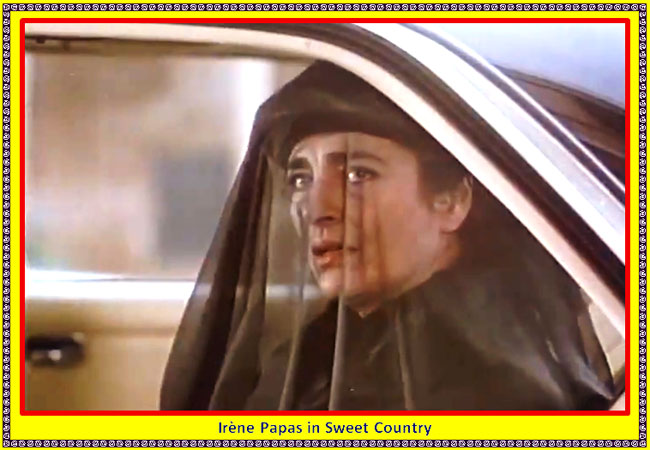
It was Irène’s association with Michael Cacoyannîs (1922-2011) that paved way for Irène’s brilliant performances in the title role in Electra (1962); in Zorba the Greek (Alexis Zorbas, 1964); in The Trojan Women (1971) and also in Sweet Country (Glykeia patrida, 1986), a forceful drama filmed in Greece. These are part of a clutch of films rightly considered as the high point of Irène’s film career. Cacoyannîs is the Greek Cypriot theatre/film director who introduced actress Melina Mercouri (as a good femme fatale) through his 1955 film, Stella.   

Audiences across the world who have seen Zorba the Greek may remember Cacoyannîs’ treatment of Irène Papas in the role of the widow when the viewer first saw glimpses of her face as she hung her immaculate sheets on the clothesline while it flapped in the wind.

Sweet Country, based on a novel by Caroline Richards, is about the emotional turmoil that befalls an American expatriate couple, Anna Willing (Jane Alexander) and professor husband Ben (John Cullum) while living under military rule following the September 1973 Rightist military coup led by General Augusto Pinochet Ugarte after the assassination of Chile’s first socialist President Salvador Allende (1908-1973). The film is an indictment of conditions that existed at that time when lead character Anna is drawn into the resistance against Pinochet as she attempt to get the torture victims across the border.

In 1968, Irène had an on-going contract to star in director John Huston’s epic production of The Madwoman of Chaillot (1969), based on the 1943 classic play La Folle de Chaillot by French novelist (Hippolyte) Jean Giraudoux. The film featured an all-star cast of Katharine Hepburn, Charles Boyer, Yul Brynner, Giulietta Masina, Edith Evans, Danny Kaye, John Gavin, Paul Henreid, Margaret Leighton, Richard Chamberlain, Donald Pleasence, and Nanette Newman.

The production of The Madwoman of Chaillot was not all smooth sailing. Few days before the production began in Nice, France, the Producers had profound reservations about director Huston who had difference of opinion on the modernization of the movie’s theme. They clinched a deal with British director Bryan Forbes to take over direction of the movie at very short notice. Furthermore, days into the shooting at the Studios de la Victorine, Nice, France, Irène opted out of her role which went to English stage actress Edith Evans DBE. Irène too had not been in a good frame of mind with the characterisation of the role of Josephine she was portraying. All this put-downs were newsworthy in the show business circles.

More a proven actress than a glamorous star alone, Irène Papas has starred in numerous movies, some of them forgettable except for her presence in them. Nonetheless, there are enough significant movies she has done that became the consuming interest to her celebrity status. Listed below, in order of year of release, are some of Irène’s movies in my collection (1):

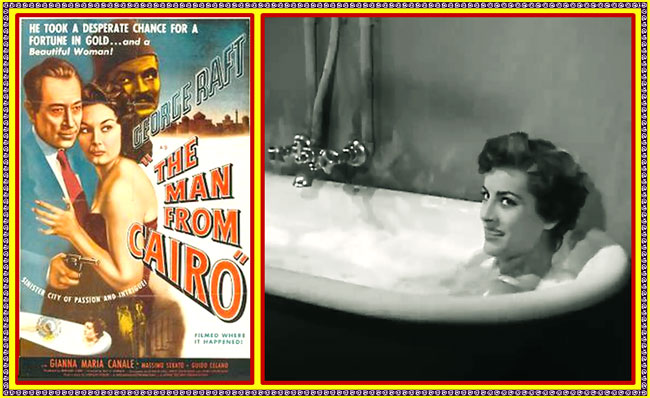
Irène Papas acted as Yvonne Lebeau, a dancer at Cote Bleu, a little nightclub in downtown Algiers in The Man from Cairo (Crime Squad/Dramma nella Kasbah, 1953). Based on story by Hungarian novelist Ladislas Fodor and directed by Ray H. Enright (and Edoardo Anton – uncredited), it was filmed on location in Algeria and Italy. The movie center upon a fortune in gold, lost on the North African desert, which lures a variety of wealth-seekers. After many twists and turns, an American tourist and General Dumont solve the mystery of the lost gold. Although Irène only had a short spell in the earlier part of the movie, George Raft, Gianna Maria Canale, and Massimo Serato in prominent roles had better scope to display their acting talents;

Irène did the starring role of Faidia in Theodora, Slave Empress (Teodora, Impératrice di Bisanzio, 1954), an Italian production by Lux Film with a cast of hundreds, massive sets and in dazzling Pathécolor directed by Riccardo Freda. Stunningly beautiful Gianna Maria Canale, the director’s better half, played the role of Teodora, the daughter of a bear feeder at the amphitheatre who rose to become empress of Byzantium, the celebrated consort of the handsome Emperor Justinian/Giustiniano (Georges Marchal). Teodora champions the causes of the common people, to the displeasure of the prime minister, Giovanni Cappodocia (Henri Guisol), the chief troublemaker who breeds conspiracy. The film marked the second co-starring role of Irène with Gianna Maria Canale, the first being The Man from Cairo.

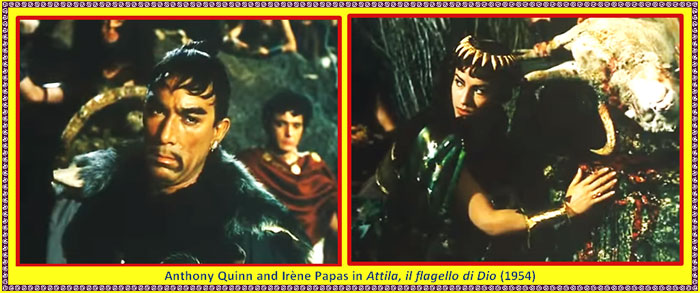
In 1954, Attila (Attila, il flagello di Dio/Attila, Hombre o Demonio/Attila, fléau de Dieu) was released with Irène in the role of Grune. The film featured the cult of the most ruthless conqueror of all time – the barbarian Attila the Hun who, with sword and flame, swept across the civilised world in the year 450 A.D. Even the mighty Roman Empire was marked for his conquests. A Dino De Laurentiis and Carlo Ponti production for Lux Film, directed by Pietro Francisci (1906-1977), Anthony Quinn gave the title role pure savagery while romancing Sophia Loren in the role of Attila’s woman Honoria. Jo                                        

Notes:  

  1. The listed reviews in this tribute is limited only to those films in my personal collection;
  2. DVD/Blu-ray of most of the movies mentioned in this write-up is available with some leading dealers.
  3. Up to now, the sources of reference for this tribute to Irène Papas are archives of the past including printed publications and visual media. DVD sleeves/images shown here are only for promotional purpose. Source: Wikipedia, amazon.com, imdb, and from DVD sleeves.
  4. This illustrated article is an affectionate nosegay to the movies referred above. Please refer to “About” of my webpage for more details.

(© Joseph Sébastine/Manningtree Archive)

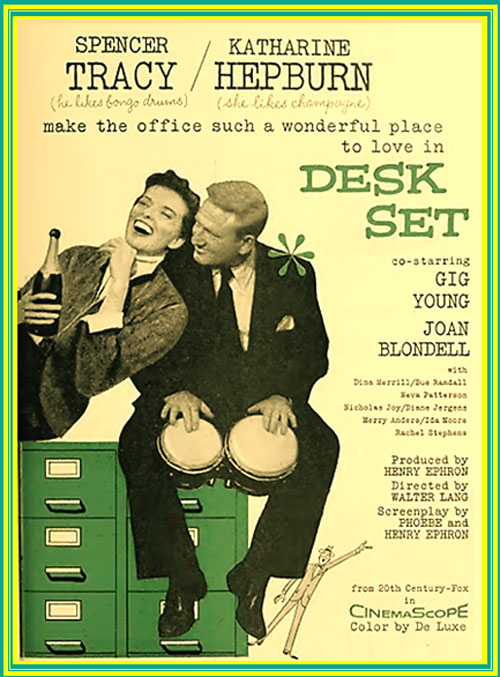
DESK SET

1957 – CinemaScope – Color by De Luxe – 20th Century-Fox

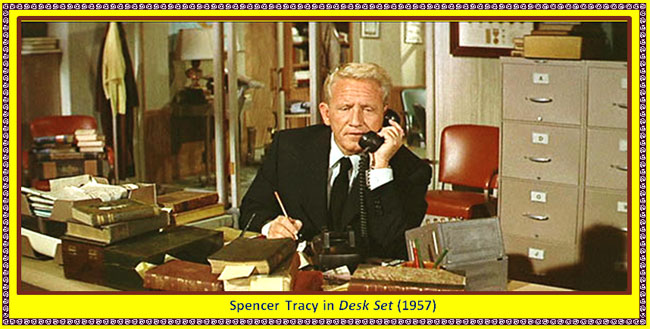
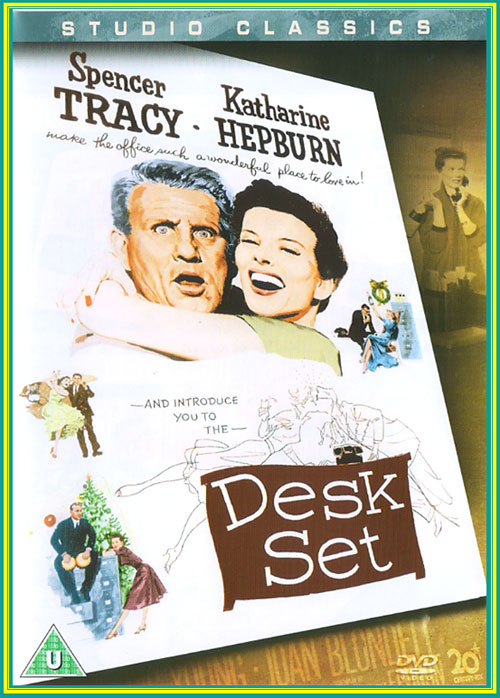
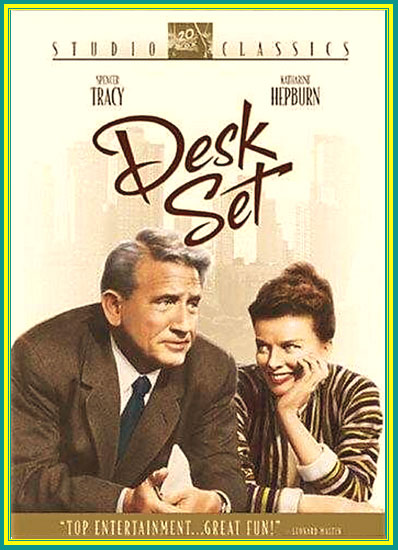
A couple of days ago, we had the pleasure to watch Desk Set, a crackling comedy which scored a genuine acting triumph for the romantic team of Katharine Hepburn and Spencer Tracy.

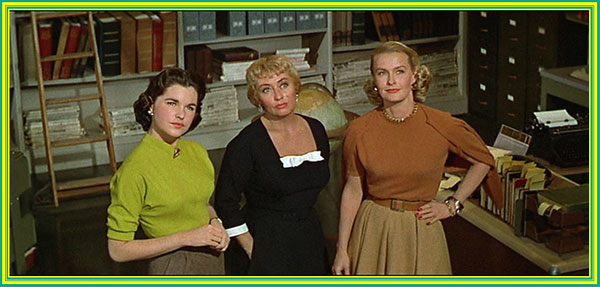
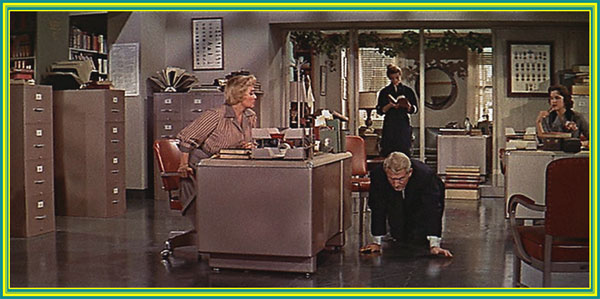
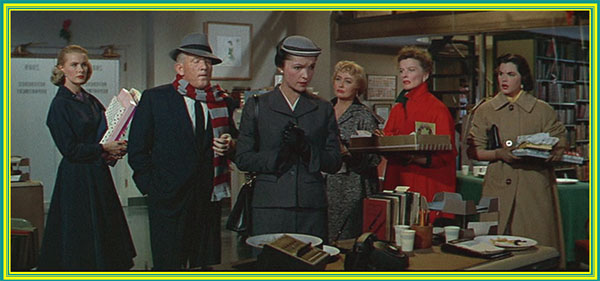
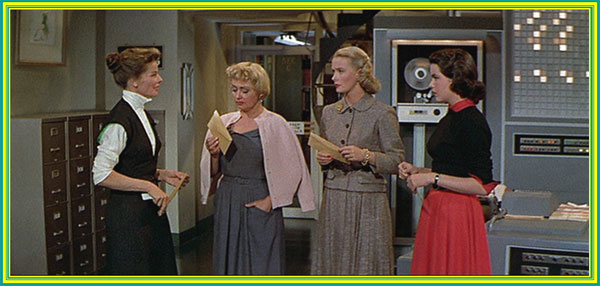
One of the newly acquired DVDs to our archive, Desk Set invites one to the Research and Reference Department of the fictitious Federal Broadcasting Company in New York. Located on the 28th floor, this department is run by the self-assured, and regretfully unmarried, Bunny Watson (a newly rejuvenated Katharine Hepburn) who works congenially with smart, clean appearing co-workers: Bunny’s breezy ally and sturdy supporter Peg Costello (comedienne Joan Blondell, chosen over actress Thelma Ritter); Sylvia Blair (dashing Dina Merrill, daughter of billionaire Marjorie Merriweather Post, in her début role); and Ruthie Saylor (Sue Randall, aka. Marion Burnside Randall in her youthful freshness).
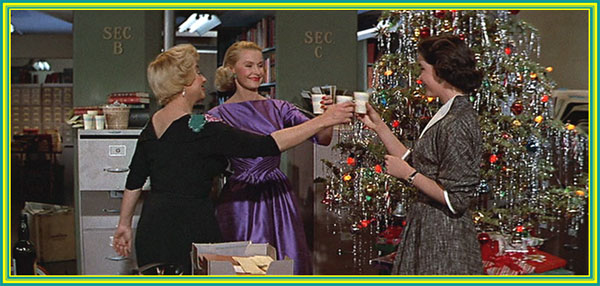
Equipped with a library containing a wide range of informative data for their manual reference, their responsibility in that corporate environment was to answer almost any query for information covering a wide field. Their motto: Be on time, do your work, be down in the bar at 5:30. As often as not, the kind of abstruse questions they encountered goes like: “What is the highest lifetime (baseball) batting average?”; “I’m trying to find out the truth about the Eskimo habit of rubbing noses. Do they rub noses, or don’t they?”….

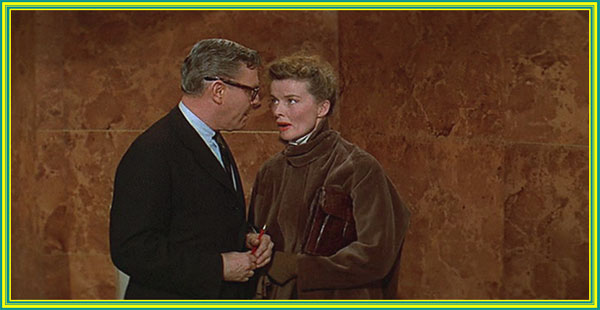
Into their cheerful work place walked in a strange character who identified himself as Richard Sumner (Spencer Tracy). His face appeared stern, mask-like, almost as though he was trying to keep his feelings hidden. No sooner had he appeared, for reason initially unbeknown to these girls, he looked around the office and started measuring the layout with a tape measure – at one stage, seeking assistance of the girls for this purpose. Maybe he’s an interior decorator assigned to redecorate their department? – or to build a Midget golf?, or is it going to be a Snack bar?, or maybe they are getting an air-conditioning unit, finally? But he didn’t look anything like an interior decorator – rather like one of those men who’s just suddenly switched to vodka.

When Bunny met Richard upon her arrival back from an appointment at IBM and a small shopping at Bonwit’s, she had wondered if he is from the story department. But that was soon cleared when he revealed he’s a methods engineer – adding that every time he mentioned what he does, people go into a panic. Before she could extract further information, Richard was called upstairs to meet the company’s boss Mr. Azae at his office.

In fact Richard is the efficiency expert assigned there on secret orders of Mr. Azae (Nicholas Joy) to investigate ground setup to install an ingenious electronic brain which Richard has invented. The machine is to be initially activated at Bunny’s reference department. For that reason, Richard intends to hang around that department for a couple of weeks, maybe a month, to get a comprehensive picture of its working. According to Mr. Azae, it’s vital that this be kept a secret from everyone, especially the girls in Research. Of course, it’s almost impossible to keep anything a secret around there.

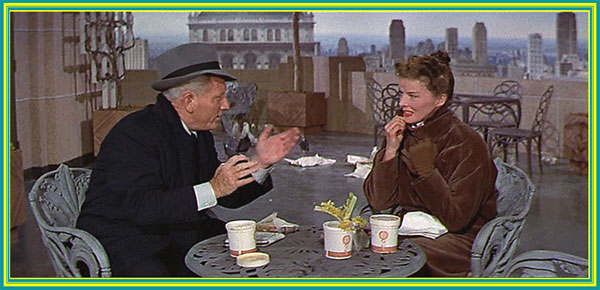
When Bunny accepted Richard’s invitation for lunch, Peg in her wisdom suggested she try the chicken with truffles, Poularde truffée, expecting Richard would take her to the marvellous Le Pavillon, the finest French restaurant in New York. In all sincerity, Richard’s idea of place for lunch was the rooftop of their building in that grey, chilly weather. What an ideal place for concentration where they can cheerfully banish thoughts of waiters, people, telephones, central heating – save for some pigeons up there – so what?

At the rooftop, a table was soon set. Bunny’s face looked as if she had suffered some bereavement. She noted that he had brought along roast beef, ham, cheese and plenty of hot coffee for a square meal. Their lunchtime conversation illuminated him about the little research she undertook on him and she showed off her knowledge that he is one of the leading exponents of the electronic brain in USA. Richard was just ahead of his time. He is the creator of an electronic brain machine called EMARAC…. the Electromagnetic Memory and Research Arithmetical Calculator – an electronic information retrieval system which offered quick access to enormous amount of detail – the machine she had seen at its demonstration at IBM earlier.

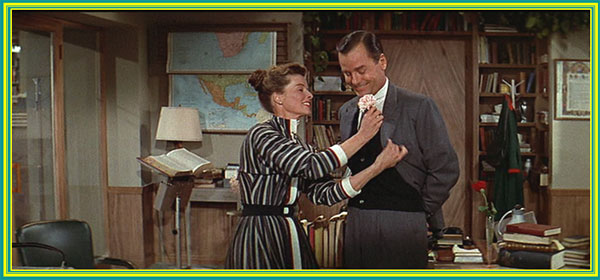
Of late, Peg was the first one to fear from the mistaken notion that the electronic brain will replace them sooner or later. Indeed, the electronic brain in the Payroll of their Federal Broadcasting Company was designed by Richard and no sooner had it installed there to perform tasks faster than the staff, half the department had disappeared. Worries about their jobs proved to be a persistent cloud over the heads of Sylvia and Ruthie while Bunny found herself drifting closer to Richard in spite of her affection for her conceited paramour Mike Cutler (Gig Young), the in-charge of her Reference Department, who found his relationship interfered by the intrusive methods engineer.

The wise-cracking, adorable Peg was trying to encourage Bunny to resist setting her heart on the elusive Mike who, having declared his love, isn’t proposing but even so, the starry-eyed Bunny seemed too willing to give it all up to become Mrs. Mike. In Peg’s book, Mike will certainly take romance but just isn’t the domestic type – he was running at least two horses.

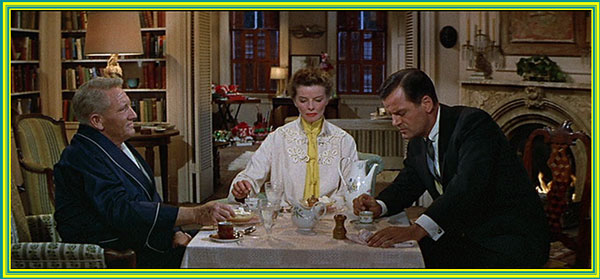
At one instance, Bunny invited Richard to her apartment during a storm. She suggested he dine with her – well aware that the very fact they were dropped at her apartment by the office grapevine Mr. Smithers himself who had too lively a mind, would set tongues wagging soon. Inside the apartment, Richard kicked up his heels and made himself cosy in the man’s robe she lend him to replace his wet cloths and other accoutrements. This should be the starting point of a real relationship between them. But then before the dinner was over, they were taken by surprise when Mike suddenly turned up and in Mike’s amorous temperament, Richard’s mere presence in her apartment was enough to trigger misunderstanding.

Just as the girls feared, the machine was soon set up in their Reference department where a prim and officious Miss Warriner (Neva Patterson) from the lab arrived to run the EMARAC’s operation. Miss Warriner didn’t look like Dracula’s sister but, no doubt, was there to suck out their jobs. Then came the pink slips in their pay envelops bolstering their suspicion that they are to be canned – replaced by the electronic brain EMARAC or “Emmy”……

Known in UK under the alternate title “His Other Woman”, this lightweight comedy yarn produced by Henry Ephron is typical in having a sense of anxiety in an enclosed place where automation and love clash. Filmed at the 20th Century-Fox Studios lot and Rockefeller Center, Manhattan, New York City, director Walter Lang (King and I) blend the pace and the rhythm, the overtones and meaning of the screenplay as a whole. Desk Set teems with clever and witty dialogue, coffee break, 5 0’clock cocktail, rooftop luncheon, fabulous Xmas party, love affairs, few bars of songs, a good deal of tomfoolery, and that ever reigning universal compulsion called office gossip….before the happy finale.

The screenplay by Phoebe and Henry Ephron (parents of writer Nora Ephron) is based on the play Desk Set by playwright William Marchant. Before writing the screenplay, the Ephrons had gone to New York to make note of the spots where the laughs came in its Broadway stage production produced by Robert Fryer. The play had opened at the Broadhurst Theatre, New York on 24 October 1955 and starred Shirley Booth (Bunny Watson), Dorothy Blackburn (Peg Costello) and Byron Sanders (Richard Sumner). As of the closing date of 7 July 1956, it did 297 satisfactory performances.

Spirited actress Katharine Hepburn’s volatile style as Bunny Watson contrasts beautifully with the steady unpretentiousness and shrewd underplaying of Spencer Tracy as Richard Sumner – a role Spence had initially refused.

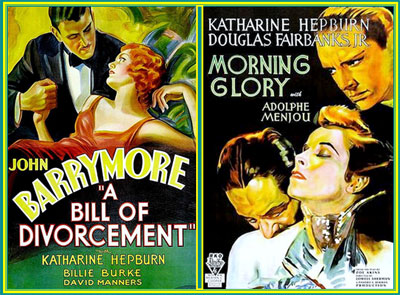
A whizz in biology, Katie wanted to be a surgeon but her fascination with acting led her to an acting career on Broadway in 1929. The Connecticut-born Katharine came over to Hollywood with aspiring actress Laura Barney Harding, and launched a magnificent career with her screen début in director George Cukor’s adaptation of Clemence Dane’s play A Bill of Divorcement (1932).

According to Cukor, Katie was quite unlike anybody he had ever seen and although she had never made a movie, she had a very definite knowledge and feeling right from the start. A Bill of Divorcement was soon followed by remarkable performance in Morning Glory (1933) based on Zoe Akins play. The movie brought her an Oscar for Best Actress – Katie’s first Oscar.

However, Katie’s public appeal was beset by her unspectacular looks and astringent quality of acting in her early films. Not unlike Greta Garbo and Marlene Dietrich who ignored what people thought, she too was gathering up reams of attention for wearing men’s clothes before it was acceptable. A magazine quoted her liking for dresses: “I do have a dress or two. I wear a dress only when it would look conspicuous to wear these clothes.”

Although at that time she was gracelessly branded box-office poison who emptied a theatre faster than a fire, she relentlessly worked her way to the threshold of glory through movies of some of the world’s renowned directors including John Ford, John Huston, George Cukor, David Lean, Stanley Kramer, Sidney Lumet, etc.

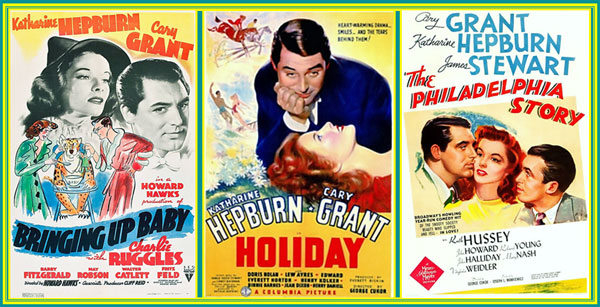
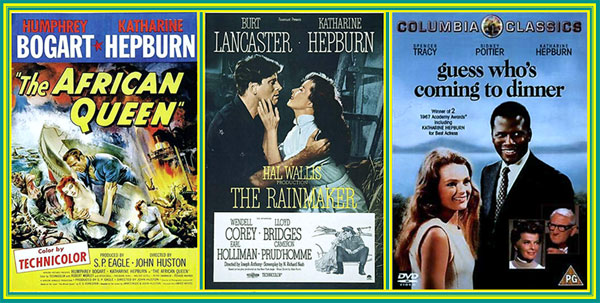
She is best remembered for Bringing Up Baby (1938) Katie’s first comedy; Holiday (1938); The Philadelphia Story (1940) all the above three with Cary Grant; The African Queen (1951) one of Katie’s favourite films; The Rainmaker (1956) with Burt Lancaster; and later in the screen version of Tennessee Williams’ short play,  Suddenly, Last Summer (1959) with Elizabeth Taylor; besides Guess Who’s Coming to Dinner? (1967 – Oscar for Best Actress); The Lion in Winter (1968 – Oscar for Best Actress); The Trojan Women (1972) with Geneviéve Bujold; On Golden Pond (1981 – Oscar for Best Actress), etc.

The teaming of life partners Katie and Spence brought forth nine movies – starting their first pairing with the gentle sex-comedy, Woman of the Year (1942 – Oscar-winning screenplay by Michael Kanin and Ring Lardner, Jr.); Adam’s Rib (1949) and Pat and Mike (1952) – both films written by Garson Kanin and wife Ruth Gordon); Guess Who’s Coming to Dinner? (1967) which was Spence’s last film appearance and Oscar-winning story/screenplay by William Rose; besides Desk Set, their eighth teaming and first film together in colour.

In Desk Set, Spence as efficiency expert Richard creates a sympathetic, complex character in spite of the initial suspicion of the reference department girls.

Milwaukee, Wisconsin-born Spencer Bonaventure Tracy had initially believed he might become a plastic surgeon. But following military service, he had taken up acting on stage. According to a magazine article attributed to MGM stock player Selena Royle, it was Selena who recommended Spence for a leading stage role when she was a star of a stock company in Grand Rapids, Michigan. Once when her company was to open, the show’s producer was distressed over the sudden departure of the leading actor. A replacement could not be arranged immediately from New York. At that time, a boy had walked in asking for a job. He had no experience but wanted to be an actor. Just as the boy started to walk away, Selena had suggested that he be allowed to read for the role. That boy, Spencer Tracy, was then accepted for the role which marked his entry into the profession. Shortly afterwards, Selena’s faith and helping wand worked again for Spence when she, on hearing that her friend George M. Cohan was preparing to produce a play called Yellow, obtained a copy of the play and rehearsed Spence secretly in the lead role. In the audition she managed to arrange for him, they knew he had a natural talent for acting. The final win-out for Spence was the lead role in Yellow – an ample qualification to graduate out of stock and to a grade-A Broadway play. Furthermore, it led him to the lead role in The Last Mile.

It was Spence’s performance in John Wexley’s successful powerful prison drama The Last Mile (initial title: All The World Wondered) which opened on Broadway in February 1930 that caught the attention of veteran director John Ford. He advised Fox Film Corporation to hire Spence who earlier had un-credited appearances in two short films of Warner Bros.

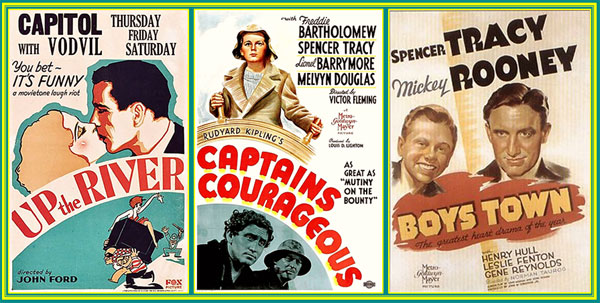
Coming over to Hollywood for a one-picture contract, he shared début feature-film roles with Humphrey Bogart in John Ford’s Up the River (1930). Then again, when Nunnally Johnson suggested casting him in the role of notorious gunman Jesse James’ brother Frank in Jesse James (1939), an unconvinced Darryl Zanuck had said “Tracy will never make a star. ….Just lacks the juice for a star.”

On the other hand, a book quotes director Stanley Kramer’s observation “….(Tracy) remains to me probably the world’s greatest moving picture actor. No one was more talented – it was the chemistry of his roles that made him so good.” That appeared more truthful since Spence’s talent was honoured with Oscars for Best Actor for two consecutive years for the role of Portuguese fisherman Manuel Fidello in director Victor Fleming’s Captains Courageous (1937) adapted from the 1897 novel of Bombay-born Rudyard Kipling; and for director Norman Taurog’s Boys Town (1938), a semi-biographical movie based on the charitable activities of Father Edward J. Flanagan. It was couple of years later during the formative days for the production of director George Stevens’ Woman of the Year when Spence and Katie met for the first time and became romantically involved.

The capable supporting cast of Desk Set includes: Ida Moore as the tiny old “trademark” woman who gets one cracking with her silent walk in appearances. Harry Ellerbe (office grapevine lawyer Mr. Smithers), Nicholas Joy (Mr. Azae), Diane Jergens (Alice), Merry Anders (Cathy), Rachel Stephens (Receptionist), Sammy Ogg (Kenny), and others…

The crew: Leon Shamroy (Cinematography), Robert Simpson (Film Editing), Cyril J. Mockridge (Music), Lyle R. Wheeler/Maurice Ransford (Art Direction), Hal Herman (Asst. Director), Charles LeMaire (Executive Wardrobe Designer), Ben Nye (Makeup), Helen Turpin (Hair styles). The credits also acknowledge the cooperation and assistance of the International Business Machines Corporation.

Broadway designer and three-time Academy Award for Best Costume Design winner Charles LeMaire’s outfits in this movie are versatility personified, the kind of tailored sophistication for the modern girl who wants to look chic on the job, for daytime dates, luncheons, and for dinner. Master costumer LeMaire who would leave his job at Fox in 1959 for freelancing had a track record of dressing just about every major movie star – among others Jean Peters, Gene Tierney, Susan Hayward, Anne Baxter, Celeste Holm, Thelma Ritter, Sophia Loren, Jennifer Jones, Marilyn Monroe,…,.

Following the world premiere engagement of Desk Set at the Roxy, New York attended by a goodly number of celebs, LeMaire’s original fashions conforming to the cinematic environment in the movie arose wide spread interest, especially among those working women who couldn’t resist new fashions or to look tailored and neat. As a toast to them, he had appearances at Bon Marché, and Strawbridge & Clothier store for style-shows to show off his outfits in Desk Set.

An amusing comedy that generates steady excitement to all types of audiences, Desk Set is rich in delights for all those who love office ambiance.  Until next time/Jo

Notes:

  • DVD/Blu-ray of most of the movies mentioned in this article is available with leading dealers.
  • For promotional purpose, DVD sleeves/posters are shown here. Source: Wikipedia, amazon.com, imdb and from my private collection.
  • This illustrated article is an affectionate nosegay to the movie reviewed above. Please refer to “About” of my webpage for more details.

(© Joseph Sébastine/Manningtree Archive)