Agnes, Sanctissima
(Part III of S. Agnes of Rome VM)

The body is a sacred garment. It’s your first and last garment;
it is what you enter life in and what you depart life with,
and it should be treated with honor – Martha Graham
With the aid of history, it is related that S. Agnes, of long remembrance, was martyred in Rome where the ancient Stadium-Domitiani (Stadium of Domitian/ Circus Agonalis/Circus Alexandri, 81-96 AD) (1) existed. This is where Piazza Navona is presently located. A few years after Agnes’ martyrdom, Rome had turned into the cradle of her cult and her burial site on the left side of Via Nomentana became a prominent centre of pilgrimage. With time, a shrine in her honour, probably a private founding, originated at the place of her martyrdom at Stadium-Domitiani.

The survival of historical tradition in things and men exercises an indescribable charm on students of civilization. According to the Depositio Martyrum (part of early Philocalian calendar), since 366 the Feast-day of S. Agnes of Rome was celebrated on January 21 by Pope Damasus I (305-384, Reign: 366-384). Pope Damasus’s veneration for the tombs of the martyrs was commemorated in poetic compositions and also by the Christian community through the years that followed. From Italy, devotion to S. Agnes floated on saintly little wings all around France, spread over to the Netherlands, and to Germany, and so on… preserving S. Agnes in the minds of the populace with faith and trust. Alongside the Apostles and Evangelists, there is no saint whose effigy is older than S. Agnes whose images, with her name inscribed, are found on ancient glass and earthenware vessels used by the Christians in the early part of the 4th century.
The papal investment in her cult, enriched by the growing fame of S. Agnes in Europe, indeed inspired later Popes, especially those during 5th, 8th and 9th centuries. S. Agnes became one of seven women, together with the Blessed Virgin Mary, who are commemorated by name in the Canon of the Holy Mass.

It was precisely after 1050, that a number of popes expressed their hope to restore the past that had been lost so that the church will recapture the purity of the early Christianity. The Shrine of S. Agnes at the ancient Stadium-Domitiani was subsequently enlarged and transformed into a small basilica by Pope Callixtus II (1065-1124, Reign: 1119-1124). Callixtus II had consecrated this Basilica on 28 January 1123, few months after the Concordat of Worms (Pactum Calixtinum) in September 1122. (2) Pope Callixtus II not only rebuilt part of the Church of Saint Paul, but also restored many ancient monuments as well as construction of aqueducts for the accessibility of different quarters of the city. By the end of the twelfth century, Rome housed more than three hundred churches.

3) After centuries have passed, it was in 1652, during the pontificate of Pope Innocent X (1574-1655, Reign: 1644-1655) when the construction of the present Baroque church of Sant’Agnese in Agone (together with the Palazzo of Pamphili family) in Piazza Navona was started by architect/sculptor Francesco Borromini (aka. Francesco Castelli, 1599-1667). Borromini is generally considered the father of all modern abuses in architecture. Borromini undertook this project after completion of the extensive repair and modernization work on the basilica of San Giovanni in Laterano – thus having completed the works in time for the 1650 Jubilee.
The façade of Sant’Agnese in Agone is reputedly Borromini’s best work. This church houses a chapel dedicated to S. Agnes for the principal reason that the chapel is located closer to the site where Agnes was martyred in c. 304. Visitors can take the stairway to the right of the Chapel’s altar down to the Cemetery Crypt of S. Agnes (sacellum infimum) in the underground (3).

This Cripta which was built as a hypogeum (underground chamber) is the only surviving part of the ancient church. Since at least the 7th century, the Cripta, is venerated as the traditional site where young Agnes received the crown of martyrdom. Presently, it also has much significance for being the Shrine where her relic (skull of S. Agnes) is preserved – most likely brought here by Pope Honorius II (1060-1130, Reign: 1124-1130).

Other traditional account relate that during the 9th century, the skull of S. Agnes was shifted from her martyrium at the Catacombe di S. Agnese to the Papal Archbasilica of St. John Lateran (Arcibasilica Papale San Giovanni in Laterano) (4) outside of Vatican City. This 4th century highest ranking Archbasilica was founded by Constantine the Great at the instigation of Pope St. Sylvester I (285-335, Reign: 314-335). The Lateran was the historic seat of the Popes, bishop of Rome from the time of Constantine to the period of the return of the Holy See from Avignon in 1377 when Pope Gregory XI (1331-1378, Reign: 1370-1378), the seventh and last Avignon pope and a nephew of Pope Clement VI, transferred the papal residence to the Vatican thereby establishing Basilica Papale di San Pietro into an elevated position.
Within the Lateran Palace was Sancta Sanctorum (5). It was an ancient oratory/private chapel of the Popes dedicated to S. Lawrence, which was in existence since earlier than the eight century. The relic (skull) of Agnes was preserved in a closed gallery over the sole altar of this Sancta Sanctorum along with a wealth of reliquaries, icon, and venerated relics. It was from this sanctified spacethat in 1124, the venerated skull was translated by Pope Honorius II (6)to the crypt of the newly consecrated Church of Sant’Agnese in Agone.

Fortunately, given that the translation of the relic of S. Agnes from Sancta Sanctorum had taken place in 1124, it had helped to prevent the relic from destruction for the reason that the old Lateran Basilica was nearly destroyed by the conflagration on the night of May 5th, 1308 during the pontificate of Clement V (1264-1314, Reign: 1305-1314). Although the Basilica was soon after rebuilt by the Romans with the aid of the pope, another disaster struck in 1360 while Innocent VI (1282-1362, Reign: 1352-1362) was the reigning pope when the entire roof fell down crushing the columns of the nave.
The name of S. Agnes is derived from the Greek adjective agnê which mean pure, chaste and should be spelled Agnê without the final‘s’. On the other hand, the Romans linked her name to the Latin word ‘agnus’ meaning ‘lamb’. And so, in the eyes of the faithful, S. Agnes of Rome, of course, is “Agna Dei” – the feminine personification of the Lamb of God.

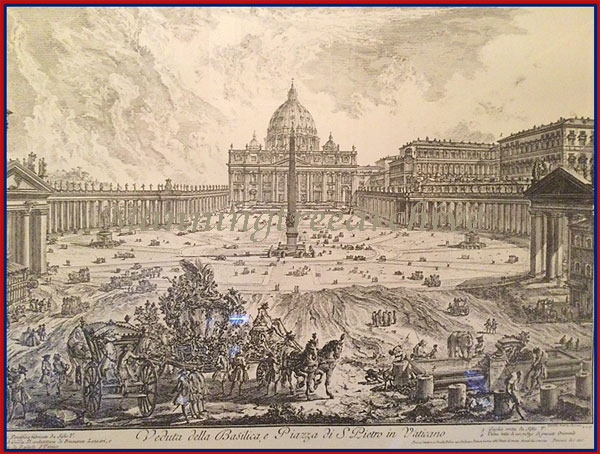
In 1662 the first statue of S. Agnes was installed amongst the hosts of saints on top of Gian Lorenzo Bernini’s imposing Doric colonnades at the square in front of the monumental Basilica Papale di San Pietro in Rome (7). Standing in the Piazza, and one can watch S. Agnes up there and contemplate in pious veneration of her memory.

Rome is a great repository of Christian relics. The souls of the saints are in the hands of God but their holy relics, and the truths of their history have been left with us as sacred deposits. S. John Chrysostom (c. 347 – 407) gave merit to this by a quote: “God beautifully has divided the martyrs with us; he has taken their souls and given us their bodies.” And those precious remains, which God has entrusted to the guardianship of the church, to the pious veneration of the faithful, it is believed He will, one day, re-establish in glory.
(Concluded)
Jo

Notes:
- The entire Campus Martius and the Capitoline Hill had to undergo total reconstruction due to the disastrous fire of 80 AD. The task was carried out by Domitian (81-96), the third emperor of the Flavian dynasty. Apart from the restoration which ncluded the Pantheon, the Portico of Octavia, etc, Domitian built the Stadium (upon the remains of which the present-day Piazza Navona is established) for athletic sports and musical spectacles with a renewed interest in Greek culture.
- The Concordat of Worms was a compromise agreement between the Catholic Church and the Holy Roman Empire Henry V (1081-1125, Reign: 1106-1125) settling the Church-State investiture dispute peacefully and the acts were ratified at the first general Council of Lateran (ninth ecumenical council) on 18 March 1123, in the middle of Lent. Henry V’s grandmother (mother of Henry IV), elder sister as well as niece were named after S. Agnes.
- The Roman builders of the time endeavoured to rescue the remains of previous edifices, but preserved them to serve as foundations.
- It is here in the basilica of the Lateran that the Church places the first meeting between S. Francis and S. Dominic.
- An ancient and miraculous image of Jesus Christ, known as the Acheiropoeton was preserved in this Sanctorum. This image was believed not to have been created by human hand.
- Different dates are also given to indicate the translation of the skull of S. Agnes: common accounts indicate that it was done after the construction of the present Baroque church of Sant’Agnese in Agone in 17th Century while elsewhere it is mentioned that it was done during the reign of the “Rosary” Pope Leo XIII (1810-1903, Reign: 1878-1903). In fact, during the pontificate of Pope Leo XIII, the pope renewed the apse and rebuilt the presbytery of the Lateran Basilica where, in the Sancta Sanctorum, the relic of S. Agnes was kept since the 9th century.
- The statue was created by sculptor Lazzaro Morelli in c. 1661-62, one of Bernini’s two students along with their workshops.

(© Joseph Sébastine/Manningtree Archive)




 Manningtree Archive
You must be logged in to post a comment.