
(Aka: Könige der Sonne, Os Reis do Sol, Solens konger, Los reyes del sol, Auringon kuninkaat, Les rois du soleil, A Nap királyai, I re del sole, Królowie slonca, Günesin krallari, Könige der Sonne – and (Initial working title: The Mound Builders) – Color – 1963)

If there was one Hollywood actor who had the exotic mien, the boundless charm, the piercing eyes, masculine authority, and the range of acting talents which magnetized him to audiences – Yul Brynner (1920-1985) could well take that honour. Complex and unpredictable, he would always be the king.

Although there are different accounts about Brynner’s name, date and place of birth, bulk of the specifics indicate that he was either born Taidje Khan or Yuliy Borisovich Bryner to Boris Bryner and Marusya Blagovidova on the island of Sakhalin off the coast of Siberia or in Vladivostok, Russia where there is a memorial plaque marking it as his birthplace. I leave this at that.

 Consequent to a serious back injury in France which curtailed his 5-year career as a trapeze acrobat with the famed Cirque D’Hiver company, and subsequently, having received training in acting with Russian teacher Michael Chekhov (1891-1955), Brynner’s decision to pursue a film career for a living, led him to appear in the thriller “Port of New York” (1949).
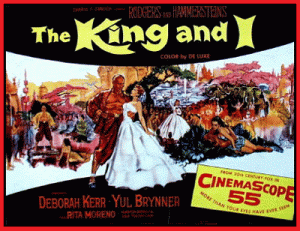
 It was his appearance as the proud and supercilious King Mongkut of Siam in the Rodgers and Hammerstein musical movie “The King and I” (1956) which established his film career and won him an Oscar for Best Actor. The role also brought to him impeccable stage discipline from performing eight times a week on Broadway since 1951 to screaming, standing ovations.
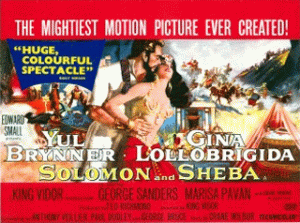
Besides, it also earned him immense popularity by spawning “The Yul Brynner Look” when he shaved his head in 1951, a revolutionary look back then which I understand was suggested by Irene Sharaff (The King and I), one of the major costume designers of the period forming part of the “Couture on the Screen”. It was a bodily feature he would sport throughout his life although he made few performances wearing wigs, namely, “The Buccaneer”, “Solomon and Sheba”, “Villa Rides”, etc.

His status as a major star of Broadway could not salvage him from the adverse impact of his accent and looks for which he was at times “considered too exotic a type to play the lead in any important film”. However, after seeing Brynner’s dynamic Broadway performance in “The King and I”, Cecil B. DeMille (1881-1959) went on to cast him as Pharaoh Ramesses II in his last film “The Ten Commandments” (1956). DeMille was right. Brynner’s vaunting arrogance and baldness captured the essence of the Pharaoh’s personality. According to a quote attributed to DeMille, Brynner’s powerful personality is “…a cross between Douglas Fairbanks, Snr., Apollo, and a little bit of Hercules”.

Brynner’s meteoric rise continued through performances in: Anastasia (1956); The Brothers Karamazov (1958); The Journey (1959); The Sound and the Fury (1959); The Buccaneer (1959); Solomon and Sheba (1959); Surprise Package (1960); The Magnificent Seven (1960); Once More, With Feeling! (1960); until the scale started its downward trend….. “Testament of Orpheus” (1962); Escape from Zahrain (1962); Kings of the Sun (1963). By that time, he was not only a well-known superstar, a good still photographer, author, guitarist, and a Special Consultant to United Nations High Commissioner for Refugees, appointed in 1960. He was living fast and high. He drove a Mercedes-Benz 300SL Roadster and smoked many packs of black Sobranie cigarettes a day “just to appear macho”. “Yul Brynner was an unusual, interesting, and intelligent man. ………. He was an absolute self-invention”, wrote English film and stage actress Claire Bloom in her memoir “Leaving a Doll’s House”.

Even though Brynner’s initial work for the production company, The Mirisch Company, Inc., was “The Magnificent Seven”, he will reunite with Mirisch once again for “Kings of the Sun” directed by Bristol born Scottish director/screenwriter/playwright/former actor J. (John) Lee Thompson (1914-2002). Fresh from the huge box-office success of his “The Guns of Navarone” (1961), Lee Thompson was the finest film-maker to emerge from the British studio system after the Second World War. Having gone to Hollywood to direct “Cape Fear” (1962), he had decided to stay behind, turning down the offer to direct “The Longest Day” (1962) in England in spite that London was at that time considered to be an ideal and exciting place to make movies.

In its place, he accepted United Artists’ invitation to direct Harold Hecht’s epic production of “Taras Bulba” (1962) starring Yul Brynner, Tony Curtis and Christine Kaufmann. Finally raised to the platform of directors commanding highest remuneration and enjoying big budgets and box office success, United Artists was only pleased to offer him another epic production, “Kings of the Sun” concerning the Maya civilization in pre-Columbian Mexico. Similar to Lee Thompson’s “Woman in a Dressing Gown” (1957), “Tiger Bay” (1959), “Cape Fear”, “Taras Bulba”, etc, this story also explored how people respond to and can be shaped by their environment.

Produced by Lewis J. Rachmil under the banner of Mirisch Company for a budget of US$4 million and based on a story by Elliott Arnold, “Kings of the Sun”, which turns 50 this year, was released through United Artists (like all the other 67 productions of Mirisch) in December 1963, a year noted for many momentous events. It was the year the First flight of Boeing 727 jet took off; British Secretary of State for War John Profumo resigned over sex scandal; Cardinal Giovanni Battista Enrico Antonio Maria Montini was elected Pope Paul VI; Martin Luther King Jr. made his “I have a dream” speech at Lincoln Memorial; Valium hit the market; US President John F. Kennedy was assassinated in downtown Dallas, Texas….. That year, the movie-world saw the release of “Cleopatra”, “It’s a Mad, Mad, Mad, Mad World”, “The Birds”, “Charade”, “From Russia with Love”, “The Great Escape”, Mirisch Corporation’s “Irma la Douce”, etc, featuring some of the most distinctive and eloquent faces in Hollywood cinema. It was also a time when parents in our part of the world used to put their children to sleep at night with bedtime stories unlike contemporary times when the children come in at bedtime and tell stories that keep the parents awake all night.


Underlining Elliott Arnold’s story of “Kings of the Sun” was the exodus of the Mayas to a new land and the final abandon of the practice of human sacrifice. The film opens with a panoramic view of the great pyramid at Chichén Itzá (c), the large pre-Columbian city of the Mayans where rows of Mayans have assembled as their Chief, “Balam. The Jaguar. Eight times King”, and Balam, the Crown Prince, (d) with headdress of high plumes of the quetzal adoring their royal heads, were brought to the crest of the pyramid to perform an important religious ritual. Following the credits, a voice-over narration is heard:

“Long ago there lived a people unique in all history – the Mayans. Greece and Rome had become ancient legends in ancient books and the European civilizations had entered into the age of the barbarians. But in the tropical jungles of Central America, a civilization had burst into full flower without metals, without horses, without wheels. These incredible people built roads, pyramids, temples worthy of ancient Egypt; they charted the heavens, devised the highest system of mathematics than the Romans and created the calendar as accurate as the one we use today.
But despite the maturity of their art and their science, in the most important part of their lives, the worship of their gods, they remained primitive.

To their minds, their gods were demanding gods, fierce and greedy, granting nothing except for a price and that price was blood. In their profound desire to win favour from the deities, the Mayans made human sacrifice, the keystone of their religion. To die as a bearer of a message to the gods was the most exalted honour a man could experience. When he was selected to be sacrificed, in that moment he himself became a god. He was worshipped as a god, granted any wish that came into his heart, until the moment he was put to death.
For centuries in small scattered kingdoms these people lived in peace with themselves and their gods. But then came conquerors from the West, with metal swords which made them invisible against the wooden weapons of the Mayans. One by one, they swallowed up the little kingdom until the last, the final stronghold – Chichén Itzá was theirs. And their leader, Hunac Ceel, already as cool as any god now felt himself as powerful as one….”

Thus begins “Kings of the Sun” with ceremonies leading to the sacrifice of a youth to bring prosperity to the Maya land. But it was a time when the stars were moving in a chaotic manner. It was in that dry season, when men were free from agricultural tasks to fight in wars that Hunac Ceel, intent upon destroying Maya civilization, attacked them. As hordes of Ceel’s ferocious warriors (possibly Toltecs) swept the Mayan land from the north and rushed up the steps of the great pyramid, the leaders of Mayas had fled into its interior chambers, locking the huge door behind them. At the sound of a heavy cedar log ramming on the secured door, they went deeper into the inner chambers where, before the corpse of their King Balam, his son, crown prince Balam was chosen as the new king, “Balam, the Jaguar. Nine times King”.

Mindful of their meagre chance of survival with their obsidian bladed swords, the new king found common ground in the proposal of the elders (Al Haleb, Ah Min, Pitz, Ah Zok) to retreat with their tribe to a safe place by the coast – at the fishing Village of Polé. As they headed for the trap door of a tunnel at the ground level, high priest Ah Min carried the small stela from their temple.

At Polé, before Hunac Ceel and his armed warriors wielding hard metal swords could attack them, Balam had to swear before the local chieftain to marry his daughter Ixchel in the new land. This was necessitated in order to convince the villagers to lend him their long cedar log fishing boats and to accompany Balam and his people to flee from the coast to a faraway land (e) where Balam hoped to settle them down, raise a new civilization and find golden opportunities. However, they will not keep old losses a faded memory. They will grow stronger in the new land and then they will return.


Barely had they managed to row some boats loaded with people into the sea before the first of Hunac Ceel’s horde burst onto the beach, shouting and launching spears. In less than no time, Balam and his people had fled in their boats to a greater distance before Ceel could catch them although few of the fatalities from the spear they suffered included Ixchel’s father. As Ixchel, now Balam’s fiancée, sat hunched in deep grief for the voyage to the north in the Gulf of Mexico, Hunac Ceel shouted from the beach: “The sea is not big enough to keep us apart, Balam. Wherever you go, I will find you.”

All endings are followed by a new beginning. Although they have never sailed the boats out across the waters beyond the sight of land, at long last, maintaining close sailing without drifting apart and, despite an opposition from an elder, they finally landed at a seemingly uninhabited Gulf Coast. Balam’s attempt to fulfil his promise to the chieftain to marry Ixchel met her disapproval since his vow was made to her father, not to her. “If he (Balam) is lonely why does he not tell me himself?”, these unsaid words of Ixchel would only come later, to Ah Min who advised her to marry Balam.

Presently they built a settlement which included irrigation systems, an essential pyramid that dominated everything by its height and at its crest was raised an altar for rituals, most importantly, for human sacrifices – for the joining of men with the gods. In a while, their presence was discovered by the head of a hostile Native American tribe who went by the name Black Eagle. The discovery was not unusual for the local tribe. There had been intruders in this land before, and they have always driven them away.

During a confrontation with Balam, Black Eagle was wounded and captured by the Mayas. When Ixchel’s friend Ixzubin refused to tend to the brute’s wounds, Ixchel volunteered to take over to nurse him back to health. Although she was subjected to his aggressive attitude, the air started to clear when he saw Ixchel the whole blessed day and every day of the Week igniting an attraction for her. But the Mayas had another agenda for Black Eagle. The Maya soldiers preferred to capture rather than kill the enemy. The captive become the sacrifice. There has been no rain since their landing. Black Eagle, a native of this land, is the next ideal candidate for their sacrifice to the god of waters….
 “Kings of the Sun” was shot on location at Chichén Itzá (Yucatán), Mazatlán (Sinaloa) and at Estudios Churubusco Azteca, Mexico (f), one of the oldest and largest movie studios in Latin America.

The script has managed to provide a sweeping picture of the traditions, advancements and primitiveness of the Mayas while maintaining a modern sense of logic in the advancement of the story. Although the film deviates from historical accuracy, in a broader sense, it is likely that its structural foundation must have derived from the sacred books of the Maya of Yucatán “The Book of Chilam Balam” in which the villain Hunac Ceel, the head-chief of Mayapan, is a prominent character.

While research provides material, it’s no substitute for creativity. Unhappy with the initial script, independent producer Walter Mirisch, who had garnered a new breed of professionals outside the studio system, had eventually secured script doctor James R. Webb (How the West Was Won (1962)) to add more structure to it which apparently met with Mirisch’s approval.

The writers had also left the dialogues of the exiled Mayas and North American tribe of Black Eagle speak the same language without a hint of differentiation for the sake of convenience for the audience. Nevertheless, the characters and action showcasing forbidden love and mortal conflict of two great chiefs should have exploded off the script and exhibited a kind of raw energy on screen rather than be dull as it appeared in certain places and also failed to generate favourable reviews for the movie during the time of its release.

Until now, much of the history of the Maya remains something of a mystery. It is widely accepted that the classic period of Mayan civilization, which stretched from Chichén Itzá in the north to Copán in the south, falls between AD 300 and AD 900 when their architectural and artistic achievements were brilliant. During that period, they built several cities in the Yucatán region and their civilisations went on to thrive until internecine warfare weakened them and left them prey to invaders from the north which culminated in the collapse of Maya civilisation between AD 800 and 900.

The pyramid, a prominent feature in the film, was an integral part of the Maya architecture. Their basic idea was to raise the sanctuary of the gods higher from the ground although its position could be easily revealed to the enemies. From the account of foot soldier Bernal Diaz de Castillo (memoir: Historia verdadera de la conquista de la Nueva España) who accompanied the expedition of Spanish Conquistadors on their voyage to Mexico in 1518 (historians have criticized his account due to multiple inaccuracies and exaggeration) and other later findings, we could know of how blood sacrifice at the top of these pyramids was a standard feature of daily life. Though this primitive act of cultural vandalism has long since been abolished, innumerable humans, often fringe members of the society or prisoners or those kidnapped during raids, were provided with special headdress, and led up the steps of the pyramid. They were made to stretch over the sacrificial stone by four priests while the fifth priest cuts open the body with an Obsidian stone knife (g) and the heart is offered to the god. The golden rule for this was the religious belief concerning life after death. The terms “sacrifice” which derives from the Latin “sacer facere” means “to make sacred”. Considering the varieties of rituals for which the pyramids were used, its design had to meet certain specific requirements such as:

- There are one or two shrines at the top of the platform dedicated to the gods;
- Apart from the methods of alignment with the stars used in the giant edifice, it is appropriately tall (not too high) to allow the spectacle of the ritual, the sacrifice and the victim’s elevation to divine status, to be visible to a large audience watching from below;
- Internal chambers and corridors are required, which was made possible by the strength of their mortar;
- To make the stairway even steeper than it is, the banisters were made to diverge slightly towards the top of the stairs;
- For the initial phase of the sacrifice, the stairway must be broad and impressive to befit the parade of the victim up the steps into the sphere of divinity;
- To dispose the corpse in a spectacular manner, it must be steep enough to provide an uninterrupted passage to the ground when it was made to roll down from the top.
To avoid being haunted by the spectre of the bloody ritual, the movie portrays the sacrificial ceremony in an implied manner by limiting the camera movements merely focused on the elites in power, a squad of religious specialists and ministerial dignitaries on the crest and the audience assembled below, all the while trying to be as authentic as possible. For realistic ambiance, few of these scenes were reportedly shot on location at the pyramid of Kukulcan at Chichén Itzá (where the initial part of the story is based).

Even though director John Sturges of “The Magnificent Seven” was slated to direct “Kings of the Sun” (then titled “The Mound Builders”) soon after completion of “The Great Escape” (1963), he had backed down from the project and went on to direct “The Satan Bug” (1965), paving way for director J. Lee Thompson to take over (h).
Although Lee Thompson never gained the heights reached with “The Guns of Navarone”, he scored notable success in several genres. The personal touch of the director is visible in style and expressions throughout the movie. Scenes depicting the instances when Ixchel’s heart reached out for Black Eagle in spite that her feelings were hanging on to Balam, or the mental struggle of the young woman as well as that of the young king and his struggle for coexistence, are effectively handled by the director. Lee Thompson was a “tiny man who carried a large sketchpad, and refused to read the script……. He never read a scene until he had to shoot it, and approached each shot on a whim. And yet, the cumulative effect was astonishing”, Anthony Quinn quoted in his memoirs “One Man Tango” referring to the production of “The Guns of Navarone”.
“Kings of the Sun” features an impressive line of prominent technicians and actors, some of them, unhappily, now deceased.

The stunts are impressive, especially a high-fall jump by Ronnie Rondell Jr., into a thatched hut from a burning observation tower. Then there was the difficulty in staging scenes over the pyramid, the uneven and very short steps to be laboriously climbed to its crest.

Cast: As Chief Black Eagle, Yul Brynner tries to work his movie star persona, dominating the scenes by his magnetic presence and undeniable sexuality. His scantily clad muscular body, his bronzed skin, long braided pigtail for hair, his panther-like gait, his piercing gaze, proud mannerisms, projects the impression of a restrained wild animal attuned to nature. With lesser dialogues, Brynner enjoys more screen time to react to the scenes, which seems well considering a quote attributed to director John Sturges mentioned in actor Eli Wallach’s memoir, “The Good, the Bad and Me: In My Anecdotage”: “Movie acting is reacting. Silence is golden on the screen”. The depth of understanding displayed by Brynner in portraying Black Eagle, a chief trying to avoid a clash of native cultures, is admirable and begs for more attention. On the personal side, whenever he was free from displaying his machismo sexiness in front of camera, Brynner was mindful of himself, often engaged in taking behind the scene photos of the production.

American dancer of Greek descent George Chakiris’ debut in films was in director Clarence Brown’s “Song of Love” (1947) in which he was credited as George Kerris. Thirteen years later, it was his role as Bernardo in the musical movie “West Side Story” (1961) based on a plot borrowed from William Shakespeare’s “Romeo and Juliet” that brought him a Golden Globe and an Oscar for Best Actor in a Support Role (1962) and catapulted him to international stardom.

Chakiris plays Balam, the young and inexperienced king who refrains from raising his voice against the ritual of human sacrifice in order to avoid conflict with his own high priest but only to eventually realize that to abandon the practice and living in peace could be the best way to honour the gods. The appraisal of Rock Brynner in the biography of his father “Yul, The Man Who Would Be King” (Page 160) that Chakiris’ “physique and self-assurance suggested about as much threat to Yul Brynner as a plastic coffee spoon”, wouldn’t meet up with disagreement of some viewers given that Chakiris’ screen glory was at times unsuccessful to be a superior match to Brynner’s commanding presence in the film.

English Rose Shirley Anne Field (Shirley Broomfield), a British pin-up magazine model for the 1950s and former Miss London had co-starred with Brynner in “Once More, With Feeling!” (1960). Her big break in movies came with an appearance opposite Sir Laurence Oliver in director Tony Richardson’s “The Entertainer” (1960). For Field, who was once known as “the British Marilyn Monroe”, the 60s were the busiest decade. And then – she was young and still learning. Following a string of successful performances in British productions, her first performance in a leading role for an American production was in “The War Lover” (1962) co-starring Robert Wagner and Steve McQueen. Somewhere around this time, she missed out on being a James Bond girl but was contracted to play the leading female role in “Kings of the Sun”.

Field’s portrayal of Ixchel, open to more avenues for improvement, covered layers of conflict of emotions for being the love interest of the captured Black Eagle who chose her to be his bride, the final wish of the sacrificial victim. She was a woman thrust into the life of the young king, whose emotional tie to her was becoming too intense.

To Black Eagle, she was the most beautiful woman in the heavens who would come and heal his wounds. To her, despite the fact that he had the look of a savage, he seems to have the soul of a man.

Curiously enough, her quizzical expressions as well as her lack of chemistry with the two men apparently met with the approval of director Lee Thompson with whom she had worked earlier in his remake of “The Good Companions” (1957). However, according to my research, I would believe that the casting team made the right choice in choosing Field (and possibly George Chakiris as well) for her facial features to be consistent with the norm of the Maya civilization which considered an elongated head as a sign of beauty. (i)

A talented actor who had appeared in “Titanic” (1953), “La Strada” (1954), “Moby Dick” (1956), “The Brothers Karamazov”, etc, American actor Richard Basehart’s (1914-1984) range of characters includes the honest, the mentally disturbed and the villains even though none of these brought him the stardom.

Basehart’s role of High Priest Ah Min, the ahkin of Chichén Itzá, took an earlier exit when, vexed by Balam’s decision to spare Black Eagle from death, he self-sacrificed on the point of an Obsidian stone knife.

American character actor Brad Dexter, co-star of Brynner in “The Magnificent Seven” and “Taras Bulba”, played in the role of Ah Haleb, batab, the general. British leading man Barry (Herbert) Morse (1918–2008) who had a prolific acting career that spanned theatre, movies and television, appeared in the role of the little priest Ah Zok, after a long break from feature films since “No Trace” (1950).

Once a screenwriter for producer/director Roger Corman, thick-set American actor Leo “Vincent” Gordon (1922-2000), usually cast in tough-guy roles (“Conqueror” (1955), “The Man Who Knew Too Much” (1956)), stars as Hunac Ceel who has nothing much to do but to act tough.

Playboy’s 1968 Playmate of the Year Victoria Vettri (aka. Angela Dorian/Victoria Rathgeb) of “Chuka” (1967) and “Rosemary’s Baby” (1968), played Ixzubin, the friend of Ixchel.

Other members of cast: Armando Silvestre (Isatai), Rudy Solari (Pitz), Ford Rainey (Ixchel’s father, the Chieftain), Angel Di Steffano (Balam’s father), José Elías Moreno (The sacrifice), narrator James Coburn’s voice is uncredited.

The movie offers numerous panoramic shots of the real locations in richly textured hues of DeLuxe Colour and in Panavision. The Cinematography is by Joseph (Joe) MacDonald (1906-1968), the award-winning American cinematographer who was born in Mexico City where Estudios Churubusco Azteca, in which the interiors of this film were shot, is located. While the veteran cinematographer’s busy tracking and wide angle shots are particularly impressive, the use of available and smartly placed source light to picture an imprisoned Brynner in successive scenes are also noteworthy.

MacDonald is the talent behind the cinematography of “My Darling Clementine” (1946), “Panic in the Streets” (1950), “Viva Zapata” (1952), “How to Marry a Millionaire” (1953), “Broken Lance” (1954), etc, which enabled him to work with renowned directors such as John Ford, Henry Hathaway, Elia Kazan, Samuel Fuller, Edward Dmytryk, Nicholas Ray, Fred Zinnemann, etc. While “The Carpetbaggers” for which he handled the cameras will be released during the same year, his next project with Lee Thompson would be “Mackenna’s Gold” (1969).

Production designer Alfred Ybarra has tried to provide highest authenticity to the sets with historical forms and designs, a mystery he solved by going back into the past to find the answers.

Since Mayas reputedly built their pyramids throughout of stone, held together with a strong lime mortar, a similar procedure is shown when young Balam’s men construct the pyramid at the new land.

New York-born film editor William (H) Reynolds (1910-1997) is best known for works which includes “Red Skies of Montana” (1952), “Three Coins in the Fountains” (1954), “Bus Stop” (1956), “The Sound of Music” (1965) in which the role of Captain Von Trapp was initially considered for Yul Brynner, Sean Connery and Richard Burton (j).

Winner of Best Costume Design, Black-and-White (1963) for “What Ever Happened to Baby Jane?” and nominated for “Hush… Hush, Sweet Charlotte” (1964), American costume designer Norma Koch (Norma – 1898-1979) was working in Hollywood since 1945. While the costumes by Koch (with wardrobe by Eric Seelig) for Black Eagle are perfect for the role, those worn by some of the other characters (of many colours with strange designs) seem to be more imaginary. Few dresses of young King Balam and his adversary Hunac Cell are decorated with similar jade works which comes across as green coloured plastic.

On the other hand, the splendid quetzal-plume headdress of the “Feathered Serpent (Quetzacoatl) cult” priests, the dress for the sacrificial victims and of some supporting characters somewhat conforms to images in the Codex Dresdensis (a pre-Columbian Maya book of the eleventh or twelfth century of the Yucatán Maya in Chichén Itzá) and Codex Florentino (a 16th-century ethnographic research project in Mesoamerica by Franciscan friar Bernardino de Sahagún) and such other available data. There is also accuracy in the clothes of some peasant women attired in “kub”, a piece of decorated cloth with holes cut for the arms and head.

The make-up by Emile La Vigne (The Magnificent Seven) although adequate sometimes neglects to keep up with the continuity while the hairstyles of King Balam (“West Side Story” look) and Ixchel (in a dark wig) by Mary Babcock (Escape from the Planet of the Apes) appear rather fanciful and unauthentic hampers the mood of the period.

Robust and rhythmic, the original Music provided by American composer/conductor Elmer Bernstein (1922-2004) is appropriately dramatic and haunting. He is one of the most prolific of all film composers – a master of all genres who believed in the power of melody and the traditional orchestra to move us. The widespread acclaim Bernstein received for scores arranged for “The Man With the Golden Arm” (1955) was further heightened when his score for “The Ten Commandments” (1956) ruled supreme. Charlton Heston wrote of Bernstein in his autobiography, “In the Arena”: “The value of Elmer Bernstein’s score is almost impossible to measure. It’s absolutely perfect for the film, guiding and shaping the emotional weight of each scene with mature mastery…”.

Bernstein’s music also graced films such as “The Magnificent Seven” (1960), “To Kill a Mocking Bird” (1962), “The Great Escape” in 1963, the year he was elected as the Vice-President of the Academy of Motion Picture Arts and Sciences. The magnificent arousing music of “Kings of the Sun” speaks volumes of his ability to capture the film audiences who had already placed Bernstein in league with his older contemporaries such as Max Steiner, Franz Waxman, Miklós Rózsa, etc.

Rest of the technicians are: Thomas Shaw (Asst. Director), Joe La Bella (Properties), Larry Allen (Asst. Editor), Richard Carruth (Music Editor), Roscoe Cline (Special Effects), John Franco (Script Supervisor), Allen K. Wood (Production Supervisor), Nate H. Edwards (Production Manager), Robert E. Relyea (Unit Manager), Stalmaster-Lister Co. (Casting), etc..

The posters of the film were designed by New York-born Frank McCarthy (1924-2002) who had worked on iconic posters of innumerable movies: “The Ten Commandments”, “Taras Bulba”, “Hatari!”, “The Great escape”, “Rio Conchos”, “Von Ryan’s Express”, “Thunderball”, “Khartoum”, “Duel at Diablo”, “The Dirty Dozen”, “You Only Live Twice”, “Once Upon a Time in the West”, “Where Eagles Dare”, and “Dark of the Sun”…. His works of mastery of texture and form with an eye for detail comprising lighting, atmospheric effects and theme, depicted moments right in the middle of the action. “I paint to achieve visual impact”, wrote McCarthy in his Introduction to the book “Western Paintings of Frank C. McCarthy”.

There has been a constant upward trend in the renewed interest in some Hollywood movies of that bygone era. “Kings of the Sun” recently kindled up curiosity amongst the film circles following the public interest perked up by the Great 2012 Doomsday Scare from the ancient Maya calendar which equated December 21 of 2012 as the end of humanity. Even so, the consolidation of talents of J. Lee Thompson, Yul Brynner, stalwart supporting players and crew, as well as the general form and design of this action film certainly merit our curiosity. However, a better script would have proven a more satisfying thing to enhance its screen glory – something worth finding out. Now more so than ever. Until next time, Ciao, Jo.

Notes:
a) The DVD of this movie, as well as those referred/illustrated in this post, are available with main dealers such as amazon.com, TCM Shop, etc.
b) The music album, “Kings of the Sun” by Elmer Bernstein & The City of Prague Philharmonic Orchestra, re-recorded at Prague in November 2003 is available with major dealers.
c) Chichén Itzá is now an important archaeological site in Yucatán combining the building genius of the Mayas and the Toltecs. Its most remarkable feature being a four-sided Kukulkan pyramid (aka “El Castillo”), probably a representation of the Mayan civil calendar. It is a square-based pyramid, 180 feet by 78 feet high, with nine tiers. The large stairways of 91 steps on each side (total 364 steps plus one being the platform adding to a total of 365 days of the solar year) are guarded by great serpent heads. The temple measures about 20 by 15 feet and has a door on each side. It’s method of construction ensures that for hundreds of years , on each spring and autumn equinoxes, the position of the sun coincided with the pyramid and project a shadow of seven triangles of light, measuring about 34 meters long from top to bottom, on the balustrade of the northeast, providing a silhouette of Kukulcan, the feathered serpent, until the triangles of light touch the stone head of the serpent god in the ground where the stairs begin. This process on the side of the structure lasts nearly five hours and its fullness can be observed approximately for 45 minutes.
d) Although a common family name in Yucatán, Balam means Jaguar.
e) According to the map shown in the film, it could be the southeastern coast of what is now Texas, North America.
f) Having been married to French fashion house executive Doris Kleiner in Mexico City in 1960, Yul Brynner had a special affinity towards Mexico City where the interiors of this movie were shot.
g) Even without glass or optical instruments, Mayans achieved spectacular success in astronomy through crossed sticks in relation to fixed features on the horizon. Besides the calendar, they also worked out arithmetic and developed hieroglyphic writing. Then again, they didn’t have iron, ploughs or wheels or cattle, sheep, goats, pigs or horses. Obsidian, a glassy volcanic rock was used to make tools and knives for human sacrifice. Cacao beans were used as money in Maya society which had its counterfeit currency in the form of beans filled with sand.
h) Following the release of “Kings of the Sun” in 1963 there was news that J. Lee Thompson planned to film “The Shoes of the Fisherman”, the 1963 novel by the Australian author Morris West, casting Paul Scofield and Spencer Tracy. In his book on Lee Thompson, author Steve Chibnall attributes the source of this information to Lee Thompson’s quote in Kinematograph Weekly in mid-1963. Even though this project never materialized, that film was finally directed by Michael Anderson starring Anthony Quinn and Laurence Olivier and released in 1968.
i) Mayans strapped boards to the head of their infants in order to flatten the front part to produce a receding forehead. Squint eyes were also a feature considered beautiful.
j) I have refrained from including few scraps of trivia related to the production of this film littered in the Internet due to lack of available sources to verify its authenticity.
k) This illustrated article is meant for the promotion of this movie. The reviews of movies in Manningtree Archive is part of my project to promote my favourite movies from a bygone era. Please refer to “About” for more details.
l) A glance backward: This review is dedicated to the memory of President John F. Kennedy who lost his life fifty years ago.

(© Joseph Sebastine/Manningtree Archive)




 Manningtree Archive
You must be logged in to post a comment.