Archives

WHAT FATE MAY BRING

The 240th anniversary of the Independence of the United States of America went past on July 4, 2016 with traditional fireworks displays, parades, concerts, barbecues, etc. Watching the celebrations on TV brought to my mind the bicentennial celebrations of U.S.A on July 4 forty years ago, when yet another jubilation rang out in some parts of the world related to an incident that lasted one week and ended with a daring rescue at Entebbe International Airport in Uganda which was featured in many print and visual media including the following three streams:

1

1: VICTORY AT ENTEBBE (telecasted on December 13, 1976)

Scarce anything awakens attention like a tale of cruelty – wrote Dr. Samuel Johnson (The Idler, 1758). The hijacking of the Air France flight 139 and rescue of hostages at Entebbe in 1976 had all the right spice and human drama to inspire more than 15 U.S film production units/studios to cash in on the events quickly. Emmy Award-winner screenwriter Ernest Kinoy quickly drew up a 200-page treatment for David L. Wolper Productions, 50% longer than most scripts, since it was originally planned as a three-hour telecast on ABC Television. Directed by Marvin J. Chomsky with music score by Charles Fox, it was also made into a theatrical film for overseas distribution. This moderate telefilm was originally shot on videotape and transferred to film for convenience in shooting and editing. Shot at Warner Bros. Studio in Burbank, California, its stellar cast consisted of Helmut Berger, Linda Blair, Kirk Douglas, Richard Dreyfuss, Helen Hayes, Anthony Hopkins, Burt Lancaster, Elizabeth Taylor, Julius Harris, etc. However, the film suffered owing to a script laden with clichéd dialogues and characterization which should have been reworked. According to the biography of a crew member, few days into the shooting, actor/comedian Godfrey Cambridge, cast in the role of President Idi Amin, died on the filming stage from a heart attack and was replaced by Julius Harris.

2

2: RAID ON ENTEBBE (telecasted on January 9, 1977)

Made for television, this was written by Golden Globe award winner Barry Beckerman and directed by Irvin Kershner (The Eyes of Laura Mars, Never Say Never Again). Of the two telemovies that came out five months after Operation Entebbe, this is considered a better paced dramatization of the hijacking and rescue and stars Peter Finch, Charles Bronson, Horst Buchholz, John Saxon, Sylvia Sidney, etc. American actor Yaphet Kotto appears as Idi Amin. The factual production had already started in late June 1976 while the hijacking incident was in progress. Telecasted by NBC, it won a Golden Globe as the Best Motion Picture Made for Television in the 35th Annual Golden Globe Awards. The film which originally ran 152 min. but cut to 113 min. for theatrical release was earlier released in theatres of Denmark on December 26, 1976.

33: MIVTSA YONATAN (ENTEBBE – OPERATION THUNDERBOLT) (released on January 27, 1977)

Nominated for the Best Oscar for Foreign Language Film, this story of the daring commando raid at Entebbe is presented in a simple narrative of good versus evil and concentrates on the rescue of the hostages, the main issue, without dwelling on hijackers’ motives, etc. Crackling with action, the film was directed by leading Israeli producer/writer Menahem Golan. According to a book, Golan had originally requested and was denied permission to accompany Israeli forces to shoot a documentary film, should any orders were given for a rescue attempt. The film was mainly shot at the specially constructed full-size replica of the Entebbe Airport terminal. The cast featured Israeli singer/actor Yehoram Gaon, Assaf Dayan, son of military leader/statesman Moshe Dayan, stage/screen actress Gila Almagor, etc, besides Israeli military personnel and equipment, some people who had actually been on the hijacked plane, including footage of some key Government officials of Israel of that time. German actor Klaus Kinski appeared as the fair-haired Wilfried Böse while Austrian actress Sybil Danning is notable in the role of deeply macho Halima. Kinski’s presence as leader of the hijackers and Dov Seltzer’s music (performed by Israel Philharmonic Orchestra) elevates this adaptation by American screenwriter Clarke Reynolds, above the two rushed-out TV versions. Golan had later told in an interview that the movie depicts exactly how Lt. Col. Yonatan Netanyahu was hit.

4

The much analysed  and debated Entebbe rescue operation has also spawned books, documentaries, movies, web articles, etc, most of which I have virtually gone through, leading me on to specific or general knowledge on this subject based on which a recap is drawn below (1):

5

The hostage-rescue operation at Entebbe: Just before 9 a.m on Sunday, June 27, 1976, Air France Flight 139 with 228 passengers on board left Lod Airport (Ben-Gurion Airport International Airport) near Tel Aviv, Israel, bound for Paris, France with an unscheduled layover at Athens, Greece. This commercial flight was hijacked by 4 passengers barely eight minutes after it took off at 12:25 p.m from Ellinikon International Airport, Athens from where the 4 hijackers (transit passengers travelling on fake passports who had arrived that morning from Bahrain on Singapore Airlines without any intention of going to Paris), boarded the aircraft with concealed guns and hand grenades taking advantage of the lax in security measures. Since 38 passengers had alighted and 56 boarded at Athens, the flight was then carrying 246 passengers plus the crew of 12. The passengers were informed that the flight was under the command of the Che Guevara Group and Gaza Unit of the PFLP. It was the first hijacking in the history of Air France.

6

Cutting across the Mediterranean Sea, the hijacked Airbus A300B4S aircraft’s wheels brushed the tarmac of Benina International Airport, Benghazi, Libya, and seven hours later, it took off from there after topping up its fuel and leaving behind a British-born Israeli citizen with symptoms of a miscarriage. No sooner had the flight set on a different course and the radio transmissions ceased from the Airbus, the alert and first reports reached Israel where the Cabinet was in its weekly meeting. While a liaison office to co-ordinate with the hostages’ families was arranged at the Lod airport, intelligence officials were frantically collecting all information and as more developments became known, various possibilities and steps for the release of hostages were being explored.

7

After a five hour flight, and having been refused permission to land at Khartoum, Sudan, the twin-engined Airbus finally trundled to a standstill on the landing-strip of the Entebbe International Airport at about 0330hrs (Monday, June 28) where the hostages had to wait nearly nine hours inside the aircraft before they were hustled into the main lounge of the disused old terminal building which was soon securely surrounded by the Ugandan troops.

8

The woman, who was left at Benghazi and flown to England by evening, confirmed that the Airbus was taken over by two South Americans and their two accomplices. It would be later established that the blond-haired man checked-in as Peruvian A. Garcia, was in fact a German called Wilfried Böse, a member of a German Revolutionary cell, while the Ecuadorian woman travelling as Ortega, was Böse‘s former German lover Brigitte Kuhlmann (2) of RZ. Their comrades were of Middle East origin. At Entebbe, the hijackers reinforced their team with the arrival of more associates which would also allow them to work in shifts. President Idi Amin of Uganda, after visiting the hostages, made it known that he offered his services in the sympathetic role of a mediator and hoped the wishes of the hijackers would be accepted.

9

The demands for the exchange of the hostages was the release of 53 political prisoners held in jails in Israel (40), Kenya (6), France (1), West Germany (5) and Switzerland (1). To deliver the prisoners to Entebbe, the deadline was set for 11.00 am GMT of Thursday, July 1.

On Tuesday, June 29, having moved the Israeli citizens/Jewish passengers of other nationalities to an adjoining room, the captors released 47 non-Jewish passengers, allowing them to fly to Paris on Wednesday on an Air France airplane.

10

As the IDF (Israel Defence Forces) looked into the feasibility of several alternative military options, they were grappling with the lack of fresh, credible and reliable intelligence information. For starters, specialists of the planning group had prior knowledge about the Entebbe airport and the merits of the Ugandan troops. Not only had Israeli experts helped train those troops, constructions in the Entebbe airport, including the old terminal building, were done by an Israeli construction firm and they had detailed architectural drawings. On the surface, the impending odds lay in the difficulty of retrieving the large group of hostages which would occasion an eight hour flight through the radar range of other countries and the inevitable refuelling of the aircrafts for their trip back home.

Meanwhile giving in to the mounting plea from the families of the hostages, the captors were made known of the intention of Israel to talk. To facilitate arrangements for the exchange, the deadline was postponed to 11:00 a.m. GMT of Sunday, July 4. Soon, selected 101 non-Jewish hostages were allowed by the hijackers to fly out to Paris. The Air France Flight Captain Michel Bacos, claiming responsibility for all passengers of his flight, chose to stay with the remaining 94 Jewish hostages, a decision welcomed voluntarily by his crew (3).

11

A passenger, who was amongst the 101 hostages released, provided valuable information about how the hostages were kept under guard and the strength of the Ugandan guards at the airport. It was also welcoming to know that the rest of Entebbe airport was operating normally and scheduled flights were still flying in and out.

12

Intervention through a possible military option called for the element of surprise, an absolute necessity to deny captors any time to harm the hostages. Opportunities don’t happen, you create them. The possibility of sky-dropping troops into Lake Victoria, spread wide at about 69,000 Sq km and touching on Uganda, Tanzania and Kenya, had to be abandoned owing to the lake’s shallow waters (only 100m deep) infested with crocodiles and rampant of Bilharzia. Besides, its shores were then hide-outs for snails which are the host for the parasitic flukes harmful to the body.

Before long, a suitable but daring ‘long-arm option’ for rescue was found feasible to rescue the hostages remaining in the terminal. Named: Operation Thunderbolt, the mission will be under the overall command of Brig. Gen. Dan Shomron. Two days before the deadline, a British-Israeli hostage named Dora Bloch had to be removed to Mulago General Hospital in Kampala when a piece of food accidently stuck in her throat.

13

With preparations for military option on, a 100-strong rescue team was drawn up from several IDF units including the elite troops. To support the intricate planning and rehearsal drill for the operation, a partial replica of the Entebbe terminal building, based on the blueprints from the construction firm, was immediately constructed. As weapons and gadgets for operational efficiency and safety were decided upon and coordinated, the disembarkation and embarkation procedures were rehearsed on a Hercules aircraft.

Four tactical Lockheed C130 Hercules transport aircrafts, recently purchased from the United States, which have the manoeuvrability and the range, would be deployed with specific assignments. Each soldier all sparked up and in full webbing, would play a critical role.  The first Hercules would carry a black Mercedes car, two Land Rovers, a paratrooper force and IDF’s elite Special Forces assault team led by Lt. Col. Yonatan Netanyahu, the unit’s recently appointed commander.

14

Rolling off the back cargo door of the Hercules, the “break-in crew” riding in the Mercedes and Land Rovers with Colgate air of confidence were expected to pass through the Ugandan airfield without resistance assuming they would be taken for President Amin and his entourage. Through access doors 3 and 4 of the seven points of entry of the old terminal they would storm the lounge where the hostages were held. Once inside, they will eliminate any resistance, free the hostages and secure the building. At the same time, unit members will also neutralise the control tower, its radar room and the machine-gun nest near it.

The other three Hercules aircrafts scheduled to land in close succession five to seven minutes later would be accorded protection on the ground by the units of the first aircraft, Upon landing, the specific assignments of the units of the three aircrafts included providing cover to secure the aircraft and keep Ugandan troops away; secure the new terminal, the new runway, the refuelling station and the adjoining airfield, and also to destroy the squadrons of MIGs parked on the far side of the airfield. They would also facilitate on-board emergency medical treatments, evacuate any casualties and help hostages to emplane the aircraft. Of the two Boeing 707s forming part of the operation, one would act as an airborne command and control equipped with superlative communications and monitor the on-ground mission and simultaneously maintain link with Tel Aviv where the communication equipment would be tuned to the operation’s wave-band. The second Boeing would serve as a full-fledged infirmary unit.

15

At 14.30 Saturday July 3, the rescue operation was approved. Operation Thunderbolt commenced that late afternoon at Sharm el-Sheikh, the operation’s “jump-off point” at the southern tip of Sinai where the planes had refuelled, having arrived earlier during the day from Ben-Gurion. To escape detection by radar the formation of C130 Hercules aircrafts equipped with American radar jamming devices flew over the Red Sea at very low altitudes (100 feet above the water and at some places at much lower altitude) and then turned inland over Sudan, flying past Ethiopia and above Kenya to approach Entebbe from over Lake Victoria, covering a distance of about 2,500 miles (4,000 km), the first 1000 miles of which was accorded fighter cover by their Mirages and Phantoms.

16

Wheels on ground at Entebbe at about one minute past midnight Uganda time, things went wrong even before the team could reach the old terminal 2.4kms away. Two commandos of the front vehicle had to shoot down an armed Ugandan soldier with their silenced .22 caliber Berettas. When the wounded soldier unexpectedly got back on his feet and took aim to shoot, reacting to a perceived threat, a commando in a Land Rover neutralized him with a long burst from his Kalashnikov. The resultant sound of the gunfire sacrificed the much required element of surprise. However, in less than an hour from touchdown of the first Hercules, the mission was successfully achieved liberating 102 hostages and crew and finally the last of the rescue aircrafts had wheels up and departed from Entebbe, marking a dramatic victory in the operation.

17

The casualties included the death of all the hijackers and their accomplices, at least twenty Ugandan soldiers and three hostages.

The best men are so often the first to be killed, because they are in front. Fatally shot in the back by a Ugandan soldier from the control tower, Lt. Col. Yonatan “Yoni” Netanyahu was declared dead (4) by the time the rescuers reached Nairobi, Kenya, from where, after refuelling, they all flew back to a military airfield in Tel Aviv for a rousing reunion with their families.

18

Dora Bloch (age 73), the passenger on her way to New York for her son’s wedding who was admitted to hospital in Kampala earlier was reportedly killed in Uganda later (5) in reprisal to the successful rescue operation planned and effected within a short space of time surmounting many odds amidst tremendous tension. Fair enough, the operation was subsequently re-named: Operation Yoni (MIVTSA YONATAN) in honour of Lt. Col. Yonatan Netanyahu.

On July 11, the Sunday following the rescue, Ms. Rina Messinger, a 20-year old aerodynamics instructor was crowned as Miss Universe 1976. Coming on the wake of the victory at Entebbe airport, a source of pride and inspiration, she was happily dubbed “Miss Entebbe” by her jubilant countrymen. From pictures I could see that she certainly looked really pretty when she smiled.

Until next time. Jo

19

20Note:

  1. Several authoritative books are available about the Entebbe rescue operation.
  2. The woman hijacker is named as Gabrielle Kroecher-Tiedemann in some films and in the book Counter Strike Entebbe by Tony Williamson.
  3. Captain Bacos was honoured with the Legion of Honour while his crew were awarded with the French Order of Merit.
  4. Yonatan Netanyahu was buried in Mount Herzl National Cemetery, Jerusalem
  5. The remains of Dora Bloch, recovered near a Sugar Plantation 20 miles east of Kampala, were shifted to Israel on June 3, 1979, and were buried with state honours in Mount of Quietudes, (Har HaMenuchot Cemetery) Jerusalem.
  6. The subject is featured in the documentary Operation Thunderbolt – Entebbe (2000) and in movies Follow Me – The Yoni Netanyahu Story (2012): and in The Last King of Scotland (One Episode in 2006)
  7. Most of the movies and books referred to in this article are available with amazon.com, amazon.co.uk and other leading dealers.
  8. Books/DVD sleeves credits: amazon.com, en.wikipedia and from my private collection.
  9. This illustrated article is an affectionate nosegay to movies of the past. Please refer to “About” of my webpage for more details.
  10. This article is dedicated to the defenders of peace – the fallen and the living.

(©Joseph Sébastine/Manningtree Archive)

Bruce Lee – Chop, Kick and Valour

B1

This day, July 20, marks the 43rd year since American martial arts actor Bruce Lee bid adios to the world. His meteoric rise to become one of the major movie phenomena of the 70s showed its first glowing signs with the release of Kung Fu actioner, The Big Boss (US: Fists of Fury, Dir: Lo Wei, 1971), a huge commercial success for Hong Kong’s Golden Harvest Productions. The film was followed-up with Lo Wei’s Fist of Fury (The Iron Hand, US: The Chinese Connection, 1972).

B2

Riding on the success of the above two ‘chop socky’ films and by then considered as the Numero Uno Kung Fu star, Bruce Lee himself directed The Way of the Dragon, (US: Return of the Dragon, 1973) – shot in Italy.

B3

However, Lee’s popularity would hit sky high and elevate him to cult status only after the release of the mind-boggling actioner, Enter the Dragon (The Deadly Three, Dir: Robert Clouse, 1973), his last completed film, in which he directed the stunt sequences and acted as the main protagonist, amongst an all-star cast of karate champions who gathered for a quadrennial Karate championship contest on a Chinese island which is the sinister fortress hideout of the evil Han.

B4

Unfortunately, having not seen the final product which he had been eagerly waiting to see on its United States premier in August, Lee died on July 20, 1973 at the age of 32 at Kowloon Tong. At that time he was working on the movie, Game of Death.

B5

The prime factor for the growth of interest in the Asian martial arts and Hong Kong movies in international box-office is attributed to this first Chinese superstar of Hollywood with his undeniable charming screen charisma. Born to a Hong Kong family in Chinatown in San Francisco on November 27, 1940, he was given the Americanised-name Bruce Lee by a hospital nurse.

At the age of six, Lee made his appearance in the Hong Kong movie, The Beginning of a Boy. As he went on to appear in twenty movies, he also took up studies in martial arts from the age of 13, in the process developing his own form of attacking style in karate, Jeet Kune Do, based on street fighting techniques.

B6

By the late 50s, back from Kowloon to United States for his higher studies, he appeared in supporting roles (1966-1967) in the TV series The Green Hornet as well as in Batman, etc. He was cast in director Paul Bogart’s Marlowe (1969), a slick update of author Raymond Chandler’s The Little Sister with actor James Garner in the role of the private eye Philip Marlowe. This movie, in which Lee’s character (also stunt supervisor) reduces Marlowe’s office to rubble, was his American début. By then, this muscular young man had become popular in the Far East film circles, eventually paving the way to showcase his brilliance in the martial arts tournament in Enter the Dragon.

B7

Enter the Dragon, which has endured all these years, also featured many other martial arts experts: John Saxon (Long time student of oriental martial arts of karate and tai chi chuan); Jim Kelly (the 1971 International Middleweight Karate Champion); Robert ‘Bob’ Wall (1970 United States Professional Karate Champion); Peter Archer (1971 Commonwealth Karate Champion); Yang Sze (Bolo Yeung) (South-East Asian Shotokan Karate Champion), and Angela Mao Ying (Black Belt Hapkido Champion of Okinawa), etc. An Uncut version of Enter the Dragon issued later features interviews, comments about incidents on the set and more footage unseen in the original released version.

B8

Enter the Dragon was Hollywood’s first major involvement in a movie rooted in the Martial Arts scene and no doubt, it was Bruce Lee’s international popularity and his niceties of the martial arts that made the rebirth of these Asian arts worldwide possible. Until next time, Jo

B9

Notes:

  1. Movies referred to in this article are available with amazon.com, amazon.co.uk and other leading dealers.
  2. DVD sleeves credits: Wikipedia, amazon.com, and from my private collection.
  3. The illustrated scenes are from the movie: Enter the Dragon.
  4. This article is an affectionate nosegay to movies of the past. Please refer to “About” of my webpage for more details.

B10

(©Joseph Sébastine/Manningtree Archive)

Remembering a Maestro of Cinema

Sat1

Sat2

Notes:
1) DVD/Blu-ray of the movies referred to in this article is available with amazon.com, amazon.co.uk and other leading dealers.
2) DVD sleeves/posters credits: Wikipedia, amazon, and from my private collection.
3) This illustrated post is an affectionate nosegay to the personality and movies referred therein. Please check “About” of my webpage for more details.

(©Joseph Sébastine/Manningtree Archive)

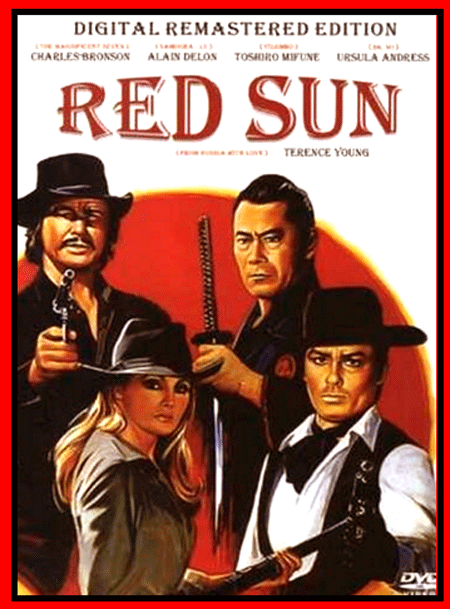
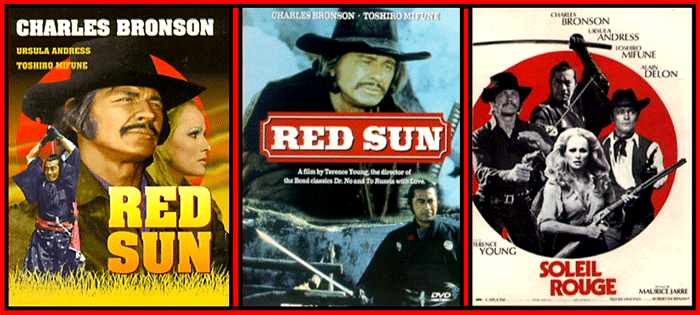
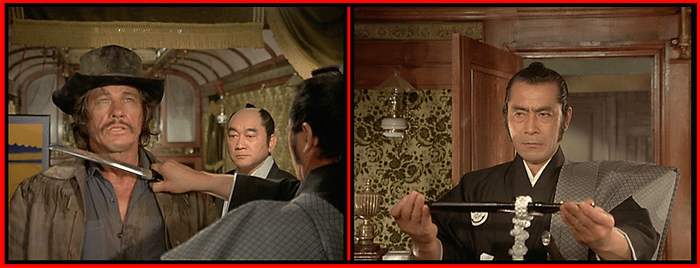
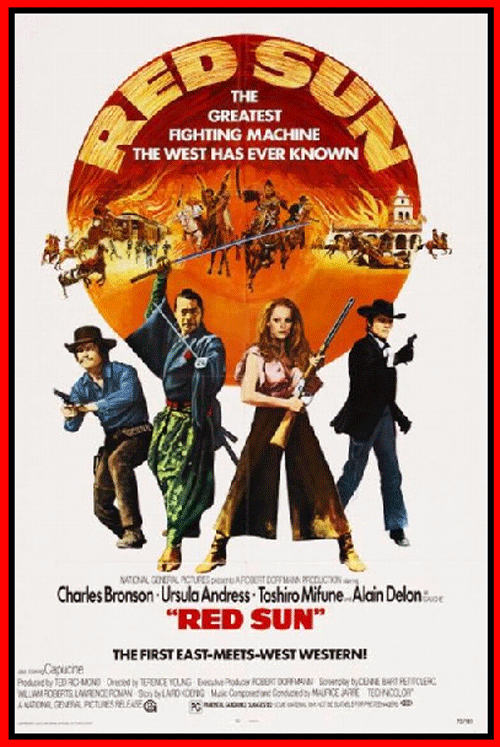
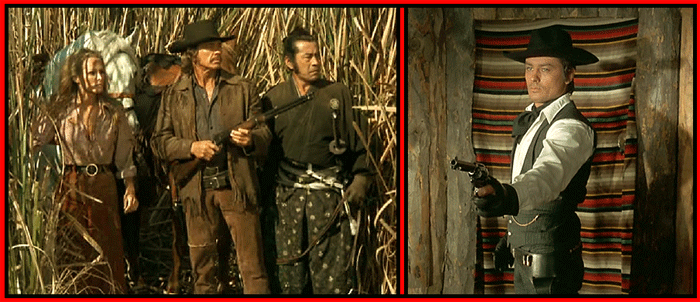
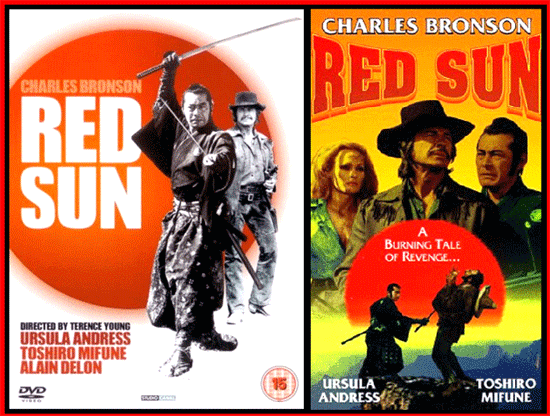
Red Sun (Soleil rouge – StarChoice.26)


Header-SC1

0 1

This second post concludes my preceding article of March 29, 2016: The Galloping Riders of Almería

0 2

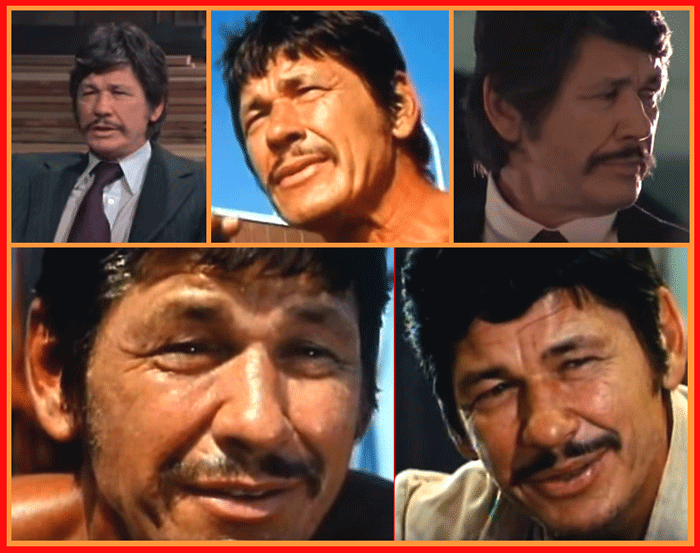
By early 1970s, Charles Bronson’s charm had transcended the borders of Europe and invaded far of corners of Asia. Movies such as The Magnificent Seven, The Great Escape, The Dirty Dozen and Once Upon A Time In The West have all contributed their magic for the popularity of Bronson. No sooner, large billboards of the craggy-faced, toughly built Bronson appeared in strategic locations in Japan where he was elevated as the quintessential ‘Western Man.’

His aura of toughness and animal magnetism even earned him an appearance in the Japanese television commercial for Mandom, proclaiming a new toiletry brand for men. The ad-film was created by none other than the Japanese filmmaker Nobuhiko Obayashi, known for his surreal visual style. As for Bronson’s film career, there was no dearth in films for he was already in talks with filmmakers about a project called Red Sun.

0 4

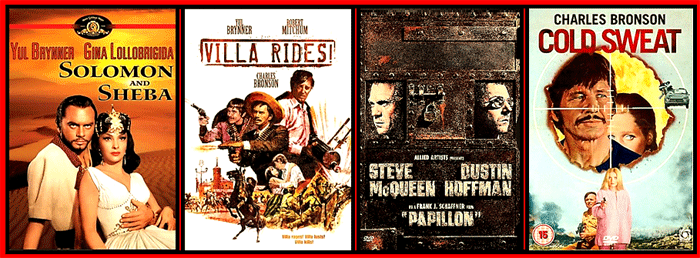
According to a book on Charles Bronson, the script for Red Sun was already available – having been passed around the major studios since 1966 when, based on an idea outlined on fifteen-pages, veteran producer Ted Richmond (Solomon and Sheba, Villa Rides!, Papillon) obtained the consent of Toshirô Mifune to star in it.

0 5

Owing to unenthusiastic response to get the film off the ground in Hollywood, Richmond associated with producer Robert Dorfmann (Le Cercle Rouge, Cold Sweat, Papillon) in Europe who signed Bronson and Delon. The choice was easier since the two stars had not only starred in their earlier projects, their commercial appeal made it possible to secure financing. The result was a co-production, between Les Films Corona, France; Oceania Produzioni Internazionali Cinematografiche (Oceania Films), Roma/Italy; Producciones Balcázar S.A., Spain, – an arrangement, besides other benefits, assured distribution in three markets.

0 6

They also roped in Terence Young to direct the movie. Young has proven his flair in directorial skills through a wide range of genre including peplum and war films since his directorial debut in 1948.

0 7

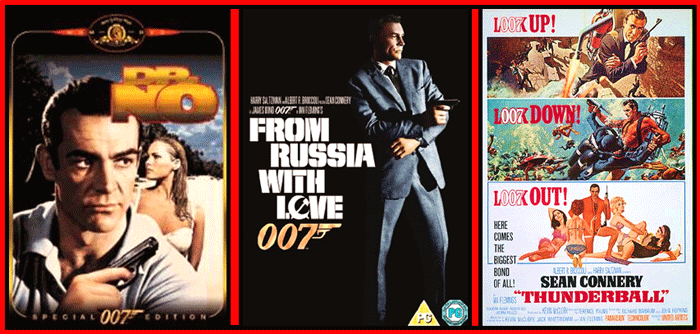
International in scope as the stylish action director of three of the first four James Bond films, Dr No (1962), From Russia With Love (1963), and Thunderball (1965), Young himself was then ranked a colourful character – consistent to the image of the British secret service agent James Bond’s taste for fine wine, expensive clothes and beautiful women.

0 8

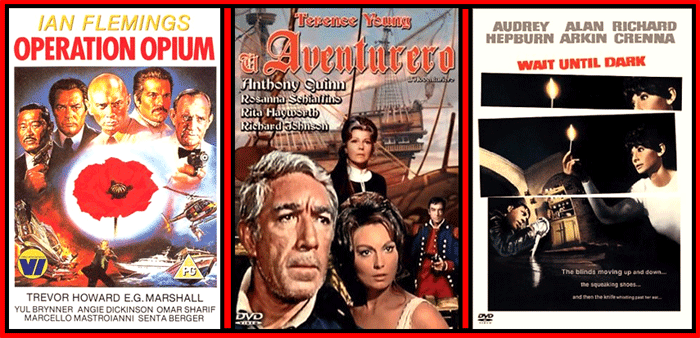
Ever since his departure from the James Bond series, Young was engaged in direction of The Poppy is Also a Flower (Operation Opium, 1966), L’Avventuriero (The Rover, 1967), Wait Until Dark (1967), Mayerling (1968), and Cold Sweat (1970), the first of three movies that Terence Young would make with Charles Bronson.

0 9

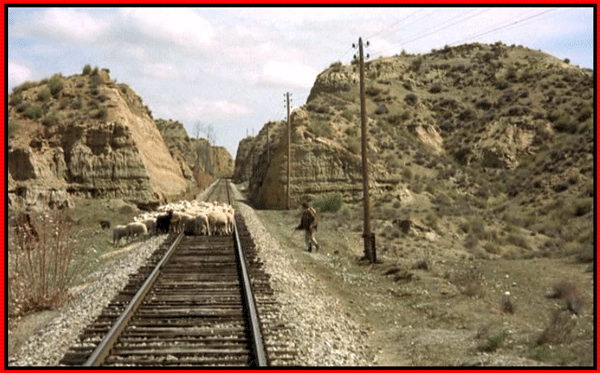
Red Sun was shot during the first half of 1971. Chosen as a stand-in for the American Southwest are the atmospheric mountains, virgin grounds, stark terrain and delicious climate of Spanish Almeria’s El Cabo de Gata (Cape Agate), Tabernas and Cortijo de la Sartenilla as well as the area between La Pedriza de Manzanares El Real and La Calahorra, effectively cutting the production cost.

0 10

Some of these places, studded with agave plants and other desert succulents, flat-roofed whitewashed houses and abandoned/renovated farmsteads, were familiar to Bronson for having worked there recently in earlier production of Sergio Leone.

0 11

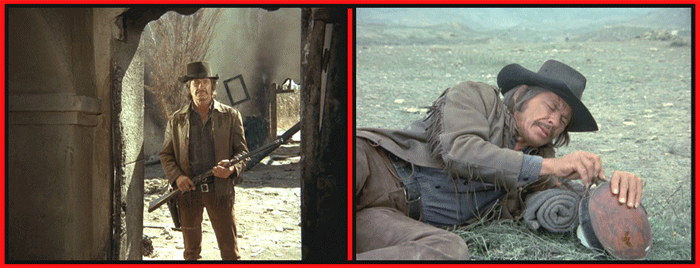
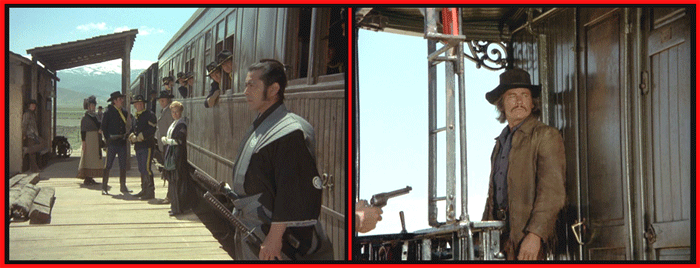
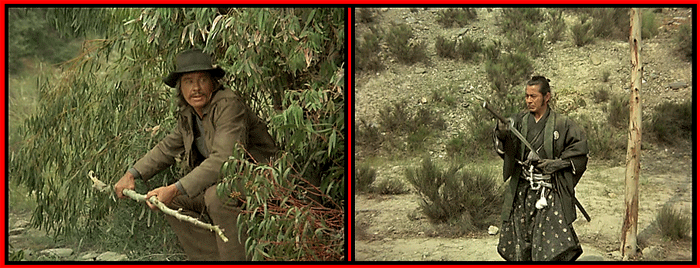
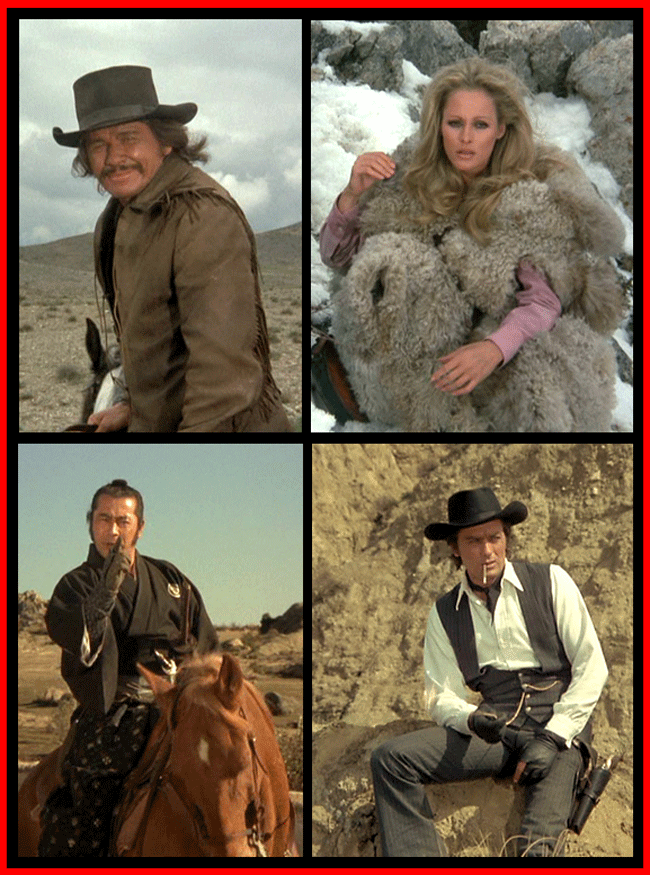
Set in the 1870s, Red Sun opens with the arrival of prairie rider Link Stuart (Charles Bronson) at a deserted railway station from where he boards a mail train bound for Washington. Besides the civilian passengers and the US soldiers protecting the gold and other valuables on the train, a delegation led by the Japanese ambassador to the United States occupied a private car.

0 12

During the reign of the 121st emperor of Japan, Emperor Kōmei-tennō (July 22, 1831 to January 30, 1867), Japan had begun its transformation into a modern industrial power following the arrival of US Commodore Matthew Calbraith Perry and his “Black Ships” on July 8, 1853 on a mission to force the opening of Japanese ports to American trade, through the use of gunboat diplomacy if necessary. Within the next decade, the drive for modernization resulted in the opening of Japan’s doors to the rest of the world.

0 13

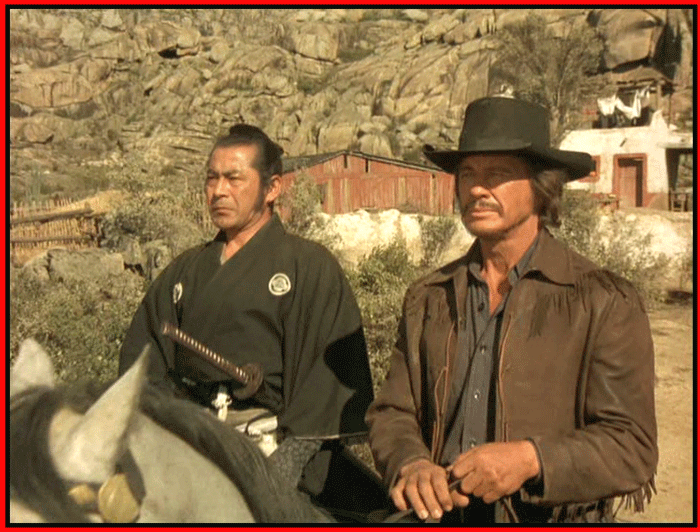
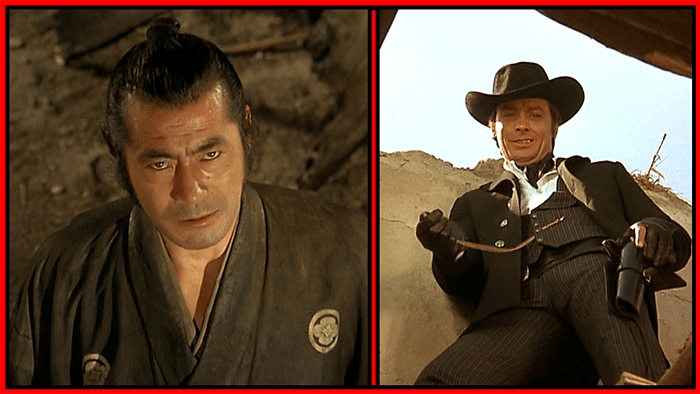
Ten years later, as the movie goes, Sakaguchi, Lord of Bizen and the first Japanese ambassador to the United States by authority from the Emperor, had arrived in San Francisco after a long and perilous voyage by sea. Even though his safe arrival to Washington is guaranteed by the US government, anticipating dangers on their way, the entourage rightfully consisted of two samurais to protect their liege lord – one being Kuroda Jubie (Toshirô Mifune) (1) to whom loyalty and death is part of his air and sea and earth.

0 14

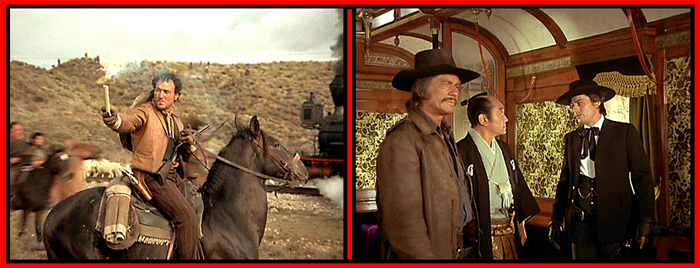
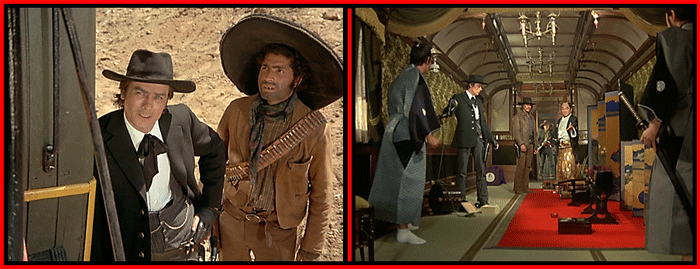
Once the train had chugged out of the station, its control was forcefully taken over by the bandit group belonging to Link and co-leader Frenchman Gauche (Alain Delon) who soon set to rob the train of its valuables. Having sent off all civilian passengers by foot, Link and Gauche barge into the private car of the Japanese entourage and steal their money while the two samurai stay meek at the ambassador’s instance.

0 15

It was after Link had left the car with the money when Gauche’s attention was drawn to a precious Mikado katana, a gold embossed sword, the Japanese was carrying for presenting to the 18th U.S. president, Ulysses S. Grant. Gauche forcefully steals it after killing one of the samurai (Hiroshi Tanaka) who aggressively opposed him. With his mission successfully completed, Gauche double-crosses his partner Link (who was promised 1/3rd of the loot) by throwing dynamite at him. Believing Link to be dead, Gauche and his henchmen ride off with the spoils.

0 16

Link was fortunate to survive the attempt on his life and was discovered by Kuroda by the railroad track. Regaining consciousness, Link was compelled by the Japanese ambassador to accompany samurai Kuroda to track down Gauche and retrieve the sword. Kuroda will attain this within seven days maintaining the code of morals and manners of the Bushidō (the way of the warrior) (2) and if he failed, carry out seppuku (belly-cut) or hara-kiri, the Japanese ritual suicide reserved for samurai.

0 17

Although Link reluctantly agreed to this he was troubled by the samurai’s intention to kill Gauche in a bloody reprisal as soon as he retrieved the sword. This would not leave Link enough time to catch Gauche alive, and obtain the loot ($400,000/-, give or take a dollar!) from the train robbery. For purpose of expediency, Link must elude Kuroda and go after Gauche alone. The journey that follows is a concoction of action, humour, nudity, betrayal, revenge and restitution of honour.

0 18

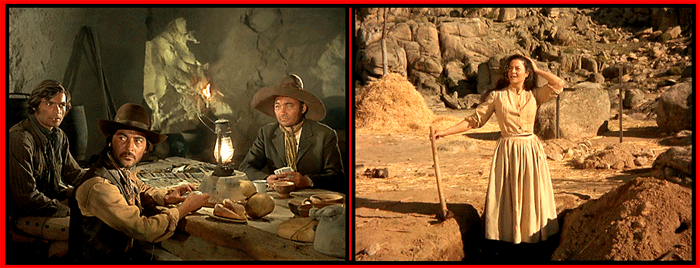
A French/Italian/Spanish production, the film was a hit in Europe and Asia while in the USA the regular critics were unkind to it which the filmgoers mostly discarded. An uncomplicated action director, Terence Young keeps the movie at a semi-brisk pace sprinkled with humour and brings the story to a dramatic climax amidst the reed thickets, shot in Venta Nueva, Adra, Spain.

0 19

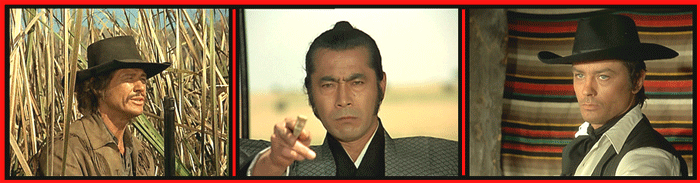
Red Sun contains the three situations essential to every western: isolation, violence and law. Kuroda, a man of dignity and honour, but quick and deadly as a rattle snake, is an isolated man in the West in his pursuit to retrieve the stolen sword and protect the honour. He was forced to associate with the outlaw Link into a path of violence, taking the law and justice into his own hands, hardly concerned whether he may die doing it or not.

0 20

Since most of the action takes place while Link and Kuroda are on the trail of the sword, director Young gives more emphasis to the interaction between the always very meticulous Bronson and much-focused Mifune – the events depicted in the movie leading to the point where Kuroda brings respect in Link for the strict bushido code which Kuroda adhered to, whereas Link manages to convince the revenge-minded Japanese to restrain from killing Gauche until Link could learn of the location where Gauche has hidden the loot. The script also briefly offers Kuroda, who generally dominates Link, an opportunity to speak of the disappearing values of the samurai as his countrymen no longer value the customs of old.

0 21

The two foreigners, Kuroda and Gauche, in the western settings of the movie contrasts dramatically: Mifune’s Kuroda representing the good and the gallant, while French actor Alain Delon’s Gotch ‘Gauche‘ Kink epitomises the bad and the ruthless; and within the limited but fairly meaty sequences of Gauche, the story maze clearly defines his debauchery, grounds for Kuroda to exact lethal vengeance. Relevant to Delon’s then public image as a “toughie” off screen, he comes across effectively as crafty and aggressive – and then again, there is always the visually interesting aspect – his pretty-boy good looks.

0 22

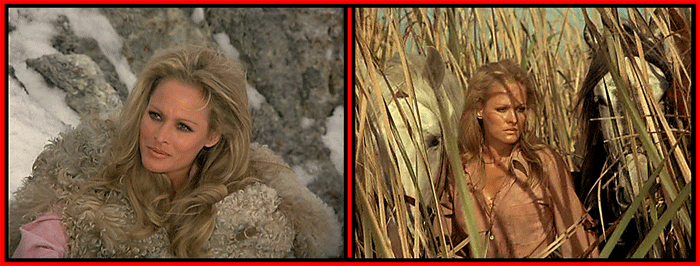
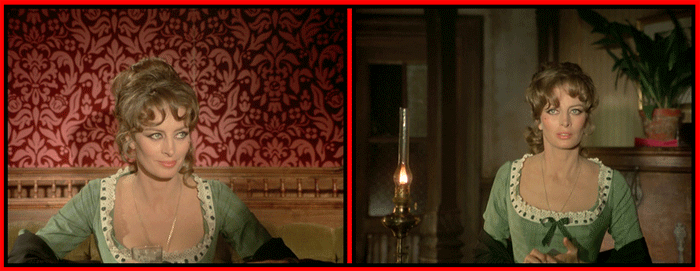
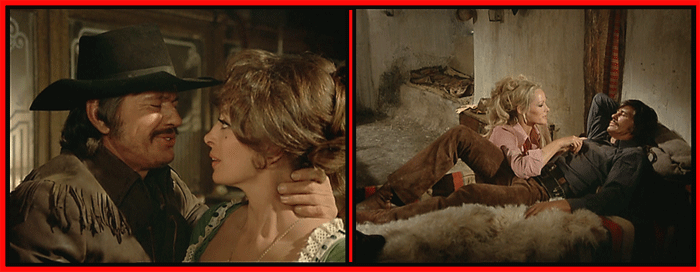
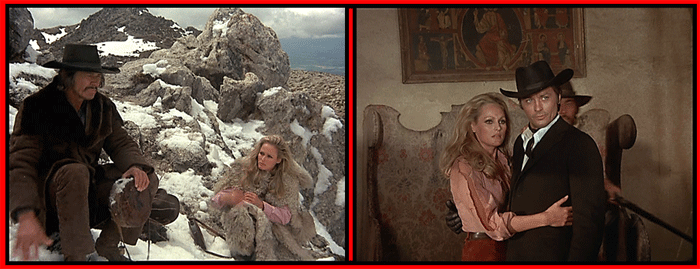
Statuesque Swiss-German actress Ursula Andress, who received second billing in the movie credits, is the foul-mouthed prostitute Christine who is the connection with Gauche whilst in love with Link. Red Sun displays her in a parody of scenes: in partial nakedness, as a helpless hostage of outlaws, as a victim of refined Indian torture, etc.

0 23

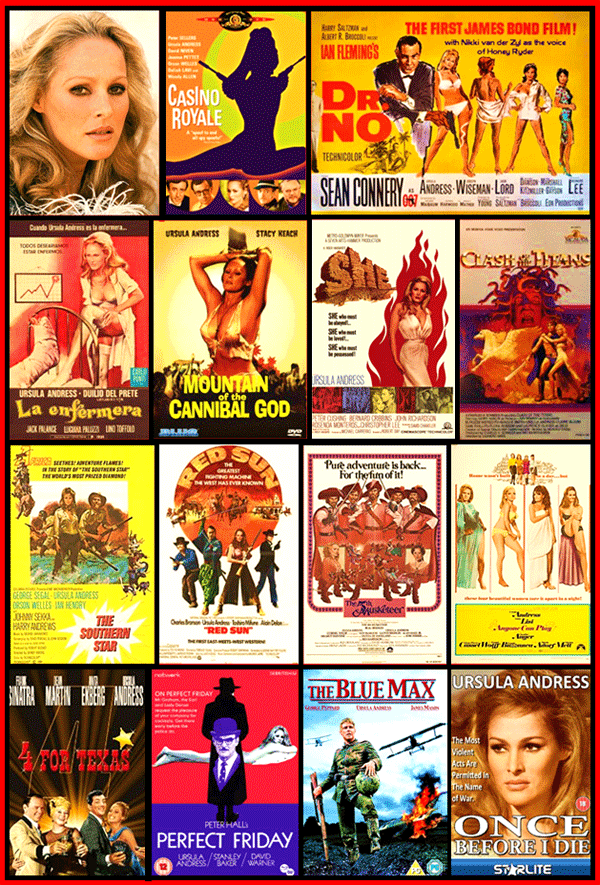
Although Andress has donned roles in Le Avventure di Giacomo Casanova/Sins of Casanova (1955), What’s New Pussycat? (1965), The Blue Max (1966), Anyone Can Play (1968), etc, it is her smouldering screen appearance as Honey Ryder in Dr. No (1962) that she is much remembered for, although she also appeared as Vesper Lynd in the satirical James Bond spoof Casino Royale (1967), a role turned down by Joan Collins, Elizabeth Taylor, Shirley MacLaine and the patrician French actress Capucine (The Pink Panther, ‘What’s New, Pussycat?).

0 24

As it turned out, Capucine (Kap-u-SEEN), whose original name is Germaine Hélène Irène Lefebvre but changed it in honour of France’s nasturtium, co-starred with Andress in the role of Pepita in Red Sun.

0 25

In the supporting role as Hyatt is Scottish actor Anthony “Tony” Dawson – a regular in Terence Young productions and often cast in a variety of villainous roles in the 1950s and 1960s including movies such as Alfred Hithcock’s Dial M for Murder (1954) and Dr. No.(3)

0 26

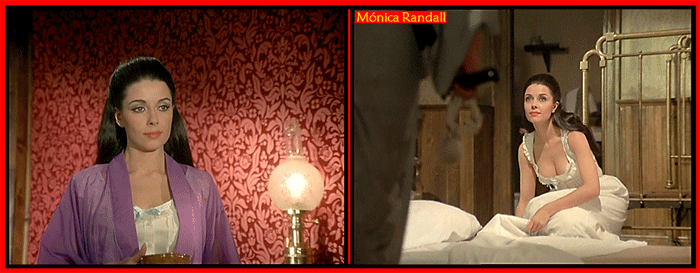
Other members of supporting cast: young French actor Luc “Luke” Merenda (Chato), Hungarian dancer/circus artist Bart Barry/ Bernabé Barta Barry (Paco), Lee Brown/Guido Lollobrigida (cousin of actress Gina Lollobrigida) (Mace), John Hamilton/Gianni Medici (Miguel), George W. Lycan (Sheriff Stone), Hiroshi Tanaka (Second samurai), Canada born Satoshi (Tetsu) Nakamura (Japanese Ambassador), Jo “José” Nieto (murdered Mexican farmer), Spanish actor Julio “Jules” Peña (Peppie, train passenger with newspaper), beautiful Spanish rose Mónica Randall/Aurora Julià Sarasa (Maria), John B, Vermont, plus a whole team of stuntmen (4).

0 27

Original Music by French composer/conductor Maurice Jarre (Maurice-Alexis Jarre) is an interesting mixture of Anglo/Japanese themes. The brilliant Eastmancolor cinematography owes to Henri Alekan of Roman Holiday (1953) fame.

0 28

The script adapted by Denne Bart Petitclere/William Roberts/Lawrence Roman is based on the story by American author Laird Koenig, famous for his novel, The Little Girl Who Lives Down the Lane (1974). Further crew consists of: Gerald Devriès (dialogue); Johnny Dwyre (Film Editing); Enrique “Henry” Alarcón (Set Decoration); Tony Pueo (Costume Design): Alberto de Rossi (Make-up); Karl Baumgartner (Special effects).

0 29

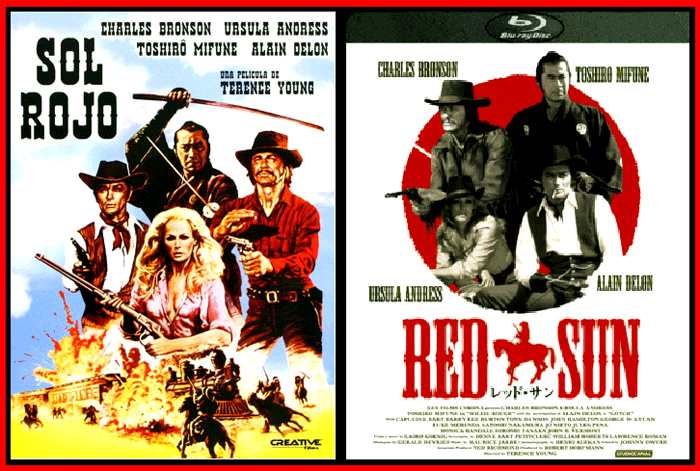
Released in 1971, Red Sun  is also known as: Sole rosso (Italy), Sol rojo (Spain), Rivalen unter roter Sonne (Germany), Sol vermelho (Portugal), Monomahia ston kokkino ilio (Greece), The Magnificient Three (Philippines)

0 30

Red Sun has its moments of fun and rough spots besides providing the opportunity to see Bronson/Andress/Mifune/Delon coming together in a pleasing blend of their American/Swiss/Japanese/French charm, embellished by the direction of Britain’s Terence Young. Until next time. Jo

0 31

Notes:

  • Toshirô Mifune’s character in Hell in the Pacific is called Tsuruhiko Kuroda.
  • The eight virtues typified by the Bushidō code: Righteousness; Courage; Benevolence; Respect; Sincerity, Honour, Loyalty, Self-Control.
  • According to a film trivia, it is Dawson’s hands we see stroking a white cat in the scenes depicting Bond’s arch-nemesis Ernst Stavro Blofeld in From Russia with Love and Thunderball.
  • One of Hollywood’s top gun coaches and fast-drawing experts, chickasaw Indian Rodd Redwing died on May 29, 1971 following a heart-attack aboard the flight while returning home from Spain after work on Red Sun.
  • Books, DVD/Blu-ray of the books/movies referred to in this article are available with amazon.com, amazon.co.uk and other leading dealers.
  • DVD sleeves/posters credits: Wikipedia, amazon, and from my private collection.
  • This illustrated article is an affectionate nosegay to the movie reviewed above. Please refer to “About” of my webpage for more details.
  • In memory of French actress/model Capucine (January 6, 1933 – March 17, 1990)

0 32

(©Joseph Sébastine/Manningtree Archive)

The Galloping Riders of Almería

b1

International superstardom finally started to cast its glare on American actor Charles Bronson in the late sixties – essentially since his appearance as the half-breed gunslinger l’uomo dell ‘armonica in Sergio Leone’s spaghetti Western “Once Upon a time in the West” (C’era una volt ail west, 1968). In the mind of filmgoers, the gristly face of Bronson with his sleepy eyes and drooping moustache had become distinguished as an image of a ‘tender tough guy’ with an explosive air of elemental violence about him, drawing audiences to his movies shown across Europe over to Asia. The Italians nick-named this stone-faced and powerful personality, their “Il Brutto” – The Ugly One.

b2

While Bronson’s films never received wide release across America where he remained an unknown actor, his leading parts were confined to European products such as Guns for San Sebastian (1967), Farewell Friend (Adieu I’Ami, 1968), Villa Rides (1968), etc.

b3

Born to Lithuanian parents settled in the bleak mining town of Ehrenfeld (known locally as Scooptown), Pennsylvania, USA, “Shulty” (nickname of Bronson as a boy) was initially a coal miner who led a life full of deprivation. Charlie served the army from early 1943 to early 1946, following which he went on to do short stints as bricklayer, waiter, baker’s helper, etc before venturing into the theatre where his face and figure could draw only bit-parts of heavies and ethnics.

b4

Without any film-acting experience other than a year of learning at the Pasadena Playhouse, he had headed for Hollywood where, from his film debut in You’re in the Navy Now (initial title: U.S.S. Teakettle, 1951) till director Robert Aldrich’s Apache (1954), he was known as Charles Buchinsky, his birth name. With Drum Beat (1954) he changed his name to Bronson after the Bronson Gate at Hollywood’s Paramount Studios which derived its name from Bronson Street in Los Angeles.

b5

Having met actress Jill “Dorothy” Ireland in Bavaria, Germany, in 1962 during the filming of The Great Escape (then married to Welsh actor David McCalum whom she divorced in 1967), Bronson (divorced from his first wife Harriet Tendler in 1965) and Jill married in October 1968, which was few months after Bronson left Hollywood for Europe where he travelled from 1969 to 1973, making various movies.

b6

He soon fitted himself into a world infested with immigrant western actors such as Steve Reeves, Clint Eastwood, Cameron Mitchell, Lee Van Cleef, Eli Wallach, Van Heflin, John Ireland, Ty Hardin, Woody Strode, Rod Steiger, Jack Palance, etc, who had taken trek to Europe to join the European actors (most of them given Western-sounding names) to star in Peplums as well as in Euro-Westerns mostly shot in Almería which provided a perfect match for the deserts of Arizona.

b7

b8

Impressed by Bronson’s performance in Machine-Gun Kelly (1958), French actor Alain Delon had by then developed an interest to work with him. Conveyed to Bronson through French producer Serge Silberman while Bronson was on location in Spain (at El Casar de Talamanca, Guadalajara, Castilla-La Mancha for director Buzz Kulik’s “Villa Rides”), the outcome was Bronson in the role of Franz Propp in Adieu I’Ami (Farewell Friend/Honor Among Thieves).

b9

When the film came out, his pairing with Delon earned them lavish praises from the critics, spiralling progress in Bronson’s career through a series of European productions including director Richard Donner’s Twinky (Lola/Statutory Affair, 1970) and French director René Clément’s chilling suspense piece Le Passager de la pluie (Rider on the Rain, 1970), the role in which, according to a book, had come seeking Bronson with a bit of urging of Alain Delon.

b10

In the late 1960s, with the sensuality of facial features that made Alain Delon a beautiful leading man still intact, Delon retained his physical presence and stylish, enigmatic look in domestic productions such as The Girl on a Motorcycle (1968), La Piscine (1969), Le Clan des Siciliens (The Sicilian Clan, 1969), Borsalino (1970), etc.

b11

Earlier in 1966, he had acted as a hitman clad in a trenchcoat and sporting a felt-hat in French director Jean-Pierre Melville’s cult classic Le Samouraï (The Samurai, 1967) which had kindled his interest in Japan where he had recently earned a large number of fans and commercial success that extended not only to his iconic status, his screen muscularity and sex appeal, but even to the sunglasses branded with his name. According to IMDB, at that time, Delon even kept a samurai blade hanging on the wall of his bedroom.

b12

Producing films since the 1970s under the name of his own production company, Adel Productions, and in a position to attract investment from across Europe and USA, Delon was then very active in filmdom and given the scale of his popularity as a global style icon, no doubt he would have gladly welcomed any interesting story angles of diverse genre to revamp his image, including a proper role where elements of Japanese culture are interestingly featured.

b13

The box-office success in Japan of more than a dozen films that director Akira Kurosawa made between 1950 and 1965 and other elements of Japanese film culture were already fanning their influence on the American filmdom. Kurosawa’s “Rashomon” (1950) came out as “The Outrage” (1964), “The Magnificent Seven” (1960) was based on “Seven Samurai”, while “A Fistful of Dollars” (1964) which invented the spaghetti Western was inspired by “Yojimbo” (1961) (1).

b14

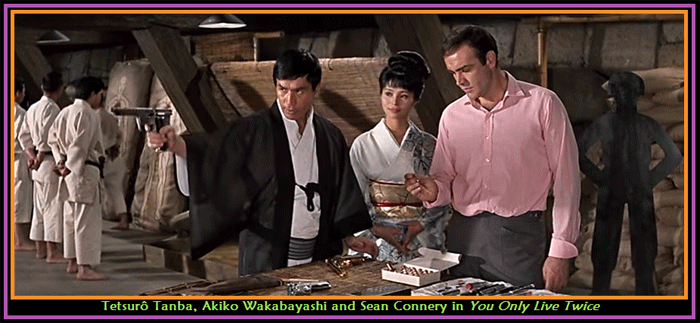
Simultaneously, “You Only Live Twice” (1967), the fourth James Bond starring Sean Connery, predominantly set in Japan, featured prominent roles for Japanese actors Tetsurô Tanba, Akiko Wakabayashi and Mie Hama. Director Richard Fleischer’s “Tora, Tora, Tora” (1970) about the Pearl Harbour attack featured a fusion of West-Orient actors and crew and Kurosawa was originally slated to direct the Japanese half of the film which did not materialised due to technical issues.

The West had also taken note of Toshirô “The Wolf/The Shogun” Mifune’s strong, monolithic screen presence. Mifune had built his career on several wonderful classics of Kurosawa which included Rashomon (1950), Seven Samurai (1954), Throne of Blood (1957), Yojimbo (1961), Red Beard (1965), and The Hidden Fortress (1958), which was Kurosawa’s personal favourite.

b15

The power of Mifune’s screen presence engendered the strength of character through silence, together with quick and deadly dynamism in action sequences. In “Something Like An Autobiography” Kurosawa wrote that, in Mifune he had come across “a kind of talent he had never encountered before in the Japanese film world.”

b16

Toshirô Mifune, himself a producer on several samurai films, was no stranger to roles in Hollywood products. Referred to as Japan’s John Wayne, he had appeared in Grand Prix (1966) and later with Lee Marvin in director John Boorman’s Hell in the Pacific (1968), a World War II drama of two adversaries, an American pilot and a marooned Japanese navy captain Tsuruhiko Kuroda, on a small uninhabited island in the Pacific Ocean. The film offered good contrast in acting styles of Marvin and Mifune (both actually served in the Pacific during World War II) as the two men of opposing countries who cease their animalistic confrontation and come to terms with peace and cooperation in order to survive.

b17

It was during this period that the American producer Ted Richmond decided to create a Shogun-type Western, with a fusion of Japanese folk legends. Jo                 (To be continued)

b18

Notes:

  • According to A New Guide to Italian Cinema, Leon has insisted that the source of A Fistful of Dollars is a play by Carlo Goldoni Arleccchino il servitor di due parroni/The Servant with Two Masters (1745)
  • Books, DVD/Blu-ray of the books/movies referred to in this article are available with amazon.com, amazon.co.uk and other leading dealers.
  • DVD sleeves credits: Wikipedia, amazon.co.uk, and from my private collection.
  • This illustrated article is an affectionate nosegay to movies of the past. Please refer to “About” of my webpage for more details.

b19

(©Joseph Sébastine/Manningtree Archive)

Dracula, Prince of Darkness (StarChoice: 25)

Header-SC1

b1

The sun is down, darkness covers the land – and Dracula lives!”

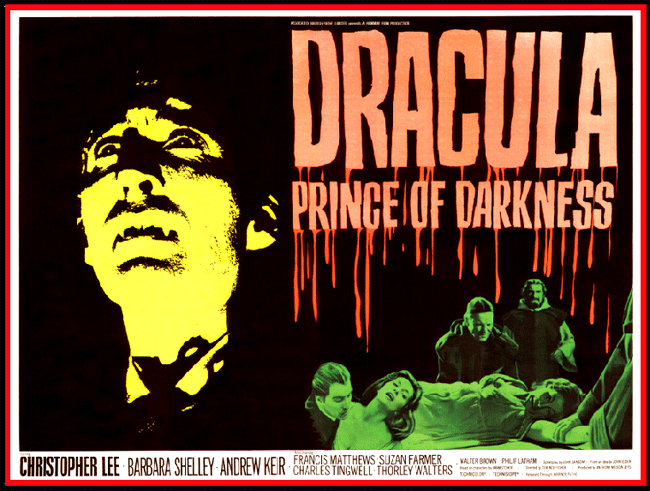
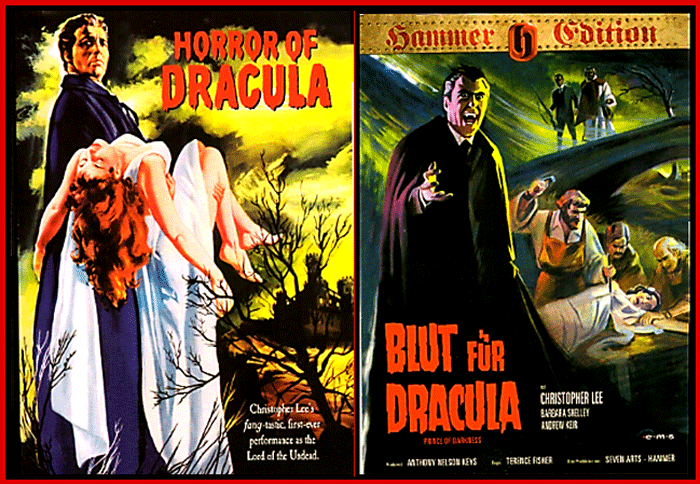
January 9th, 2016 marked the 50th anniversary of the initial release (UK) of Hammer Films’ Dracula, Prince of Darkness”, the second instalment in their colourful Dracula series with Christopher Lee in the title role.

b2

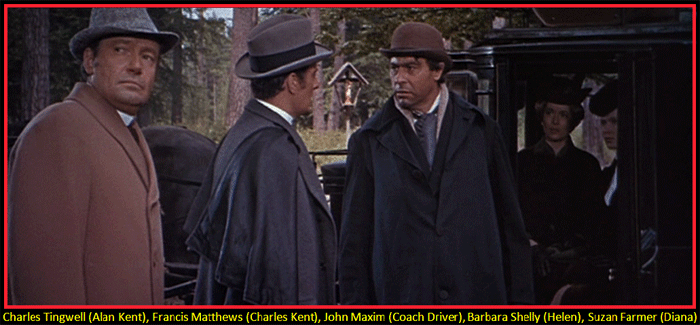
Produced by Anthony Nelson Keys (1911 – 1985) at an estimated budget of £100,000 (according to imdb)(1) and presented by Seven Arts and Hammer Films, the story centers around two couples finding shelter in the night in a dark and mysterious castle situated in the forest outside the village of Carlsbad. They had been traveling through the Carpathian Mountains of central Europe for climbings and sightseeings, and were forced out of their hired horse-carriage at the crossroads of a mountain track by their coach driver terrified at the approach of the sunset.

b3

Taken to the castle by a mysterious driverless coach and having arrived at the very plaace which was the subject of a cautionary advice of a Father Sandor for them to stay away from it, they were surprised at the hospitality extended to them by the sinister Klove, the manservant of the lord of the castle, Count Dracula, who apologised for the absence of his master since he was dead for the past ten years. A crackling fire burns in the grate, dinner table set for four created the impression that they were expected. Indeed Klove’s master had left instructions that the castle should always be ready to receive guests… The couples drank a toast to the master of the castle: “To Count Dracula!”.  

b4

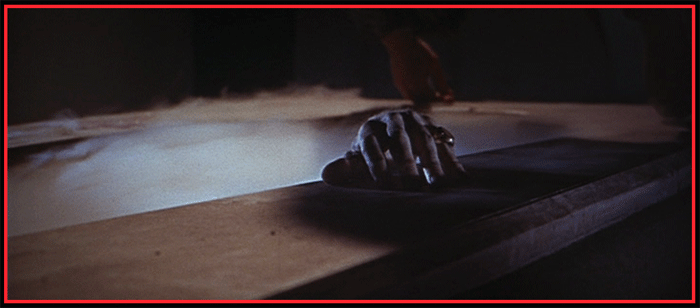
As if he was convinced that the new arrivals would spend the night in the castle, the mysterious Klove had already prepared their rooms, had their luggage secretly brought in from the carriage and placed neatly at the foot of the beds before he had gone to greet them. Once the couples had retired to their respective rooms following their dinner, sometime soon in the dead of night, the occasion appeared auspicious to Klove to set out to implement his plan. Many years ago, he had faithfully collected the clothes, signet ring, dust, etc, of Dracula after his master’s body had disintegrated into a pile of human dust. The set of scenes that would unfurl during that night in the underground vault depicted the resurrection of Dracula – by intermixing Dracula’s bodily grey ash with the blood flowing from the corpse of Alan Kent suspended on a rope above the sarcophagus. And therein, blood fired the ashes and Dracula, the Lord of the Darkness, fully restored, rose to go about his single-minded pursuit of blood and ghastly deeds!

b5

When Welsh scriptwriter Jimmy Sangster was assigned to re-write the old script (The Revenge of Dracula), by prolific screenwriter Anthony Hinds, based on characters created by novelist Bram Stoker, none of them had known that the incongruity of the final product would allow them to attach only their noms de plume, to it, viz., John Sansom and John Elder respectively. In his late thirties, Sangster kept abreast of the pulse of Hammer’s target audiences. He would spend four decades at Hammer, in the capacity of production manager, scriptwriter, producer and director.

b6

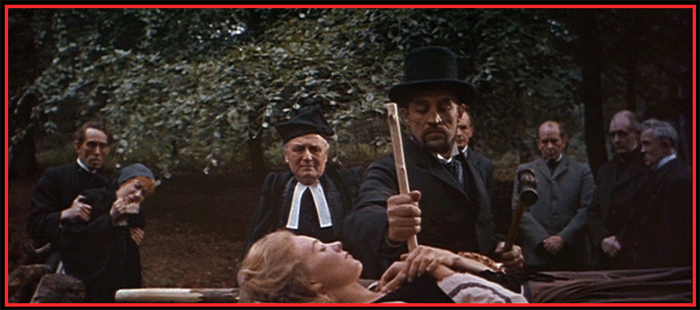
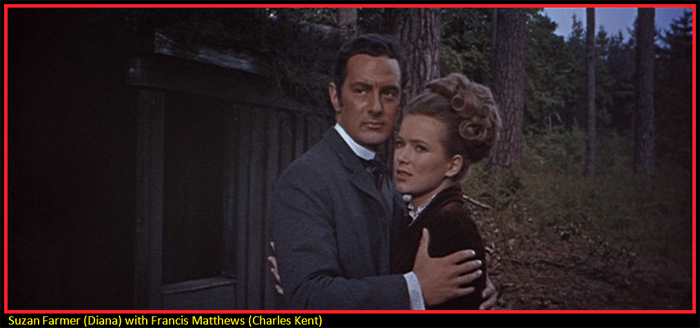
Sangster was then known for brilliant ideas and sudden shocks which, as a rule, he sprinkled into the storylines of scripts; often linking the ideas to traditions related to vampires however minor they are – as, in “Dracula, Prince of Darkness”, when Charles and Diana escape from Dracula’s castle, he leaves Diana near a hut at the crossroads before returning to the castle. It was deemed that she would be safer there from vampires. I would have imagined such a scene is in tune with the European tradition that if a suspected vampire if killed or buried at a crossroads, he will be unable to rise again.

b7

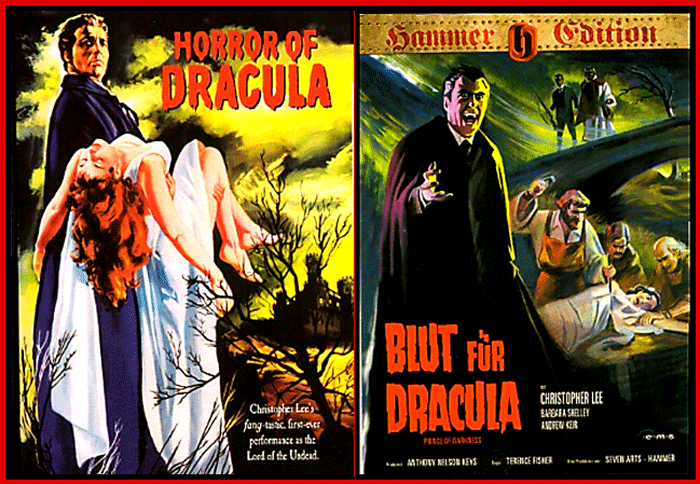
As for the resurrection of the Count for this sequel, a convincing method was drawn up to use blood as the ingredient since the Count was destroyed into a pile of dust in Hammer’s “Dracula” (1958, U.S. title: Horror of Dracula), the first Dracula film in colour with thrilling visual treats of vampire violence, blood and sexuality. This method of resurrection with blood would be repeatedly used by Hammer to revive the Count in their subsequent Dracula films.

b8

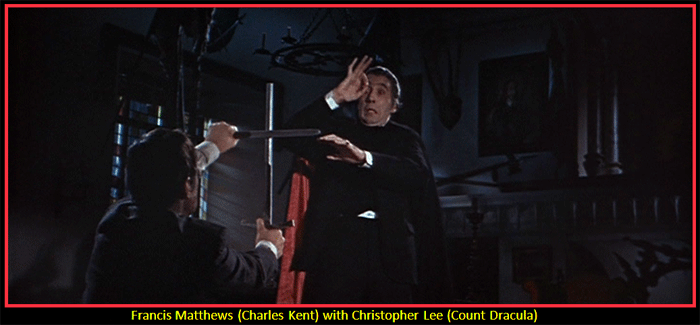
Christopher Lee as the pale-looking Count Dracula topping gray streaked hair with a widow’s peak and eyebrows that join across, appears around 46 minutes (based on DVD edition of 86 minutes. Theatrical duration is 90 minutes.) into “Dracula, Prince of Darkness” (DPOD), clad in his long black cloak (now lined with blood-red lining), at times, with red contact lenses that covered the whole ball of the eyes, except for the cornea and iris, and of course, with the trademark pair of canine fangs intact (“long, but not too long, sharp but not sabre-toothed”, as a writer wrote). The Count’s character traits of commanding manner, fit constitution, cold austerity, penetrating eyes, icy sadism, tremendous ferocity, fiendish snarls and charismatic sex appeal are all there but short of dialogue to which Jimmy Sangster later claimed that the script was written without any lines for the Count. Alternate opinions to the contrary exists, including Lee’s own assertion in an autobiography that he did not use the dialogue as it was impossible for anybody to write convincing lines for him. Lee is reputed to have read Stoker’s “Dracula” many times over and over and, given the opportunity, always ventured to provide his personal view of its interpretation. There is another reference in a book which relates that when Lee finally consented to star as Dracula in 1965 he had become an expensive commodity and his services were being charged on a daily basis which resulted in his scenes being brief and without dialogue. Anyhow, short of dialogue, Dracula hissed and snarled and menaced in the movie, emphasising the vampiristic elements of Dracula.

b9

For Hammer, Lee’s mere appearance as the good-looking Count Dracula was enough to click the box-office and create fans for Hammer which had increased ever since the 6’ 5” Lee first appeared as a silhouette before he came out of the shadows and glided down the long baronial stairs of his castle and introduced himself as “Count Dracula” in Hammer’s “Dracula” (HOD).

b10

Following Lee’s marriage to the Danish model and painter Birgit (Gitte) Kroencke in 1961, the couple had moved to Switzerland. Hammer was happy to see Lee move back to England in 1965, and agree to appear in “DPOD” since afraid of being typecast as the Count, he had refrained from starring as Dracula for nearly seven years, venturing into other films, which had pushed Hammer to bring out different vampires as antagonists, viz., blonde-haired Baron Meinster (David Peel) in “Brides of Dracula” (1960) (2) and Doctor Ravna (Noel Willman) in “Kiss of the Vampire” (1963) while retaining Dracula for enactment by Christopher Lee whenever he is ready. Although Lee went on to become admired as an actor of vast experience and wide-ranging acting talents, like Sean Connery got docketed to James Bond, Lee’s career was always popularly tagged with the “old toothy”, and had gained him great financial success and international stardom.

b11`

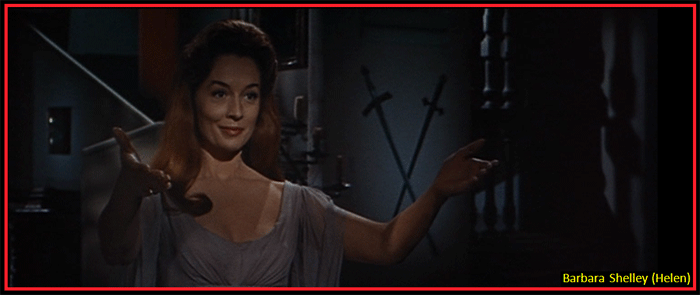
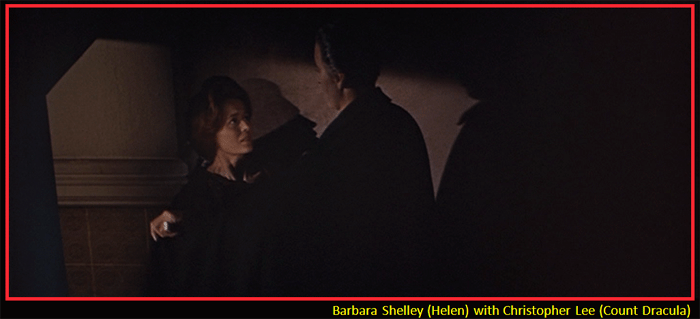
Barbara Shelly, the auburn-haired English beauty with her bewitching brown eyes, makes a very exciting vampire in “DPOD”, her initial style of attire of the Victorian wife Helen giving way for a seductive outfit when, in the dark of the night, the process of her initiation into the realm of vampires gets underway. Director Terence Fisher had rightly divulged Shelly’s capacity to aptly showcase the mannerisms of the spitfire vampire she had turned into, quite contrasting to her initial portrayal of the shrewish wife who seemed strangely fearful of something bad she had sensed present in the castle in which they had taken shelter.

b12

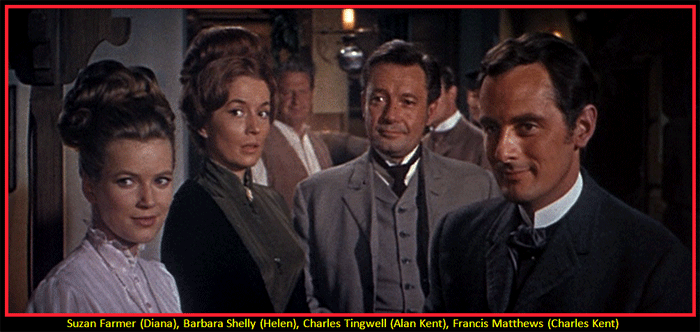
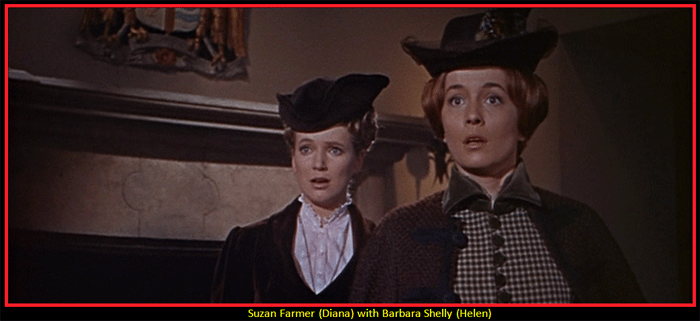
Lovely blonde Suzan Farmer appears as Diana Kent, the brave wife of Charles, notable for her liveliness and attitude to take things as they come. It was Diana who had the presence of mind to initially grab the gun and shoot at Dracula on the frozen moat which led to the discovery that running water is a deterrent for him – a realization that would add to an earlier instance when she accidently discovered that the crucifix on the chain around her neck could stop the evil although, at a later scene, under the demonic influence of Dracula, she would submissively take the crucifix off her neck and stand unprotected before Dracula ready to oblige to his demand to taste the blood flowing from his chest.

b13 -Horror-of-Dracula

Peter Cushing, who first appeared in the title role of Hammer’s “The Curse of Frankenstein” (1957), shot to international stardom as the indomitable vampire-killer Dr. (Prof.) Abraham Van Helsing in “Dracula”, a role which represented the force of goodness, making him an integral part of the Dracula cycle and a perfectly matched team with Christopher Lee. I have read somewhere that it was Cushing’s idea to make Van Helsing run along the refectory table and hold Dracula back with the glare from two metal candlesticks used for a cross until the Count desiccated into a heap of dust in the closing scenes of “Dracula”. According to one of Peter Cushing’s memoirs, when Anthony Hinds found that Cushing could not appear in “DPOD” due to contractual commitments, Hinds had obtained his consent to use the ending scenes of “Dracula” as opening scenes of “DPOD” for which Cushing was subsequently remunerated by Hammer Films.

b14

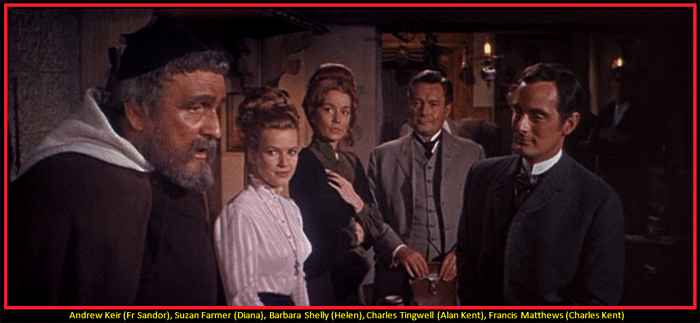
DPOD” featured a new adversary for Dracula, Father Sandor (Andrew Keir), the Abbot of Kleinberg who, on his way to Kleinberg, accidently meets the four English travellers at the wayside inn and warns them to avoid travel to Carlsbad or stay clear of the nearby castle which the couples disregarded opting to keep up with their schedule only to meet with dire consequences. British TV actor Philip Latham, who had earlier appeared in Hammer’s 1964 films “The Devil-Ship Pirates” and “The Secret of Blood Island”, comes across very effectively as Klove, the quiet and sinister manservant of Count Dracula – soberly clad in black, devoid of gesticulations – a tool of the forces of evil.

b15

b16 Terry-FisherAustralian born British television heart-throb Charles Tingwell (Alan Kent), and television star Francis Matthews (Charles Kent) appear as brothers and husbands of the visiting English ladies. The cast also includes: Thorley Walters (monastery calligrapher Ludwig), Walter Brown (Brother Mark), George Woodbridge (Landlord), Jack Lambert (Brother Peter), Philip Ray (Priest), Joyce Hemson (Mother), John Maxim (Coach Driver), etc.

DPOD” tenders some excellent visual treats under the directional chores of Terence “Terry” Fisher (1904 – 1980). Starting as a clapper boy in the film industry at the age of 28, his first directorial assignment was “The Last Page” (aka. Man Bait, 1952, based on a 1946 play by James Hadley Chase) from where he rose up to become one of the best known directors to work for Hammer and one of the virtuosos behind the success of their films like “The Curse of Frankenstein” (1957), “Dracula” (1958), “The Revenge of Frankenstein” (1958), “The Mummy” (1959), “The Phantom of the Opera” (1962), etc.

b17

Consistent with Hammer’s reputation of using the major chunk of a film’s scanty budget on its production design, sets, models, costumes, photography, editing for stunning visual impact, “DPOD” has impressive sets and lavish-looking production values. It was from the brilliant talent of Bernard Robinson, the Set Designer for Hammer’s first two Dracula films that earned Hammer their signature looks for stunning backdrops and sets of the Dracula movies. Although in this official sequel, the story of “DPOD” takes place ten years after the end of the first movie and supposedly happens in the same castle of “Dracula“, Robinson’s ingenuity shows through in the difference of the interiors and exterior of the sets of Castle Dracula, everything dusted and polished. The coffins used for Dracula and Diana in the film have gold covered hinges to contradict with the old custom of Transylvanian coffin-makers using silver nails as a protection against vampires.

b18

Entirely shot in Technicolor  from April 26 through June 4, 1965 at Bray Studios, Down Place, Oakley Green (Berkshire); and on locations at Black Park in Slough, Iver Heath (Buckinghamshire); and St Michael’s Church, Bray, Berkshire, England, the crew consists of: James Bernard (Music), Michael Reed (Director of photography), Chris Barnes (Film Editing), Don Mingaye (Art Direction), Roy Ashton (Makeup), Frieda Steiger (Hair stylist), Rosemary Burrows (Wardrobe), Bowie Films Ltd (Special effects), among others.

b19

The special effects team of Les Bowie did not have to deal with “Kensington Gore”, the fake theatrical blood (stage blood) manufactured in England, since both the final scenes of “Dracula” and “DPOD” are devoid of blood,  though there is massive amount of fake blood shown during the resurrection of Dracula in “DPOD

b20

According to a magazine, for the complex shooting of scenes depicting the final destruction of Dracula, Bowie’s team had tried many techniques to get the scene right: they tried real blocks of ice in a swimming pool for few close shots; wax moulds at another time as it floats on the water; and for the final shots, a circular section of plaster mounted on pivots. At the same time, Christopher Lee has written in a book that he slid down a piece of wood on a hinge, painted white to look like ice.

b21

Part of the many trivia is about an incident while shooting the last scenes when one of the contact lenses of Lee fell onto the salt-covered wooden board (made to look as block of ice) which was retrieved and re-fixed to his eye without properly cleaning off the salt causing acute agony to Lee. An unfortunate incident would have intervened the production and turn fatal for Eddie Powell, Lee’s stunt double and husband of wardrobe mistress Rosemary Burrows, when he was trapped in the freezing waters of the castle moat during enactment of the scene when Dracula finally sank through the layer of ice into the water, but was rescued in time from drowning. However, as the story goes, Dracula will lay trapped in that icy grave until Hammer decided to allow him to be resurrected in 1968 in “Dracula Has Risen from the Grave”, ironically, with the blood of a wounded priest.

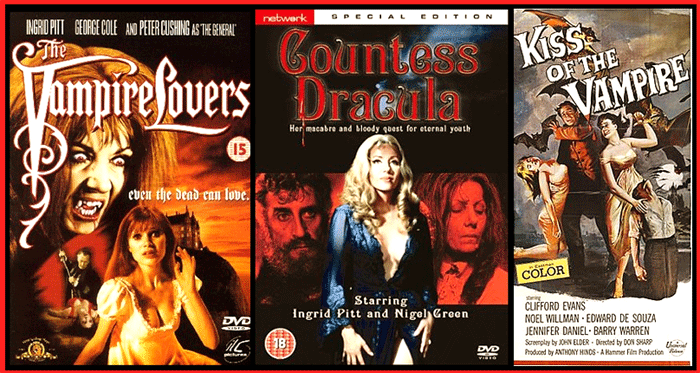
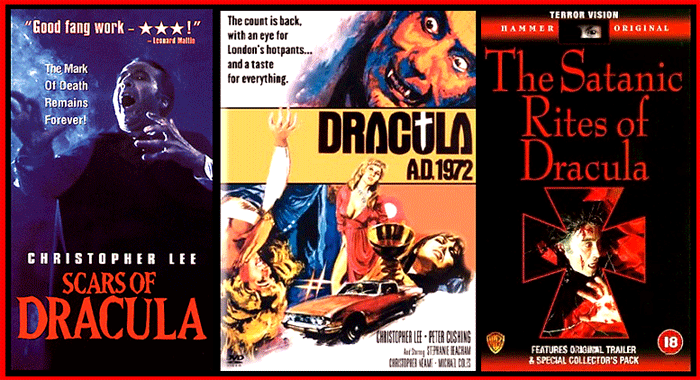
Besides “Dracula Has Risen from the Grave”, Hammer Films’ Dracula series continued featuring Christopher Lee in the role of the Count in “Taste the Blood of Dracula” (1970), “Scars of Dracula” (1970), “Dracula A.D. 1972” (1972), and finally in “The Satanic Rites of Dracula” (1973).

b22

It is undisputed that so many old manor houses in England have their ghost story. The legends of vampires (Vukodlak for Serbians/Murony to Wallachians) have always been there and will survive and flourish on print and visual entertainment in future also. As the viewers, we enjoy the choice to discern whether they are good, bad or indifferent for us – or for horrorsceptics to reassert their sense of rational control. When Hammer Films were first shown, they were sometimes reckoned as objects of derision and censure in some quarters. Now they are treated as classics of their kind. Since 2012, starting with “Dracula Prince of Darkness”, Hammer’s classic library of films are being restored/re-mastered into HD for Blu-ray and future media formats under the restoration project initiated by StudioCanal in coordination with major studios.

I have enjoyed some of those movies on several occasions, including “Dracula, Prince of Darkness” – and although sadly Christopher Lee and Peter Cushing are no more, I would imagine many would have gladly watched another Hammer movie in which Lee reprised the role of Dracula in the period and Gothic ambiance of Stoker’s novel. No doubt, Hammer Films, at its finest, were truly distinctive.  Jo

b23

Notes:

  1. The budget is projected as £220,000 by BFI screenonline.
  2. For more on “Brides of Dracula”, please refer to my reviews of May 10 & 14, 2013
  3. Dracula, Prince of Darkness” was initially released as double bill with Hammer’s “The Plague of the Zombies
  4. Books, DVD/Blu-ray of the books/movies referred to in this article are available with amazon.com, amazon.co.uk and other leading dealers.
  5. DVD sleeves credits: Wikipedia, amazon.co.uk, and from my private collection.
  6. This illustrated article is an affectionate nosegay to the movie reviewed above. Please refer to “About” of my webpage for more details.
  7. This is in memory of director Terence Fisher who was born on 23rd of February. May his soul rest in peace.

b24

(©Joseph Sébastine/Manningtree Archive)

Hammer – H as in Horror

b1

British actor Christopher Lee is no more, but the nocturnal Transylvanian character he immortalised in Hammer Films’ Dracula series is very much alive and baring fangs at the discerning viewers. For centuries, folklores of blood-drinking vampires and other supernatural characters were tales of enduring fascination, dark passion, belief and fear.

b2

For most people, the name Transylvania conjures up haunted castles and vampires; and maintain some understanding about the characteristics of a vampire: that the vampire’s power ceases at the coming of the day; that they feed on human blood and their bite could transform the victim into a new vampire, that the objects for protection against them is a Christian cross, garlic, running water, etc.

b3

Such tales of uncanny, having echoed throughout Europe down centuries, may have now died down, their existence judged improbable in the modern view. Yet, what is the truth behind the legends of the undead? Are they alive and immortal only as products of fertile imaginations, dreams and fantasies? Anyhow, potential immortality is considered a salient feature of the vampire.

b7


b5

b6The evil title character of the gothic horror novel, “Dracula” (published in June 1897) written by Irish writer Bram (Abraham) Stoker (Nov 8, 1847 – Apr 20, 1912) has been linked to Vlad Ţepeş (Vlad Tsepesh/Vlad Dracul/Vlad the Impaler, 1431 – 1476) (1), a flesh-and-blood prince who launched the Romanian resistance against Ottoman expansion in the 15th century.

Of the qualities attributed to Prince Vlad are his practice of impaling enemies on stakes in that age of brutality; his heroism in defending his country against the Ottoman invasion, but nowhere there is evidence proving him as a vampire.

b4

b8

The review that would follow this frontrunner post is just my humble tribute to a movie from the very-British Hammer Films, a trailblazer for the genres of horror and suspense during the 1950s and ’60s.

b9

Most of the films of Hammer had triggered the adrenalin of millions of audiences across the world with their quality entertainment primarily produced at a splendid private residence called Down Place, in Bray, Berkshire, England where, it is claimed, there existed a resident ghost known as “The Blue Lady”. Charming!

b10

b11

Hammer had all the ingredients in place to reincarnate the monster of Frankenstein, Count Dracula, Baron Meinster, Countess Dracula …. – mostly 85-minutes spine-chilling storylines of hauntings, spirits, exorcisms, poltergeists, banshees, consistent with the rules of folklore and legends, oral or written, prolific to Ireland, Scotland, Eastern Europe, India, etc.

b12

b13

However true they are, I do not have any personal experiences to believe or disbelieve those beyond the grave incarnations. But while watching a Hammer horror movie, when I see a door open without a human hand on the knob, or hear the light or heavy sound of footsteps in the corridor when no one is supposed to be there, or see the face of someone who had been buried the other day calling through the open window in the dead of the night, I guess I like to have a sense of fearlessness. One thing is certain, I doubt I would ever want to run into any one of those undead creatures, especially Count Dracula, “the most evil and terrible creature who ever set his seal on civilisation.”

(Review in my next post)   Jo

b14

Notes:

  1. For more on the origins of Vlad Ţepeş: Dracula, Prince of Many Faces: His Life and His Times by Radu R. Florescu & Raymond T. McNally
  2. Books, DVD/Blu-ray of the books/movies referred to in this article are available with amazon.com, amazon.co.uk and other leading dealers.
  3. DVD sleeves credits: Wikipedia, amazon.co.uk, and from my private collection.
  4. This illustrated article is an affectionate nosegay to Hammer Films. Please refer to “About” of my webpage for more details.

b15

(©Joseph Sébastine/Manningtree Archive)

StarChoice 24: The Shell Seekers

Header-SC1

1

“Life is so extraordinary. Wonderful surprises are just around t

he most unexpected corners.”

This quote appeared on the Facebook page of a friend just in time for Christmas of last year. The quote from Winter Solstice by British author Rosamunde Pilcher was familiar to me from one of the only two books by her I have read in early March 2001 while in Rome. The part-time Receptionist of my hotel, an American student in Rome, had just finished reading it and lent it to me to keep me “company”.

2

Set in the north of Scotland, Winter Solstice tells the story of Elfrida Phipps. Single and in her 60s, she had retired with her canine companion “dog size” Horace to Dibton in pretty Hampshire, England after a long career on the stage. Though this delightful novel of people who converge to form an unlikely family; of loss and the healing power of love, was a best seller; unlike the 1989 TV movie adaptation of her 1987 novel The Shell Seekers, (the only other novel of Ms. Pilcher I have read), the TV movie adaptation of Winter Solstice (2003) starring Sinéad Cusack, Geraldine Chaplin and Jean Simmons did not conjure up much inspired reviews.

3

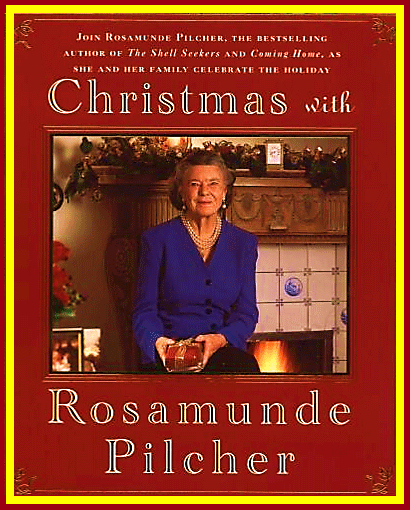
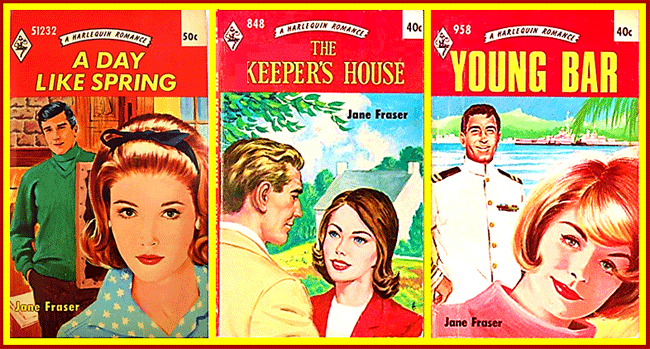
Author Rosamunde Pilcher OBE (née Scott) was born to Helen and British commander Charles Scott on 22 September 1924 in Lelant, Cornwall, England. After World War II during which she was on active service as a member of the WRNS (Women’s Royal Naval Service), she married Graham Hope Pilcher in 1946 and moved to Dundee, Scotland, where she raised two daughters and two sons. It was here she took up writing in order to earn a living. Setting off as an author of Mills and Boon romances, she wrote under the pseudonym Jane Fraser: (Half-Way To The Moon (1949), Dangerous Intruder (1951), A Day Like Spring (1953), A Family Affair (1958), The Keeper’s House (1963), A Long Way from Home (1963), Young Bar (1965), etc).

4

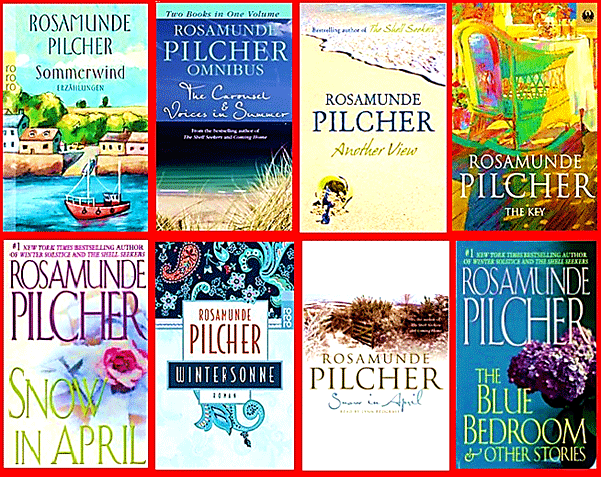
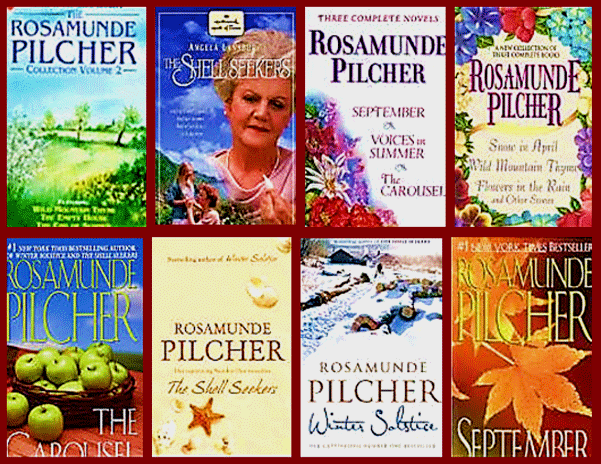
Having switched her pseudonym to her married name Rosamunde Pilcher in 1955, her breakthrough into the more lucrative American fiction market in the 1970s gave a much needed transformation to her career and the birth of nearly 30 novels, the front sleeves of some of which are pictured here.

5

6

While many of her stories are set in the land of her childhood and featured characters so very human, they also presented culinary recipes and tips for gardening. “The Shell Seekers”, Ms. Pilcher’s 13th novel and international breakthrough, had topped the New York Times best-seller list for 30 consecutive weeks and was nominated by the British public in 2003 as one of the top 100 novels in the BBC’s Big Read.

7

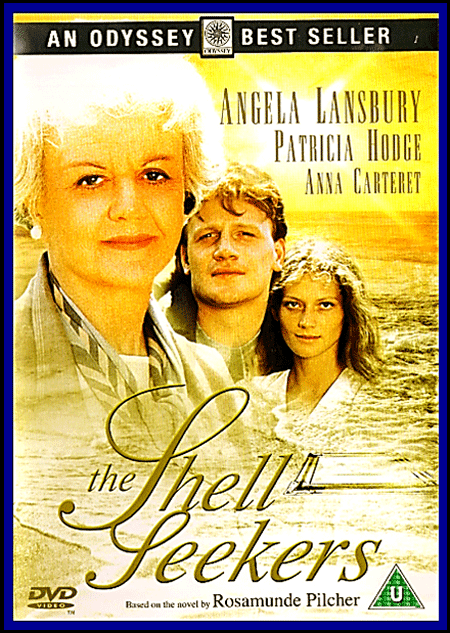
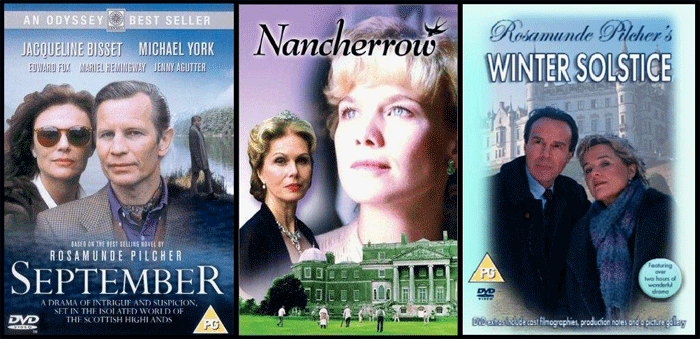
In the Introduction to the Tenth-Anniversary Edition of “The Shell Seekers”, Ms. Pilcher wrote that the ideas for this “big fat novel for women” took shape when she saw a programme on television entitled “Painting the Warmth of the Sun” – about the painters of West Penwith, in Cornwall, some of whom she had known. Of the many Pilcher movie adaptations in my movie collection, viz., September (1996), Nancherrow (1999), Winter Solstice (2003), etc, the one I preferred most was her poignant family saga The Shell Seekers (1989).

8

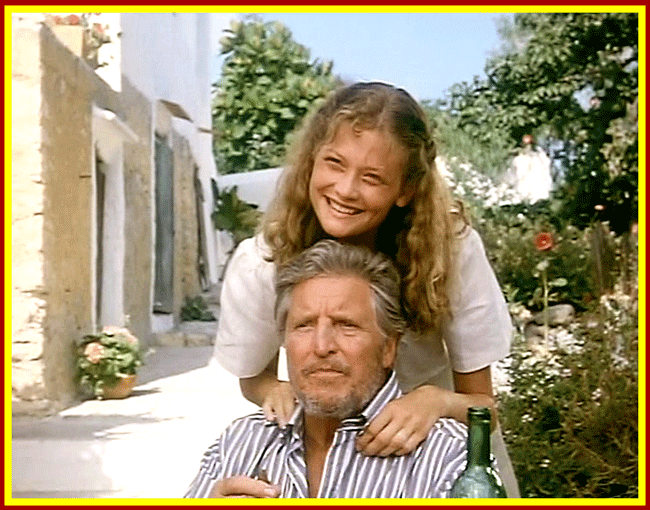
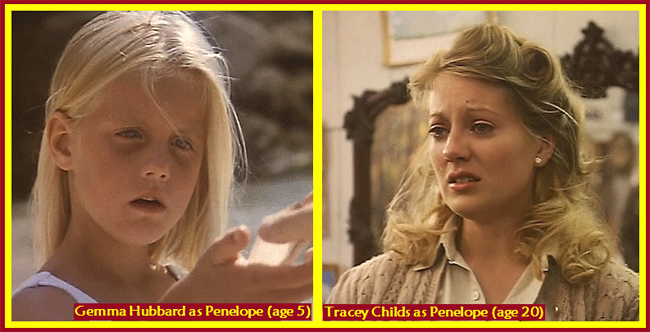
Filmed entirely on location on the beautiful island of Ibiza (Islas Baleares, Spain), Cornwall, Lee International Studios, Shepperton, England and the picturesque villages of the Cotswolds, “The Shell Seekers” is the story of Penelope Stern Keeling and “the disastrous effect that the prospect of an inheritance, worldly goods and money, can have on a perfectly normal family.”

9

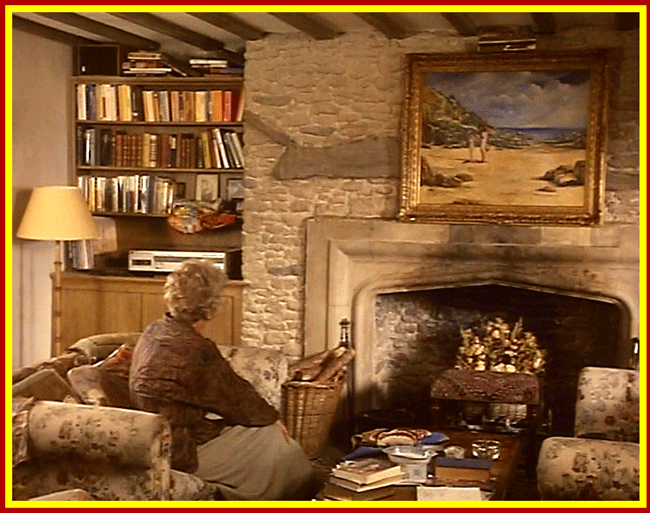
This typical English poignant family drama opens with Penelope, age 63, recuperating in a hospital bed from a mild heart attack. No sooner we take in the scene, she discharges herself from the hospital where she was supposed to stay at least a week and heads for her little cottage called Podmore’s Thatch in the village of Temple Pudley. Happy to be back home, she was absolutely determined to get down to make her garden into something special that year.

10

However, Penelope’s departure from the hospital against the doctor’s wishes was nothing short of concern and displeasure to her children owing to their concern for her living alone at her little cottage.

11

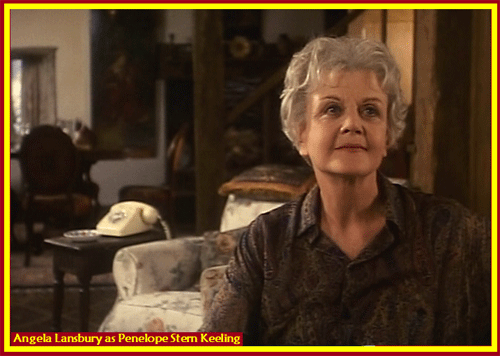
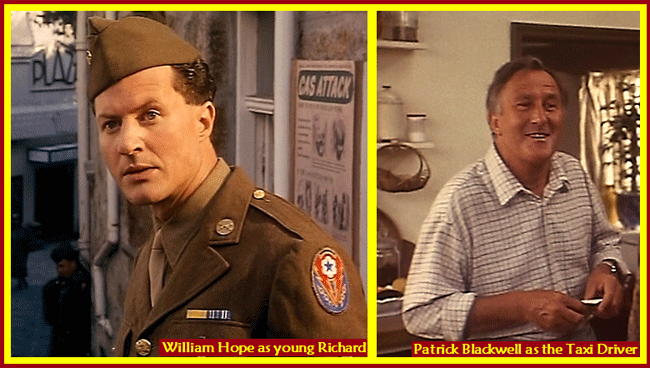
Progressively, the film moves ahead to reveal the passions, tragedies, and secrets, her bohemian childhood at Cornwall with her painter father and French mother years and years ago, her loveless marriage during the World War II with Ambrose Keeling; her forsaken love affair with Richard Lomax, an American friend of her father; down to the troubled relationship with her three children, Nancy, Noel and Olivia, she had failed to bring up a little better.

12

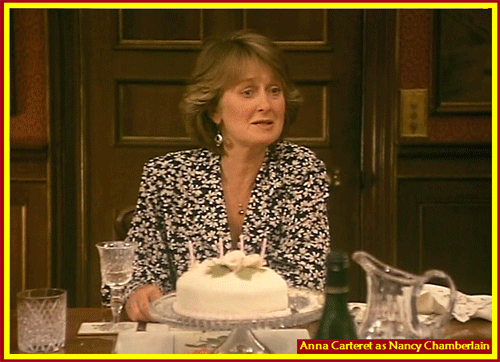
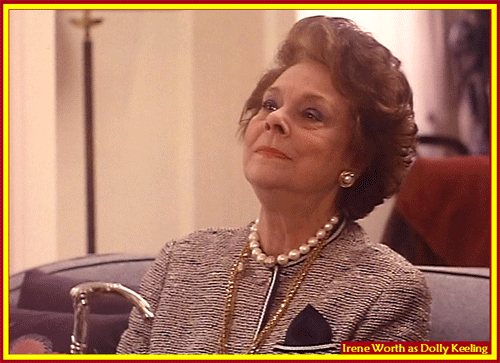
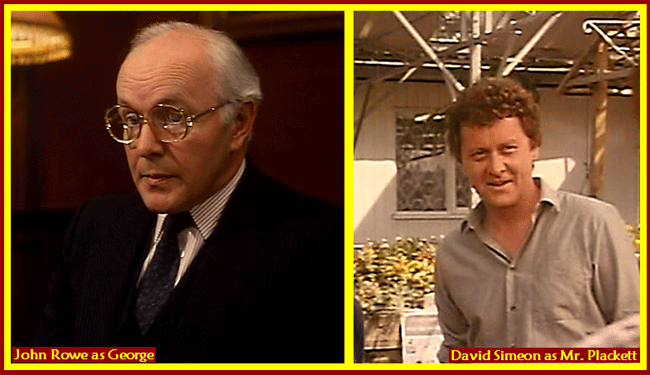
  1. Nancy Chamberlain: Penelope’s tiresome social-climbing first born, who liked to think that she was responsible for her mother. Brought up in London and indulged in fantasies nurtured by the romance novels of Barbara Cartland and Georgette Heyer which she devoured, she presently lived in an old Georgian vicarage at Bamworth, Gloucestershire, trapped in a miserable marriage with George, and overshadowed by Dolly Keeling, an unsolicited alley who is her father’s sister, the one who disliked Penelope and sought every opportunity to belittle her.
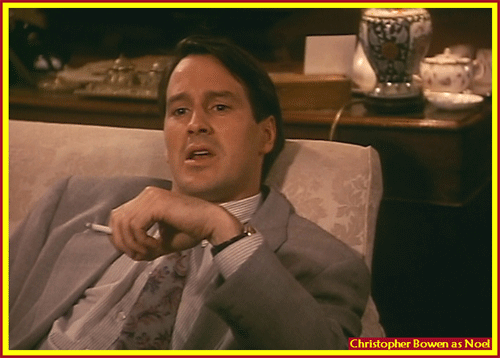
  2. Noel Keeling: The young and handsome, materialistic and self-centred son, obsessed with his desire to become a commodity broker.

13

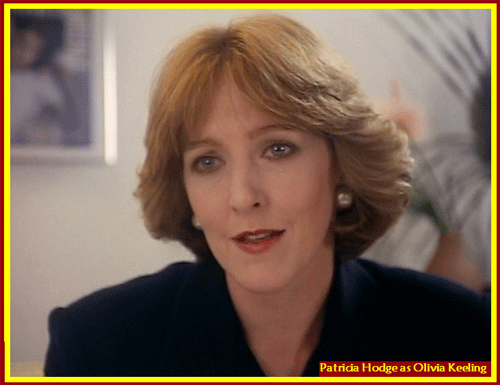
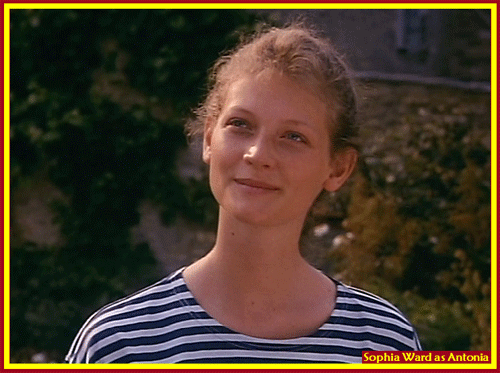
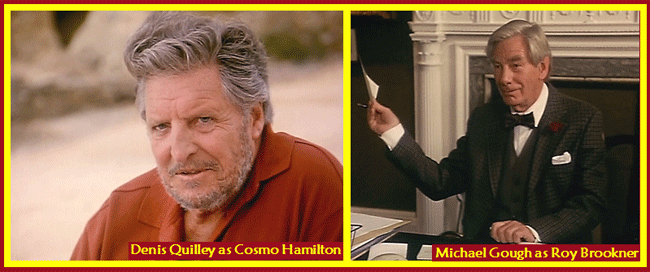
  1. Olivia Keeling: A cool-headed, compassionate woman in love and living in Ibiza with a divorced Italian called Cosmo Hamilton and his teenage daughter Antonia. She was desperate to secure a career as a Managing Editor of a magazine, a position for which she had worked for quite some years. Liked by matriarch Penelope, she is the only one of Penelope’s children truly concerned of her Mumma’s health and knew her closely down to the point that Mozart’s “Eine Kleine Nacht Musik” was her Mumma’s favourite.

14

When Nancy and Noel learned that one of the landscape paintings of their long-dead grandfather Lawrence Stern (1870-1945) had fetched £200,000/- in an auction triggering a flurry of renewed popularity in his paintings, the event set Penelope’s life on a course of discoveries about the hidden sides to her children’s ugly personalities and family devotions.

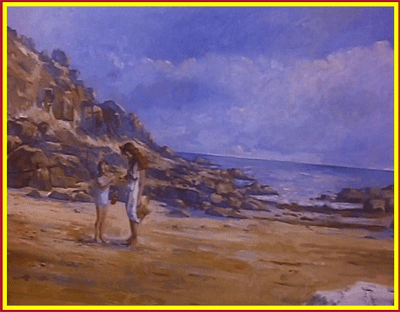
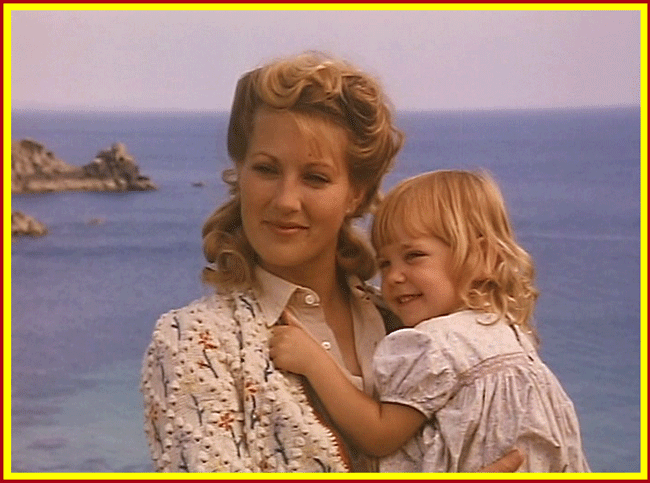
15Nancy and Noel were quick to figure out the fortune that could be earned from the sale of Stern’s last painting “The Shell Seekers”, which their mother owned and considered her prized possession, although Noel had till then thought of it as old fashioned. Symbolizing Penelope’s unconventional life, Stern’s painting featured his wife Sophie Stern (1906-1943) and their child Penelope happily playing on the beach.

Nancy’s first ploy was to incite her mother to sell the masterpiece which hung on the wall of her little cottage and to use the money mainly for her mother’s well-being and care, She lauded about all the good things that the money could bring Penelope: she could have a gardener; a housekeeper; a nurse…. Simultaneously, Nancy and Noel’s necessities, which were also of a higher nature and could not be attained with their present financial resources, can be appropriately resolved.

16

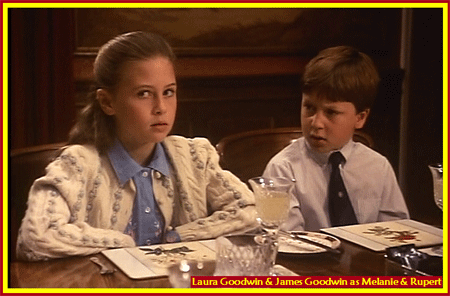
  1. For Nancy the simple has become obsolete and the complex more attractive. Nancy was prodded with monetary issues such as: money to pay the school fees of her two children Melanie (age 14) and Rupert (age 11) to attend expensive boarding schools; to purchase new clothes for Melanie; funds for George’s club fees which were already late, etc. Allowing that Penelope could unload some money from the painting on Nancy, all these could be dealt with to her satisfaction;
  2. Noel could use the money to keep up his extravagant lifestyle which he was now striving to achieve from a tiny apartment in a superior location of the town. It would still remain a distant dream for him unless he could obtain his share of inheritance which would enable him to leave his low-income job and become a commodity broker. He would also buy a bigger Flat from where he could work, break into certain highflying circles and entertain them.

17

Like Penelope, Olivia was unmotivated to cash in on her inheritance. She loved her mother and admired her non-judgmental attitude. Penelope knew it all. For her, the painting and some sketches are mainly all that’s left of her father. If an occasion arises for her to sell the painting, she will only chose at her own choice. However, she cannot sit on the fence undecided. The emphasis on monetary affairs had left her bruised, but much wiser. She devised a scheme which she believed would not only be important to her but would also be best for her children and could pave way for peace amongst them. The first step toward creating an improved future is developing the ability to envision it. At the outset, she would go to Cornwall. You simply cannot do away with the past.

18

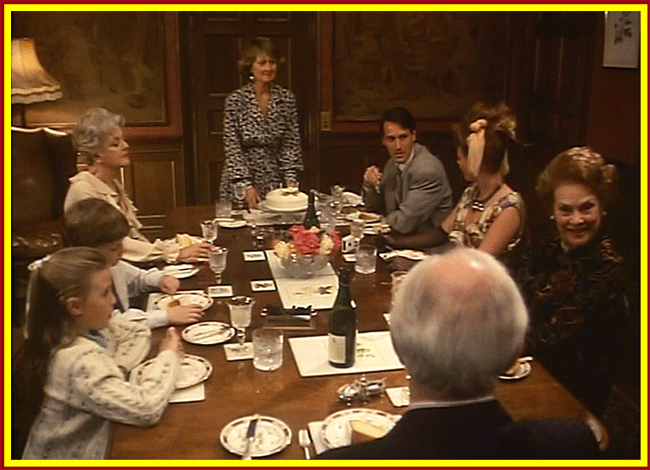
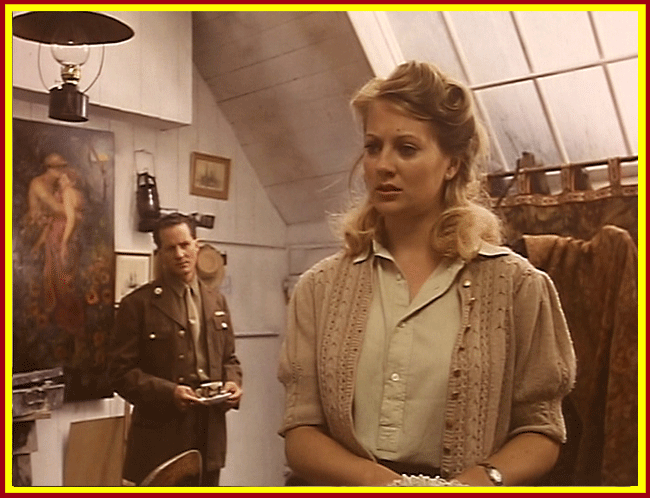
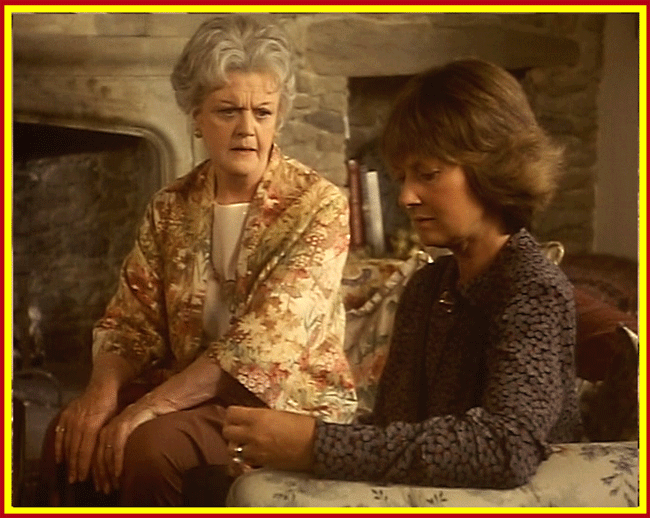
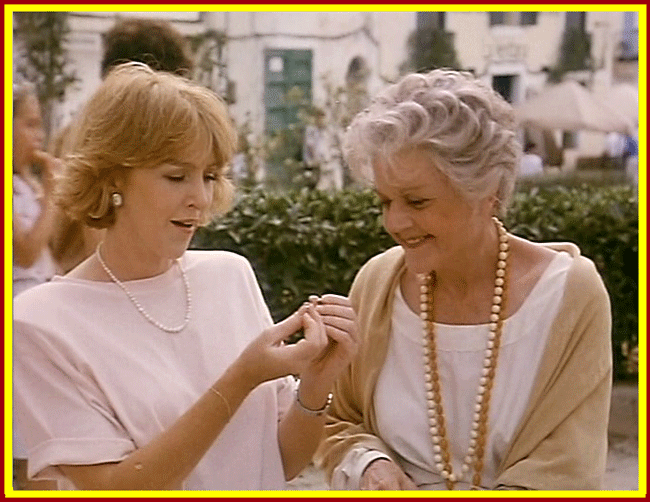
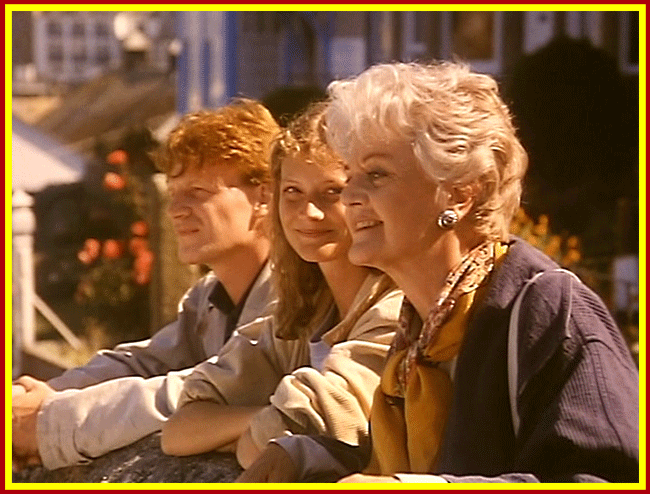
A Central Film production for Central Television in association with Marian Rees Associates, Inc, The Shell Seekers was produced by Anne Hopkins and directed by the BAFTA Award-winning, Lucknow, (Uttar Pradesh, India) born Waris Hussein (“Henry VIII and His Six Wives” (1972), “Edward And Mrs Simpson” (1978)). It is adapted from the novel for the TV by John Pielmeir, the winner of the Humanitas Prize for “Choices Of the Heart”, and features the following:

19

20

21

22

23

24

25

26

27

28

29

30

31

32

Production crew: James di Pasquale (Music), Fred A. Chulack (Editor), Jane Martin (Production Designer); Brian West (Director of Photography); Judy Moorcroft (Costume designer); Ann Brodie/Magdalen Gaffney (Make-up); Paul le Blac (Ms.Lansbury’s Hair & Wig Design).

33

Many of Rosamunde Pilcher’s novels were made as long-running series of television adaptations (“Die andere Frau”, “Federn im Wind”) in Germany and were shot on location in Cornwall and other parts of England. It is an undeniable fact that her novels have given a much needed fillip to the tourism in Cornwall as tourists flock there to enjoy a first-hand experience of Ms. Pilcher’s world in Cornwall where good things happen to good people.

34

What a happy woman I am, living in a garden, with books, babies, birds and flowers, and plenty of leisure to enjoy them. Sometimes I feel as if I were blest above all my fellows in being able to find happiness so easily,” Ms Pilcher wrote in The Shell Seekers. Plain and simple – if you like happily ever after movies that warm the heart, The Shell Seekers is a gift for you. So long for now, Jo

35

Notes:

  • To honour the 90th birthday (22 September 2014) of Rosamunde Pilcher, a Cornwall Art Exhibition titled “THE SHELL SEEKERS” was organised by Seventh Wave Gallery, UK featuring 30 Cornish Artists showcasing 60 pieces of original artwork at The Castle, Bude, Cornwall from 11 September to 4 October 2014.

36

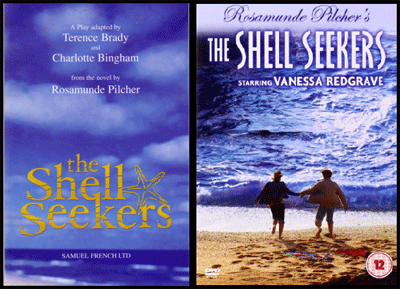
  • The Shell Seekers was adapted for the stage in 2006 by husband-wife team Terence Brady and Charlotte Mary Thérèse Bingham.
  • Another TV adaptation of The Shell Seekers directed by Piers Haggard appeared in 2006 starring Vanessa Redgrave, Prunella Scales and Victoria Hamilton.
  • Books/Audio books, DVD/Blu-ray of the books/movies referred to in this article are available with http://www.amazon.com, http://www.amazon.co.uk and other leading dealers.
  • This illustrated article is an affectionate nosegay to the movie reviewed above. Please refer to “About” of my webpage for more details.

37

The disease of indifference toward others arises when

each person thinks only of himself, and loses the sincerity

and warmth of personal relationships.” Papa Francesco

(©Joseph Sébastine/Manningtree Archive)

SURVIVING WITH DIGNITY

1

The joy of Christmas is nearer, drawing in a beehive of activities allied to it. The Christian Churches here, as in all parts of the world, are livened up for the yearly holy event marking the birth of baby Jesus, followed by the close of another year. Most educational institutions are on preparatory mode for holding mid-term exams prior to the culmination of the vacation season.

2

Plans are being made for annual vacations, or joyous activities, or gourmet feasts, or family get-togethers. Banking on the commercial value of the holiday season, the hospitality industry and other retailing sectors including big Malls are once again out with window decorations, dangling fantasies and other crowd-tickler marketing gimmicks through the media, web and signposts.

3

One is baffled and bewildered by the choice of innovative merchandize, latest tech trends, etc, available.  “Happy Shopping Holidays” – three charming words dominate this period to augment the marketing campaigns.

4

A special event at all times to me, Christmas, like Easter, has a considerable period of preparation. The Gospel of St. Matthew relates so briefly about preparations that had taken place some 2020 years ago when, three wise men, proficient in astronomy and astrology, turned their heads up to gaze at a brilliant star that would set them on a journey. Theirs was a spiritual desire to find and adore a new-born child – to lay their gifts contained in caskets of odoriferous wood at the child’s tiny feet – gifts of pure gold (asserting the kingship of Christ), frankincense (Christ’s divinity) and myrrh (that He was man, and doomed to death).

5

Their long and perilous journey through “field and fountain, moor and mountain, following yonder star” culminated in success when they found the new-born Jesus not in the stable, as usually depicted in the scene by artists, but in a roofed house where the three holy ones were temporarily lodged. These three wise men (or kings) would be the first to acknowledge Christ.

6

These wise men, assumed to be three given that three gifts were given in homage of Christ’s birth, are identified by various names, but generally known as Balthazar, Melchior and C(G)aspar since the ninth century (1). Believed to be Babylonian names, according to an old valuable book about Virgin Mary, they probably hail from the city of Séleucide which was the abode of the most celebrated astronomers of antiquity (2).

7

The Bible also relates to another journey during that period, taken place hundreds of miles away from the path the Magi would travel. Carpenter Joseph of Nazareth in Galilee accompanied by his wife Mary was on their way to Bethlehem of Judea, to register their names and pay tribute-money owing to the Roman Census of population and landed possessions.

8

Besides his beloved pregnant wife riding on a donkey, Joseph, humble, modest and retiring, was devoid of possession of anything of great value except for few clothes and the usual provisions for their painful journey of possibly five days. Their basket made of palm leaves could have included dates, figs, raisins, thin cakes of barley meal, earthen vessel to hold water, and the most precious swaddling-bands Mary’s hands had prepared to envelop her child. The census, made in the late autumn or early winter when agricultural work had ceased, might have attracted great concourse of people to the region that accommodation in cells of caravansaries in Bethlehem were unavailable.

9

Whatever the reason, upon their arrival at Bethlehem, Joseph and Mary sought shelter in a stable in the interior of a little cavern located in the suburbs which served as a stable and sometimes as refuge for the shepherds in cold and stormy nights. In there, after a good lengthy time following the hour of the Nativity, the new-born infant was adored by the shepherds as the Christkindl lay in a manger, wrapped in swaddling clothes.

11

12The adoration of the shepherds and the Magi is depicted in several movies. One of the realistic among them appears in the initial scenes of director William Wyler’s cinematic triumph, Ben-Hur (1959), its devotional ambiance enhanced by the Academy Award winning music score of Miklós Rózsa (1907-1995). Watching Wyler’s “Ben-Hur” is an enjoyable and rewarding experience. Its grandeur and spectacle, colourful characters, richness of its screenplay, excellent direction, fantastic production values, the realistic action sequence of the chariot race, the many visual symbolic threads woven into the story such as water accentuated as an agent of renewal, the dramatic effect emphasized without showing Christ’s face, the transition from full orchestra to organ during the sequences in which Christ appears, and most importantly, its story about a rich man passing through the eye of the needle, had caught up my imagination that “Ben-Hur” rates the highest number of times I have seen a movie.

13

The little figurines of the Magi from the story of the Adoration of the Biblical Magi, part of the ensemble of the Christmas crib-set in our house, were objects of marvel in my childhood. Their crowned figures clad in embroidered robes featured all the paraphernalia and pomp of royalty; their camels decked with ornamental bridles and saddles, the mysterious gifts in their hands, were all sprigs of fascination. Their images got better and fine-looking as we purchased better crib-sets over the years – from Austria, Italy and Bangkok.

14

The custom of exchanging gifts could date back to the three wise men. As some stories go: in olden times on Christmas Eve, children used to place shoes filled with oats outside their huts for the camels of the Magi which they hoped would be miraculously replaced with gifts.

15

16

The closest I got to the physical entity of the three wise men was when we stood before the gilded and decorated triple Sarcophagus traditionally believed to contain the relics of the Magi at the Shrine of the Three Holy Kings (Dreikönigsschrein) behind the high altar of Cologne Cathedral (Der Kölner Dom) in Germany.

17

Those relics were transferred from the church of St. Eustorgius in Milan on 23rd July 1164 by the powerful imperial chancellor, Rainald von Dassel (later Archbishop of Cologne) (3) having received them from the Holy Roman Emperor Frederick I (Barbarossa).
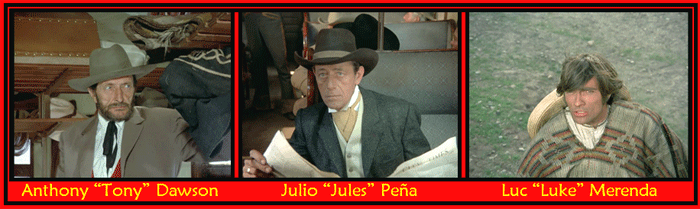
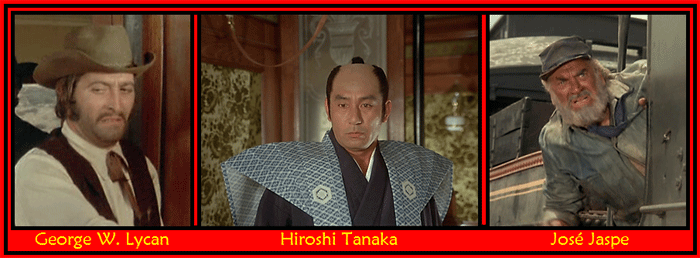
18

Sometime after her arrival in the Holy Land around December 326/January 327 A.D., Helena (Flavia Iulia Helena Augusta/St. Helena – 248/9-329?), the mother of Emperor Constantine and discoverer of the True Cross, had discovered the bones of the Magi while searching for relics and building churches in honour of the life of Jesus. Chroniclers contend that she transferred the relics to Constantinople and later, Bishop Eustorgius, a native of Constantinople, was allowed by Emperor Constans (Flavius Iulius Constans Augustus – from 337 to 350) to transfer them to Milan in 343/44. The relics eventually became the most remarkable medieval cults to royalty.

19

The magi, a popular subject of tapestry, are patrons of travellers and pilgrims. In addition to the above three places, I have visited other centres where Christian reliquaries are kept, but a visit to one in Greece connected to the Magi remains yet to be realised. The Holy Monastery of Agiou Pavlou (Saint Paul’s) in Mount Athos houses, among many other relics, some cases containing gold, frankincense and myrrh, believed to be the gifts the Magi brought to baby Jesus. The authenticity of some of the relics could be doubtful but such vestiges play an important role as catalysts in connecting us to the history and legends of our illustrious past.

20

21Christmas, celebrated everywhere, is particularly enjoyable at some places where it exudes a whole lot of charm to enjoy it the most. We have spent Christmas Day and New Year’s Day in different countries. Those special days made good memories for us – just like some days bearing special names are auspicious for many: Thanksgiving Day, Republic Day, Independence Day, May Day, Father’s Day, Mother’s Day, Patriots’ Day, Valentine’s Day, Friendship Day, Day of Tiger, of Elephant, etc….. All this is very well.

Then again, woven into the fabric of the year are ill-fated days from history lesson: 9/11 (World Trade Center attack), 26/11 (Mumbai attack), 13/11 (Paris attack), ……. – named after disastrous events that have spawned sadness in us and bruised our pride, occasioned by malicious minds hell-bent on executing everything violent in excess. The world witnessed outpour of grief when innocent and helpless people lost their lives recently owing to brutal violence.

Even so, pain nourishes courage. The global goodwill resonated in displays of solidarity, judiciousness and calm wisdom when the Eiffel Tower, Paris; San Francisco City Hall; Tower Bridge, the London Eye, the National Portrait Gallery in Trafalgar Square, Wembley Stadium in London; Brandenbourg Gate in Berlin; Christ the Redeemer statue in Rio de Janeiro; the CN Tower in Toronto; Burj Khalifa in Dubai; Tokyo Tower; Sydney Opera House; etc, showcased colours of blue, white and red. Vive la France!

22

Naturally, we bank on a sense of order and peace around us and we wish our lives to measure up to our hopes. There is nothing so precious and nothing more important than peace, though throughout history it has often been taken for granted until it’s too late. The past high degree of violence and unpredictability, offensive to our good spirits, had markedly dampened this holiday cheer. Recently there was news about tourists being selective on places to go for a safe and peaceful vacation.

23

24

25

26As for us raring to go, despite the weather, we could opt for Christmas time in Italy even though we would be doing only a repeat of what we have done there many times over the years. There would be the traditional outdoor Christmas markets in Florence, Verona, Venice, Rome, …. On Christmas Eve, we could attend the Papal Mass by Papa Francesco at the Basilica Papale di San Pietro in Vaticano and admire the huge Christmas tree and the life-sized Nativity scene in Piazza San Pietro; or at the Cattedrale di Santa Maria del Fiore (Duomo di Firenze); or at Basilica di San Marco, Venezia and watch the gondola arrive with Babbo Natale (Father Christmas) to distribute goodies, before sitting down for dinner and Bellini at Cipriani’s Harry’s Bar; or at Basilica di Sant’Antonio di Padova where we have wonderful friends amongst the Franciscan friars of the Basilica, etc.

Besides England, France, Germany, Austria, Switzerland, Spain, Portugal, all wonderful places where we have enjoyed the local culture, Madrid (Spain) would garner our priority due to the wonderful ensemble of jolly good friends we have there. Alternatively, should we look at the East, we could always opt for Thailand, Singapore – or within good old India.

27

28

Now with the three wise women  in my life, my wife and two daughters, here – it’s ample reason to take the pleasure of this season in the comfort of our sweet home. There won’t be snow here. But, never mind – the carollers and Santa Claus will come, maybe even Santa Mama.  Peaceful Cochin and Fort Cochin will be decked with lights and stars – with the brightest most cheerful displays. Impersonations of the three wise men may appear in the yearly Carnival on the first of the New Year. Listen closely and we may hear Santa Claus cracking up with laughter in helplessness – at the seasonal hike in retail prices. I think there was never a sad Christmas time in Fort Cochin except maybe in 1524 when a period of mourning was observed owing to the death of Portuguese explorer Vasco da Gama at Fort Cochin on Christmas Eve.

29

Out of the many boxes resting in our storeroom for the past eleven months would spring beautiful stars, lights and ornaments to deck up our Christmas tree and adorn strategic places in our house. A beautiful floral table centrepiece will be made. My wife, very skilful with dazzling décor ideas, characteristic of her German origin, will once again ensure that all is done.

30

31As for the creation of the Christmas crib, I believe I still have the inspiration from the creative astute shown by San Francesco di Assisi when he, with the permission of Pope Honorius III, recreated the Nativity scene (Presepio) for “the babe of Bethlehem” at the village of Greccio in Provincia di Rieti, Italy during the Christmas of 1223. Then again, the most inspiring of all this would be the message of Christmas – summarized in three magical words: “Kindness, Love, Peace”.

Not outdated or irrelevant, those sweet meditations of a mature faith appear relevant, especially in these times of adversity, to “survive with dignity”. Jo

Notes:

  • In art, so far as is known, the name of the three wise men appears for the first time in a relief sculpture on the lintel of the central portal above the main door at Chiesa di Sant’Andrea, the oldest surviving church in Pistoia, Tuscany. Created by Magister Gruamonte and his brother Adeodatus, it dates to 1166 – about 29 years prior to the birth of St. Anthony of Padova.
  • The three wise men were said to have come from the kingdoms of Tarshish, Sheba and Seba – three of the many places proposed as their countries of origin.
  • In “The War of Frederick I. against the Communes of Lombardy”, Rainald is named as Reinhardt.
  • The DVD/Blu-ray of “Ben-Hur” (1959) referred in this article, is available with main dealers of movies. Please refer to “About” of my webpage for more details.
  • This article is in memory of Michael and Gertrud Schüller, (late) parents of Carina, who would have loved to spend this Christmas here with us. May their souls rest in peace.

32

33

(© Joseph Sebastine/Manningtree Archive)