
Archives
StarChoice 23: MRS. ‘ARRIS GOES TO PARIS

 The day was wet and windy when we learned that an unexpected restriction was rightly slapped on visitors’ entry to the top of Gustave Eiffel’s Tower, the emblem of Paris. For Bianca, a first-time visitor to Paris at that time, the spectacular view from the third inner platform at 276m had to be compensated with a panoramic view from the second inner platform (115m) of the Eiffel Tower which was overcrowded with visitors despite the chilly wind. The night before from the window of our hotel rooms, we had seen the tower fizzes with champagne sparkle (336 600-W projector sodium lamps and 20,000 bulbs for the Sparkling Tower) periodically from sundown to the early hour while the old moon gleamed over it. Why does Paris hold a special place in many hearts? Most visually recognisable in Europe, the city’s beauty is undeniable. From where my wife Carina, Bianca and I stood on the second platform, not in the very distance was the Arc de Triomphe. Our eyes shifted from the Arc and trailed over the tree-lined straight boulevard of the Avenue des Champs-Élysées with its lovely sense of space now obstructed from view by the masses of buildings, to Le Grand Palais with its iron and glass domes.
 Scanning past the city’s oldest monument, Obélisque de Luxor in the vast Place de la Concorde; and the splendid Jardin des Tuileries, we can’t miss architect I M Pei’s pyramid and that honourable house of La Gioconda, Le Musée du Louvre, where I have spent many many days over many years discovering the magnificent genius of our gifted ancestors, each object d’art systematically displayed for global citizens. Further to our right on the eastern half of the natural island, Île de la Cité in the Seine, loomed the 90m Gothic spire of Cathédrale Notre Dame de Paris, beyond which is Gare de Paris-Bercy from where we would catch the night train to Milan four days later. Gazing at the distance to the left, our eyes fell on the dome of that neo-Romanesque-Byzantine edifice, Sacré-Cœur (Sacred Heart) Basilica on the Montmartre (Mount of Martyrs) hill where we had chosen our hotel for this time to explore the life in Montmartre. Each arrondissement of this legendary metropolis is self-contained for necessities, its treasures, and its secrets. All life is here – in Paris.
 Bianca, our eldest daughter, with her imminent degree in Fashion Design on her mind, had her thinking caps on for ideas and inspirations of the French fashion: Chanel, Dior, Vuitton, Yves Saint Laurent,… – all the more reason, this is the age where luxury fashion endeavours to be more accessible to the public. Her eyes were now busy trying to locate the Christian Dior Couture building on Avenue Montaigne which she finally found straight ahead of us, few blocks up the Pont de l’Alma Tunnel where Princess Diana with two others was killed in a car crash on the night of 31 August, 1997. Well, Dior would be our next destination for the day, the first of the haute-couture houses she intended to trail to “catch the fresh French fashion touch.” True to the word: Fashion is followed!
Mrs. ‘Arris Goes to Paris (1992)
Interestingly, renowned American novelist Paul Gallico (Paul William Gallico – July 26, 1897 – July 15, 1976) in his beautiful short novel, Mrs. Harris Goes to Paris, published in 1958, tells the story about a widowed English working class woman’s visit to Paris to buy a beautiful dress. This book forms part of the four “Mrs. Harris” books Gallico wrote, viz., Mrs. Harris Goes to New York (1959), Mrs. Harris Goes to Parliament (1965, aka: Mrs Harris, M. P), and Mrs. Harris Goes to Moscow (1974). Adapted as a TV play with some alterations by John Hawkesworth, “Mrs. ‘Arris Goes to Paris” was filmed on locations in London, Paris and Budapest.  Synopsis: It was the London of 1953. Our protagonist, Mrs. Ada Harris, the charwoman somewhere in her late 50s or early 60s, led a regular-as-clockwork life in Battersea cleaning homes of well-to-dos living in and on the fringes of fashionable Eaton Square and Belgravia – 10 hours a day – 5 ½ days a Week. One morning after she had reported for work at the luxurious home of Lord and Lady Dent, one of her rich clients, Ada was sent to her Ladyship’s bedroom to collect some letters. There, Ada saw an invitation to Lord and Lady Dent to attend Her Majesty’s Coronation Ball at Buckingham Palace on Friday, 5th June 1953. It was then she saw two lovely gowns hanging by the wardrobe – one red and the other in pale blue. Ada had never seen anything so beautiful in her whole life.
  When Lady Dent found Ada admiring her pale blue gown, she informed Ada that they are from Dior in Paris and the pale blue gown cost a pricey 450 guineas, an astronomical sum in 1953. Lady Dent plans to wear one of the gowns to the Coronation Ball. When Ada was given the chance to select one of the gowns for Lady Dent to wear for the Ball, the blue gown was Ada’s choice since she thought that the pale blue was the best for the Palace. Besides, they say Her Majesty liked pale colours. Lady Dent was apparently impressed by Ada’s selection.
  In next to no time, Ada was besotted by the desire to own a similar Dior gown, but the cost, of course, was beyond her financial capacity. Having played in the weekly football Pool, Ada won 174 pounds 6 shillings and 4 pence – not much – but it was a good start for her to edge closer to owning a Dior dress. Mrs. Butterfield, her Cockney neighbour and close friend in the same profession was taken aback by Ada’s new interest in getting dressed up. She was all questions: from where will Ada find that kind of money with her low salary? Where will Ada wear the gown after all? Play dress-up in the attic? Ada had her reasons: they may only be charwomen – but they certainly can have their dreams – there is no law against that. As with everything in life, money buys quality. She would work hard enough. She is going to get a Dior gown. Seriously!
  As a Chinese proverb goes, “To get through the hardest journey we need take only one step at a time, but we must keep on stepping”. She “scrimped and saved and slaved” with unwavering determination for three long years until she possessed just sufficient money to see her through her travel to Paris and return, plus the cost to acquire the gown. Perfect!
  The year would be about 1956 by now when Ada, upon arrival in Paris, was confronted by the reality that obtaining an original couture creation from Christian Dior’s Salon is a challenging task. Then again, at the House of Christian Dior in the Avenue Montaigne, she was lucky enough to have met Mme Colbert, the Chief Vendeuse of Dior who was at that time in the middle of organising a Collection to be shown to a selected audience that afternoon where the guest of honour will be Her Royal Highness Princess Margaret, famed for her love for Christian Dior’s creations in the 1950s.
 As it turned out, with Mme Colbert’s help, Ada ended up sitting in the front row of the show next to a Ministre, Marquis Hippolite, who would soon become fascinated by her charming personality.
  In a little while, as the Dior show proceeded with the display of magnificent haute couture creations, a young model named Natasha appeared dressed in a most gorgeous dress no: 89 “Temptation” which was the dream of Mrs. Ada Harris. Overwhelmed with admiration for that soft-pink gown, Ada’s incessant clapping was disdainfully stared at by the room full of high-society women in their aura of riches, getting their fashion fix here.
  Following the show, Mme Colbert was delighted to accept Mrs. Harris’ booking for the gown “Temptation” at the cost of 437,000 francs (£450). Arrangements were swiftly made with the head dressmaker, Monsieur Marcel and his assistant Mme. Claudine who agreed they would spin into overdrive to get her dress done within a week.
  Accommodation was arranged quickly for Ada’s one-week stay in Paris. However, to get Ada measured and fitted, it was found necessary to evade an antagonist in the form of the pompous director of the House of Dior, Monsieur Armont, who appeared to be an expert in brewing up anxiety in the salon. Mrs. Harris had never thought of that possibility.
  And so, Ada slips under the protective umbrella of the triad: Mme Colbert, M Marcel and Mme Claudine. Keep the fingers crossed – everything comes to the one who waits.
  Ada’s forced and unforeseen stay in Paris was not in vain. By the time the week has come to a full circle, she had sown the magical seeds of sure-fire success all around her: to put a bachelor’s house tidier; to bring together two lovers; mend the stormy time between the Marquis, his daughter Mme Louise and granddaughter Claire; and arranged a much needed letter for Mme Colbert from Le General de Gaulle conferring the Order of Croix de Guerre with palm posthumously on her husband M Michelle Colbert, a member of La Résistance Française who was shot dead 12 years ago during the German occupation of France.
  As luck would have it, not only M Michelle’s name will be inscribed in the book of the Heroes of the Resistance, but Mme Colbert will also be given the Médaille de la Résistance from the General himself. Wonderful!
  In spite of this, M Armont still persisted on her neck. However, as in all stories trailing the legend of Cinderella, Ada Harris’ had her saving grace in a friendship to help her through her hurdles and finally finger-point M Armont as the bad leaf on the lettuce. Friendship isn’t a big thing – it is a million little things.
  Mrs. ‘Arris Goes to Paris is a Canada-United Kingdom-Hungary co-production, and filmed with the production assistance of Air France and Christian Dior. It was produced by Susan Cavan and Andras Hamori and directed by Anthony Shaw (the first son of Angela Lansbury and Peter Shaw).
  The ensemble of crew consists of: Stanley Myers (music); Laszlo George (Director of Photography); Sidney Wolinsky (Film Editing); Roger Murray-Leach (Production Design); Jane Robinson (Costume Design); Tamas Hornyanszky (Art Director), Virginia Gallico (Creative Consultant), etc.
  One of the seasoned pros of the past, the performance of British actress Angela Lansbury, CBE (born on 16 October, 1925 in London) as Mrs. Ada Harris, a honest, working-class widow without children, is heart-warming. Out on a long-distance adventure, Angela’s Ada is a delight to watch as she braves the hurdles on the Parisian scenery.
  Daughter of Irish stage/screen actress Moyna MacGill, and granddaughter of George Lansbury, the British Labour Party leader, the Strawberry blonde Angela had her screen debut in the role of the sly maid in Gaslight (D: George Cukor, 1944) which earned her nomination for Academy Award for best Supporting actress. MGM soon regarded her as a rising young star. Although she had to content with supporting roles owing that she was considered not pretty enough to be a leading lady, film after film she lured the limelight away from the top-billed stars of her movies.
  Early in her career, she appeared in the post-war colour remake of the costume drama The Three Musketeers (D: George Sidney, 1948) in which Angela portrayed the role of Queen Ann. Next, I saw her in the biblical tale Samson and Delilah (D: Cecil B. DeMille, 1949) as the Philistine Semadar who was romanced by Victor Mature’s young Danite Samson.
 She favoured her appearance in a string of movies: The Red Danube (D: George Sidney, 1949), The Purple Mask (D: Bruce Humberstone, 1955), All Fall Down (D: John Frankenheimer, 1961), The Manchurian Candidate (D: John Frankenheimer, 1962), Harlow (D: Gordon Douglas, 1965), etc. Success in movies drove her further to establish careers on stage and in television shows. She appeared in the long-run stage musical hit Mame (Jerry Herman); in TV productions including Murder, She Wrote, launched in 1984; in the musical Sweeney Todd (D: Stephen Sondheim); in Barry Sandler’s adaptation of Agatha Christie’s Miss Marple mystery The Mirror Crack’d (D: Guy Hamilton, 1980), etc. It is Angela’s sweet singing voice that we hear when the housekeeper Mrs. Potts sings in Beauty and the Beast (D: Garry Trounsdale & Kirk Wise, 1991) in the scene where the Beast romances Belle with dinner and a dance.
 Egyptian actor Omar Sharif (born Michael Shalhoub) was already a Romantic/sex symbol of the Egyptian cinema before he rose to international stardom with his role as the fierce tribesman in Lawrence of Arabia (D: David Lean, 1962). While Mrs. ‘Arris Goes to Paris was preparing for production, Sharif was already working in Continental Europe acting in two films by French director Henri Verneuil: Mayrig (1991, and later, a TV play in 1993), 588 Rue Paradis (1992), and in Italian director Duccio Tessari’s Beyond Justice (1992). Omar Sharif was contracted as a guest star to portray the wealthy and charming Ministre, Le Marquis Hippolite de Chassagne. Sharif’s physical presence gave character of Marquis more than the film could have acquired from the script alone.
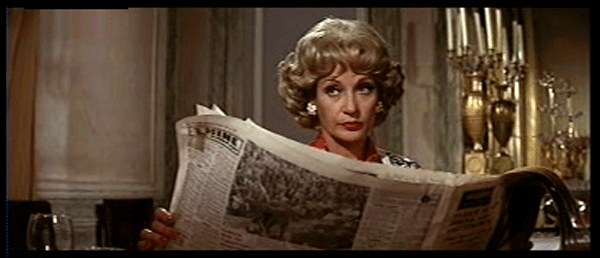
 Diana Rigg (born Enid Diana Elizabeth Rigg in Doncaster, England) is the Tracy (Contessa Teresa di Vicenzo) of On Her Majesty’s Secret Service (Peter Hunt, 1969), the only woman 007 James Bond married. Dame Diana had already established her reputation in Shakespeare plays before international fame came her way for her role as the secret agent Emma Peel in the TV series The Avengers (1961–1969). The performance of Diana Rigg was first-rate as the brainy and fair Mme Colbert who tries to assert her authority as the in-charge of the sales in the House of Dior, and lock horns with M Armont who threw his weight around and refused to let Mrs. Harris, a commoner, have the gown.
 Montréal, Québec, Canada actor Lothaire Bluteau (Jesus of Montreal, 1989) is the dignified André Fauvel, the Dior accountant who was shy to reveal his fancy for model Natasha but thought that she deserved better than a “pen-pusher” like him.
  A talented British actor, whenever John Savident (A Clockwork Orange, 1971) appears as the assertive and aggressive M Armont, it is like watching a snake come out of a basket.
  Lila Kaye (An American Werewolf in London, 1981) acts as Mrs. Butterfield with the cockney dialect matching Mrs. Harris’, which is at its most distinctive during their journey to their workplaces by the doubledecker London bus no: 19 to Victoria.
 In her screen debut role, Winnipeg Manitoba, Canada-born Tamara Gorski (Murder at 1600, 1997) is exquisite as the small, fair-haired young Dior model Natasha Petitpierre, truly blessed with the loveliest of natures and the sweetest smile in that part of Paris.
 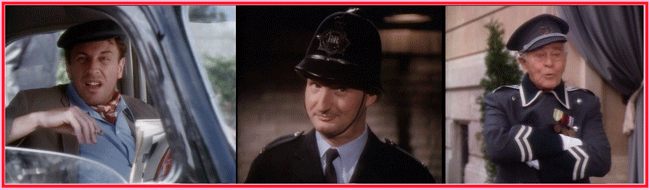 Also on the supporting cast are: William Armstrong (M. Marcel), Barbara Barnes (Mme. Claudine), Tamsin Olivier (Mme. Louise), Trudy Weiss, Jenö Pataky, Jason Carter, Alex Knight, György Emõd, Mel Martin, Toby Whithouse, David Sterne, Anna Safranek, Ottó Szokolay, Tibor Medveczky, Kieron Jecchinis, Fruzsina Radnai, amongst others.
  The film rightly features the period-details of the fairy-tale storyline: the white horse-driven van of Lambs Farm Dairy delivering milk in silver-topped bottles; the street-cleaner with his pulling cart; the old Harrods delivery van; the style of dressing, etc.
 Complemented by the melodious music of Stanley Myers, Mrs. ‘Arris Goes to Paris, with competent cast of actors and some interesting plot twists, is a nice and gentle family film, that lifts our hearts with a positive assurance that things can turn up right if you set your mind to it. Watch it if you can – there is nothing wrong in having a little fantasy now and then to lift the spirits. Jo.
  Notes: 1.. This illustrated article is an affectionate nosegay to the movie reviewed above. Please refer to “About” of my webpage for more details. 2.. The DVDs of the movies referred above are available with main dealers such as amazon.com, TCM Shop, etc. 3.. The novel “Mrs. Harris Goes to Paris” (original UK title: Flowers for Mrs. Harris) by Paul Gallico is available with leading book dealers.
(©Joseph Sébastine/Manningtree Archive)
StarChoice 22: THE TAMARIND SEED
THE TAMARIND SEED (1974)

 While in Bangkok recently, I once hopped over to the enormous Saphan Khao Fruit Market, mainly to take some photographs of the Dragon Fruit (Gao Mung Gorn) and other exotic and unfamiliar fruits you will come across in Bangkok. Now Saphan Khao Market is a fruit lovers’ paradise where most fruit-lovers can come across their requirements. Having feasted on a delicious breakfast with cheeses, cold meats, small bowl of salads and an assortment of wheat breads, and a hassle-free taxi ride from our hotel in the infamous morning traffic of Bangkok, we were not in a hurry to leave this market. Amongst the huge crowd of customers on that day was a group of tourists from Singapore tasting and buying a fruit called “Makham wan” (Scientific name: Tamarindus indica), a sweeter variety of tamarind available in Thailand which is generally eaten fresh after peeling, while it can also be boiled in water to make a refreshing fruit drink. Native to tropical Africa and widely grown in India, the long, bean-like pods containing sweet and sour pulp of the tamarind fruit and shiny Spanish mahogany-coloured seeds is not alien to us as it forms part of the culinary usage in this part of the world just as in Latin American countries.
  Next to the Singaporeans savouring the tamarind fruit (Puli, in Malayalam), I could see a tall plastic container with holes around its lower rim, positioned by the drainage to the side of the stall, where customers could discard the tamarind seeds and pod shells and its strings. Those holes acted as lower outlets for the dirty water to flow out when the water tap above the container is occasionally opened to cleanse the contents in it. Considering the numerous nutritional and health benefits of these seeds and pods, they were eventually collected and transported elsewhere for processing. The seeds are also a popular snack amongst the rural population as an emergency appetizer. Due to its medicinal qualities, they are roasted, soaked and eaten whole to expel intestinal parasites or added with other ingredients to make substitute for coffee. I was told that the extract of the seeds is also used in eye drops for dry eyes while these seeds are also powdered and used as starch in the textile industry.
  At that moment, I was reminded of a curious legend told in the 1974 Blake Edwards’ film “The Tamarind Seed” in which the seeds play a pivotal role in the culmination of the love affair between the characters played by Julie Andrews and Omar “Cairo Fred” Sharif. As the legend of The Tamarind Seed goes: “A slave on Hayward’s plantation, St. Peter, accused of stealing a sheep, was hanged from a Tamarind tree. He protested his innocence, saying that the tree would vindicate him. Since then the Tamarind tree has born a seed in the shape of a man’s head.”
  Although we longed to see that film once again, our copy was in our library in India. I stored the thought away for fulfilment at a later date. That later date turned up only after I learned of the sad demise of its male star in the central role.
  Blake Edwards (born William Blake Crump), as we know was originally a writer and actor before he turned director of movies under the titles: Breakfast at Tiffany’s (1961); Days of Wine and Roses (1962); What Did You Do in the War, Daddy? (1966); 10 (1979), S.O.B. (1981); Victor Victoria (1982); The Pink Panther series; etc.
 He is also the director of Darling Lili and The Tamarind Seed, which was the second of seven films made with Julie Andrews (born Julia Elizabeth Wells) by Blake Edwards since his marriage to her in November, 1969. The first film, Darling Lili (1970) featured Andrews as a World War I spy against the English posing as a London music hall performer who turns a dance performance into a striptease. The film failed to generate audience interest at its release but the role of Lili Smith transformed Julie Andrews as sexy from the sweetened screen image she earned from the title role (her film debut) in Mary Poppins (1964, D: Robert Stevenson).
  The second film, The Tamarind Seed was based on the 1971 book by Evelyn Anthony, faithfully adopted for the screen by Blake Edwards, effecting modifications on the geographical details of the romantic storyline from Washington, D.C/New York to Paris/London and supplementing with scenes such as the action sequence at the London Heathrow Airport. The Tamarind Seed featured a contemporary love story with spy elements of the Cold War.
  Now in this review of The Tamarind Seed, we are talking here about a time when KGB, Lubyanka prison, Iron Curtain were constant reminders of dread. The attractive British widow of the movie, Judith Farrow (Julie Andrews) whose husband had died in a car crash, is on holiday in Barbados to find herself after failure of a six-month affair with a married British group-Captain Richard Paterson.
  The small hilly island of Barbados, shaped like a loin pork chop, with its large sugar cane plantations, elegant resorts, hotels, many miles of silky white beaches, and, of course, sun, has been the most favoured travel destination for sun-seekers for several centuries. Here, by sheer coincidence, Judith is strangely drawn to a tall, dark, ‘very kind, knowledgeable and generous man” called Feodor Sverdlov (Omar Sharif) staying in a neighbouring villa, here on vacation “to get away from people”.
  No sooner their friendship became known in official channels, their activities were closely monitored. What on earth is she doing with a Russian spy? From Judith, Feodor learned that she is a personal assistant to a man called Sam Neilson of the Home Office in London. Feodor let her know that he is employed as a military attaché at the Soviet embassy in Paris. During the time they have been seeing each other, they had developed simple, satisfying routines: two dinners, an early morning swim, a dinner at the Colony Club and sparkling conversations. While on a visit to the Bridgetown museum, they came across “The Legend of the Tamarind Seed” and a seed in the shape of a man’s head. Impressed by the legend, she wished she would find such a tamarind seed.
  Ever since they met, Feodor had been full of life, energy, and mischief and let her know of his desire for her. Although she found him affectionate and harmless, she was always thinking defensively. All the same, she told him about her failed affair with Captain Paterson, a mistake she admitted to Feodor later. Feodor too was not far behind in telling her about his unhappy marriage to a woman back home, who is a very good judge of everything and knows exactly what is right and what is not right. He didn’t find it a great mistake in letting her know that he did not feel anything for the socialist revolution anymore. The following day, as Judith wanted, they went looking for the tamarind tree at Hayward’s plantation.
  Later, en route to London, Judith’s flight was over the Atlantic Ocean when she found a tamarind seed, in the shape of a human head, in an envelope given to her by Feodor when he bid goodbye at the hotel. She was happy so now had her tamarind seed.
  In Paris, Judith was interrogated by Jack Loder (Anthony Quayle), the British Intelligence officer located at the Paris embassy, which Judith found irritating, but felt helpless.
  Her friendship with Feodor has put her in a cloud of suspicion and she is considered a security risk. Questions were raised at her. Was their meeting really accidental? Why did this man choose Judith out of the whole island? Was Feodor trying to recruit Judith as spy? The way Judith was, she would be a brilliant gift to them. Anyhow, Loder would take the issue in stride and directed her to inform him of any specific developments. Jack Loder had other worries, too. He worked in a world of political loyalty, betrayal, murder and professionalism. He had discovered that an unknown Soviet spy under the code name “Blue” existed within the British government.
  Arriving back in his Paris office, Feodor spoke of his friendship at Barbados with his Russian boss, General Golitsyn (Oscar Homolka). The General, who listened with perceptible interest, was led to believe that the woman in question has a very confidential job at the Home Office in London and could be very useful. Feodor also suggested that he could recruit Judith. In fact, Feodor secretly believed that this ploy would enable him to meet Judith again, the inspiration and object of his love, and he can continue with the affair blossomed at Barbados.
  In time Judith met up with Feodor for a dinner and let him know about Loder’s interrogation. Feodor advised her to “try to tell the truth as long as possible, that way when time has changed and you have to lie, there is a great chance that you will be believed.” Although in the beginning Judith was wary of starting a new relationship, things are different now. Later, based on warning from Judith, Feodor decided against returning to Russia but elected to seek political asylum in Canada with the help of Captain Paterson and Jack Loder. Feodor will not go empty handed to Canada. In exchange to set up home there with the usual guarantees, Feodor will be a very worthy acquisition to Britain. His offer to the British would be magnificent: the identity of the unknown British traitor “Blue”. For that prize, he knew Loder would plan everything for Feodor down to a “T”.
  Subsequently, Feodor stole an ultra-secret file from the Soviet embassy for the British intelligence – an action which would set off the bulls and bears of the good old days of the Cold War lashing out dangerous repercussions in the lives of Judith and Feodor.
  As the character of actor Donald Sutherland spoke in the 2003 version of the movie, The Italian Job: ‘There are two kinds of thieves in this world: the ones who steal to enrich their lives, and the ones who steal to define their lives.’ Well, Feodor’s reason is obvious.
 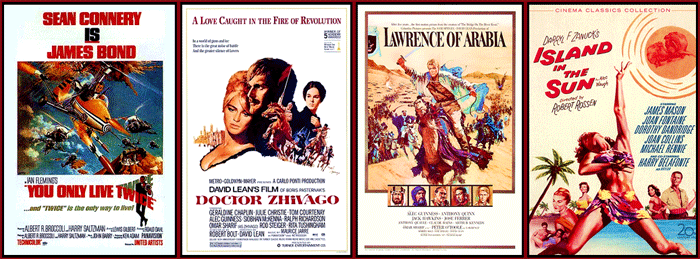 Produced by Ken Wales with music by John Barry, the American-Britsh romantic drama, rated PG, has an impressive line-up of crew: Ernest Walter (Editor – The Shoes of the Fisherman (1968)); Harry Pottle (Art Direction – You Only Live Twice (1967)); Maurice Binder (Main title designer – earlier James Bond movies); John Briggs (wardrobe supervisor – Isadora (1968)) and Academy Award-winning cameraman Freddie Young (Doctor Zhivago/Lawrence of Arabia). Young had worked in Barbados earlier for the 1957 film Island in the Sun (Dir: Robert Rossen)
  British-born Julie Andrews in the role of the British Home Office functionary has the role tailor-cut for her. Julie is always worth looking although in this movie she does not wholly delve beneath the surface of her character. Julie Andrews’ clothes in this film are by Christian Dior and co-ordinated by Emma Porteus.
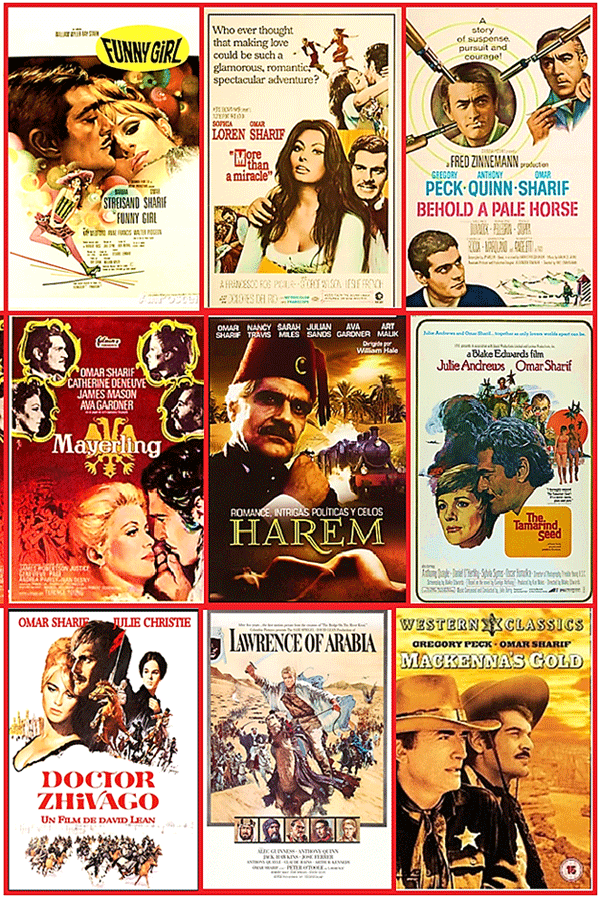
  With his dark Egyptian features and smouldering eyes, Omar Sharif (born Michel Demetri Shalhoub) as the Russian spy lover displays a masterly flair in liveliness and chivalry, and, of course, very persisting with his wanting for Judith ever since he met her. Sharif was a very popular heart-throb during this period with a string of romances and a steady row of films prior to The Tamarind Seed: The Last Valley (Dir: James Clavell), The Horsemen (Dir: John Frankenheimer) and The Burglers (Le casse, Dir: Henri Verneuil).
  In 1973 when he appeared as Le capitaine Nemo in six episodes of the TV-Mini-Series L’île mystérieuse, he had purchased a huge mansion on the Spanish island of Lanzarote (in the Canary islands off the coast of West Africa), calling it Casa Omar Sharif. In May, 1973, The Tamarind Seed started initial filming at locations at Barbados’ west and east coasts before the unit shifted to London for further filming. Meanwhile, in early June, Omar Sharif won The Ladbroke World Master Bridge Championship, when he beat the former champion Latvia-born Boris Schapiro in London.
  Under Blake Edward’s intelligent and sophisticated direction, the film also features an impressive line-up of supporting cast: Anthony Quayle; Oscar Homolka (Final film); Irish actor Daniel O’Herlihy (Fergus Stephenson, the British minister in Paris); David Baron (Richard Paterson); Celia Bannerman (Rachel Paterson); Bryan Marshall (George MacLeod); live up to the roles of their characters. Also in the supporting role is English actress Sylvia Syms (Sylvia May Laura Syms OBE) as the unhappy diplomatic wife Margaret Stephenson with desire for unholy carnal pleasures and an energizing passion for dominance. Syms, who would act as Queen Elizabeth the Queen Mother in The Queen (2006, Dir: Stephen Frears), earned a BAFTA nomination for The Tamarind Seed.
  Other members of cast: Roger Dann (Colonel Moreau); Sharon Duce (Sandy Mitchell); George Mikell (Major Stukalov); Kate O’Mara (Anna Skriabina); Constantin de Goguel (Dimitri Memenov); Alexei Jawdokimov (Igor Kalinin); Janet Henfrey (Embassy Section Head); John Sullivan (1st KGB Agent); Terence Plummer (2nd KGB Agent); Leslie Crawford (3rd KGB Agent). The film is also known under the titles: La semilla del tamarindo (Spain); Il seme del tamarindo (Italy); A Semente de Tamarindo (Portugal); Die Frucht des Tropenbaumes (West Germany); Sementes de Tamarindo (Brazil). The Soundtracks are: a) “Play It Again” sung by Wilma Reading (uncredited) – Music (John Barry), Lyrics (Don Black) and b) “Man with a Monkey” Music (Sam Fonteyn).
  The Tamarind Seed was filmed through facilities of Samuelson Film Service Ltd, London. Besides locations at Eaton Square, Belgravia, I remember having read somewhere that more location shooting was facilitated at the London Zoo, at scriptwriter George Axelrod’s house in Mayfair district and at a Jazz Club. In Paris apart from Champs-Élysées, and other streets, locations included France-Amériques, Orly Airport, etc.
  The film never fully explores the attractions of Barbados which retains its Old World charm which is British. On a historical note, this is the place where George Washington brought his brother, Lawrence, in 1751 to recuperate from tuberculosis (now known as the George Washington House) – the only land outside North America Washington ever set foot. Apart from the scenic beauty of the sandy beaches and the horizon, people lazing under coconut palms, parts of cultivated countryside, and interior of the museum, hotels, etc, the heritage monuments and picturesque sights of the island are not shown – such as the bronze statue of Admiral Lord Nelson (erected on 22 March 1813) at Trafalgar Square (renamed National Heroes Square) in the picturesque capital city of Bridgetown, which is older than the Lord’s statue in London.
  With a good script, charming performances, haunting score, this is a lovely movie for those who love ingenious espionage thrillers and mature romance – a mellow way to end the day. Jo.
  Notes: 1.. The DVDs of the movies referred in this article are available with main dealers such as amazon.com, TCM Shop, etc.
2.. This illustrated article is meant for the promotion of this movie. Please refer to “About” of my webpage for more details. 
3.. The book Judith is reading when she first met Feodor is a hardback edition of Kingsley Amis novel The Riverside Villas Murder, published in 1973 (read elsewhere that this dust jacket was designed by illustrator and children’s author Ian Beck.)
4.. Darling Lili gathered Academy Award nominations for Best Original or Adaptation Score and Best Original Song (Whistling Away the Dark – sung by Julie Andrews) for Henry Mancini (music) and Johnny Mercer (lyrics); and for Best Costume Design for Jack Bear and Donald Brooks.
5.. Evelyn Bridget Patricia Ward-Thomas (pseudonym: Evelyn Anthony, Anthony Evelyn, Eve Stephens) born on July 3, 1928, and convent educated, wrote ten successful romance/historical novels before turning to genres: Mystery/Crime/Suspense. She lives in Essex, England.
6.. Those of you who liked the novel “The Tamarind Seed” may like to check Evelyn Anthony’s “The Defector” for their similarities. Further books by Evelyn Anthony currently in Manningtree Archive: 


 7.. Sharif divorce his wife, Egyptian film and television actress and producer Faten Hamama in 1974, the year this movie was released (Faten Hamama died on January 17, 2015 at the same age Omar Sharif will join his former wife at the grave in less than six months later.)
8.. Julie Andrews is the second Julie to become Sharif’s heroine following Julie Christie of Doctor Zhivago. Julie Newmar was his co-star in Mackenna’s Gold.
9.. The movie’s links to month of July: Author Evelyn Anthony was born on July 3 (1928); Director Blake Edwards born on July 26 (1922); Omar Sharif died on July 10 (2015).
10.. This article is in memory of Omar Sharif – May his soul rest in peace. 
(© Joseph Sebastine/Manningtree Archive)
OMAR SHARIF
FAREWELL, Mr. OMAR SHARIF (10 April 1932 – 10 July 2015)
CHRISTOPHER LEE – A TITAN OF CINEMA
Is Count Dracula one of your favourite book/screen personalities? Well, the 6 feet 4 inches veteran British actor/musician/Opera singer/author Christopher Lee will not be reincarnating in the form of Count Dracula anymore. Lee of horror characters such as Kharis the high priest/Mummy (The Mummy, 1959), Count Dracula, Dr. Fu Manchu, Rasputin the Mad Monk, Lord Summerisle (The Wicker Man, 1973), sadly died on Sunday 7th June at Chelsea and Westminster hospital in London, after suffering heart and respiratory problems. 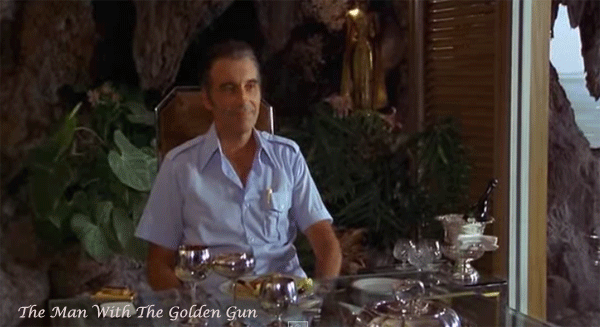
Lee, who belonged to the Carandini family, one of the oldest families in Italy dating back to the first century AD and to Emperor Charlemagne, was listed in the Guinness Book of World Records as the world’s tallest leading actor amongst Clint Eastwood and others. He was also a step-cousin of the late Ian Fleming, author of James Bond novels. According to reports, Fleming had recommended Lee for the role of Bond’s nemesis in Dr. No (1962) but the role went to Joseph Wiseman. Finally, Bond in the form of Roger Moore faced him in the role of the three-nippled, million-dollars-a-hit assassin Francisco Scaramanga in The Man with the Golden Gun (1974).
From early on, Lee’s flair for acting was evident when he appeared as the evil Rumpelstiltskin at Miss Fisher’s Academy in Wengen, Switzerland. In spite of his five-year stint in the Royal Air Force and Intelligence during World War II he was rejected for a role in the war-movie The Longest Day (1962) on the grounds that he didn’t command the look of a military personal.  After his retirement from the RAF by the end of the war, taking heed from the suggestion of his cousin Count Nicolò Carandini, he obtained a seven-year contract with Rank Organisation in 1946. Lee debuted in the psychological drama Corridor of Mirrors (1948), the first film directed by Terence Young. In the following decade, despite that he was remonstrated for being too tall, dominating the frame, he appeared in many films.
Christopher Lee as Count Dracula in Horror of Dracula
Then came his Hammer years. At the age of 35, Jimmy Carreras’ Hammer Film Productions cast him in the role of Mary Shelley’s Frankenstein’s creature in The Curse of Frankenstein (Dir. Terence Fisher, 1957). This successful role earned him the mantle of Bram Stoker’s Transylvanian bloodsucker Count Dracula in Dracula (aka. Horror of Dracula, 1957). Under the master direction of British film director Terence Fisher, Lee portrayed the fanged Count as the most attractive and virile of all screen vampires. How can one forget that striking first entrance of Lee’s Count Dracula at the doorway and his descent down the stairs? Lee would go on to feature the stature and presence of Count Dracula in further eight movies including Dracula Prince of Darkness (Dir. Terence Fisher, 1965), Dracula Has Risen from the Grave (Dir. Freddie Francis, 1968), El Conde Drácula (Dir. Jesús Franco, 1970), The Satanic Rites of Dracula (aka. Count Dracula and his Vampire Bride, Dir. Alan Gibson, 1974), etc.  With British studio Hammer specialized in the production of screen horror, Lee’s name was for many years synonymous with the best in horror films. He was part of the four iconic horror film stars: Vincent Price, John Carradine, Peter Cushing and they acted together in House of the Long Shadows (Dir. Peter Walker, 1983). While Vincent Price shared his birthday with Christopher Frank Carandini Lee (born on 27th May 1922 in the upmarket Belgravia area of London), Peter Cushing was born a day earlier on 26 May. Although Lee set up his own production company, Charlemagne Productions Ltd, he diverged from his horror image to mainstream film roles. Nevertheless, it is an unwritten fact that, just as Sean Connery will be indelibly associated with James Bond, the image of Count Dracula will always be correlated to Christopher Lee.
 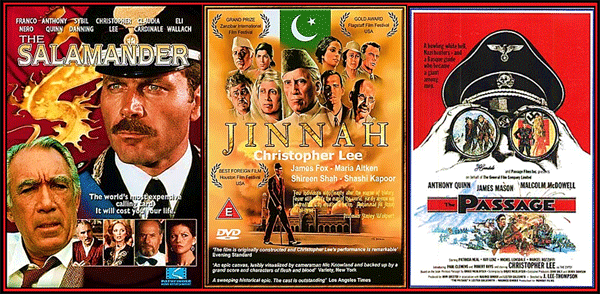 Fluent in a variety of languages, the English-born actor Lee was appointed a Commander of the British Empire (CBE) by Queen Elizabeth II (15-Jun-2001 Queen’s Birthday Honours) and Knight of the British Empire 2009. He is also a Commander Brother of the Order of St. John of Jerusalem. In 2002, Lee was awarded the prestigious World Award for Lifetime Achievement in Vienna, etc. Lee was also presented with the Academy Fellowship at the BAFTAs in February 2011.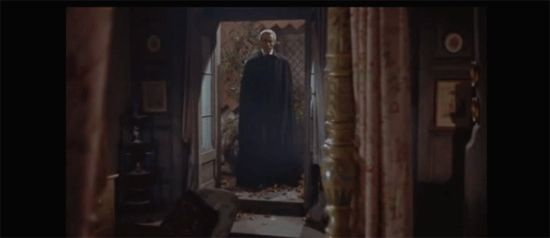
Lee as Count Dracula in Horror of Dracula
Sir Christopher launched his singing career in the 1990s, with an album of Broadway tunes. During his illustrious career, the veteran actor appeared in over 250 films, some of them the most iconic of our times. Watching the innumerable films of Christopher Lee in my collection was always joyful for me – especially those of 1950s to mid-70s.  Endings are usually sad and we will miss Sir Christopher Lee. Nevertheless, there always will be the comfort in knowing that I can sit with a couple of soft pillows and a glass of red wine and watch the legendary actor come alive through one of his movies, his deeply melodic basso voice booming.
FINIS
NB: The DVDs of the above movies and music albums of Sir Christopher Lee are available with main dealers such as amazon.com, TCM Shop, etc.
(©Joseph Sébastine/Manningtree Archive)
A Candle for a Special Person
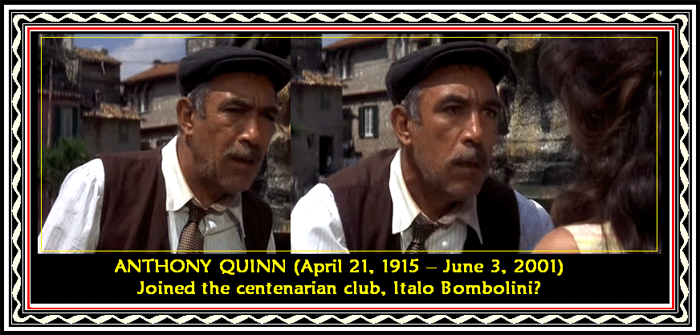
StarChoice 21: JEAN SIMMONS: Lovely – Radiant – Luminous

As Varinia in Spartacus
On January 31, 1929 a child was born in Crouch End, London. Her parents, physical education teacher Charles Simmons, and his wife, Winifred, named her Jean Merilyn Simmons. 
Black Narcissus
Later “discovered” from the Aida Foster School of Dancing in Golders Green in North London, she would become known to the world as Jean Simmons, the beautiful, radiant actress who made a name for herself especially through British and Hollywood movies working with some of the greatest talents in the film business. 
Black Narcissus
In a career that flourished more than 60 years, she would go on to receive numerous award nominations, and also win an Emmy Award (Outstanding Supporting Actress in a Miniseries or a Movie) for her role in the 1983 mini-series, The Thorn Birds. The British honoured her with an OBE (Officer of the Order of the British Empire) in 2003 for her services to acting.  Although I had seen David Lean’s film adaptation of Charles Dickens’ “Great Expectations” (1946), it was her role as the passionate Kanchi, the Indian servant girl in the Michael Powell and Emeric Pressburger film “Black Narcissus” (1947 – starring Deborah Kerr) that brought Simmons to my attention.
With Richard Burton in The Robe
Soon after, I saw her in The Robe (1953 – D: Henry Koster), the Biblical film she is most known for. Indeed, it was the potent mixture of Biblical events in addition to the presence of talents like Richard Burton and Victor Mature that impelled me to see this film adaptation of Lloyd Cassel Douglas’ (The Big Fisherman) Roman epic novel about the magic robe of Christ. 
With Richard Burton in The Robe
In that first CinemaScope movie, Jean Simmons, with her startlingly attractive dark looks and screen presence, performed well amidst a fine troupe of stars. She played the graceful Diana, a noble Roman with Christian beliefs, in love with Roman centurion Marcellus Gallio (Richard Burton) who wins the robe worn by Jesus in a dice game. 
With Carroll Baker in The Big Country
 Later, I saw her captivating beauty and talent in Laurence Olivier’s Hamlet (1948 – as Ophelia); in the screen version of George Bernard Shaw’s Androcles and the Lion (1952 – D: Gabriel Pascal); Angel Face (1952 – D: Otto Preminger); The Egyptian (1954 – D: Michael Curtiz); with Marlon Brando in Désirée (1954 – D: Henry Koster), in Guys and Dolls (1955 – D: Joseph L. Mankiewicz); The Big Country (1958 – D: William Wyler); Elmer Gantry (1960 – D: Richard Brooks); Spartacus (1960 – D: Stanley Kubrick); etc. Then there were many lost opportunities for her like the role of Princess Ann in Roman Holiday (1953) which director William Wyler wanted Simmons to play. But as fate had it, the role eventually went to Audrey Hepburn and earned Hepburn the Best Actress Academy Award for 1953. Simmons once summed up her career with a quote, “My career has had a lot of ups and downs, but basically it has been wonderful.”

With Kirk Douglas in Spartacus
Married to Stewart Granger (m. 1950–1960) and Richard Brooks (m. 1960–1977), the doe-eyed British beauty died on January 22, 2010, at her home in Santa Monica, Los Angeles County, California. 
Black Narcissus
 January 31 also marks the birthdays of several popular personalities: Tallulah Bankhead; Suzanne Pleshette; James Franciscus; Kelly Lynch; Portia de Rossi; Carol Channing; Mario Lanza; Derek Jarman; Daniela Bianchi; …. Austrian Composer Franz Schubert; Authors Zane Grey and Norman Mailer; etc. As Jean Paul Richter quotes, “Our birthdays are feathers in the broad wing of time.” Bye for now, Jo
  Notes:
a) The DVDs of this movies referred above are available with main dealers such as amazon.com, TCM Shop, etc.
b) This illustrated article is meant for the promotion of the movies mentioned above. Please refer to “About” for more details.

With Kirk Douglas in Spartacus
(© Joseph Sebastine/Manningtree Archive)
That Cyd! The Beautiful Dynamite *
 MARCH 8: Remembering American actress and dancer Cyd Charisse (1922 – 2008) of films: Ziegfeld Follies (1945); Singin’ in the Rain (1952); The Band Wagon (1953); It’s Always Fair Weather (1956); Meet Me in Las Vegas (1956); Silk Stockings (1957); Party Girl (1958); Something’s Got to Give (1962); The Silencers (1966), etc.
 Born on March 8, 1922, she was originally known as Tula Ellice Finklea, and later by the name “Lily Norwood” before she became popular as Cyd Charisse – the leggy fabulous dancer who brightened up the Hollywood musicals of the 1950s, notably opposite Fred Astaire and Gene Kelly. In her autobiography, “Debbie: My Life”, actress Debbie Reynolds quoted: “Cyd did everything perfectly. Her legs went over her head and into the sky.”
 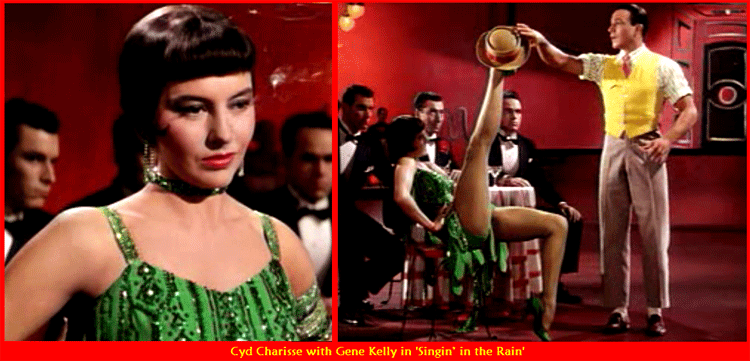 Cyd Charisse will be missed by many. She now reposes at the Hillside Memorial Park Cemetery in Culver City, Los Angeles County, California where actress Shelley Winters is also buried. One of the most beautiful talented dancers on film, Cyd will always be in our hearts.
 Cyd, You danced into our hearts. You will never be forgotten. Jo

Notes:
a) The DVDs and music albums of most of the movies referred in this post are available with main dealers such as amazon.com, TCM Shop, etc.
b) This illustrated article is meant for the promotion of the actors and movies referred therein. Please refer to “About” for more details.
c) * Referred as “beautiful dynamite” in “Steps in Time: An Autobiography” by Fred Astaire
(© Manningtree Archive)
StarChoice 20: KINGS OF THE SUN

(Aka: Könige der Sonne, Os Reis do Sol, Solens konger, Los reyes del sol, Auringon kuninkaat, Les rois du soleil, A Nap királyai, I re del sole, Królowie slonca, Günesin krallari, Könige der Sonne – and (Initial working title: The Mound Builders) – Color – 1963)

If there was one Hollywood actor who had the exotic mien, the boundless charm, the piercing eyes, masculine authority, and the range of acting talents which magnetized him to audiences – Yul Brynner (1920-1985) could well take that honour. Complex and unpredictable, he would always be the king.

Although there are different accounts about Brynner’s name, date and place of birth, bulk of the specifics indicate that he was either born Taidje Khan or Yuliy Borisovich Bryner to Boris Bryner and Marusya Blagovidova on the island of Sakhalin off the coast of Siberia or in Vladivostok, Russia where there is a memorial plaque marking it as his birthplace. I leave this at that.

 Consequent to a serious back injury in France which curtailed his 5-year career as a trapeze acrobat with the famed Cirque D’Hiver company, and subsequently, having received training in acting with Russian teacher Michael Chekhov (1891-1955), Brynner’s decision to pursue a film career for a living, led him to appear in the thriller “Port of New York” (1949).
 It was his appearance as the proud and supercilious King Mongkut of Siam in the Rodgers and Hammerstein musical movie “The King and I” (1956) which established his film career and won him an Oscar for Best Actor. The role also brought to him impeccable stage discipline from performing eight times a week on Broadway since 1951 to screaming, standing ovations.
Besides, it also earned him immense popularity by spawning “The Yul Brynner Look” when he shaved his head in 1951, a revolutionary look back then which I understand was suggested by Irene Sharaff (The King and I), one of the major costume designers of the period forming part of the “Couture on the Screen”. It was a bodily feature he would sport throughout his life although he made few performances wearing wigs, namely, “The Buccaneer”, “Solomon and Sheba”, “Villa Rides”, etc.

His status as a major star of Broadway could not salvage him from the adverse impact of his accent and looks for which he was at times “considered too exotic a type to play the lead in any important film”. However, after seeing Brynner’s dynamic Broadway performance in “The King and I”, Cecil B. DeMille (1881-1959) went on to cast him as Pharaoh Ramesses II in his last film “The Ten Commandments” (1956). DeMille was right. Brynner’s vaunting arrogance and baldness captured the essence of the Pharaoh’s personality. According to a quote attributed to DeMille, Brynner’s powerful personality is “…a cross between Douglas Fairbanks, Snr., Apollo, and a little bit of Hercules”.

Brynner’s meteoric rise continued through performances in: Anastasia (1956); The Brothers Karamazov (1958); The Journey (1959); The Sound and the Fury (1959); The Buccaneer (1959); Solomon and Sheba (1959); Surprise Package (1960); The Magnificent Seven (1960); Once More, With Feeling! (1960); until the scale started its downward trend….. “Testament of Orpheus” (1962); Escape from Zahrain (1962); Kings of the Sun (1963). By that time, he was not only a well-known superstar, a good still photographer, author, guitarist, and a Special Consultant to United Nations High Commissioner for Refugees, appointed in 1960. He was living fast and high. He drove a Mercedes-Benz 300SL Roadster and smoked many packs of black Sobranie cigarettes a day “just to appear macho”. “Yul Brynner was an unusual, interesting, and intelligent man. ………. He was an absolute self-invention”, wrote English film and stage actress Claire Bloom in her memoir “Leaving a Doll’s House”.

Even though Brynner’s initial work for the production company, The Mirisch Company, Inc., was “The Magnificent Seven”, he will reunite with Mirisch once again for “Kings of the Sun” directed by Bristol born Scottish director/screenwriter/playwright/former actor J. (John) Lee Thompson (1914-2002). Fresh from the huge box-office success of his “The Guns of Navarone” (1961), Lee Thompson was the finest film-maker to emerge from the British studio system after the Second World War. Having gone to Hollywood to direct “Cape Fear” (1962), he had decided to stay behind, turning down the offer to direct “The Longest Day” (1962) in England in spite that London was at that time considered to be an ideal and exciting place to make movies.

In its place, he accepted United Artists’ invitation to direct Harold Hecht’s epic production of “Taras Bulba” (1962) starring Yul Brynner, Tony Curtis and Christine Kaufmann. Finally raised to the platform of directors commanding highest remuneration and enjoying big budgets and box office success, United Artists was only pleased to offer him another epic production, “Kings of the Sun” concerning the Maya civilization in pre-Columbian Mexico. Similar to Lee Thompson’s “Woman in a Dressing Gown” (1957), “Tiger Bay” (1959), “Cape Fear”, “Taras Bulba”, etc, this story also explored how people respond to and can be shaped by their environment.

Produced by Lewis J. Rachmil under the banner of Mirisch Company for a budget of US$4 million and based on a story by Elliott Arnold, “Kings of the Sun”, which turns 50 this year, was released through United Artists (like all the other 67 productions of Mirisch) in December 1963, a year noted for many momentous events. It was the year the First flight of Boeing 727 jet took off; British Secretary of State for War John Profumo resigned over sex scandal; Cardinal Giovanni Battista Enrico Antonio Maria Montini was elected Pope Paul VI; Martin Luther King Jr. made his “I have a dream” speech at Lincoln Memorial; Valium hit the market; US President John F. Kennedy was assassinated in downtown Dallas, Texas….. That year, the movie-world saw the release of “Cleopatra”, “It’s a Mad, Mad, Mad, Mad World”, “The Birds”, “Charade”, “From Russia with Love”, “The Great Escape”, Mirisch Corporation’s “Irma la Douce”, etc, featuring some of the most distinctive and eloquent faces in Hollywood cinema. It was also a time when parents in our part of the world used to put their children to sleep at night with bedtime stories unlike contemporary times when the children come in at bedtime and tell stories that keep the parents awake all night.


Underlining Elliott Arnold’s story of “Kings of the Sun” was the exodus of the Mayas to a new land and the final abandon of the practice of human sacrifice. The film opens with a panoramic view of the great pyramid at Chichén Itzá (c), the large pre-Columbian city of the Mayans where rows of Mayans have assembled as their Chief, “Balam. The Jaguar. Eight times King”, and Balam, the Crown Prince, (d) with headdress of high plumes of the quetzal adoring their royal heads, were brought to the crest of the pyramid to perform an important religious ritual. Following the credits, a voice-over narration is heard:

“Long ago there lived a people unique in all history – the Mayans. Greece and Rome had become ancient legends in ancient books and the European civilizations had entered into the age of the barbarians. But in the tropical jungles of Central America, a civilization had burst into full flower without metals, without horses, without wheels. These incredible people built roads, pyramids, temples worthy of ancient Egypt; they charted the heavens, devised the highest system of mathematics than the Romans and created the calendar as accurate as the one we use today.
But despite the maturity of their art and their science, in the most important part of their lives, the worship of their gods, they remained primitive.

To their minds, their gods were demanding gods, fierce and greedy, granting nothing except for a price and that price was blood. In their profound desire to win favour from the deities, the Mayans made human sacrifice, the keystone of their religion. To die as a bearer of a message to the gods was the most exalted honour a man could experience. When he was selected to be sacrificed, in that moment he himself became a god. He was worshipped as a god, granted any wish that came into his heart, until the moment he was put to death.
For centuries in small scattered kingdoms these people lived in peace with themselves and their gods. But then came conquerors from the West, with metal swords which made them invisible against the wooden weapons of the Mayans. One by one, they swallowed up the little kingdom until the last, the final stronghold – Chichén Itzá was theirs. And their leader, Hunac Ceel, already as cool as any god now felt himself as powerful as one….”

Thus begins “Kings of the Sun” with ceremonies leading to the sacrifice of a youth to bring prosperity to the Maya land. But it was a time when the stars were moving in a chaotic manner. It was in that dry season, when men were free from agricultural tasks to fight in wars that Hunac Ceel, intent upon destroying Maya civilization, attacked them. As hordes of Ceel’s ferocious warriors (possibly Toltecs) swept the Mayan land from the north and rushed up the steps of the great pyramid, the leaders of Mayas had fled into its interior chambers, locking the huge door behind them. At the sound of a heavy cedar log ramming on the secured door, they went deeper into the inner chambers where, before the corpse of their King Balam, his son, crown prince Balam was chosen as the new king, “Balam, the Jaguar. Nine times King”.

Mindful of their meagre chance of survival with their obsidian bladed swords, the new king found common ground in the proposal of the elders (Al Haleb, Ah Min, Pitz, Ah Zok) to retreat with their tribe to a safe place by the coast – at the fishing Village of Polé. As they headed for the trap door of a tunnel at the ground level, high priest Ah Min carried the small stela from their temple.

At Polé, before Hunac Ceel and his armed warriors wielding hard metal swords could attack them, Balam had to swear before the local chieftain to marry his daughter Ixchel in the new land. This was necessitated in order to convince the villagers to lend him their long cedar log fishing boats and to accompany Balam and his people to flee from the coast to a faraway land (e) where Balam hoped to settle them down, raise a new civilization and find golden opportunities. However, they will not keep old losses a faded memory. They will grow stronger in the new land and then they will return.


Barely had they managed to row some boats loaded with people into the sea before the first of Hunac Ceel’s horde burst onto the beach, shouting and launching spears. In less than no time, Balam and his people had fled in their boats to a greater distance before Ceel could catch them although few of the fatalities from the spear they suffered included Ixchel’s father. As Ixchel, now Balam’s fiancée, sat hunched in deep grief for the voyage to the north in the Gulf of Mexico, Hunac Ceel shouted from the beach: “The sea is not big enough to keep us apart, Balam. Wherever you go, I will find you.”

All endings are followed by a new beginning. Although they have never sailed the boats out across the waters beyond the sight of land, at long last, maintaining close sailing without drifting apart and, despite an opposition from an elder, they finally landed at a seemingly uninhabited Gulf Coast. Balam’s attempt to fulfil his promise to the chieftain to marry Ixchel met her disapproval since his vow was made to her father, not to her. “If he (Balam) is lonely why does he not tell me himself?”, these unsaid words of Ixchel would only come later, to Ah Min who advised her to marry Balam.

Presently they built a settlement which included irrigation systems, an essential pyramid that dominated everything by its height and at its crest was raised an altar for rituals, most importantly, for human sacrifices – for the joining of men with the gods. In a while, their presence was discovered by the head of a hostile Native American tribe who went by the name Black Eagle. The discovery was not unusual for the local tribe. There had been intruders in this land before, and they have always driven them away.

During a confrontation with Balam, Black Eagle was wounded and captured by the Mayas. When Ixchel’s friend Ixzubin refused to tend to the brute’s wounds, Ixchel volunteered to take over to nurse him back to health. Although she was subjected to his aggressive attitude, the air started to clear when he saw Ixchel the whole blessed day and every day of the Week igniting an attraction for her. But the Mayas had another agenda for Black Eagle. The Maya soldiers preferred to capture rather than kill the enemy. The captive become the sacrifice. There has been no rain since their landing. Black Eagle, a native of this land, is the next ideal candidate for their sacrifice to the god of waters….
 “Kings of the Sun” was shot on location at Chichén Itzá (Yucatán), Mazatlán (Sinaloa) and at Estudios Churubusco Azteca, Mexico (f), one of the oldest and largest movie studios in Latin America.

The script has managed to provide a sweeping picture of the traditions, advancements and primitiveness of the Mayas while maintaining a modern sense of logic in the advancement of the story. Although the film deviates from historical accuracy, in a broader sense, it is likely that its structural foundation must have derived from the sacred books of the Maya of Yucatán “The Book of Chilam Balam” in which the villain Hunac Ceel, the head-chief of Mayapan, is a prominent character.

While research provides material, it’s no substitute for creativity. Unhappy with the initial script, independent producer Walter Mirisch, who had garnered a new breed of professionals outside the studio system, had eventually secured script doctor James R. Webb (How the West Was Won (1962)) to add more structure to it which apparently met with Mirisch’s approval.

The writers had also left the dialogues of the exiled Mayas and North American tribe of Black Eagle speak the same language without a hint of differentiation for the sake of convenience for the audience. Nevertheless, the characters and action showcasing forbidden love and mortal conflict of two great chiefs should have exploded off the script and exhibited a kind of raw energy on screen rather than be dull as it appeared in certain places and also failed to generate favourable reviews for the movie during the time of its release.

Until now, much of the history of the Maya remains something of a mystery. It is widely accepted that the classic period of Mayan civilization, which stretched from Chichén Itzá in the north to Copán in the south, falls between AD 300 and AD 900 when their architectural and artistic achievements were brilliant. During that period, they built several cities in the Yucatán region and their civilisations went on to thrive until internecine warfare weakened them and left them prey to invaders from the north which culminated in the collapse of Maya civilisation between AD 800 and 900.

The pyramid, a prominent feature in the film, was an integral part of the Maya architecture. Their basic idea was to raise the sanctuary of the gods higher from the ground although its position could be easily revealed to the enemies. From the account of foot soldier Bernal Diaz de Castillo (memoir: Historia verdadera de la conquista de la Nueva España) who accompanied the expedition of Spanish Conquistadors on their voyage to Mexico in 1518 (historians have criticized his account due to multiple inaccuracies and exaggeration) and other later findings, we could know of how blood sacrifice at the top of these pyramids was a standard feature of daily life. Though this primitive act of cultural vandalism has long since been abolished, innumerable humans, often fringe members of the society or prisoners or those kidnapped during raids, were provided with special headdress, and led up the steps of the pyramid. They were made to stretch over the sacrificial stone by four priests while the fifth priest cuts open the body with an Obsidian stone knife (g) and the heart is offered to the god. The golden rule for this was the religious belief concerning life after death. The terms “sacrifice” which derives from the Latin “sacer facere” means “to make sacred”. Considering the varieties of rituals for which the pyramids were used, its design had to meet certain specific requirements such as:

- There are one or two shrines at the top of the platform dedicated to the gods;
- Apart from the methods of alignment with the stars used in the giant edifice, it is appropriately tall (not too high) to allow the spectacle of the ritual, the sacrifice and the victim’s elevation to divine status, to be visible to a large audience watching from below;
- Internal chambers and corridors are required, which was made possible by the strength of their mortar;
- To make the stairway even steeper than it is, the banisters were made to diverge slightly towards the top of the stairs;
- For the initial phase of the sacrifice, the stairway must be broad and impressive to befit the parade of the victim up the steps into the sphere of divinity;
- To dispose the corpse in a spectacular manner, it must be steep enough to provide an uninterrupted passage to the ground when it was made to roll down from the top.
To avoid being haunted by the spectre of the bloody ritual, the movie portrays the sacrificial ceremony in an implied manner by limiting the camera movements merely focused on the elites in power, a squad of religious specialists and ministerial dignitaries on the crest and the audience assembled below, all the while trying to be as authentic as possible. For realistic ambiance, few of these scenes were reportedly shot on location at the pyramid of Kukulcan at Chichén Itzá (where the initial part of the story is based).

Even though director John Sturges of “The Magnificent Seven” was slated to direct “Kings of the Sun” (then titled “The Mound Builders”) soon after completion of “The Great Escape” (1963), he had backed down from the project and went on to direct “The Satan Bug” (1965), paving way for director J. Lee Thompson to take over (h).
Although Lee Thompson never gained the heights reached with “The Guns of Navarone”, he scored notable success in several genres. The personal touch of the director is visible in style and expressions throughout the movie. Scenes depicting the instances when Ixchel’s heart reached out for Black Eagle in spite that her feelings were hanging on to Balam, or the mental struggle of the young woman as well as that of the young king and his struggle for coexistence, are effectively handled by the director. Lee Thompson was a “tiny man who carried a large sketchpad, and refused to read the script……. He never read a scene until he had to shoot it, and approached each shot on a whim. And yet, the cumulative effect was astonishing”, Anthony Quinn quoted in his memoirs “One Man Tango” referring to the production of “The Guns of Navarone”.
“Kings of the Sun” features an impressive line of prominent technicians and actors, some of them, unhappily, now deceased.

The stunts are impressive, especially a high-fall jump by Ronnie Rondell Jr., into a thatched hut from a burning observation tower. Then there was the difficulty in staging scenes over the pyramid, the uneven and very short steps to be laboriously climbed to its crest.

Cast: As Chief Black Eagle, Yul Brynner tries to work his movie star persona, dominating the scenes by his magnetic presence and undeniable sexuality. His scantily clad muscular body, his bronzed skin, long braided pigtail for hair, his panther-like gait, his piercing gaze, proud mannerisms, projects the impression of a restrained wild animal attuned to nature. With lesser dialogues, Brynner enjoys more screen time to react to the scenes, which seems well considering a quote attributed to director John Sturges mentioned in actor Eli Wallach’s memoir, “The Good, the Bad and Me: In My Anecdotage”: “Movie acting is reacting. Silence is golden on the screen”. The depth of understanding displayed by Brynner in portraying Black Eagle, a chief trying to avoid a clash of native cultures, is admirable and begs for more attention. On the personal side, whenever he was free from displaying his machismo sexiness in front of camera, Brynner was mindful of himself, often engaged in taking behind the scene photos of the production.

American dancer of Greek descent George Chakiris’ debut in films was in director Clarence Brown’s “Song of Love” (1947) in which he was credited as George Kerris. Thirteen years later, it was his role as Bernardo in the musical movie “West Side Story” (1961) based on a plot borrowed from William Shakespeare’s “Romeo and Juliet” that brought him a Golden Globe and an Oscar for Best Actor in a Support Role (1962) and catapulted him to international stardom.

Chakiris plays Balam, the young and inexperienced king who refrains from raising his voice against the ritual of human sacrifice in order to avoid conflict with his own high priest but only to eventually realize that to abandon the practice and living in peace could be the best way to honour the gods. The appraisal of Rock Brynner in the biography of his father “Yul, The Man Who Would Be King” (Page 160) that Chakiris’ “physique and self-assurance suggested about as much threat to Yul Brynner as a plastic coffee spoon”, wouldn’t meet up with disagreement of some viewers given that Chakiris’ screen glory was at times unsuccessful to be a superior match to Brynner’s commanding presence in the film.

English Rose Shirley Anne Field (Shirley Broomfield), a British pin-up magazine model for the 1950s and former Miss London had co-starred with Brynner in “Once More, With Feeling!” (1960). Her big break in movies came with an appearance opposite Sir Laurence Oliver in director Tony Richardson’s “The Entertainer” (1960). For Field, who was once known as “the British Marilyn Monroe”, the 60s were the busiest decade. And then – she was young and still learning. Following a string of successful performances in British productions, her first performance in a leading role for an American production was in “The War Lover” (1962) co-starring Robert Wagner and Steve McQueen. Somewhere around this time, she missed out on being a James Bond girl but was contracted to play the leading female role in “Kings of the Sun”.

Field’s portrayal of Ixchel, open to more avenues for improvement, covered layers of conflict of emotions for being the love interest of the captured Black Eagle who chose her to be his bride, the final wish of the sacrificial victim. She was a woman thrust into the life of the young king, whose emotional tie to her was becoming too intense.

To Black Eagle, she was the most beautiful woman in the heavens who would come and heal his wounds. To her, despite the fact that he had the look of a savage, he seems to have the soul of a man.

Curiously enough, her quizzical expressions as well as her lack of chemistry with the two men apparently met with the approval of director Lee Thompson with whom she had worked earlier in his remake of “The Good Companions” (1957). However, according to my research, I would believe that the casting team made the right choice in choosing Field (and possibly George Chakiris as well) for her facial features to be consistent with the norm of the Maya civilization which considered an elongated head as a sign of beauty. (i)

A talented actor who had appeared in “Titanic” (1953), “La Strada” (1954), “Moby Dick” (1956), “The Brothers Karamazov”, etc, American actor Richard Basehart’s (1914-1984) range of characters includes the honest, the mentally disturbed and the villains even though none of these brought him the stardom.

Basehart’s role of High Priest Ah Min, the ahkin of Chichén Itzá, took an earlier exit when, vexed by Balam’s decision to spare Black Eagle from death, he self-sacrificed on the point of an Obsidian stone knife.

American character actor Brad Dexter, co-star of Brynner in “The Magnificent Seven” and “Taras Bulba”, played in the role of Ah Haleb, batab, the general. British leading man Barry (Herbert) Morse (1918–2008) who had a prolific acting career that spanned theatre, movies and television, appeared in the role of the little priest Ah Zok, after a long break from feature films since “No Trace” (1950).

Once a screenwriter for producer/director Roger Corman, thick-set American actor Leo “Vincent” Gordon (1922-2000), usually cast in tough-guy roles (“Conqueror” (1955), “The Man Who Knew Too Much” (1956)), stars as Hunac Ceel who has nothing much to do but to act tough.

Playboy’s 1968 Playmate of the Year Victoria Vettri (aka. Angela Dorian/Victoria Rathgeb) of “Chuka” (1967) and “Rosemary’s Baby” (1968), played Ixzubin, the friend of Ixchel.

Other members of cast: Armando Silvestre (Isatai), Rudy Solari (Pitz), Ford Rainey (Ixchel’s father, the Chieftain), Angel Di Steffano (Balam’s father), José Elías Moreno (The sacrifice), narrator James Coburn’s voice is uncredited.

The movie offers numerous panoramic shots of the real locations in richly textured hues of DeLuxe Colour and in Panavision. The Cinematography is by Joseph (Joe) MacDonald (1906-1968), the award-winning American cinematographer who was born in Mexico City where Estudios Churubusco Azteca, in which the interiors of this film were shot, is located. While the veteran cinematographer’s busy tracking and wide angle shots are particularly impressive, the use of available and smartly placed source light to picture an imprisoned Brynner in successive scenes are also noteworthy.

MacDonald is the talent behind the cinematography of “My Darling Clementine” (1946), “Panic in the Streets” (1950), “Viva Zapata” (1952), “How to Marry a Millionaire” (1953), “Broken Lance” (1954), etc, which enabled him to work with renowned directors such as John Ford, Henry Hathaway, Elia Kazan, Samuel Fuller, Edward Dmytryk, Nicholas Ray, Fred Zinnemann, etc. While “The Carpetbaggers” for which he handled the cameras will be released during the same year, his next project with Lee Thompson would be “Mackenna’s Gold” (1969).

Production designer Alfred Ybarra has tried to provide highest authenticity to the sets with historical forms and designs, a mystery he solved by going back into the past to find the answers.

Since Mayas reputedly built their pyramids throughout of stone, held together with a strong lime mortar, a similar procedure is shown when young Balam’s men construct the pyramid at the new land.

New York-born film editor William (H) Reynolds (1910-1997) is best known for works which includes “Red Skies of Montana” (1952), “Three Coins in the Fountains” (1954), “Bus Stop” (1956), “The Sound of Music” (1965) in which the role of Captain Von Trapp was initially considered for Yul Brynner, Sean Connery and Richard Burton (j).

Winner of Best Costume Design, Black-and-White (1963) for “What Ever Happened to Baby Jane?” and nominated for “Hush… Hush, Sweet Charlotte” (1964), American costume designer Norma Koch (Norma – 1898-1979) was working in Hollywood since 1945. While the costumes by Koch (with wardrobe by Eric Seelig) for Black Eagle are perfect for the role, those worn by some of the other characters (of many colours with strange designs) seem to be more imaginary. Few dresses of young King Balam and his adversary Hunac Cell are decorated with similar jade works which comes across as green coloured plastic.

On the other hand, the splendid quetzal-plume headdress of the “Feathered Serpent (Quetzacoatl) cult” priests, the dress for the sacrificial victims and of some supporting characters somewhat conforms to images in the Codex Dresdensis (a pre-Columbian Maya book of the eleventh or twelfth century of the Yucatán Maya in Chichén Itzá) and Codex Florentino (a 16th-century ethnographic research project in Mesoamerica by Franciscan friar Bernardino de Sahagún) and such other available data. There is also accuracy in the clothes of some peasant women attired in “kub”, a piece of decorated cloth with holes cut for the arms and head.

The make-up by Emile La Vigne (The Magnificent Seven) although adequate sometimes neglects to keep up with the continuity while the hairstyles of King Balam (“West Side Story” look) and Ixchel (in a dark wig) by Mary Babcock (Escape from the Planet of the Apes) appear rather fanciful and unauthentic hampers the mood of the period.

Robust and rhythmic, the original Music provided by American composer/conductor Elmer Bernstein (1922-2004) is appropriately dramatic and haunting. He is one of the most prolific of all film composers – a master of all genres who believed in the power of melody and the traditional orchestra to move us. The widespread acclaim Bernstein received for scores arranged for “The Man With the Golden Arm” (1955) was further heightened when his score for “The Ten Commandments” (1956) ruled supreme. Charlton Heston wrote of Bernstein in his autobiography, “In the Arena”: “The value of Elmer Bernstein’s score is almost impossible to measure. It’s absolutely perfect for the film, guiding and shaping the emotional weight of each scene with mature mastery…”.

Bernstein’s music also graced films such as “The Magnificent Seven” (1960), “To Kill a Mocking Bird” (1962), “The Great Escape” in 1963, the year he was elected as the Vice-President of the Academy of Motion Picture Arts and Sciences. The magnificent arousing music of “Kings of the Sun” speaks volumes of his ability to capture the film audiences who had already placed Bernstein in league with his older contemporaries such as Max Steiner, Franz Waxman, Miklós Rózsa, etc.

Rest of the technicians are: Thomas Shaw (Asst. Director), Joe La Bella (Properties), Larry Allen (Asst. Editor), Richard Carruth (Music Editor), Roscoe Cline (Special Effects), John Franco (Script Supervisor), Allen K. Wood (Production Supervisor), Nate H. Edwards (Production Manager), Robert E. Relyea (Unit Manager), Stalmaster-Lister Co. (Casting), etc..

The posters of the film were designed by New York-born Frank McCarthy (1924-2002) who had worked on iconic posters of innumerable movies: “The Ten Commandments”, “Taras Bulba”, “Hatari!”, “The Great escape”, “Rio Conchos”, “Von Ryan’s Express”, “Thunderball”, “Khartoum”, “Duel at Diablo”, “The Dirty Dozen”, “You Only Live Twice”, “Once Upon a Time in the West”, “Where Eagles Dare”, and “Dark of the Sun”…. His works of mastery of texture and form with an eye for detail comprising lighting, atmospheric effects and theme, depicted moments right in the middle of the action. “I paint to achieve visual impact”, wrote McCarthy in his Introduction to the book “Western Paintings of Frank C. McCarthy”.

There has been a constant upward trend in the renewed interest in some Hollywood movies of that bygone era. “Kings of the Sun” recently kindled up curiosity amongst the film circles following the public interest perked up by the Great 2012 Doomsday Scare from the ancient Maya calendar which equated December 21 of 2012 as the end of humanity. Even so, the consolidation of talents of J. Lee Thompson, Yul Brynner, stalwart supporting players and crew, as well as the general form and design of this action film certainly merit our curiosity. However, a better script would have proven a more satisfying thing to enhance its screen glory – something worth finding out. Now more so than ever. Until next time, Ciao, Jo.

Notes:
a) The DVD of this movie, as well as those referred/illustrated in this post, are available with main dealers such as amazon.com, TCM Shop, etc.
b) The music album, “Kings of the Sun” by Elmer Bernstein & The City of Prague Philharmonic Orchestra, re-recorded at Prague in November 2003 is available with major dealers.
c) Chichén Itzá is now an important archaeological site in Yucatán combining the building genius of the Mayas and the Toltecs. Its most remarkable feature being a four-sided Kukulkan pyramid (aka “El Castillo”), probably a representation of the Mayan civil calendar. It is a square-based pyramid, 180 feet by 78 feet high, with nine tiers. The large stairways of 91 steps on each side (total 364 steps plus one being the platform adding to a total of 365 days of the solar year) are guarded by great serpent heads. The temple measures about 20 by 15 feet and has a door on each side. It’s method of construction ensures that for hundreds of years , on each spring and autumn equinoxes, the position of the sun coincided with the pyramid and project a shadow of seven triangles of light, measuring about 34 meters long from top to bottom, on the balustrade of the northeast, providing a silhouette of Kukulcan, the feathered serpent, until the triangles of light touch the stone head of the serpent god in the ground where the stairs begin. This process on the side of the structure lasts nearly five hours and its fullness can be observed approximately for 45 minutes.
d) Although a common family name in Yucatán, Balam means Jaguar.
e) According to the map shown in the film, it could be the southeastern coast of what is now Texas, North America.
f) Having been married to French fashion house executive Doris Kleiner in Mexico City in 1960, Yul Brynner had a special affinity towards Mexico City where the interiors of this movie were shot.
g) Even without glass or optical instruments, Mayans achieved spectacular success in astronomy through crossed sticks in relation to fixed features on the horizon. Besides the calendar, they also worked out arithmetic and developed hieroglyphic writing. Then again, they didn’t have iron, ploughs or wheels or cattle, sheep, goats, pigs or horses. Obsidian, a glassy volcanic rock was used to make tools and knives for human sacrifice. Cacao beans were used as money in Maya society which had its counterfeit currency in the form of beans filled with sand.
h) Following the release of “Kings of the Sun” in 1963 there was news that J. Lee Thompson planned to film “The Shoes of the Fisherman”, the 1963 novel by the Australian author Morris West, casting Paul Scofield and Spencer Tracy. In his book on Lee Thompson, author Steve Chibnall attributes the source of this information to Lee Thompson’s quote in Kinematograph Weekly in mid-1963. Even though this project never materialized, that film was finally directed by Michael Anderson starring Anthony Quinn and Laurence Olivier and released in 1968.
i) Mayans strapped boards to the head of their infants in order to flatten the front part to produce a receding forehead. Squint eyes were also a feature considered beautiful.
j) I have refrained from including few scraps of trivia related to the production of this film littered in the Internet due to lack of available sources to verify its authenticity.
k) This illustrated article is meant for the promotion of this movie. The reviews of movies in Manningtree Archive is part of my project to promote my favourite movies from a bygone era. Please refer to “About” for more details.
l) A glance backward: This review is dedicated to the memory of President John F. Kennedy who lost his life fifty years ago.

(© Joseph Sebastine/Manningtree Archive)
StarChoice 19: Dark of the Sun
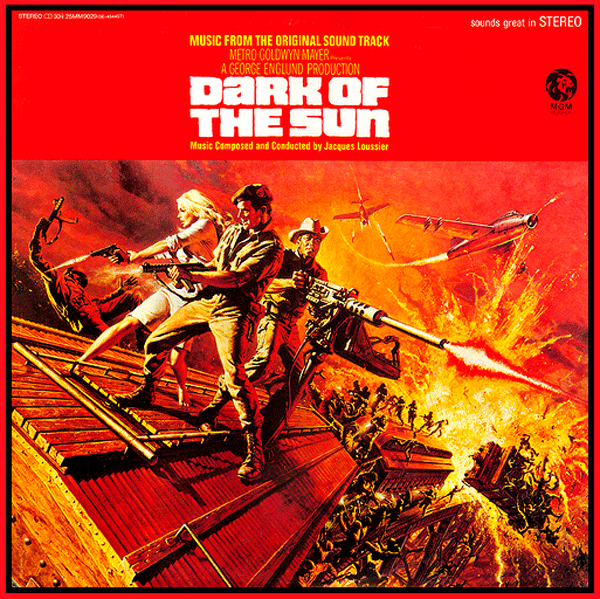
(Aka: The Mercenaries, Último tren a Katanga, Il buio oltre il sole, Le dernier train du Katanga, De Laatste Trein uit Katanga, Sista tåget från Katanga – Colour, 1967)
 On July 20, 1973, Chinese/American actor Bruce Lee died in the apartment of Taiwanese actress Betty Ting-Pei in Hong Kong. Six days later, Lee’s martial arts film “Enter the Dragon” directed by American producer/director Robert Clouse (1928-1997) was released in Hong Kong, and the world was swept by Bruce Lee craze. But three years earlier, Clouse directed a film, an adaptation of author John D. MacDonald’s novel of the same title “Darker than Amber” (1970) which was the only Travis McGee novel adapted to the silver screen then. I was one of the luckiest to have seen that cult film on big screen in Cochin, with most of the graphically violent (for its time) fight scenes between Travis and villain Terry (William Smith) intact although the DVD print I would own later suffered from missing moments which adhere to the reports that many cuts of that film exists. Most importantly, it was the film that introduced me to Australian actor Rod Taylor who portrayed the protagonist Travis McGee.
 During my days in Yemen in the 1990s, TNT (Turner Network Television) was a great source for me to enjoy some of the movies of Taylor such as “The Time Machine” (1960), “Seven Seas to Calais” (1962), “The Liquidator” (1965), “Trader Horn” (1973) and Telly Savalas starrer TV movie “Hellinger’s Law” (1981). Unbeknown to me at that time, our subsequent travels would enrich the Manningtree Archive with DVDs of Taylor’s movies, viz., ‘The Virgin Queen” (1955), “Raintree County” (1957), “Separate Tables” (1958), “Colossus and the Amazon Queen” (1960), “The Birds” (1963), “A Gathering of Eagles” (1963), and “The Glass Bottom Boat” (1966) besides “The Time Machine”, “Darker than Amber” and “Dark of the Sun”, a brutal tale of violence, greed, chicanery and lust amid the diamonds. I loved them all.

Produced by American producer/director George Englund and stylishly directed by Jack Cardiff, “Dark of the Sun” is adopted for the screen by Oscar-nominated Screenwriter Ranald MacDougal (1915-73 – for some reason credited as Quentin Werty) and Adrien Spies (1920-98) (with an uncredited materials by Cardiff) from the second published novel “The Dark of the Sun” (1965) by author Wilbur Smith, an established novelist popular in the reading circles.
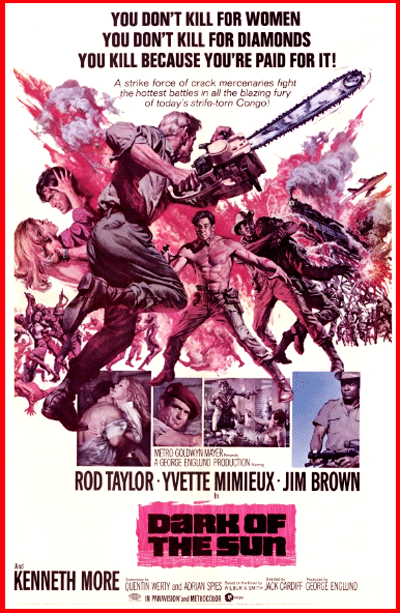
Wilbur “Addison” Smith, born on January 9, 1933 in North Rhodesia (now Zambia), was educated at Michaelhouse and Rhodes University. A full-time writer since 1964 after the publication of “When The Lion Feeds”, most of his meticulously researched novels, usually set in Africa, fall into three series: The Courtney, The Ballantyne and The Egyptian. Smith’s books are not literary masterpieces, but they offer interesting reading – an appropriate criteria for many of his books to occupy a good length of space in a bookshelf in our house.

1950s and 60s saw a lot of political intrigue and action in Africa when most African countries achieved independence. Like using a lucky rabbit foot to rub for bringing luck, the conflicts in Africa were expressly used as an appealing topical background in lieu of coup d’état of Central and South American countries of the sixties (Ecuador, Argentina, Guatemala, Honduras, Bolivia, Brazil, Panama, Peru…..) to create box-office Hollywood action films. Such films accentuated mercenaries as the adventurous heroes fighting against local black liberationists. This phenomenon would extend to the eighties when we are shown actors such as Richard Burton, Richard Harris and Roger Moore portraying roles of mercenaries in “The Wild Geese” (1978) and become good guys.
The fictionalized events depicted in the movie “Dark of the Sun” (DOTS) is set during the Congolese Civil War (1960-66), to say, precisely during the Simba Rebellion of 1964 while in the novel these events are set during the Baluba Rebellion of 1960.
Although as late as 1959 the Belgians were still asserting their intention to continue governing the Congo, by January 1960 this policy was changed due to international pressure and they conceded full political independence. Thus, on June 30, 1960, Belgian Congo became known as “République du Congo“. Shortly, hordes of Europeans fled the country as certain provinces engaged in secessionist struggles against the new government. Although this opened a way for Congolese to replace the European military and administrative officers, the country was unprepared and devoid of any Congolese university graduates with serious administrative experience. Besides, none of the political parties or movement was stable enough to organise and prepare itself for power.
When the newly-independent administration collapsed due to strains and owing that the administration’s leader Patrice Emery Lumumba was eventually kidnapped and murdered on January 17, 1961, years of chaos waited ahead. In this context, extensive violence of the gravest nature was reported during the Simba Rebellion fought by the rebel fighters who were mostly tribesmen from the provinces of Kivu and Orientale. Being the antagonists in “DOTS”, they were archetypally called Simbas (Swahili word for “lions”) for sporting the spirit of lions and entertaining faith in their immunity to bullets during battle.
Synopsis: “Dark of the Sun” opens with the arrival of a military aircraft carrying a hardboiled mercenary Captain Bruce Curry (Rod Taylor) and his partner Sergeant Ruffo (Jim Brown) at the main airport of the République démocratique du Congo where large crowds of people, having finished their departure formalities, were awaiting evacuation transport out of the country knotted in the Simba Rebellion.
Curry was brought in by the Congolese political heavy, the incumbent President Mwamini Ubi to undertake a dangerous mission to rescue a community of besieged Europeans (exactly 74 multinational persons) cut off for a month at an isolated diamond-mining town called Port Reprieve at the heart of the sub-Saharan Africa, before they are attacked by Simba rebels. A hard and very experienced man who knew that people like him were issued with their service contract only on their arrival, Curry is the right person to put together a force that is strong enough to journey through 300 miles of rebel territory and bring these people.
But according to Mr. Delage of the Belgium mining people, a collaborator of President Ubi and someone who remained inside the mainstream of palace power and politics, the mission is linked to the urgent need of Ubi to retrieve a cache of uncut diamonds worth fifty million dollars which is in the custody of Delage’s manager Superintendent Bussier in Port Reprieve. Normally it was in the vault of Banque Centrale in Port Reprieve where they kept the diamonds from all the mines in the northern part of the country.

The machinations of Delage involved a plot to finance the local government of Ubi to acquire much needed guns, planes and medical supplies, if only Curry could bring them the diamonds in exactly three days. Curry is also required to pick up a man and a woman of the mining company from half way up to Port Reprieve. Although the remuneration offered was 125,000 francs (according to the movie, about US$25,000/), President Ubi readily accepted Curry’s demand for US$50,000/- provided that Curry make the deadline.
In addition to Sgt Ruffo, a native of Congo, Curry enlisted the services of his alcoholic friend Dr. Wreid (Kenneth More) for the three-day mission bribing him with twelve bottles of Pinch (The Dimple Pinch) Finest Blended Scotch Whisky and US$100/- a day. At the 1st Battalion Quarters of L’armee Congolaise, he recruited Lieutenant Surrier who knows the country but Taylor had to grudgingly consent to include Nazi sympathiser Captain Henlein also due to his expertise in military affairs.
In addition to having secured necessary equipment, weapons and ammunition, five 50-calibre machine guns were strategically positioned on their mode of transport – a steam train no: 54 marked with “CHEMIN DE FER DU CONGO” on both sides of a rail-carriage. Spacing guard posts in the front, rear, middle and both sides, twenty of the best soldiers of the Striker Blue Force with combat experience were housed in each of the two flat cars with sandbags all around the edge.
After the mission was set into motion through the strife-torn UN-held territory, the initial physical assault to their moving train came in the form of a series of attacks by a fighter aircraft of United Nations peacekeeping Forces despite the fact that, on the strength that the train is on a mission of mercy, Curry carried a pass from the UN Headquarters to let his train go unmolested to Port Reprieve and back.
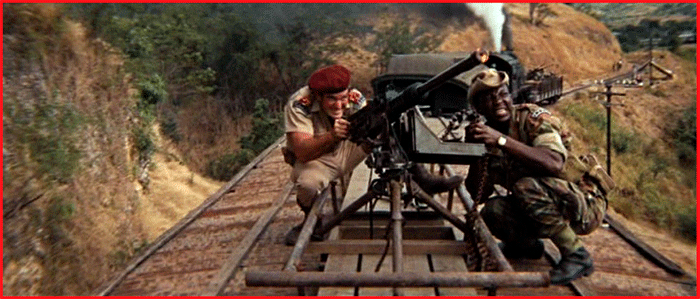
After overcoming the aerial attack with the train’s engine intact, the mercenaries could only secure the rescue of Claire (Yvette Mimieux) from the premises of the sugarcane plantation, since her husband was murdered by the Simbas and the mutilated remains of the members of their staff littered all over their burning property. Flustered by the brutality of the Simbas’ attack that resulted in the tragedy, Curry was at the receiving end of Claire’s blame for being late in rescuing them.
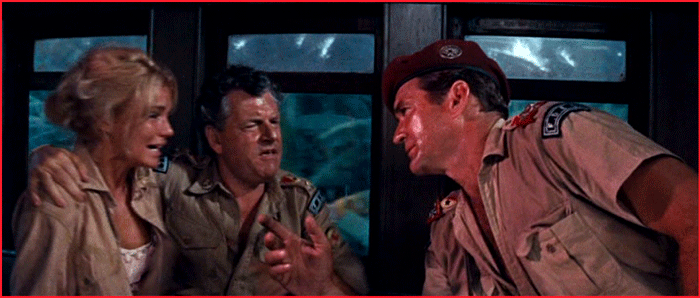
For now, Henlein started to brew up trouble at Masapa Junction by killing two native children as he suspected them to be rebel spies. Later, when Curry interrupted Henlein’s romantic advances towards beautiful Claire, he was forced into a vicious duel with Henlein that would fortunately end short of extreme disaster only by the timely interruption of Ruffo. The life of Curry was gradually turning into a living nightmare – even before General Moses and his vicious rebels who infested Congo turned up on screen ……..

Jack Cardiff (1914-2009) had worked in Congo earlier during the making of “The African Queen” (1951) when the unit had suffered from the heat, insects and disease. But to overcome the problems of political and logistical nature in filming “DOTS” on location in the Congo which in fact Cardiff had personally scouted, the movie was finally filmed in Jamaica (though the end credits stipulate “Made on location”) with interiors at Metro-Goldwyn-Mayer British Studios Ltd, Borehamwood in England. Jamaica not only offered a suitable landscape but also the essential steam train for the mercenary expedition which forms a vital part of the story. But then, director Jack Cardiff always had a penchant for seeking far off locations for his films.

 Cardiff (nicknamed “Jack O’Lantern” for his mastery in “lighting”) had established a much deserved reputation as a superb colour cinematographer before he became known as a director of routine films, even then he undertook cinematographic assignments for movies. One of the first to use the Technicolor film camera, he became one of the photographers of actress Marilyn Monroe counted on to make her look beautiful.
Cardiff’s artistry has put in a great deal of splendid colour photography to many movies including Michael Powell/Emeric Pressburger’s “The Red Shoes” (1948), John Huston’s “The African Queen”, Joseph L. Mankiewicz’s “Barefoot Contessa” (1954), Richard Fleischer’s “The Vikings” (1958), etc. He won a Golden Globe and an Academy Award for Best Cinematography (Colour) for the visually breath-taking “Black Narcissus” (1947 – Dir: Michael Powell/Emeric Pressburger) the lighting and colour palette of which was inspired by the works of Dutch painter Johannes Vermeer (1632-1675) while it is widely known that the spectacular Himalayan scenery you see in the movie was flawlessly created with matte paintings and filmed at Pinewood Studios. His memoir “Magic Hour: A Life in Movies” provides a record of how colour cinematography was developed in Britain. Cardiff would later work behind the camera for “The Dogs of War” (1980), another mercenary movie that is set in the fictional African country of Zangara.

Fascinated by Cardiff’s imaginative and picturesque colour photography on Errol Flynn starrer “Master of Ballantrae” and also “Crossed Swords” (Il Maestro di Don Giovanni) which included beautiful colour photography of the exteriors filmed in the picturesque hilly village of Lauro in the province of Avellino, Campania, Italy, Flynn made Cardiff the director and Supervisor of Photography of “William Tell” (1953), a co-production by Flynn and his colleague Barry Mahon in conjunction with Italian producers which, if released, would have beaten “The Robe” (1953) to become the first feature film to be released in CinemaScope. However, the project was eventually abandoned due to contractual default by backers after completion of about 30 minutes of edited Pathé colour footage. Following the release of “Intent to Kill” (1958), his directorial debut, Cardiff helmed direction of two more films before directing D.H Lawrence’s “Sons and Lovers” (1960) which earned him an Academy Award nomination as Best Director and a Golden Globe.
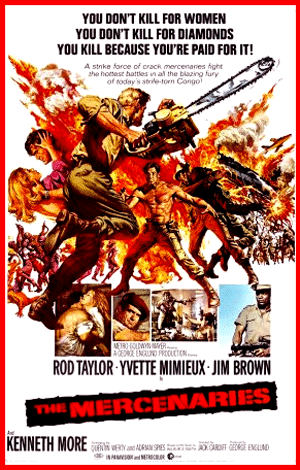
Released in the UK as “The Mercenaries”, “DOTS” conjured up a lot of criticism during its original release for its graphic scenes of violence although Cardiff later opinionated that, in accordance with his research, the violence shown in the movie is already toned down by him in comparison to the actual violence that happened during the period. Although such violence seems almost restrained alongside today’s movies and despite the fact that the violence and tumult of this movie allows the viewer to contemplate on the imperfections of colonial rule and atrocities of the Simbas for self-government, Cardiff has effectively handled the script which offers flashes of poignant moments of friendship, affection and compassion.

“DOTS” benefits from an excellent cast, led by Rod (Rodney Sturt) Taylor. Born in Sydney, Australia in 1930, Taylor came to United States in 1954. Upon earning a contract with MGM, his first leading role was in director George Pal’s “The Time Machine” (1960) when he met his co-star Yvette Mimieux. Taylor’s initial meeting with Cardiff was unexpected – occasioned when director John Ford fell ill and was substituted by Cardiff to direct “Young Cassidy” (1965), in which Taylor played the title role of the Irish playwright Seán O’Casey (1880-1964) – a role that was originally offered to Sean Connery. Having become good friends, the same year they re-united in Cardiff’s James Bond-spinoff “The Liquidator” for which Taylor received top billing above co-stars Trevor Howard and Jill St. John. “DOTS” would be their final film together.
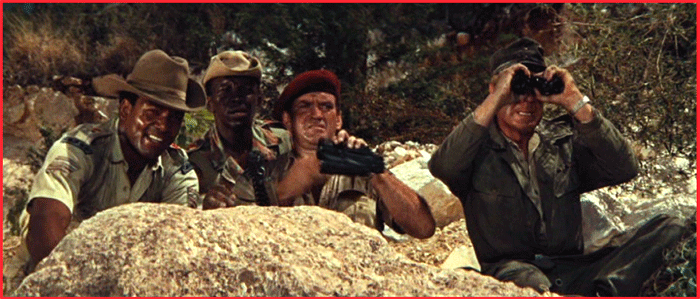
Tough, hardened men, physically fit, mercenaries joined up for challenging assignments for a variety of personal and political motives. Taylor’s Capt. Bruce Curry is an intriguing personality – a veteran mercenary with the right background and temperament and clear motivations that flourished in a democratised version of a soldier of fortune.
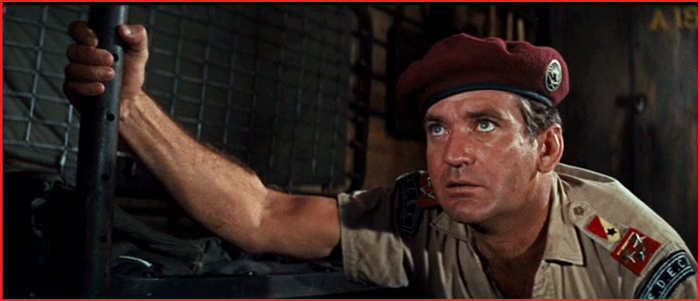
Some has opinionated that the character of Curry is based on Indian born Thomas Michael (Mad Mike) Hoare, a mercenary “Major” with expertise in African military activities, especially his involvement in leading two separate mercenary groups during the Congo Crisis, in which one of his groups were to fight in the Simba Rebellion.

Anyhow, Curry is someone who still retained traditional values. Although he embodied duty, determination, restraint and responsibility, Curry’s ultimate aim is money and that clearly reflects in the film. The real purpose of Curry’s assignment was to retrieve the diamonds. Without the existence of diamonds, President Ubi’s intention to send the mission to rescue the refugees would not have become a possibility.
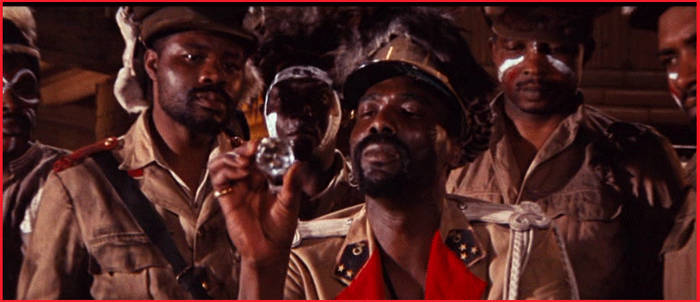
Although the film does not touch upon the final delivery of the diamonds to Ubi, we can safely assume that the diamonds were finally handed over to Ubi to empower his government with essentials. However, the ending of the film, reportedly devised by Taylor himself, earned disappointment of some critics for the opinion that, even though Curry honours his friendship to Rufus by turning himself in to Corporal Kataki for court-martial, such an act was not called for since he was only part of a proxy army, hired to be brave and brutal, and authorised to “do whatever is necessary” for the success of the mission.

Having been an amateur boxing champion prior to his venture into acting presented Taylor with the vigour and physicality to do his own action scenes in some of his nerve wrecking action films. When “DOTS” was filmed, Taylor, with natural hand-eye coordination, was in excellent shape for the terrific action scenes of the rugged, hard-boiled Curry which he did all by himself with exemplary flair, earning rave reviews from his fans as a role tailor-made for him. In fact, the audience loved Taylor for being capable to portray roles which demanded virility and dynamism while, at the same time, loaded with enough feminine sensitivity to touch the heartstrings of women. This was the potent mixture that soared Taylor’s popularity in the 1960s.
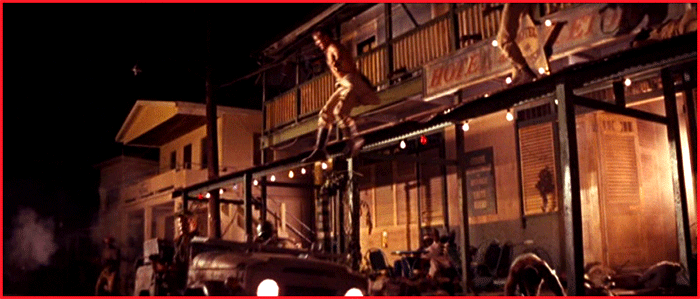
The thrilling action sequences showing Curry charging his Land Cruiser through the sun-baked terrain of the rocky mountain and river could be used as the ultimate footage for an ad of a four-wheel drive. It was reported that during his jump from a building into a jeep, he sprained his foot. Similar incidents occurred in another three occasions.

You see the dynamo Rod Taylor right there in the middle of the action, as guns blared from different firing locations, bullets whistling over the heads, grenades exploded. No wonder the movie is considered as one of Taylor’s best. This is justifiable since the American film exhibitors industry bestowed him with a Golden Laurel award as one of the top action stars of 1968 for his performance in this old-fashioned entertainment.
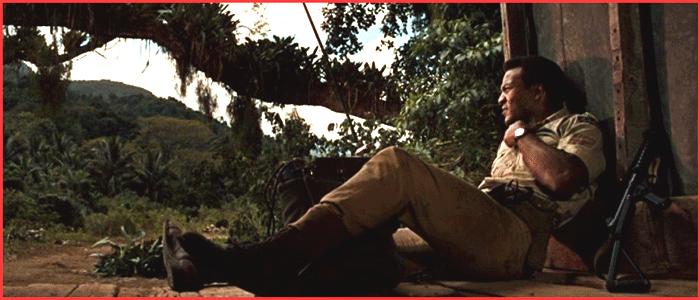
The six-foot four, solidly built Jim Brown (born in 1936 in Georgia) stars as the dignified and hard-bitten mercenary Sgt. Ruffo. The macho counterpart of Curry and one of the positive assets of this film, Ruffo is a Congolese patriot who was educated in America as an exchange student and spoke four languages. Ruffo had uncompromising noble principles – his mind channelled on a bordered road to his goal, focused on the best traditions.
The script has taken liberties to use the interactions between Curry and Ruffo to touch upon the cultural issues and also, flash some light on the priorities and patriotism in the world of the mercenary soldier. It has also traced some of the little-known and sinister corners of activities in the Congo of the period – such as diamond mining, and the secret world of arms dealing. In one sequence, Ruffo tells Curry that he had come out of the trees by invitation and he will kill anybody who tries to send him back up again. There was a certain finality to the way he said it.

Yet, in another sequence, Ruffo relates to Curry about his tribe’s primitive belief that if you eat the heart and brain of your enemy, his strength and wisdom will be added to your own. In a faultless diagnosis, Ruffo observes that such primitive savage tribal beliefs based on ignorance are no different than Henlein’s primitive savage tribal beliefs.

Brown was the major football player of Cleveland Browns’ from 1957 through 1965 before he switched his attention to acting as his choice of profession. He debuted in “Rio Conchos” (1964) which was followed by “The Dirty Dozen” (1967) in which he displayed his own brand of courage.
Back in the 1960s, Sidney Poitier was, as a reviewer once wrote, “the white establishments very own favourite black superstar”. He was liked and respected and though non-sexual, as a star he had “more charm and genuine acting talent than almost any of his contemporaries, black, white or polka dot…” In contrast, Brown reeked of testosterone. Well-built with imposing physical features, and moving with the undulating grace of a big panther, the sheer splendour of his physical presence filled the screen. The interracial love scene in “100 Rifles” (1969) featuring Brown in bed with Raquel Welch is considered momentous in cinematic history. However, at times, his imposing appearance and charisma conjured up negative skirmish in others. In his memoir “More of Less”, supporting actor Kenneth More CBE (1914-1982) mentioned about the friction between Jim Brown and Rod Taylor during filming “DOTS” which at times showed signs of settlement with fists.

German character actor Peter Carsten (aka. Ginter Ransenthaler, 1928-2012, -“The Quiller Memorandum” (1966), “Zeppelin” (1971)) was at his evil best as Henlein – a hardened career soldier who walked around with devil in his eyes and heart, a Swastika clipped to the front of his shirt. From the initial sequence itself the idea is to convey the impression that Henlein’s arrogant, confrontational muscularity always worked harder to attain hegemony. He is also a man of repressed desires, transgressive pleasures that the circumstances of his place of existence denied.
While Henlein’s sadistic villainy is projected through many sequences: the cold-blooded shooting of the two native children; his vicious fight with Curry wielding a nasty-looking whizzing chainsaw which culminates in Curry forcing his head on the rail-track before the approaching train; and the final duel – all of which are further heightened by his sympathy towards Nazis.
At length, Carsten’s acting (his vocals are partially dubbed by American voice actor Paul Frees (1920-1986)), has conveyed the appropriate menace to his rabble-rouser scenes that would generate necessary revulsion towards Henlein in popular imagination and guide audience’s expectation for his comeuppance which would eventually come in a frighteningly realistic eye-for-an-eye revenge fight.
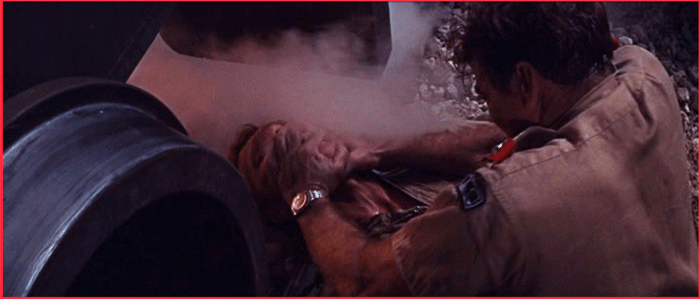
Kenneth “Gilbert” More (1914-1982) portrays the role of the drunkard medic Dr. Wried in perfect abandon. When Dr. Wried decided to be part of Curry’s mission, he knew that for the next three days or maybe longer there would not be any time for comfort and security other than some time for his bottles until, he chanced upon the opportunity for redemption – to finally sacrifice himself for his chosen profession. “DOTS” apparently offered him just the type of role that More wanted to play during a time his career was slipping, pushing him to become a major TV star with “The Forsyte Saga”.
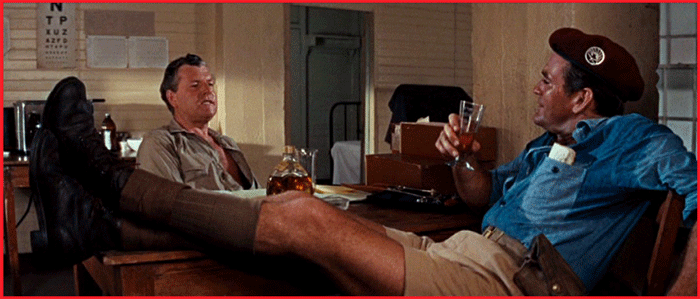
Pushing fifty during the filming of “DOTS”, More was going through a bad patch in his marital life. In 1968, he left his second wife Mabel Edith Barkby for English actress Angela Douglas, whom he had met in 1962 on the set of “Some People” and married her in March, 1968.
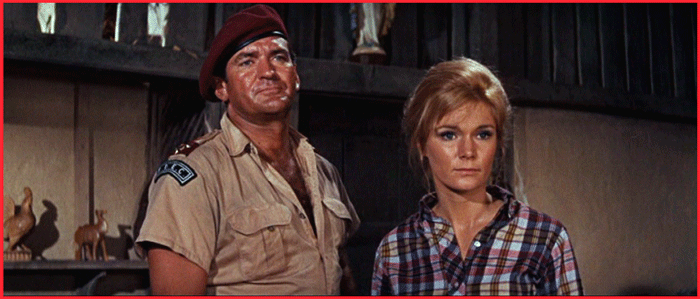
Strikingly beautiful American leading lady Yvette Mimieux’s Claire was a character both admired and derided, desired and vilified. The sole survivor of the massacre at the sugar plantation, Claire, with her thick, sun-gilded blonde hair, her trim figure attired in cotton shirt and tight trousers, lacks much prominence in the movie other than to indulge in some translation work and also to make romantic astrological stars look favourable to Curry, yet, more than ever, the film has used Henlein’s fascination for her as an object of desire to emphasise the decadence of his character.

The 5’4” petite blonde Yvette “Carmen” Mimieux started appearing in movies almost straight from the college, debuting with “The Time Machine“. Her further appearances are in “The Light in the Piazza” (1962), “The Neptune Factor” (1973) and “The Black Hole” (1979), etc.

It’s an unwritten fact that in every woman there is beauty – in all of them – one way or the other. For some, it’s so obvious – for others, you have to look for it. But it is there for the discerning eye to see. When I think of starriest screen queens such as Mae West, Katharine Hepburn, Doris Day, Marilyn Monroe, Barbara Stanwyck, Rita Hayworth, Sophia Loren, and Gina Lollobrigida, I note that Mimieux had a wholesome sexuality that made her clean-cut as Sandra Dee though as sensuous as Brigitte Bardot. Something smoulders and sizzles in her and there, in her blue eyes were a trace of pensive sadness – and emotions begin to grow.
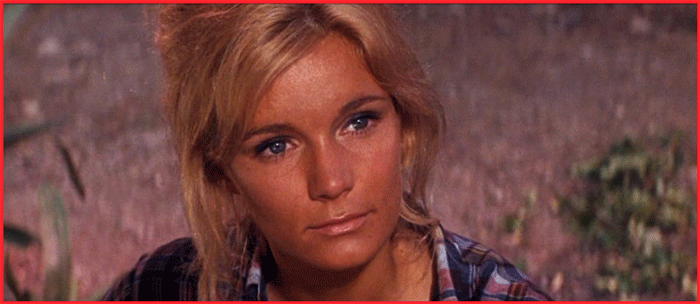
In fact, Mimieux was once hailed by the media as America’s answer to Brigitte Bardot. A quote attributed to director George Pal once described the curvaceous Mimieux, winner of many beauty-awards, as “a cross between a fairy princess and Brigitte Bardot”. Ever conscious of her figure, the movie’s Press Book states that when she was not before the camera filming “DOTS”, to maintain her trim figure, Mimieux spent her free time scuba-diving and skimming the surf of the Caribbean.
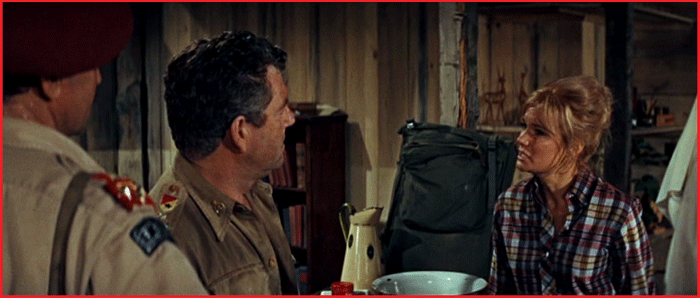
Mimieux’s contribution into music is an LP by The Connoisseur Society titled “Flowers of Evil. Charles Baudelaire” (1968) in which she collaborated with the Indian music maestro Ustad Ali Akbar Khan (1922-2009).
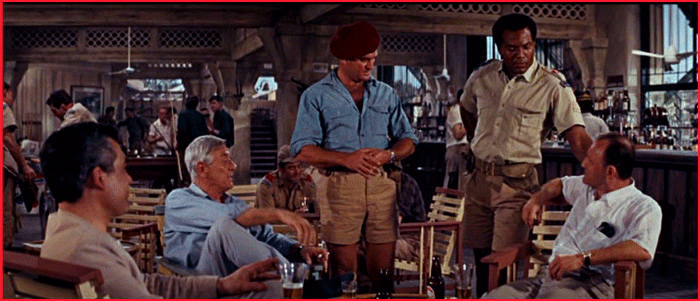
The other supporting actors are British character actor Andre Morell (Bussier, the keeper of diamonds), French newcomer Olivier Despax (young Belgian Lieutenant Surrier), Guy Deghy (Delage), Bloke Modisane (Corporal Kataki), West Indian leading man Calvin Lockhart (President Ubi), Alan Gifford (Jansen of Life Magazine), David Bauer (Adams of International News), Murray Kash (Cochrane), John Serret (Father Dominic), Danny Daniels (ruthless Sambas leader General Moses), Monique Lucas (Madame Bussier), Louise Bennett (Mrs. Ubi), Paul Jantzen (Captain Hansen), etc.

Filmed in Panavision in beautiful Metrocolor by British cinematographer Edward “Ted” Scaife (“Khartoum”, “The Dirty Dozen”) (with uncredited camerawork by Jack Cardiff), the film is graced with the enthralling and haunting music score composed and conducted by French pianist and composer Jacques Loussier – a cut above the usual and a strong element of the film. Starting with Spanish film “The Happy Sixties” (1963 – Los felices sesenta), Loussier has composed scores for nearly seventy films which includes “Monique” (1970), TV series “Thierry la Fronde” (1963-66), etc. A licensed pilot, Loussier is also reputed for his jazz improvisation of many of Johann Sebastian Bach’s compositions.

While the costumes, props and pyrotechnics conform to the period, the make-up at times lacks the continuity. The film also suffers from continuity: In the beginning of the movie, you are shown the military aircraft about to touch the airstrip while in the subsequent scene, we see the expatriates looking up at the sky to the sound of the approaching aircraft.
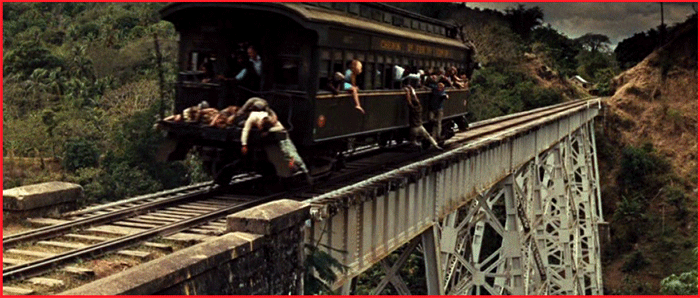
In another sequence, we see a passenger fall off the train while in the next scene the same man fell again through the window into the depth below. Other main members of the crew consists of: Ernest Walter (Film Editor – “Adventures of Quentin Durward”), Elliot Scott (Art Director), Cliff Richardson (Special Effects), Douglas Twiddy (Production Manager), Alan McCabe (Camera Operator), etc.
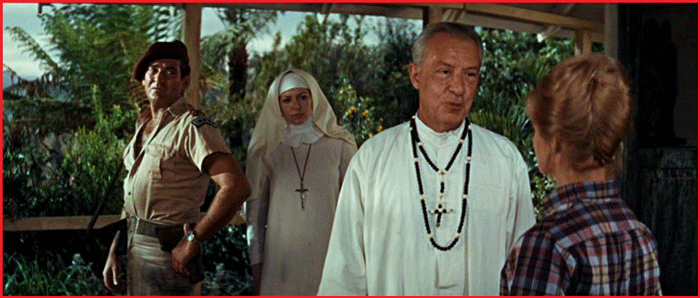
Right now, the internet is strife with estimations of scenes of love, hardcore violence and gore allegedly missing in the released versions of “DOTS”. These estimations somewhat conforms to the established length of the movie. Besides, certain abrupt transitions in scenes can be noted during the violent scenes at Port Reprieve.
Pictures of Curry and Claire embracing and kissing depicted in the art of promotional Posters and the movie’s Press Book are certainly missing in the DVD of a 2011 Spanish release with a duration of approximately 101 minutes which I have in my collection. But I cannot vouch for my vague remembrance of such scenes in the version I had seen on the TNT Chanel in Yemen some eighteen years ago. I would believe that it would no doubt merit restoration of any missing scenes to the movie’s entirety.
In spite of the above aspects, which not at all dampen an engaging cinematic experience, the conflict between the wills of a tough but dedicated Curry, villainous Henlein and the savage hordes of Simbas of the movie ensure that “Dark of the Sun”, packed with an effective and suspenseful script, appropriate locations, good acting, topped by uncompromising action and hardened violence, befits an entertainment of the rough category. Go one better. Watch it with a stiff drink.
a) As the end credits states, this film is “Suggested For Matured Audiences”.
b) The DVD of this movie is available with main dealers such as amazon.com, TCM Shop, etc.
c) Read the novel “The Dark of the Sun” by Wilbur A Smith.
d) Original soundtrack album “Dark of the Sun” is available with main dealers.
e) This illustrated article is meant for the promotion of this movie. Please refer to “About” for more details.
f) A glance backward: This review is dedicated to the memory of Jack Cardiff, OBE, finest of the British colour cinematographers.
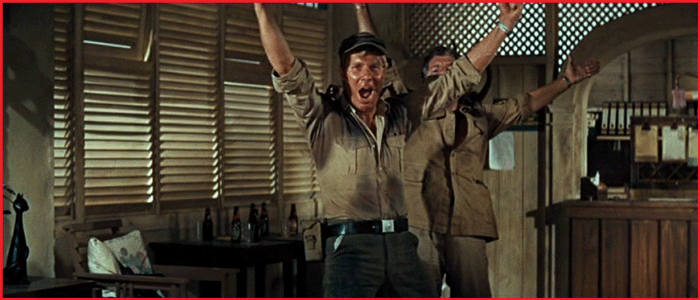
(Text: © JS/Manningtree Archive)
 Manningtree Archive
You must be logged in to post a comment.