Archives

M as in Michelangelo

Continuation of: The Florentine Mystique

Memory is the guardian of all things – Cicero

A lifetime of passion for art had intensely taken root in Michelangelo (Michelagniolo, March 6, 1475 – February 18, 1564) since he entered the sculpture garden of Lorenzo de’ Medici (Lorenzo di Piero de’ Medici, January 1, 1449 – April 8, 1492). Noting his talents, Lorenzo saw in the teenager a promising student of sculpture who would one day bring honour to Firenze.

Born to Ludovico di Leonardo Buonarotti Simoni and his wife Francesca at Castello di Caprese, Michelangelo’s desire for art had grown in him long before 1488 when he was nurtured among the stone quarries of Settignano in the care of a stonemason and his wife. Undoubtedly, his allure for art had kept on its steadfast progress during his apprenticeship as a painter with Domenico Ghirlandaio (1449-1494) who had returned from Rome only few years ago after painting in the Sistine Chapel between 1482 and 1484 for Pope Sixtus IV (Francesco della Rovere, 1414-1484, pope from 1471).

Young Michelangelo’s first two marble works, Madonna (Madonna della Scala) and the Battle of the Centaurs, were executed during his formative years under Bertoldo di Giovanni (ca. 1420-1491), Donatello’s pupil and keeper of the statues and sculpture in the Medici gardens of San Marco.

It was here Il Magnifico Lorenzo maintained many fine art treasures he collected for the good school of Painters and Sculptors he founded – similar to the “Accademia Leonardi Vinci”, the school of arts (1) connected with Leonardo da Vinci (1452–1519) established during his Milanese stay from 1482 until the fall of Duke Lodovico (Il Moro) Sforza (1451-1508) in 1499.

What a marvellous idea to spread all those priceless collections of antiques out where Michelangelo could look around with child-like wonder and delight. It was here that his fellow-pupil young Pietro Torrigiano (ca. 1472-1522/8), moved by envy or driven by pride, broke Michelangelo’s nose and was obliged to flee from Firenze having earned the hatred of the Florentines (2). 

Taken into Lorenzo’s household, Michelangelo enjoyed the privilege of a room, a place at Lorenzo’s dining table with his sons and swathed in the opportunities to absorb culture from the Medicean circle until Lorenzo’s untimely death at his country Villa at Careggi in April, 1492 – which almost brought to an end the true golden age of the Italian Renaissance.
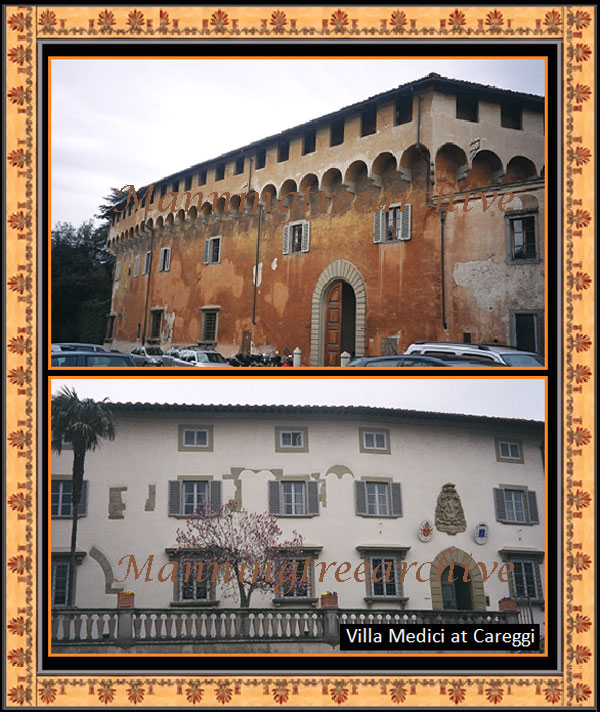
Sometime after Michelangelo’s return to his father’s house following the death of Lorenzo, a problem become apparent after Piero de’ Medici (1471-1503), the eldest son of the deceased Lorenzo, took over leadership of the Signoria. Young, haughty, chivalrous, and rather despotic in his views, interest in the affairs of the State which even in an abbreviated form seldom came out of Piero. Successively, for reasons attributed to the political developments, in 1494, the Medici was expelled from Firenze – declaring them traitors and rebels. The efforts of the Medici to regain their power in Firenze would succeed only in 1512 when Giuliano de’ Lorenzi de’ Medici (Giuliano II, 1478-1516) was brought in from Venice to head the Signoria, but shortly thereafter, Firenze would turn into a papal dependency.

Unable to remain neutral in the above developments, Michelangelo left Firenze and stayed at Bologna, after a brief stint at Venice. Upon his return to Firenze in 1495 when the political climate has improved, he was among those who were consulted vis-à-vis the Sala del Maggior Consiglio of Palazzo della Signoria which Girolamo Savonarola (1452-98) proposed to enlarge to accommodate the new government of the people following the expulsion of Piero de’ Medici from Firenze.

A marble Sleeping Cupid Michelangelo fashioned during this time was eventually sold to Cardinal Raffaele Riario of San Giorgio which paved the way for him to proceed to Rome in June, 1496. In there, following the creation of the life-size drunken Bacchus, on August 26, 1498, he earned the commission to execute a Pietà for Cardinal Jean Bilhères de Lagraulas (Cardinal di San Dionigi), the French ambassador at Rome who desired a suitable monument for himself in Rome by the hand of the famous Michelangelo.  

This classic work in marble, when finished was placed in the circular chapel dedicated to Santa Maria della Febbre (Our Lady of the Fever) of the old Basilica di San Pietro (3) which was at that time still standing.

The future spacious Piazza San Pietro surrounded by vast semi-circular colonnades which the Baroque master Gian Lorenzo Bernini (1598-1680), the greatest sculptor since Michelangelo, designed in front of the Basilica (1656-1667) was then covered with a cluster of small constructions and pathways. La Pietà,as the Italians call the group,earned Michelangelo great fame and fortified his reputation as “Il Divinio” (The Divine One) among the artists of his lifetime.

With the completion of La Pietà (1498-1499), the world had witnessed the creation of two classic masterpieces within the span of a few years – the other being The Last Supper (Cenacolo), the marvellous wall-painting Leonardo da Vinci probably begun in c. 1495 on the refectory wall of Santa Maria delle Grazie, the monastery of Dominican friars in Milan and finished in 1498.

At the age of twenty-six, Michelangelo returned to Firenze where he would be a resident till 1504. By then, many changes had taken place in Firenze – it was now devoid of the divinely ordained preaching of Girolamo Savonarola who had eventually faced excommunication followed by implementation of his death sentence when he was hanged and burned on May 23, 1498 – bringing to an end the story of medieval Firenze.

Michelangelo was now ready to take on the offer of the powerful Consuls of the Arte della Lana, the Operai of the Cattedrale di Santa Maria del Fiore of Firenze. They proposed to him to fashion, complete and finish to perfection a colossal male statue out of a huge block of marble conveyed from Carrara to Firenze many years ago.

The Arte della Lana who owned this block of marble had once offered it in vain to Donatello, the favoured architect of the Medici.  Afterwards, a certain Maestro Simone da Fiesole had commenced work of a huge figure on it but left his work unfinished. Even though Giorgio Vasari was misinformed to name “Maestro Simone” as the sculptor who spoiled that block of marble, it was Agostino di Duccio (1418-81) who upon his return to Firenze from Perugia in 1463, entered the Guild and commenced work on this block of marble which he shortly quit for unknown reasons. A decade later, Antonio Rossellino (1427-c.1479), best known for his Madonna reliefs, gave it a try which didn’t reach anywhere.

Sculptor Andrea Contucci (Andrea dal Monte Sansovino, ca. 1467-1529) who had entered into the guild in 1491 had sought to secure this block to carve a statue by augmenting it with additional pieces of stone. (4) But Arte della Lana preferred to hear Michelangelo’s stance in the matter before they acceded to Contucci’s request. 

Furthermore,they had also consulted with Leonardo da Vinci when he returned back from Milan in the summer-time of 1500. But curiously enough, their efforts to rope him in were in vain, although Leonardo had retired to Firenze in quest of better fortune and finding little or no work of interest to engage him here was seeking employment in the service of Cesare Borgia (1476-1507) who was then cherishing reconstruction of a kingdom of Central Italy under his headship.

As for Michelangelo, this block of marble quarried years before his birth, was just the sort of thing he was aiming at. He was only pleased to accept the commission which was first signed on August 16, 1501: to undertake the Contractual work from September 1501, and complete it within the term of the next two years.   

Michelangelo’s acceptance of the commission gave an atmosphere of hope to Arte della Lana which also guaranteed a good monumental sculpture out of the block without the addition of several pieces.

Follow on: Rise of the Brave Shepherd

Notes:

  1. In 1531, Baccio Bandinelli founded a school of arts in the quarters granted to him in the Vatican besides another in Florence in c. 1550. Then again, it is Giorgio Vasari who founded the first proper Academy of Fine Arts in Firenze in 1563.
  2. In 1519, Benvenuto Cellini (1500-71) refused Pietro Torrigiano’s invitation to accompany him to England for the one reason that the impolitic Torrigiano had broken Michelangelo’s nose. During 1511-18, Torrigiano had worked on the double tomb of Henry VII and Elizabeth of York, and the tomb of Henry’s mother, Lady Margaret Beaufort, in Westminster Abbey in England.
  3. The ancient chapel of Santa Maria della Febbre (St. Mary of the Fever), older than the Constantinian Basilica,  was originally built as a mausoleum which was converted into the sacristy south of the new Basilica di San Pietro Rome in 1506.
  4. Andrea Sansovino (Andrea Contucci) would in turn obtained commission for the Baptism of Christ for the Battistero di San Giovanni of Firenze by 1500 but left it unfinished by leaving for Rome in 1505 to work on the marble wall-tombs (1506-09) of Cardinal Ascanio Maria Sforza (1455-1505) and Cardinal Girolamo Basso della Rovere (1434-1507) at Basilica Parrocchiale Santa Maria del Popolo.

(© Joseph Sébastine/Manningtree Archive)

The Florentine Mystique

Continuation of: The Greek Connection

Wherever you go, there you are – Confucius

Mindful walking during daytime is a pursuit we engage in whilst we are in Firenze. Such legwork on days of less tourist frenzy not only helps to face fewer hustle and gearbox but also inspires to look around through the eyes of Love. Getting out and about here would reward one the opportunity to reflect on the barometers of a community that was fashioned by this architecture of mediaeval characteristics – originated from the various strange phases of Florentine history.

Unlike passeggiata, the Italian tradition of taking an after-sumptuous-meal leisurely stroll for fun, socializing or for health reasons, an observant visitor on easy-going walks around the streets and piazzas of this City of Flowers proffer a distinctive Italian atmosphere and colour.

Since olden Italy was divided into small States and constantly at war with each other.  On that note, the dwellings of great families were generally composed of a double wall of strong stone masonry to turn them into strongholds. And so, some of the greatest architectural achievements in Firenze of that period were houses so outsize they were considered as palaces.

The mediaeval characteristics are much evident in Firenze’s piazzas, courtyards, gardens, open arcades, etc. Distinctive features of the buildings reveal deep-set windows protected by heavy iron grills, arches, porches, and curves that express feeling in design.

While the roof line below the terracotta is adorned with heavy, ornamental cornice, the walls are divided into sections with vertical pilasters and horizontal strips of mouldings. The street front has the popular round-headed windows while the ground floor windows, smaller in size, are appropriately defended with barred grills.

In the photographic viewpoint, there are fabulous shots of varied angles all around which includes after-rain puddle reflections and curious modern day sights.

There are numerous Tuscan Romanesque arches, frescoes on the walls, decorative street lamps, old horse tethering wrought iron rings on the walls, bas-reliefs on lintels, iron holders on the walls for torches to illuminate the street, etc (1).

In the architectural point-of-view, the kind of marbles, including Carrara marble, and other materials for construction and architectural adornment used all around here are of varying characteristics.

Of the two main types of sandstones, pietra forte, the fine-grained, brownish-yellow sandstone of considerable resilience is the primary material and used widely as well as in the construction of prominent edifices such as Basilica di Santa Croce, Palazzo Pitti, Santa Maria Novella, Palazzo Vecchio, etc.

At Cattedrale di Santa Maria del Fiore, pull focus and take another look up at the Cupola of Filippo Brunelleschi (1379-1446). Pietra serena, the silvery grey sandstone much favoured by Brunelleschi, is used widely there – particularly at the three girdling belts of the Cupola.

All this may seem rather nostalgic pictorials of old architecture and ornate details and may seem looking backwards. Better still, we understand Città di Firenze clearer as our perspectives evolve to the realisation that the splendour and flair of the past goes with you at every step in Firenze, which the illustrious Dante Alighieri praised as ‘La bellissima e famosissima figlia di Roma’ (3).

Follow on: M as in Michelangelo

Notes:

  1. Some of the cast iron piazza/park bench supports, lamp-posts, sewer covers, are still marked with Fonderia delle Cure – Giovanni Berta in Firenze (likewise in Rome), relates to the earlier century.
  2. Pietra serena: Mainly used as ornamental, art, architectural decorations, etc, pietra serena or pietra di macigno is an elegant variety of calcareous sandstone composed of sedimentary layers of different colour. Because of its good mechanical strength it is used also at Cappella dei Pazzi and Cappelle Medicee. The archives of the Opera del Duomo will be of much use to those interested more on this subject.
  3. La bellissima e famosissima figlia di Roma: Beautiful and famous daughter of Rome.

(© Joseph Sébastine/Manningtree Archive)

The Greek Connection

Continuation of: A Procession of One

Each day is a little bit of history – José Saramago

Firenze, the name Florentines love to call their city in Italian is used by us only during our visits and in our writings. Like the ancient Florentines did, between my wife and I, we call it in its older and most beautiful form: FIORENZA, because she flourished exceedingly and was the Flower of all Italian graces. Fiorenza has music to it for those who listen in the pleasantness of old tradition. 

The imposing sculpture of Baccio Bandinelli’s Hercules and Cacus at Piazza della Signoria depicts Hercules holding the hair of Cacus, the giant kneeling in defeat before him, while he held a club in his right hand, the famous weapon he had cut for himself in the forest of Nemea.

I have always looked at this Renaissance sculpture in a wholesome way – certainly not in awe of it. Short of any pretention as a scientific expert on Arts or scholarly expert of Greek antiquity, I prefer to merit it as nothing less than an admirable work although it can be said that the artist’s projection of strength is mere bulk.

Conversely, in what I have scrutinized and thought of this sculpture aside from the comments and reactions of its onlookers I came across at the Piazza della Signoria, one can hardly disregard the many serious, biased, cultivated kind of art-writings from Giorgio Vasari (1511-1574) and Benvenuto Cellini (1500-71) down to our modern day scientific art critics which strengthen one’s conviction that the sculpture lacked that exceptional magnetism that could turn the heads of onlookers and fixate their attention on it. 

Although Hercules clad in the skin of the Nemean lion is a popular image; he is often represented naked as he is portrayed here by Bandinelli: a powerful upper body with rigid set of shoulders, short necked, head smaller in proportion to full muscular limbs, a curling beard which does not mar the serious expression from the general area of his face. One could note a similarity of those features on sculptor Giambologna’s (Giovanni da Bologna, ca. 1529-1608) Hercules slaying the Centaur Nessus (1599) displayed few feet away under the right-hand arch of the noble Loggia dei Lanzi (1).

Installed as a pendent to Michelangelo’s biblical hero David (popularly called Il Giganté), the naked Hercules parallels the stark nakedness of David who stood with his body’s weight resting on right leg, his gaze divulging an inner anticipation for the next course of action to take. Taken together, the nudity depicted here bespoke of the period when nude studies of male figures was the norm for gods, heroes and even renowned mortals.

Very early on, nude and partially nude artworks based on antique characters have shown their presence in Italy. It took wider popularity with the rediscovery of art of ancient Greece and Rome. In effect, the Greek sculptors’ main interest was to portray man at his idealized best since man was particularly considered as the noblest measure of all things to them – undifferentiated from the gods they conceived in man’s likeness. The representation of Gods, warriors and mortals in heroic nudity was the sculptors’ open admiration for the perfectly formed male body which is hardly a sensual aspect in the society of a time where athletes openly workout in scant clothes for events like Olympics.

Hercules being a favourite hero and symbol of the Florentine Republic, it’s hardly surprising to come across many such representations in Firenze. One cannot ignore the Trecento Florentine Seal which bore the image of Hercules since about 1281, as a testimony to the familiarity of Hercules in the Florentine culture.

Since we usually rent apartments for our Florentine visits in the vicinity of Piazza del Duomo or in the area between Il Duomo and Piazza S. Marco, we cannot avoid touching upon Piazza del Duomo almost every day of our stay in Firenze.

The group of ecclesiastical buildings which form the center of Firenze comprise of Cattedrale di Santa Maria del Fiore (Il Duomo); the octagonal Baptistery (Battistero di San Giovanni) (2) and Campanile di Giotto (belfry tower).

Il Duomo was named Santa Maria del Fiore in reference to the lily (the emblem of Virgin Mary) in the red shield of the Republic, which indicates the tradition that Firenze was founded in a field of flowers. This edifice was built on the site of the cathedral dedicated to S. Reparata who, at the tender age of 12, had undergone martyrdom in Cappadocia during the persecution of Roman Emperor Decius in 3rd century AD. From 680 to 1298, she was the primary patroness of Firenze, following which the city was placed under the tutelage of Virgin Mary and S. John the Baptist. According to a legend, Santa Reparata itself was erected on the ground occupied by the parish church of San Salvador. Subsequently, when Santa Reparata was raised as the parish church, the Baptistery became pro tempore the Cathedral for a few years.

At Piazza di S. Giovanni, it’s delightful to remember Lorenzo Ghiberti’s (1378-1455) artistic works on the gilded doors of the Baptistery situated across from Il Duomo. Ghiberti most likely cast it in a process the French called, encirage, using the same enormous furnace in his workshop in Via Sant’Egidio, nearly opposite Santa Maria Nuova, where he had created the Northern Gates. Taking in the astonishing beauty of these celebrated doors of the Eastern Gates, Michelangelo once praised them as fit to be “the Gates of Paradise.”

On the southern side of the Baptistery was a representation of Hercules amongst the eight depictions of virtues belonging to the 28 gilded bronze reliefs on Andrea Pisano’s (ca. 1270-1348/9) bronze door, probably the earliest in Firenze (3). Another representation from the workshop of Andrea Pisano is the relief of Hercules and Cacus (Lower register No 2: Social Justice) on the eastern side of the Campanile di Giotto which supposedly occupy the site of a small oratory of S. Zenobius, the first bishop of Firenze. 

Follow-on: The Florentine Mystique

Notes:

  1. Loggia de’ Lanzi is so called from the Swiss lancers who were placed here by Grand Duke Cosimo I.
  2. Although the date of Baptistery is lost in uncertainty, legend has it that theedificewas supposedly erected in 589 by German-born Theodelinda (Theudolinde, 570-627), daughter of King Garibald of Bavaria and queen of the Lombards who was devoted to the Christian faith of the Catholics. In about 1229, works under Jacopo de’ Lapi took place to level the ground around Baptistery and replace the old brick pavement with stone. A book relates the occasion as: “At that time the Baptistery stood at a higher elevation than afterwards, and at the base were steps. Around the building were ranged Roman sarcophagi, which were used by Florentine families of distinction for internment, as well as for monuments, when the entire Piazza between the Cathedral and Baptistery constituted the cemetery of Florence.”
  3. Since December 2019, all three sets of bronze and gold doors of the Baptistery are displayed next to one another at the Sala del Paradiso of the Museo dell’Opera di Santa Maria del Fiore after completion of the restoration project began in 1978 by the Opificio delle Pietre Dure in Firenze.

 (© Joseph Sébastine/Manningtree Archive)

A Procession of One

Continuation of: Distant Fire, Delightful Gleams

There are certain things in life one feels to be good and beautiful and must hunger after them. Throughout the 15th century Italy (1), it had become fashionable for men of wealth, influence and of the church to decorate their premises with fine arts of those derived from the classical Greco-Roman cultural heritage – collections primarily of Greek art from finds in mainland Italy and Sicily.

It is no small matter how much the architectural and artistic achievements of the ancient Greeks have set its effects on the Western culture in general. The renewed interest in the classical past and in the grammar of Greek architecture came not only with the progress in trade and banking activities of both Venetian and Genoese families in the Aegean, but also from the steadily growing awareness and appreciation in Western Europe for Greek literature. While, amongst other aspects, this was fostered by the printing of Greek type initiated by Aldus Manutius (ca. 1449-1515) in Venice’s Sant’Agostino neighbourhood, it also spearheaded an increase in the influx of visiting scholars between Western Europe and the Greek lands.

The taste for art collecting per se aroused far reaching expectations for a brilliant coterie of sculptors, painters, and goldsmiths which occasioned burgeoning of an imposing series of reproductions of Greco-Roman art, etc.

On an equal par with Genoa, Milan and Venice in northern Italy, Firenze of that time was one of the richest, liveliest regions of varied economic activity. Primarily a manufacturing centre with booming export trades, its principal foundation of wealth lay in the cloth industry. Furthermore, the Medici Bank which ranked as the biggest and most respected financial magnets of Europe was a prestigious laurel to Firenze’s singular privilege as the top most banking centre.

Mindful of the historical personalities of the wealthy merchant families of Firenze, foremost amongst men from the long line of bourgeois Mediceans includes: Cosimo de’ Medici (Cosimo di Giovanni de’ Medici/Cosimo the Elder (Pater Patriae, 1389-1464), his grandsons: Lorenzo de’ Medici (Lorenzo il Magnifico, 1449-92), Giuliano de’ Medici (1453-1478) (see profile pictures on the title card (2)), and counting two of their family popes: Pope Leo X (Giovanni di Lorenzo de’ Medici, 1475-1521, pope from 1513), and Pope Clement VII (Giulio di Giuliano de’ Medici, 1478-1534, pope from 1523). As Mediceans, theirs was a procession of one – all too princely a Medici to neglect their great patronage for all kinds of arts and science. 

Essentially, the Medici transformed art’s status to “fine arts”. There is some modern-day appraisal that this view could be a myth created by the Medici themselves. Then again, to appreciate the many-sided aspects that could outshine this view, of course, one should go to Tuscany and Italy on the whole. Where better to do it than there?

The Medici’s endeavours helped to remove the impediment on opportunities at hand for their contemporary sculptors, painters, architects, and thereby enriched their earnings, career success and recognition. Above all, they paved the way for most of the artisans to demonstrate their brilliant talents and expressions through so many artistic treasures of the Renaissance. One such personage was Baccio Bandinelli (Bartolommeo di Michelangelo Bandinelli/Brandini, 1493–1560).

Baccio Bandinelli was one amongst the most favoured by the House of Medici which included the great maestro Michelangelo (Michelagniolo di Lodovico Buonarroti (1475-1564), Donatello (Donato di Niccolo di Betto Bardi, ca. 1386-1466), Bertoldo di Giovanni (ca. 1440-1491), Giuliano da Sangallo (Giuliano Giamberti, 1443-1516), Sandro Botticelli (Alessandro di Mariano Filipepi, Ca. 1444-1510), Leonardo da Vinci (1452-1519) amongst others.

Being one of Firenze’s principal mannerist sculptors, it was Baccio Bandinelli who created the sculpture: Hercules and Cacus(1525-34) which stands guard on a pedestal on the right side of the portal of Palazzo Vecchio while, a marble replica of Michelangelo’s David (1501-04) (3) stood in pride of place on the other side along the old Ringhiera (4).

Follow-on: “The Greek Connection” (Part 3)

  1. The term Italy in this write up refer to the country as a whole since Italy finally became a unified nation-state only in 1871;
  2. Picture credits of Title header: Source: commons.wikimedia.org: From left:

1) Ritratto di Cosimo il Vecchio – Portrait of Cosimo de’ Medici the Elder by Jacopo Pontormo (1494–1557) – Galleria degli Uffizi, Firenze;

2) Ritratto di Lorenzo Il Magnifico Portrait of Lorenzo de’ Medici by Giorgio Vasari  (1511–1574) – at Galleria degli Uffizi, Firenze; 

3) Portrait of Giuliano de’ Medici by Sandro Botticelli (1445–1510) – at Accademia di Belle Arti G. Carrara, Bergamo

3) This substitute of Michelangelo’s David was created by sculptor Luigi Arrighetti (1858-1938) with Saul Fanfani (1856-1919) and installed here in June 1910. The original David (installed in May 1504) was removed in 1873 to the shelter of Galleria dell’Accademia Firenze to avoid further weathering and damage. A bronze cast of David by Clement Papi (1803-75), can be seen at Piazzale Michelangelo, Firenze, where it was on view from September 13, 1875

4) Only the remnants of the original Ringhiera of the 14th century remains after its removal in 1812.

(© Joseph Sébastine/Manningtree Archive)

Distant Fire, Delightful Gleams

I have come where I have long desired to be…. – Charles V

Within the wide Piazza della Signoria and its Loggia dei Lanzi (1), the open-air museum on the southern side, there are many sculptural art from a time when Arts enjoyed extensive prosperity in Firenze (Florence), Italy.

This area was frequently bustling with activity before the outbreak of Covid-19 pandemic took over globally and triggered significant precautionary restrictions such as traveller mobility, health-related formalities, border closures, travel bans, etc.

As in the case of Italy, the world’s fifth-most visited destination, the crisis inflicted a heavy toll on its tourism, plunging it into the worst recession since World War II. But the recent popular expression, “Even George Clooney doesn’t come anymore with this pandemic,” is now giving way to optimism among the population as there are efforts to reopen the country to tourism from June forward owing to the progressive easing of restrictions and the awaited EUDCC (EU Digital COVID Certificate) Gateway for safe movement between countries.

Being constant visitors, Firenze is always linked to our minds with summer and sunshine. When the blue Tuscan sky is magically clear or whenever we do not entertain any intention to swap Firenze (its palaces, monuments, galleries and piazzas, etc) for a full-field investigation of the towns and cities nestling in the hillsides of Tuscany, this here is one of the places where we often spent time during the Florentine leg of our visits.

A certain pleasing ambiance prevails at this sprawling Piazza with its public-space displays which are more conducive to us for serious reflection than just to sit elsewhere in Firenze and people-watch – even though, at times, with the pleasure of listening through earphones to the delightful masters of Italian opera: Gaetano Donizetti (1797–1848), Vincenzo Bellini (1801-35), Giuseppe Verdi (1813–1901), or Giacomo Puccini (1858 –1924), in their home settings.

Compared to the public squares of Firenze such as Piazza del Duomo, Piazza Santa Croce, Piazza della Repubblica, the show-place of Firenze is Piazza della Signoria. This is reputedly the place where almost all the Florentine history probably has passed.

Adding to its plus side are all those strenuous sculptures executed with the most delicate mastery, as well as the great “Neptune” fountain (Fontana del Nettuno/il Biancone) of Bartolommeo Ammanati (1511-92). In many instances, it leaves distinct impressions and memories on the visitors.

During high tide of visitors in the Piazza, few may fail to notice an inscribed circular plaque on the pearl grey Pietra Serena (2) paved pavement which marks the spot of the Cimento di Fuoco, the ordeal of fire on May 23rd, 1498 when Girolamo Savonarola (1452-98) was hanged and burned.

Before the Loggia became a day-to-day controlled area for certain hours following an episode of vandalism to the marble statue of Pio Fedi’s “The Rape of Polyxena” (3), we used to sit on the left stone-terrace that runs between the two Corinthian columns, closer to the lion by F. Vacca (4), one of the two colossal marble Medici lions which flank the entrance of the Loggia.

The imposing Palazzo Vecchio loomed to our right. Its principal doorway with an overhead decorative fronton is conspicuous in the center of the two “termini” posts, which formerly served as supports to the chain to bar the entrance.

From where we sat, it was easier to clearly admire the topic of my present write-up located on our right side of Palazzo’s entrance: the white marble sculpture of the most celebrated of all the heroes of antiquity in the Renaissance’s colourless view of the Classical nude: Hercules.

Continued in Part 2: “A Procession of One

Notes:

  1. The loggia was variously known as Loggia dei Priori, Loggia della Signoria, Loggia dei Lanzi, Loggia di Orcagna, D’Orcagna – not necessarily in this order. By Benci di Cione and Simone di Francesco Talenti, the Loggia (1376-82) was originally designed to shelter the Signoria from adverse weather conditions during civil and religious ceremonies or to accommodate the Priori for their convocations of the people. In contemporary times, it suits as a venue for Live Orchestra concerts, etc.
  2. Pietra Serena: Sandstone typical of Florentine Renaissance architecture and building mainly extracted from the hills of Settignano and Gonfolina area/Lastra a Signa, in the northeast and in the west of Firenze.
  3. Pio Fedi’s “The Rape of Polyxena” (1865/6) depicts Achilles receiving Trojan princess Polyxena when she offered herself for the return of her brother Hector’s body. Having secured Polyxena in his left arm, Achilles’ sword is raised to beat Queen Hecuba, who is desperately trying to protect her daughter. The dead person under Achilles’ feet is the corpse of Prince Hector.
  4. The right lion is of Grecian origin brought from Rome together with the 6 antique sculptures placed against the inner wall.
  5. This is for Carina, my travel companion and wife, who understands perfectly what ‘dedication’ means.

(© Joseph Sébastine/Manningtree Archive)

The Grand Entrance

Soon it will be “Goodbye 2010s” to an eventful decade and on its wake will resonate “Hello 2020s” in spirits of fresh-found confidence. Despite the anticipations of the prospect of a flourishing brand new year, considering the shifts in attitudes, fixation on praising excess, awful incidents emerging around the world, etc, one can’t help feeling a quiver of anxiety about what have the wheels of fate in store. As the years roll by with an almost frightening rapidity in a fusion of happiness, apprehensions and solidities, experiences prove that there are instances when one could not help feeling like a hooked fish on the time’s line.

Now as we hold up five fingers, four, three, two …. to signify the final-run-down to the Christmas day, the tale of Christmas miracle cannot be aptly told without music. This time around, in our mind’s eye, we go to Salzburg – to that gem of the Austrian Alps of castles, fortresses, churches, museums, parks, and, of course, nature.

Some years ago, we had the pleasure to drive around and savour the enchantment of Austria. Vienna hosted us as the base of our domicile for this visit. A clear rival to Paris in the superiority and variety of its architectural decorations and every style of art, Vienna proffered us a good stroke of fun with the fortunate presence of our friends.

As I wrote in earlier posts, we drove or foot-marched over much of the city to set our sights on the fave haunts of the locals and also on out-of-the-way tourist spots not counting the 18th-century Schönbrunn Palace, the Museums, Wiener Staatsoper, the Burgtheater, Stephansdom, Café Sacher Wien and other coffee spots where no one knows how to make bad coffee.

Hoping to get some more inspiration and to make good of the plentiful time at our disposal, we had jumped in with both feet and visited places as far as Graz, Salzburg, and their vicinities. Without a glitch, those days were mostly bright and of clear blue sky. All the way the only shadow cast was from the trees.

Our trip to Graz was covered in the car and company of my old business friend in Vienna from my days in the Middle East. At Salzburg, we were driven around by Herr Rupert, a gentlemanly fellow who only wanted to please as he took us around. Rupert, as we know, is the name of the patron saint of Salzburg who founded the Abbey of St. Peter’s beneath the sheltering cliffside of Mount Mönchsberg in the center of the Old City. With musical luminaries as talented as Wolfgang Amadeus Mozart and Herbert von Karajan gracing the annals of the city, the delight of music is so divine and tangible in the air.

Now back to Christmas – a little more than 200 years ago, Josef Mohr (1792-1848), an assistant priest in the sacristan of Oberndorf bei Salzburg wrote a new poem of Christmas flavour at his first parish in Mariapfarr, the village of his father where Josef had cut his teeth as a priest at a young age in 1815.

Although limited to a year, Josef’s clerical term out at Mariapfarr was in 1816 when Prince Klemens von Metternich (1773–1859), the Chancellor of Austria, won repossession of the Province of Salzburg for Austria from the Bavarian crown. The following year, Josef was appointed as curate to Oberndorf, about twenty km from Salzburg. It was a village of boatmen, wooden and stone houses located on the Austrian bank on the serpentine bend of the River Salzach (Salt River/Igonta). Originally a Roman settlement, Oberndorf was mentioned in the Salzburg chronicles as early as 1050.

It is said that a clergyman sees you at your best, a lawyer at your worst and a doctor as you really are. Having taken up residency in Oberndorf, Josef conducted his priesthood which enriched the life of that parish.

During the morning of the day Josef had written the poem, he was with his closest friend Franz “Franzl” Xaver Gruber (1787-1863), a village schoolmaster, song writer and church organist. Josef was attending a celebration in the school house of Franz in the village of Arnsdorf when they realised that there was no really great Christmas song. The Christmas is already right at their doorstep.

And so, the poem Josef wrote celebrates the greatest birthday of all time – illumines the holy night and the birth of a baby in a stable at Bethlehem long time ago. It held the vision of a baby so little and soft – pure as a white flame. Having grown up close to River Salzach, no doubt, Josef must be inspired by the legend of the statue “The Enthroned Madonna with Child” (about 1500) which is believed to be a work of miracles and supposedly washed ashore by the ice-drift in the River Salzach.

At Josef’s instance, Franz who lived in Arnsdorf and performed in the post of organist at Oberndorf since 1816, soon composed tune to accompany the poem in German verses which was named the “Stille Nacht, heilige Nacht” (Silent Night). A task he accomplished creditably, Franz’s composition, said to be done during the afternoon of November 24, 1818, was goodness set to music and his idea of perfection lauded the dictum that a good melody must be rooted in the nature of the human voice.


The song was performed publically for the first time during the Christmas Midnight Mass of 1818 at St. Nikola parish church at Oberndorf – just a stone’s throw away from the serpentine bend of River Salzach. The working partnership of Josef and Franz was extremely successful – an alliance that would subsequently unite their names famously for all time. Rendering the song as a duet in the plain rural dignity of that church, curate Josef sang the melody and played the guitar while composer Franz sang the bass. It was complemented by chorus of the resident choir. Undoubtedly, Josef and Franz didn’t want to face less than perfection in their song and it made a remarkable effect on the congregation of parishioners of that great Midnight Mass.

In such ready expertness, “Stille Nacht, heilige Nacht” had to be first played to guitar accompaniment because the works of the church organ on which it was to be played at the church service was damaged useless probably by the gnawing mice and river flooding. Even though under normal circumstances guitar was not a medium in vogue acceptable to play a German song in the church service, the guitar had become a favoured medium since by that period the six-string guitar had replaced the lute completely and was of greater prominence on the European concert stages.

The work of Josef and Franz more or less would have been confined to the repertory of that parish and slipped into obscurity had it not been for Karl Mauracher, an organ builder, a one-off who came to repair the damaged organ. He took an interest in the song and sought a copy of its text and music to take along with him to his village in beautiful Tyrol in Western Austria which attracts many tourists.

No sooner had they heard the version of the song from the organ builder, the Strasser Quartette, famous for their beautiful singing of Tyrolese mountain songs, was won over by the full zenith of its charm. At length, they added it to their repertoire and performed widely on their concert tours as “The Tyrolian Song” due to its place of birth. It was often considered a folk song but without any known authorship of its poet or musical composer.

Although the Rainers, another singing group had taken “Stille Nacht, heilige Nacht” into their shows as early as 1819, it was later sung by the Strasser Quartette before the congregation at the great cathedral of Leipzig, Germany. The song remained unprinted until 1840. Some attributed its melody to Johann Michael Haydn (1737–1806) until the Royal Court musicians in Berlin, in their wisdom, enquired with the Abbey of St. Peter’s (Stift Sankt Peter) in Salzburg about the origin of the Christmas song “Silent Night”, believed to be by Michael Haydn of that Abbey. Through Franz’s son, this inquiry reached the ears of Franz who was then still alive while Josef had since deceased. It was nearing the end of 1854 when Franz set his claim to Berlin and soon after received credit for his creation.

In 1854, the “romanticist on the throne” Emperor Friedrich Wilhelm IV of Prussia (Reign: 1840-1861), whose beautiful Queen consort Elisabeth (Elise) Ludovika of Bavaria who had been brought up in the Roman Catholic faith, took great interest in “Stille Nacht, heilige Nacht” following its performance before him by the Berlin Church Choir. He delightfully ordered it be given first place in all Christmas programmes. Curiously, he was the first Emperor of Prussia to enter a Roman Catholic place of worship when, back in 1844, he attended the celebrations marking the completion of the Cologne Cathedral (Kölner Dom). From that distance of time, trooping ahead past events like its performance during the World War I front-line during the Christmas Truce, until today, “Stille Nacht, heilige Nacht” was on a moving treadmill fuelled year on and on by popularity – casting a celestial spell upon all Christendom and in a multitude of directions.

During an interview in the early last century, the grandson of Franz produced a copy of the manuscript of “Silent Night” in his possession which he claimed to be a copy made by Franz Gruber in 1836. The original is no longer in existence. It was the oldest known copy and contained the original stanzas penned by Josef for which voices and instruments were arranged.

Presently, the Stille Nacht Kapelle, the memorial chapel blessed in 1937, stands on the site of the old St. Nikola Church which disappeared with time – perhaps consequent to the deadly maelstrom of floods of River Salzach in 1899 when most of the river-side houses were carried away. The year 1899 may be remembered by movie lovers as the year of birth of American actor Humphrey “Bogie” Bogart. He was a Christmas baby born on December 25th. The image of the old chapel can be seen, among other works, on the brochure of Stille Nacht Kapelle and as chocolate-box scenes.

The carols we always associate with Christmas are of very old religious lyric and musical idea. The combination of singing and dancing carols is undated since it existed among people from time immemorial. As one could think of the Christian tradition of the joyful hymn of praise “Gloria in excelsis Deo” the angels sung to the Shepherds, appreciating the Nativity story in a stirring age in our history, the popular mind could also reflect on the soft lullaby of the Nazarene maiden Mary as she lulls her new-born babe to sleep in a manger of that hamlet called Bethlehem (according to a book, the name Bethlehem signifies the “House of Bread“).

Fashions have changed – tastes have altered – the carols may go in and out of favour. Then again, together with the seasonal favourites “O Come All Ye Faithful / Adeste Fideles,” “Hark! The Herald Angels Sing”, the jubilant “Joy to the World”, etc, the soulful Christmas carol “Silent Night” has always sweetened the joyous effect in our home during the Christmas Eve.

As Christmastime shows up annually, we have had our moments in the festivities, feasting and jollities that goes along with it. In common parlance, the Christmas favourite lists: the living room dressed in the house’s finest, the Nativity crib, a brightly decorated tree to glisten and gleam with baubles, tinsel and fairy lights, the mistletoe, the Christmas stockings and gifts, the brass and silver brightly polished, the holiday table laden for sumptuous feast fit for a gastrophile at heart, the seasonal melodies like the “Stille Nacht, heilige Nacht,” to moon and swoon, to talk over old and new times with near and dear. All those Christmas traditions are perfect and nice to hold on to – and meaningful, too.

The concept of the illuminated Christmas trees in legends of Germany relates to the heathen belief that the new life energy developed after midwinter by all trees and sprigs should be taken into homes to radiate its power among all those who live there. Delightfully, there are other things also not to lose sight of – mind you, to ensure a certain period to reminisce and meditate about all things that one builds too high in one’s mind and to thank for our many blessings.

At this time, Christmas would seem funny here without snow. But we would overlook that – for it has always been so. Then again, certainly there will be melodies inspired by my wife from our collection of her native Weihnachtslieder to ensure this Christmastime will be one of enchantment.

A Merry Christmas full of Joy and Cheer

Jo & Carina

(©Joseph Sébastine/Manningtree Archive)

Catch – as – Catch Can

Excitement is soaring for high-class racing action in Dubai where horses are a passion. This excitement is hardly surprising in the Arabian Peninsula – the region from where the pure-bred Arab stock had emerged to become lauded as the oldest of the world’s recognised breeds – their influence in creation of the Thoroughbred generally acknowledged all over the world.

A land of startling contrasts, Dubai of United Arab Emirates, has, years on, offered a sparkling calendar of interesting equestrian pursuits and leisure activities such as courses for riding skills, show-jumping, dressage, polo, horse riding trips, etc, through its various clubs and stables. The Dubai World Cup (DWC) 2017 will take place on Saturday, March 25 at Meydan Racecourse where the 2017 DWC Carnival is underway.

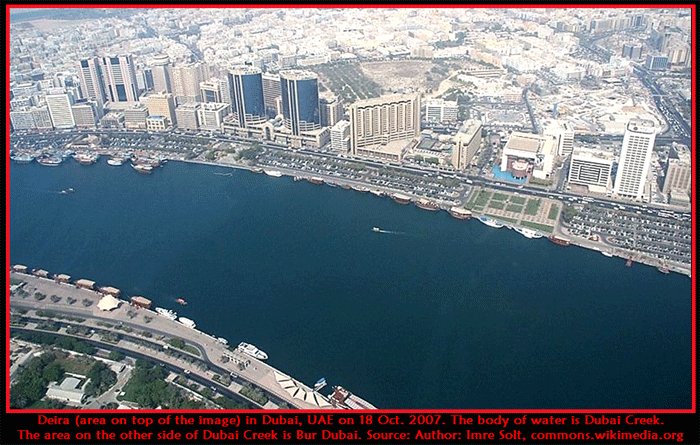
As for me, UAE is the region in which I had flown in the most number of times, for short visits and transit – like drive traffic, all stop and go, since I very often flew with regional Airlines from the early-nineties – a silent witness to the city’s astonishing growth to today’s modern metropolis, Dubai (which I was told is a mixed Farsi and Arabic word meaning literally, two sides of the water. I have also heard its meaning being referred to the Hindi words “Do – bhaee” (Two – Brothers)! Few documents may exist before 1799 when the local inhabitants were primarily engaged in fishing and harvesting pearls. But at the creek of Dubai, one can still see the big wooden dhows and smaller, short-keeled sambuqs.

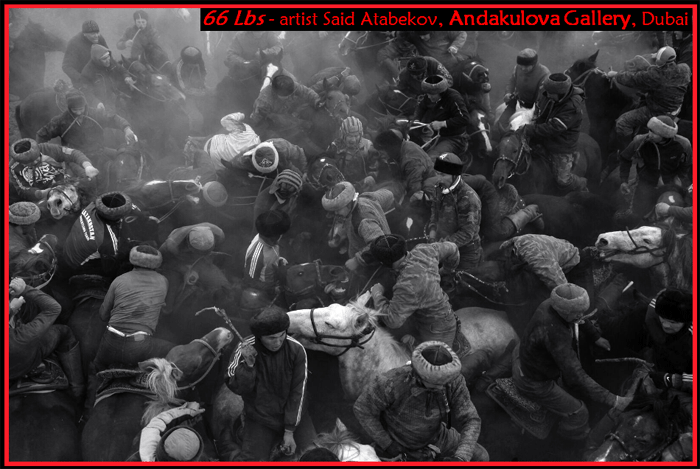
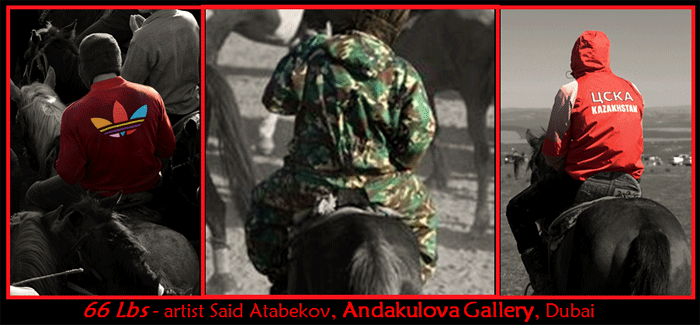
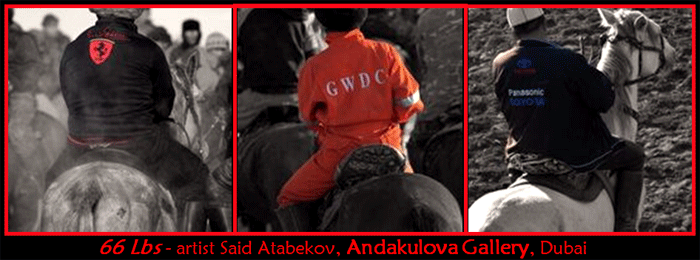
Of the many activities complementing the Dubai World Cup is a Solo Show by Said Atabekov, the internationally renowned Uzbekistan born contemporary artist, who now lives and works in Kazakhstan.

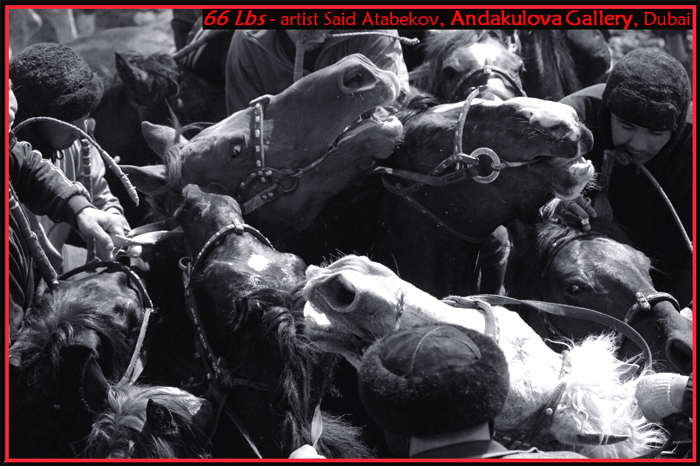
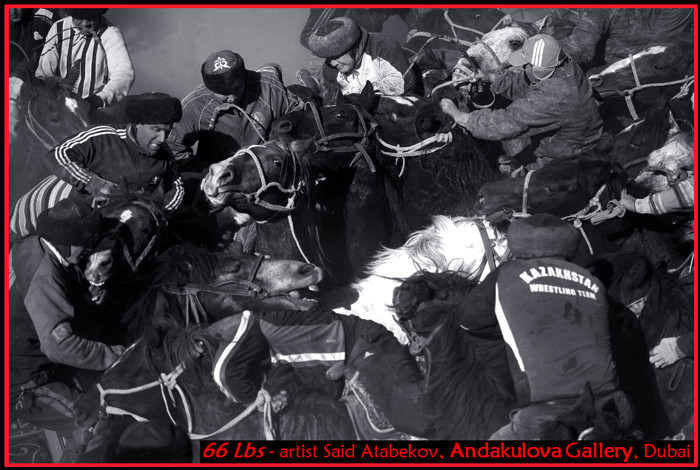
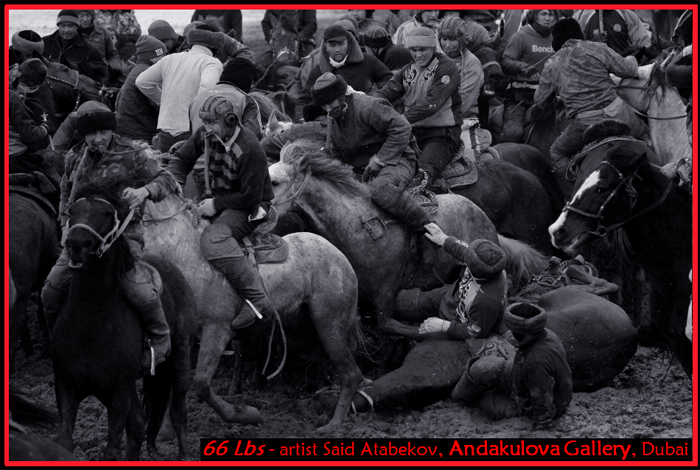
Titled “66 Lbs”, Atabekov’s show featuring photo, video and site installation, can be viewed at Andakulova Gallery (Unit 18, P4 Level, Damac Park Towers DIFC) in Dubai during March 06th – May 12th, 2017. What attracted me to this show is not simply because it featured horses.

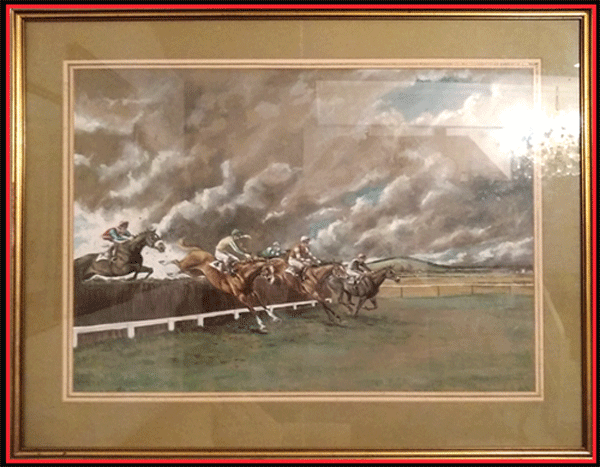
With a good number of original “sporting art” also bolstering our love of arts, paintings of sedate hunting or race horses are not alien to our house. From the horse’s first appearance in a convincing anatomical form in an Assyrian bas-relief of the seventh century BC, at length, it has been an inspiration in all forms of arts and later in literature for the majesty and grace of this spirited animal “par excellence”. Over time, many terms sprang out of its name: horse-radish, horse-parsley, horse mushroom, iron horse, pale horse, white horse, brazen horse, wooden horse, Trojan horse, horse bridge, horse-power, horse trading, …..

The largest physiques of horses I have come across, to name but a few, are the set of four horses (Triumphal Quadriga) at Basilica di San Marco in Venice; the wooden horse inside il Salone of the Palazzo della Ragione; Donatello’s equestrian statue of Gattamelata on Piazza del Santo (both in Padua); and such other statues in many piazzas and squares in Europe.

According to classical mythology, Poseidon created the horse. Indeed, from the domestication of the horse, possibly by the tribes of the steppes flanking the Caspian Sea thousands of years ago, the horse has been the friend and companion of man, prized for his beauty, loved for his docility. Eaten, sacrificed, worshipped, it gradually became a means of transport, communication and of horseback conquest in the heroic age. As a story goes, in the early centuries before Jesus Christ, when the Greeks colonised Southern Italy and brought in thousands of horses, the luxurious people of Sybaris trained all their horses to dance to the sound of music – of flutes in particular. Then again, there was also a time when some were addicted to the atrocious practice of sacrificing live horses to their gods or bury them with their masters.

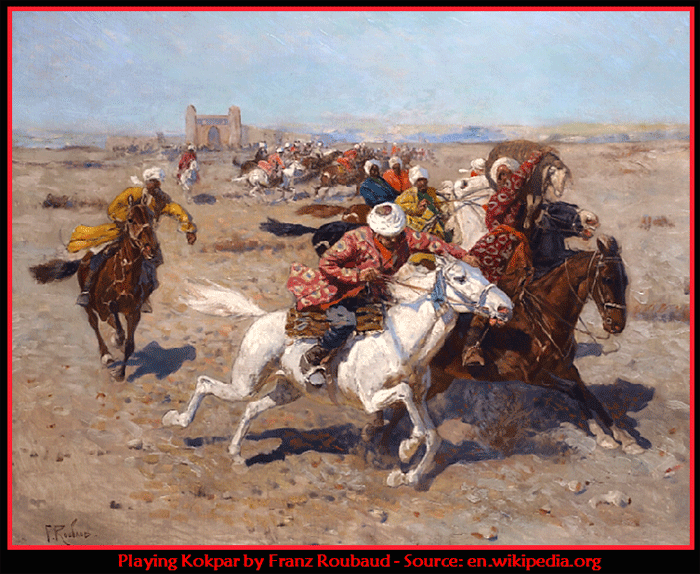
The show’s distinctiveness is the bridge the artist has built between the past and the present with strong images that resonate with tradition – with emphasis on the ancient nomadic game of Kokpar of Kazakhstan. A primitive version of polo, played in two considerably different forms: tudabarai and qarajai, the game Kokpar  has two (or more) teams on horseback competing to pick a headless goat carcass off the ground (zamin-gir) without dismounting or snatch it from someone else at full gallop (chakka-gir) and carry it over the goal line. Usually, the credit for best horsemanship, strength and courage goes to the winning team.

Being aware of this as I am – it is gross the way it sounds. But the element of my main interest in this equestrian sport, part of the cultural backbone of some countries, is merely the nomadic tradition and the strict set of rules it accentuates. According to this solo show, the mandatory weight of the animal carcass used for the game which is fixed as 66 Lbs – hence, the title of this Show.

The Kazakh horses are traditionally an ancient breed originally bred in that region and are exceptionally hardy and competent to withstand extreme climatic conditions. Kokpar (known in a variety of names or simply as “catch-as-catch can”) of the Central Asian countries is one of the games fostered not only out of necessity – but also for recreation as well. The game, which probably owes it origins to the period of reign of the Macedonian king Alexander the Great (B: 356 BC – D: 323 BC) or Genghis Khan (B: 1162 – D: 1227) of the Mongol Empire, or to the Turkic-Mongol people, is part of the contests devised to provide, in times of peace, excitement as well as to retain fitness, readiness and skill of horse and horsemen for sudden deployment in unexpected wars. Such activities also aided to counter their boredom resulting from specific exercise in one place.

Specialization in such games enabled the noblest horse and its valiant rider to attain mutual equilibrium as one unit – as can be visualised in the artistic depiction of half-man and half-horse – the fabulous centaur of Greek mythology – the fusion where man dominates mentally and dictates the strategies taking advantage of the obedience, physical strength and exceptional memory of the horse – a feat attained from the animal owing to kind and patient training.

Whereas, in the mounted folk game of Kokpar, known in Afghanistan as Buzkashi (buz, a goat and kashidan, to pull) (Mongolian baz-kiri), the goat (or calf) carcass is the objective for the contesting buzkashi riders (chapandazan) who to carry it off to a “goal”.

The 51-year old artist Atabekov has captured the vibes and thrill of Kokpar by actually riding amidst the two teams of powerful masculine participants on powerful horses – his camera mopping up their emotions, vanity, endurance and the intensity of their action in all its complexity.

The mayhem of lurching, rearing, bumping, kicking, biting, leering, cursing in the midst of dust, noise and sweat as it happens when they engage in grapple from each other in fierce competitive spirit, sometimes (unintentionally!) hitting out at the opponents (not at their horses) with their camchin (buzkashi whip with wooden handle). In his relentless effort, the artist has endeavoured to draw attention of the viewer to the game and spirit of Kokpar and the national sport of Kazakhstan.

Back to you…soon. Jo

The concluding instalment of this two-part serial will follow.

Notes:

  1. The horse in the title header is one of those stationed by the Colosseum of Roma, Italy
  2. My thanks are particularly due to Karen Fernandez, Andakulova Gallery, Dubai for her interest and the pictures and in-put on the artist.

(© Joseph Sébastine/Manningtree Archive)

Heirlooms – On Memory Trail

1

Concluding instalment of the two-part serial: Heirlooms – Old Habits Die Hard

Whenever we travel to countries where we have consolidated friendships, we often get the wonderful chance to attend parties. To be honest, when I am away from home, I would rather be a guest there than a host.

2

Some fifteen years ago, attending a dinner party in the house of a Singapore businessman I know in a professional capacity, I had the opportunity to see some fine examples of old walnut, and mahogany cabinets of his Indonesian ancestors, dating back to the 18th century.

3

Whenever I popped over to Singapore, a country of gentle memories for me, we would set aside business interests and shared wonderful dinner time when he would bring his personal histories up to date. A sparkling personality, whenever he spoke, he had that confident reassuring voice you feel when an aircraft pilot speaks before the take-off.

4

Once, I got so engrossed in the history of Dutch Batavia and romance of each cabinet (couple of them were in marquetry) explained by my friend that our earlier conversation about Australian Aboriginal breast-plates was completely overridden in his talk. It was real pleasure to closely see those lovely “conversation pieces” and perceive how his narrations about family possessions developed as an acute reminder of the joys and fascinations of collecting.

13

Romance and antique collecting go hand in hand. Speaking about Fort Cochin in our local grounds, an area which had experienced Portuguese/Dutch/English settlement since 1500s, old reputed (especially Anglo-Indian) families of Fort Cochin once had many valuable possessions reminiscent of that era.

6

These heirlooms had pride of place in their living room as something that is functional and to enhance the home and status. Many early family heirlooms such as old furniture, Christian figures, wall carvings, photo frames, porcelain, books, bric-a-brac, have, over the years, been lost due to negligence, lack of proper antique restorers, shifting of residence or on the open market – some of which can still be found in those local don’t-touch-or-we’ll-make-you-pay sort of places in Jew Town. However, for most of such families, besides the traditional recipes from that bygone era, a Bible or framed photos of ancestors, family photo albums or a wedding dress or similar has always retained their charm as heirlooms.

7

8Having recognised the value of their possessions in context with the settlements, I believe there are still those few who had refrained from throwing out a potential pot of gold. They have retained them for their descendants in perpetuity.

In the future, those items must become worth more for sheer rarity, apart from its association with our past. Who knows what things scorned today will be tomorrow’s highly prized?

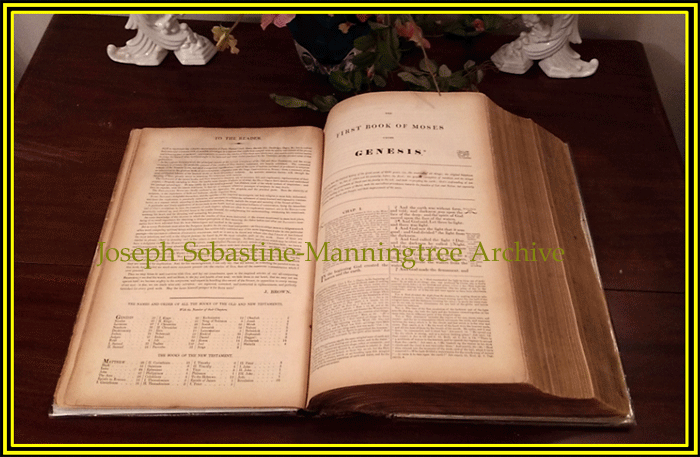
The possessions in our home which we consider precious could not all be of great monetary value but nevertheless remain priceless to us. One of the near recent additions is an early 19th century Bible, quite bulky and slightly soiled, which we acquired from an antique seller in Portobello Road near Notting Hill Gate in London.

9

Even though we had to pay through the nose to acquire it, that was less worrying compared to the effort it took to bring it home to Cochin since, during that trip, we had to traverse in a pre-scheduled journey by Eurotrain to Paris, and to Milan, to Padua, to Florence, to Rome and home via Dubai. Having brought home under the stewardship of our daughter Bianca, its arrival here was met with such greater happiness that all those hardships seemed insignificant.

10

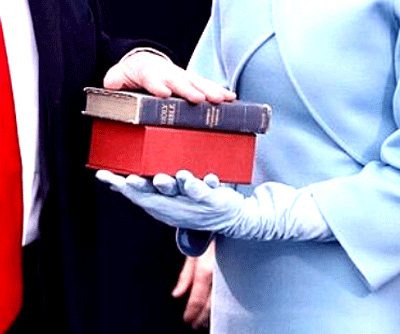
For ages, the Bible, the world’s most famous book, has not only earned its place as an important family heirloom, but has gained an accretion of ceremonial use. The last time we saw the images of couple of Bibles together was on the television when beautiful Melania Trump’s hands held two Bibles upon which her husband, President-elect Donald John Trump took the ceremonial oath of office as the 45th President of the United States of America, on January 20, 2017.

11

I understand that the bigger Bible, an 1853 King James version bound in burgundy velvet with metal trim, which rested directly on soon-to-be First Lady Melania’s right palm belonged to President Abraham Lincoln upon which he was sworn in for his first inauguration in 1861. The smaller one on the top belonged to President Trump, gifted to him by his beloved mother on June 12, 1955.

12

If that smaller Bible has not already been regarded as a family heirloom, the occasion of that swearing-in ceremony has no doubt catapulted its transition into one. Maybe, that Bible would eventually be passed over to one of President Trump’s children – probably to his youngest son.

5The strength of a nation lies in the individual. And the people are progressive. Who can predict now the chance that, probably many years into the future, on a January 20th, that son himself may stand tall at the same spot where his father had stood at the west front of the Capitol in last January, with his left palm resting on his heirloom Bible.

Predictions are difficult. Going forward, only God knows who has more than a walk-on-part in history. So this is faith. Until next time, Jo

PS: Dear reader, this article about family heirlooms is definitely apolitical.

14

(©Joseph Sébastine/Manningtree Archive)

A Winsome Sweet ‘17

1

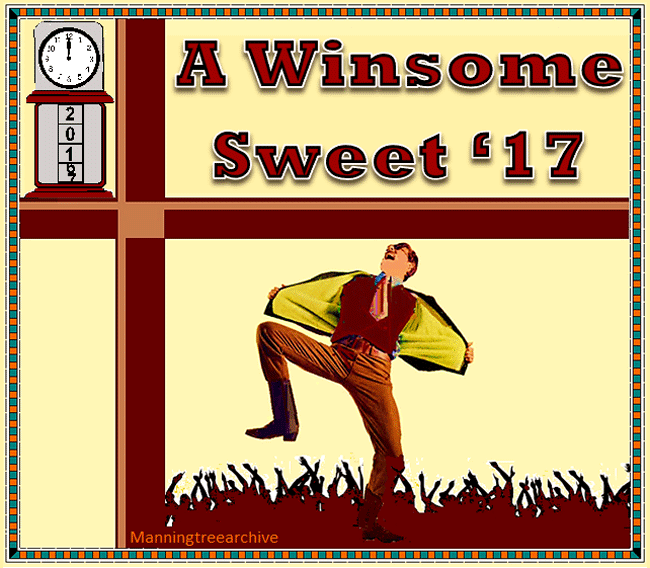
2The New Year’s Day 2017 has arrived with hopes – giving new courage and belief for a fresh start. The transitory period when the old year gives way for the new often kindles a curious manifestation of optimism in us and inspires hope for a “happy and better New Year” – free from the misfortunes of the year just gone by. Inwardly, this feeling is merely a repetition of the optimism that inspired us at earlier New Year’s Eves when it was wished that the ensuing New Year would bring its own heaven. Even though the year’s outcome was contrary to our expectation, yet again, when the clock struck the first note of midnight at the New Year’s Eve, and the bells ring, the fire crackers were lit, Auld Lang Syne was sung to be followed by other old, new, nostalgic medley of seasonal carols and songs, and toasts were raised, we take fresh heart to, once again, hope for the best.

New Year’s Day is the eighth day after Christmas and traditionally, bears the name “Octava Domini” (In Octavas Domini) in the Gelasian and Gregorian Sacramentaries. The first of January appeared as an ecclesiastical festival at Rome for the first time at the beginning of the ninth century, where it is called from the first Circumcisione Domini. The idea and date of this festival are derived from the Gospel of St. Luke (Chapter II. 21), since eight days after birth, the Christmas child of Virgin Mary was circumcised and received the name Jesus, a personal name. The year ends with the birth and begins with the naming.

3

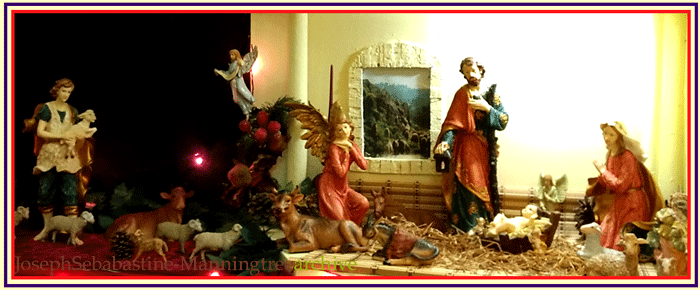
This year’s crib in our house

The traditions and customs related with New Year’s Day were concerned with bringing good luck for the coming year. When the year dies out at the chimes of the midnight hour, and when the traditional toast and ubiquitous salutations of “Happy New Year” and “Good Health” resonate the air and people hugged, kissed and shook hands; whatever be the attitude of the body, certain thoughts in some of us would become silent prayers turned heavenward, thanking for the past years and hoping for the best times and good health. Holy Toledo! The truth is you cannot savour the joys of life without good health.

4

It is also a time for New Year resolution – decisions intended to abandon a bad habit or adopt a good one in the New Year, most popular being the decision to give up smoking and to diet which are always updated as time passes by. According to a survey, two people out of three made such resolutions but most soon break them.

5

Back in December 2013 we were in Bangkok for the festive season. There was political unrest in the country at that time between red and yellow shirts. But rather than let the tourism go haywire and celebration of people curtailed, the sensible local authorities, very efficient to cope with the matters of their positions and departments, did not clamp on any undue restrictions which was laudable.

6

On that warm Saturday morning of December 2013, I was waiting to keep my appointment at one of my favourite Foot Reflexology parlours in Bangkok which I had managed to reach from my hotel with some difficulty. As many of you will know, Bangkok is notorious for traffic congestions, but since yesterday (Friday, 27th) the streets were unusually packed as the New Year revellers flocked out of Bangkok to their villages. A friend of the owner of the parlour, a middle-aged Thai was also in the lobby with me waiting for the arrival of his friend. A great conversationalist, he is known to me from my earlier visits. That was the extent of our acquaintance. Having known that I write about Bangkok, he wisely used my waiting time to give me a run through about some of the many traditions and customs of his land – most of which I had come to know over the years in some finery.

7

9When our conversation touched upon Songkran festival (marks the start of the traditional Thai New Year which falls during April), he suddenly switched the topic to the hair style he would be getting at the adjoining salon either on 30th or 31st (specifically on Monday and Tuesday which he believed are the only good days for getting haircut!!) in time for the New Year’s Eve. At that time, his hairdresser would remove the red-shades from his natural jet black hair worn too long by Thai standards. Although I tried to avert the conversation from being nosy about his personal choice, he went right ahead and told that he is clearing the red shades for his elder sister who has invited him to her house for late dinner on the New Year’s Eve which he intended to attend, after cutting-short his own razzle-dazzle with his friends at the local pub.

8As assigned, he would be the “first-foot” to enter his sister’s household to usher in the New Year. This fairly clear-cut custom, which has many versions, is based on a Hogmanay (a New Year’s Eve in Scotland) tradition, and still kept up in some Far Eastern and Australian households.

It is believed that if the first person to cross the threshold of a house after midnight, when the old year ends and the New begins, is a dark haired man, a year of good luck will follow. Since her brother’s last “first-foot”, she had experienced lesser gale over the domestics. And certainly, once more the elements of specific gifts a “first-footer” usually brings which symbolised life, hospitality and warmth is in his consideration to take along with him.

For his sister, who displayed great strength and furious energy to go through the ritual of sweeping her whole house thoroughly on 31st of every December, the recruitment of her brother to make the necessary entrance at her house is rooted on her belief that it should be someone with dark hair and not of her household.

10

Family ties are stronger at Christmas and New Year time – and louder, too. First of January is Global Family Day, too. Mind you, he would have his fun in her home ground – the whisky, the songs, the smile, the smells – and the mishmash of games: shuffleboard, Ping-Pong, Bingo, cards, and God knows what else. To reach her home at that time of the night without the bow-wow of stray dogs in her street would be a benefit since any stray dogs living in the premises on New Year’s Eve were particularly cleared because, according to his sister, they brought bad luck.

11

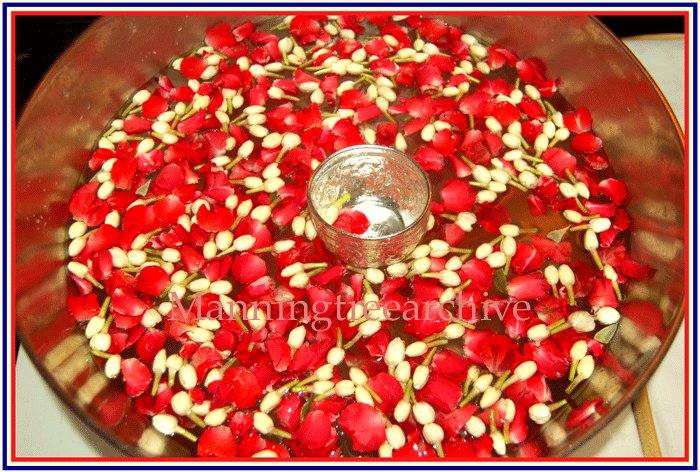
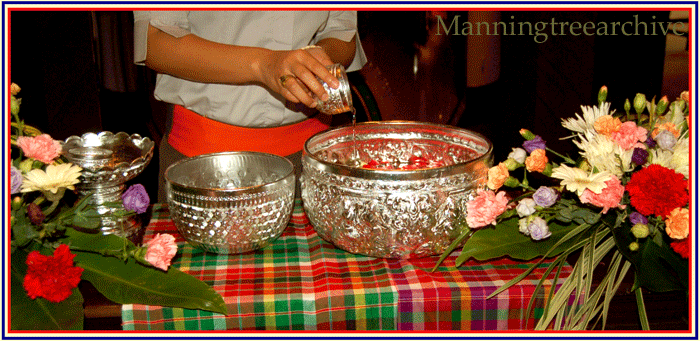
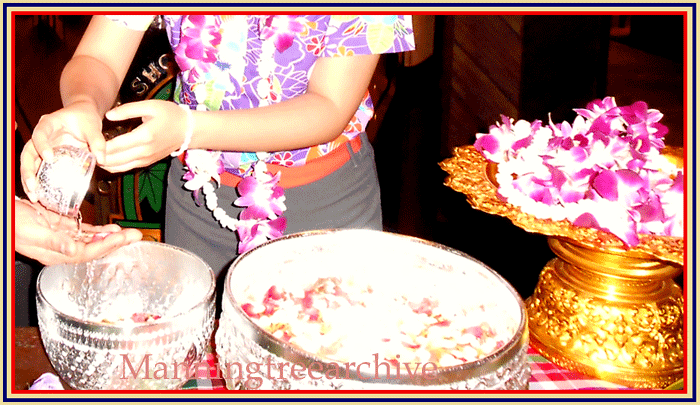
People do strange things hoping for best things ahead. Not long ago, a European chef of Mandarin Oriental spoke about a Thai chef’s unbridled enthusiasm for anything associated with superstitions. The Roman belief that misfortune would come into a house by anyone entering with his left foot first, is a custom which is strictly followed with right foot by his family. They have a tradition to criss-cross certain rituals of the Thai Songkran festival also with the customs of New Year’s Day.  The ingredients they used in this respect, forming part of the ritual of bathing of Buddha statues during Songkran, consists of five bowls containing different-coloured floating flowers – each colour to represent prosperity in a variety of forms: Rose Red to bring a tranquil life devoid of obstacles; Marigold Orange to signify success and wealth; Anchan Blue representing strength to overcome obstacles; Pandan Green for peace without problems; and Jasmine White to symbolise a joyful life.

12

The question about how a fairly intelligent and even moderately educated person could inwardly believe these superstitions – that number 13 is unlucky, or that one should not start a new venture on Friday, etc., in spite of its universal acceptance, is, how-do-you-say-it, much like a pyramid balanced in unstable equilibrium upon its point. Nevertheless, people do knock on wood; take a pinch of salt and throw it over their left shoulder; or refuse to walk under a ladder, and hope that, “touch wood”, this New Year would hopefully go down in memory as the year they moved into the house of prosperity, good health, peace, joy and all things of goodness – with the baggage of serious misfortune safely left behind. I remember the saying, if you must leave your old house and move to a new one do not take your old broom with you.

Thank you for riding with me during the past year. I raise a toast: Here is wishing my friends and readers a lovely, peaceful and prosperous new 2017. Jo

13

(©Joseph Sébastine/Manningtree Archive)

NOTRE DAME WILL STAND – Part II

2-01

Will you walk a little faster?” said a whiting to a snail,

“There’s a porpoise close behind us, and he’s treading on my tail.”

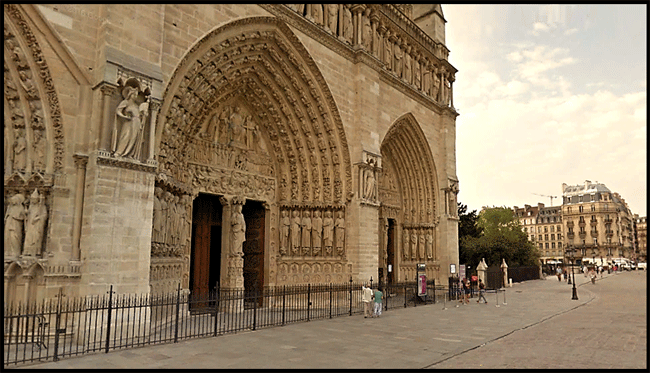
Here at last, we are at the queue at Portail de Sainte-Anne and these lines from: Alice’s Adventures in Wonderland, The Lobster Quadrille (The Mock Turtle’s Song) by Lewis Carroll (1832-1898) had crossed my mind. To whoever was right behind me at the queue – there certainly was urgency to get into the cathedral.

2-02

Once inside, we would soon realise that the timing of the visit to Cathédrale Notre Dame de Paris was perfect for us. Before we could explore the double aisles, various chapels, rose windows, the ambulatory, etc, our attention was drawn to the streams of music wafting from the central transept where, we soon found the Chorus, soloists and an orchestra in jubilant mood – practising a classical music concert. So that explained the urgency at the queue.

2-03

In comparison with its length, the cathedral is extremely broad. Standing over the black and white coloured floor tiles at the west end, the interior appeared well lit though I could see a marked variation between the principal nave, the transept and the chancel.

2-04

However, despite the changes made to provide more light to the tribunes, in gloomy weather, the cathedral can still appear sombre and even cavernous. This subject about the light reminded me of an entry I once read in the Duchess of Windsor’s (Wallis Simpson) memoirs: “….As the Prince of Wales (Edward VIII) walked past, I (Wallis) overheard him mutter to his uncle, the Duke of Connaught: “Uncle Arthur, something ought to be done about the lights. They make all the women look ghastly.” (1)

2-05

Good music often transports me into another dimension. Slipping into a wooden bench nearer the transept, we spent some time in glorious musical bliss while the 14th century Statue of Virgin Mary Holding the Christ Child joyfully watched over us as she leaned against the south-east pillar where an altar dedicated to the Virgin had stood earlier. This work is dedicated to “Notre-Dame de Paris” and the most distinguished of nearly 40 representations of the Virgin inside the cathedral.

2-06

At every moment in the world, things change and the shape of things to come seldom announced its presence among us, but later on. It was as if fate had planned our visit to arrive here right on our schedule. Had we lingered longer by the banks of the Seine and watched the barges and bateaux mouches float silently along the river; or indulged longer to thumb through dusty volumes at the quayside bouquinistes’ stalls selling bouquins (old used books) and other special treasures, while enjoying the kiss of the sun from above; or idled more time away sitting under the candy-stripped awning of the open-air café on the chestnut-lined boulevard, with a lingering glass of red and a croquet-monsieur, relishing the general joy of watching the moving stream of pedestrians; – then, we might never have reached this cathedral to enjoy the musical treat on that day. Punctuality works! Carina always said Punctuality is indeed my first, last and middle name.

2-07

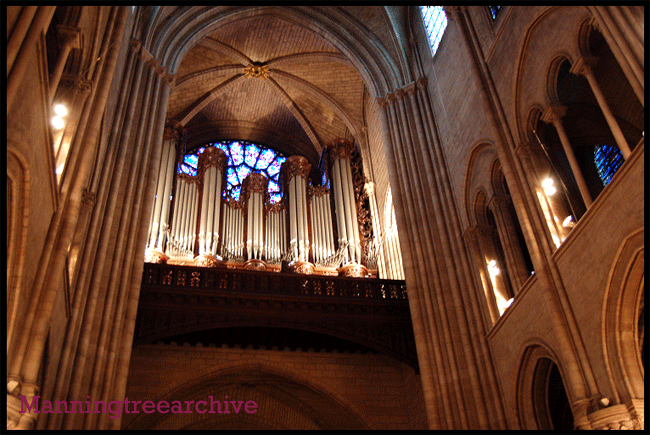
I was too entranced in the music to turn around to look up the nave at the West end where, directly below the artistic upper West Rose window is situated the great organ (one of the three) – a marked feature of the Cathédrale. Rebuilt by Thierry Lesclope in 1730, enlarged in 1785 by Cliquot, and improved by Cavaillè-Coll, it is reputedly the largest organ in France, There is no need for me to look back at it now. I had endeavoured to study it during earlier visits and my mental picture of that area is clear down to the upper ends of the organ’s pipes obstructing the lower half of that Rosette.

2-08

Presently the musical performance came to a close, and a wave of applause swept through the cathedral. Most of the crowd, as if signalled by an internal green alert, had started to head for the exit – possibly, in search of the sun.  We resumed our exploration along the far-stretching southern aisle, passing the great cylindrical columns rising to support the vaulted ceilings, their weights being shared by the external flying buttresses on both sides of the huge structure. On our right was the line of chapels forming part of the numerous chapels around the walls.

2-09

I can well understand why Notre Dame de Paris has had a splendid acceptance. In its long course of construction, this edifice had to transit through the art movements of Romanesque and the Gothic, a progression that branded it as a transitional structure. The gauzy structure of Gothic architecture resulted in the rise of stained glass, the virtual elimination of solid wall space and transformed the walls as connecting space for windows. At that time, the thought crossed my mind that all this would be of professional interest to my second daughter Andrea, engaged with her studies in architecture back home.

2-010-north

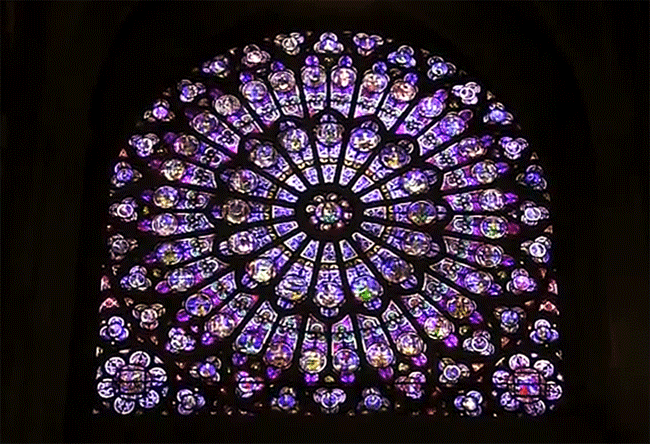
An important feature on the southern side of the slightly projecting transept is the Rose window. Now this is an artful creation of bold, simple trellis designs with an amazing arrangement of stained glass work. The most frequent background was a red trellis on a blue field. During an earlier visit, I overheard a local guide mentioning about the window’s primary colours to a group of American tourists, suggesting that “it is very drawable.”

2-011-south

But if we observe it with a painterly eye, there is a revelation. We could see the predominant blue dissolves for different colours; and the window glows in pink and crimson tones. The colours had been there to be found all the time. When taken as a boy to Notre Dame, it was this rose window of the south which seized upon the imagination of the great architect Viollet le Duc (January 1814 – September 1879) and stirred his passion for Gothic. In “Paris; the Magic City by The Seine”, author Gertrude Hauck Vonne explains that situation: “While gazing at it the organ began to play, and he (Viollet) thought that the music came from the window – the shrill, high notes from the light colors, and the solemn, bass notes from the dark and more subdued hues.”
2-012

2-013As we proceeded further ahead, we would notice that not only the nave, but the choir, possessed double aisles. To our right was the entrance to The Sacristy (formerly part of the Palais Episcopal) and The Treasury which housed many precious things. Before going around the magnificent semi-circular apse at the east end to the northern aisle, one could see the High Altar; the three large statues: the Descent from the Cross; Louis XIII, (both by Guillaume Coustou, 1677 – 1746) and of Louis XIV (by Antoine Coysevox, 1640 – 1720). The Ambulatory (pourtour) of the Choir was raised above the body of the church by three steps, both sides enclosed by a low grille in wrought iron with gilding. I could well imagine the magnificent set-piece of pageantry of various ceremonial occasions held here; and how the echoes of many “Te Deums” had resonated inside these old walls for victories long forgotten, and for those many long remembered.

The removable stones of the pavement close to the small organ on the north side of the choir lead to a subterranean burial chamber for eminent officials of the cathedral. Remains of a small Gallo-Roman votive pillar to Jupiter (which I had mentioned in the First Part) were discovered some six feet beneath the apse during excavations for this crypt during 1711.

Prior to the northern Rose Window, one could see the famous Porte Rouge (Red Door), a masterpiece that dates back to the 14th century. It derived its name from its painted doors.

2-014-north

Corresponding with the statue of Notre-Dame de Paris on the south is a statue of St. Denis by Nicolas Coustou in the north. Although many of the treasures were destroyed by the Revolution, granted there is time and inclination to explore the interior, one could spot the intrinsic beauty of many things that were well made – the sexpartite system of alternating ground supports, the clearstory, the stone step, the various windows, moulding round the doors, an artistic door handle, the numerous sculptures, fine chandeliers, paintings of much value ,… and the flowers at the foot of the statue of Notre-Dame de Paris which seem, to some, suddenly glow as if they were lit from within.

2-015

Having purchased a Médaille for Andrea from a counter at the west end, we walked out through the northern Portail ae la Saint Vierge. In the bright sunlight one could clearly see the splendid character of the ironwork of the outer doors.

2-016

Curious tradition relates this to the skill and energy of the devil. Up above, the grotesque representations of Chimères and gargouilles or “Devils of Notre Dame” lurked on strategic locations of the cathedral, scowling down from their point of vantage upon the French metropolis – probably their mark of attention even reached our present hotel somewhat closer to Basilique du Sacré-Cœur – one of the many hotels of Paris noted also for its number of French oils – impressionist, expressionist, and abstract.

2-017

As we took leave of Notre Dame de Paris, I reflected on the staying power of this ornate feat of architecture – this edifice of a community’s tangible bygone days. Have I missed something here? Although individual escape from the present into the past has rarely been more widespread than it is now, there is another side of the coin of course. Recently the world has witnessed the cruel destruction of historical monuments to suit the ideologies of certain groups.

2-018

In September 2016, The Telegraph (UK) reported the discovery of upto seven cylinders of gas tanks and documents in a specific language in an unmarked Peugeot 607 next to Notre Dame cathedral, sparking fresh terror fears. Condemnations and appeals against such ideologies were heard. Victor Hugo’s 1831 novel, Notre-Dame de Paris, was the product of a similar protest and aimed to draw attention of his contemporaries to deter the destruction of existing architecture.

2-019

By visiting and polishing up our love for noble monuments of the past, relating the stories behind their construction, understanding the masters who build them in their times, we not only comprehend the traditions, aesthetic and cultural history of an area but also of the high-values reached by civilization. Time is the most precious commodity I possess. I am glad that the hour glass of my life is also filled by precious moments like the favourite footpaths I have treaded in the course of my visit here – helpful journeys into the past which I am excited to make from time to time. And, hopefully, when I come back here again, I know Notre Dame de Paris will be here – waiting. Jo

2-020

Notes:

  • Besides other improvements, the Cathedral’s lighting system was upgraded by late 2012 owing to a year-long 850th anniversary celebration.
  • For those in need of flowers for Notre Dame de Paris, there is a huge selection at Marché aux fleurs, Place Louis Lépine – Quai de la Corse near Cité Metro Station.
  • I am indebted to many publications dating from the late 19th century onwards, for useful background data;
  • This article is dedicated to my daughter Andrea Lalis Sebastine, the architect in our family.

2-021

(©Joseph Sébastine/Manningtree Archive)