Tag Archive | Ben-hur

Irène Papas – Greece Comes to LA

You can be important to someone but not all the time….

The pretty Greek actress Irène Papas’ cinematic debut took place in Hamenoi Angeloi (Fallen Angels, 1948, credited as Eirini Papa) directed by Egyptian-born Nikos Tsiforos. This could be true in keeping with the date of release even though elsewhere in the media it is also mentioned that her debut big screen performance (as Eirini Pappa) was in Nekri politeia (Dead City), the directorial debut of Frixos HeIiades (Phryxos Iliadis). That movie in which Irène had a short spell playing a girl named Lena was released in December 1951, the year she separated from her husband, director Alkis Papas.

Nekri politeia was exhibited at the 5th Festival de Cannes held in Southern France from 23 April to 10 May 1952 where Irene was an invitee. For someone who was learning her craft and gaining confidence she was being courageous and had started to look the popular conception of a star. Her face was beautiful with an almost perfect bone-structure, black hair, dark expressive eyes, and she moved with a natural inborn elegance – with the grace of the dancer in her.

While attending the Film Festival, the late Prince Aly Khan, then husband of American screen actress Rita Hayworth, chose Irène as his partner for the dance that would open the prestigious reception of the film exhibition. “That meeting with Aly Khan set me back ten years,’ a biography (1) had quoted Irène as saying at that time. According to a book on Aly Khan, it was Irène’s name which was most persistently linked with Aly’s by the end of that film festival. As a result, her photograph and life story soon flashed in newspapers around the world. But then again, according to The Courier-Mail, Brisbane, Irène brushed away the rumours as “Nice flirtation. Although we had a nice flirtation, reports of a possible marriage are ridiculous. I am separated from my husband, but I am still married, and have not asked for a divorce.”

Impressed by Irène’s performance in Nekri politeia, the Italian international producers of Ponti-De Laurentiis Cinematografica immediately offered her an acting contract. Although she did not perform in the film they initially proposed since it was decided to do not cast her in it for the one reason that the role featured a simple and voluptuous vampire. Instead, the producers cast her in the role of Mrs. Luisa Azzali in Le infedeli (The Unfaithfuls / Escándalo en Roma, 1953, dir: Mario Monicelli & Steno) which was a vehicle for Gina Lollobrigida and May Britt.  

It was Irène Papas’ collaboration with Italy’s Lux Films (2) that paved way for her to appearance in noteworthy movies of 1954 such as Attila, il flagello di Dio starring Sophia Loren and Anthony Quinn in principal roles; and Theodora, Slave Empress featuring Gianna Maria Canale and Georges Marchal.

By then, the long gaze of Hollywood had already fallen on Irène Papas. I read somewhere that director Elia Kazan also took an interest in casting her. Anyhow, going over to Hollywood should be quite fun for her.

Arriving in America in the fall of 1954, her first film-test was done by film producer Sol C. Siegel (1903-1982) of movies such as: A Letter to Three Wives (1949), Gentlemen Prefer Blondes (1953), Three Coins in the Fountain (1954), etc. Upon his proposition, Irène was given the kind of reception the film studio reserved for the more obvious gold-runners – and as it turned out, following her screen test, it only took the studio just three days to sign her up in a long-term contract. The producers had taken her acting talent very seriously, at which point, it gave her no small pleasure to be hailed on the lot as a “beautiful Anna Magnani”. There was talk that she will have the leading feminine role (3) in the 1959 remake of Ben-Hur which was to have all the ingredients that translate into great popular appeal.  

Irène Papas made her Hollywood-produced film debut in the role of Jocasta Constantine (4), a former dance-hall Greek emigrant in the Western, Tribute to a Bad Man (1956). Complimenting Irène in the movie was James Cagney’s vigorous acting as the Wyoming horse rancher Jeremy Rodock. Directed by Robert Wise with music by Miklós Rózsa (1907-1995), it was filmed in CinemaScope in Colorado in August 1955.

By then she had met actor Marlon Brando who had won rave notices for his performance in director Elia Kazan’s A Streetcar Named Desire, the 1951 melodrama based on Tennessee Williams’ play. It was only with the passing of time, she revealed that Brando was chryso mou (my darling), the love of her life. Although they never married, instead, her second marriage became a reality in 1957 when she wed film producer José Kohn. That nuptial also hit difficult times and didn’t last longer.

Irène Papas might not have liked working in Hollywood forever because she decided to return to Greece. Before that became a reality, she appeared in few TV sitcoms as well as in series of classical and modern stage presentations including: Fyodor Dostoevsky’s The Idiot; William Shakespeare’s The Merchant of Venice; etc. Moreover, she also endeavoured to step forward into boosting her talent. She went to New York City and enrolled in an acting course by Artistic Director Lee Strasberg at the reputed Actors Studio, founded in 1947. That was an appropriate move on her part on the light of the perception that what is taught reaches through to minds that, once set right, have a chance of staying right.

Back in Greece, Irène didn’t fancy much interest to perform in the Greek theatre. Obviously, she was introspective for having met with negative criticisms during earlier shows. Following appearance in The Lake of Sighs (I limni ton stenagmon, 1959) written and directed by Grigoris Grigoriou, Irène was pleased to avail the opportunity to portray Laskarina Bouboulina (Laskarina Pinotsis) in Greek film director Kostas Andritsos’s Bouboulina (1959), a B&W movie about the heroic exploits of Greece’s first naval commander – in skirts, who historically defeated the Ottoman Empire and liberated Greece.

Laskarina was born in May 1771 inside the prisons of Constantinople (Istanbul) where her mother, Skevo, the daughter of a prominent family of the island of Hydra, was visiting her dying husband Stavrianos Pinotsis who was a prisoner there for his part in the Peloponnese revolution of 1769-70 against the Turks. Shortly after Pinotsis’ death, she lived with her mother at the island of Hydra for four years before moving to Spetses Island. In 1788, she married a Spetsiot skipper and upon his early death, she wed another Spetsiot captain named Dimitrios Bouboulis who also commanded his own ship. In May 1811, Bouboulis too lost his life in sea battle with Algerian pirates off Lampedusa in the Mediterranean Sea.

As a widow, she inherited considerable fortune and undertook to boost the strength of her fleet. To safeguard herself from the attempt of Ottoman authorities to confiscate her fortune, she became an active member of the secret organisation, Filiki Etaireia (Friendly Society). Her efforts in preparations for the impending Greek War of Independence (1821-29) included buying arms and ammunition from foreign ports, as well as creation of her flagship, the Agamemnon, a 33-metre corvette armed with 18 heavy cannons. Upon the outbreak of hostilities, among other things, she commanded her own fleet and fought with great enthusiasm and incredible heroism. The gallant Laskarina Bouboulina was consequently transformed into a legendary figure correlated to the siege of Nafplio and synonymous with female courage and heroism of later Greek history. Killed in May 1825 connected to a family feud, she was posthumously honoured (5). Koula Agagiotou, Andreas Barkoulis and Miranda Myrat also co-starred in the movie Bouboulina.

It was Irène Papas’ impact as a dramatic performer that won her worldwide acclaim with her brilliant performances in the title role in director Michael Cacoyannîs’ Electra (Elektra, 1962). Over the years, in a career spanning about 60 years, Irène Papas starred in over 70 films. Featured in Greek, French, Italian and Hollywood movies, Carl Foreman’s The Guns of Navarone (1961), Michael Cacoyannîs’ Zorba the Greek (1964), Costa-Gavras’ Z(1969) and Francesco Rosi’s Christ Stopped at Eboli (Eboli/Cristo si è fermato a Eboli, 1979) are some of the many movies that catapulted her fame beyond Greece to Italy, Spain, France, England and across the Atlantic Ocean and beyond. Jo

Notes:

  1. Life of the Party: The Biography of Pamela Digby Churchill Hayward Harriman by Christopher Ogden;
  2. Italian film producers Carlo Ponti (1912-2007) and Dino De Laurentiis (1919-2010) joined the Lux Films soon after the Company’s relocation to Rome in 1940;
  3. The role of Esther in Ben-Hur (1959) went to beautiful Israel actress Haya Harareet. The film when made was a successful achievement by MGM and for the exhibitors.
  4. According to imdb: this role was previously offered to A-list actresses: Grace Kelly, Eva Marie Saint and Jennifer Jones.
  5. Upon death of Laskarina Bouboulina on May 22, 1825, she was buried at the cemetery of Agia Anna Church up on the mountain. Her bones were later shifted into the family vault at the Church of Aghios Ioannis (The Church of St. John) below, built in 1822 and fully funded by Laskarina. In 1938, the casket was donated to the Museum of Spetses upon its inauguration. The Bouboulina museum was established much later in 1991.
  6. Up to now, the sources of reference for this tribute to Irène Papas are archives of the past including printed publications and visual media. DVD/Blu-ray of most of the movies mentioned in this write-up is available with some leading dealers.
  7. DVD sleeves/images shown here are only for promotional purpose. Source: Wikipedia, amazon.com, imdb, and from DVD sleeves.
  8. This illustrated article is an affectionate nosegay to the movies referred above. Please refer to “About” of my webpage for more details.

 (© Joseph Sébastine/Manningtree Archive)

The Kaleidoscope of Hoof Prints

b1

(This follows my article The Ballad of JEANETTE and MICHEL  of March 2, 2016)

If there are phrases on my tongue which connote the blessings that can unwittingly come in many disguises to the gentle-natured donkey, it is those plans and purpose which chanced upon as revealed in some events of “The Bible”. With Palm Sunday (March 20, 2016) followed by Easter (March 27, 2016) coming up, bringing in a time when it is not unusual for people to be religious in thoughts, I take a little liberty to reflect on those events.

b2

Animals like sheep, camel, donkey, have afforded their presence to many episodes of the Bible. Indeed there are momentous occasions when the donkey was part of events that were important junctures in the life of Jesus Christ.

b3

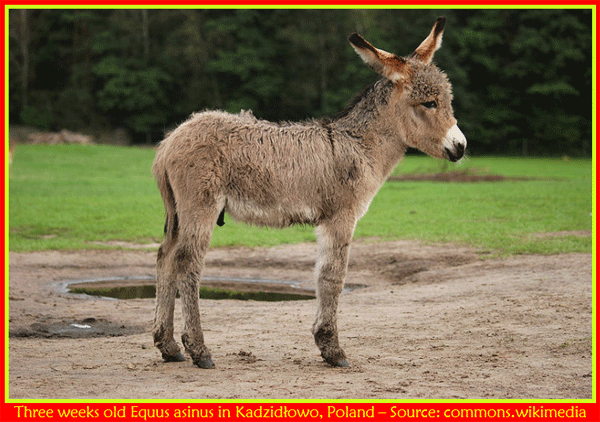
The ass of Palestine and the Bible has been identified as the Nubian wild ass of Egypt. This common beast of burden, used for agricultural work and also for riding, is not in the East by any means a despised or a despicable animal – but considered part of a moderate household. Whole families rode him, shared food with him, and sometimes allowed him to stay in a section of the room with the family.

b4

Visitation: It is related that Mary, pregnant with Jesus, used a donkey when she set out on her journey for her ‘Visitation’ to congratulate cousin Elizabeth who was pregnant with the child who would one day become known as John the Baptist. According to tradition, that donkey had travelled about seventy miles from Nazareth over hills and through valleys to the little town in the Judaean hills where Elizabeth and her husband, priest Zachary dwelt. Considering that the feast of the Annunciation of the Birth of Jesus is held on March 25th, this journey could probably have occurred during the last days of March or early April when the rainy season was just over. Although Joseph is not named in this journey, it is unlikely that Mary would have ventured on a long and arduous journey alone and abode with Elizabeth for about three months before she rode back to her home in Nazareth. Besides, it was customary to have a driver for the donkey, when women rode on them.

b5

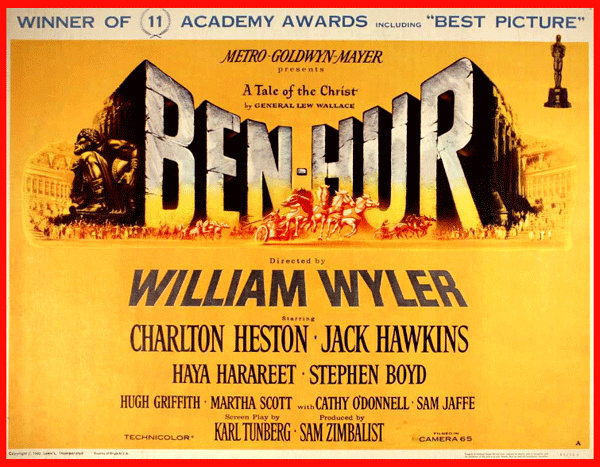
To Bethlehem: The initial scenes of William Wyler’s biblical epic movie “Ben-Hur” (1959) portrays Joseph, a village carpenter, leading a meek donkey by the bridle, on which sat his pregnant wife Mary covered with a long cloak, during their journey from Nazareth to Bethlehem in Judea to enrol their names in a census which had been ordered by Caesar Augustus. The vague details of that journey of about seventy miles could be visualised as five days of privation, fatigue and discomfort through an uncomfortable path in the winter chill of December. A book on the Virgin Mary names this donkey as “Eleabthona”, but we could only wonder if it was the same animal which had previously been similarly used when Mary went on her “Visitation” to Elizabeth.

b6

To Jerusalem: Whichever donkey it was, that animal had the opportunity to be closer to the newly born Jesus in the stable outside Bethlehem. Besides, amongst the few other domesticated animals present there, he was the one who would render service as the mode of transport to Joseph’s family when, at the age of forty days, the infant Jesus was taken to Jerusalem for presentation in the Temple and return.

b7

To Egypt: Sometime thereafter, warned of an imminent danger to the child, the family hastily embarked on a journey in the middle of the night, with Mary and the child riding the donkey, as they rushed out of the territory of King Herod to retire into Egypt. With the winter still persisting, that journey of ten days covering about two hundred miles via the city of Pelusium (modern Tell el-Farama) was not without difficulties and dangers arising from cold, wet and stormy weather, lack of shelter over their heads, less water, attack by robbers and wild beasts, proceeding partially through the shifting sands of the desert as far as the land of Gessen, where they resided (1). Not until had King Herod died in the spring of 4 BC, did they retire to the early home of Joseph and Mary at Nazareth of Galilee.

b8

Soon after, the donkey of those journeys slips into obscurity even though according to a recorded event of Jesus’ youth, at the age of twelve, Jesus was taken on a long journey to Jerusalem to attend the Passover before returning to Nazareth when the service of a donkey would have been required.

b9

It is widely held that the dark line down a donkey’s back and across the forequarters in the shape of a Latin cross denotes the heritage of that race from the day one of their forebears carried Jesus on its back during His triumphal entry into Jerusalem which is commemorated as the first Palm Sunday (Dominica in ramis Palmarum), and marks the beginning of what is technically called Passion Week.

b10

To Jerusalem: According to the Gospels, Jesus, having come to the little village of Bethphage (Beitphage) on the summit of the Mount of Olives sent two disciples into the village to fetch an ass and a colt they would find tied there. Having brought the animals, they cast their garments upon the ass and made Jesus sit thereon. (2) The animal carried Jesus, sitting meek and gentle on its back, as it treaded over the olive palm fronds strewn over the garments laid on the path, amidst the joy and singing of a multitude of accompanying people wielding branches of palm trees as a testimony of honour and respect.

At that time Jerusalem was surrounded with fertile fields and trees, and on the southern slope of Olivet, where they were passing, date-bearing palm trees grew in great abundance. The Palm has been in all times and places the emblem of victory and its reward and it was the custom to carry and wave palm-branches as a sign of joy and victory.

b11

At length, the donkey carried Jesus down the hill, passed between the walls of Gethsemane and the Garden of Olives, crossed the Cedron valley (Kidron), through the road leading up to St. Stephen’s Gate (Lions’ Gate), and entered the Temple through the Golden Gate with its beautiful pillars. This occasion, commemorated on Palm Sunday with a Procession of Palms was customary in Jerusalem as early as 386 when it was first mentioned, and was adopted in the west by the seventh century as attested to by Isidore of Seville, who died in 636.

b12

Until the Reformation in the Middle Ages, the event was remembered in a folklorised ritual on Palm Sunday (Palmsonntag) in some southern German speaking regions when, in addition to the tradition of the blessing of palms (Palmbüscheln), a procession known as “Palmesel” (Palm Sunday donkey) was held when a statue of Jesus mounted on a wooden effigy of an ass fixed on a wheeled wooden bier was taken round the streets spread with clothes and strewed with palm branches. To mark this joyous occasion, people sang hymns and waved fronds of palm or of some other similar tree, while at some places bouquets of flowers attached to boughs of trees were sometimes carried in the procession calling it the Easter of Flowers.

The ass was not forgotten either. A book on ecclesiastical architecture relates an old tradition that “the ass on which Christ made His entry into Jerusalem left Judea immediately after the Crucifixion, and passing over the sea dry-shod to Rhodes, Cyprus, Malta, Sicily, and Aquileia, finally reached Verona, where it lived to a very old age. After its death its bones were collected and deposited in the belly of the wooden ass of Santa Maria in Organo, which was made as a memorial of it and its exact image.”

b13

Just as that event at Jerusalem made them an object of peculiar reverence to the early Christians, the cross on its back inspired belief that children suffering from whooping cough will be cured if they are made to sit on the mark and the donkey walked in a circle nine times.

It is interesting to think, with what different sentiments one regards the donkey at different periods. The poor quadruped which tradition says earned its reputation for stupidity in the Garden of Eden when it could not remember its name when God asked it, is actually, as one of my friends wrote, a poorly understood animal.

b14

Ass, when properly kept, is a handsome animal – much stronger in proportion, and much more hardy than the horse. The positive efforts of institutions such as Kölner Zoo in Germany, The Donkey Sanctuary in Devon, England, etc, very much help the welfare of the docile and friendly donkey to save them from becoming snapshots of a bygone era. Let us be glad that they are there and keep alive the age old tradition that to see a donkey will bring one the good luck. Until next time, Ciao, Jo

b15

Notes:

  1. According to some publications, the particular place where Joseph settled in Egypt is probably Metaryieh, near On/Heliopolis, about two hours distance north-east of Cairo.
  2. A Franciscan church, built on the foundation of an ancient shrine, stands to commemorate the place where Christ mounted the ass, contains a stone traditionally identified as used by Jesus to mount the ass for the journey to Jerusalem.
  3. Thanks to: Mr. Bernd Marcordes, Kurator, AG Zoologischer Garten Köln, Germany for the picture of Michel and Jeanette; to Ms. Pippa Helock of The Donkey Sanctuary, Devon for the picture “Looking Handsome”; and to Stefan Ahrens of Bistum Regensburg, Germany for the four pictures.
  4. Print and visual versions of “Ben-Hur” is available with amazon.com, amazon.co.uk and other leading dealers.

b16

Joseph Sébastine/Manningtree Archive)
SURVIVING WITH DIGNITY

1

The joy of Christmas is nearer, drawing in a beehive of activities allied to it. The Christian Churches here, as in all parts of the world, are livened up for the yearly holy event marking the birth of baby Jesus, followed by the close of another year. Most educational institutions are on preparatory mode for holding mid-term exams prior to the culmination of the vacation season.

2

Plans are being made for annual vacations, or joyous activities, or gourmet feasts, or family get-togethers. Banking on the commercial value of the holiday season, the hospitality industry and other retailing sectors including big Malls are once again out with window decorations, dangling fantasies and other crowd-tickler marketing gimmicks through the media, web and signposts.

3

One is baffled and bewildered by the choice of innovative merchandize, latest tech trends, etc, available.  “Happy Shopping Holidays” – three charming words dominate this period to augment the marketing campaigns.

4

A special event at all times to me, Christmas, like Easter, has a considerable period of preparation. The Gospel of St. Matthew relates so briefly about preparations that had taken place some 2020 years ago when, three wise men, proficient in astronomy and astrology, turned their heads up to gaze at a brilliant star that would set them on a journey. Theirs was a spiritual desire to find and adore a new-born child – to lay their gifts contained in caskets of odoriferous wood at the child’s tiny feet – gifts of pure gold (asserting the kingship of Christ), frankincense (Christ’s divinity) and myrrh (that He was man, and doomed to death).

5

Their long and perilous journey through “field and fountain, moor and mountain, following yonder star” culminated in success when they found the new-born Jesus not in the stable, as usually depicted in the scene by artists, but in a roofed house where the three holy ones were temporarily lodged. These three wise men (or kings) would be the first to acknowledge Christ.

6

These wise men, assumed to be three given that three gifts were given in homage of Christ’s birth, are identified by various names, but generally known as Balthazar, Melchior and C(G)aspar since the ninth century (1). Believed to be Babylonian names, according to an old valuable book about Virgin Mary, they probably hail from the city of Séleucide which was the abode of the most celebrated astronomers of antiquity (2).

7

The Bible also relates to another journey during that period, taken place hundreds of miles away from the path the Magi would travel. Carpenter Joseph of Nazareth in Galilee accompanied by his wife Mary was on their way to Bethlehem of Judea, to register their names and pay tribute-money owing to the Roman Census of population and landed possessions.

8

Besides his beloved pregnant wife riding on a donkey, Joseph, humble, modest and retiring, was devoid of possession of anything of great value except for few clothes and the usual provisions for their painful journey of possibly five days. Their basket made of palm leaves could have included dates, figs, raisins, thin cakes of barley meal, earthen vessel to hold water, and the most precious swaddling-bands Mary’s hands had prepared to envelop her child. The census, made in the late autumn or early winter when agricultural work had ceased, might have attracted great concourse of people to the region that accommodation in cells of caravansaries in Bethlehem were unavailable.

9

Whatever the reason, upon their arrival at Bethlehem, Joseph and Mary sought shelter in a stable in the interior of a little cavern located in the suburbs which served as a stable and sometimes as refuge for the shepherds in cold and stormy nights. In there, after a good lengthy time following the hour of the Nativity, the new-born infant was adored by the shepherds as the Christkindl lay in a manger, wrapped in swaddling clothes.

11

12The adoration of the shepherds and the Magi is depicted in several movies. One of the realistic among them appears in the initial scenes of director William Wyler’s cinematic triumph, Ben-Hur (1959), its devotional ambiance enhanced by the Academy Award winning music score of Miklós Rózsa (1907-1995). Watching Wyler’s “Ben-Hur” is an enjoyable and rewarding experience. Its grandeur and spectacle, colourful characters, richness of its screenplay, excellent direction, fantastic production values, the realistic action sequence of the chariot race, the many visual symbolic threads woven into the story such as water accentuated as an agent of renewal, the dramatic effect emphasized without showing Christ’s face, the transition from full orchestra to organ during the sequences in which Christ appears, and most importantly, its story about a rich man passing through the eye of the needle, had caught up my imagination that “Ben-Hur” rates the highest number of times I have seen a movie.

13

The little figurines of the Magi from the story of the Adoration of the Biblical Magi, part of the ensemble of the Christmas crib-set in our house, were objects of marvel in my childhood. Their crowned figures clad in embroidered robes featured all the paraphernalia and pomp of royalty; their camels decked with ornamental bridles and saddles, the mysterious gifts in their hands, were all sprigs of fascination. Their images got better and fine-looking as we purchased better crib-sets over the years – from Austria, Italy and Bangkok.

14

The custom of exchanging gifts could date back to the three wise men. As some stories go: in olden times on Christmas Eve, children used to place shoes filled with oats outside their huts for the camels of the Magi which they hoped would be miraculously replaced with gifts.

15

16

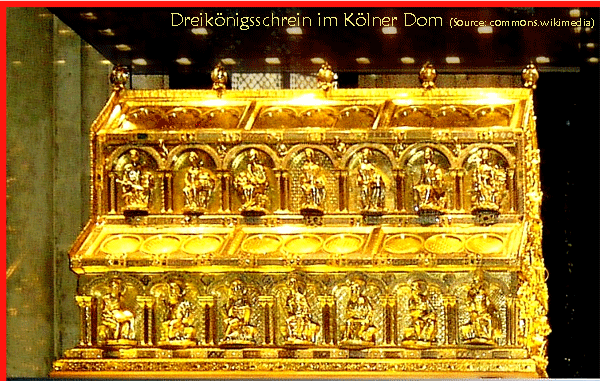
The closest I got to the physical entity of the three wise men was when we stood before the gilded and decorated triple Sarcophagus traditionally believed to contain the relics of the Magi at the Shrine of the Three Holy Kings (Dreikönigsschrein) behind the high altar of Cologne Cathedral (Der Kölner Dom) in Germany.

17

Those relics were transferred from the church of St. Eustorgius in Milan on 23rd July 1164 by the powerful imperial chancellor, Rainald von Dassel (later Archbishop of Cologne) (3) having received them from the Holy Roman Emperor Frederick I (Barbarossa).
18

Sometime after her arrival in the Holy Land around December 326/January 327 A.D., Helena (Flavia Iulia Helena Augusta/St. Helena – 248/9-329?), the mother of Emperor Constantine and discoverer of the True Cross, had discovered the bones of the Magi while searching for relics and building churches in honour of the life of Jesus. Chroniclers contend that she transferred the relics to Constantinople and later, Bishop Eustorgius, a native of Constantinople, was allowed by Emperor Constans (Flavius Iulius Constans Augustus – from 337 to 350) to transfer them to Milan in 343/44. The relics eventually became the most remarkable medieval cults to royalty.

19

The magi, a popular subject of tapestry, are patrons of travellers and pilgrims. In addition to the above three places, I have visited other centres where Christian reliquaries are kept, but a visit to one in Greece connected to the Magi remains yet to be realised. The Holy Monastery of Agiou Pavlou (Saint Paul’s) in Mount Athos houses, among many other relics, some cases containing gold, frankincense and myrrh, believed to be the gifts the Magi brought to baby Jesus. The authenticity of some of the relics could be doubtful but such vestiges play an important role as catalysts in connecting us to the history and legends of our illustrious past.

20

21Christmas, celebrated everywhere, is particularly enjoyable at some places where it exudes a whole lot of charm to enjoy it the most. We have spent Christmas Day and New Year’s Day in different countries. Those special days made good memories for us – just like some days bearing special names are auspicious for many: Thanksgiving Day, Republic Day, Independence Day, May Day, Father’s Day, Mother’s Day, Patriots’ Day, Valentine’s Day, Friendship Day, Day of Tiger, of Elephant, etc….. All this is very well.

Then again, woven into the fabric of the year are ill-fated days from history lesson: 9/11 (World Trade Center attack), 26/11 (Mumbai attack), 13/11 (Paris attack), ……. – named after disastrous events that have spawned sadness in us and bruised our pride, occasioned by malicious minds hell-bent on executing everything violent in excess. The world witnessed outpour of grief when innocent and helpless people lost their lives recently owing to brutal violence.

Even so, pain nourishes courage. The global goodwill resonated in displays of solidarity, judiciousness and calm wisdom when the Eiffel Tower, Paris; San Francisco City Hall; Tower Bridge, the London Eye, the National Portrait Gallery in Trafalgar Square, Wembley Stadium in London; Brandenbourg Gate in Berlin; Christ the Redeemer statue in Rio de Janeiro; the CN Tower in Toronto; Burj Khalifa in Dubai; Tokyo Tower; Sydney Opera House; etc, showcased colours of blue, white and red. Vive la France!

22

Naturally, we bank on a sense of order and peace around us and we wish our lives to measure up to our hopes. There is nothing so precious and nothing more important than peace, though throughout history it has often been taken for granted until it’s too late. The past high degree of violence and unpredictability, offensive to our good spirits, had markedly dampened this holiday cheer. Recently there was news about tourists being selective on places to go for a safe and peaceful vacation.

23

24

25

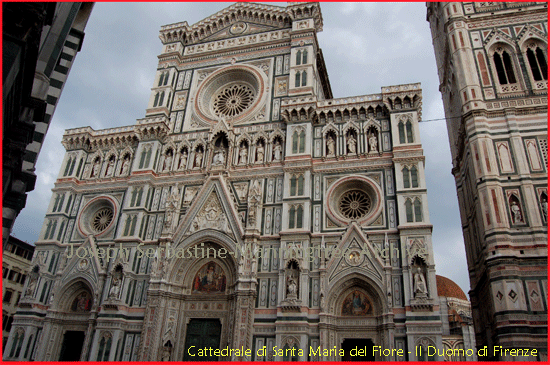
26As for us raring to go, despite the weather, we could opt for Christmas time in Italy even though we would be doing only a repeat of what we have done there many times over the years. There would be the traditional outdoor Christmas markets in Florence, Verona, Venice, Rome, …. On Christmas Eve, we could attend the Papal Mass by Papa Francesco at the Basilica Papale di San Pietro in Vaticano and admire the huge Christmas tree and the life-sized Nativity scene in Piazza San Pietro; or at the Cattedrale di Santa Maria del Fiore (Duomo di Firenze); or at Basilica di San Marco, Venezia and watch the gondola arrive with Babbo Natale (Father Christmas) to distribute goodies, before sitting down for dinner and Bellini at Cipriani’s Harry’s Bar; or at Basilica di Sant’Antonio di Padova where we have wonderful friends amongst the Franciscan friars of the Basilica, etc.

Besides England, France, Germany, Austria, Switzerland, Spain, Portugal, all wonderful places where we have enjoyed the local culture, Madrid (Spain) would garner our priority due to the wonderful ensemble of jolly good friends we have there. Alternatively, should we look at the East, we could always opt for Thailand, Singapore – or within good old India.

27

28

Now with the three wise women  in my life, my wife and two daughters, here – it’s ample reason to take the pleasure of this season in the comfort of our sweet home. There won’t be snow here. But, never mind – the carollers and Santa Claus will come, maybe even Santa Mama.  Peaceful Cochin and Fort Cochin will be decked with lights and stars – with the brightest most cheerful displays. Impersonations of the three wise men may appear in the yearly Carnival on the first of the New Year. Listen closely and we may hear Santa Claus cracking up with laughter in helplessness – at the seasonal hike in retail prices. I think there was never a sad Christmas time in Fort Cochin except maybe in 1524 when a period of mourning was observed owing to the death of Portuguese explorer Vasco da Gama at Fort Cochin on Christmas Eve.

29

Out of the many boxes resting in our storeroom for the past eleven months would spring beautiful stars, lights and ornaments to deck up our Christmas tree and adorn strategic places in our house. A beautiful floral table centrepiece will be made. My wife, very skilful with dazzling décor ideas, characteristic of her German origin, will once again ensure that all is done.

30

31As for the creation of the Christmas crib, I believe I still have the inspiration from the creative astute shown by San Francesco di Assisi when he, with the permission of Pope Honorius III, recreated the Nativity scene (Presepio) for “the babe of Bethlehem” at the village of Greccio in Provincia di Rieti, Italy during the Christmas of 1223. Then again, the most inspiring of all this would be the message of Christmas – summarized in three magical words: “Kindness, Love, Peace”.

Not outdated or irrelevant, those sweet meditations of a mature faith appear relevant, especially in these times of adversity, to “survive with dignity”. Jo

Notes:

  • In art, so far as is known, the name of the three wise men appears for the first time in a relief sculpture on the lintel of the central portal above the main door at Chiesa di Sant’Andrea, the oldest surviving church in Pistoia, Tuscany. Created by Magister Gruamonte and his brother Adeodatus, it dates to 1166 – about 29 years prior to the birth of St. Anthony of Padova.
  • The three wise men were said to have come from the kingdoms of Tarshish, Sheba and Seba – three of the many places proposed as their countries of origin.
  • In “The War of Frederick I. against the Communes of Lombardy”, Rainald is named as Reinhardt.
  • The DVD/Blu-ray of “Ben-Hur” (1959) referred in this article, is available with main dealers of movies. Please refer to “About” of my webpage for more details.
  • This article is in memory of Michael and Gertrud Schüller, (late) parents of Carina, who would have loved to spend this Christmas here with us. May their souls rest in peace.

32

33

(© Joseph Sebastine/Manningtree Archive)