Tag Archive | Christianity

A Beautiful Mindset

Recently some of my posts featured Attila the Hun and Jesus Christ, among other subjects. They both in the end conquered the World. Attila did it by force – evoking the violence of hordes of Huns. Christ attained it by love. Indeed, Christianity of Christ is a faith for all occasions. It not only teaches one to be courageous in darker times but also to be happy wisely.

At this fag-end of the year 2024, I appreciatively focus on this Christmastime and the brotherhood and some festivities associated with it. In fact, one of the great vital principles of Christianity is the brotherhood of all humanity. As I write this now, it’s the Christmas Eve – by and large, a time of gaiety and good cheer. Only few hours remaining for the event made known by the Bible, viz. Virgin Mary brought forth her first-born son and wrapped him up in swaddling clothes and laid him in a manger… ushering in the Christmas Day!

There existed a custom which exalted a child born at Christmas as fortunate in life and never see a ghostie as long as that child lived. At the same time, there was another belief that those born on a Christmas Eve cannot see spirits to the end of their days and do not require holly and mistletoe as guardians against evil. On the whole, majority of superstitions and omens related to Christmas belong to a happy nature.

Born on January 18, I qualify as a Capricornian (those born between December 22 and January 20). I have heard that Capricorn is related to the most elevated point in the heavens and perhaps the best known sign of all those in the Zodiac. Part of the reason is based on the statistic that it is during the reigning period of Capricorn; millions of people all over the world could avail the opportunity to pay homage to the most famous birthday of all — the glorious birthday of the Baby Jesus on December 25 – born in Bethlehem of Judah, in the days of King Herod.

Perchance, it is this affinity which explains the innate religious trait in most Capricornians even though oft-times such a trait is unrealised or unconscious.

In general, Christmas is a grand time for getting together, for meeting new ones and greeting old friends. Behind all the merriment, there’s an inherent significance in Christmas: Peace on Earth — Goodwill to Men. Such is the message of Jesus, and that is the spirit that underlies a genuine Christmas celebration. Jo

(©Joseph Sébastine/Manningtree Archive)

Christmas of Long Ago

A charming feature of the present festive season is the decorated evergreen Christmas tree, ablaze with tiny lights, which represents the spirituality of Christmas. In Europe and elsewhere, pine and fir are species grown as fresh Christmas trees. At times, when they were not readily available potted, a similar species of conifer, perchance, Norfolk Island pine (star pine, Araucaria Heterophylla) is acquired as a substitute.

The topic of substitution brings to my mind a letter I came across in an old edition of an Australian magazine. It was written by a woman about her great-grandmother who was a colonist passenger in a ship sailing from England bound for Australia more than 165 years ago. In 1851, there was a gold rush in Australia when gold had been discovered at Ballarat, closer to Melbourne which caused such an on-rush of emigration that during 1852-57 about 225,000 people arrived in Australia. In fact, the urge for emigration has been gathering momentum much earlier due to the 1845 blight that ruined the potato crop, the staple diet of Ireland. As a result of that Irish Potato Famine, about one million Irish citizens died from disease and starvation; while another million emigrated; mostly to America.

At that time, the ship building sector was also undergoing a transitional period when sailing ships were changing from wood to steel although some ships were made from iron. The subject ship had an auxiliary steam engine for use when the wind was calm or contrary. While her engine was only capable of 200 horse power, I reckon, it took about 60 days to reach Australia from England.

As the narration goes, everyone in that ship was looking forward to spend Christmas in the new land and ladle great helpings of Aussie hospitality. But, on the Christmas Eve, all passengers were disheartened to learn that the ship was still hundreds of miles away from the seashore which meant – no Christmas tree. But when the children gathered in the ship’s saloon for their gifts, they were surprised to find a little tree with real leaves. That tree, adorned with tinsel ornaments and white sugar for ‘snow,’ was already lighted with tiny candles.

Assuming that the ship will be delayed and Christmas would be spent at wintry sea, the ship’s carpenter, a “rough diamond” but a “very smart man” and a stickler to the “Englishness” of Christmas, took the task to make the tree. Upon sailing from Cape Town, he sowed parsley seeds in a box filled with sand (from ship’s ballast) and sawdust. While it was kept out of reach of salt spray, the crew took turns to water it using their daily allowance of drinking water. As Christmas neared, the parsley had grown luxuriantly. From the firewood the carpenter carved out the stem and the branches on which the parsley leaves were tied. Thus, a Christmas tree was born!

True to the Christmas ideal, how thoughtful of the ship’s carpenter to use his skill to create and decorate the Christmas tree and share it to swell the hearts of friends and strangers. Just as it always does, Christmas invites us to throw open the doors of our hearts and homes for child Jesus and love to come in. Are you decorating your Christmas tree today? – Jo

Images of Christmas tree courtesy: Sharon Grace Martinez

(©Joseph Sébastine/Manningtree Archive)

S. Agnes of Rome VM

S. Agnes of Rome VM

Lat. Sancta Agnes, Ital. Sant’ Agnèse, Spa. Santa Inèz,

Santa Ignes, Fr. Sainte Agnes, SS. Agnetis, Angl. Agnes

c 291 – c 304 – Feast: January 21

Part I (in 3 parts)

S. Agatha of Sicily (d. c 251), S. Cecilia (d. c 280), S. Agnes (d. c 304), and S. Lucia of Syracuse (d. 304) are the four great virgins of the Latin Church. Martyrs of early Christianity they are – the first and last being Sicilians and the remaining two Romans.

Since the time of Roman emperor Constantine the Great (C., Flavius Valerius Constantinus, c. 274-337), a basilica stood beside Via Nomentana in Rome in honour of the Roman maiden S. Agnes who followed Christ from her infancy. Upon wearing the crown of martyrdom in c. 304 when she was twelve or thirteen years of age, she was buried in a cemetery named after her which has close proximity of this basilica.

A special patroness of maidens and chastity, and named in the first Eucharistic prayer, S. Agnes is one of the most popular of saints and patron saint of Roman virgins. Earlier writings tells us that S. Agnes, whose name signifies lamb in Latin and chaste in Greek, was born in an illustrious Roman patrician family in c. 291 and baptised at a very early age.

Through the years that followed, Agnes became renowned for her tender beauty and also for her enthusiastic piety to lead a life of purity. At the age of twelve, she was denounced as a Christian to Symphronius, the Roman prefect of the city. Her accuser was the prefect’s own son Procop, an unsuccessful suitor to whom Agnes refused matrimony alleging that she was already dedicated to Christ.

During that primitive age of the Church, Caesar had many, many ears that listened for him.

Persecution of Christians under the iron hand of imperial Rome spanned a space of three hundred years when many innocent Christians were tormented to convert. If that does not work, the process was to line them all up. Behead the first one, and if the next does not renounce his faith in Christianity, work one’s way to the very end. Nevertheless, such persecutions did not annihilate the believers but enflamed the faith of the martyrs instead.

How could Agnes be an ardent believer of a man who had been executed by a Roman governor of Judea? In a word, she was deemed guilty of blasphemy against the Roman gods. The accusation against Agnes during Emperor Diocletian’s fierce continuous persecution of Christians (303-305) (1) resulted in her detention and interrogation following which she was subjected to different stages of torture. However, Agnes’ saintly bearing had helped her to retain her consecrated virginity after she was forcefully confined to a house of infamy in Circo Agonale (2), Rome.

In such circumstances the imperial Roman persecutors will always have to win. But here they have failed in their efforts to compel Agnes’ recantation of the Christian faith and also to coerce her to worship goddess Vesta (3). With their anger ignited, Agnes was subjected to an ordeal by fire but the outcome was that she remained untouched by the scalding hot flames. Soon after, at the orders of Pro-prefect Aspasius, she was publicly decapitated by the sword of a lictor (4).

Later writings on S. Agnes reveal that she was the focus of praises by great Christian scholars such as S. Jerome (Eusebius Hieronymus, c. 342-420); S. Ambrose of Milan (c. 339-397 – detailed in his treatise de Virginibus addressed to his elder sister, S. Marcellina V (330-398)); Pope S. Damasus I (Reign: 366-384); and Latin Christian poet Marcus Aurelius Prudentius (c. 348-413) in his 4th century hymn, The Passion of Agnes in Liber Peristephanon (Crown of Martyrs).

By S. Agnes’ martyrdom, she had only gone beforehand ‘in the sign of faith.’ The lives of saints are an exposition of the faith of Jesus Christ. The fairness of Christianity is that women are regarded as equally gifted with holiness as men are and all true, without prejudice, both are evenly loved by God. When a list of the Roman church martyrs perished during the great persecution of Diocletian was compiled around 336, it marked the first inscription of Sancta Agnes, the fair Roman maiden with an air of saintly dignity blended with the most benign sweetness.  

Jo                                                                                (Continued in Part II)

Notes:

  1. We do not know with certainty in which persecution Agnes won the martyr’s crown. This incident is variously placed during periods of severe persecution under: Caius Trajanus Decius (249-251); Publius Licinius Valerianus (257-260); Gaius Valerius Diocletian (303-305).
  2. Circo Agonale: The Agonale Circus (Stadium Domitiani) was built on the site of the great circus of Tarquin the elder. In the course of time, the area fell into ruins. Under Pope Callixtus II (1065-1124), the Church of Sant’Agnese in Agone was built there and consecrated on 28 January 1123.
  3. Vesta (Hestia in Greek) is the Virgin goddess of the hearth and home in the Roman religion. She is one among the 12 superior Roman divinities (Dii majorum gentium) collectively known as Dii Consentes – the others being: Jünõ, Minerva, Cërês, Diana, Vënus, Mars, Mercürius, Diovis, Neptünus, Vulcanus, Apollõ. The worship of Vesta survived to the last days of paganism before it was abolished by pious Roman Emperor Gratian (Augustus Grãtiãnus, 359-383) in 382 A.D, a year prior to his assassination for his enmity to the Pagan superstition.
  4. The source of this account relates to the Latin ‘Acts‘ and the Ambrosian hymn.    

(© Joseph Sébastine/Manningtree Archive)

S. Cecilia (Sancta Caecilia)

S. Cecilia (Sancta Caecilia) VM 2nd-3rd century

(Martyred circa A.D. 280. In all the Calendars. Sarum Ep. and Gosp. : Ecclus. xli. 9-12; St. Matt. xiii. 44-52.)

As early as the 4th century, S. Cecilia (of Rome) was considered as one of the most famous of martyred Roman maidens. Born of distinguished lineage, she was eminent for her piety, and had vowed virginity. In those days, martyrdom was always a possibility. But to the one who practiced, with perfect fidelity, the maxims of Christianity ,‘To die for Christ is not to lose youth but to renew it.’ 

Martyred for proclaiming faith, and God, and Christianity, and Jesus Christ, this reputed patroness of music and musicians, was initially entombed in a cypress coffin in the cemetery of S. Callistus (Catacombe di San Callisto) on the Appian Way in Rome. Even though the cemetery bears his name, Pope S. Callistus I (217-222) himself is interred elsewhere, in the cemetery of Calepodius on the Via Aurelia.

In 821, Pope S. Paschal I (817-24) initiated the transfer of the relics of Cecilia from the Catacomb to the Basilica di Santa Cecilia in Trastevere in Rome. For five weeks all Rome streamed to the Basilica to venerate her body; and it was not until S. Cecilia’s Day that it was again sealed up in its coffin and marble sarcophagus.

The splendid Basilica di Santa Cecilia, rebuilt in 822, is believed to have been erected by Pope S. Urban I (222-30) on the spot where Cecilia lived and died. To this day, notwithstanding various rebuilding, it bears traces of its origin. It was in this old Basilica that on November 22, 545 while celebrating the Feast of S. Cecilia when Pope Vigilius (537-555) was arrested on the order of Empress Theodora of Constantinople.

Ever since 1599 (during the reign of Pope Clement VIII (1592-1605)) to this day, S. Cecilia’s alleged relics rest in the crypt beneath the high altar of this basilica in Trastevere. Feast: November 22.

I am a gentlewoman born,’ Cecilia had said; ‘among men Iam called Caecilia, but my noblest name is Christian.’

  1. Image source: commons.wikimedia.org: Top) Guercino – St. Cecilia, Google Art Project, Dulwich Picture Gallery; Middle) Carlo Saraceni – The Martyrdom of St Cecilia, Los Angeles County Museum of Art; Bottom) Orazio Gentileschi and Giovanni Lanfranco, Saint Cecilia and an Angel, National Gallery of Art, Washington, D.C.
  2. In memory of my beloved wife Renate Elisabeth who left for heavenly abode on August 24, 2023

(© Joseph Sébastine/Manningtree Archive)

The Roots and Wings of Valentine

1

Halloween, Thanksgiving, Christmas and New Year – the holidays of the short evenings are over. The spring vegetables are slowly entering the markets. Given that love is the keynote of that sweetest day of February when moments are made into memories, shops have displayed pretty favours for exchange between lovers and couples to mark the Valentine’s Day. As usual, a good number of high-flying hotels will be a much sought after destination on the 14th of this month for the lovers and couples out for a memorable candlelit evening of gastronomy, drinks, music, romance and to feel like a million dollars.

2Where we live, distinctive venues for such occasions are many and more are sprouting up every other month. Ecstatic to get it going, the dining tables there will be prettily decorated with fresh flowers, ferns, bisque cupids, candles, tableware, in addition to scattered red rose petals over the table cloth where a wide range of delicacies will be served with emphasis on its appearance since eye has much to do with the flavour of all food. Some even have in-house Mehndi artists or caricaturist to enhance the romantic ambiance.

The succulent specialities on offer in many restaurants, especially on occasions of festivities, present an extensive spread of seafood, meat and vegetarian delicacies and gorgeous after-food deserts very much compatible to all those gourmets. There, only few of the dishes need any explanation. From past experiences, the cuisine for the V-Day could include freshly shucked oysters, poached lobsters with dill and limoncello cream sauce, river Prawn Saganaki, baked fish, Beef Stroganoff, Braised Balsamic Chicken, Porcini Pork Tenderloin, Broccoli Quinoa Casserole, asparagus salad, etc, incorporating many of the general favourites of authentic regional Indian favourites cooked to perfection by chefs and their skilful teams playing cupids at the live stations. Be it ever so humble, praise for their delicious food never misses to light up their eyes as if they had won the lottery.

3

The objective is to make the Valentine’s Day the sweetest and memorable day of the year – touchingly sentimental, fun and ethical for those who wish to share their love and affection towards one another. In a time when affection and meaningful human communication takes a back seat as most eyes are buried in Smartphones, iPads, or other distractions, occasions like the V-Day reminds us to show that we love.

4

The tradition of the Festival of Love probably owes its origins to one of the pagan Roman festivals, Lupercalia, the festival of fertility which was celebrated in mid-February in ancient Rome. As part of its ritual, two young boys of patrician families dressed in goatskins, daub their faces with the blood of sacrificed goat and dog, and during a traditional course whipped maidens with stripes of leather as they passed. Expressing joy and happiness, such lashes were appreciated reckoning they would miraculously prevent or cure infertility. Somewhere between belief and doubt lies the faith.

5

After Christianity became more prevalent in Rome, the festival became associated with St. Valentine (1) a Christian priest and physician in Rome who was martyred on February 14, c. 269 AD (on the eve of Lupercalia) for being an advocate for the cause of peace and love. The book “Saint Valentine” by Robert Sabuda relates the story about how Valentine restored the blindness of a young girl with his deep faith and healing skills.

The custom of sending Valentines stems from a medieval belief that birds began to pair on the day Valentine was beheaded under the cruel Roman Emperor Claudius II Gothicus (Marcus Aurelius Valerius Claudius/Claudius the Goth, 268 to 270) who succumbed to plague in 270 AD. Amongst the customs that continued was the opportunity to choose a sweetheart or Valentine and letters or tokens can be sent secretly to the object of affection as a declaration of romantic love.

6

The rejuvenation of this event, after a slack in popularity but persisting through writings including those of Geoffrey Chaucer (c. 1345-1400) and William Shakespeare (1564-1616), could be attributed to the innumerable cards, books, poems, songs, stage presentations and films that flourished since the eighteenth century onwards. Nevertheless, it is always those couples entwined in their genuine love for each other, blessedly always much abundant in the world, who have kept this tradition of love alive and blooming. Some of the legends and stories of love that sparkled as jewels through the timeline of our world has inspired millions and has undoubtedly caught the imagination of the world.

7

I can think of many love deities and personalities in every culture dedicated to different fervours of love: Egyptian divinities Osiris and Isis; Roman Jupiter and Juno (Greek Zeus and Hera); Solomon and Sheba; Pharaoh Amenhotep IV (Akhenaten) and Queen Nefertiti; Orpheus and Eurydice; Queen Cleopatra and Mark Antony; Justinian and Theodora; Lancelot and Guinevere; Layla and Majnun; Shah Jahan and Mumtaz Mahal; Salim (Emperor Jahangir) and Anarkali (Nadira Begum or Sharf-un-Nissa);

8

Queen Victoria and Prince Albert; Napoleon and Joséphine de Beauharnais; Jean-Paul Sartre and Simone de Beauvoir; Romeo and Juliet; Tristan and Isolde; Robin Hood and Maid Marian; Tarzan and Jane. I do not exclude  those stars of the film world who, at certain times, had become real life romantic characters they played on screen (2):

9

Mary Pickford and Douglas Fairbanks; Ingrid Bergman and Roberto Rossellini; Sir Laurence Olivier and Vivien Leigh; Katherine Hepburn and Spencer Tracy; Clark Gable and Carole Lombard; Rita Hayworth and Orson Welles; Humphrey Bogart and Lauren Bacall; Richard Burton and Elizabeth Taylor; etc… the love is always in the air and for many of them sometimes everything falls together.

10

Of the many customs built around this festival of love, few old customs like the artistic Victorian cards have sadly disappeared while more formal ways of messaging through emails or SMS or that great equalizer called WhatsApp have taken over in popularity.

11Then again, besides the enthusiasm of some couples, the reason Valentine’s Day has garnered more popularity today is due to the print and visual media and to the efforts of the corporate/marketing strategists striving to make it a gross consumer fest.

If the customary choices of the old school fancied Valentine cards, books, tokens, boxes of Belgian chocolates or selected kinds of gifts, and even considered a hug as a great gift; the preferences has presently progressed to all things high-flying – the posh sort – choices big and small, often putting some aficionados under “wallet” pressure – choices such as couture labels, a Visconti pen, a Supreme Goldstriker iPhone with the highest GB, a gorgeous clutch bag, a beautiful sparkling necklace, amazing Stuart Weitzman shoes, vintage boots, a Patek Philippe or Breitling wristwatch, luxury fragrances, a Lamborghini Veneno car, a holiday in The Bahamas, diamonds, secret tattoos, belly button ring, …. the list has become endless to maximize the vibes… The choice is ours.

Nevertheless, fresh flowers have always remained one of the popular gifts.

12

To give fresh flowers – those embodiments of perfect beauty – to a sweetheart….. what gift could honestly be nicer and special? They even leave their fragrance on the hand that bestows them.

13

When young mortal Adonis of Greek mythology lost his life owing to a wound he received from a boar during a chase, Aphrodite (Venus to the Romans), the goddess of love and beauty and the love of his life, found solace from her deep grief in the beautiful Anemone flower which sprung from his blood (or from her tears), until the gods of the lower world favoured her by allowing Adonis to spend six months of every year on earth with Aphrodite. And it is from Aphrodite’s son Eros (Cupid/Amor) that V-Day earned the grace of Cupid, the god of love – a wanton boy with arrows in a golden quiver, who is related to a thousand tricks and cruel sports – the most potent being the pierce from his golden arrow that would kindle love in the stricken heart.

14

When my wife first came to meet me, she brought along an enormous bunch of fresh ivory coloured tulips in a box all the way from England, carefully looked after by the cabin crew of British Airways. Truly a heart of gold she has. She had specifically chosen that spring flower due to my ardent “tulipomania”. Of course, one’s own preferred choice would be different. A friend’s wife preferred velvety red roses from her husband since it’s the symbol of happy and passionate love, while another friend suggested that, if possible, we bring garden daisies to cheer his hospitalised wife when we visited her.

15Somewhere along the way, love has taken its place in the age-old form of art that associate flowers with different meanings. Floriography signifies the name of the language of flowers as practiced in traditional cultures in many parts of the world. The Japanese call it Hanakotoba.

As ivory coloured tulips will always be the symbol of true love for me, the symbolism and hidden meaning of those flowers that express love and affection, subject to change with various combination (3), is generally regarded as: Apple Blossom (Good fortune) – Balsam (Ardent love) – Jasmine (Grace and Elegance) – Lavender (Devotion) – Lilac (First Emotions of Love) – Orchid (Fertility, love and Beauty) – Red Tulip (Declaration of Love) – Sunflower (Adoration) – Violet (Faithfulness), Hibiscus (Sacred Love and Beauty)….

16

Amongst the vast array of flowers lingers the “Forget-Me-Nots”, the lover’s flower. The legend has it that a valiant German knight slipped and fell into water when stooping to gallantly pick up some beautiful blue flowers growing in the water which his paramour wanted him to get for her. Before he finally sank under the water, he threw the flowers at his love and implored her to “Vergiß mein nicht” (Forget Me Not). It was the voice of genuine love that was calling out, to remind, “I will be always with you. I will love you just as you are.”   

Amore!   If love is the key to our hearts, no doubt, then the heaven is within us. Ciao, Jo

17

Notes:

  • According to the Roman Martyrology, two persons under the name of Valentine were martyred on February 14, c. 269. One was St. Valentine who was buried on the Flaminian Way where a basilica was erected in 350. Another Valentine was the bishop of Interamna (Terni) about 104 kms from Rome, beheaded there by order of Placidus, prefect of Interamna. Many scholars believe that these two persons are the same.
  • The book Saint Valentine by Robert Sabuda and DVDs of the movies of the stars referred above are available with reputed dealers.

18

 (©Joseph Sébastine/Manningtree Archive)

SURVIVING WITH DIGNITY

1

The joy of Christmas is nearer, drawing in a beehive of activities allied to it. The Christian Churches here, as in all parts of the world, are livened up for the yearly holy event marking the birth of baby Jesus, followed by the close of another year. Most educational institutions are on preparatory mode for holding mid-term exams prior to the culmination of the vacation season.

2

Plans are being made for annual vacations, or joyous activities, or gourmet feasts, or family get-togethers. Banking on the commercial value of the holiday season, the hospitality industry and other retailing sectors including big Malls are once again out with window decorations, dangling fantasies and other crowd-tickler marketing gimmicks through the media, web and signposts.

3

One is baffled and bewildered by the choice of innovative merchandize, latest tech trends, etc, available.  “Happy Shopping Holidays” – three charming words dominate this period to augment the marketing campaigns.

4

A special event at all times to me, Christmas, like Easter, has a considerable period of preparation. The Gospel of St. Matthew relates so briefly about preparations that had taken place some 2020 years ago when, three wise men, proficient in astronomy and astrology, turned their heads up to gaze at a brilliant star that would set them on a journey. Theirs was a spiritual desire to find and adore a new-born child – to lay their gifts contained in caskets of odoriferous wood at the child’s tiny feet – gifts of pure gold (asserting the kingship of Christ), frankincense (Christ’s divinity) and myrrh (that He was man, and doomed to death).

5

Their long and perilous journey through “field and fountain, moor and mountain, following yonder star” culminated in success when they found the new-born Jesus not in the stable, as usually depicted in the scene by artists, but in a roofed house where the three holy ones were temporarily lodged. These three wise men (or kings) would be the first to acknowledge Christ.

6

These wise men, assumed to be three given that three gifts were given in homage of Christ’s birth, are identified by various names, but generally known as Balthazar, Melchior and C(G)aspar since the ninth century (1). Believed to be Babylonian names, according to an old valuable book about Virgin Mary, they probably hail from the city of Séleucide which was the abode of the most celebrated astronomers of antiquity (2).

7

The Bible also relates to another journey during that period, taken place hundreds of miles away from the path the Magi would travel. Carpenter Joseph of Nazareth in Galilee accompanied by his wife Mary was on their way to Bethlehem of Judea, to register their names and pay tribute-money owing to the Roman Census of population and landed possessions.

8

Besides his beloved pregnant wife riding on a donkey, Joseph, humble, modest and retiring, was devoid of possession of anything of great value except for few clothes and the usual provisions for their painful journey of possibly five days. Their basket made of palm leaves could have included dates, figs, raisins, thin cakes of barley meal, earthen vessel to hold water, and the most precious swaddling-bands Mary’s hands had prepared to envelop her child. The census, made in the late autumn or early winter when agricultural work had ceased, might have attracted great concourse of people to the region that accommodation in cells of caravansaries in Bethlehem were unavailable.

9

Whatever the reason, upon their arrival at Bethlehem, Joseph and Mary sought shelter in a stable in the interior of a little cavern located in the suburbs which served as a stable and sometimes as refuge for the shepherds in cold and stormy nights. In there, after a good lengthy time following the hour of the Nativity, the new-born infant was adored by the shepherds as the Christkindl lay in a manger, wrapped in swaddling clothes.


11

12The adoration of the shepherds and the Magi is depicted in several movies. One of the realistic among them appears in the initial scenes of director William Wyler’s cinematic triumph, Ben-Hur (1959), its devotional ambiance enhanced by the Academy Award winning music score of Miklós Rózsa (1907-1995). Watching Wyler’s “Ben-Hur” is an enjoyable and rewarding experience. Its grandeur and spectacle, colourful characters, richness of its screenplay, excellent direction, fantastic production values, the realistic action sequence of the chariot race, the many visual symbolic threads woven into the story such as water accentuated as an agent of renewal, the dramatic effect emphasized without showing Christ’s face, the transition from full orchestra to organ during the sequences in which Christ appears, and most importantly, its story about a rich man passing through the eye of the needle, had caught up my imagination that “Ben-Hur” rates the highest number of times I have seen a movie.

13

The little figurines of the Magi from the story of the Adoration of the Biblical Magi, part of the ensemble of the Christmas crib-set in our house, were objects of marvel in my childhood. Their crowned figures clad in embroidered robes featured all the paraphernalia and pomp of royalty; their camels decked with ornamental bridles and saddles, the mysterious gifts in their hands, were all sprigs of fascination. Their images got better and fine-looking as we purchased better crib-sets over the years – from Austria, Italy and Bangkok.

14

The custom of exchanging gifts could date back to the three wise men. As some stories go: in olden times on Christmas Eve, children used to place shoes filled with oats outside their huts for the camels of the Magi which they hoped would be miraculously replaced with gifts.

15

16

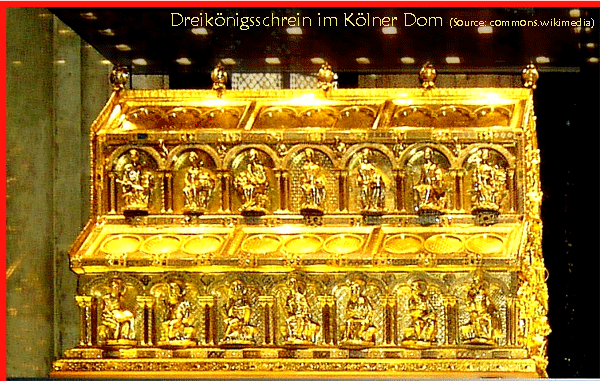
The closest I got to the physical entity of the three wise men was when we stood before the gilded and decorated triple Sarcophagus traditionally believed to contain the relics of the Magi at the Shrine of the Three Holy Kings (Dreikönigsschrein) behind the high altar of Cologne Cathedral (Der Kölner Dom) in Germany.
17

Those relics were transferred from the church of St. Eustorgius in Milan on 23rd July 1164 by the powerful imperial chancellor, Rainald von Dassel (later Archbishop of Cologne) (3) having received them from the Holy Roman Emperor Frederick I (Barbarossa).

18

Sometime after her arrival in the Holy Land around December 326/January 327 A.D., Helena (Flavia Iulia Helena Augusta/St. Helena – 248/9-329?), the mother of Emperor Constantine and discoverer of the True Cross, had discovered the bones of the Magi while searching for relics and building churches in honour of the life of Jesus. Chroniclers contend that she transferred the relics to Constantinople and later, Bishop Eustorgius, a native of Constantinople, was allowed by Emperor Constans (Flavius Iulius Constans Augustus – from 337 to 350) to transfer them to Milan in 343/44. The relics eventually became the most remarkable medieval cults to royalty.

19

The magi, a popular subject of tapestry, are patrons of travellers and pilgrims. In addition to the above three places, I have visited other centres where Christian reliquaries are kept, but a visit to one in Greece connected to the Magi remains yet to be realised. The Holy Monastery of Agiou Pavlou (Saint Paul’s) in Mount Athos houses, among many other relics, some cases containing gold, frankincense and myrrh, believed to be the gifts the Magi brought to baby Jesus. The authenticity of some of the relics could be doubtful but such vestiges play an important role as catalysts in connecting us to the history and legends of our illustrious past.

20

21Christmas, celebrated everywhere, is particularly enjoyable at some places where it exudes a whole lot of charm to enjoy it the most. We have spent Christmas Day and New Year’s Day in different countries. Those special days made good memories for us – just like some days bearing special names are auspicious for many: Thanksgiving Day, Republic Day, Independence Day, May Day, Father’s Day, Mother’s Day, Patriots’ Day, Valentine’s Day, Friendship Day, Day of Tiger, of Elephant, etc….. All this is very well.

Then again, woven into the fabric of the year are ill-fated days from history lesson: 9/11 (World Trade Center attack), 26/11 (Mumbai attack), 13/11 (Paris attack), ……. – named after disastrous events that have spawned sadness in us and bruised our pride, occasioned by malicious minds hell-bent on executing everything violent in excess. The world witnessed outpour of grief when innocent and helpless people lost their lives recently owing to brutal violence.

Even so, pain nourishes courage. The global goodwill resonated in displays of solidarity, judiciousness and calm wisdom when the Eiffel Tower, Paris; San Francisco City Hall; Tower Bridge, the London Eye, the National Portrait Gallery in Trafalgar Square, Wembley Stadium in London; Brandenbourg Gate in Berlin; Christ the Redeemer statue in Rio de Janeiro; the CN Tower in Toronto; Burj Khalifa in Dubai; Tokyo Tower; Sydney Opera House; etc, showcased colours of blue, white and red. Vive la France!

22

Naturally, we bank on a sense of order and peace around us and we wish our lives to measure up to our hopes. There is nothing so precious and nothing more important than peace, though throughout history it has often been taken for granted until it’s too late. The past high degree of violence and unpredictability, offensive to our good spirits, had markedly dampened this holiday cheer. Recently there was news about tourists being selective on places to go for a safe and peaceful vacation.

23

24

25

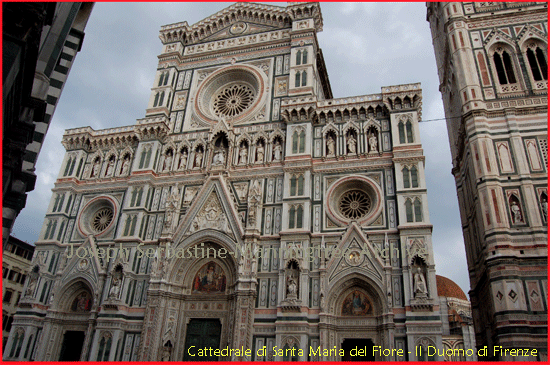
26As for us raring to go, despite the weather, we could opt for Christmas time in Italy even though we would be doing only a repeat of what we have done there many times over the years. There would be the traditional outdoor Christmas markets in Florence, Verona, Venice, Rome, …. On Christmas Eve, we could attend the Papal Mass by Papa Francesco at the Basilica Papale di San Pietro in Vaticano and admire the huge Christmas tree and the life-sized Nativity scene in Piazza San Pietro; or at the Cattedrale di Santa Maria del Fiore (Duomo di Firenze); or at Basilica di San Marco, Venezia and watch the gondola arrive with Babbo Natale (Father Christmas) to distribute goodies, before sitting down for dinner and Bellini at Cipriani’s Harry’s Bar; or at Basilica di Sant’Antonio di Padova where we have wonderful friends amongst the Franciscan friars of the Basilica, etc.

Besides England, France, Germany, Austria, Switzerland, Spain, Portugal, all wonderful places where we have enjoyed the local culture, Madrid (Spain) would garner our priority due to the wonderful ensemble of jolly good friends we have there. Alternatively, should we look at the East, we could always opt for Thailand, Singapore – or within good old India.

27

28

Now with the three wise women  in my life, my wife and two daughters, here – it’s ample reason to take the pleasure of this season in the comfort of our sweet home. There won’t be snow here. But, never mind – the carollers and Santa Claus will come, maybe even Santa Mama.  Peaceful Cochin and Fort Cochin will be decked with lights and stars – with the brightest most cheerful displays. Impersonations of the three wise men may appear in the yearly Carnival on the first of the New Year. Listen closely and we may hear Santa Claus cracking up with laughter in helplessness – at the seasonal hike in retail prices. I think there was never a sad Christmas time in Fort Cochin except maybe in 1524 when a period of mourning was observed owing to the death of Portuguese explorer Vasco da Gama at Fort Cochin on Christmas Eve.

29

Out of the many boxes resting in our storeroom for the past eleven months would spring beautiful stars, lights and ornaments to deck up our Christmas tree and adorn strategic places in our house. A beautiful floral table centrepiece will be made. My wife, very skilful with dazzling décor ideas, characteristic of her German origin, will once again ensure that all is done.

30

31As for the creation of the Christmas crib, I believe I still have the inspiration from the creative astute shown by San Francesco di Assisi when he, with the permission of Pope Honorius III, recreated the Nativity scene (Presepio) for “the babe of Bethlehem” at the village of Greccio in Provincia di Rieti, Italy during the Christmas of 1223. Then again, the most inspiring of all this would be the message of Christmas – summarized in three magical words: “Kindness, Love, Peace”.

Not outdated or irrelevant, those sweet meditations of a mature faith appear relevant, especially in these times of adversity, to “survive with dignity”. Jo

Notes:

  • In art, so far as is known, the name of the three wise men appears for the first time in a relief sculpture on the lintel of the central portal above the main door at Chiesa di Sant’Andrea, the oldest surviving church in Pistoia, Tuscany. Created by Magister Gruamonte and his brother Adeodatus, it dates to 1166 – about 29 years prior to the birth of St. Anthony of Padova.
  • The three wise men were said to have come from the kingdoms of Tarshish, Sheba and Seba – three of the many places proposed as their countries of origin.
  • In “The War of Frederick I. against the Communes of Lombardy”, Rainald is named as Reinhardt.
  • The DVD/Blu-ray of “Ben-Hur” (1959) referred in this article, is available with main dealers of movies. Please refer to “About” of my webpage for more details.
  • This article is in memory of Michael and Gertrud Schüller, (late) parents of Carina, who would have loved to spend this Christmas here with us. May their souls rest in peace.

32

33

(© Joseph Sebastine/Manningtree Archive)