Tag Archive | Garden of Eden

Lessons from The Garden

Part III of The Flower and The Nettle (in 3 parts)

A word or a smile is often enough to put fresh life in a despondent soul.” – St. Thérèse of Lisieux

Although few names are listed in the Bible from Adam to Noah, it is estimated that even before the murder of Abel around 130 years after Adam’s creation, through the human reproductive process, there were upwards of four hundred thousand male descendants of Adam, in addition to women and children. If a tradition of Abyssinia speaks truly, they were descended from Shem, the son of Noah.

One legend that engaged the minds of the ancients of Abyssinia asserts that the devil or Satan, the head hunter from the garden, was not yet done with just the fall of Eve and Adam. That episode in the garden was only the beginning – a foretaste. Hiding in the serpent for that first time, the devil’s initial attempt was to attribute the prohibition on the fruit of the tree of knowledge in the midst of the garden to envy. Thus, by planting the seeds of doubt in the mind of the woman, the evil one had secured a sparkling victory by inducing disobedience in Adam through Eve which led to their punishment.

Thereafter, God had questioned Adam and his woman but didn’t question the devil: because it’s a non-issue. The devil is confirmed as who he is. He doesn’t just act evil for he is the evil one, at times a fire out of control. The devil cannot be other than he is. His success in this episode, no doubt, had opened the pathway for the evil one to continue with his fiendish stratagem.

In spite that Adam and Eve realised that the Satan impersonated as a serpent had deceived them at so great a price, yet with a singleness of purpose, the devil had ventured to deceive those human mortals once again with his deceptive ways. As we believe, his satanic force of will favoured special and privileged footing in terms of continuity and high advantages in exercising his misdemeanours which was his known forte since a constant endeavour to do evil always exhales and ascends from hell.

The devil is not a literary invention. The Abyssinian version of the Fall of Man of the Old Testament was that jealousy is the prevailing root of all evil and it descended with other sins from our first parents. And so, there are temptations everywhere. The devil will always do his best to tempt you into sin until you get to that place where you fall in love with sin, ungodliness and worldly lusts. He wants you down there with him – like his everlasting inheritance.

One day, Eve was in the cave waiting for Adam to return from the field. At the set of sun, the devil, the hater of all good, decided to approach her.

Eve spent most of her time in their dwelling place in a cave in a rock on the western border of the garden where the earth was very broad. She often thought about how very peaceful and distinct their charmed life of comfort, as they knew it, having lived in that Garden. She knew of the values of that period, of life that knows no Death; and an important lesson about loss.

Unlike their times inside the Garden of Eden when a certain glory rested on them, the punishment inflicted by God on them to work on the uninhabited expanse of land surface for agricultural crop yields to meet their daily bread, often kept Adam away from the presence of Eve. Besides, Adam used to visit a sacred place for his daily prayer – part of his normal course of activities on any given day.

The dusk was falling and Eve, while working with her spindle, wondered what kept Adam away such long time. Even though the devil had picked her lonely moment to take advantage of her, he didn’t expect Eve’s mind would be a strange hard shell to infiltrate.

When Eve came to the mouth of the cave and to the delicious outside air, the evil one, disguised as the accursed serpent, made his apparition, “sorrowfully licking the dust, wiggling on its breast on the ground and venomous, by reason of God’s curse,” which implied that originally the serpent’s physical form walked erect.

With its eyes blood-red, it swelled its head and stood on its tail near the mouth of the cave because the devil could not enter into the cave due to their prayers. With a display of pomp, he said that he hoped what he was going to tell her would meet with her approbation.
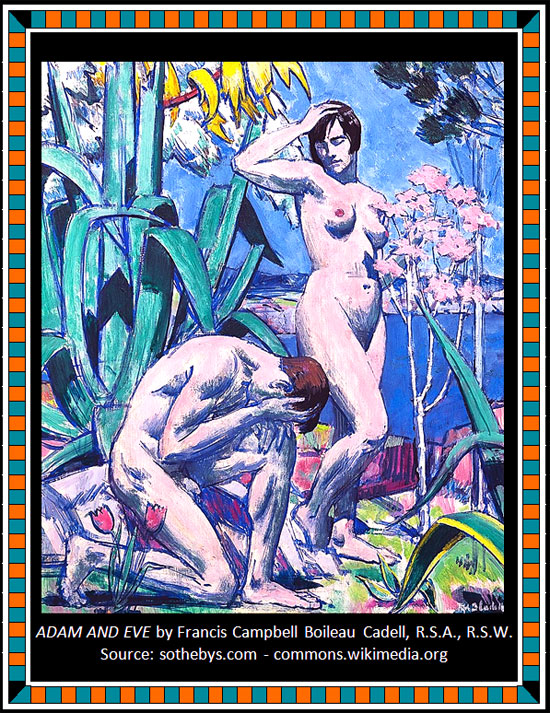
The insidious tempter asserted that Eve was a deceived wife and nothing could make him so miserable as to find her unhappy. Adam merits much greater attention from her – for he could be seeing another woman elsewhere during his absence from Eve.

So far, she had no reason to be suspicious of Adam even though, after their expulsion from the Garden, many things have changed. Adam was not the similitude of his Creator – the man of original state of innocence and happiness which he was when God breathed the breath of life into him and pronounced him good.

As devil’s words, warm and sympathetic, set the dogs onto her mind, the tempter craftily proposed to show to her the other woman if only Eve would give credit to his words. He had vouched that she could ask the leaves of the trees for the truth, ask the stars of the night sky, or ask the calmness of the universe, carefully avoiding any mention of the Sun, now about to set, but which dazzles and beautifies.

Heeding to Eve’s request, the devil went ahead of her to the river bank. She followed him until they came to the still waters of the river, the place where he had declared Eve could see her rival. Looking down into the fresh waters of the sun-flecked mountain watercourse, Eve could make out the woman staring back at her – the life in the water. Eve felt dashed and low.

Although the devil didn’t give her to know at that time, her own reflection was sufficient to corroborate her of the other woman’s existence. Although the devil had started out with zeal, now finding himself unable to keep still looking severe, the evil one, animated by infectious evil spirits, eased out of the serpent and hid away from Eve.

His spirit soared at his devil’s luck in deceiving her. He could hardly contain his satanic laughter. That is all that matters and that is always the case. Then, as now, mankind had not been free from the wiles of the devil – the cause of many troubles.
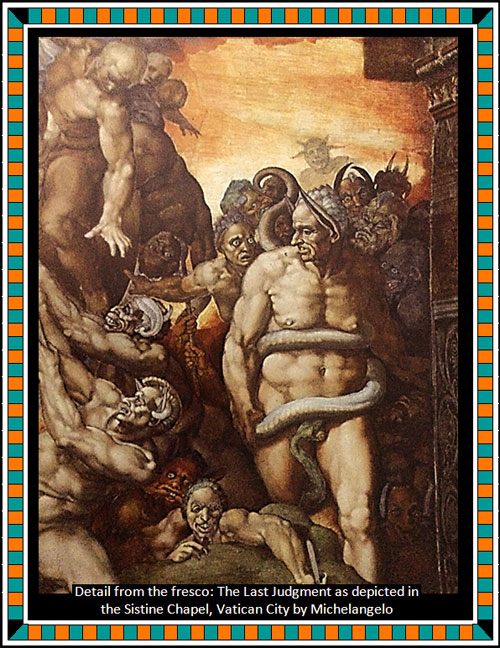
It is difficult to clothe in adequate illustration the ghastly attributes with which painting and writings have invested this horrendous evil character – the devil or Satan. Years later, the Africans of the Guinea Coast would come to an understanding on the issue at hand – learn how to tame the evil, a cognitive achievement that is properly creditable to a legend of their ancestors.

The influences of such a legend have been subject of various interpretations. However, it is not a competition. It asserted that the only defence one would require against the hideous devil and his minions unnumbered, is a mirror. If anyone will keep a mirror beside the Devil, he must see himself in it, and he at once rushes away in terror of his own ugliness.

Jo                                                         (Concluded)

Notes: This Part Three is based on folk-tale.

(© Joseph Sébastine/Manningtree Archive)

Speak of The Devil

Part II of The Flower and The Nettle (in 3 Parts)

Seek not outside yourself, heaven is within – Mary Lou Cook

Happiness is a living emotion. It was in the Garden of Eden with its magnificent vegetation, plentiful fauna, and teeming population of many other species wherein Adam, his woman and the animals happily occupied the same plane of existence. It was in this garden that the Creator, who is the foundation of all good, established the union of those first two human beings – which occasioned the beginning of the human family and birth of society. It was in this garden where, both Adam and the woman ate only the abundant fruits of the trees and lived in their state of pristine innocence.

This is also where the first punishment for disobedience was meted out against these two frail creatures who had sinned through pride – for by consuming the forbidden fruit man knew the good he had fallen from, and the evil he had fallen into.

As regards the vexed question of banishment from Eden as a consequence, the respective punishments enforced on Adam and his woman, the couple who originally enjoyed immortality and “walked with God”, brought upon them sickness and death; with the necessity of working for a living, Adam will struggle in pain so much of his further earthly span to prepare the ground fertile to cultivate; and the woman, who was every way perfect and bearer of life, is to suffer multiplied pain during childbirth.  

God always intended for human beings to work for a living and for work to be a joy. In the beginning, work was meant as a gift. In the beautiful garden where Adam lived with the woman, no doubt, they didn’t fritter their life away but oft-times occupied themselves tending to that garden. One could think of the time when Adam studied all living things and engaged in the act of naming them – something more than a passing notice but a very important symbol.

The chastisements imposed by God also made them discover their nakedness and awakened in them a sense of shame in contrast to their prevailing state wherein they were unashamed of being naked.  

They hid behind the loincloths made of fig-leaves gathered probably from the tree whose forbidden fruit Adam and the woman had eaten (1) in defiance of the commandment of their God the Creator.

The fact remained that, the mixture of mercy and wrath and expulsion from the Garden of Eden they had incurred was the aftereffect of the crafty exploit of a devious sinner in a serpent’s form. That demonic sinner was none other than the devil. As the Prince of Evil, he is also called Satan, the fallen and lost, but a hero of his own story, who had employed jealousy as a seductive weapon with the utmost subtlety to entice the guileless and unsuspecting woman by praising the alluring beauty of the tree and the seeming benefits which it might confer.

The devil had accosted the woman in the absence of Adam. Perhaps she had only heard the terms of the covenant from Adam. To seduce the woman into disobedience, the evil one had made use of the serpent (chivja). If anything, by his prevarication, the first man Adam not only sinned himself by his disobedience to God and obedience to the devil, but entailed misery on his whole posterity as the blood of the first human stock flows in the veins of every living human being.

The spell of trustworthiness the devil created to seduce the woman into disobedience was no simple feat but craftily attained by him by employing a methodical and deceitful approach for which this evil creature would later become world renowned for.

From the earliest years, painters around the world, while depicting the Fall of Man, have illustrated the devil’s impersonation as a serpent and accentuated the cunningness of this evil snake creature when it engaged Adam’s woman (2) in conversation that led to the Fall of Man, an episode which formed part of the inspired history of the great events of 2369 years depicted in the Book of Genesis of the Old Testament which started with the first ten words: “In the beginning God created the heavens and the earth.”

Jo                                                            (Continued in Part III: Lessons from The Garden)

Note: (1) A fable would later on gather popularity as “Adam’s apple” (Latin: Pomum Adami) in relation to the protuberance in the forepart of the throat, so called from the supposition that a piece of the forbidden fruit stuck in Adam’s throat. 

(2) Later, Adam would call his woman Eve – the word Eve is “Chavah/Hawwah” in Hebrew, means “Life, lifegiving“)

 (© Joseph Sébastine/Manningtree Archive)

The Flower and The Nettle

Part I (in 3 parts)

Let us make man in our image, after our likeness” (Genesis 1:26)

Time is always on the run. As for now, let me take the privilege to rewind it to take you to the very infancy of the world – to that ancient time when the first parents who stood at the head of the human race lived care-free in the majestic Garden of Eden, that sacred place stated in the Book of Genesis, the first book of the Bible which is the Book of all beginnings. Purportedly written by Moses, the Book of Genesis tells about how the world came into existence and life actually began.

Predominantly evergreen, the colour that represented hope and new life, the Garden of Eden was reputedly the terrestrial paradise that God planted eastward from Canaan, in Eden. An emblem of the heavenly state, this garden probably lay not far from the ancient Babylon, where the rivers Euphrates on the west, and Hiddekel, or Tigris (which goes toward the east of Assyria) on the east, joined into one and watered it. These waters, after running a little southward, parted into the two streams of Gihon (extent the whole land of Ethiopia) on the east, and onto Pison (extent the whole land of Havilah, where there is gold) on the West. However, the abundant literature on the subject does not lead to a definite answer to the garden’s location.

Human race certainly had a beginning. Science tells us about the evolution of man in variations such as: First Primate (Forerunner of Man); Java Man (about 1,000,000 B.C); Peking Man (about 750,000 B.C); Heidelberg Man (about 500,000 B.C); Neanderthal Man (about 100,000 B.C) with whom our cultural history begins and the formation of Homo sapiens (about 50,000 B.C) which is our own species. In all likelihood there was a first of the species Homo sapiens of the earth, earthy, who once stood at the head of the human race. Adam or whatever his name was, his blood flows in the veins of every living human being belonging to the same species on earth today, as the Bible clearly expresses it.

According to the Book of Genesis, God formed man’s body of the dust of the ground with most exquisite art and skill and breathed into his nostrils the breath of life; and man became a living rational soul. This being our Creator’s greatest achievement, His creation was a human person from the earth, capable of exercising the functions of all sorts of life, although he lacked the Holy Spirit. It was in the very Paradise of God where the Bible says, the first man Adam was graciously placed.

Based on the Old Testament, it is uncomplicated to fathom how the garden of Eden’s image is subliminally imbued in the minds and hearts of the Christians at large. The Bible disclose that, this well-watered Garden of Eden which had a luxuriant natural vegetation, where grew every tree that is pleasant to the sight, was decked and enriched with every choice of precious fruits good for food – the inference being Garden of Eden is a magical place – peaceful.

Amidst the garden stood the principal tree of life, so called because of the invigorating nature of its fruit; and it was made a sacramental pledge of man’s eternal life in heaven, provided he kept the covenant which God made with him. Besides the tree of life, therein was the tree of knowledge of good and evil, so called because, by its fruit God, manifesting his supreme authority, tried Adam’s perfect obedience: for in the day that he eat from it, he shall surely die.

On the word of the Bible, God knew that a help meet for man is essential, since it is not good that the man should be alone. The intended female must be suitable to his nature, useful on all occasions for their mutual comfort, and the propagation of their species.

God caused a deep sleep to fall upon Adam, and as he slept, a female was brought forth from one of the ribs of Adam. He endowed her, as He did Adam, with power of thought, speech and endless life. Once brought her to Adam to honour the institution of marriage, to Adam she was the bone of his bones and flesh of his flesh. He called her ‘Woman’ (îsshâh), because she was taken out of Man.

Jo                                                             (Continued in Part II: Speak of The Devil…)

Dedicated to my late wife Renate Elisabeth Simeon (Carina) who took me out of the woods and showed me the trees.

(© Joseph Sébastine/Manningtree Archive)

The Kaleidoscope of Hoof Prints

b1

(This follows my article The Ballad of JEANETTE and MICHEL  of March 2, 2016)

If there are phrases on my tongue which connote the blessings that can unwittingly come in many disguises to the gentle-natured donkey, it is those plans and purpose which chanced upon as revealed in some events of “The Bible”. With Palm Sunday (March 20, 2016) followed by Easter (March 27, 2016) coming up, bringing in a time when it is not unusual for people to be religious in thoughts, I take a little liberty to reflect on those events.

b2

Animals like sheep, camel, donkey, have afforded their presence to many episodes of the Bible. Indeed there are momentous occasions when the donkey was part of events that were important junctures in the life of Jesus Christ.

b3

The ass of Palestine and the Bible has been identified as the Nubian wild ass of Egypt. This common beast of burden, used for agricultural work and also for riding, is not in the East by any means a despised or a despicable animal – but considered part of a moderate household. Whole families rode him, shared food with him, and sometimes allowed him to stay in a section of the room with the family.

b4

Visitation: It is related that Mary, pregnant with Jesus, used a donkey when she set out on her journey for her ‘Visitation’ to congratulate cousin Elizabeth who was pregnant with the child who would one day become known as John the Baptist. According to tradition, that donkey had travelled about seventy miles from Nazareth over hills and through valleys to the little town in the Judaean hills where Elizabeth and her husband, priest Zachary dwelt. Considering that the feast of the Annunciation of the Birth of Jesus is held on March 25th, this journey could probably have occurred during the last days of March or early April when the rainy season was just over. Although Joseph is not named in this journey, it is unlikely that Mary would have ventured on a long and arduous journey alone and abode with Elizabeth for about three months before she rode back to her home in Nazareth. Besides, it was customary to have a driver for the donkey, when women rode on them.

b5

To Bethlehem: The initial scenes of William Wyler’s biblical epic movie “Ben-Hur” (1959) portrays Joseph, a village carpenter, leading a meek donkey by the bridle, on which sat his pregnant wife Mary covered with a long cloak, during their journey from Nazareth to Bethlehem in Judea to enrol their names in a census which had been ordered by Caesar Augustus. The vague details of that journey of about seventy miles could be visualised as five days of privation, fatigue and discomfort through an uncomfortable path in the winter chill of December. A book on the Virgin Mary names this donkey as “Eleabthona”, but we could only wonder if it was the same animal which had previously been similarly used when Mary went on her “Visitation” to Elizabeth.

b6

To Jerusalem: Whichever donkey it was, that animal had the opportunity to be closer to the newly born Jesus in the stable outside Bethlehem. Besides, amongst the few other domesticated animals present there, he was the one who would render service as the mode of transport to Joseph’s family when, at the age of forty days, the infant Jesus was taken to Jerusalem for presentation in the Temple and return.

b7

To Egypt: Sometime thereafter, warned of an imminent danger to the child, the family hastily embarked on a journey in the middle of the night, with Mary and the child riding the donkey, as they rushed out of the territory of King Herod to retire into Egypt. With the winter still persisting, that journey of ten days covering about two hundred miles via the city of Pelusium (modern Tell el-Farama) was not without difficulties and dangers arising from cold, wet and stormy weather, lack of shelter over their heads, less water, attack by robbers and wild beasts, proceeding partially through the shifting sands of the desert as far as the land of Gessen, where they resided (1). Not until had King Herod died in the spring of 4 BC, did they retire to the early home of Joseph and Mary at Nazareth of Galilee.

b8

Soon after, the donkey of those journeys slips into obscurity even though according to a recorded event of Jesus’ youth, at the age of twelve, Jesus was taken on a long journey to Jerusalem to attend the Passover before returning to Nazareth when the service of a donkey would have been required.

b9

It is widely held that the dark line down a donkey’s back and across the forequarters in the shape of a Latin cross denotes the heritage of that race from the day one of their forebears carried Jesus on its back during His triumphal entry into Jerusalem which is commemorated as the first Palm Sunday (Dominica in ramis Palmarum), and marks the beginning of what is technically called Passion Week.

b10

To Jerusalem: According to the Gospels, Jesus, having come to the little village of Bethphage (Beitphage) on the summit of the Mount of Olives sent two disciples into the village to fetch an ass and a colt they would find tied there. Having brought the animals, they cast their garments upon the ass and made Jesus sit thereon. (2) The animal carried Jesus, sitting meek and gentle on its back, as it treaded over the olive palm fronds strewn over the garments laid on the path, amidst the joy and singing of a multitude of accompanying people wielding branches of palm trees as a testimony of honour and respect.

At that time Jerusalem was surrounded with fertile fields and trees, and on the southern slope of Olivet, where they were passing, date-bearing palm trees grew in great abundance. The Palm has been in all times and places the emblem of victory and its reward and it was the custom to carry and wave palm-branches as a sign of joy and victory.

b11

At length, the donkey carried Jesus down the hill, passed between the walls of Gethsemane and the Garden of Olives, crossed the Cedron valley (Kidron), through the road leading up to St. Stephen’s Gate (Lions’ Gate), and entered the Temple through the Golden Gate with its beautiful pillars. This occasion, commemorated on Palm Sunday with a Procession of Palms was customary in Jerusalem as early as 386 when it was first mentioned, and was adopted in the west by the seventh century as attested to by Isidore of Seville, who died in 636.

b12

Until the Reformation in the Middle Ages, the event was remembered in a folklorised ritual on Palm Sunday (Palmsonntag) in some southern German speaking regions when, in addition to the tradition of the blessing of palms (Palmbüscheln), a procession known as “Palmesel” (Palm Sunday donkey) was held when a statue of Jesus mounted on a wooden effigy of an ass fixed on a wheeled wooden bier was taken round the streets spread with clothes and strewed with palm branches. To mark this joyous occasion, people sang hymns and waved fronds of palm or of some other similar tree, while at some places bouquets of flowers attached to boughs of trees were sometimes carried in the procession calling it the Easter of Flowers.

The ass was not forgotten either. A book on ecclesiastical architecture relates an old tradition that “the ass on which Christ made His entry into Jerusalem left Judea immediately after the Crucifixion, and passing over the sea dry-shod to Rhodes, Cyprus, Malta, Sicily, and Aquileia, finally reached Verona, where it lived to a very old age. After its death its bones were collected and deposited in the belly of the wooden ass of Santa Maria in Organo, which was made as a memorial of it and its exact image.”

b13

Just as that event at Jerusalem made them an object of peculiar reverence to the early Christians, the cross on its back inspired belief that children suffering from whooping cough will be cured if they are made to sit on the mark and the donkey walked in a circle nine times.

It is interesting to think, with what different sentiments one regards the donkey at different periods. The poor quadruped which tradition says earned its reputation for stupidity in the Garden of Eden when it could not remember its name when God asked it, is actually, as one of my friends wrote, a poorly understood animal.

b14

Ass, when properly kept, is a handsome animal – much stronger in proportion, and much more hardy than the horse. The positive efforts of institutions such as Kölner Zoo in Germany, The Donkey Sanctuary in Devon, England, etc, very much help the welfare of the docile and friendly donkey to save them from becoming snapshots of a bygone era. Let us be glad that they are there and keep alive the age old tradition that to see a donkey will bring one the good luck. Until next time, Ciao, Jo

b15

Notes:

  1. According to some publications, the particular place where Joseph settled in Egypt is probably Metaryieh, near On/Heliopolis, about two hours distance north-east of Cairo.
  2. A Franciscan church, built on the foundation of an ancient shrine, stands to commemorate the place where Christ mounted the ass, contains a stone traditionally identified as used by Jesus to mount the ass for the journey to Jerusalem.
  3. Thanks to: Mr. Bernd Marcordes, Kurator, AG Zoologischer Garten Köln, Germany for the picture of Michel and Jeanette; to Ms. Pippa Helock of The Donkey Sanctuary, Devon for the picture “Looking Handsome”; and to Stefan Ahrens of Bistum Regensburg, Germany for the four pictures.
  4. Print and visual versions of “Ben-Hur” is available with amazon.com, amazon.co.uk and other leading dealers.

b16

Joseph Sébastine/Manningtree Archive)