Tag Archive | Jesus Christ

A Beautiful Mindset

Recently some of my posts featured Attila the Hun and Jesus Christ, among other subjects. They both in the end conquered the World. Attila did it by force – evoking the violence of hordes of Huns. Christ attained it by love. Indeed, Christianity of Christ is a faith for all occasions. It not only teaches one to be courageous in darker times but also to be happy wisely.

At this fag-end of the year 2024, I appreciatively focus on this Christmastime and the brotherhood and some festivities associated with it. In fact, one of the great vital principles of Christianity is the brotherhood of all humanity. As I write this now, it’s the Christmas Eve – by and large, a time of gaiety and good cheer. Only few hours remaining for the event made known by the Bible, viz. Virgin Mary brought forth her first-born son and wrapped him up in swaddling clothes and laid him in a manger… ushering in the Christmas Day!

There existed a custom which exalted a child born at Christmas as fortunate in life and never see a ghostie as long as that child lived. At the same time, there was another belief that those born on a Christmas Eve cannot see spirits to the end of their days and do not require holly and mistletoe as guardians against evil. On the whole, majority of superstitions and omens related to Christmas belong to a happy nature.

Born on January 18, I qualify as a Capricornian (those born between December 22 and January 20). I have heard that Capricorn is related to the most elevated point in the heavens and perhaps the best known sign of all those in the Zodiac. Part of the reason is based on the statistic that it is during the reigning period of Capricorn; millions of people all over the world could avail the opportunity to pay homage to the most famous birthday of all — the glorious birthday of the Baby Jesus on December 25 – born in Bethlehem of Judah, in the days of King Herod.

Perchance, it is this affinity which explains the innate religious trait in most Capricornians even though oft-times such a trait is unrealised or unconscious.

In general, Christmas is a grand time for getting together, for meeting new ones and greeting old friends. Behind all the merriment, there’s an inherent significance in Christmas: Peace on Earth — Goodwill to Men. Such is the message of Jesus, and that is the spirit that underlies a genuine Christmas celebration. Jo

(©Joseph Sébastine/Manningtree Archive)

S. Agnes of Rome VM

S. Agnes of Rome VM

Lat. Sancta Agnes, Ital. Sant’ Agnèse, Spa. Santa Inèz,

Santa Ignes, Fr. Sainte Agnes, SS. Agnetis, Angl. Agnes

c 291 – c 304 – Feast: January 21

Part I (in 3 parts)

S. Agatha of Sicily (d. c 251), S. Cecilia (d. c 280), S. Agnes (d. c 304), and S. Lucia of Syracuse (d. 304) are the four great virgins of the Latin Church. Martyrs of early Christianity they are – the first and last being Sicilians and the remaining two Romans.

Since the time of Roman emperor Constantine the Great (C., Flavius Valerius Constantinus, c. 274-337), a basilica stood beside Via Nomentana in Rome in honour of the Roman maiden S. Agnes who followed Christ from her infancy. Upon wearing the crown of martyrdom in c. 304 when she was twelve or thirteen years of age, she was buried in a cemetery named after her which has close proximity of this basilica.

A special patroness of maidens and chastity, and named in the first Eucharistic prayer, S. Agnes is one of the most popular of saints and patron saint of Roman virgins. Earlier writings tells us that S. Agnes, whose name signifies lamb in Latin and chaste in Greek, was born in an illustrious Roman patrician family in c. 291 and baptised at a very early age.

Through the years that followed, Agnes became renowned for her tender beauty and also for her enthusiastic piety to lead a life of purity. At the age of twelve, she was denounced as a Christian to Symphronius, the Roman prefect of the city. Her accuser was the prefect’s own son Procop, an unsuccessful suitor to whom Agnes refused matrimony alleging that she was already dedicated to Christ.

During that primitive age of the Church, Caesar had many, many ears that listened for him.

Persecution of Christians under the iron hand of imperial Rome spanned a space of three hundred years when many innocent Christians were tormented to convert. If that does not work, the process was to line them all up. Behead the first one, and if the next does not renounce his faith in Christianity, work one’s way to the very end. Nevertheless, such persecutions did not annihilate the believers but enflamed the faith of the martyrs instead.

How could Agnes be an ardent believer of a man who had been executed by a Roman governor of Judea? In a word, she was deemed guilty of blasphemy against the Roman gods. The accusation against Agnes during Emperor Diocletian’s fierce continuous persecution of Christians (303-305) (1) resulted in her detention and interrogation following which she was subjected to different stages of torture. However, Agnes’ saintly bearing had helped her to retain her consecrated virginity after she was forcefully confined to a house of infamy in Circo Agonale (2), Rome.

In such circumstances the imperial Roman persecutors will always have to win. But here they have failed in their efforts to compel Agnes’ recantation of the Christian faith and also to coerce her to worship goddess Vesta (3). With their anger ignited, Agnes was subjected to an ordeal by fire but the outcome was that she remained untouched by the scalding hot flames. Soon after, at the orders of Pro-prefect Aspasius, she was publicly decapitated by the sword of a lictor (4).

Later writings on S. Agnes reveal that she was the focus of praises by great Christian scholars such as S. Jerome (Eusebius Hieronymus, c. 342-420); S. Ambrose of Milan (c. 339-397 – detailed in his treatise de Virginibus addressed to his elder sister, S. Marcellina V (330-398)); Pope S. Damasus I (Reign: 366-384); and Latin Christian poet Marcus Aurelius Prudentius (c. 348-413) in his 4th century hymn, The Passion of Agnes in Liber Peristephanon (Crown of Martyrs).

By S. Agnes’ martyrdom, she had only gone beforehand ‘in the sign of faith.’ The lives of saints are an exposition of the faith of Jesus Christ. The fairness of Christianity is that women are regarded as equally gifted with holiness as men are and all true, without prejudice, both are evenly loved by God. When a list of the Roman church martyrs perished during the great persecution of Diocletian was compiled around 336, it marked the first inscription of Sancta Agnes, the fair Roman maiden with an air of saintly dignity blended with the most benign sweetness.  

Jo                                                                                (Continued in Part II)

Notes:

  1. We do not know with certainty in which persecution Agnes won the martyr’s crown. This incident is variously placed during periods of severe persecution under: Caius Trajanus Decius (249-251); Publius Licinius Valerianus (257-260); Gaius Valerius Diocletian (303-305).
  2. Circo Agonale: The Agonale Circus (Stadium Domitiani) was built on the site of the great circus of Tarquin the elder. In the course of time, the area fell into ruins. Under Pope Callixtus II (1065-1124), the Church of Sant’Agnese in Agone was built there and consecrated on 28 January 1123.
  3. Vesta (Hestia in Greek) is the Virgin goddess of the hearth and home in the Roman religion. She is one among the 12 superior Roman divinities (Dii majorum gentium) collectively known as Dii Consentes – the others being: Jünõ, Minerva, Cërês, Diana, Vënus, Mars, Mercürius, Diovis, Neptünus, Vulcanus, Apollõ. The worship of Vesta survived to the last days of paganism before it was abolished by pious Roman Emperor Gratian (Augustus Grãtiãnus, 359-383) in 382 A.D, a year prior to his assassination for his enmity to the Pagan superstition.
  4. The source of this account relates to the Latin ‘Acts‘ and the Ambrosian hymn.    

(© Joseph Sébastine/Manningtree Archive)

S. Cecilia (Sancta Caecilia)

S. Cecilia (Sancta Caecilia) VM 2nd-3rd century

(Martyred circa A.D. 280. In all the Calendars. Sarum Ep. and Gosp. : Ecclus. xli. 9-12; St. Matt. xiii. 44-52.)

As early as the 4th century, S. Cecilia (of Rome) was considered as one of the most famous of martyred Roman maidens. Born of distinguished lineage, she was eminent for her piety, and had vowed virginity. In those days, martyrdom was always a possibility. But to the one who practiced, with perfect fidelity, the maxims of Christianity ,‘To die for Christ is not to lose youth but to renew it.’ 

Martyred for proclaiming faith, and God, and Christianity, and Jesus Christ, this reputed patroness of music and musicians, was initially entombed in a cypress coffin in the cemetery of S. Callistus (Catacombe di San Callisto) on the Appian Way in Rome. Even though the cemetery bears his name, Pope S. Callistus I (217-222) himself is interred elsewhere, in the cemetery of Calepodius on the Via Aurelia.

In 821, Pope S. Paschal I (817-24) initiated the transfer of the relics of Cecilia from the Catacomb to the Basilica di Santa Cecilia in Trastevere in Rome. For five weeks all Rome streamed to the Basilica to venerate her body; and it was not until S. Cecilia’s Day that it was again sealed up in its coffin and marble sarcophagus.

The splendid Basilica di Santa Cecilia, rebuilt in 822, is believed to have been erected by Pope S. Urban I (222-30) on the spot where Cecilia lived and died. To this day, notwithstanding various rebuilding, it bears traces of its origin. It was in this old Basilica that on November 22, 545 while celebrating the Feast of S. Cecilia when Pope Vigilius (537-555) was arrested on the order of Empress Theodora of Constantinople.

Ever since 1599 (during the reign of Pope Clement VIII (1592-1605)) to this day, S. Cecilia’s alleged relics rest in the crypt beneath the high altar of this basilica in Trastevere. Feast: November 22.

I am a gentlewoman born,’ Cecilia had said; ‘among men Iam called Caecilia, but my noblest name is Christian.’

  1. Image source: commons.wikimedia.org: Top) Guercino – St. Cecilia, Google Art Project, Dulwich Picture Gallery; Middle) Carlo Saraceni – The Martyrdom of St Cecilia, Los Angeles County Museum of Art; Bottom) Orazio Gentileschi and Giovanni Lanfranco, Saint Cecilia and an Angel, National Gallery of Art, Washington, D.C.
  2. In memory of my beloved wife Renate Elisabeth who left for heavenly abode on August 24, 2023

(© Joseph Sébastine/Manningtree Archive)

Catch – as – Catch Can

Excitement is soaring for high-class racing action in Dubai where horses are a passion. This excitement is hardly surprising in the Arabian Peninsula – the region from where the pure-bred Arab stock had emerged to become lauded as the oldest of the world’s recognised breeds – their influence in creation of the Thoroughbred generally acknowledged all over the world.

A land of startling contrasts, Dubai of United Arab Emirates, has, years on, offered a sparkling calendar of interesting equestrian pursuits and leisure activities such as courses for riding skills, show-jumping, dressage, polo, horse riding trips, etc, through its various clubs and stables. The Dubai World Cup (DWC) 2017 will take place on Saturday, March 25 at Meydan Racecourse where the 2017 DWC Carnival is underway.

As for me, UAE is the region in which I had flown in the most number of times, for short visits and transit – like drive traffic, all stop and go, since I very often flew with regional Airlines from the early-nineties – a silent witness to the city’s astonishing growth to today’s modern metropolis, Dubai (which I was told is a mixed Farsi and Arabic word meaning literally, two sides of the water. I have also heard its meaning being referred to the Hindi words “Do – bhaee” (Two – Brothers)! Few documents may exist before 1799 when the local inhabitants were primarily engaged in fishing and harvesting pearls. But at the creek of Dubai, one can still see the big wooden dhows and smaller, short-keeled sambuqs.

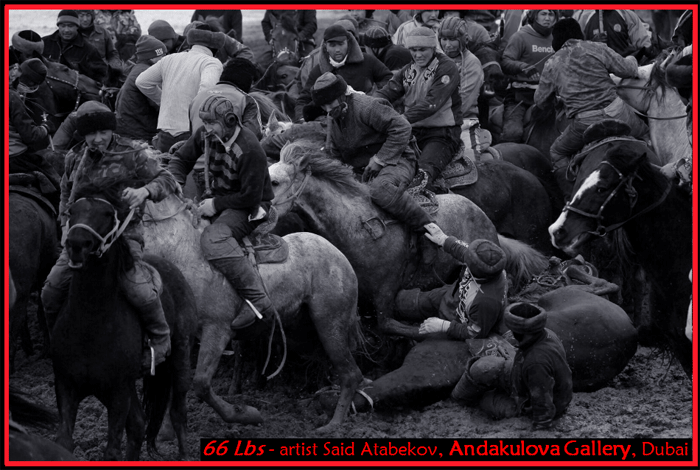
Of the many activities complementing the Dubai World Cup is a Solo Show by Said Atabekov, the internationally renowned Uzbekistan born contemporary artist, who now lives and works in Kazakhstan.

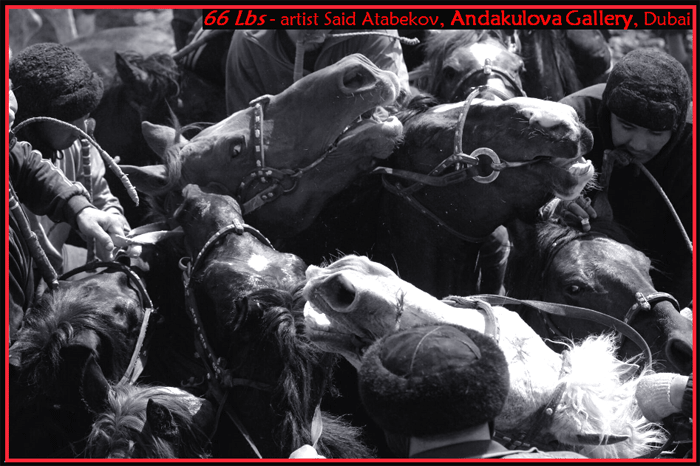
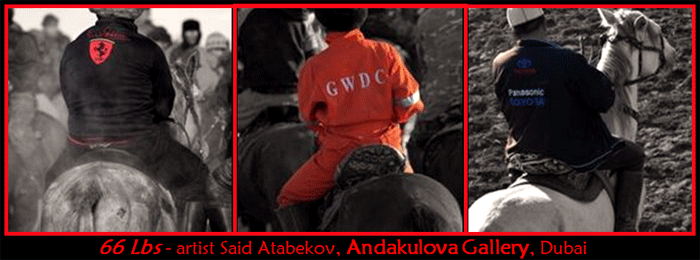
Titled “66 Lbs”, Atabekov’s show featuring photo, video and site installation, can be viewed at Andakulova Gallery (Unit 18, P4 Level, Damac Park Towers DIFC) in Dubai during March 06th – May 12th, 2017. What attracted me to this show is not simply because it featured horses.

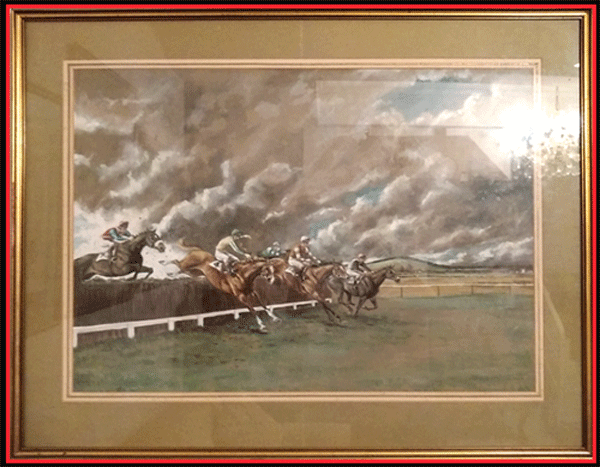
With a good number of original “sporting art” also bolstering our love of arts, paintings of sedate hunting or race horses are not alien to our house. From the horse’s first appearance in a convincing anatomical form in an Assyrian bas-relief of the seventh century BC, at length, it has been an inspiration in all forms of arts and later in literature for the majesty and grace of this spirited animal “par excellence”. Over time, many terms sprang out of its name: horse-radish, horse-parsley, horse mushroom, iron horse, pale horse, white horse, brazen horse, wooden horse, Trojan horse, horse bridge, horse-power, horse trading, …..

The largest physiques of horses I have come across, to name but a few, are the set of four horses (Triumphal Quadriga) at Basilica di San Marco in Venice; the wooden horse inside il Salone of the Palazzo della Ragione; Donatello’s equestrian statue of Gattamelata on Piazza del Santo (both in Padua); and such other statues in many piazzas and squares in Europe.

According to classical mythology, Poseidon created the horse. Indeed, from the domestication of the horse, possibly by the tribes of the steppes flanking the Caspian Sea thousands of years ago, the horse has been the friend and companion of man, prized for his beauty, loved for his docility. Eaten, sacrificed, worshipped, it gradually became a means of transport, communication and of horseback conquest in the heroic age. As a story goes, in the early centuries before Jesus Christ, when the Greeks colonised Southern Italy and brought in thousands of horses, the luxurious people of Sybaris trained all their horses to dance to the sound of music – of flutes in particular. Then again, there was also a time when some were addicted to the atrocious practice of sacrificing live horses to their gods or bury them with their masters.

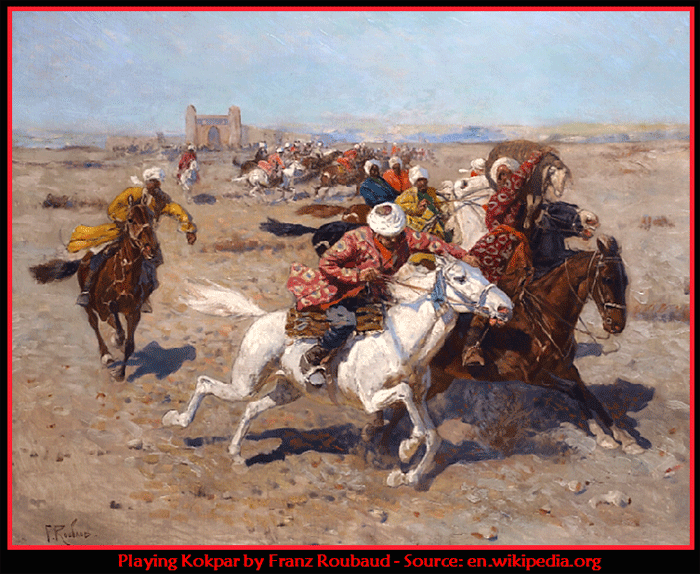
The show’s distinctiveness is the bridge the artist has built between the past and the present with strong images that resonate with tradition – with emphasis on the ancient nomadic game of Kokpar of Kazakhstan. A primitive version of polo, played in two considerably different forms: tudabarai and qarajai, the game Kokpar  has two (or more) teams on horseback competing to pick a headless goat carcass off the ground (zamin-gir) without dismounting or snatch it from someone else at full gallop (chakka-gir) and carry it over the goal line. Usually, the credit for best horsemanship, strength and courage goes to the winning team.

Being aware of this as I am – it is gross the way it sounds. But the element of my main interest in this equestrian sport, part of the cultural backbone of some countries, is merely the nomadic tradition and the strict set of rules it accentuates. According to this solo show, the mandatory weight of the animal carcass used for the game which is fixed as 66 Lbs – hence, the title of this Show.

The Kazakh horses are traditionally an ancient breed originally bred in that region and are exceptionally hardy and competent to withstand extreme climatic conditions. Kokpar (known in a variety of names or simply as “catch-as-catch can”) of the Central Asian countries is one of the games fostered not only out of necessity – but also for recreation as well. The game, which probably owes it origins to the period of reign of the Macedonian king Alexander the Great (B: 356 BC – D: 323 BC) or Genghis Khan (B: 1162 – D: 1227) of the Mongol Empire, or to the Turkic-Mongol people, is part of the contests devised to provide, in times of peace, excitement as well as to retain fitness, readiness and skill of horse and horsemen for sudden deployment in unexpected wars. Such activities also aided to counter their boredom resulting from specific exercise in one place.

Specialization in such games enabled the noblest horse and its valiant rider to attain mutual equilibrium as one unit – as can be visualised in the artistic depiction of half-man and half-horse – the fabulous centaur of Greek mythology – the fusion where man dominates mentally and dictates the strategies taking advantage of the obedience, physical strength and exceptional memory of the horse – a feat attained from the animal owing to kind and patient training.

Whereas, in the mounted folk game of Kokpar, known in Afghanistan as Buzkashi (buz, a goat and kashidan, to pull) (Mongolian baz-kiri), the goat (or calf) carcass is the objective for the contesting buzkashi riders (chapandazan) who to carry it off to a “goal”.

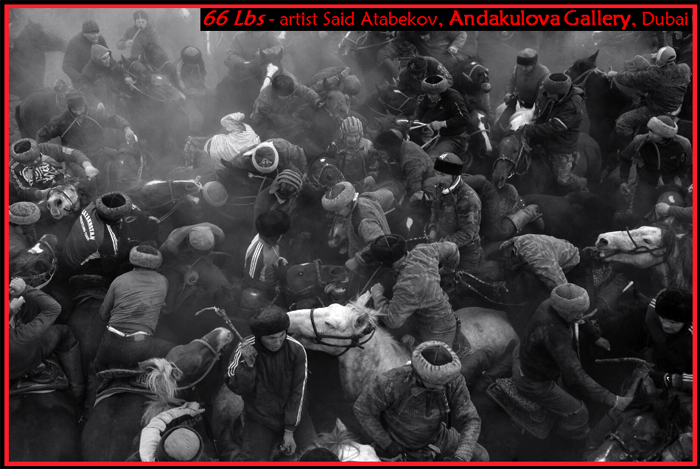
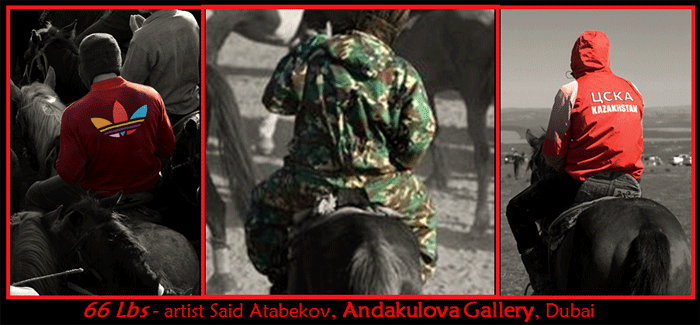
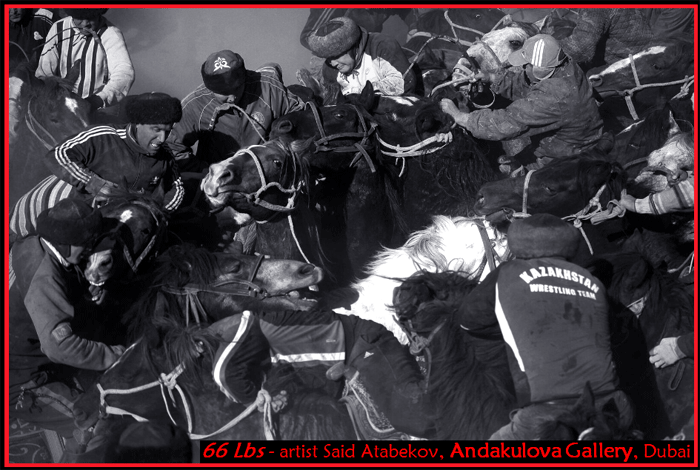
The 51-year old artist Atabekov has captured the vibes and thrill of Kokpar by actually riding amidst the two teams of powerful masculine participants on powerful horses – his camera mopping up their emotions, vanity, endurance and the intensity of their action in all its complexity.

The mayhem of lurching, rearing, bumping, kicking, biting, leering, cursing in the midst of dust, noise and sweat as it happens when they engage in grapple from each other in fierce competitive spirit, sometimes (unintentionally!) hitting out at the opponents (not at their horses) with their camchin (buzkashi whip with wooden handle). In his relentless effort, the artist has endeavoured to draw attention of the viewer to the game and spirit of Kokpar and the national sport of Kazakhstan.

Back to you…soon. Jo

The concluding instalment of this two-part serial will follow.

Notes:

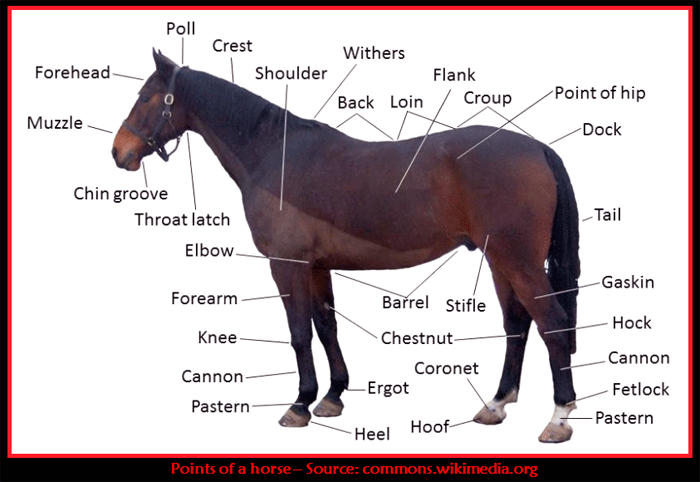
  1. The horse in the title header is one of those stationed by the Colosseum of Roma, Italy
  2. My thanks are particularly due to Karen Fernandez, Andakulova Gallery, Dubai for her interest and the pictures and in-put on the artist.

(© Joseph Sébastine/Manningtree Archive)

Mr. Telly Savalas, Back to the Limelight…, Please!

1

Part I

Life with many beginnings and endings is a progression of cycles. Just like the years before, the New Year arrived in the cyclical order – ushering in the divisions of days, weeks, months, various seasons, in conjunction with personal social relationship events such as the dates of birthdays, weddings, anniversaries, etc. Within the past three weeks of January in the present calendar, there were few birthdays (including mine on 18th) and anniversaries of people I have had the privilege of knowing – and also a reminder of more to come as the year progresses – a good number of which must be reinforced by remembrance.
2

Those with nostalgic longing for movies of the second half of the 20th century would not have to jog their memory much to remember the late Telly Savalas, the Film/Television actor, TV show host and Singer. Telly shared his birth and death in January – on consecutive days of 21st and 22nd. In many of us, the image of Telly Savalas was moulded not only from the characters he portrayed in a string of movies or from his presentations in Television, or the music albums but also from the wide attention he generated to himself by display of his images in a wide range of American-International magazines.

3

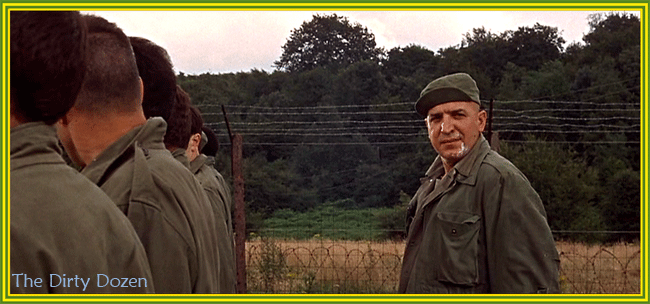
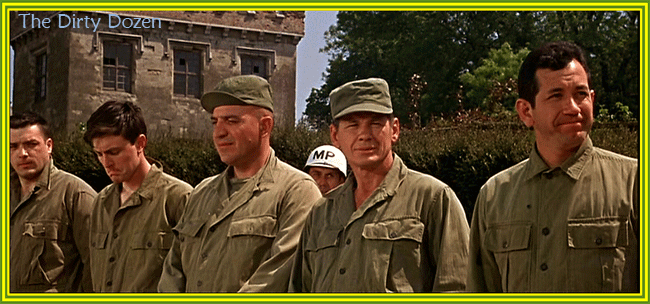
Of those movies featuring him in a succession of devious characters, one could easily think of the box-office hit, The Dirty Dozen (D: Robert Aldrich, 1967) which presented Telly as a convict and brutal rapist; he was an earthy renegade killer whose frumpy mistress (Shelley Winters) described him as having “as much feelin’s as a bald-headed hog” in The Scalphunters (D: Sydney Pollack, 1968); a black marketer in Battle of the Bulge (D: Ken Annakin, 1965); a no-good army sergeant in Mackenna’s Gold (D: J. Lee Thompson, 1969), a sadistic bandit leader in A Town Called Hell (D: Robert Parrish, 1971); a crooked narcotics agent in Clay Pigeon (D: Tom Stern, 1971); the cold-blooded assassin in L’assassino… è al telefono (D: Alberto De Martino, 1972)….. and so the list goes on until he came across his alter ago Kojak.

4

Like the bald headed Hollywood actor Yul Brynner, it is difficult to fully fathom the real story of Telly Savalas since he told a different story in every other interview – a phenomenon I had noticed while researching for this article.

5

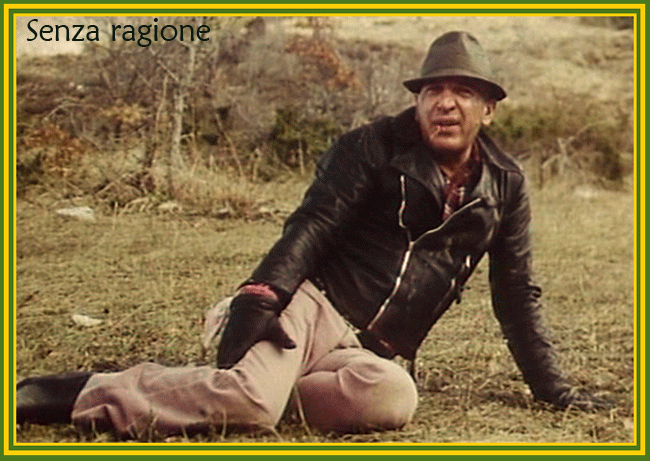
Aristoteles Savalas (a) was born in Garden City, New York, on January 21, 1922 (b). He was the second son of artist Christina Kapsalis (a former Miss Greece beauty queen from the Greek village of Anogia) and to Nicholas Constantine Savalas (originally spelled Tsavalas – hailing from the village of Gerakas), who made a fortune in tobacco, lost the lot and made another fortune in the bakery business. As teenagers, both his parents had emigrated to America in the early 1900s.
6

The second of five children (three brothers: Constantine Socrates, George Demosthenes, Theodore Praxiteles and sister: Katherine), in his earlier days, Aristoteles who spoke fluent Greek, had to sell newspapers, shine shoes and work as a lifeguard to help support the family. Somewhere along the way, he became regularly known as Telly. Having enrolled in the army in 1941 and following four years of service during the World War II he was discharged duly decorated with a Purple Heart for injuries sustained. How he was wounded in the war is unclear – quite similar to the ambiguity about how his left index finger got slightly mangled.
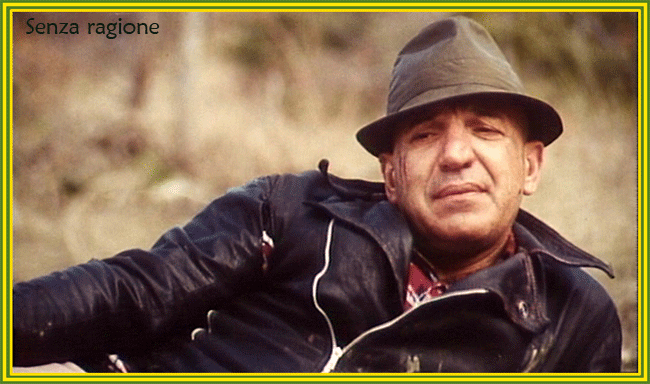
7With the intention to pursue a career in the diplomatic service, Telly graduated in psychology from Columbia University where he had met Katherine Nicolaides. After his father’s death, Telly married Katherine in 1948 and together they had Christina. Following few years work with the Near East Information Services branch of the U. S State Department as host of the Your Voice of America series, ABC (American Broadcasting Company) News hired him as a producer. Having left ABC in January 1959, he had his first TV acting role in And Bring Home a Baby, of Sunday Armstrong Circle Theatre (1950–1963). Burt Lancaster saw his work and drew him to California to appear in episodes of the CBS TV series The Witness (1960-61).

8

About the age of 39, Telly had forayed into acting in feature films, debuting with Mad Dog Coll (D: Burt Balaban, 1961) which chronicled the career of the Irish American gangster, Vincent “Mad Dog” Coll. Telly portrayed the role of another Lieutenant in the crime drama film The Young Savages (D: John Frankenheimer, 1961), the first of Burt Lancaster’s four picture deal with United Artists (the other three being Birdman of Alcatraz (1962), The Train (1964) and The Hallelujah Trail (1965)).
9

Luck played into his hands when, impressed by his performance in the roles of Al Capone and “Lucky” Luciano in The Witness in which the life and crimes of America’s notorious rogues are investigated at a committee of inquiry; and also in The Young Savages shot in New York, Lancaster provided him the important role of the solitary row prisoner Feto Gomez of Leavenworth Prison in the prison biography, Birdman of Alcatraz. This breakthrough role earned Telly an Academy Award nomination as Best Supporting Actor.

Following his divorce from Katherine, in early 1960s when his film roles were mainly villainous, he got married for the second time to Marilyn (Lynn) Gardner.

10

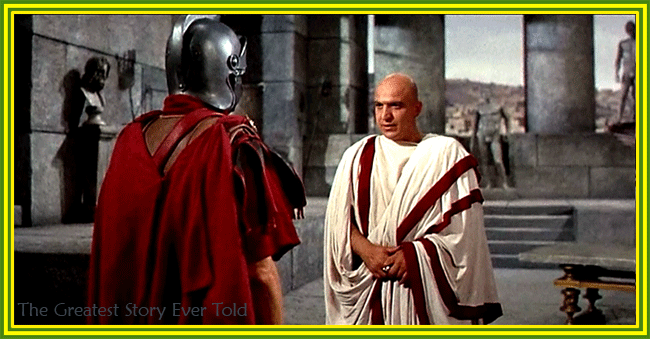
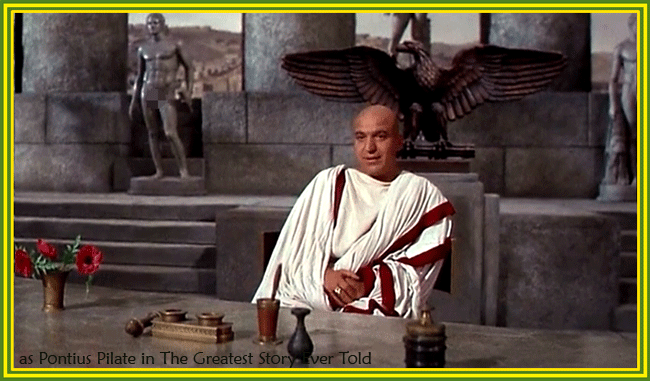
When director George Stevens’ cameo-packed dramatization of the life of Jesus Christ, The Greatest Story Ever Told (1965) was announced, many eyebrows were raised at the parade of famous actors in unexpected roles. The casting of Telly as Pontius Pilate drew smiles from those who thought that a Brooklyn accent has no place in a Biblical epic.

11

Stevens thought that the 6’1” Telly would look more virile and powerful in the role of the Roman prefect (governor) of Judaea if he shaved his head. Telly found the proposition extremely attractive and decided to go on with life as it was before retaining his signature bald look he took for his role in this Bible epic. Whyever not?
12

He simply chose to shave his head for the look. By the way, men generally don’t grow beards because they dislike shaving – but because they think their whiskers make them look better and give them a distinctive image.
13

He is on record in an interview as saying about the time Telly told his mother Christina vis-à-vis his casting in The Greatest Story Ever Told. She had rounded things off with the remark: “You are joking!” and she continued, “You’ll make a Marvellous Jesus!” She must hold the world record for being the world’s most optimistic mother.
14

Telly had a memorable role as James Bond’s notorious arch-rival Ernest Stavro Blofeld in On Her Majesty’s Secret Service (D: Peter Hunt, 1969) in which stuntman Joe Powell nearly got killed doubling him in the bobsleigh in Switzerland. Two of his co-stars of The Greatest Story Ever Told, Donald Pleasance and Max von Sydow also played Blofeld in You Only Live Twice (D: Lewis Gilbert, 1967) and in Never Say Never Again (D: Irvin Kershner, 1983).

15

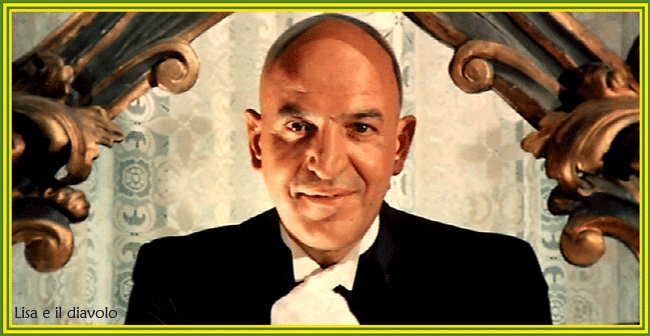
Of his bald head, he once said that “everyone’s born bald.” In spite that Telly was typecast as a villain for being entirely bald, audiences took him to their hearts – believing that in the baddie they saw onscreen rested a sweet nature. His strong features and ethnic look came handy for the role of Shan in Genghis Khan (D: Henry Levin, 1965).

16

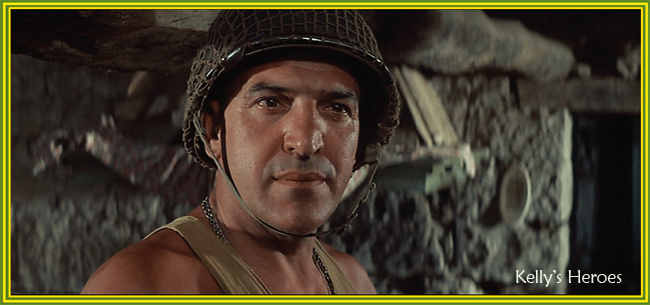
The success of that film gave his career further fillip earning him roles in Buona Sera, Mrs. Campbell (D: Melvin Frank, 1968), The Assassination Bureau (D: Basil Dearden, 1969), Kelly’s Heroes (D: Brian G. Hutton, 1970); Pretty Maids All in a Row (D: Roger Vadim, 1971), etc.  For the title role of Pancho Villa (1972), the bald look was vindicated by the shaving of his head in prison during the opening sequence.

17

Since 1974, after a long separation Telly and Marilyn were divorced. According to the mini documentary “Telly Savalas: The Golden Greek”, he had met the beautiful Sally Adams while working on the movie, On Her Majesty’s Secret Service  (c). In 1973, Cojack with ‘c” hit the TV screens and his luck seems to improve.
18

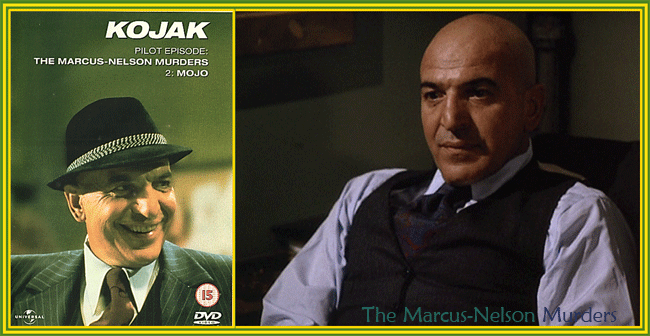
Although the bald-headed, deep, gravel-voiced Telly had been acting since the late 1950s, real popularity came looking for him in the title role of the famous CBS TV series Kojak (October, 1973-April, 1978) which was a spun-off from the made-for-TV pilot, The Marcus-Nelson Murders (D: Joseph Sargent, First American Broadcast: March 8, 1973).
19

Few initial instalments showed him wade through a stereo-typed routine of law-and-order claptrap. But soon Kojak became a prime program as the series turned tough and reasonably true – taking on the look, sound, feel, taste, and smell of the New York crime investigations.
20

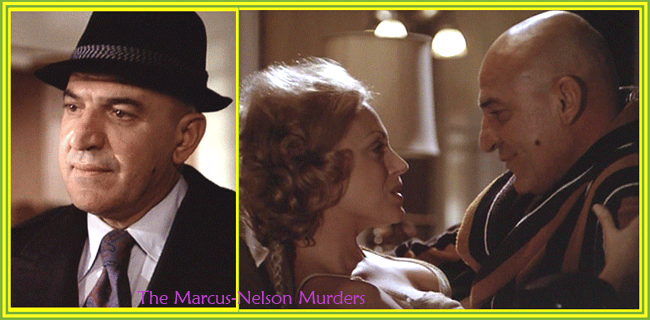
Working out of a Precinct of Manhattan, Telly’s Lieutenant Theo Kojak, in fabulous three-piece suit, displayed a more credible human being. Much of the vicious power and toughness Telly had displayed in his earlier villainous roles were there. But the exception was that, in his new persona as the stubborn and tenacious good guy Kojak with a deep concern for people and justice, his wrath was targeted against the crooks, spooks and killers. Audiences related to Kojak’s passionate belief in equality and fairness and his vehement opposition to police bureaucracy. Well, you know the rest.

21

While Telly reigned supreme in the role of the chrome-domed streetwise cop’s cop with a sweet tooth for sucking lollipops and a penchant to wisecrack snazzy lines, Telly soon became indelibly identified with the character of Kojak. “Telly and Kojak are one and the same,” Telly said in a TV interview, drawing a parallel between him and Kojak.

22

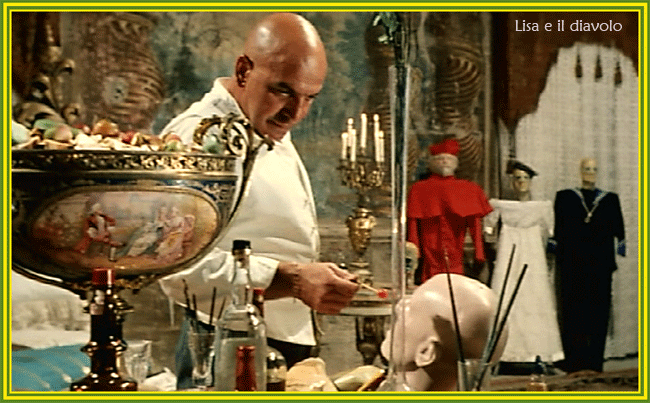
His love for the suckers, I mean, his serious attitude towards the lollipops, reportedly to replace Telly’s addiction for long thin cigars, was initially featured in Episode eight “Dark Sunday” of Kojak in December 1973. This addiction for suckers could have its origins in Toledo, Spain and to Italian director Mario Bava, the father of Italian horror films.

This concludes Part I.  Part II will follow. Jo
23

Notes:

  1. The spelling of first name is based on Certificate of Death: 39419004248 dt.22-1-1994 shown in a website although the name on his tombstone differs;
  2. The date is based on his death Certificate;
  3. Some sources maintain that Telly met Sally while working on the movie, The Dirty Dozen.
  4. This article owes its source to various newspapers, books, magazines, visual media, etc.
  5. Films forming part of the collection of Manningtree Archive are highlighted in bold.
  6. Most of the movies and books referred to in this article are available with amazon.com, amazon.co.uk and other leading dealers.
  7. DVD sleeves credits: amazon.com, en.wikipedia, imdb and from my private collection.
  8. This illustrated article is an affectionate nosegay to the movies and performers of the past. Please refer to “About” of my webpage for more details.

24

(©Joseph Sébastine/Manningtree Archive)