Tag Archive | Manningtree Archive

UNDER THE MISTLETOE

X1

In a season for giving and sharing, of stocking the freezer and checking the lights, these are moments to treasure – special moments to share in twinship with the special one.

We are at home this Christmas time, after many Christmas spent far away from home – away from its relentless commercialisation.

X2

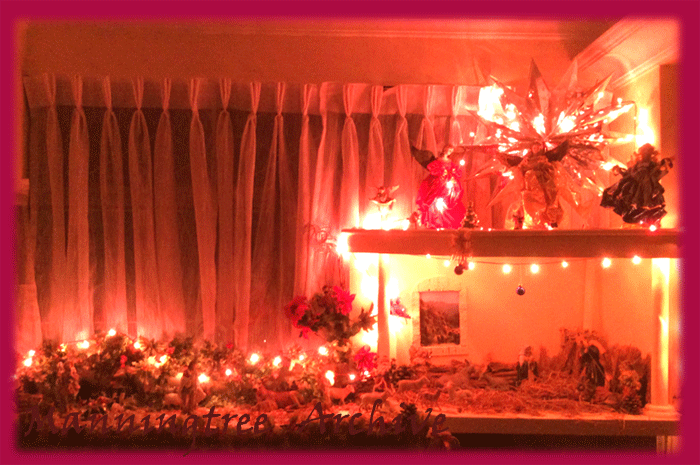
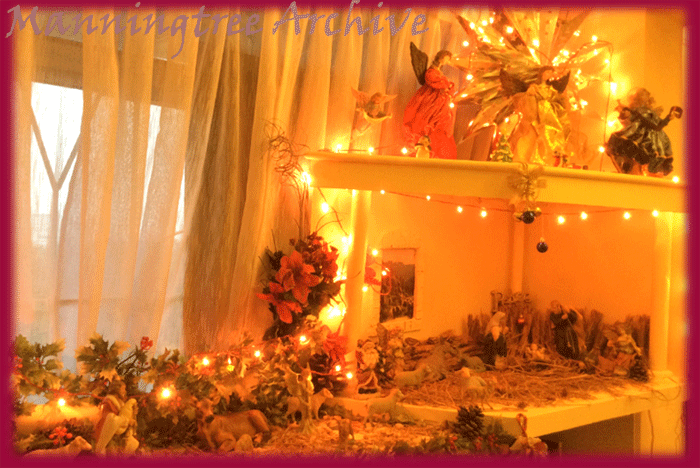
We all have our favourite things about Christmas. Our Christmas tree and the little electric lights were brought out for the ritual of decorating it with enormous pleasure by my wife Carina, born in Germany where the tradition of decorating a tree for Christmas is thought to have originated. Her creative skills to try out new decorative ideas are evident on our tree decked out with readymade decorations (no edible decorations on this tree!) brightened by the magical glow of little lights.

X3

A red tablecloth, embroidered by Carina’s mother, covered our dining table – its centrepiece, a beautiful floral arrangement in a crystal container. Two stars, white and silver, were hung on two locations. We love this time. It can be magical – of Peace, Hope and Love.

Love can give us a fairy tale – all the sweets of life…. It is said “Love is only a word until we find the person who gives it a sense”. We would not disagree on that…

X4

We wish all of you more happiness and good health to light up this Festive and Family time of the year. – Jo

X5

Some more Christmas scenes from our house:

X6

X7

X8

X9

(Photos: © Joseph Sebastine/Manningtree Archive)

THE PASSION FOR FASHION

1

Bangalore (Bengaluru*) is the capital of the State of Karnataka in India which shares the border of our State, Kerala, with Tamil Nadu. I have enjoyed the temperate climate and higher elevation of Bangalore many times since my teen days, but more often from the time our daughter Bianca enrolled at the National Institute of Fashion Technology (NIFT), Bangalore in 2010. This time around, in June 2014, we had gone there to attend the NIFT Graduation Day/Convocation Ceremony 2014.

2

NIFT, which is unique and special, provides the best training for budding Indian designers with a sense of fashion, ideas and dreams. It gave them hope that one day they could also become fashion pacesetters of the future like established designers such as Manish Malhotra, Rohit Bal, Ritu Kumar, Sabyasachi Mukherjee, Tarun Tahiliani, J J Valaya, Manish Arora, etc.

3

3a

My tryst with a major fashion event was back in September 2002 at Colchester, England, which sparked a long dissertation over the subject of “dressing for dinner”, which extended across that day’s dinner with Carina at the Prince of Wales (8 Kensington Church Street, London). That dinner had concluded with the opinion that good taste and judgment is of supreme importance if one wishes to be well-dressed.

4

We could also endorse the dictum that men should be kept in mind while designing clothes for women!

4a

The show at Colchester later prompted me to read the autobiography of Paramount / Universal Pictures costume designer, Edith Head (Edith Claire Posener). Winner of eight Academy Awards, she had not only transformed glamorous stars such as Marlene Dietrich, Sophia Loren, Rita Hayworth, Elizabeth Taylor, Doris Day, Cary Grant, Yul Brynner, etc, into the characters they play on the screen but also designed costumes for opera and circus. Who could fail to notice the everyday girl style of Audrey Hepburn in “Roman Holiday” (1953) or Yul Brynner’s Pharaoh in ‘The Ten Commandments’ (1956)?. Soon I my attention was drawn to the works of Edith’s contemporaries such as Irene Sharaff, Ann Roth, etc.

5

But my real interest in fashion was awakened when Carina and I were staying in Milan with a friend who often did promotions/networking for major fashion shows in Milan. Since then, apart from being fascinated by fashion window displays in many World capitals, I had kept a climatic eye on the dressing of women. One is never bored!

6

7

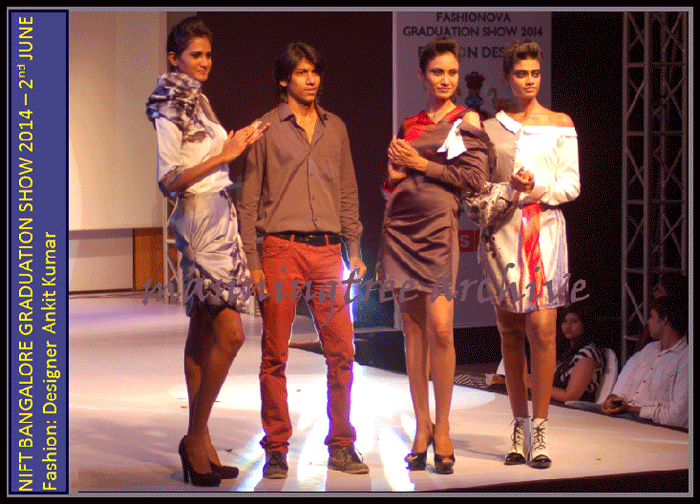
Fast-forward to Bangalore: the aggressive monsoon showers that lashed onto the NIFT Campus on that June evening did not cause hindrance to the students, their guardians converging from around the country, their confrere, the NIFT faculty and other consultants/volunteers/technicians, pouring into the main auditorium for the KNIT MODA / FASHIONOVA Graduation Show 2014 – the most important event in the knitwear/fashion curriculum of NIFT.

8

9

Apart from the opportunity to the budding designers to enhance their specialised learning by participating in their first fashion event, the show provided them with a creative platform for designing; fabric research; to create dresses with fantastic fit and impeccable construction; and also strikes a fine balance between backstage work and catwalk presentation. The event acted as a lever for aspiring talents to make fresh impressions and move forward into the public eye – ready to take their life to a whole new level.

10

11

And really, during the past few days, the prestigious NIFT campus had seen visits from recruiters interested in fresh ideas and new blood which is integral to their business. They had interviewed the undergraduate designers which had provided them with opportunities to hear about the emerging talents’ awareness in fabric, textiles and fashion trends in addition to their views on creativity; the cycles of fashion; the glamour of the job – the type of designer they aspire to be. Some of these inexperienced fashion enthusiasts will eventually go through all the apprentice stage and tough employment conditions of the industry to master the dictates of fashion before, driven by an unprejudiced joy of fashion, establish their own fashion service.

12

13

As we entered into the excited atmosphere of the auditorium, we could see that apart from the cunningly lit lights and sound, a platform was installed as the runway that would showcase the little debut collections of Womenswear and Menswear derived from the hard work and talent of the Resident fashionistas. A battery of photographers with their gadgets was shuffling around the runway like the organisers of the event. This is going to be fun!

14

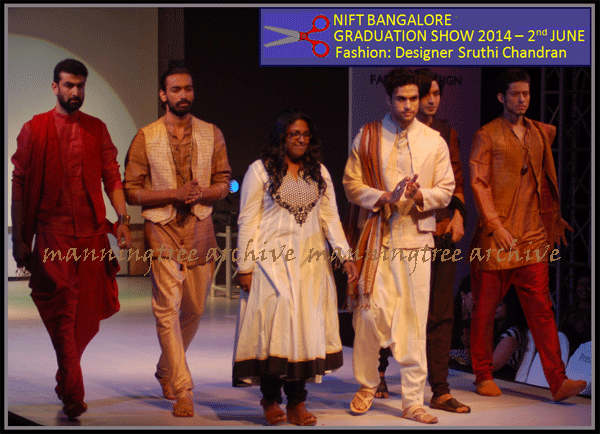
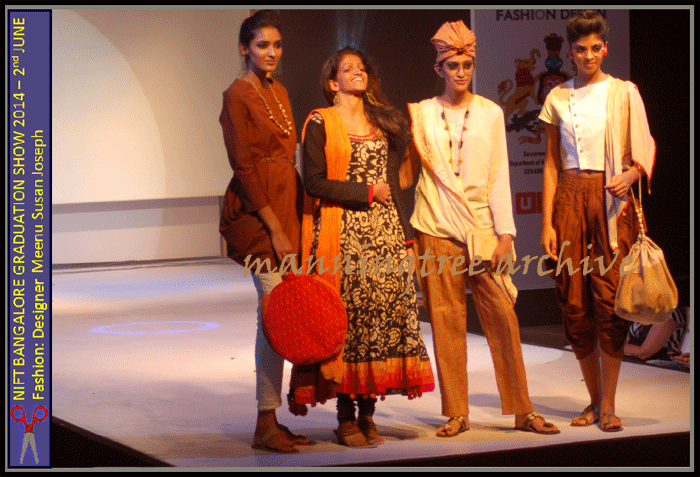
After the preliminary introductions, the show commenced with presentation of the Knitwear collections followed by Fashion apparels. Presented on time, the collections came into focus one after the other attired by fabulous models adorned with trend-led accessories and fascinators. Their movements crackled with energy while their faces displayed emotions of joy, anger, sadness and pensiveness in synergy with each theme.

15

16

The collection was a mixture of Western and traditional cuts. Some featured the vibrant colours inspired by the summer festivals of India while one attired her models with dresses that would fit into the modern architecture and rooms currently in fashion in emerging cities of India. Some showed great deal of personal originality while others almost fantastic in their novelty.

17

The entire show was highlighted with coloured spotlights, and during occasional breaks from pumping Asian-Western soundtrack, well-known commentator Prasad Bidapa enchanted the spectators with the salient features of each presentation before the designer, cheerful, full of gusto, full of zip, appeared on the runway to endorse his/her collection. Indeed, shows like this being part of the curriculum will continue to exist. However, some media news has raised the issue that fashion shows could possibly become endangered events since its survival is threatened by scheduling complications, technological advances and infighting.

18

Fashion is a glamorous but tough industry and it has grown into a huge industry and worked at so many tiers. The idea is that, a degree in Fashion design is not just about fashion design anymore as there are so many other directions to take you off considering the various elements connected to fashion. These new aspects have undoubtedly made fashion an unbounded turf for motivated students where people would be their passion – their curiosity would be in peoples’ personality and their figure.

19

20

The NIFT show had begun, as such shows should, quite mildly but its conclusion was marked with whistles and thunderous applause as the audience rejoiced. Well, the event of the day has come to an end, mission accomplished with ease and grace, but there would not be a let-down in the energy and enthusiasm of these undergraduates. When the Earth turns on its axis one more time, it will be the Graduation Day for them and the successful culmination of their dream.

21

22

These students are coming fast into focus and hopefully, one day may provide a new fashion experience surmounting the existing line-up. This is an age of creativity and the ground is always fertile for the inspired designers. Essentially, they can get inspiration from almost everything. Besides, there is no age in clothes today. An elegant blessing is that fashion creates its own demand. Till next time, Jo

22a

Nothing captures the moments of the Show better than photographs – some of the best are here below.

23

24

25

26

27

28

29

30

31

32

33

34

35

36

37

38

39

40

41

42

43

44

45

46

47

48

49

50

51

52

53

54

55

56

57

58

59

60

61

62

63

64

65

66

67

68

69

70

71

72

73

74

75

76

77

78

79

80

81

82

83

84

85

86

1)     A 9th century Ganga inscription refers to Bangalore as “Bengaluru”. “Bangalore” is believed to be an anglicised version.

2)    Manningtree Archive congratulates the winners and each one who made the KNIT MODA / FASHIONOVA Graduation Show 2014 a memorable event.

90a

(Photos: © Joseph Sebastine/Manningtree Archive)

Songkran: The Spirit of the Moment

1

Thailand is in a festival cheer. Though rain was expected for sometime, as for now, the skies are clear above Bangkok. For the past few days, people were flocking to Don Mueang airport and to bus/metro terminal stations to head for their home provinces to celebrate the annual Songkran (The Water Festival) holidays.

1a

I heard that under the “Leave your homes in police care” programme, many houses in Bangkok have reportedly registered with the police for protection while the tenants are away on holidays. Owing to the heavy traffic on major routes out of Bangkok, the road safety campaigns for the “seven days of danger” are popularised.

2

To prevent and reduce road accidents from drink driving, the provincial health officials nationwide are strictly enforcing an alcohol ban in designated areas during the 7-day period of the water festive season of Songkran which runs until Thursday.

3

Believed to have been derived from the Sankranti Hindu festival, the uniquely beautiful tradition of Songkran (from the Sanskrit word samkrānti) marks the Thai New Year’s Day.

4

Celebrated throughout the country, the occasion is a time for family re-unions and of bonding between family members, friends, etc.

5

It is an occasion to show reverence and appreciation to one’s parents and seek blessings from the elders. Young people pour fragrant water into the elders’ palms in a gesture of humility to ask for their blessings.

6

Traditionally, this is called the ‘Rod Nam Dum Hua’ ceremony which is performed on the first day of Songkran. Indeed, April 13th officially set as the day of Songkran also marks the National Elderly Day.

7

The Songkran holidays signify the heritage and tradition of the people of Thailand. It marks the occasion for temple visits and annual house cleaning.

8

Apart from the ritual of pouring water on sacred Buddha statues and making food offerings at temples, some enterprising Shopping Malls have also set up conveniences for the bathing of Buddha statues which includes five bowls containing different coloured (representing prosperity in a variety of forms) floating flowers for visitors to pour over the sacred statues.

9

10

Our arrival here in Bangkok, the City of Angels, on April 4th was timed to coincide with the busy days of the special exhibitions, shopping promotions, entertaining activities including carnival games, craft and cooking demonstrations, traditional performances, etc, whilst Bangkok geared up for the start of Songkran.

11

By April 12th, many fairs in Bangkok were offering a variety of attractions for the visitors. There is a fair where one can pay respect to the Buddha tooth relic from Tibet while another offered the opportunity to see a replica of Phra Narai Balaji or Lord Venkateswara from India. Then there are activities such as pail-kicking competitions for elderly people or facilities for children to build traditional Sand Piles (sand chedis), in addition to parades, beauty pageants, decorated floats, oyster shelling competitions and general merriment. Children can take enjoyment in splashing water at painted jumbos housed at the Elephant Camp in Ayutthaya.

12

Water has a special meaning in Asia. It represents life, prosperity and, of course, a new beginning. It also symbolizes joy, tranquillity and coolness to hot summer days.

13

14

During this festival, groups of farangs (expatriates) and local people armed with water-guns and buckets splash/hurl water at pedestrians and onto moving traffic as a ‘gesture to give and request a blessing”. The water splashing fun also symbolizes the washing off all misfortunes of the past year and welcoming the New Year.

15

16

Many shops displayed water-guns of different colours and sizes to choose from. There are also places where barrels of water are sold or else, you can refill your water-gun from bottled undrinkable water on sale. Some shops sell beige coloured powder (Din sor pong) which is mixed with little water to smear on the faces and bodies.

17

18

Also on sale are waterproof Songkran pouches to protect the cellphone, etc from the hurling water. It’s all part of the festival fun. When the water hits you – do it the Thai way. Don’t miss out on the fun. Just smile and move on, probably into the sunlight to dry off.

19

A sure bet to get water-soaked in Bangkok is to be at the front courtyard of CentralWorld where a three-day event is held which includes a foam party.

20

21

Apart from popular Songkran venues at the Ratchaprasong area, Silom Road, the biggest and wildest celebration was at Khao San Road, Bangkok’s backpacker quarters.

22

Everywhere you are often greeted cheerfully with “sawatdi pi mai” (Happy New Year) as they try to drench you with water.

23

According to TAT (Tourism Authority of Thailand), the occasion is fun time and attracts foreign tourists to the Kingdom. It’s the only time of the year one can bathe Buddha statues for blessings, enjoy a variety of themed activities and hurl water at one another!

24

The water-guns were out on the streets by the afternoon of April 12th. We took the first hit from some children near our hotel while returning after a delicious lunch at the “Lord Jim’s” Restaurant of Bangkok’s legendary Mandarin Oriental Bangkok Hotel, cooked under the supervision of one of the top Executive Chefs of Bangkok, Chef Stefan Trepp. More about this in another write-up.

25

26

Today April 13th, following the Palm Sunday Mass at the Assumption Cathedral we had taken an extensive drive through the water-splashing streets of Bangkok. At the wheel of the car was Mr. Vichai, a former employee of Saudi Aramco and later of Mandarin Oriental Bangkok, whose ardent fervour to receive maximum water-hits on his four-wheel drive perfectly matched the exhilarating enthusiasm of the young and old Songkran revellers engaged in the celebrations on the streets.

27

28

I saw cheerful people everywhere – unified, smiling and cheerful. Some of them were dressed up in traditional costumes (Chud-Thai).

29

30

34-15-4-14

The unity and the strong national spirit of the Thais will remain the underlining strength of this country – a need to be preserved. Earlier in the evening of this New Year’s day, just before we reached our hotel, it had rained. It is said that a light, lovely rain is always a blessing and a good sign of prosperity.

31

To some, Thailand might just be a popular tourist destination. But to me, this country remains endearing not only for its charm and history but also for the many wonderful friends and memories I have gained since I first started visiting Thailand regularly (twice this year and counting) since 2002.

32

At this late hour when I write this in the Suite in our hotel, I could hear the muffled sounds of merriment from the streets down below. Songkran is a time for togetherness, for love, for food, for fun, for exchanging-gifts, and for long holidays – and at the heart of this festival lie the important values of Thai Society. Sawasdee, Jo

35-15-4-14

33

(© All photos except those credited to TAT (Tourism Authority of Thailand): Carina-Joseph Sebastine/Manningtree Archive)

Following two pictures – Courtesy: Bank Ake, Bangkok

Bank1

Bank2

An Affordable Gift …..

1

Every girl deserves flowers. The first time I gave a flower to a sweet girl was at the age of 11. I was in the middle of school vacation and we were staying at my mother’s parental house in Fort Cochin. This Anglo-Indian girl, almost my age, is the sister of one of my friends.

2-Lon

She had shown great interest in me over the last one month when I saw her inadvertently at my friend’s house or when we hung out at the beach, though I didn’t have the nerve to utter a word other than smile back at her. I had spent hours imagining intimate conversations with her but when it actually happened, it was she who took the bull by the horn and spelled out that she liked me. El amor!!

3-Bonn

A longing fulfilled is sweet to the soul. It brought me a touch of self-confidence charged with energy, enthusiasm – and more sensitivity. It also made me want to show her that she’s not just someone inconspicuous. Giving heeds to the whispers of my heart, I decided to give her a “special something”. But what could I give? The only thing that my student’s pocket could afford at that age was what the groundnuts (peanuts) seller sold by the beach.

4-white-roses

It was on a Sunday evening when a friend suggested that he could help with the idea of flowers. Though only three years older than me, he appeared ingenious – a bit “learned” in such subjects. By the following Monday afternoon, my Mom was looking for a white rose that had suddenly gone missing from our garden. (If she remembers, that riddle will be cleared to her now with this post. Alright, Mom, my cell phone is switched on)

5-rose Mandarin

It is generally held that a red rose is a symbol of love – but the one available to me at that time was white. Later on I came to know that a white rose is nothing short of remarkable. A single white rose is a hopeful sign and means that the giver’s heart is innocent and hasn’t yet known love. That has to be true!

6-roses Mandarin

Well, the girl was over the moon when she received that “Oh, It’s-soooo-lovely” flower. It opened several buds of flowers of happiness in me, too. Then again, that teeny adoration fizzled out over time as we both moved on with our studies and lives. Even so, that white rose planted in me the first seeds of the significance of flowers.

Flowers will die, but the fragrance and memories they sometimes leave behind has a lasting quality. Jo

7 Ring-Roses

Pictures (from top)

1.. “Special Thanks” of Manningtree Archive to the “models” of our main title picture.

2.. On the premises of St Mary Abbots Parish Church, London

3.. At Blumenmarkt (Flower Market), Remigiusplatz, Bonn, Germany

4.. At Chatuchak Weekend Market, Bangkok, Thailand

5 & 6.. Floral display at Mandarin Oriental Hotel, Bangkok

7.. “Ring a Ring a Roses” by Myles Birket Foster (1825–1899) – Source: Bonhams / commons.wikimedia.org

8.. On Calle Floridablanca in San Lorenzo de El Escorial, near Madrid, Spain

8a-Title

 (© Manningtree Archive)

On the Path of Il Poverello

How we remember, what we remember, and why we remember form the most personal map of our individuality

– writer Christina Baldwin

Pope-1Today March 13, 2014 marks the First Anniversary of the papacy of Pope Francis. Looking back, it brings to mind that Wednesday night of March 13, 2013 when the conclave of 115 cardinal-electors of the Roman Catholic church, gathered inside the Sistine Chapel, elected Cardinal Jorge Mario Bergoglio, (born December 17, 1936) the archbishop of Buenos Aires as the 266th pontiff, due to the resignation of Pope Benedict XVI on February 28, 2013.

Pope-2We were watching the late night news when the TV Station cut into this news and shifted the focus onto the central balcony called “Loggia della Benedizion” above the main entrance on the façade of the Basilica di San Pietro in Vaticano, from where Cardinal Protodeacon (for the 2013 conclave) Jean-Louis Pierre Tauran would proclaim the newly elected Pope. Soon the announcement came:

Pope-3

  • * Annuntio vobis gaudium magnum; Habemus Papam: 
  • Eminentissimum ac Reverendissimum Dominum,
  • Dominum Georgium Marium
  • Sanctae Romanae Ecclesiae Cardinalem Bergoglio
  • qui sibi nomen imposuit Franciscum

Pope-4WhoBergoglio? As the world waited, the man in white robe finally made his first appearance before the rain-soaked crowds in the vast Piazza San Pietro, to give his solemn blessing “Urbi et Orbi”. Following the prayer for Pope Emeritus, Benedict XVI, the new Vicar of Peter from almost “the end of the world“, asked the faithful to pray to the Lord that he be blessed by Him – so that he may proceed with the mission as the Lord would wish. The crowd prayed, cheered and waved flags: Francesco! Francesco! A man clad in midnight-blue coveralls, with a look of happiness etched on his face, shouted: Viva il Papa! Viva il Papa!“. The journey Jorge Mario Bergoglio was destined to take has begun.

Pope-5A year has now passed and during this period the bespectacled Holy Father’s days were a continuous thread of revelation about himself; about his thinking on a variety of issues: religion, politics, global issues, lifestyle, … As his pontificate acquired a definite shape, he reasserted himself as a man who had let the potent power of simplicity work in his life – a man who radiated love and charm and concern for the common man.

Pope-6The Argentinian-born Pope who took the name of San Francesco de Assisi, Il Poverello (the little poor one), is currently on a Lenten spiritual of preaching and prayer at a spiritual retreat in the town of Ariccia, in the Alban Hills about 15 miles outside the Vaticano.

Pope-7At this time, in the run-up to the Supreme Pontiff’s first Easter, I could envisage the long days ahead of him in the journey of fraternity, of love, of trust; and his efforts to promote, safeguard and symbolize the unity of the church. May he receive the benefit of our prayers to remain admirably robust and our wishes that all his days will be lit with the brightness of God whom he represents. Jo

Pope-8 Benedict-(2005)* Note: English text of the announcement: “I announce to you, news of great joy: We have a Pope! The most eminent and most reverend Lord, Lord Jorge Cardinal of the Holy Roman Church Bergoglio, Who takes for himself the name of Francis.”

Pope-9

  • Photo credits (from top):
  • 1.. The marble bas-relief “Delivery of the Keys” (Consegna delle chiavi) by Ambrogio Bonvicino (1552-1622) put up in 1614 just below the central balcony called “Loggia della Benedizion” (Loggia of the Benedictions) (May 19, 2010 – Photo by Andrea Lalis Sebastine)
  • 2.. Pope Benedict XVI at Piazza San Pietro. (October 22, 2008, Manningtree Archive)
  • 3.. Basilica di San Pietro, Vaticano (October 22, 2008 – Photo by Bianca Celine Diane)
  • 4.. Pope Francis
  • 5.. March 13, 2013: Pope Francis just after his election at the central balcony of St. Peter’s Basilica (author: Tenan – Source: http://en.wikipedia.org)
  • 6.. San Francesco d’Assisi – painting by Cimabue (part of Frescoes in the Church of San Francesco, Assisi) – (Source: commons.wikimedia.org)
  • 7.. Pope Francis (Source: en.wikinews.org)
  • 8.. Pope Benedict XVI at his window on the third floor of the papal apartments facing Piazza San Pietro. (March, 2005, Manningtree Archive)
  • 9.. Pope Benedict XVI during his weekly general audience in Piazza San Pietro (October 22, 2008 – Photo by Bianca Celine Diane)
  • 10.. Architectural elements on the façade belltowers of Basilica di San Pietro. The Saints on both sides of one of the clocks (designed by Giuseppe Valadier) are S. Thaddeus and S. Matthew (April, 2012, Manningtree Archive)

Pope-10

(© Manningtree Archive)

That Cyd! The Beautiful Dynamite *

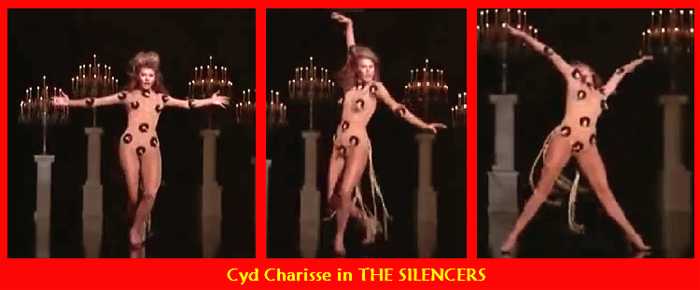
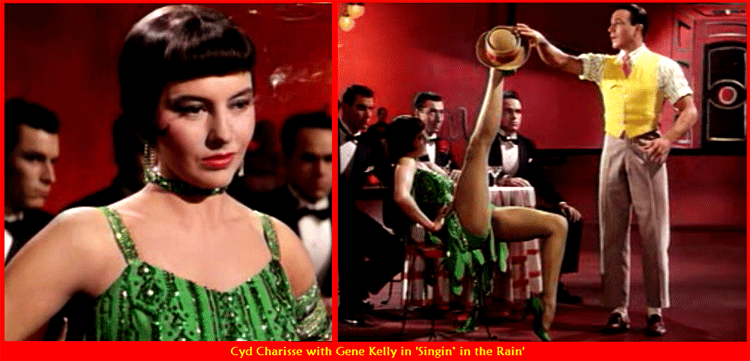
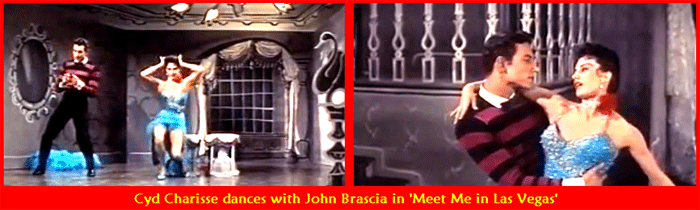
cyd1MARCH 8: Remembering American actress and dancer Cyd Charisse (1922 – 2008) of films: Ziegfeld Follies (1945); Singin’ in the Rain (1952); The Band Wagon (1953); It’s Always Fair Weather (1956); Meet Me in Las Vegas (1956); Silk Stockings (1957); Party Girl (1958); Something’s Got to Give (1962); The Silencers (1966), etc. cyd2cyd3Born on March 8, 1922, she was originally known as Tula Ellice Finklea, and later by the name “Lily Norwood” before she became popular as Cyd Charisse – the leggy fabulous dancer who brightened up the Hollywood musicals of the 1950s, notably opposite Fred Astaire and Gene Kelly. In her autobiography, “Debbie: My Life”, actress Debbie Reynolds quoted: “Cyd did everything perfectly. Her legs went over her head and into the sky.” cyd4Cyd Charisse will be missed by many. She now reposes at the Hillside Memorial Park Cemetery in Culver City, Los Angeles County, California where actress Shelley Winters is also buried. One of the most beautiful talented dancers on film, Cyd will always be in our hearts.

cyd5Cyd, You danced into our hearts. You will never be forgotten.  Jo

cyd6

Notes:

a)       The DVDs and music albums of most of the movies referred in this post are available with main dealers such as amazon.com, TCM Shop, etc.

b)       This illustrated article is meant for the promotion of the actors and movies referred therein. Please refer to “About” for more details.

c)       * Referred as “beautiful dynamite” in “Steps in Time: An Autobiography” by Fred Astaire

(© Manningtree Archive)

FORT COCHIN – Pepper, Souls and Restless Waves

1

This is dedicated to the memory of my beloved maternal grandfather, Abraham – “silver in his hair and gold in his heart”

2In nomine Patris, I baptise thee Jo……...” the priest had pronounced during that ceremony held many years ago at Santa Cruz Cathedral (Basilica) at Fort Cochin (Kerala, South India). When those words were quoted to me by my maternal grandfather Abraham eight years later, it was decisive in arousing in me a curiosity for that cathedral and its origins that stretched back to the arrival of the Portuguese.

It is a place where I had witnessed many similar functions and weddings – including some of the festivals that dotted its annual calendar. Living on the mainland of Cochin (earlier Cocym, Cochym, Cochim,.… now, Kochi), those occasions were opportunities for me to hop over to Fort Cochin and be with my maternal grandparents.

Until the age of nine, the Cochin that existed before 14th century was rather shrouded in obscurity to me. My earliest knowledge of Fort Cochin at that time was fixated on an event said to have occurred in 1341 which occasioned it’s emergence as a prominent village consequent to the great flood of the River Periyar – during which a natural harbour was formed when the sea mouth of the Vembanad estuary opened up, and eventually ushered in trade and colonialism.

It is generally held that, it was due to this natural calamity that, Mahodayapuram (Mahodaya Pattanam) and its ancient port of Muziris (Kodungallur), which had silted up, lost their importance.

3

4

History has taught us that Fort Cochin had seen the presence of the Arabs, then the Chinese before the Portuguese came along, followed by the Dutch and finally, the British. The fact remains that during the second half of the fifteenth century the intercourse between China and Malabar has waned, until at last it ceased altogether, leaving some tangible symbols in the form of Chinese Nets, pagoda-style roofs, palm-woven, broad-brimmed hats of the fishermen, Chinese style porcelain, clay pots (Cheena chatti), etc.

5

And when the Portuguese came to India in 1498, suffering losses by shipwreck, disease and hunger, in due course they realized that, they were not conquering some kind of uncivilized and uncultured people – indeed, they were confronted by a civilization different from theirs, superior in some and inferior in many respects.

6I have often thought that it is my privilege to have been born in Fort Cochin reaped with legends and vibrant history. Primarily, I was fortunate to be the grandson of Abraham, once a teacher with Santa Cruz School (less than 200 meters from his house), who, with his useful and reliable knowledge about the East and the West, had sowed the first seeds of fascination in me for geography and history, especially about Fort Cochin. He had told me of names I haven’t heard before, …..  Zheng He (Cheng Ho – 1371–1433), Marco Polo (c. 1254-1324), Ibn Battuta (1304– 1368/1369), Dom Vasco da Gama (c. 1460/9–1524), Dom Pedro Álvares Cabral (c. 1467/68–c. 1520), Dom Afonso de Albuquerque (c. 1453–1515), Dom Francisco de Almeida (ca. 1450-1510), etc…

7

Over the years, it was from him that I first learned of Fort Cochin being the fundamental reference point for many firsts in Kerala, even in India. It was the first place of European settlement in India; the first place where a foreign Fort was built; the first place in India where European food was served; cake and hot bread was baked; wine fermentation was tried; vindaloo (derived from the Portuguese dish “carne de vinha d’alhos”) made its first appearance in its original form using wine instead of vinegar.

8

Most likely, it is the place where tobacco, potato, cauliflower, and new species of fruits such as pineapple, papaya, cashew, guava, custard apple, etc., were initially introduced. The chillies came from the West Indies and revolutionized the palates of locals. I savoured all this in small doses whenever I was in Fort Cochin until 1970, sitting before him, during long balmy evenings that stretched into the late hours.

9

In the course of time, further readings led me to complement my list with more firsts: It is certainly the birthplace of Cochin Creole Portuguese, the language that came into existence with the contact of Portuguese language with the local languages and developed hand-in-hand with the formation of Catholic and Indo-Portuguese households. Since the Portuguese occupied Goa only by 1510, Fort Cochin, a citadel of peaceful coexistence, could probably be the first place where the concept of Mestiços or Luso-Indians (people of mixed and Portuguese descent through Indian women or even, órfãs del rei/young orphan Portuguese girls) emerged – the forerunners to Anglo-Indians who, imbibed in the European way of living, can be called the first moderns of India.

10

No doubt, the true success of Kerala would remain in its ability to maintain religious harmony. Even though dress codes sometimes marked out the religious identities of the different groups, not prone to the extremes of communal disturbance or religious chauvinism, the natives dressed in mundu, chatta, and neriyathum; sari and blouse; pattu pavadai; ghagra cholis; pardah, Muslim cap, green belt and lungi; Western-style skirts and trousers – all existed side by side in perfect harmony.

11

Once, my grandfather’s talk had diverged into the subject of another ritual that was said to have taken place some 489 years ago at less than 100 meters from Santa Cruz Cathedral – at the Church of San Francesco (now called St. Francis CSI Church). When that event took place, the place was known as the Church of Santo António (Igreja de Santo António), dedicated to the Saint who would subsequently capture the reverence and affection of Kerala devotees irrespective of their caste and creed.

12

The occasion was the funeral of the Portuguese explorer Dom Vasco da Gama in late 1524. At the time of his death, the retired and ageing Dom Gama, by then “Conde da Vidigueira” (Count of Vidigueira) and the second Viceroy of India, was on his third visit to India when he fell ill and death stole him on Christmas Eve.

13

14Years later, I would discover a written account of that event only in the writings of Gaspar Corrêa, (the Secretary of Albuquerque) in Lendas da India (a) which covered the history of the Portuguese from 1497 to 1549. According to Corrêa, Dom Gama was suffering from “great pains in the neck for some days, which had got awry, and some boils came to the surface at the nape of the neck.” In spite of remedies, it got worse to such an extent that the pains deprived him of speech. Having realised that his death was imminent, they shifted him from the fortress to the houses (perhaps this could be the Vasco House) of a Diogo Pereira close by to the church of Santo Antonio. Dom Gama was a great devotee of the Santo António, who himself is not unfamiliar to the perils of the sea. After Dom Gama’s testament was prepared and orders issued to subordinates that included his wish to convey his bone to the kingdom, as a basic preparation for death, Dom Gama made his confession and holy sacraments were administered to him. His life departed him in the night of Christmas, 1524, at three o’clock after midnight.

Corrêa relates: “The body, dressed in silk clothes, and over them a mantle of the Order of Christ, with a sword and gilded belt, and gilt spurs fixed upon dark buskins and on its head a dark round barret-cap, was placed in the hall, in the bier of the brotherhood of Mercy, uncovered; and the gentlemen, clothed in the mantles of their order, bore it on their shoulders, with many tapers, and followed by all the people. It was carried to the monastery of St. Antony, and buried in the principal chapel; and upon the tomb was a square grating surrounding the grave, of the height of a span, lined with black velvet, and a black and white fringe, placed upon a velvet cloth, which covered all the grave. There the next day a great service was performed”.

15

Having discovered the ocean route from Europe round the Cape of Good Hope to India, the tough and fearless navigator Dom Gama, and his hard-bitten crew with seafaring capability had landed at Kappad near Calicut (renamed Kozhikode) on May 20, 1498 which culminated in the diversion of the profitable spice trade that passed through Syria and Alexandria into a new route – consequently destroying the monopoly of Venice and elevating Lisbon as the great spice-market of Europe. It was a time when much of the traffic in the Indian Ocean was dominated by the vessels of Muslim merchants who for centuries had controlled the trade routes with the support of powerful local rulers.

Although historians know little about why Dom Gama was chosen to command the expedition to India, the three objectives of Dom Gama’s feat to the southeast coast of India is well understood: conquest, commerce, and conversion. His success in breaking the maritime domination of the others had set the stage for him to not only earn a place in history by the side of Fernão de Magalhães and Cristóbal Colón but also established a link connecting the source of his family fortune to India.

16

Favours such as the territorial title of “Dom”, “Admiral of India”, an annual pension of 1,000 cruzados, title of annual hereditary pension of 300,000 reis, right to send money to India, were granted to him. His return in a blaze of triumph to Lisbon after the first journey to India had also brought him a privileged marriage to prominent nobleman Álvaro de Ataíde’s daughter Dona Catharina de Ataíde just months before he set sail for his second journey to India in 1502 with the object of securing a permanent foothold on the Indian coast.

17a

Consequent to Dom Gama’s discovery, more adventurers like Pedro Álvares Cabral and the energetic commander Afonso de Albuquerque, the first European since Alexander the Great who dreamed of establishing an empire in India, or rather Asia, followed.

18

When the Portuguese arrived in India, Cochin was in vassalage to Zamorin of Calicut. But the Raja’s surface appearances were out of step with inner truths. Irritated under the dominance of Calicut, Unni Goda Varma Koyil (Unni Raman Koyil I (? – 1503)) (b), the Raja of Cochin, was exploring ways to break away. He saw the arrival of Portuguese as a chance to assert his independence. No sooner they earned the goodwill and permission of the Raja to engage in trade and built a factory in Cochin, Cabral established the first Portuguese trading post in India, which the Portuguese called “Estado da India” (State of India). Besides their trade in pepper, they also popularised other spices such as cinnamon, cardamom, ginger, etc, in the European countries.

19

The Portuguese victory in fending off the invading armies of the Zamorin and vassal Malabari states in the Battle of Cochin (the first siege was in mid-1503 and the Second Siege of Cochin was during March-July 1504) which took place on land and sea not only thwarted Zamorin’s attempt to conquer Cochin but also helped in reinstating the Raja of Cochin on the throne. This facilitated the Portuguese to secure their continued presence and strengthen commercial and missionary relations. The initial siege had proven that protection could not be achieved by unassertive means. In order to lay the foundation of the shore defences and to defend the local Portuguese factory, they acquired permission from Raja Unni Raman Koyil II (1503-1537) to build a Fort on the southside of the entrance of the river leading into the backwater using the Raja’s workers and material.

20

21The foundation stone of this Fort was laid by the newcomer Albuquerque on September 27, 1503. Completed within a few months, the Fort would finally have seven large bastions, with the first bastion directly facing the sea. Named Fort Manuel de Cochim (Manuel/Emmanuel Kotta) after Manuel I the Fortunate (c) (English: Emmanuel I – 1469-1521), the 14th King of Portugal and Algarves, the area became known as Fort Cochin (d).

The Portuguese built their settlement in India behind Fort Manuel. They were acclimatised by birth to a hot climate. As they did in other Portuguese trading posts/colonies along the coastal districts where their power made itself felt, a wooden Catholic chapel was constructed in the neighbourhood in 1503 by five Franciscan friars who had accompanied the Portuguese expedition.

Dedicated to São Bartolomeu, one of the Twelve Apostles of Jesus, the Chapel merits the honour of being the oldest European church in India and went on to garner great historical significance as a mute witness to the European power struggle in India.

A house to the left towards the rear of this chapel (in Rose Street) (e) with typical European glass pane windows and balcony-cum-veranda, considered to be one of the oldest Portuguese houses in India, is supposed to be the place where Dom Gama lived. Today it is known as Vasco House. The close proximity of this house and Dom Gama’s devoted attachment to this Chapel could be one of the criteria for his burial in this chapel.

22

23

Great builders and promoters of architecture than any other form of fine art, the Portuguese apparently caught the admiration of the Raja of Cochin who was tolerant of other religions. The Raja granted permission to the first Portuguese viceroy (appointed in 1505), Dom Francisco de Almedia (1450–1510), a nobleman of illustrious rank and first cousin of Dom Gama’s wife Catarina de Ataide, to construct buildings using stone and masonry work. At the same time as Fort San Angelo (Kannur Fort/Kotta) was being built by the Portuguese with brilliantly red laterite stone at Cannanore, the foundation stone of Santa Cruz Cathedral was laid at Fort Cochin on May 3, 1505, on the old Feast Day of the “Invention of the Holy Cross”, the instrument of salvation. Hence, the church was called “Santa Cruz”. As we can observe, almost always in the early European explorations, religious and commercial motives were intertwined.

24

In 1506, the wooden Chapel of São Bartolomeu by the side of the 4-acre Parade Ground (formerly Barrack Ground) was pulled down and reconstructed into a permanent structure with gabled timber-framed roof covered with tiles.

25

While the façade of the Church in typical Portuguese style is flanked on both sides by a stepped pinnacle, the windows and doors displayed semi-circular arches.

26

The bell turret is divided into three compartments and must have been visible to the European sailors from afar during their arrival and departure. In 1516, the newly consecrated church was dedicated to Santo António, the patron saint of Lisbon. The original title deeds written on palm leaf (Ola) pertaining to the land gifted by the Raja of Cochin to construct this church is still kept in the church. It was here Dom Gama was buried with honours in 1524, bestowing the church with historic significance.

27

28

The method of construction using stone and masonry work for church edifices was unheard of during that period since construction of such imposing structures were solely limited to royal palaces or temples. Although this church does not have any architectural merits, it was during this period, when ornate monumentality of the European churches was introduced to India, which initiated the synthesis of Church art and architecture of an alien nation and religion to indigenous forms and techniques of Kerala’s artistic and architectural traditions.

29

With the Raja of Cochin residing at Mattancherry, the peninsula became a fusion of traditional folk art forms and culture of Kerala as well as the West, although, till today, the peninsula retains the predominance of Malayali identity, its spiritual and traditional values.

30

Europeans visiting Mattancherry “to pay their respects” to the Raja could not only watch the Raja’s numerous elephants with good features (Lakshanams), sometimes richly caparisoned, but also now and then enjoy performing arts like Sinkari Melam, Theyyam, Ottanthullal, Padayani, Maritheyyam, Peelikavadi, Karakattam, Kurathiyattam, Kathakali, Thiruvathirakali, Bharathanatyam, Pulikali, Margam Kali, kolkali, etc., – moments that were decisive in formulating a fusion of new and vital forms of literature and drama like “Chavittunadakam” (Stomping Drama) (f), etc.

31

Having spent months out on the rough seas with sea-hardened sailors and listening occasionally to their bawdy sea shanties, these occasions must have appeared so refreshingly fresh and unique to the Europeans.

32

Here they sometimes listened to discussions on the merits of Ayurvadic treatments, astrology, Vastu Shastra (Feng Shui), and about the delicious vegetarian food such as Sambar, Rasam, Puliserry, Aviyal, Thoran, Inji Curry, Kalan, Olan, Parippu curry, Kootu curry, Theeyal, Pachadi, Kichadi, Injithairu, Achaar, Pappadam, Payasam, etc, and mentally compared them to those of Europe such as fresh bread, beef stew, grilled sardines, cinnamon rolls, sauces, etc, cooked in their settlement in Fort Cochin. The world has become very small.

33

During the time of Raja Veera Kerala Varma (aka. Gangadhara Veera Keralan – 1537-65) in 1538, fourteen years after the death of Dom Gama, his mortal remains were removed from the Church of Santo António to Portugal.

34

35

However, the original gravestone of Dom Gama’s empty tomb can still be seen today on the ground floor near to the Southern sidewall (g).

36

37

The southernwall marks the gravestones of Dutch personnel while those of the Portuguese are fixed on the northern sidewall – shifted from the floor of the nave in 1886.

38

39Closely following the maritime accomplishments of the Portuguese, the Dutch were determined to take part in the valuable spice trade and establish their monopoly in pepper.

Cochin’s existence as a long-time Portuguese protectorate since 1503 finally came to an end when the Dutch laid siege to Fort Manuel and captured Cochin in 1663, almost a hundred years after the Jews of Kerala constructed their Paradesi (Cochin Jewish) Synagogue in 1568 (h) under the reign of Raja Kesava (Kesara) Rama Varma II (1565-1601) in the neighbouring Mattancherry.

Since the Portuguese posed a threat to the island of Ceylon which the Dutch had conquered not long ago, their conquest of the Malabar region was initially only on account of Cochin’s strategic importance. However, so as to make it easier to defend and maintain their settlement, they would reduce the size of Fort Manuel, and also demolish several houses to make the settlement narrower.

40

41

42

Soon Protestantism gained influence and the control of the Church of Santo António shifted from the Order of Franciscans. Having decided to rid of all Portuguese influence, all European Catholic priests were ordered to quit the territory. The Dutch demolished all Catholic convents and churches except the Church of Santo António (The contents of a placard before the church include the sentence: “From 1510 AD to 1663 AD the Portuguese officially called St. Francis Church as the conventional church of the order of St. Francis of Assisi”), and the Santa Cruz Cathedral, which they used as their arms storehouse (i).

43

44

Successively, when some of the Catholics practising their faith at the Church of Santo António/San Francesco shifted to the Roman Catholic Church of the Our Lady of Hope (Nossa Senhora de Esperanca) in Vypeen, the existing pulpit and some screens of the Church of Santo António were also shifted with them. In their place, a new communion table and the rostrum furniture were installed.

45

46

According to a report, on January 8, 1664, the Dutch celebrated the first service with a parade of all arms commemorating their initial entry into the city after capturing Fort Manuel in January, 1663. Likewise, a tablet just above the main entrance relates to some restoration works the Dutch made in 1779.

47

48

During the time of the Dutch, Hendrik Adriaan van Rheede tot Drakenstein (1636-1691) served as the Governor of Cochin (1670-1677). In 1674 he began working on his book Hortus Malabaricus (Garden of Malabar), a pioneering compilation of 740 plants of economic and medical value in the Malabar Coast and published its first volume in 1678 (j). The book is also reputed to have the first printed words in Malayalam.

49

50

The British captured Cochin after occupying Fort Manuel in October of 1795. In spite of their supremacy, the British were lenient enough to let the Dutch, who had controlled Fort Cochin for 132 years, to retain possession of the Church of Santo António/Cochin/San Francesco.

51

Eight years later after the British took over, Fort Manuel was blown up by the British East India Company in compliant with the orders to destroy all fortifications and public buildings and the leading Dutch families who resided there with every degree of splendour started to desert the place.

52

In 1804, after the Dutch had voluntarily handed over the Church of Santo António to the Anglican Communion it was rededicated to San Francesco. It was eventually placed under the Ecclesiastical Department of the Government of India.

53

54

Some more renovations took place during the 19th century as confirmed by a tablet indicating that “Repaired by The Government of Madras. Anno 1887. Being the Fiftieth Year of the Reign of Victoria, Queen of Great Britain and Ireland and Empress of India”.

55

According to the “Imperial Gazettee of India – Volume IV”, “the facade of the church was surmounted by an ornamented bronze cross and a weathercock, 6 feet high, which could be distinctly perceived some 10 miles off at sea; but in 1865 these were pulled down.”

56

57

Since 1923, the church is treated as a protected monument of national importance under the Archaeological Survey of India and now remains under the Ancient Monuments and Archaeological Sites and Remains Act 1958 although it is owned by the Church of South India (CSI), the successor of the Church of England in India, that came into existence by a union of Anglican and Protestant churches in South India.

58

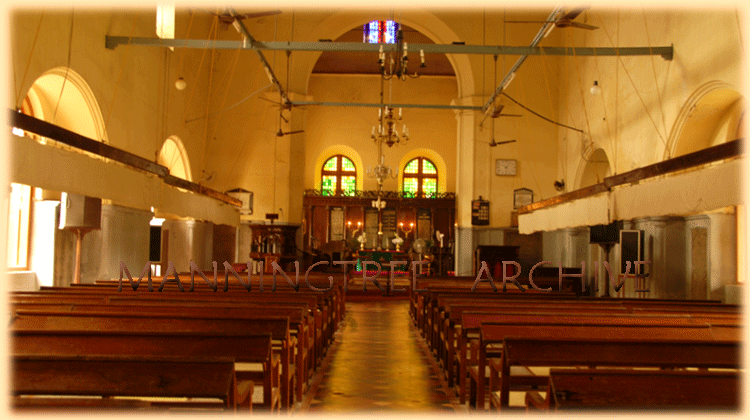
One symbol of British days which can still be seen today is the continued use of manually operated large swinging cloth fans on frames called “Pankhas” suspended above the congregation.

59

60

But history lovers would also love to have a peek at the “Doop Boek(k) of the church. It is the old Baptism and Marriage Register of the diocese covering the period 1751-1804, the most authentic record of the Dutch East India Company (Dutch: Vereenigde Oost-Indische Compagnie or VOC or more colloquially as The Seventeen) and others who strode on the turf of the history of Fort Cochin.

61

I understand that the original of that Het doop-en trouwboek is in the department of the India Office Records forming part of the VOC archives of the British Library in London, the very repository of the archives of the British East India Company (EIC).

62

63In the aura of the colonial past stands a cenotaph before the church, erected on October 21, 1920, in memory of the residents of Cochin who fell in World War I. You can also see a clock that was set up on the façade on November 13, 1923 in memory of Hal Harrison Jones, a former Managing Director of Aspinwall & Co., Ltd, who died at Cochin.

The land before the church is now occupied by constructions including some colonial bungalows situated amidst landscaped grounds forming part of a club which commenced operation in early 1900s with admission privileges restricted to the British and men only (presently Cochin Club).

64

What there is left of the beach that has had many cultural influences on these colonial powers exist on the west beyond the club grounds – its past glory diminished like the Fort Manuel, the remnants of which can be seen along the beach, like the symbol of a bygone era steeped in its historic significance and heritage value.

65

The few occasions we had to interact with the locals during our visit to Portugal in 2006 had offered me the understanding that the bygone grand era is looked back by them with pride though they are at wonder about how they had managed to attain it.

66

Even so, the fact remains that history should be seen in the context of its time – to the moods, attitudes, and conditions that existed during that time – as much as it is due to the farsightedness and pro-activeness of the illustrious explorers and adventurers; it is not unconventional to be aware that greed and brutality also played its roles to sustain this achievement, until more smarter and more able European powers appeared on the horizon and took over.

67

The changes that took place by stages in the colonial period had greater impact on Fort Cochin. In point of fact, the spirit and character of Fort Cochin is largely defined by its unique history and heritage. While it is no longer fashionable to think of history in terms of kings and captains, we cannot ignore the truth about the past communities of colonial times and even the one that predates the Western conquerors. The cantilevered Chinese fishing nets that still raise their heads are a tangible signpost to that period.

68

I recently attended a seminar on the heritage of Fort Cochin. There prevailed a sense of anticipation in the air – like a promise that something positive would eventually come out of it. Given that heads of historical monuments, prominent historians, archaeological experts, local populace and enthusiasts are roped in to participate, such seminars and activities of organisations are positive steps to regenerate and conserve the eco-cultural landscape of the area, its historical monuments, etc., and to watch out and curtail all actions that wipe out traces of the ancient civilisation.

69

70

The active involvement of dedicated personalities like Dr. Charles Dias, MP and Dominic Presentation, MLA, and official departments like the Department of Tourism, etc, is commendable. Of the various protective measures being considered, languages like Cochin Creole Portuguese which has originated during the colonial times, and other kinds of intangible cultural heritage that are becoming extinct must also be given due attention.

71

While the golden sands of the beach, still a distant dream, has to be definitely rejuvenated and there can be merit in establishing a community swimming pool – a public facility to enable visitors, especially low-budget travellers, etc, who like to swim safely in the ambiance of the beach and the Arabian Sea.

72

Understanding is a two-way street. Following that Seminar, a short walk I took around the old Fort area provided me with the opportunity to examine how much of its character and quality has been preserved. Sure enough, one of Fort Cochin’s blessings is its partial isolation and you can stroll at a leisure pace in the quiet streets. That cool and quite ambiance is what makes this “sweet spot” so charming and endearing.

73

Even now, you will not miss its charisma displayed so prominently on the doorways, walls and facades of the Portuguese, Dutch and British buildings from colonial periods lining the streets. Regrettably, many from the public, the tourists and heritage enthusiasts are still left unaware of several salient features of Fort Cochin’s history and monuments.

74

Through awareness programmes and encouraging research, many ambiguities can be clarified and questions answered: Where were the real boundaries of the Fort Manuel, or where each of the seven bastions, renamed by Dutch as Groningen, Friesland, Utrecht, Zeeland, Holland, Gelderland, Stroomburg (names of Dutch provinces) was situated? Where was the smaller bastion called Overijssel or riverside entrances to the fort – Water-Gate, Bay-Gate, and New-Gate, located? Where is the Loafer’s Corner? Why is it that there are hardly any Dutch surnames compared to those of Portuguese; etc.

75

76

The vestiges of three former European colonial powers that line the Burger Street (Burgerstraat), the Princess Street (Prinsesstraat); the remnants of the Fort; the huge, shady trees lining the lanes; the garden bungalows with large rooms, high ceilings and verandas, arched doorways, carved doors, colonial windows; the few edifices such as the Old Harbour House, Koder House, Vasco House, David Hall, the Bishop’s House (once the residence of the Portuguese Governor), Thakur House (Kunal or Hill Bungalow); the playgrounds, etc, – all extend their roots to a bygone era.

77

78

As the spice race is long over, it is the tourism that had opened its door to Fort Cochin’s history. As the tourism industry in Fort Cochin encompasses many different areas, any tendency to cash in on its tourist potentiality by overpricing on services would have a negative impact on Fort Cochin and deter the tourists from returning. Besides, certain visible “not so goody-goody” problems that have cropped up with the encroachers, illegal shack vendors, the dumping of garbage, etc., are aspects that are being addressed.

79

Although there are isolated incidents connected with the sale of drugs and abuse towards the visitors, the police have shown exemplary effort to curb these unsocial elements which are a menace in any part of the world.

80

Development is part and parcel of a society whose requirements and demands change when society changes. Nevertheless, I would say without fear of contradiction, that development must not ignore the past, socio-economic attitude of the people and their culture. No doubt, it’s a blessing that the restrictions and lack of opportunities for haphazard development has preserved this area to a remarkable degree even though intrusiveness can be seen popping its head up in some places. It reminded me of the policies implemented at places of historical importance like Assisi, Siena, Firenze, Toledo, to name a few, where preservation is given the highest priority to maintain the connection the present has with the past.

81

82

More than aides-mémoires of the collective past, historic place like Fort Cochin has social, economic, educational, and other values. I hope the renewed interest in this area would not only provide an incentive to our efforts for the welfare and protection of Fort Cochin and its surroundings but also bring in the essential cultural pride. Until next time. Ciao, Jo

83

PS:

84a)   It seems that Gaspar Corrêa’s (1496-1563) Lendas da India, an indispensible contemporary source on India’s history or the story of Portuguese expansion, was not published until the 19th century.

b)   The names of Rajas vary in different publications.

c)   Dom Manuel was called “the Fortunate” because of the great wealth he earned from Portugal’s maritime discoveries.

d)  The second part of the name Cochin might have derived from kochazhi which in local language Malayalam stands for “small estuary”.  

e)   Dom Manuel I was bestowed with a Golden Rose by Pope Julius II in 1506. By receiving a second Golden Rose from Pope Leo X in 1514, Manuel became the first individual to receive more than one Golden Rose, which is a gold ornament traditionally blessed by the popes annually and conferred as a token of reverence or affection.  The street must have been named “Rose Street” by the Portuguese as a mark of respect to their king during the above mentioned period.

f)   Chavittunatakam: The first documentation and publication of this art form is planned by South Zone Culture Centre and Kerala Folklore Academy.

g)   In the writings of Gaspar Corrêa also, it is mentioned that Dom Gama was buried in the principal chapel of the monastery of St. Antony while in some writings it is referred as Monastery of St. Francis, Cathedral of Cochym . In an article of the Boletim do Governo, Goa, December 21, 1858, on the subject of Dom Gama’s tomb, he was buried in the principal chapel of the church of the Franciscan monastery of Cochym.

85h)   According to Cochin State Manual by C. Achyutha Menon, the first synagogue was established at Muziris but it does not exist today.

i)    This arms storehouse of the Dutch fell into the hands of the British who demolished it when they took over Cochin in 1795 under the rule of Rama Varma (Sakthan Thampuran – 1790-1805).

j)    Colóquios dos simples e drogas da India” (Conversations on Indian Herbs and Drugs) was published in Goa on April 10, 1563 by Portuguese Jewish physician/naturalist Garcia da Orta, a pioneer of tropical medicine, nearly a hundred years earlier to the publication of “Hortus Malabaricus”.

k)   The Doop Boek was maintained for 40 years and was sent to London in 1932 for repairs. Having rebound in the original style, it is unavailable for public scrutiny although a Photostat copy of the original book is, I understand, available to satisfy their curiosity.

l)    For more details on Kerala: http://www.keralatourism.org

m) A special thanks to Ms. Pearl Prakash.

n) This article presents only sign posts from the history of Fort Cochin. The excuse for its appearance at this time is my attempt to summarise these events at this juncture when much discussion on Fort Cochin’s importance and protection are progressing.  Although certain proposals are mentioned here, I have not included all the various proposals and implementations currently being addressed by the Government, other institutions and enthusiasts.

(© Joseph Sebastine/Manningtree Archive)
 

StarChoice 20: KINGS OF THE SUN

1

(Aka: Könige der Sonne, Os Reis do Sol, Solens konger, Los reyes del sol, Auringon kuninkaat, Les rois du soleil, A Nap királyai, I re del sole, Królowie slonca, Günesin krallari, Könige der Sonne – and (Initial working title: The Mound Builders) – Color – 1963)

2

If there was one Hollywood actor who had the exotic mien, the boundless charm, the piercing eyes, masculine authority, and the range of acting talents which magnetized him to audiences – Yul Brynner (1920-1985) could well take that honour. Complex and unpredictable, he would always be the king.

3

Although there are different accounts about Brynner’s name, date and place of birth, bulk of the specifics indicate that he was either born Taidje Khan or Yuliy Borisovich Bryner to Boris Bryner and Marusya Blagovidova on the island of Sakhalin off the coast of Siberia or in Vladivostok, Russia where there is a memorial plaque marking it as his birthplace. I leave this at that.

4

5Consequent to a serious back injury in France which curtailed his 5-year career as a trapeze acrobat with the famed Cirque D’Hiver company, and subsequently, having received training in acting with Russian teacher Michael Chekhov (1891-1955), Brynner’s decision to pursue a film career for a living, led him to appear in the thriller “Port of New York” (1949).

6It was his appearance as the proud and supercilious King Mongkut of Siam in the Rodgers and Hammerstein musical movie “The King and I” (1956) which established his film career and won him an Oscar for Best Actor. The role also brought to him impeccable stage discipline from performing eight times a week on Broadway since 1951 to screaming, standing ovations.

Besides, it also earned him immense popularity by spawning “The Yul Brynner Look” when he shaved his head in 1951, a revolutionary look back then which I understand was suggested by Irene Sharaff (The King and I), one of the major costume designers of the period forming part of the “Couture on the Screen”. It was a bodily feature he would sport throughout his life although he made few performances wearing wigs, namely, “The Buccaneer”, “Solomon and Sheba”, “Villa Rides”, etc.

7

His status as a major star of Broadway could not salvage him from the adverse impact of his accent and looks for which he was at times “considered too exotic a type to play the lead in any important film”. However, after seeing Brynner’s dynamic Broadway performance in “The King and I”, Cecil B. DeMille (1881-1959) went on to cast him as Pharaoh Ramesses II in his last film “The Ten Commandments” (1956). DeMille was right. Brynner’s vaunting arrogance and baldness captured the essence of the Pharaoh’s personality. According to a quote attributed to DeMille, Brynner’s powerful personality is “…a cross between Douglas Fairbanks, Snr., Apollo, and a little bit of Hercules”.

8

Brynner’s meteoric rise continued through performances in: Anastasia (1956); The Brothers Karamazov (1958); The Journey (1959); The Sound and the Fury (1959); The Buccaneer (1959); Solomon and Sheba (1959); Surprise Package (1960); The Magnificent Seven (1960); Once More, With Feeling! (1960); until the scale started its downward trend….. “Testament of Orpheus” (1962); Escape from Zahrain (1962); Kings of the Sun (1963). By that time, he was not only a well-known superstar, a good still photographer, author, guitarist, and a Special Consultant to United Nations High Commissioner for Refugees, appointed in 1960. He was living fast and high. He drove a Mercedes-Benz 300SL Roadster and smoked many packs of black Sobranie cigarettes a day “just to appear macho”. “Yul Brynner was an unusual, interesting, and intelligent man. ………. He was an absolute self-invention”, wrote English film and stage actress Claire Bloom in her memoir “Leaving a Doll’s House”.

9

Even though Brynner’s initial work for the production company, The Mirisch Company, Inc., was “The Magnificent Seven”, he will reunite with Mirisch once again for “Kings of the Sun” directed by Bristol born Scottish director/screenwriter/playwright/former actor J. (John) Lee Thompson (1914-2002). Fresh from the huge box-office success of his “The Guns of Navarone” (1961), Lee Thompson was the finest film-maker to emerge from the British studio system after the Second World War. Having gone to Hollywood to direct “Cape Fear” (1962), he had decided to stay behind, turning down the offer to direct “The Longest Day” (1962) in England in spite that London was at that time considered to be an ideal and exciting place to make movies.

10

In its place, he accepted United Artists’ invitation to direct Harold Hecht’s epic production of “Taras Bulba” (1962) starring Yul Brynner, Tony Curtis and Christine Kaufmann. Finally raised to the platform of directors commanding highest remuneration and enjoying big budgets and box office success, United Artists was only pleased to offer him another epic production, “Kings of the Sun” concerning the Maya civilization in pre-Columbian Mexico. Similar to Lee Thompson’s “Woman in a Dressing Gown” (1957), “Tiger Bay” (1959), “Cape Fear”, “Taras Bulba”, etc, this story also explored how people respond to and can be shaped by their environment.

11

Produced by Lewis J. Rachmil under the banner of Mirisch Company for a budget of US$4 million and based on a story by Elliott Arnold, “Kings of the Sun”,  which turns 50 this year, was released through United Artists (like all the other 67 productions of Mirisch) in December 1963, a year noted for many momentous events. It was the year the First flight of Boeing 727 jet took off; British Secretary of State for War John Profumo resigned over sex scandal; Cardinal Giovanni Battista Enrico Antonio Maria Montini was elected Pope Paul VI; Martin Luther King Jr. made his “I have a dream” speech at Lincoln Memorial; Valium hit the market; US President John F. Kennedy was assassinated in downtown Dallas, Texas….. That year, the movie-world saw the release of “Cleopatra”, “It’s a Mad, Mad, Mad, Mad World”, “The Birds”, “Charade”, “From Russia with Love”, “The Great Escape”, Mirisch Corporation’s “Irma la Douce”, etc, featuring some of the most distinctive and eloquent faces in Hollywood cinema. It was also a time when parents in our part of the world used to put their children to sleep at night with bedtime stories unlike contemporary times when the children come in at bedtime and tell stories that keep the parents awake all night.

12

13

Underlining Elliott Arnold’s story of “Kings of the Sun” was the exodus of the Mayas to a new land and the final abandon of the practice of human sacrifice. The film opens with a panoramic view of the great pyramid at Chichén Itzá (c), the large pre-Columbian city of the Mayans where rows of Mayans have assembled as their Chief, “Balam. The Jaguar. Eight times King”, and Balam, the Crown Prince, (d) with headdress of high plumes of the quetzal adoring their royal heads, were brought to the crest of the pyramid to perform an important religious ritual. Following the credits, a voice-over narration is heard:

14

Long ago there lived a people unique in all history – the Mayans. Greece and Rome had become ancient legends in ancient books and the European civilizations had entered into the age of the barbarians. But in the tropical jungles of Central America, a civilization had burst into full flower without metals, without horses, without wheels. These incredible people built roads, pyramids, temples worthy of ancient Egypt; they charted the heavens, devised the highest system of mathematics than the Romans and created the calendar as accurate as the one we use today.

But despite the maturity of their art and their science, in the most important part of their lives, the worship of their gods, they remained primitive.

15

To their minds, their gods were demanding gods, fierce and greedy, granting nothing except for a price and that price was blood. In their profound desire to win favour from the deities, the Mayans made human sacrifice, the keystone of their religion. To die as a bearer of a message to the gods was the most exalted honour a man could experience. When he was selected to be sacrificed, in that moment he himself became a god. He was worshipped as a god, granted any wish that came into his heart, until the moment he was put to death.

For centuries in small scattered kingdoms these people lived in peace with themselves and their gods. But then came conquerors from the West, with metal swords which made them invisible against the wooden weapons of the Mayans. One by one, they swallowed up the little kingdom until the last, the final stronghold – Chichén Itzá was theirs. And their leader, Hunac Ceel, already as cool as any god now felt himself as powerful as one….”

16

Thus begins “Kings of the Sun” with ceremonies leading to the sacrifice of a youth to bring prosperity to the Maya land. But it was a time when the stars were moving in a chaotic manner. It was in that dry season, when men were free from agricultural tasks to fight in wars that Hunac Ceel, intent upon destroying Maya civilization, attacked them. As hordes of Ceel’s ferocious warriors (possibly Toltecs) swept the Mayan land from the north and rushed up the steps of the great pyramid, the leaders of Mayas had fled into its interior chambers, locking the huge door behind them. At the sound of a heavy cedar log ramming on the secured door, they went deeper into the inner chambers where, before the corpse of their King Balam, his son, crown prince Balam was chosen as the new king, “Balam, the Jaguar. Nine times King”.

17

Mindful of their meagre chance of survival with their obsidian bladed swords, the new king found common ground in the proposal of the elders (Al Haleb, Ah Min, Pitz, Ah Zok) to retreat with their tribe to a safe place by the coast – at the fishing Village of Polé. As they headed for the trap door of a tunnel at the ground level, high priest Ah Min carried the small stela from their temple.

18

At Polé, before Hunac Ceel and his armed warriors wielding hard metal swords could attack them, Balam had to swear before the local chieftain to marry his daughter Ixchel in the new land. This was necessitated in order to convince the villagers to lend him their long cedar log fishing boats and to accompany Balam and his people to flee from the coast to a faraway land (e) where Balam hoped to settle them down, raise a new civilization and find golden opportunities. However, they will not keep old losses a faded memory. They will grow stronger in the new land and then they will return.

19

20

Barely had they managed to row some boats loaded with people into the sea before the first of Hunac Ceel’s horde burst onto the beach, shouting and launching spears. In less than no time, Balam and his people had fled in their boats to a greater distance before Ceel could catch them although few of the fatalities from the spear they suffered included Ixchel’s father. As Ixchel, now Balam’s fiancée, sat hunched in deep grief for the voyage to the north in the Gulf of Mexico, Hunac Ceel shouted from the beach: “The sea is not big enough to keep us apart, Balam. Wherever you go, I will find you.”

21

All endings are followed by a new beginning. Although they have never sailed the boats out across the waters beyond the sight of land, at long last, maintaining close sailing without drifting apart and, despite an opposition from an elder, they finally landed at a seemingly uninhabited Gulf Coast. Balam’s attempt to fulfil his promise to the chieftain to marry Ixchel met her disapproval since his vow was made to her father, not to her. “If he (Balam) is lonely why does he not tell me himself?”, these unsaid words of Ixchel would only come later, to Ah Min who advised her to marry Balam.

22

Presently they built a settlement which included irrigation systems, an essential pyramid that dominated everything by its height and at its crest was raised an altar for rituals, most importantly, for human sacrifices – for the joining of men with the gods. In a while, their presence was discovered by the head of a hostile Native American tribe who went by the name Black Eagle. The discovery was not unusual for the local tribe. There had been intruders in this land before, and they have always driven them away.

23

During a confrontation with Balam, Black Eagle was wounded and captured by the Mayas. When Ixchel’s friend Ixzubin refused to tend to the brute’s wounds, Ixchel volunteered to take over to nurse him back to health. Although she was subjected to his aggressive attitude, the air started to clear when he saw Ixchel the whole blessed day and every day of the Week igniting an attraction for her. But the Mayas had another agenda for Black Eagle. The Maya soldiers preferred to capture rather than kill the enemy. The captive become the sacrifice. There has been no rain since their landing. Black Eagle, a native of this land, is the next ideal candidate for their sacrifice to the god of waters….

24  “Kings of the Sun” was shot on location at Chichén Itzá (Yucatán), Mazatlán (Sinaloa) and at Estudios Churubusco Azteca, Mexico (f), one of the oldest and largest movie studios in Latin America.

25a

The script has managed to provide a sweeping picture of the traditions, advancements and primitiveness of the Mayas while maintaining a modern sense of logic in the advancement of the story. Although the film deviates from historical accuracy, in a broader sense, it is likely that its structural foundation must have derived from the sacred books of the Maya of Yucatán “The Book of Chilam Balam” in which the villain Hunac Ceel, the head-chief of Mayapan, is a prominent character.

26

While research provides material, it’s no substitute for creativity. Unhappy with the initial script, independent producer Walter Mirisch, who had garnered a new breed of professionals outside the studio system, had eventually secured script doctor James R. Webb (How the West Was Won (1962)) to add more structure to it which apparently met with Mirisch’s approval.

27

The writers had also left the dialogues of the exiled Mayas and North American tribe of Black Eagle speak the same language without a hint of differentiation for the sake of convenience for the audience. Nevertheless, the characters and action showcasing forbidden love and mortal conflict of two great chiefs should have exploded off the script and exhibited a kind of raw energy on screen rather than be dull as it appeared in certain places and also failed to generate favourable reviews for the movie during the time of its release.

28

Until now, much of the history of the Maya remains something of a mystery. It is widely accepted that the classic period of Mayan civilization, which stretched from Chichén Itzá in the north to Copán in the south, falls between AD 300 and AD 900 when their architectural and artistic achievements were brilliant. During that period, they built several cities in the Yucatán region and their civilisations went on to thrive until internecine warfare weakened them and left them prey to invaders from the north which culminated in the collapse of Maya civilisation between AD 800 and 900.

29

The pyramid, a prominent feature in the film, was an integral part of the Maya architecture. Their basic idea was to raise the sanctuary of the gods higher from the ground although its position could be easily revealed to the enemies. From the account of foot soldier Bernal Diaz de Castillo (memoir: Historia verdadera de la conquista de la Nueva España) who accompanied the expedition of Spanish Conquistadors on their voyage to Mexico in 1518 (historians have criticized his account due to multiple inaccuracies and exaggeration) and other later findings, we could know of how blood sacrifice at the top of these pyramids was a standard feature of daily life. Though this primitive act of cultural vandalism has long since been abolished, innumerable humans, often fringe members of the society or prisoners or those kidnapped during raids, were provided with special headdress, and led up the steps of the pyramid. They were made to stretch over the sacrificial stone by four priests while the fifth priest cuts open the body with an Obsidian stone knife (g) and the heart is offered to the god. The golden rule for this was the religious belief concerning life after death. The terms “sacrifice” which derives from the Latin “sacer facere” means “to make sacred”. Considering the varieties of rituals for which the pyramids were used, its design had to meet certain specific requirements such as:

30

  1. There are one or two shrines at the top of the platform dedicated to the gods;
  2. Apart from the methods of alignment with the stars used in the giant edifice, it is appropriately tall (not too high) to allow the spectacle of the ritual, the sacrifice and the victim’s elevation to divine status, to be visible to a large audience watching from below;
  3. Internal chambers and corridors are required, which was made possible by the strength of their mortar;
  4. To make the stairway even steeper than it is, the banisters were made to diverge slightly towards the top of the stairs;
  5. For the initial phase of the sacrifice, the stairway must be broad and impressive to befit the parade of the victim up the steps into the sphere of divinity;
  6. To dispose the corpse in a spectacular manner, it must be steep enough to provide an uninterrupted passage to the ground when it was made to roll down from the top.

To avoid being haunted by the spectre of the bloody ritual, the movie portrays the sacrificial ceremony in an implied manner by limiting the camera movements merely focused on the elites in power, a squad of religious specialists and ministerial dignitaries on the crest and the audience assembled below, all the while trying to be as authentic as possible. For realistic ambiance, few of these scenes were reportedly shot on location at the pyramid of Kukulcan at Chichén Itzá (where the initial part of the story is based).

31

Even though director John Sturges of “The Magnificent Seven” was slated to direct “Kings of the Sun” (then titled “The Mound Builders”) soon after completion of “The Great Escape” (1963), he had backed down from the project and went on to direct “The Satan Bug” (1965), paving way for director J. Lee Thompson to take over (h).

Although Lee Thompson never gained the heights reached with “The Guns of Navarone”, he scored notable success in several genres. The personal touch of the director is visible in style and expressions throughout the movie. Scenes depicting the instances when Ixchel’s heart reached out for Black Eagle in spite that her feelings were hanging on to Balam, or the mental struggle of the young woman as well as that of the young king and his struggle for coexistence, are effectively handled by the director. Lee Thompson was a “tiny man who carried a large sketchpad, and refused to read the script……. He never read a scene until he had to shoot it, and approached each shot on a whim. And yet, the cumulative effect was astonishing”, Anthony Quinn quoted in his memoirs “One Man Tango” referring to the production of “The Guns of Navarone”.

Kings of the Sun” features an impressive line of prominent technicians and actors, some of them, unhappily, now deceased.

32

The stunts are impressive, especially a high-fall jump by Ronnie Rondell Jr., into a thatched hut from a burning observation tower. Then there was the difficulty in staging scenes over the pyramid, the uneven and very short steps to be laboriously climbed to its crest.

33

Cast: As Chief Black Eagle, Yul Brynner tries to work his movie star persona, dominating the scenes by his magnetic presence and undeniable sexuality. His scantily clad muscular body, his bronzed skin, long braided pigtail for hair, his panther-like gait, his piercing gaze, proud mannerisms, projects the impression of a restrained wild animal attuned to nature. With lesser dialogues, Brynner enjoys more screen time to react to the scenes, which seems well considering a quote attributed to director John Sturges mentioned in actor Eli Wallach’s memoir, “The Good, the Bad and Me: In My Anecdotage”: “Movie acting is reacting. Silence is golden on the screen”. The depth of understanding displayed by Brynner in portraying Black Eagle, a chief trying to avoid a clash of native cultures, is admirable and begs for more attention. On the personal side, whenever he was free from displaying his machismo sexiness in front of camera, Brynner was mindful of himself, often engaged in taking behind the scene photos of the production.

34

American dancer of Greek descent George Chakiris’ debut in films was in director Clarence Brown’s “Song of Love” (1947) in which he was credited as George Kerris. Thirteen years later, it was his role as Bernardo in the musical movie “West Side Story” (1961) based on a plot borrowed from William Shakespeare’s “Romeo and Juliet” that brought him a Golden Globe and an Oscar for Best Actor in a Support Role (1962) and catapulted him to international stardom.

35

Chakiris plays Balam, the young and inexperienced king who refrains from raising his voice against the ritual of human sacrifice in order to avoid conflict with his own high priest but only to eventually realize that to abandon the practice and living in peace could be the best way to honour the gods. The appraisal of Rock Brynner in the biography of his father “Yul, The Man Who Would Be King” (Page 160) that Chakiris’ “physique and self-assurance suggested about as much threat to Yul Brynner as a plastic coffee spoon”, wouldn’t meet up with disagreement of some viewers given that Chakiris’ screen glory was at times unsuccessful to be a superior match to Brynner’s commanding presence in the film.

36

English Rose Shirley Anne Field (Shirley Broomfield), a British pin-up magazine model for the 1950s and former Miss London had co-starred with Brynner in “Once More, With Feeling!” (1960). Her big break in movies came with an appearance opposite Sir Laurence Oliver in director Tony Richardson’s “The Entertainer” (1960). For Field, who was once known as “the British Marilyn Monroe”, the 60s were the busiest decade. And then – she was young and still learning. Following a string of successful performances in British productions, her first performance in a leading role for an American production was in “The War Lover” (1962) co-starring Robert Wagner and Steve McQueen. Somewhere around this time, she missed out on being a James Bond girl but was contracted to play the leading female role in “Kings of the Sun”.

37

Field’s portrayal of Ixchel, open to more avenues for improvement, covered layers of conflict of emotions for being the love interest of the captured Black Eagle who chose her to be his bride, the final wish of the sacrificial victim. She was a woman thrust into the life of the young king, whose emotional tie to her was becoming too intense.

38

To Black Eagle, she was the most beautiful woman in the heavens who would come and heal his wounds. To her, despite the fact that he had the look of a savage, he seems to have the soul of a man.

39

Curiously enough, her quizzical expressions as well as her lack of chemistry with the two men apparently met with the approval of director Lee Thompson with whom she had worked earlier in his remake of “The Good Companions” (1957). However, according to my research, I would believe that the casting team made the right choice in choosing Field (and possibly George Chakiris as well) for her facial features to be consistent with the norm of the Maya civilization which considered an elongated head as a sign of beauty. (i)  

40

A talented actor who had appeared in “Titanic” (1953), “La Strada” (1954), “Moby Dick” (1956), “The Brothers Karamazov”, etc, American actor Richard Basehart’s (1914-1984) range of characters includes the honest, the mentally disturbed and the villains even though none of these brought him the stardom.

41

Basehart’s role of High Priest Ah Min, the ahkin of Chichén Itzá, took an earlier exit when, vexed by Balam’s decision to spare Black Eagle from death, he self-sacrificed on the point of an Obsidian stone knife.

42

American character actor Brad Dexter, co-star of Brynner in “The Magnificent Seven” and “Taras Bulba”, played in the role of Ah Haleb, batab, the general. British leading man Barry (Herbert) Morse (1918–2008) who had a prolific acting career that spanned theatre, movies and television, appeared in the role of the little priest Ah Zok, after a long break from feature films since “No Trace” (1950).

43

Once a screenwriter for producer/director Roger Corman, thick-set American actor Leo “Vincent” Gordon (1922-2000), usually cast in tough-guy roles (“Conqueror” (1955), “The Man Who Knew Too Much” (1956)), stars as Hunac Ceel who has nothing much to do but to act tough.

44

Playboy’s 1968 Playmate of the Year Victoria Vettri (aka. Angela Dorian/Victoria Rathgeb) of “Chuka” (1967) and “Rosemary’s Baby” (1968), played Ixzubin, the friend of Ixchel.

45

Other members of cast: Armando Silvestre (Isatai), Rudy Solari (Pitz), Ford Rainey (Ixchel’s father, the Chieftain), Angel Di Steffano (Balam’s father), José Elías Moreno (The sacrifice), narrator James Coburn’s voice is uncredited.

46

The movie offers numerous panoramic shots of the real locations in richly textured hues of DeLuxe Colour and in Panavision. The Cinematography is by Joseph (Joe) MacDonald (1906-1968), the award-winning American cinematographer who was born in Mexico City where Estudios Churubusco Azteca, in which the interiors of this film were shot, is located. While the veteran cinematographer’s busy tracking and wide angle shots are particularly impressive, the use of available and smartly placed source light to picture an imprisoned Brynner in successive scenes are also noteworthy.

47

MacDonald is the talent behind the cinematography of “My Darling Clementine” (1946), “Panic in the Streets” (1950), “Viva Zapata” (1952), “How to Marry a Millionaire” (1953), “Broken Lance” (1954), etc, which enabled him to work with renowned directors such as John Ford, Henry Hathaway, Elia Kazan, Samuel Fuller, Edward Dmytryk, Nicholas Ray, Fred Zinnemann, etc. While “The Carpetbaggers” for which he handled the cameras will be released during the same year, his next project with Lee Thompson would be “Mackenna’s Gold” (1969).

48

Production designer Alfred Ybarra has tried to provide highest authenticity to the sets with historical forms and designs, a mystery he solved by going back into the past to find the answers.

49

Since Mayas reputedly built their pyramids throughout of stone, held together with a strong lime mortar, a similar procedure is shown when young Balam’s men construct the pyramid at the new land.

50

New York-born film editor William (H) Reynolds (1910-1997) is best known for works which includes “Red Skies of Montana” (1952), “Three Coins in the Fountains” (1954), “Bus Stop” (1956), “The Sound of Music” (1965) in which the role of Captain Von Trapp was initially considered for Yul Brynner, Sean Connery and Richard Burton (j).

51

Winner of Best Costume Design, Black-and-White (1963) for “What Ever Happened to Baby Jane?” and nominated for “Hush… Hush, Sweet Charlotte” (1964), American costume designer Norma Koch (Norma – 1898-1979) was working in Hollywood since 1945. While the costumes by Koch (with wardrobe by Eric Seelig) for Black Eagle are perfect for the role, those worn by some of the other characters (of many colours with strange designs) seem to be more imaginary. Few dresses of young King Balam and his adversary Hunac Cell are decorated with similar jade works which comes across as green coloured plastic.

52

On the other hand, the splendid quetzal-plume headdress of the “Feathered Serpent (Quetzacoatl) cult” priests, the dress for the sacrificial victims and of some supporting characters somewhat conforms to images in the Codex Dresdensis (a pre-Columbian Maya book of the eleventh or twelfth century of the Yucatán Maya in Chichén Itzá) and Codex Florentino (a 16th-century ethnographic research project in Mesoamerica by Franciscan friar Bernardino de Sahagún) and such other available data. There is also accuracy in the clothes of some peasant women attired in “kub”, a piece of decorated cloth with holes cut for the arms and head.

53

The make-up by Emile La Vigne (The Magnificent Seven) although adequate sometimes neglects to keep up with the continuity while the hairstyles of King Balam (“West Side Story” look) and Ixchel (in a dark wig) by Mary Babcock (Escape from the Planet of the Apes) appear rather fanciful and unauthentic hampers the mood of the period.

54

Robust and rhythmic, the original Music provided by American composer/conductor Elmer Bernstein (1922-2004) is appropriately dramatic and haunting. He is one of the most prolific of all film composers – a master of all genres who believed in the power of melody and the traditional orchestra to move us. The widespread acclaim Bernstein received for scores arranged for “The Man With the Golden Arm” (1955) was further heightened when his score for “The Ten Commandments” (1956) ruled supreme. Charlton Heston wrote of Bernstein in his autobiography, “In the Arena”: “The value of Elmer Bernstein’s score is almost impossible to measure. It’s absolutely perfect for the film, guiding and shaping the emotional weight of each scene with mature mastery…”.

55

Bernstein’s music also graced films such as “The Magnificent Seven” (1960), “To Kill a Mocking Bird” (1962), “The Great Escape” in 1963, the year he was elected as the Vice-President of the Academy of Motion Picture Arts and Sciences. The magnificent arousing music of “Kings of the Sun” speaks volumes of his ability to capture the film audiences who had already placed Bernstein in league with his older contemporaries such as Max Steiner, Franz Waxman, Miklós Rózsa, etc.

56

Rest of the technicians are: Thomas Shaw (Asst. Director), Joe La Bella (Properties), Larry Allen (Asst. Editor), Richard Carruth (Music Editor), Roscoe Cline (Special Effects), John Franco (Script Supervisor), Allen K. Wood (Production Supervisor), Nate H. Edwards (Production Manager), Robert E. Relyea (Unit Manager), Stalmaster-Lister Co. (Casting), etc..

25

The posters of the film were designed by New York-born Frank McCarthy (1924-2002) who had worked on iconic posters of innumerable movies: “The Ten Commandments”, “Taras Bulba”, “Hatari!”, “The Great escape”, “Rio Conchos”, “Von Ryan’s Express”, “Thunderball”, “Khartoum”, “Duel at Diablo”, “The Dirty Dozen”, “You Only Live Twice”, “Once Upon a Time in the West”, “Where Eagles Dare”, and “Dark of the Sun”…. His works of mastery of texture and form with an eye for detail comprising lighting, atmospheric effects and theme, depicted moments right in the middle of the action. “I paint to achieve visual impact”, wrote McCarthy in his Introduction to the book “Western Paintings of Frank C. McCarthy”.

58

There has been a constant upward trend in the renewed interest in some Hollywood movies of that bygone era. “Kings of the Sun” recently kindled up curiosity amongst the film circles following the public interest perked up by the Great 2012 Doomsday Scare from the ancient Maya calendar which equated December 21 of 2012 as the end of humanity. Even so, the consolidation of talents of J. Lee Thompson, Yul Brynner, stalwart supporting players and crew, as well as the general form and design of this action film certainly merit our curiosity. However, a better script would have proven a more satisfying thing to enhance its screen glory – something worth finding out. Now more so than ever. Until next time, Ciao, Jo.

59

Notes:

a)   The DVD of this movie, as well as those referred/illustrated in this post, are available with main dealers such as amazon.com, TCM Shop, etc.

b)   The music album, “Kings of the Sun” by Elmer Bernstein & The City of Prague Philharmonic Orchestra, re-recorded at Prague in November 2003 is available with major dealers.

c)   Chichén Itzá is now an important archaeological site in Yucatán combining the building genius of the Mayas and the Toltecs. Its most remarkable feature being a four-sided Kukulkan pyramid (aka “El Castillo”), probably a representation of the Mayan civil calendar. It is a square-based pyramid, 180 feet by 78 feet high, with nine tiers. The large stairways of 91 steps on each side (total 364 steps plus one being the platform adding to a total of 365 days of the solar year) are guarded by great serpent heads. The temple measures about 20 by 15 feet and has a door on each side. It’s method of construction ensures that for hundreds of years , on each spring and autumn equinoxes, the position of the sun coincided with the pyramid and project a shadow of seven triangles of light, measuring about 34 meters long from top to bottom, on the balustrade of the northeast, providing a silhouette of Kukulcan, the feathered serpent, until the triangles of light touch the stone head of the serpent god in the ground where the stairs begin. This process on the side of the structure lasts nearly five hours and its fullness can be observed approximately for 45 minutes.

d)   Although a common family name in Yucatán, Balam means Jaguar.

e)   According to the map shown in the film, it could be the southeastern coast of what is now Texas, North America.

f)    Having been married to French fashion house executive Doris Kleiner in Mexico City in 1960, Yul Brynner had a special affinity towards Mexico City where the interiors of this movie were shot.

g)   Even without glass or optical instruments, Mayans achieved spectacular success in astronomy through crossed sticks in relation to fixed features on the horizon. Besides the calendar, they also worked out arithmetic and developed hieroglyphic writing. Then again, they didn’t have iron, ploughs or wheels or cattle, sheep, goats, pigs or horses. Obsidian, a glassy volcanic rock was used to make tools and knives for human sacrifice. Cacao beans were used as money in Maya society which had its counterfeit currency in the form of beans filled with sand.

h)   Following the release of “Kings of the Sun” in 1963 there was news that J. Lee Thompson planned to film “The Shoes of the Fisherman”, the 1963 novel by the Australian author Morris West, casting Paul Scofield and Spencer Tracy. In his book on Lee Thompson, author Steve Chibnall attributes the source of this information to Lee Thompson’s quote in Kinematograph Weekly in mid-1963. Even though this project never materialized, that film was finally directed by Michael Anderson starring Anthony Quinn and Laurence Olivier and released in 1968.

i)    Mayans strapped boards to the head of their infants in order to flatten the front part to produce a receding forehead. Squint eyes were also a feature considered beautiful.

j)    I have refrained from including few scraps of trivia related to the production of this film littered in the Internet due to lack of available sources to verify its authenticity. 

k)   This illustrated article is meant for the promotion of this movie. The reviews of movies in Manningtree Archive is part of my project to promote my favourite movies from a bygone era. Please refer to “About” for more details.

l)    A glance backward: This review is dedicated to the memory of President John F. Kennedy who lost his life fifty years ago.

60

(© Joseph Sebastine/Manningtree Archive)

VIENNA – A TRYST WITH VERDI

1

On July 21st, Philippe Léopold Louis Marie became the seventh king of Belgium when his father King Albert II of Belgium abdicated citing age and failing health. Minutes later, the father and son appeared on the balcony of Palais Royal in Brussels in the presence of Queen Paola, Philippe’s wife Queen Mathilde (d’Udekem d’Acoz), their four children and former Queen Fabiola, while a huge crowd cheered and shouted “Long live the king” from below. The new sovereign vowed to strive for the unity of the nation. Promise is a big word. Promises bind us to each other, and to a common commitment for the future.

2

The sight of Palais Royal resurfaced memories of our visit to Belgium few years ago in fulfilment of a promise I made to Carina.  Of the many attractions we saw there – the Grand Place (Grote Markt) and the baroque and gothic guildhalls and Town Hall surrounding it; the Sablon Square (De Zavel or Le Sablon); the Cathedral of St Michael and Saint Gudula; the Basilica of the Sacred Heart (Basilica of Koekelberg); the 1619 bronze fountain statue of a little boy by Jerome Duquesnoy called Mannekin Pis; to name a few, we had also taken time to see the Palais Royal from outside even though it was a wet day.

4

5

6Then again, few years prior to that visit to Belgium, we went to Vienna (Austria) to fulfil yet another promise I made for her birthday – to take her to the Vienna State Opera (Wiener Staatsoper) to enjoy Giuseppe Verdi’s “La Traviata(1).

Now, “La Traviata” initially came to my attention when I purchased the album “Favourite Arias” of Spanish soprano Victoria de Los Ángeles (Victoria Gómez Cima, 1923-2005) back in the late eighties. This re-issue of excerpts from complete operas included Bizet’s “Carmen”, Gounod’s “Faust”, Puccini’s “Gianni Schicchi” and “Madama Butterfly”, among others.

7

Classical music was always close to my heart. In a way, all music tends to become classical as time goes on. Although living in Cochin didn’t offer the chance to go to a ballet or opera or jazz concert, European classical music was not inaccessible to me during my teens owing to radio broadcasts of Voice of America, or audio cassettes or gramophone records.

8

9Then there were opportunities to listen to it during visits to the friendly houses of a Fernandez or a Rozario or a Ferrero located in the vicinity of the Infant Jesus Church in Cochin or at Fort Cochin where, almost certainly, on my way to the Santa Cruz Cathedral or back on a Sunday morning I could also be elated over the ebullient and melodious classical repertoire wafting from the houses of the Anglo-Indians – pieces of music which I could not identify then, but gave me the impulse and motivation to learn by ear.  All I had to do was open my mind to it.

Although I have not seen as many operas as Carina, we have over the years enjoyed few performances at Teatro La Fenice de Venezia and Teatro alla Scala in Milano where I would have also loved to enjoy some performances by the great Maria Callas (1923 – 1977) during those remarkable years when she sang there.

As for La Traviata, in spite of our many visits to Europe and England, it’s dates had always eluded us until we decided to fly over to Vienna to see director Otto Schenk’s version at the Wiener Staatsoper, reputed to be the house with the largest repertoire performed under the direction of talents of Gustav Mahler, Richard Strauss, Herbert von Karajan, Karl Böhm, Lorin Maazel and many others.

10

Having booked our tickets online through the Vienna Ticket Office, we had opted to collect them from their office at Brucknerstraße, instead of having them send to India or to Room no: 414 of Hilton Vienna Danube where we would be staying or to pick them up at the Box Office at the venue.

11

12

It was my first visit to Austria though I had long association with that country from 1993 onwards owing to my involvement in purchase of ship loads of Austrian Sawn Softwood for delivery at Hodeidah in Yemen where I was working for many years.

13

For us, the opportunity to watch an opera at the Wiener Staatsoper (VSO) was a wonderful experience. It is an imposing building in the corner of Kärntnerstraße and Vienna Ringstraße (Opernring 2) in the very heart of cultural Vienna. It was constructed in Renaissance style during the years 1861-1869 to the plans of Viennese architect August Sicard von Sicardsburg (1813-68) with interiors designed by Edward van der Nüll (1812-1868) using the Viennese “city expansion fund”.

14

How wonderful it must have been to witness the arrival of Emperor Franz Joseph and Empress Elisabeth (Sissi) in their phaeton (Mylord) to inaugurate the Imperial Opera House on May 25, 1869 which was followed by the staging of Mozart’s “Don Giovanni”. This event had happened 250 years since Aleotti’s Teatro Farnese, claimed as the first proscenium-arch theatre of the Continent, was set up at Parma in 1618 although the first public opera-house was opened only in 1637 at Venice by composer Cavalli.

16

Originally called the Vienna Court Opera (Wiener Hofoper), it was renamed Vienna State Opera when the Habsburg Monarchy collapsed and Austria emerged as a republic. The VSO guided tour offers the opportunity of an extensive tour of the building including the entrance foyer, central staircase, Marble Hall, Schwind Foyer, Gustav Mahler Hall (formerly “Tapestry Hall”), the auditorium and Tea Salon (formerly the Emperor’s Salon) on the first floor. We can also see the medallions of the original designers, many paintings symbolizing the ballet, the opera and the ceiling painting (“Fortuna, ihre Gaben streuend“) adorning the staircase in addition to the allegorical statues featuring the seven liberal arts: architecture, sculpture, poetry, dance, musical art, drama; etc.

17

Apart from the impressive structural aspects of the building and its popularity for being a venue of the Wiener Opernball for many decades and certainly, the Vienna Philharmonic Orchestra; the opera house owes its progress to the artistic influence of its original directors: Franz von Dingelstedt (1867–1870), Johann von Herbeck (1870–1875), Franz von Jauner (1875–1880), Wilhelm Jahn (1881–1897) and Gustav Mahler (1897–1907).

18

During World War II, the city suffered fifty-two air raids in which about twelve thousand buildings including St. Stephen’s Cathedral (Stephansdom), the Burg Theatre, etc, were destroyed and nearly eleven thousand inhabitants of Vienna were killed. The ugly reality was the auditorium, stage and almost the entire décor and props for more than 120 operas with around 150,000 costumes were destroyed in the bombings of March, 1945. Given that the theatre occupied a privileged position in Vienna and united public interest on it, the building was rebuilt based on a plan of Erich Boltenstern, the winner of the Opera House’s architectural competition who kept his design similar to the original. Hence, the façade, the entrance hall and the foyer that we see remain in their original style.

19

20On November 5, 1955, the Opera House once again opened its doors to the public with Ludwig van Beethoven’s Fidelio, conducted by Karl Böhm (1943–1945 and 1954–1956). Over the days in Vienna, we could enjoy glimpses of the grandeur of the building; the two statues of riders on horseback (representing Erato’s two winged horses that are led by “Harmony and the Muse of Poetry”) on the main façade of the loggia; the artistic marble staircase; the numerous statues and figurative embellishments inside and outside including “Die Zauberflöte” series of frescoes on the veranda and in the foyer credited to Schwind; the completely re-built horseshoe-shaped auditorium and the well-protected stage that stretched its entire width; the orchestra pit that could hold about 110 musicians; the ring of built-in ceiling lights made of crystal glass; the seating in traditional colours of red, gold, and ivory; the reinforced concrete side boxes covered with wood for acoustic reasons; and the largest pipe organ with 2,500 pipes – the core centre where Wiener Staatsoper had created a world-wide reputation for its first-class opera performances by nearly all great singers of international rank in the course of the past hundred years.

The Turkish taxi-driver, with a head full of dark wavy hair, who took us to the opera house, appeared to be an eternal sunny optimist – always smiling and cheerful. Right this moment when we went past the Wiener Prater (2 Bezirk), the theme from Tchaikovsky’s “Nutcracker” filled the taxi. The one that followed was from Mozart’s “Die Zauberflöte”. Obviously, opera means so much to the people of Vienna and also to those who came and made it their home.

21

22

Indeed, music gives Vienna its core, and that is the beauty of this City of Music. It’s a city truly in love with artists. In its heyday, it had a string of greats such as Hayden, Mozart, Schubert, Brahms, Mahler, Strauss – enriching it with their contributions. Beethoven owed his first success to his piano-playing in Vienna. Vivaldi died in Vienna (2). A staff of FNAC, Milano once told me that the Viennese operetta is the chief root from which American musical grew. And then, Vienna is the birthplace of waltz. Wherever you go, you hear ‘the sound of music’.

23

Although music is the main factor in opera, its effect and success depended on a combination of other arts and factors, namely, literature, poetry, design, costume, stage, painting, sound, lighting; and essentially the singer or the impresario, conductor, orchestra, chorus, etc. Human drama underlined the operas of Giuseppe Verdi, Richard Wagner (1813-1883) and Giacomo Puccini (1858-1924), Verdi’s successor.

24

33With a repertoire of about 26 to 28 operas, Giuseppe 25(Fortunino Francesco) Verdi (1813-1901) is undoubtedly the most successful and popular composer admired by audiences, critics and music scholars alike. Following the successful adaptation of French novelist/playwright Alexandre Dumas’ (Dumas fils, 1824-1895) novel “The Lady of the Camelias” (1848 – “La Dame aux Camélias”) as a stage play in 1852, Verdi immediately put music to the libretto (text) by Murano born Francesco Maria Piave (1810 –1876), transforming it into an opera titled “La Traviata” (The Fallen Woman). The female protagonist, Marguerite Gautier (3) (based on Marie Duplessis, (aka Alphonsine Plessis, 1824-1847), the real-life lover of Dumas) was also renamed as Violetta Valéry.

Verdi’s “La Traviata” in three acts features a wonderful poignant story laced with scintillating, tragic music. Since its first appearance on March 6, 1853 at Teatro La Fenice, “La Traviata” has held the stage continuously, just as “Rigoletto” (1851) and “Il Trovatore” (1853). “La Traviata” was not unfamiliar to us owing to a DVD in our collection – the Glyndebourne Festival Opera version (1988) directed by Peter Hall featuring Marie McLaughlin and Walter MacNeil (4). (Images from this version are reproduced under the “Synopsis” mentioned below).

26

At the Wiener Staatsoper, the Maestro has by now stepped into the orchestra pit and the theatre reverberated with joyous shrieks and applause of the marvellous Vienna audience. Suddenly he turned to face the orchestra. Hush fell in the theatre as he raised his arms, readying for his electrifying volatile and expressive gesturing. A beat – and the performance began.

27

Synopsis: Paris and environs, around 1850. During a glittering party at the reformed courtesan Violetta’s house to celebrate her recovery from an illness, Gastone, the Vicomte de Letorieres, introduced Violetta to a clean-living young bourgeois Alfredo Germont whom she has long admired. Following a fiery drinking song (Brindisi “Libiamo ne’lieti calici”) by Alfredo, having felt dizzy and occasionally caught coughing, Violetta nudged the others, including her ‘protector’, the wealthy Baron Douphol, to proceed to the ballroom next door for dancing.

28

Soon Alfredo joined her and confessed his love for her (duet. ‘Un di felice, eterea’’). He had been living with this secret love for some time. Although Violetta wanted them just to remain friends saying that she cannot bear the burden of such heroic love, she nevertheless gave him a camellia which he should bring back to her when it has died. Alfredo realised that it would mean tomorrow. Evidently, his love has taken quick steps towards her heart.

29

Once Alfredo had left and the dawn started to appear in the sky, all the others bid her thanks and took their leave. Alone, in the quite of the room, she felt that she can’t outrun the darkness of her life and the tumult of lust and festivities surrounding it, even though she longed to fill it with light from the happiness of pure love which had eluded her till then (E strano! E strano! Ah, fors’è lui che l’anims ……. Sempre libera). Act I ends here.

30

Act II opens at Violetta’s country house outside Paris where Alfredo and Violetta were living together for some time. When Alfredo learns from Annina, their servant (De’ miei bollenti spiriti) that Violetta is to sell the property in order to support herself, thereupon, he proceeded to Paris to resolve this issue. Before long, she was visited by Alfredo’s father Giorgio Germont who asked her to give up his son since his humiliating relationship with Violetta will adversely affect the reputation of his family and marriage of his daughter (Pura siccone un angelo) who is as pure as an angel.

31

Once Germont has left, having persuaded her to renounce her lover (duet ‘Un di, quando le veneri’) due to social disapproval, the heartbroken Violetta wrote two letters – one addressed to Alfredo. She hides the letter for Alfredo when he took her by surprise on his sudden return from Paris. Veiling her feelings behind a passionate embrace for a moment, she broke away from him and she ran out of the room. Her letter was subsequently delivered to Alfredo through a messenger. Heartbroken from learning that she’s leaving him, the depressed Alfredo was consoled by his father who has just arrived. (‘Di Provenza il mar, il suol’) ……..

32

What a day that has been! Right up until the end, excitement had thrummed through us even though the performance was not long. The success of Verdi’s operas is resultant to his unique talent to establish character and feeling through melody, which the listener was able to quickly understand and feel. Immensely popular, “La Traviata” is today a staple of the standard operatic repertoire.

34

35The Italian version of “La Traviata” we saw was the 248th 36performance in this production and conducted by Hungarian classical conductor Michael Halász who had taken over the post of resident conductor at VSO in 1991. The Chorus was led by Ernst Dunshirn.

Our seats nos: 3 and 4 in the seventh row, right in the front, provided us with a clear view of the performance, the costumes, interior decorations, hand props, modes and manners though this vantage point didn’t allow us to catch some interplay between the conductor and musicians.

The opera music demands more vocal range and techniques. A considerable degree of musicianship is also required of the singers. Albanian soprano Inva Mula, with her beautiful, robust voice that cut through the orchestrations, led the cast as Violetta Valéry, the “Dame aux Camélias” with her self-sacrificing devotion in the face of tragedy.

Although Verdi has given some spectacular music to Alfredo (portrayed here by tenor Roberto Aronica), it is Violetta who dominates the show. The sort of spiritual quality Verdi injects into most of his heroines is also evident in Violetta.

37

38I can understand why the character of Violetta, who lived in her tender and morbid world, is a difficult one for any soprano, as some critics have pointed out. As British soprano Josephine Barstow expressed, “You have to sing Verdi with heart.” The brilliant opening act “Sempre Libera” requires great agility just as the other acts which also demand considerable dramatic vigour. Besides, there is the problem of attempting to portray a dying person, without compromising the musical aspect of the role. These are aspects of this opera that allows you to delve into its deeper 39depths. However entertaining an opera was, it would be meaningless if it serves only to entertain but failed to educate and stimulate the brain.

While the costumes were based on designs by Hill Reihs-Gromes, the credit for stage design went to Günther Schneider-Siemssen. The other members of the cast were: Zsuzsanna Szabó (Flora Bervoix), Waltraud Winsauer (Annina), Franco Vassallo (Giorgio Germont), John Wiedecke (Baron Douphol), etc. The main cast jointly appeared during all the three performances of this opera during that season, while Winsauer was almost a constant figure in the role of Annina from 1984 till 2008.

40Like Joseph Losey’s “Don Giovanni” (1979) and Francesco Rosi’s “Carmen” (1984), “La Traviata” has also spawned its film versions. Besides “The Lost One” (1947, original title: “La signora dalle camelie“) in English by director Carmine Gallone starring Nelly Corradi; and the 1968 film musical of Mario Lanfranchi, starring Anna Moffo and Franco Bonisolli; Franco Zefferilli’s production of “La Traviata” came out in 1982 starring Teresa Stratas and Plácido Domingo backed by the Metropolitan Opera Orchestra and Chorus.

Like millions of feature films, there are good, bad and undistinguished operas. The excellent amongst these provide us with the true satisfaction of what opera is all about. There are millions of connoisseurs of opera, ever-increasing, who care for the arias, duets, ensembles, choruses, marches, ballets, and finales of the operatic spectacles. Its grand and exuberant style, its traditions and culture, its conventions and law have survived and still thrive on with encouragement from millions. Maria Callas reportedly did so much to build interest in this lyric drama.

In spite of the public interest in all things operatic, opera remains unawakened in many countries. It is also viewed with prejudice by some young and adults who would not go to symphony concerts or ballet performances or operas as they get easily stimulated by glossy mass entertainments, for instance, pounding music and the kind of dances that is rather physical exercise, in colourful clothes, for which most kids of today can easily display their forte.

41

Expansion of opera into developing countries where opera remains ignored offers great potential. Hindrances due to language have already been bridged in France, Germany, Russia, England, America, Canada, Mexico, Argentina, Brazil, etc. It also exists in varied forms in Japan, Korea, Thailand, China, ….

42

43Like many States of India, Kerala, not unfamiliar to the magic of theatre, has a wealth of traditional ethnic performing art forms featuring ancient, religious and contemporary themes. In addition to Kathakali, Mohiniyattam, Kalaripayattu, Oottan Thullal, Oppana, etc, there are also other versions of dramas including, the vanishing art, the colourful “Chavuttu Nadakam” (The Stomping Drama) which mainly features European history or Biblical stories, mostly centring on Emperor Charlemagne.

This coastal traditional art of Kerala with elaborate costumes, abrupt body movements to music, which owes its origins to the Christian missionaries who came to Kerala in the 16th century, virtually resembles the opera.

But progress in the field of performing arts like opera face hindrances since, nowadays, concern for culture takes a back seat while certain commercially viable disciplines are favoured in some countries.

As for India, the growth of traditional performing arts like Chavuttu Nadakam, and also opera, ballet, etc, should have had better chance of progress with the entry of corporate bodies into the global show biz. Besides, encouraged by thriving business, entertainment sectors like film industry, music promoters, etc, presently envisage tremendous improvement from global expansion. Yet another contributing factor is the spending power of the growing middle-class of India.

Keeping in tune with this, more avenues of opportunities are emerging as an increased number of TV channels, radio stations and print media are sprouting all over the place, triggering aggressive clamour for news, sensational and exclusive – especially from entertainment shows, celebrity gossip and catchy advertisements to fill the thousands of slots in television/radio and in pages of print media.

44

Some of the people I have spoken to here have not seen an opera and are ambiguous of its characteristics. Opportunities to enjoy such arts are not part of the itinerary of travel packages on offer for the vast amount of Indian tourists visiting Europe. Nevertheless, the encouraging part is that they are interested in knowing of it. Maybe those with vibrant operatic culture should more vigorously shoulder the task of making firm footing for global promotion of such traditional performing arts also and create opportunities for people to get acquainted with it – to generate interest in them to understand and enjoy those arts. But forget the disappointments – it is heartening to see that institutions like JT Pac, National Centre for the Performing Arts (NCPA), Kerala Sangeetha Nataka Akademi, etc, are trying to bridge this setback.

45Late into that night, in the comfort of Hotel Hilton Vienna Danube, I sat by the window of our room writing down every detail and idea that came my way about our joyful tryst with Verdi, before the performance recedes into memory. As the conductor and composer Leonard Bernstein said, “Opera is not exclusively for the elite”. Like Luciano Pavarotti, and Mirella Freni, I cannot read music nor do I know how sentences work in Italian. Nevertheless, having seen the DVD and closely studied written materials of this opera and other classics in our possession innumerable times, the hindrances were easily surmounted, though I still find Wagner a bit heavy to stomach. Then again, for an occasional clarification, there was the expert sitting next to me, though her handkerchief was frequently making its short journeys up to her face to wipe away the emotions generated from the show on stage.

Now with our extensive collection of books, DVDs and other audio/video recordings of operas and its excerpts, our operatic adventure is still continuing.

46

Hilton Vienna Danube is the only waterfront hotel in Vienna. It has large rooms with all amenities, superb service, and offers stunning views from the right bank of River Danube (Donau), the trade highway stretching from the German Black Forest and snakes through Central and Eastern Europe to touch the Black Sea on the coast of Romania.

47

48

From the window I could see the silhouette of the six-lane Reichsbrücke (Empire Bridge) cutting across the charming Danube to my left. The sight of Danube conjured up excerpts from Johann Strauss II’s “Le beau Danube bleu” in my mind.

49

Even in the night, I could see light and heavy boats plying through the river time to time, even though swimmers, rowers and surfers and boats of Hundertwasser Tour or Grand Danube River Cruise were missing now. Beyond the river, I could see a string of lights of an incessant number of aircrafts in the dark sky, possibly somewhere above Pillichsdorf or Aderklaa, following an invisible path to make their U-turn, to position for landing at the Vienna International Airport (Flughafen Wien) to my right, which often induced queries from Carina about how “I am directing the air-traffic from my seat by this window”.

50

Tomorrow, despite the threat of rain, our daytrips would cover some ladies shopping at Mariahilfer Straße, and explore the book shops on Wollzeile near Stephansdom, followed by Sacher-Torte and Glühwein at Café Sacher Wien, a delightful place to be in and enjoy the original torte or an apple strudel or their good variety of cakes, coffees, food items, et al, in great ambiance and with friendly service.

51

It’s time to call it a day. Perhaps I would stay awake for a while before sleep hits me – as I sometimes do after reading a book or enjoying a movie past the zero hours. But then, I wouldn’t find it a reason to complain. As legend says, when you can’t sleep at night, it’s because you are awake in someone else’s dream. There goes my heart…. Until next time, Servus, Jo

52

31)     Wiener Staatsoper is closed from July 1st until August 31st and reopens with a performance of “La Traviata” on September 3rd, 2013.

2)    Other major Composers who died in Vienna and their year of death: Antonio Vivaldi (1741); Christoph Willibald Gluck (1787); Franz Joseph Hayden (1809); Wolfgang Amadeus Mozart (1791); Ludwig van Beethoven (1827); Franz Schubert (1828); Johann Strauss II (1899); Johannes Brahms (1897); Anton Bruckner (1896); Gustav Mahler (1911), etc.

3)    Actresses who had performed on stage in the most coveted role of Marguerite Gautier include Lillian Gish, Tallulah Bankhead, Isabelle Adjani, dancer/Impresario Ida Rubinstein and of course, the great Sarah Bernhardt, who also schooled Ida in this role.

4)    DVDs and other audio/visual media of “La Traviata” including the Glyndebourne Festival Opera version (1988) directed by Peter Hall (from which images are shown under the “Synopsis” above) are available with main dealers such as amazon.com, TCM Shop, etc.

5)    Reproduction of photos credited to “WienTourismus” appearing in this post was made possible through the permission of Vienna Tourist Board, Vienna, Austria.

6)    Photo of “Café Sacher Wien” was reproduced here with the kind permission of Hotel Sacher Wien.

7)    The three uncredited photos of Hilton Vienna Danube: courtesy of Hotel Hilton Vienna Danube.

8)    This illustrated article is meant for the promotion of the opera. Please refer to “About” of this website for more details.

53

A glance backward: This article is dedicated to the memory of Maria Callas,

one of the towering figures of opera.

(© Manningtree Archive)