Tag Archive | Westminster Abbey

Can This Be Irène Papas?

Part I (in 6 parts)

Taking joy in life is a woman’s best cosmetic. – Rosalind Russell

A best-seller book on the relationship between Maria Callas and Aristotle Onassis refer to a conversation that took place aboard the Golden Greek’s opulent 325-ft seaworthy mansion, the Christina in early days of 1960. To perpetuate soprano Callas’ celebrity status which was floundering at that time due to inconsistency of her voice, the Anatolian shipping tycoon was apprehensive of her future and seriously sought ways to prolong her celebrity status.

On that particular day, Onassis’s guest aboard the Christina was the American Screenwriter/Film Producer Carl Foreman (1914-1984) who also held his share of admiration for the opera diva Maria Callas. Foreman suggested casting María Callas opposite actor Anthony Quinn in his up-coming production of The Guns of Navarone which will have everything a war movie should have. Theoretically, almost seven to eight months of filming was envisaged for this movie: four months, April to July, 1960, on location at the town of Lindos on the island of Rhodes, Greece and rest of the filming utilizing the good facilities at Shepperton Studios which is nicely situated in Surrey, England. To finalise the film’s production procedures, Foreman was scheduled to visit London shortly – at a time when London was abuzz with the ensuing engagement in February of Princess Margaret, sister of Queen Elizabeth II, with Antony Armstrong-Jones, and nuptials at Westminster Abbey scheduled for May 1960.  

For the moment, Onassis was delighted when Foreman broached his offer (1). Foreman’s proposal was a stroke of strategic chance. The billionaire Greek shipowner who exuded power and wealth had a reputation of working hard and had great faith in the guiding principle of chance. However, Maria Callas lost courage and declined the part of the Greek resistance fighter, Maria Pappadimos. The role finally went to Greek-born stage and screen star Irène Papas.

One of the most talented and strikingly photogenic stars whose first name is pronounced as “Ee-ree-nee,” Irène Papas was only an upcoming actress at that time. Her celebrity status was only gathering momentum, even though, as an actress she was not unpopular to the motion picture audiences as well as to moviemakers throughout Europe and also in Hollywood where she starred in a movie opposite James Cagney in 1955. Indeed, she was not a stranger to Anthony Quinn. In one of his books, Quinn described their long association as a love-hate relationship which originated from September-November, 1953 during the making of Carlo Ponti-Dino De Laurentiis production of Attila. It was the first feature movie of Irène Papas that I saw.

According to Quinn, in total, he made nine pictures with Irène Papas which includes Attila, Flagello di Dio (1954); The Guns of Navarone (1961), Zorba the Greek (1964); A Dream of Kings (1969), El asesinato de Julio César  (1972); The Message (1976), Omar Mukhtar, Lion of the Desert (1980) while some publications state the true count as seven films. Quinn also related in his book that Irène is one of the later stars like Paul Newman, Joanne Woodward, among others, who attended and absorbed the lessons from the free acting classes for students arranged by Quinn during the latter half of the 1950s in a rented space above a retail store in Hollywood.

Irène Papas was born Eirini/Irini/Irène Lelekou on September 03, 1929 to Stavros (a teacher of classical drama) and Elini Lelekou (née Prevezanou, a school teacher), in the semi-mountainous village of Chiliomodi (Chiliantari), located 21km away from the Greek city of Corinth, gate-way to the Peloponnese (2). According to a publication of 1863, the name “Chiliomodi” presumably originated from the nearby Monastery of Panagia Faneromeni Chiliomodi which was built in the 13th century upon an area of land equal to a thousand “modi”. When the founder of this monastery, St. Simeon, came to build here, the measure of beans he sowed had brought forth a thousand fold: hence the name Chiliomodi or Chilia Modia or a thousand measures. Gradually, the word became corrupted into Chiliantari.

According to Irène herself, her vocation for art was born out of jealousy. One of four daughters of her parents, as a teenager there were times when Irène had to stand aside and watch other girls being harassed by boys while no one even looked at her. At the Balls, she was the only one who was never asked to dance. The turning point came on the day a friend from her school came to visit her at home and began to recite a scene from Johann Wolfgang von Goethe’s Faust in which the improvised actor had to cry.

Irène who was 12 years old at that time, observed her friend’s act and decided that she could do much better in that performance. It was at that juncture she realized that she wanted to become an actress. Besides, this could also be a way she could attract people’s attention to herself. No sooner had she informed her parents her wish to enrol in a drama course, her plea was met with their opposition as they encouraged Irène to study architecture. They decided that their Irène koukla (doll) is not crazy but just crazed over to become an actress. To prevent Irène’s wish without winning her eternal resentment, an idea was mounted, probably half-heartedly.

Through their colleagues at the school who taught Irène, they intervened to induce Irène to concentrate in her studies so that she would engross herself to flower in her studies and give up pursuing an acting career. However, Irène must have loved such a play of her parents. She enrolled in the Royal School of Dramatic Art in Athens and devoted herself to studying classical theatre (3). There she was also regaled by the subject of Greek legends.  

During the waning days of World War II, the country was caught up in the violence of the Greek Civil War erupted in end of 1944 between the Royalists and the communists. In 1948, after graduation, she presented her stage debut with a joyful performance by singing and dancing in a variety show which earned her first 30 drachmas (about a US dollar). That remuneration would, no doubt, suggest that in her performance she was lithe and intense; and caught up with the spirit of the dance, she had moved with grace, expression and agility.

A period of vocation into printed magazine sector and dramatic theatre transpired early in Irène’s acting career. During that time, in the sunshine and optimism of young love, she walked down the aisle with Greek actor/writer/director Alkis Papas (1922-2018). The marriage was short-lived but his surname “Papas” stuck to become a permanent part of her identity. Years later, she starred in Alkis Papas’ directorial debut, Hey, Girls! (Psit… koritsia!, 1959) – the first Greek movie to be shown on Greek television.

Jo                                     (Continued in Part II: Irène Papas – Greece Comes to LA)

Notes:

  1. In 1963, Italian producer Dino De Laurentiis wanted to cast María Callas as Sarah, the barren wife of Abraham, in his blockbuster biblical epic, THE BIBLE in the Beginning… (1966) while director-actor John Huston wanted American actress Ava Gardner who eventually portrayed that role;
  2. In 1960, actor Gregory Peck and his French-born wife Veronique Passani visited Corinth while Peck was filming The Guns of Navarone on location in the Greek Isles. A special “Navarone” poster highlighting the visit of Mr. & Mrs. Gregory Peck at Corinth was brought out by the American Society of Travel Agents in tie-in with the film’s promotion campaign stressing the slogan, “Vacation in Greece, The Country Where “Navarone” was Filmed,” which was sent at that time to its member agencies throughout the country;  
  3. She was christened Irène possibly in honour of St. Irene, the Great Martyr whose life holds some conspicuous similarities to the life of Irène Papas. Originally named Penelope, St. Irene was born in the city of Magedon in Persia to the pagan king Licinius. During her young days, St. Irene was kept isolated in a high tower by her father to avoid her exposure to Christianity she longed to be part of. Enlightened by her special reverence for the Christian Faith as well as to the Christian virtues taught by her private tutor a great deal of the time, she actively proclaimed Christianity and brought thousands of people to Jesus Christ. This led to her persecution and eventually, St. Irene was beheaded.
  4. Up to now, the sources of reference for this tribute to Irène Papas are archives of the past including printed publications and visual media. DVD/Blu-ray of most of the movies mentioned in this write-up is available with some leading dealers.
  5. DVD sleeves/images shown here are only for promotional purpose. Source: Wikipedia, amazon.com, imdb, and from sleeves of movies in my collection.
  6. This illustrated article is an affectionate nosegay to the actress and movies referred above. Please refer to “About” of my webpage for more details.
  7. To the illustrious memory of my late wife Renate Elisabeth Simeon (Carina) who forever bloom in my heart where she is planted.

(© Joseph Sébastine/Manningtree Archive)

M as in Michelangelo

Continuation of: The Florentine Mystique

Memory is the guardian of all things – Cicero

A lifetime of passion for art had intensely taken root in Michelangelo (Michelagniolo, March 6, 1475 – February 18, 1564) since he entered the sculpture garden of Lorenzo de’ Medici (Lorenzo di Piero de’ Medici, January 1, 1449 – April 8, 1492). Noting his talents, Lorenzo saw in the teenager a promising student of sculpture who would one day bring honour to Firenze.

Born to Ludovico di Leonardo Buonarotti Simoni and his wife Francesca at Castello di Caprese, Michelangelo’s desire for art had grown in him long before 1488 when he was nurtured among the stone quarries of Settignano in the care of a stonemason and his wife. Undoubtedly, his allure for art had kept on its steadfast progress during his apprenticeship as a painter with Domenico Ghirlandaio (1449-1494) who had returned from Rome only few years ago after painting in the Sistine Chapel between 1482 and 1484 for Pope Sixtus IV (Francesco della Rovere, 1414-1484, pope from 1471).

Young Michelangelo’s first two marble works, Madonna (Madonna della Scala) and the Battle of the Centaurs, were executed during his formative years under Bertoldo di Giovanni (ca. 1420-1491), Donatello’s pupil and keeper of the statues and sculpture in the Medici gardens of San Marco.

It was here Il Magnifico Lorenzo maintained many fine art treasures he collected for the good school of Painters and Sculptors he founded – similar to the “Accademia Leonardi Vinci”, the school of arts (1) connected with Leonardo da Vinci (1452–1519) established during his Milanese stay from 1482 until the fall of Duke Lodovico (Il Moro) Sforza (1451-1508) in 1499.

What a marvellous idea to spread all those priceless collections of antiques out where Michelangelo could look around with child-like wonder and delight. It was here that his fellow-pupil young Pietro Torrigiano (ca. 1472-1522/8), moved by envy or driven by pride, broke Michelangelo’s nose and was obliged to flee from Firenze having earned the hatred of the Florentines (2). 

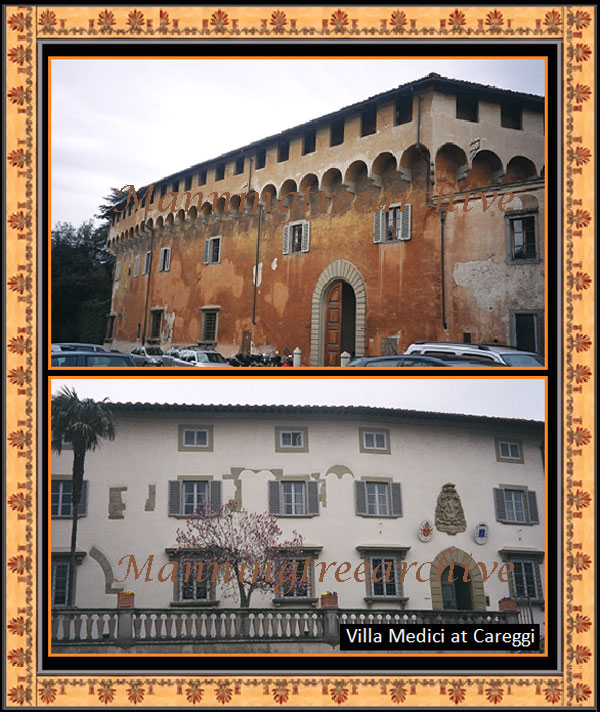
Taken into Lorenzo’s household, Michelangelo enjoyed the privilege of a room, a place at Lorenzo’s dining table with his sons and swathed in the opportunities to absorb culture from the Medicean circle until Lorenzo’s untimely death at his country Villa at Careggi in April, 1492 – which almost brought to an end the true golden age of the Italian Renaissance.

Sometime after Michelangelo’s return to his father’s house following the death of Lorenzo, a problem become apparent after Piero de’ Medici (1471-1503), the eldest son of the deceased Lorenzo, took over leadership of the Signoria. Young, haughty, chivalrous, and rather despotic in his views, interest in the affairs of the State which even in an abbreviated form seldom came out of Piero. Successively, for reasons attributed to the political developments, in 1494, the Medici was expelled from Firenze – declaring them traitors and rebels. The efforts of the Medici to regain their power in Firenze would succeed only in 1512 when Giuliano de’ Lorenzi de’ Medici (Giuliano II, 1478-1516) was brought in from Venice to head the Signoria, but shortly thereafter, Firenze would turn into a papal dependency.

Unable to remain neutral in the above developments, Michelangelo left Firenze and stayed at Bologna, after a brief stint at Venice. Upon his return to Firenze in 1495 when the political climate has improved, he was among those who were consulted vis-à-vis the Sala del Maggior Consiglio of Palazzo della Signoria which Girolamo Savonarola (1452-98) proposed to enlarge to accommodate the new government of the people following the expulsion of Piero de’ Medici from Firenze.

A marble Sleeping Cupid Michelangelo fashioned during this time was eventually sold to Cardinal Raffaele Riario of San Giorgio which paved the way for him to proceed to Rome in June, 1496. In there, following the creation of the life-size drunken Bacchus, on August 26, 1498, he earned the commission to execute a Pietà for Cardinal Jean Bilhères de Lagraulas (Cardinal di San Dionigi), the French ambassador at Rome who desired a suitable monument for himself in Rome by the hand of the famous Michelangelo.  

This classic work in marble, when finished was placed in the circular chapel dedicated to Santa Maria della Febbre (Our Lady of the Fever) of the old Basilica di San Pietro (3) which was at that time still standing.

The future spacious Piazza San Pietro surrounded by vast semi-circular colonnades which the Baroque master Gian Lorenzo Bernini (1598-1680), the greatest sculptor since Michelangelo, designed in front of the Basilica (1656-1667) was then covered with a cluster of small constructions and pathways. La Pietà,as the Italians call the group,earned Michelangelo great fame and fortified his reputation as “Il Divinio” (The Divine One) among the artists of his lifetime.

With the completion of La Pietà (1498-1499), the world had witnessed the creation of two classic masterpieces within the span of a few years – the other being The Last Supper (Cenacolo), the marvellous wall-painting Leonardo da Vinci probably begun in c. 1495 on the refectory wall of Santa Maria delle Grazie, the monastery of Dominican friars in Milan and finished in 1498.

At the age of twenty-six, Michelangelo returned to Firenze where he would be a resident till 1504. By then, many changes had taken place in Firenze – it was now devoid of the divinely ordained preaching of Girolamo Savonarola who had eventually faced excommunication followed by implementation of his death sentence when he was hanged and burned on May 23, 1498 – bringing to an end the story of medieval Firenze.

Michelangelo was now ready to take on the offer of the powerful Consuls of the Arte della Lana, the Operai of the Cattedrale di Santa Maria del Fiore of Firenze. They proposed to him to fashion, complete and finish to perfection a colossal male statue out of a huge block of marble conveyed from Carrara to Firenze many years ago.

The Arte della Lana who owned this block of marble had once offered it in vain to Donatello, the favoured architect of the Medici.  Afterwards, a certain Maestro Simone da Fiesole had commenced work of a huge figure on it but left his work unfinished. Even though Giorgio Vasari was misinformed to name “Maestro Simone” as the sculptor who spoiled that block of marble, it was Agostino di Duccio (1418-81) who upon his return to Firenze from Perugia in 1463, entered the Guild and commenced work on this block of marble which he shortly quit for unknown reasons. A decade later, Antonio Rossellino (1427-c.1479), best known for his Madonna reliefs, gave it a try which didn’t reach anywhere.

Sculptor Andrea Contucci (Andrea dal Monte Sansovino, ca. 1467-1529) who had entered into the guild in 1491 had sought to secure this block to carve a statue by augmenting it with additional pieces of stone. (4) But Arte della Lana preferred to hear Michelangelo’s stance in the matter before they acceded to Contucci’s request. 

Furthermore,they had also consulted with Leonardo da Vinci when he returned back from Milan in the summer-time of 1500. But curiously enough, their efforts to rope him in were in vain, although Leonardo had retired to Firenze in quest of better fortune and finding little or no work of interest to engage him here was seeking employment in the service of Cesare Borgia (1476-1507) who was then cherishing reconstruction of a kingdom of Central Italy under his headship.

As for Michelangelo, this block of marble quarried years before his birth, was just the sort of thing he was aiming at. He was only pleased to accept the commission which was first signed on August 16, 1501: to undertake the Contractual work from September 1501, and complete it within the term of the next two years.   

Michelangelo’s acceptance of the commission gave an atmosphere of hope to Arte della Lana which also guaranteed a good monumental sculpture out of the block without the addition of several pieces.

Follow on: Rise of the Brave Shepherd

Notes:

  1. In 1531, Baccio Bandinelli founded a school of arts in the quarters granted to him in the Vatican besides another in Florence in c. 1550. Then again, it is Giorgio Vasari who founded the first proper Academy of Fine Arts in Firenze in 1563.
  2. In 1519, Benvenuto Cellini (1500-71) refused Pietro Torrigiano’s invitation to accompany him to England for the one reason that the impolitic Torrigiano had broken Michelangelo’s nose. During 1511-18, Torrigiano had worked on the double tomb of Henry VII and Elizabeth of York, and the tomb of Henry’s mother, Lady Margaret Beaufort, in Westminster Abbey in England.
  3. The ancient chapel of Santa Maria della Febbre (St. Mary of the Fever), older than the Constantinian Basilica,  was originally built as a mausoleum which was converted into the sacristy south of the new Basilica di San Pietro Rome in 1506.
  4. Andrea Sansovino (Andrea Contucci) would in turn obtained commission for the Baptism of Christ for the Battistero di San Giovanni of Firenze by 1500 but left it unfinished by leaving for Rome in 1505 to work on the marble wall-tombs (1506-09) of Cardinal Ascanio Maria Sforza (1455-1505) and Cardinal Girolamo Basso della Rovere (1434-1507) at Basilica Parrocchiale Santa Maria del Popolo.

(© Joseph Sébastine/Manningtree Archive)