Archives

DESK SET

1957 – CinemaScope – Color by De Luxe – 20th Century-Fox

A couple of days ago, we had the pleasure to watch Desk Set, a crackling comedy which scored a genuine acting triumph for the romantic team of Katharine Hepburn and Spencer Tracy.

One of the newly acquired DVDs to our archive, Desk Set invites one to the Research and Reference Department of the fictitious Federal Broadcasting Company in New York. Located on the 28th floor, this department is run by the self-assured, and regretfully unmarried, Bunny Watson (a newly rejuvenated Katharine Hepburn) who works congenially with smart, clean appearing co-workers: Bunny’s breezy ally and sturdy supporter Peg Costello (comedienne Joan Blondell, chosen over actress Thelma Ritter); Sylvia Blair (dashing Dina Merrill, daughter of billionaire Marjorie Merriweather Post, in her début role); and Ruthie Saylor (Sue Randall, aka. Marion Burnside Randall in her youthful freshness).

Equipped with a library containing a wide range of informative data for their manual reference, their responsibility in that corporate environment was to answer almost any query for information covering a wide field. Their motto: Be on time, do your work, be down in the bar at 5:30. As often as not, the kind of abstruse questions they encountered goes like: “What is the highest lifetime (baseball) batting average?”; “I’m trying to find out the truth about the Eskimo habit of rubbing noses. Do they rub noses, or don’t they?”….

Into their cheerful work place walked in a strange character who identified himself as Richard Sumner (Spencer Tracy). His face appeared stern, mask-like, almost as though he was trying to keep his feelings hidden. No sooner had he appeared, for reason initially unbeknown to these girls, he looked around the office and started measuring the layout with a tape measure – at one stage, seeking assistance of the girls for this purpose. Maybe he’s an interior decorator assigned to redecorate their department? – or to build a Midget golf?, or is it going to be a Snack bar?, or maybe they are getting an air-conditioning unit, finally? But he didn’t look anything like an interior decorator – rather like one of those men who’s just suddenly switched to vodka.

When Bunny met Richard upon her arrival back from an appointment at IBM and a small shopping at Bonwit’s, she had wondered if he is from the story department. But that was soon cleared when he revealed he’s a methods engineer – adding that every time he mentioned what he does, people go into a panic. Before she could extract further information, Richard was called upstairs to meet the company’s boss Mr. Azae at his office.

In fact Richard is the efficiency expert assigned there on secret orders of Mr. Azae (Nicholas Joy) to investigate ground setup to install an ingenious electronic brain which Richard has invented. The machine is to be initially activated at Bunny’s reference department. For that reason, Richard intends to hang around that department for a couple of weeks, maybe a month, to get a comprehensive picture of its working. According to Mr. Azae, it’s vital that this be kept a secret from everyone, especially the girls in Research. Of course, it’s almost impossible to keep anything a secret around there.

When Bunny accepted Richard’s invitation for lunch, Peg in her wisdom suggested she try the chicken with truffles, Poularde truffée, expecting Richard would take her to the marvellous Le Pavillon, the finest French restaurant in New York. In all sincerity, Richard’s idea of place for lunch was the rooftop of their building in that grey, chilly weather. What an ideal place for concentration where they can cheerfully banish thoughts of waiters, people, telephones, central heating – save for some pigeons up there – so what?

At the rooftop, a table was soon set. Bunny’s face looked as if she had suffered some bereavement. She noted that he had brought along roast beef, ham, cheese and plenty of hot coffee for a square meal. Their lunchtime conversation illuminated him about the little research she undertook on him and she showed off her knowledge that he is one of the leading exponents of the electronic brain in USA. Richard was just ahead of his time. He is the creator of an electronic brain machine called EMARAC…. the Electromagnetic Memory and Research Arithmetical Calculator – an electronic information retrieval system which offered quick access to enormous amount of detail – the machine she had seen at its demonstration at IBM earlier.

Of late, Peg was the first one to fear from the mistaken notion that the electronic brain will replace them sooner or later. Indeed, the electronic brain in the Payroll of their Federal Broadcasting Company was designed by Richard and no sooner had it installed there to perform tasks faster than the staff, half the department had disappeared. Worries about their jobs proved to be a persistent cloud over the heads of Sylvia and Ruthie while Bunny found herself drifting closer to Richard in spite of her affection for her conceited paramour Mike Cutler (Gig Young), the in-charge of her Reference Department, who found his relationship interfered by the intrusive methods engineer.

The wise-cracking, adorable Peg was trying to encourage Bunny to resist setting her heart on the elusive Mike who, having declared his love, isn’t proposing but even so, the starry-eyed Bunny seemed too willing to give it all up to become Mrs. Mike. In Peg’s book, Mike will certainly take romance but just isn’t the domestic type – he was running at least two horses.

At one instance, Bunny invited Richard to her apartment during a storm. She suggested he dine with her – well aware that the very fact they were dropped at her apartment by the office grapevine Mr. Smithers himself who had too lively a mind, would set tongues wagging soon. Inside the apartment, Richard kicked up his heels and made himself cosy in the man’s robe she lend him to replace his wet cloths and other accoutrements. This should be the starting point of a real relationship between them. But then before the dinner was over, they were taken by surprise when Mike suddenly turned up and in Mike’s amorous temperament, Richard’s mere presence in her apartment was enough to trigger misunderstanding.

Just as the girls feared, the machine was soon set up in their Reference department where a prim and officious Miss Warriner (Neva Patterson) from the lab arrived to run the EMARAC’s operation. Miss Warriner didn’t look like Dracula’s sister but, no doubt, was there to suck out their jobs. Then came the pink slips in their pay envelops bolstering their suspicion that they are to be canned – replaced by the electronic brain EMARAC or “Emmy”……

Known in UK under the alternate title “His Other Woman”, this lightweight comedy yarn produced by Henry Ephron is typical in having a sense of anxiety in an enclosed place where automation and love clash. Filmed at the 20th Century-Fox Studios lot and Rockefeller Center, Manhattan, New York City, director Walter Lang (King and I) blend the pace and the rhythm, the overtones and meaning of the screenplay as a whole. Desk Set teems with clever and witty dialogue, coffee break, 5 0’clock cocktail, rooftop luncheon, fabulous Xmas party, love affairs, few bars of songs, a good deal of tomfoolery, and that ever reigning universal compulsion called office gossip….before the happy finale.

The screenplay by Phoebe and Henry Ephron (parents of writer Nora Ephron) is based on the play Desk Set by playwright William Marchant. Before writing the screenplay, the Ephrons had gone to New York to make note of the spots where the laughs came in its Broadway stage production produced by Robert Fryer. The play had opened at the Broadhurst Theatre, New York on 24 October 1955 and starred Shirley Booth (Bunny Watson), Dorothy Blackburn (Peg Costello) and Byron Sanders (Richard Sumner). As of the closing date of 7 July 1956, it did 297 satisfactory performances.

Spirited actress Katharine Hepburn’s volatile style as Bunny Watson contrasts beautifully with the steady unpretentiousness and shrewd underplaying of Spencer Tracy as Richard Sumner – a role Spence had initially refused.

A whizz in biology, Katie wanted to be a surgeon but her fascination with acting led her to an acting career on Broadway in 1929. The Connecticut-born Katharine came over to Hollywood with aspiring actress Laura Barney Harding, and launched a magnificent career with her screen début in director George Cukor’s adaptation of Clemence Dane’s play A Bill of Divorcement (1932).

According to Cukor, Katie was quite unlike anybody he had ever seen and although she had never made a movie, she had a very definite knowledge and feeling right from the start. A Bill of Divorcement was soon followed by remarkable performance in Morning Glory (1933) based on Zoe Akins play. The movie brought her an Oscar for Best Actress – Katie’s first Oscar.

However, Katie’s public appeal was beset by her unspectacular looks and astringent quality of acting in her early films. Not unlike Greta Garbo and Marlene Dietrich who ignored what people thought, she too was gathering up reams of attention for wearing men’s clothes before it was acceptable. A magazine quoted her liking for dresses: “I do have a dress or two. I wear a dress only when it would look conspicuous to wear these clothes.”

Although at that time she was gracelessly branded box-office poison who emptied a theatre faster than a fire, she relentlessly worked her way to the threshold of glory through movies of some of the world’s renowned directors including John Ford, John Huston, George Cukor, David Lean, Stanley Kramer, Sidney Lumet, etc.

She is best remembered for Bringing Up Baby (1938) Katie’s first comedy; Holiday (1938); The Philadelphia Story (1940) all the above three with Cary Grant; The African Queen (1951) one of Katie’s favourite films; The Rainmaker (1956) with Burt Lancaster; and later in the screen version of Tennessee Williams’ short play,  Suddenly, Last Summer (1959) with Elizabeth Taylor; besides Guess Who’s Coming to Dinner? (1967 – Oscar for Best Actress); The Lion in Winter (1968 – Oscar for Best Actress); The Trojan Women (1972) with Geneviéve Bujold; On Golden Pond (1981 – Oscar for Best Actress), etc.

The teaming of life partners Katie and Spence brought forth nine movies – starting their first pairing with the gentle sex-comedy, Woman of the Year (1942 – Oscar-winning screenplay by Michael Kanin and Ring Lardner, Jr.); Adam’s Rib (1949) and Pat and Mike (1952) – both films written by Garson Kanin and wife Ruth Gordon); Guess Who’s Coming to Dinner? (1967) which was Spence’s last film appearance and Oscar-winning story/screenplay by William Rose; besides Desk Set, their eighth teaming and first film together in colour.

In Desk Set, Spence as efficiency expert Richard creates a sympathetic, complex character in spite of the initial suspicion of the reference department girls.

Milwaukee, Wisconsin-born Spencer Bonaventure Tracy had initially believed he might become a plastic surgeon. But following military service, he had taken up acting on stage. According to a magazine article attributed to MGM stock player Selena Royle, it was Selena who recommended Spence for a leading stage role when she was a star of a stock company in Grand Rapids, Michigan. Once when her company was to open, the show’s producer was distressed over the sudden departure of the leading actor. A replacement could not be arranged immediately from New York. At that time, a boy had walked in asking for a job. He had no experience but wanted to be an actor. Just as the boy started to walk away, Selena had suggested that he be allowed to read for the role. That boy, Spencer Tracy, was then accepted for the role which marked his entry into the profession. Shortly afterwards, Selena’s faith and helping wand worked again for Spence when she, on hearing that her friend George M. Cohan was preparing to produce a play called Yellow, obtained a copy of the play and rehearsed Spence secretly in the lead role. In the audition she managed to arrange for him, they knew he had a natural talent for acting. The final win-out for Spence was the lead role in Yellow – an ample qualification to graduate out of stock and to a grade-A Broadway play. Furthermore, it led him to the lead role in The Last Mile.

It was Spence’s performance in John Wexley’s successful powerful prison drama The Last Mile (initial title: All The World Wondered) which opened on Broadway in February 1930 that caught the attention of veteran director John Ford. He advised Fox Film Corporation to hire Spence who earlier had un-credited appearances in two short films of Warner Bros.

Coming over to Hollywood for a one-picture contract, he shared début feature-film roles with Humphrey Bogart in John Ford’s Up the River (1930). Then again, when Nunnally Johnson suggested casting him in the role of notorious gunman Jesse James’ brother Frank in Jesse James (1939), an unconvinced Darryl Zanuck had said “Tracy will never make a star. ….Just lacks the juice for a star.”

On the other hand, a book quotes director Stanley Kramer’s observation “….(Tracy) remains to me probably the world’s greatest moving picture actor. No one was more talented – it was the chemistry of his roles that made him so good.” That appeared more truthful since Spence’s talent was honoured with Oscars for Best Actor for two consecutive years for the role of Portuguese fisherman Manuel Fidello in director Victor Fleming’s Captains Courageous (1937) adapted from the 1897 novel of Bombay-born Rudyard Kipling; and for director Norman Taurog’s Boys Town (1938), a semi-biographical movie based on the charitable activities of Father Edward J. Flanagan. It was couple of years later during the formative days for the production of director George Stevens’ Woman of the Year when Spence and Katie met for the first time and became romantically involved.

The capable supporting cast of Desk Set includes: Ida Moore as the tiny old “trademark” woman who gets one cracking with her silent walk in appearances. Harry Ellerbe (office grapevine lawyer Mr. Smithers), Nicholas Joy (Mr. Azae), Diane Jergens (Alice), Merry Anders (Cathy), Rachel Stephens (Receptionist), Sammy Ogg (Kenny), and others…

The crew: Leon Shamroy (Cinematography), Robert Simpson (Film Editing), Cyril J. Mockridge (Music), Lyle R. Wheeler/Maurice Ransford (Art Direction), Hal Herman (Asst. Director), Charles LeMaire (Executive Wardrobe Designer), Ben Nye (Makeup), Helen Turpin (Hair styles). The credits also acknowledge the cooperation and assistance of the International Business Machines Corporation.

Broadway designer and three-time Academy Award for Best Costume Design winner Charles LeMaire’s outfits in this movie are versatility personified, the kind of tailored sophistication for the modern girl who wants to look chic on the job, for daytime dates, luncheons, and for dinner. Master costumer LeMaire who would leave his job at Fox in 1959 for freelancing had a track record of dressing just about every major movie star – among others Jean Peters, Gene Tierney, Susan Hayward, Anne Baxter, Celeste Holm, Thelma Ritter, Sophia Loren, Jennifer Jones, Marilyn Monroe,…,.

Following the world premiere engagement of Desk Set at the Roxy, New York attended by a goodly number of celebs, LeMaire’s original fashions conforming to the cinematic environment in the movie arose wide spread interest, especially among those working women who couldn’t resist new fashions or to look tailored and neat. As a toast to them, he had appearances at Bon Marché, and Strawbridge & Clothier store for style-shows to show off his outfits in Desk Set.

An amusing comedy that generates steady excitement to all types of audiences, Desk Set is rich in delights for all those who love office ambiance.  Until next time/Jo

Notes:

  • DVD/Blu-ray of most of the movies mentioned in this article is available with leading dealers.
  • For promotional purpose, DVD sleeves/posters are shown here. Source: Wikipedia, amazon.com, imdb and from my private collection.
  • This illustrated article is an affectionate nosegay to the movie reviewed above. Please refer to “About” of my webpage for more details.

(© Joseph Sébastine/Manningtree Archive)

Anne of the Thousand Days

Manningtree Archive has its own story – of memories one has of the past which reflect in the private collection its title implies – a non-profit library stacked with books, movies and music. Looking at it in the right way one can see that this collection is like an ever-growing garden, no doubt. Here below is a promo write-up presenting one of the movies in our collection.

Anne of the Thousand Days

(1969, Panavision-Technicolor, Hal Wallis Production/Universal Pictures)

Produced by veteran producer Hal B. Wallis (Becket, True Grit, Casablanca, Little Caesar) and directed by Charles Jarrott, this engrossing costumer with authentic sets explores the life and times of King Henry VIII. and his pursuit and conquest of the beautiful Anne Boleyn that changed the course of English history.

Adapted by Richard Sokolove from the play by Maxwell Anderson, the events, though in-accurate, are set in one of the great eras of English history – and include the tragic day of Tuesday, 19th of May 1536 when hapless Anne was beheaded by the black-masked French executioner’s sword on Tower Green in the Tower of London. She is a prisoner of history and the facts of that history are now widely known.

 Hal Wallis, a giant in the film industry, was always deeply interested in English history. In 1964, his stunning historical spectacle Becket was released – superbly acted by the million-dollar piece of talents Richard Burton (as Archbishop of Canterbury Thomas à Becket) and Peter O’Toole (as King Henry II.) and helmed by director Peter Glenville. Becket was a moneyspinner. According to Wallis, it was during the filming of Becket when Burton showed his interest in filming Anne of the Thousand Days and wanted Wallis to buy the play for him. At length, this was duly done surpassing incidental issues regarding the play’s rights.

In a role originally offered to Buenos Aires-born actress Olivia Hussey (Romeo and Juliet, 1968), the young French-Canadian actress Geneviève Bujold shines as Anne Boleyn, the winsome young Maid of Honour who danced into Henry VIII’s line of vision and eventually became the second of his succession of wives, fostered by Cardinal Thomas Wolsey.

Hailing from Montreal, Quebec, Canada, the convent-educated Bujold had appeared in Montreal’s theatre productions and in films such as director René Bonniére’s Amanita Pestilens (1962), La Fleur de l’Age ou les Adolescentes/Adolescents (1964), before she was chosen in Europe by French director Alain Resnais to play in La Guerre est finie/ The War Is Over (1966) opposite Yves Montand and Ingrid Thulin. This was followed by Le Roi de Coeur/King of Hearts (1966) and Le Voleur/The Thief of Paris (1967). However, her only successful performance during that time came in the title role of Isabel (1968) which was written, produced and directed by her then husband Paul Almond. In their 28th September 1970 cover story on Bujold, Time magazine called Isabel a success d’estime.

Hal Wallis who screened movies in his private screening room at home in search of new talents was impressed by the sensitivity, warmth and youthful maturity of Bujold’s performance in Isabel for which she won the Canadian Film Award for Best Performance by a Lead Actress. He has now found his Anne Boleyn and words were pledged to Bujold.

Richard Burton who held approval rights over his co-star, also found her acceptable. Burton’s position garnered all respect. Bujold reminded him of “the late and lamented Vivien Leigh.” Burton insisted that Bujold, whom he nicknamed “Gin”, must be given ‘star’ treatment as he did himself. This didn’t digest well with wife Elizabeth Taylor who haunted the set to keep an eye on them.

Producer Elliott Kastner (Where Eagles Dare, 1968) had earlier sought Liz Taylor to do a film at the same time as Richard Burton did Anne of the Thousand Days. During the early pre-production stages a problem arose – a sense of onrushing doom for the movie. Indeed, it was the role of ravishing Anne Boleyn which Liz wanted to play.

Hal Wallis took Liz’s request with gloomy silence of disapproval. She has already  sailed past her prime to play the beautiful and coquettish young Anne. According to Wallis, Burton who was there chipped in and skilfully let the steam off: “Sorry, luv. You’re too long in the tooth.”

References to Anne’s appearance from all that I have read indicate that, besides her tall stature and classical oval shaped face with a deceptively prim mouth, the other notable feature of this refreshingly witty conversationalist was her expressive dark eyes and a wealth of black hair.

When the film was released, Bujold’s success in the role of Anne was so pronounced that it earned her the Golden Globe for Best Performance by an Actress in a Motion Picture – Drama, turning her into an overnight sensation in Hollywood. Some critics hailed her as the new Hepburn.

With many royal roles gracing his acting career, playing royalty was nothing new to Richard Burton. Seeking a powerful screen performance, Burton donned the part of Tudor King Henry VIII. (Reign: 1509-1547) – that finest dressed sovereign with a beard of gold, gigantic appetites and a will of iron who desperately desired to swiftly divorce Katherine of Aragon, his queen of nearly 2 ½ decades, to hastily wed the dazzling Anne Boleyn although her elder sister Mary Boleyn’s improper familiarities with Henry VIII. were hardly a secret in a close court where it is hard to keep secrets.

With this role, Burton entered the realm of actors who has portrayed the controversial Tudor monarch marvellously interpreted previously by Charles Laughton in the sweeping biographical movie, The Private Life of Henry VIII. (1933, D: Alexander Korda).

Greek actress Irene Papas is the richly apparelled, Queen Katherine of Aragon, daughter of King Ferdinand II of Aragon and Queen Isabella of Castile who proffered royal support to Christopher Columbus in his expeditions. Papas came across perfectly as a queen lovely in person and in mind – truly gentle and feminine in her manners as Katherine of Aragon is reputed for.

The Toronto-born Shakespearean actor John Colicos as the villainous Thomas Cromwell and one of Britain’s most brilliant character actors Michael Hordern as Anne’s father Sir Thomas Boleyn; give noteworthy performances in their pivotal roles.

Apparelled all in red is Anthony Quayle as the skilled diplomat Cardinal Thomas Wolsey. During his earlier stage career, Quayle had tackled the title role in director Tyrone Guthrie’s theatre production of Henry VIII at Stratford-on-Avon. In that fine performance, Quayle’s Henry, with short red hair, was a very political king, strong and vigorous with a lust for life. Soon after watching the play in 1950, His Majesty King George VI. (r.1936-1952), who was with Queen Elizabeth, had gone to the dressing-room and congratulated Quayle on his splendid performance. Adding to Quayle’s favourite part of his growing resume, this portrayal as Cardinal Wolsey in Anne of the Thousand Days won him the nomination for the Best Performance by an Actor in a Supporting Role category in the 42nd Academy Awards 1970.

Others in the supporting roles are:

Joseph O’Conor (Bishop John Fisher),

Peter Jeffrey (Thomas Howard, 3rd Duke of Norfolk),

director Jarrott’s then wife Katharine Blake (Elizabeth Boleyn),

Valerie Gearon (Mary Boleyn),

William Squire (Sir Thomas More),

Terence Wilton (Lord Henry Algernon Percy, heir to the Earl of Northumberland who offered Anne Boleyn his hand and heart);

Lesley Paterson (Jane Seymour);

Nicola Pagett (Princess Mary);

Amanda Jane Smythe (Baby Elizabeth), et al et al.

At the insistence of Richard Burton, Liz made a surprise (un-credited) appearance in a bit role as a masked lady with low-cut gown in a scene featuring Katherine of Aragon being interrupted while praying in Greenwich Chapel. A report indicates that Liz Taylor purportedly received pay of $35 for the afternoon’s work. Un-credited bit roles feature Liz’s daughter, Liza Todd and Burton’s daughter, Kate.

Crew includes:

Bridget Boland and John Hale (Screenplay);

Georges Delerue (Music Composer);

Arthur Ibbetson B.S.C. (Cinematography);

Maurice Carter (Production Design);

Lionel Couch (Art Direction);

Margaret Furse (Costume Design);

Mary Skeaping (Choreography);

Richard Marden (Editor) and others.

Made at Penshurst Place, Hever Castle (Kent) and Shepperton Studios outside London, the film, sprouting from a script of 144 pages long, brims with excitement, pageantry and scenery reflecting the Tudor love of music, dancing, gardens and flowers. At that juncture when the filming was being completed, the whole world was abuzz over the landing of astronauts Neil Armstrong and Edwin “Buzz” Aldrin on the moon on 20th July 1969.

Anne of the Thousand Days was qualified for ten Academy Award nominations. Margaret Furse (Becket, The Lion in Winter) was the winner of Oscar for Best Costume Design. Her richly superb costumes were patterned after the famous portraits by German painter Hans Holbein the Younger whilst the period costumes and footwear were prepared by London firms: Bermans and Frederick Freed, respectively. The other Golden Globe awards honouring the film came for the categories: Best Motion Picture – Drama; Best Director; Best Screenplay.

Anne of the Thousand Days was selected by Her Majesty Queen Elizabeth II for the Royal Film Performance and shown at the Odeon Leicester Square, London on 01 February 1970. Prominent among the dignitaries presented to Her Majesty on that unique Annual event for charity was the film’s producer Hal B. Wallis, wife/actress Martha Hyer and Geneviève Bujold (clad in a long white gown with a white cape worn over it). She was escorted by director/husband Paul Almond. By and largest, a well-made movie. Jo

Notes:

  • Some delightful remembrance of King Henry VIII in our collection: The Sword and the Rose (1953, James Robertson Justice), A Man for All Seasons (1966, Robert Shaw); Henry VIII and His Six Wives (1972, Keith Michell), The Prince and the Pauper/Crossed Swords (1977, Charlton Heston); Henry VIII (2003 TV series, Ray Winstone); The Other Boleyn Girl (2008, Eric Bana).
  • DVD/Blu-ray of the movies referred to in this article are available with leading dealers.
  • Image source: Wikipedia, amazon, Pinterest, and from my private collection.
  • This illustrated article is an affectionate nosegay to the movie reviewed above. Please refer to “About” of my webpage for more details.

(© Joseph Sébastine/Manningtree Archive)

Viva Italia – 4: Amore Piazza San Marco, Venezia – Com’ era, dov’ era

A recap of our thoughts on our beloved Venezia during this unfortunate time when La Serenissima suffers worst series of high tides, or ‘acqua alta.’ This entry was earlier posted by me on November 25, 2012.

manningtreearchive's avatarManningtree Archive

It breaks my heart when I think about the recent floods in Venezia which submerged the stone pavements of one of the greatest urban spaces in Europe, Piazza San Marco (St. Mark’s Square) and water gushed into the Basilica di San Marco (Basilica of St. Mark). With water levels reportedly rising to a critical level of 59 inches above normal, they say it was the “sixth-highest level since records began in 1872”. Even though floods are no stranger to Venezia since this phenomenon occurs almost annually as a consequence of eustasy (rising sea level) and subsidence (lowering of the land), the frequency of the floods are rising. It not only brings about great inconvenience to the Venetians but also inflicts immeasurable damage to the Piazza, to the bell tower, the underground passages and all around damage and instability to an…

View original post 4,053 more words

NOTRE DAME WILL STAND

Saddened by the devastating fire at the historic Cathédrale Notre Dame de Paris – a religious symbol and World treasure. Tears for ‘Our Lady of Paris.’ (Tuesday, April 16, 2019)

manningtreearchive's avatarManningtree Archive

“The Gothic of Verona is far nobler than that of Venice;

and that of Florence nobler than that of Verona.

… that of Notre Dame of Paris is the noblest of all.”

  • The Seven Lamps of Architecture by John Ruskin

1

The day was bright and filled with leisure hours. We would not have wished to be anywhere else in the world on that day but in the grand Cathédrale of Notre-Dame in Paris, the capital of elegance and art. With the presence of our daughter Bianca, the last few days had swiftly accelerated and rolled away quickly. She was absolutely vibrant. Having visited the central landmarks and point of identification, viz., the Eiffel Tower, Arc de Triomphe and the Avenue des Champs-Élysées, Sacré-Cœur, The Louvre and Mona Lisa, all of which has been absorbed into the tradition of Paris, we had decided to take her to other blessedly French…

View original post 2,789 more words

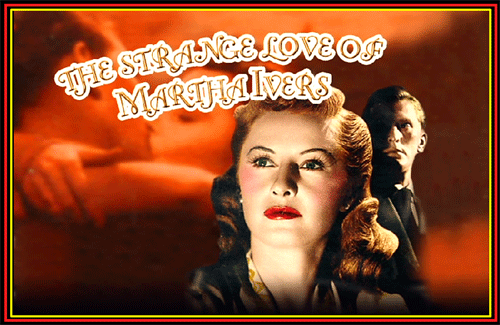
The Strange Love of Martha Ivers

The Strange Love of Martha Ivers – (StarChoice: 28)

Excerpts from: The Importance of Being Kirk DOUGLAS 

 …… In one of her memoirs, beautiful actress Lauren Bacall wrote about how in 1945 she met star-finder/star-maker Hal Brent Wallis in the club car of the train while travelling to East with her husband Humphrey Bogart. Wallis, an independent producer since 1944 was on board the Santa Fe Super Chief train, bound for New York to look for new talents there. One night, over drinks in the lounge, she tipped Wallis to take a gander at the young and talented Kirk Douglas – a sort of a young Spencer Tracy – who was in a stage play in New York.

Lauren ‘Betty’ Bacall knew that Wallis always looked for an off-beat quality in his screen heroes.

A man with astute combination of imagination and executive ability, some of the potential actors Wallis found and expertly built them into stars of the screen included Jerry Lewis, Dean Martin, Charlton Heston, Dolores Hart, Elvis Presley, Polly Bergen, Anthony Franciosa, Barbara Stanwyck, Robert Cummings, Don Defore, Ann Richards, Kristine Miller, Douglas Dick, Betsy Drake, Marisa Pavan, Shirley MacLaine, …..

People abroad are hungry for film entertainment and share with American audiences a keen interest in new personalities. It is this desire for new faces that has prompted my continued search for talent and the signing of such people as Lizabeth Scott, Burt Lancaster, Kirk Douglas and Wendell Corey,” Wallis was quoted in 1947.

Betty had a similar story. Taking into heart the All-American dream of every girl in the country at that time, she had come to Hollywood to become a star. In 1943, New York socialite and legendary beauty Slim Hawks, wife of director/producer Howard Hawks, saw the 18-year-old model’s picture on the cover of Harper’s Bazaar (March 1943) and prodded Hawks to “get a hold of this girl” with that “down-under” look. This “great find” was cast with Humphrey Bogart in Hawks’ adaptation of the Ernest Hemingway novel, To Have and Have Not (1944). That had opened a whole new life to Betty.

In June 1945, Hollywood’s “Gentleman Producer” Wallis went to the Broadway production and was impressed by Kirk playing the helpful ghost of the Unknown Soldier of World War I on stage in The Wind Is Ninety (Jun 21, 1945 – Sep 22, 1945). Tellingly, Kirk’s performance earned him best notices for its warmth and sincerity.

At that juncture, Wallis’ company had three films lined up on the production board: The Searching Wind (1946, D: William Dieterle), The Strange Love of Martha Ivers and Perfect Marriage (1947 D: Lewis Allen). Kirk was summoned to Wallis’ office in New York and later to the coast…….

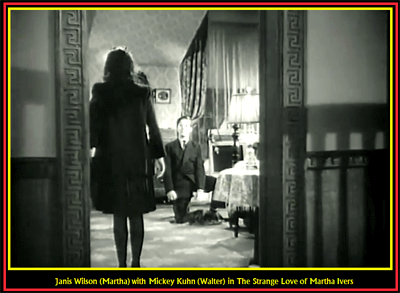
…….Kirk netted his debut role in Hal B. Wallis Productions’ gripping noir melodrama, The Strange Love of Martha Ivers (1946) as the husband of wealthy Martha Ivers, played by Barbara “Missy” Stanwyck, a trouper of vixen roles.

Effectively directed by Lewis Milestone, this exciting movie, from an unpublished story, “Love Lies Bleeding” by Jack Patrick (screenplay by Robert Rossen), told the grim tale of unbalanced emotions in the small industrial city of Iverstown in 1946 where, wealthy, conniving social climber Martha Ivers held a lifelong criminal secret over her weakling, drunkard husband, Walter O’Neil (Kirk Douglas), a district attorney.

During their adolescence years in 1928, Walter had witnessed Martha commit the murder of her bullying aunt Mrs. Ivers (Judith Anderson) in a fit of blind anger.

At that time, the little boy O‘Neil had affirmed Martha’s lie about a man having burst into the house and killed the aunt. In due course, Martha inherits a large family fortune from her dead aunt whom she loathed.

With murder and blackmail ruling the roost, The Strange Love of Martha Ivers is without a trice of comedy to lighten the tension.

Spectators who have seen this movie would recall Kirk’s introductory scene wherein his first dialogue on screen was the customary salutation of “Hello”.

And, with that one all-time favourite word, Kirk Douglas, at about age 30, took off to a promising start of his phenomenal career.

It was a befitting entry into the movie-stardom for Kirk who proved himself a fine actor who could measure up with such veterans as Van Heflin (back from war and on loan from M-G-M) and Barbara Stanwyck, in a role similar to the alluring double-crosser in the movie classic, Double Indemnity (1944, D: Billy Wilder).

Those who liked the smoky blonde Lizabeth Scott (born Emma Matzo in 1922) in her film debut You Came Along (1945, D: John Farrow), would want to see her don the role of Toni Marachek, the probationer from jail seeking love and companionship.

Cast over protests from female lead Stany, Scott’s Toni is the dynamic love interest of Sam Masterson (Heflin in his Johnny Eager (1941, D: Mervyn LeRoy) -type role), a professional gambler who learns that Martha has one murder to her name.

Perchance the true colours of costumes by master designer Edith Head wither their grandeur in monochrome. Setting pace to Victor Milner’s photography is also the music score by Miklós Rózsa which relate each character, setting, or situation to a musical theme.

This post-war period film was released on July 24, 1946 having completed production during October 2 – December 7, 1945. The Strange Love of Martha Ivers had its world premiere abroad TWA’s transcontinental Constellation trip departing Los Angeles on May 24, 1946.

Reportedly, about five months from the film’s release, the citizens of Kirk’s hometown in Amsterdam, N.Y, launched a pre-election campaign urging Kirk’s nomination for an award for his performance in The Strange Love of Martha Ivers, although the official Academy award nominations has not yet begun.

You probably wouldn’t prefer to meet any of the selfish, grasping characters of The Strange Love of Martha Ivers, but it’s an edge of the seat evil tale to watch unfold – without children.

Until next time, Jo

Notes:

  • Given that the abridged version of my write-up “The Importance of Being Kirk DOUGLAS” has by now exceeded 105 pages, it is deemed only fair that the write-up should come out, if possible, in its entirety in a book format. Therefore, only excerpts (movie reviews) from it are posted here.
  • Some of the DVD/Blu-ray of the movies referred to in this article is available with leading dealers.
  • DVD sleeves/posters credits: Wikipedia, amazon, imdb and from my private collection. Please refer to “About” of my webpage for more details.

(© Joseph Sébastine/Manningtree Archive)

The Importance of Being Kirk DOUGLAS

I think of my life like a stone thrown into a calm pool.”

                                – Kirk Douglas, The Ragman’s Son

This tribute to Hollywood actor Kirk Douglas is truly accidental than most of my posts, in the sense that this never followed the carefully visualised course I planned at its inception – which was to create a 1,200-word write-up. But as my research evolved over the last many months, I chanced upon a profusion of representational materials about Kirk that my endeavour to piece together the salient landmarks in his life finally brimmed to the expanse of dimension you will come across in the text below.

Kirk Douglas is one of the last remaining great male movie stars of the studio era, even though certain cinematic greats like Clint Eastwood who came close behind Kirk cannot be ignored. Back in the good old days when movies had little competition and the moviegoers were devoted and regular, Kirk emerged from obscurity to turn into an established star on the strength of combining toughness with an acute intelligence in his choice and interpretation of the parts he played. Amongst the many directors he had the privilege to work with are the best of the crop such as Joseph L. Mankiewicz, William Wyler, Billy Wilder, Vincente Minnelli, John Sturges, John Huston, Burt Kennedy, etc.

As with all stars, the glamour and publicity surrounding Kirk is part of his work and charisma. Kirk Douglas once wrote, “When you become a movie star, you create an image for the public.” This perfectly complemented the dialogue Kirk’s character Jonathan Shields spoke to Georgia Lorrison (Lana Turner) in a scene in The Bad and the Beautiful (1952), “When you’re on the screen, no matter who you’re with, or what you’re doing, the audience is looking at you. That’s star quality.”

Kirk Douglas came into my life when I first saw a movie during its re-run in a local theatre two decades after its release. I could recall it as Ulysses (1954). Watching it, Kirk had come across to me as a versatile star – vibrant, handsome, virile – all rolled into one. In those teenage days, I was taken by the ease and punch of his portrayal in the title role, and since then, whenever possible, I had tried to follow his career which, over the years, grew in stature gaining brilliant achievements.

Now, how many millions around the world have seen Kirk’s movies? How many were liked or disliked or earned moviegoers to his films owing to Kirk’s acting and/or celebrity factor? What screen or personal stories perpetuated his legend in the public’s mind?

Many years ago, a magazine featured an interview with one of Kirk’s secretaries of the late 1960s. She fondly remembered him as “a very demanding person to work for, and works at a frantic pace himself. He has many businesses apart from films…. He is a very nice person…. I found him very attractive and virile – a real man’s man.”

Think of it. There is a tremendous amount of the past in all our presents. I have not met Kirk personally. Although I would love to, it is most unlikely that I will ever meet him. But I have always nurtured that curiosity to find out specifically how Kirk earned the reputation of a self-made man, a legendary hardworking American stage/screen actor, producer, director, author, millionaire, humanitarian, philanthropist, art collector, winner of awards/honours for achievements both on and off screen, and a family man with a beautiful wife called Anne Buydens sheltered in a solid marriage now nearing its 64th year on May 29th.

My growing film archive of about 6,500 movies gives primacy to films released up to early 1980s – most of which are now historic milestones of the movie industry. Thus far, it contains almost three dozen movies featuring Kirk Douglas. No doubt, that three dozen would be much lesser compared to the numerous hardbound volumes of scripts of all of Kirk’s movies which, according to Kirk’s memoirs, are arranged in chronological order on the top shelf at his house.

Likewise, I feel lucky that I was born during a period when I could enjoy those just-released films on a large theatre screen – maybe with a lesser quality presentation, but enough to be content in those happy days. And at the close of the movie, to walk out into the Lobby amidst the excited, arguing, impressed viewers. It’s no fun if one happens to see those movies now on TV – greatly edited and, like in our part of the world, interrupted by numerous (but necessary) persistent and disparate commercials that pounce on your senses like rapid gunfire from an AK47; or shown either during the work days or too late into the night.

At length, this compilation is derived from a trail of information that lay scattered in innumerable books, magazines, media interviews, movie documentaries or whatever sources I could possibly access – to all of which this write-up is thankfully and humbly indebted. This is neither a scholarly compilation of biographical data nor could it be free of possible errors – mainly whereas the schedule of production of movies is subject to re-takes, fillers, etc. This is just my personal attempt to recapture the great events, and some minor ones, of Kirk’s life – primarily up to the period before early 1980s.

To minimalize the content, some finer details about Kirk and his movies, readily available in numerous books, websites, visual media, etc., are left out. Keeping in par with the good old times Kirk’s films captured, I must honestly add that, the theory I have adopted for this write-up is to overlook any broken fence and admire the flowers in the garden. As you read further on, I hope you will chance upon the many pleasant factors that inspired me to write about – Mister Kirk Douglas.

(The First instalment of this series follows)

Jo

Notes:

  • DVD/Blu-ray of the movies referred above is available with leading dealers.
  • Picture credits: Please refer to “About” of my web page for more details.
  • It would be factual to endorse that the year-long delay in my posts occasioned from a string of turbulence of personal nature that thrashed on the cruising path of my life during the last so many months and yet, the ducks are not in a row. I dedicate this tribute with love and gratitude to: 1) Renate Elisabeth (Carina), my wife and oracle of love for her support, wisdom and unfailing vigilance; and to 2) Carolyn Page, the sweet spot who fondly lit a fire under you-know-where to turn the heat on me to accelerate the publishing of this post.

(© Joseph Sébastine/Manningtree Archive)


Staying Power of “The Horsemen”

Concluding installment of the two-part serial: “Catch-as-Catch Can”

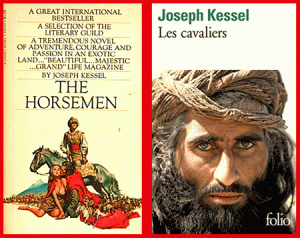
In my mind’s eye, artist Said Atabekov’s solo show reminded me of “The Horsemen” (Les Cavaliers), the 1967 best-selling novel written by the French writer Joseph Kessel (1898-1979). Enriched by the extraordinary gifts of characterisation and narrative of Kessel, it was the kind of book that cast a spell over the reader, and when you finished it, the experience preys on your mind to think back over the whole plot and rediscover the many priceless pearls from a bygone era which are littered in it.

The Horsemen told the gutsy saga, in contemporary setting, of family conflict between Uraz, a proud and ambitious Afghan horse rider and Tursen, his father, the Master of the Horse at the stables of the regal Osman Bey and the bravest Buzkashi chapandaz of the time, renowned for his highest degree of horsemanship, physical strength, courage and competitive spirit.

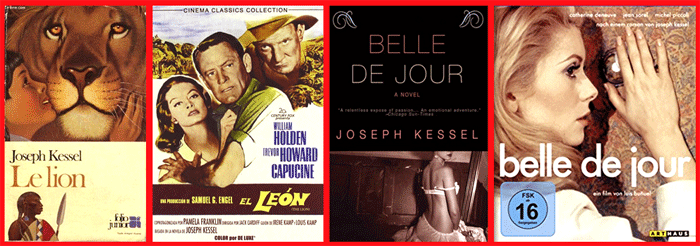
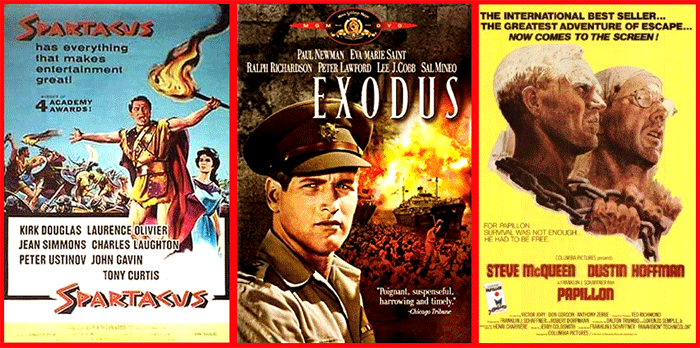
By the time producer/writer Edward Lewis and his constant film collaborator, director John Frankenheimer decided to turn The Horsemen into a movie (the films rights of which they had purchased jointly), two of Kessel’s novels were already lauded as popular films: The Lion (1962, D: Jack Cardiff) which is a marital drama of an American lawyer who goes to Africa to deal with his child and animal interest; and Belle de Jour (1967, D: Luis Buñuel), a fascinating fact and fantasy tale of a surgeon’s wife who took a liking to afternoon work in a brothel.Lewis and Frankenheimer contracted with Colorado born screenwriter (James) Dalton Trumbo’s (1905-1976, Spartacus, Exodus, Papillon), to adapt Kessel’s book. Joseph Kessel, who considered Trumbo in the first rank of screenwriters, was delighted by the news. According to a book on Dalton Trumbo, they agreed to pay him $125,000 for the completed script and another $125,000 in ten equal instalments.

Although Lewis questioned Trumbo’s depiction of the lead character’s motivations, Frankenheimer found the finished script “perceptive” and “damned good.” However, when made into an old-fashioned action-adventure movie of the same title, the studio executives demanded that the rough cut be reduced from slightly over three hours to two hours.

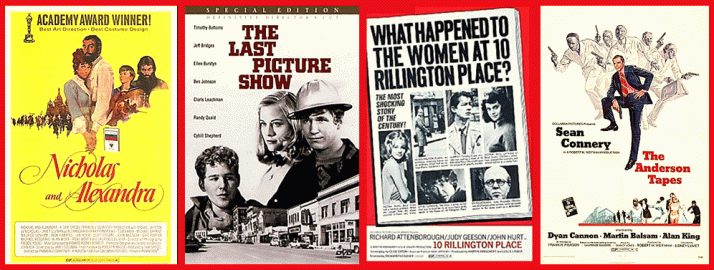
A co-production of John Frankenheimer Productions and Edward Lewis Productions, Inc. with the cooperation of Afghan Films, Colombia Pictures released The Horsemen in mid-1971, the year the studio turned to look back rather than forward – releasing movies such as Nicholas and Alexandrea (D: Franklin Schaffner), The Last Picture Show (D: Peter Bogdanovich), 10 Rillington Place (D: Richard Fleischer), The Anderson Tapes (D: Sidney Lumet), etc.

Similar to film directors such as Arthur Penn, Delbert Mann, Marty Ritt, Franklin Schaffner, Sidney Lumet and George Roy Hill, director John Frankenheimer (1930-2002), took the road out from television to Hollywood, where, retaining only the most useful elements of his earlier style, he became one of the most versatile directors in the American cinema.

He made dramatic hits such as Birdman of Alcatraz (1962), Seven Days in May (1964), Seconds (1966), although the movie that catapulted his name to fame was the satirically angled political thriller, The Manchurian Candidate (1962). A demanding director, whose hallmark was working well with most actors, Frankenheimer’s work projected a fascination with the mechanics of visual story telling.

A reporter once noted in a newspaper: “You won’t find much romance or many complex leading ladies in a Frankenheimer film: For the most part his characters are men, real men, fighting each other or some outside force trying to destroy a way of life. His films are known for their biting look at this country’s political and social times.”

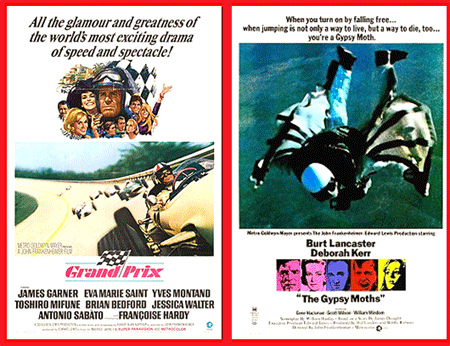
Director Frankenheimer’s flair in games and sports were evident in his Grand Prix (1966) and The Gypsy Moths (1969). The Horsemen (Cavalieri Selvaggi), made just before Frankenheimer’s career went into sharp decline in the 1970s, was the first film ever made in Afghanistan during a period when it was a popular destination all the year round for Western tourists to enjoy its rugged mountains and valued relics of ancient civilisation.

The production received plentiful cooperation from the government – and according to a magazine article, the authorities even allowed Frankenheimer to bring in a helicopter to shoot aerial scenes.

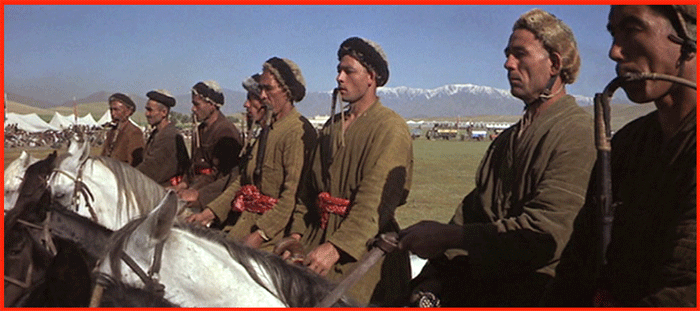
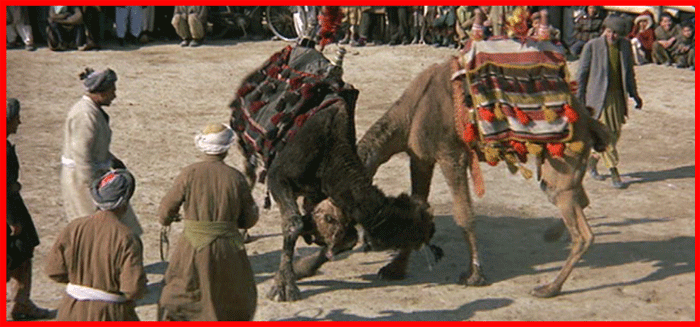
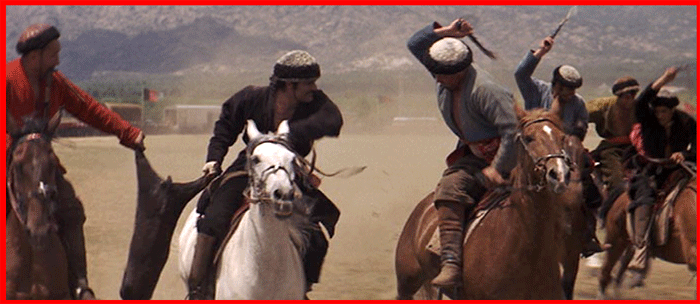
The film featured a spectacular tale of human drama giving emphasis to the skill, violence, and great courage of man-and-horse rivalries played out in the ancient equestrian tradition of buzkashi, an amalgamation of dirty polo and open rioting which brings to one’s mind the legends of the Golden Horde of the times of Mongol king Genghis Khan, whose warriors slipped into enemy camps and without dismounting from their horses, swooped up goats, sheep, etc., and rode away undetected with their pillage.

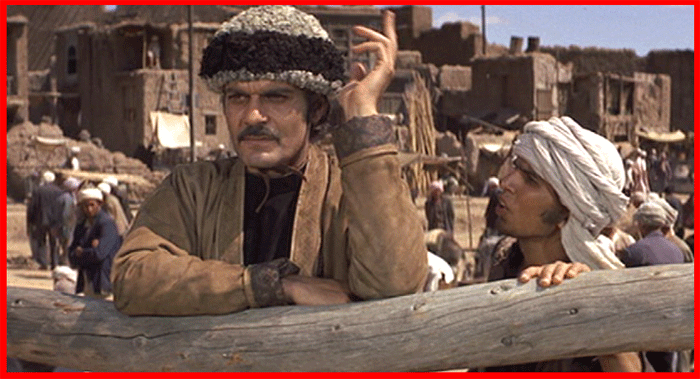
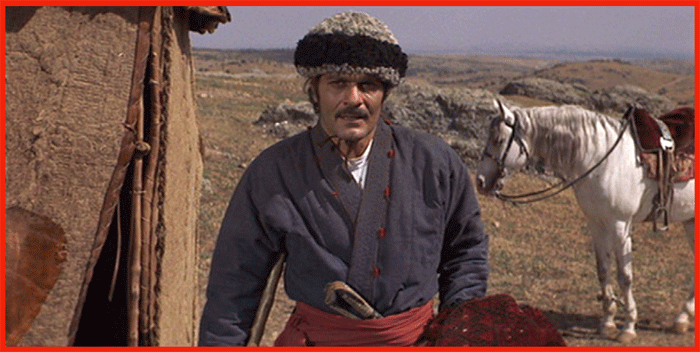
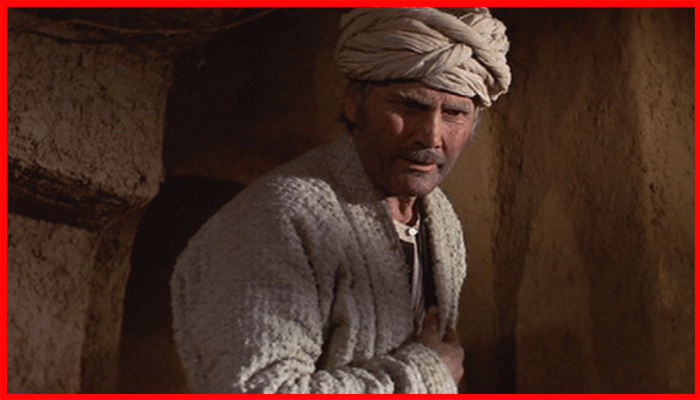
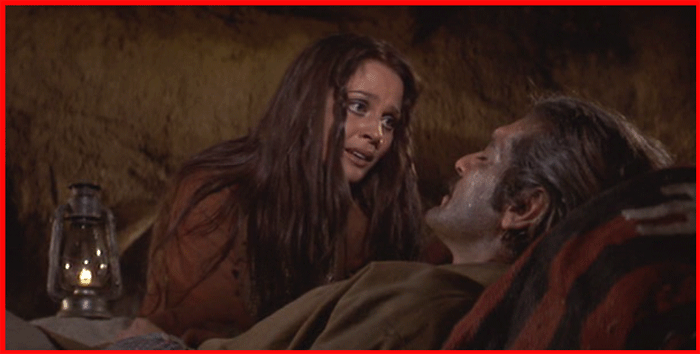
Having realised that he could no longer play in buzkashi, the valiant chapandaz (specialist buzkashi rider) Tursen’s (Jack Palance) mind was clouded over by his son Uraz’s (Omar Sharif) youth and prowess. For Uraz, like his father before him, is reputedly the greatest chapandaz in the three provinces of Meymaneh, Mazar-e Sharif and Qataghan.

To prove his machismo and to challenge the code of behaviour by which he had been raised, as well as to please his imperious father who refused to give up the values and beliefs of his native land and had chosen Uraz to ride on the newest and finest purebred stallion, Jahil, Uraz had decided to compete in the king’s Royal Buzkashi tournament on the field of Bagrami in Kabul. Winning the game would ensure that Tursen would deed Jahil to Uraz – which was Tursen’s challenge to secure Uraz’s victory in the Buzkashi competition (1).

The game featured in the movie, where the horseman with the carcass is fair game for an all-out assault, was played at its roughest when the leather whips were applied with devastating effect on challenging riders.

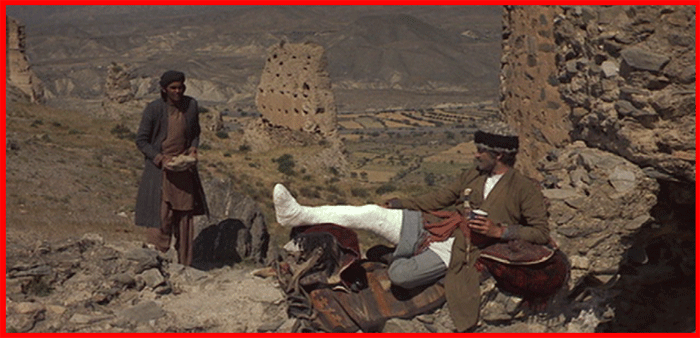
Although Uraz’s boldness and fierce competitive spirit was evident throughout the game, in an unfortunate incident during the game after he had grabbed the carcass off the ground, Uraz fell and broke a leg. But then, in the last moment, his colleague Salih had leapt onto Jahil to win the tournament for their Meymaneh clan.

Later, escaping from the hospital where he was admitted, Uraz was forced to journey back home to the province of Meymaneh to face his father. Disgraced and humiliated in failing to measure up to his father, Uraz imposed severe ordeals on himself – eventually suffering terrible tribulations from the amputation of one of his legs infected with gangrene. Accompanying him through the treacherous old Bamian Road across the mountains were his faithful syce Mukhi (David de Keyser, uncredited) and a crafty nomad woman called Zareh/Zereh (Leigh Taylor-Young sporting a new gold nose ring) with her greedy eyes set on to acquire Jahil.

Having allowed to join Uraz in his journey  as Mukhi’s woman and having seen Uraz sick and weak, Zareh’s mind was devious to realise how a good buzkashi horse like Jahil would play for as long as twenty years and would bring glory and wealth to her. Encouraged by the knowledge that the prize-horse Jahil’s ownership would pass on to Mukhi upon Uraz’s death, Zareh took upon herself to convince Mukhi that they could go to the land of Hazarajat and make a fortune by racing the swiftest Jahil in the great annual fair.

As Uraz progressed on his passage home with his animal powers of endurance and survival, it didn’t take long before Zareh found out that, although Uraz liked women, he liked horses even better.

The great old film stars are everlasting. They live on in the hearts of all who have adored their looks and performances, and anytime is a good time to view their films repeatedly.

Star of Doctor Zhivago (1965, D: David Lean) and Funny Girl (1968, D: William Wyler), the dark-eyed Omar Sharif (1932-2015, born: Maechel Shalhoud in Alexandria of Syrian-Lebanese descent) whom actor Peter O’Toole irreverently dubbed “Cairo Fred”, needs no introduction. Following his dramatic entrance from the sands of the Sahara into screen stardom in the opening scene of Lawrence of Arabia (1962, D: David Lean), the flamboyant American actor became a whirlwind which brought him adulation, riches and hearts of millions of female movie lovers in particular. He frequently appeared in dashing leading man roles, relishing the honour of being a social idol, a superstar and a worthy successor to Rudolph Valentino.

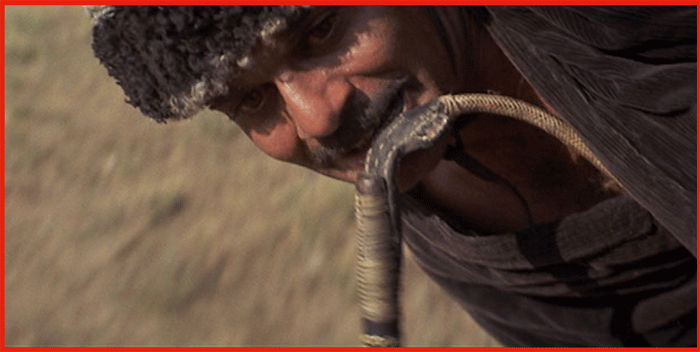
The Memoirs of Roger Vadim quotes Omar Sharif as “a charming man and exciting friend, but he had a very particular style with women. In spite of the passionate lover that he played on the screen, he was rarely romantic.”  Sharif had remarked during the filming of The Horsemen that he welcomed the opportunity to play a straight role. It  is a provocative film role in which he shared something in common with the character of Uraz – the ambitious chapandaz dressed in a thick caftan and high-heeled boots, leather whip gripped between his teeth, his head adorned with a hat lined with astrakhan fur and the emblem of a chapandaz fixed on it.

As a racehorse owner and breeder himself who, during that time, paid US$50,000 to send his mares to America to mate with wonder horse, Canadian-bred Nijinsky, (about which he was asked to narrate a French documentary in 1970,) Sharif did not shirk some tough riding in The Horsemen – at times holding the reins in one hand and the sand-stuffed, 120lb. carcass of a goat in the other, sequences which were added in Spain.

During production, he spoke of his understanding of horses. At the age of four he had begun by riding on tourist horses trotting around the pyramids: “It’s not all that difficult, really… I have ridden horses since I was a child in Cairo and I can hang on to a horse.” Then again, Sharif who had brought along an American masseur to Afghanistan to ease his muscle strains from the game, was, on tricky bits, obliged to indorse assistance of a double for some of his buzkashi riding scenes.

According to an article, the required footage for the film was canned by Frankenheimer by making the teams play every day for 30 straight days. Just like artist Said Atabekov, director Frankenheimer with his Polaroid would, at times, shoot interesting pictures of the men and horses in action. To complement the game scenes shot at Aranjuez in Spain, about ten chapandaz (including leading buzkashi riders, Jalal and Habib, who had tremendous riding and game-time experience in buzkashi) were flown from Afghanistan for filming a third of the movie over a parched Spanish playing-field. A Spanish army helicopter was also engaged for this.For the role of Tursen, the filmmakers wanted a star with enough physical presence and regional look to match Sharif. Movie audiences have seen Omar Sharif and Jack Palance together in Che! (1969, D: Richard Fleischer) although they were criticised as miscast in the roles of Che Guevara and Fidel Castro. Maybe the filmmakers had hoped to derive a better result from this combination from their roles as Uraz and Tursen.

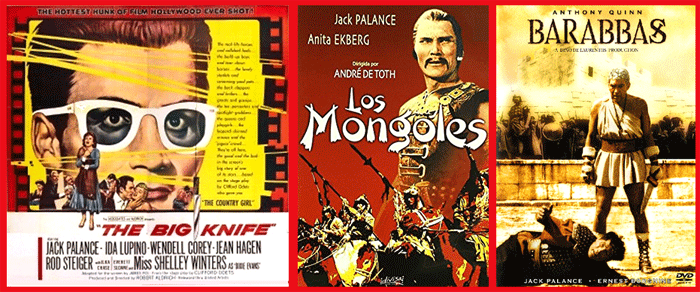
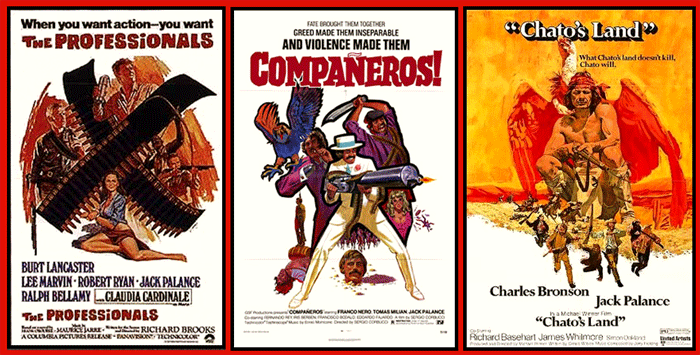
The hard, villainous skull-faced one-time boxer Palance was the heaviest Heavy Hollywood knew in the old days before he deserted Hollywood for Europe. The lantern-faced Palance chews the scenery as a “mean as dirt” gunslinger imported by cattle interests to confront former gunfighter Alan Ladd in Shane (1953, D: George Stevens), Paramount’s splendid outdoor drama of the Old West.Moviegoers may also remember him as a disillusioned film star in The Big Knife (1955, D: Robert Aldrich) and in a good number of films made in Europe such as: The Mongols (1961, D: Andre de Toth/Riccardo Freda), Barabbas (1962, D: Richard Fleischer), The Professionals (1966, D: Richard Brooks), Justine: Le Disavventure della Virtu (1968, D: Jess Franco), Vamos a Matar, Companeros! (1970, D: Sergio Corbucci), Chato’s Land (1971, D: Michael Winner), etc.According to a biography of actress Joan Crawford, during filming of the solid suspense thriller, Sudden Fear (1952, D: David Miller), Crawford was disturbed by Palance’s “moodiness and particular techniques, such as racing around the studio stage to incite his emotion.” Quite possibly, Palance, in his first starring role and an actor whom Crawford once fired, was nervous and apprehensive about acting as the new husband of Crawford, the legendary star who had shared screen space with biggest film icons such as Clark Gable, Spencer Tracy, Gary Cooper, Robert Taylor, etc. In The Horsemen, one will find Palance mellowed, put on weight and smiles as if he meant it.Beautifully filmed in Eastmancolor and Panavision (2) in Afghanistan and Spain, Cinematographer Claude Renoir brilliantly succeeds in recapturing the look and feel of the period. The original cinematographer James Wong Howe (nicknamed Low Key Hoe) who had worked on many Frankenheimer movies was replaced.According to the book The Great Moviemakers of Hollywood’s Golden Age, Howe admits having worked two or three weeks on his last picture, The Horsemen, but left over a disagreement with director Frankenheimer for refusing to use a particular lens rented for the movie. (3)

The 23-year old, fresh-faced, Leigh Taylor-Young, when contracted to play the leading lady role in The Horsemen, which took about two and a half years to make, had a repertoire of film appearances credited to her career.

Debuting in the Broadway play Three Bags Full (1966)  under the name Leigh Taylor-Young, she progressed with appearance in the TV soap opera Peyton Place, following which she went on to make five major motion pictures in a row.The Horsemen also features: British general purpose actor Peter Jeffrey (Hayatal), George Murcell (Mizrah), bald-headed Viennese character actor Eric Pohlmann (Merchant of Kandahar), Vernon Dobtcheff (Zam Hajji), Saeed Jaffrey (District Chief), John Ruddock (Scribe), Mark Colleano (Rahim), Salmaan Peer (Salih), Aziz Resh, Leon Lissek, and Vida St. Romaine as the Gypsy woman. Some websites identify actor Srinanda De in the role of Mukhi.

The crew also consists of: Costume designer: Jacqueline Moreau; Production Designer: Pierre Louis Thevenet; Music composed and conducted by: Georges Delerue.

Following the filming, director John Frankenheimer had joined Harold F. Kress to edit the film in Paris and also devoted part of the nights attending cooking classes for three months at Le Cordon Bleu which was followed by a tour of Europe studying the great chefs. Undeniably, the film’s production had occasioned a learning experience for Frankenheimer in the traditional game of buzkashi which inspired in him the thought of holding buzkashi tournaments in the USA.

As for Sharif, whose interests thrived on bridge games, globe-trotting, dating girls and owning horses, among others, his movie days in Afghanistan acquired him a new buddy to share his Rolls-Royce and his new Penthouse overlooking the Bois de Boulogne in Paris: a majestic Afghan hound named Baz (Bazo), a gift from the King of Afghanistan (4).

Until next time, Jo

PS: This here Second installment of the two-part serial “Catch-as-Catch Can” would have appeared earlier, had I been able to go ahead with my scheduled visit to Dubai in April-May for research work for that post. Unfortunately, I had to forego that trip and sustain subsequent delay due to urgent engagements.

Notes:

  • Please refer to the first part: “Catch-as-Catch Can” for more details on Buzkashi.
  • The film’s Trailer states “Super Panavision
  • For the benefit of minimal content in this post, many finer details re. the production of this film, readily available in numerous websites, books, etc, is not incorporated.
  • A chapter in “No Better Friend: Celebrities and the Dogs They Love,” by Elke Gazzara features an interesting narration about how the last king of Afghanistan, Muhammad Zahir Shah (1914-2007; Reign: 1933-1973) presented one-year old Bazo to Sharif, through his emissary, while Sharif was already inside the aircraft waiting to take off to Paris after having spent more than five months location shoot there for The Horsemen.
  • Books, DVD/Blu-ray of the movies referred to in this article are available with amazon.com, amazon.co.uk and other leading dealers.
  • DVD sleeves/posters credits: Wikipedia, amazon, imdb and from my private collection.
  • This illustrated article is an affectionate nosegay to the movie reviewed above. Please refer to “About” of my webpage for more details.
  • In memory of John Frankenheimer who died on July 06, 15 years ago.

(© Joseph Sébastine/Manningtree Archive)

Lovescapes of Hearts

00

Have you ever looked for love in the petals of a rose…. or a tulip? If the answer is yes, then this write-up is for you.

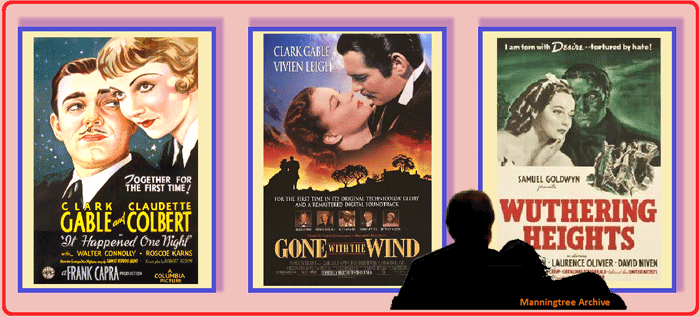
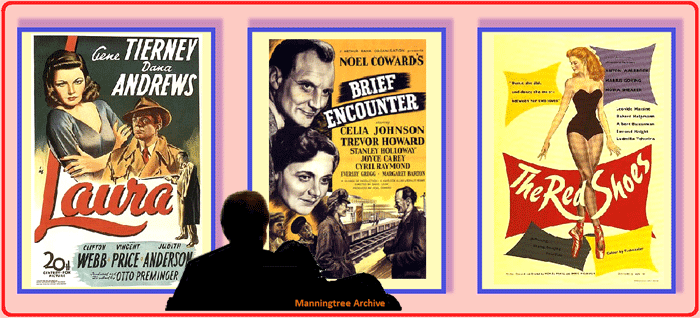
Just as in real life and in literature, opera, poetry and in lyrical music, love’s tenderness, beauty, joy and fall out has been eulogised in fantastic depictions on the silver screen. To many movie-goers, most of those vintage movie magic by renowned film personalities are like love letters, though short of handwritten in ink, but visual illustrations of romance set amidst glamour and mystery – joy and melancholy. Made to touch heart strings and to stay with the viewer long after it ends, few are nevertheless unabashedly sentimental and manipulative or even cheapo exploitation flicks.

Here below are representative posters of some renowned movies heralded in the romantic genre made in a span of 50 years during 1930s to 1970s:

1

2

3

4

5

6

7

8

9

10

11

12

13

14

15

16

17

18

19

20

21

Until next time, Jo

Note:

  1. I have limited the selection of movies to those only forming part of my cinematic collection of 6,000 movies plus. The omission of many fine representations including details of the movies are simply due to lack of space.
  2. Most of the movies in the pictorial section above are available with amazon.com, amazon.co.uk and other leading dealers.
  3. Posters/DVD sleeves credits: amazon.com, en.wikipedia, imdb and from my private collection.
  4. This illustrated article is an affectionate nosegay to movies of the past. Please refer to “About” of my webpage for more details.

00

Joseph Sébastine/Manningtree Archive)

Telly Savalas in the Limelight

001

Part II of Mr. Telly Savalas, Back to the Limelight…., Please!

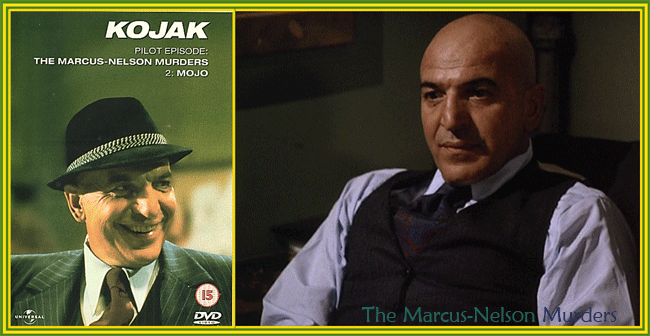
Kojak hoisted the 49 year-old Savalas to superstardom, bestowing on the Greek the status of a sex-symbol, whose trademark quip in his Graeco-Yiddish-Brooklyn accent: “Who loves ya, baby?” engaged wide attention. The title role also brought the actor with a mole on his left cheek an Emmy and two Golden Globes. (Telly revived Kojak in some TV episodes during 1985-1990.) image

As film after film came his way, his commitment to his career not only remained progressive, but Telly had also acquired a taste for wealth and the lifestyle that went with it – savouring the attention his fans bestowed on him. They fed his ego, reaffirming the appeal of Savalas the Star. Like in all aspects of his life, his self-indulgent lifestyle reflected on his stylish images, airbrushed to perfection, on the cover of glossy magazines to the licence plate of his car which flashed “Telly S”.

image

He met friendly receptions wherever he went for shooting movies or not. He had a great time in southwest Africa in 1975 shooting Killer Force (aka. The Diamond Mercenaries, D: Val Guest, 1976). Likewise, the German fans were happy to see him in West Berlin for the location work of Inside Out (aka. Hitler’s Gold/The Golden Heist, D: Peter Duffell, 1975). In Berlin, the children rolled up their sleeves to have their arm autographed by him while the girls greeted him with fresh red roses and handful of lollies which he often gave away.

image

Keeping up with the then trend in Hollywood for racehorses, Telly ventured into horse racing when actor Walter Matthau turned down an offer to invest in a racehorse. With producer/director Howard W. Koch taking half interest, Telly acquired the other half at $3000 in an American thoroughbred racehorse whom he named Telly’s Pop (either after the lollipops he devours or his late-father who took him to his first horse race as a boy in New York).

image

Although Telly later admitted on his CBS-TV show that he does not know anything about horses, audiences who had seen The Scalphunters, Mackenna’s Gold, etc, know that he could handle a horse.

image

Telly dipped his toes into championship gambling and promotion of brand products. Lifting himself into the line-up of singing stars of stage and screen such as Mae West, Ethel Merman, Noel Coward, Robert Mitchum, Jayne Mansfield, Harry Belafonte, Christopher Lee, he forayed into the music industry and had some chart success – tunes that would make Duke Ellington tap his shoes seven-feet under.

image

By the age of 54, Telly had won over audiences with his nightclub act in Lake Tahoe and Las Vegas where one of the highlights was a bouzouki dance he performed with his brother Constantine. In November 1975, at the wish of Her Majesty Queen Elizabeth II, Telly sang at her Royal Command Palladium concert where celebrities like Count Basie, Charles Aznavour, etc performed in spite of the bomb scare that autumn. During that time, the media reported him playing golf with world’s top golfer Tom Weiskopf on the Ailsa golf course at Turnberry in Scotland.

image

image

Often things in life simply don’t go according to set decisions. Telly never forgot the break he got from Burt Lancaster into movies which he reciprocated to the career of others. A 1975 newspaper reported actor Gene Hackman talking on the Douglas show about how Telly, while preparing to move from New York to start out his acting career in Hollywood, suggested to Hackman to “get his skates on” and head for the West Coast where the real action is – which resulted in Hackman’s entry into films on the Coast. Like Telly, the film Mad Dog Coll also marked the debut of Gene Hackman. Telly also played an active part in philanthropy and philhellenism. However, as always, there are different perspectives about Telly bordering on arrogance and rudeness I have also come across during my research.

image

For the Greek-American icon who once said that he carried his Hellenism like a badge of merit, the opportunity to play a real Greek on Greek soil came in 1978 in the WW2 POW adventure film, Escape to Athena (D: George Pan Cosmatos, 1979) which had an all-star cast including Roger Moore, David Niven, and Claudia Cardinale.

image

In his autobiography, actor Roger Moore wrote about his location days for Escape to Athena on the isle of Rhodes when he brushed up on his gambling at the tables of the local casino which were also frequented by Telly. Stuntman Vic Armstrong’s autobiography also contains interesting pieces about the location shooting of this movie – about how, in the early hours, a bored Telly would phone him to play a game of poker.

image

Telly visited Greece again in early 1982 for location shoot in Laconia for My Palikari (American Playhouse, D: Charles Dubin). He turned this into a family affair and had his young son Nicholas from Los Angeles christened at the church in the village of Anogia, the birthplace of Telly’s mother.

image

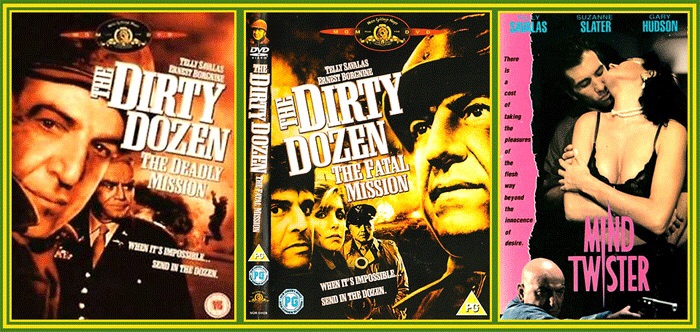
Meanwhile, his career progressed with movies including Capricorn One (D: Peter Hyams, 1977), Beyond the Poseidon Adventure (D: Irwin Allen, 1979), Border Cop (aka. Blood Barrier, D: Christopher Leitch, 1979), Hellinger’s Law (D: Leo Penn, 1981), Fake-Out (aka. Nevada Heat, 1982), Alice in Wonderland (D: Harry Harris, 1985), The Dirty Dozen: The Deadly Mission (D: Lee H. Katzin, 1987), The Dirty Dozen: The Fatal Mission (D: Lee H. Katzin, 1988), Mind Twister (D: Fred Olen Ray, 1994), Backfire! (D: Dean Bell, 1995), etc.

image

Augmenting his taste for the international high life, he was regularly featured in forgettable European movies shot across the Atlantic. Some of them were as dull as a wet Good Friday but made pots of money. Having worked with European moviemakers earlier, Telly was at ease with the European way of shooting schedules and locations all over Europe. In the movie business, one gets to work closely with a lot of people. His further outings into Continental productions also gained him good rapport with more moviemakers as well as with industry professionals and eminent personalities.

image

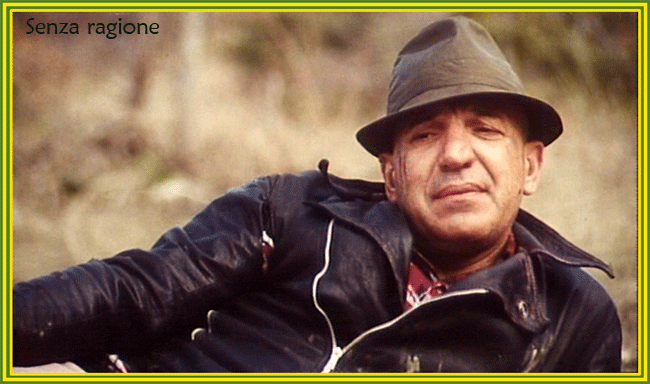
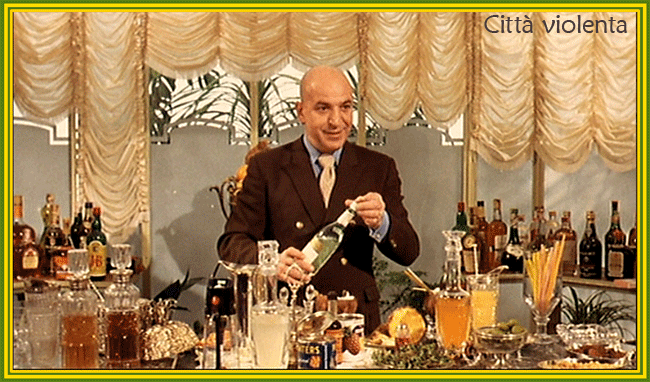
A Town Called Hell (D: Robert Parrish, 1971) and A Reason to Live, A Reason to Die (D: Tonino Valerii, 1972) were shot in spaghetti film locations in Almeria and Madrid. His repertoire of European productions also included the Charles Bronson-Jill Ireland vehicle Città violenta (aka: Final Shot/The Family/Violent City, D: Sergio Sollima, 1970), Crime Boss (D: Alberto De Martino, 1972), Senza Ragione (aka Redneck, D: Silvio Narizzano, 1973), Faceless (aka. Les prédateurs de la nuit, D: Jesús Franco, 1987).

image

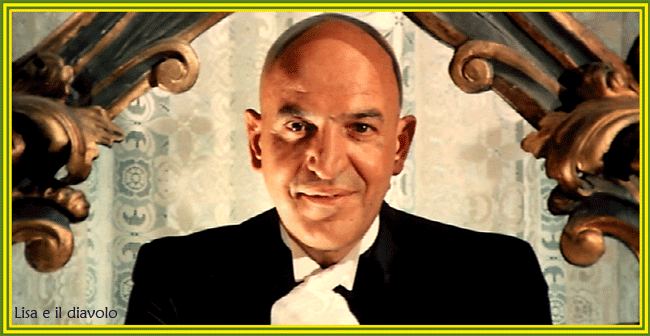
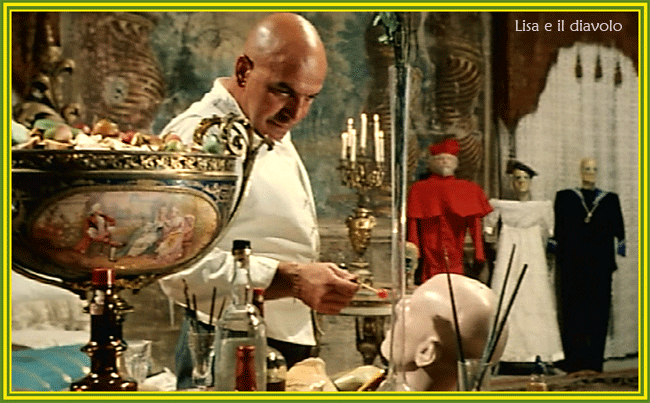
Besides Telly’s appearance in Horror Express (1972), Italian director Mario Bava and producer Alfred Leone cast him in Lisa and the Devil (Lisa e il Diavolo, 1973 – re-edited into The House of Exorcism (1975)) as the devious butler Leandro, the Devil who lured Lisa (Elke Sommer) into the Spanish villa of a blind Contessa and her deranged son. It is in this masterpiece of Mario Bava, mainly shot during the latter half of 1972 in Toledo, outside Madrid and Barcelona that Bava showed the lollipop sucking Telly to great effect, and the sucker became Telly’s trademark in Kojak by late 1973.

image

While his continuous interest in Continental filmmaking extended to the 1991-93 TV series  Ein Schloß am Wörthersee shot in Austria and Italy, Telly had also appeared in faraway locations like Australia where he shot Rose Against the Odds (D: John Dixon, 1991).

image

Hollywood Boulevard’s Walk of Fame awarded him his Star in 1983. The following year, Telly and his third wife Julie Hovland were married. Having promised to be together for richer, for poorer, in sickness and in health, they remained married until his death.

On Saturday July 23, 1988, the tragedy struck. Christina Savalas, Telly’s mother and a leading American artist whose “Picassolike” work received local and international exhibitions, died of heart failure at age 84 at Providence Saint Joseph Medical Center, Burbank, California.

image

On Saturday, January 22, 1994, one day after his 72 birthday, surrounded by wife Julie Hovland and family, Telly died of Prostate cancer at the suite he kept at the Sheraton Universal Hotel, Universal City. According to the death certificate, the cause is stated as Renal Failure/Metastatic Disease/Transitional Cell Cancer of Bladder.

image

After services at St. Sophia Greek Orthodox Cathedral in Los Angeles, Telly was buried at Forest Lawn Memorial Park, Hollywood Hills, Los Angeles, on January 25, 1994. The large marker on the lawn of his grave contains the header “Telly Aristotle Savalas” (a) followed by the quote from Aristotle:

The hour of departure has arrived,

and we go our ways –

I to die and you to live.

Which is better God only knows.

image

Telly has gone. Has he fulfilled his aims and ambitions? The question brings to mind a letter the French novelist and playwright Honoré de Balzac, when quite a young man, wrote to his sister about his aims and ambitions: “….. I have two and only two passionate desires – to be famous and to be loved. Will they ever be satisfied?”  As for Telly, maybe none may dispute that he had fulfilled both the desires Balzac was referring to.

Until next time, Jo

image

Notes:

  1. The spelling of the middle name on the marker and the Certificate of Death: 39419004248 dt. 22-1-1994 shown in a website differs.
  2. This article owes its source to various newspapers, books, magazines, visual media, etc.
  3. Films forming part of the collection of Manningtree Archive are marked in bold.
  4. Most of the movies and books referred to in this article are available with amazon.com, amazon.co.uk and other leading dealers.
  5. DVD sleeves credits: amazon.com, en.wikipedia, imdb and from my private collection.
  6. This illustrated article is an affectionate nosegay to the movies and performers of the past. Please refer to “About” of my webpage for more details.

001

(©Joseph Sébastine/Manningtree Archive)

Mr. Telly Savalas, Back to the Limelight…, Please!

1

Part I

Life with many beginnings and endings is a progression of cycles. Just like the years before, the New Year arrived in the cyclical order – ushering in the divisions of days, weeks, months, various seasons, in conjunction with personal social relationship events such as the dates of birthdays, weddings, anniversaries, etc. Within the past three weeks of January in the present calendar, there were few birthdays (including mine on 18th) and anniversaries of people I have had the privilege of knowing – and also a reminder of more to come as the year progresses – a good number of which must be reinforced by remembrance.

2

Those with nostalgic longing for movies of the second half of the 20th century would not have to jog their memory much to remember the late Telly Savalas, the Film/Television actor, TV show host and Singer. Telly shared his birth and death in January – on consecutive days of 21st and 22nd. In many of us, the image of Telly Savalas was moulded not only from the characters he portrayed in a string of movies or from his presentations in Television, or the music albums but also from the wide attention he generated to himself by display of his images in a wide range of American-International magazines.

3

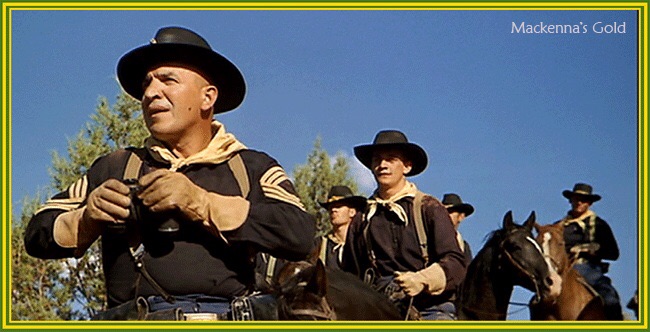
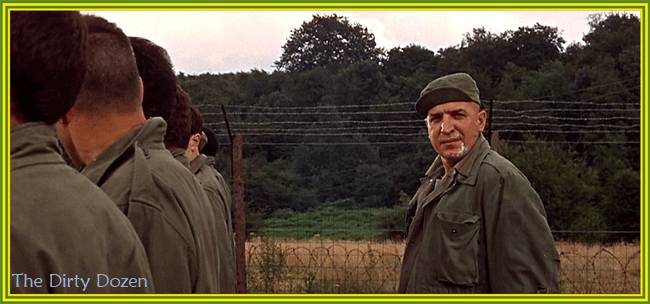
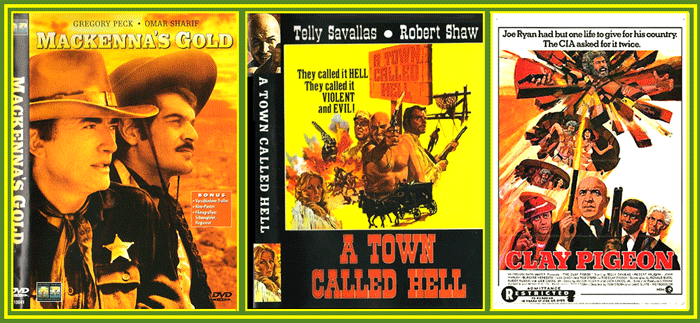
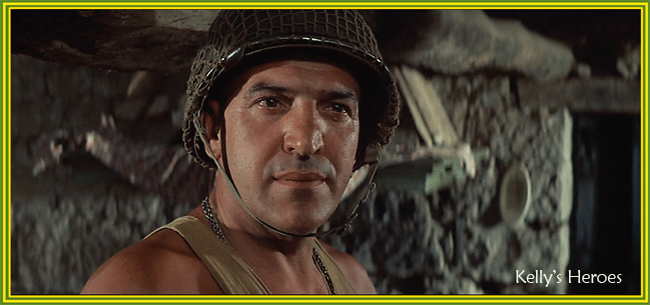
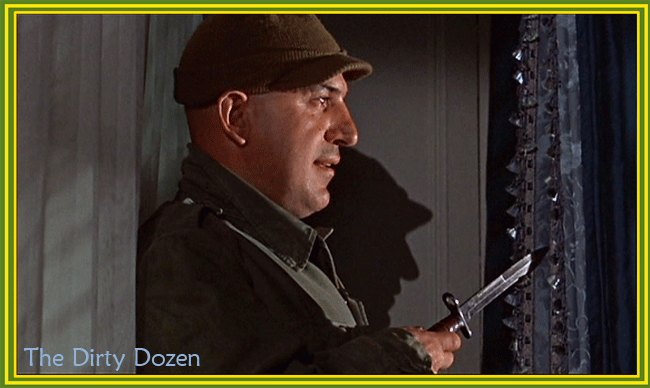
Of those movies featuring him in a succession of devious characters, one could easily think of the box-office hit, The Dirty Dozen (D: Robert Aldrich, 1967) which presented Telly as a convict and brutal rapist; he was an earthy renegade killer whose frumpy mistress (Shelley Winters) described him as having “as much feelin’s as a bald-headed hog” in The Scalphunters (D: Sydney Pollack, 1968); a black marketer in Battle of the Bulge (D: Ken Annakin, 1965); a no-good army sergeant in Mackenna’s Gold (D: J. Lee Thompson, 1969), a sadistic bandit leader in A Town Called Hell (D: Robert Parrish, 1971); a crooked narcotics agent in Clay Pigeon (D: Tom Stern, 1971); the cold-blooded assassin in L’assassino… è al telefono (D: Alberto De Martino, 1972)….. and so the list goes on until he came across his alter ago Kojak.
4

Like the bald headed Hollywood actor Yul Brynner, it is difficult to fully fathom the real story of Telly Savalas since he told a different story in every other interview – a phenomenon I had noticed while researching for this article.

5

Aristoteles Savalas (a) was born in Garden City, New York, on January 21, 1922 (b). He was the second son of artist Christina Kapsalis (a former Miss Greece beauty queen from the Greek village of Anogia) and to Nicholas Constantine Savalas (originally spelled Tsavalas – hailing from the village of Gerakas), who made a fortune in tobacco, lost the lot and made another fortune in the bakery business. As teenagers, both his parents had emigrated to America in the early 1900s.

6

The second of five children (three brothers: Constantine Socrates, George Demosthenes, Theodore Praxiteles and sister: Katherine), in his earlier days, Aristoteles who spoke fluent Greek, had to sell newspapers, shine shoes and work as a lifeguard to help support the family. Somewhere along the way, he became regularly known as Telly. Having enrolled in the army in 1941 and following four years of service during the World War II he was discharged duly decorated with a Purple Heart for injuries sustained. How he was wounded in the war is unclear – quite similar to the ambiguity about how his left index finger got slightly mangled.

7With the intention to pursue a career in the diplomatic service, Telly graduated in psychology from Columbia University where he had met Katherine Nicolaides. After his father’s death, Telly married Katherine in 1948 and together they had Christina. Following few years work with the Near East Information Services branch of the U. S State Department as host of the Your Voice of America series, ABC (American Broadcasting Company) News hired him as a producer. Having left ABC in January 1959, he had his first TV acting role in And Bring Home a Baby, of Sunday Armstrong Circle Theatre (1950–1963). Burt Lancaster saw his work and drew him to California to appear in episodes of the CBS TV series The Witness (1960-61).

8

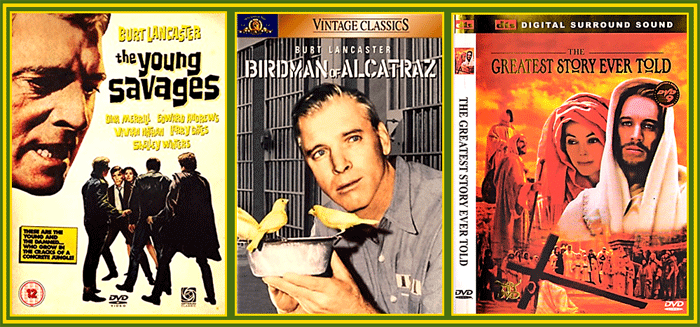
About the age of 39, Telly had forayed into acting in feature films, debuting with Mad Dog Coll (D: Burt Balaban, 1961) which chronicled the career of the Irish American gangster, Vincent “Mad Dog” Coll. Telly portrayed the role of another Lieutenant in the crime drama film The Young Savages (D: John Frankenheimer, 1961), the first of Burt Lancaster’s four picture deal with United Artists (the other three being Birdman of Alcatraz (1962), The Train (1964) and The Hallelujah Trail (1965)).

9

Luck played into his hands when, impressed by his performance in the roles of Al Capone and “Lucky” Luciano in The Witness in which the life and crimes of America’s notorious rogues are investigated at a committee of inquiry; and also in The Young Savages shot in New York, Lancaster provided him the important role of the solitary row prisoner Feto Gomez of Leavenworth Prison in the prison biography, Birdman of Alcatraz. This breakthrough role earned Telly an Academy Award nomination as Best Supporting Actor.

Following his divorce from Katherine, in early 1960s when his film roles were mainly villainous, he got married for the second time to Marilyn (Lynn) Gardner.

10

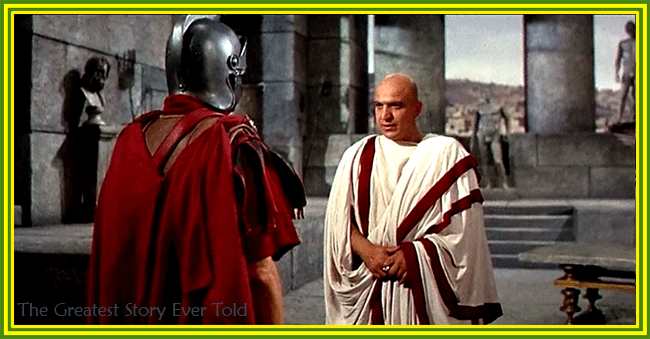
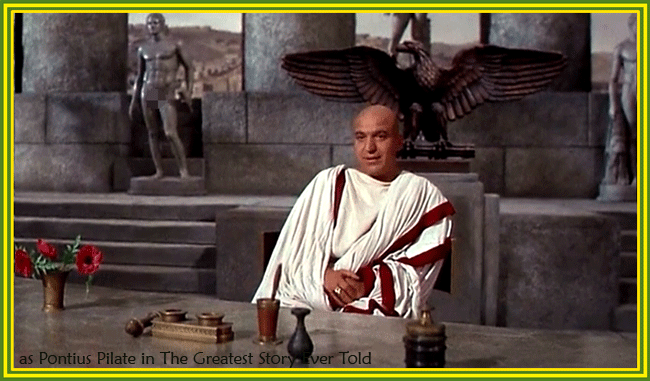
When director George Stevens’ cameo-packed dramatization of the life of Jesus Christ, The Greatest Story Ever Told (1965) was announced, many eyebrows were raised at the parade of famous actors in unexpected roles. The casting of Telly as Pontius Pilate drew smiles from those who thought that a Brooklyn accent has no place in a Biblical epic.

11

Stevens thought that the 6’1” Telly would look more virile and powerful in the role of the Roman prefect (governor) of Judaea if he shaved his head. Telly found the proposition extremely attractive and decided to go on with life as it was before retaining his signature bald look he took for his role in this Bible epic. Whyever not?

12

He simply chose to shave his head for the look. By the way, men generally don’t grow beards because they dislike shaving – but because they think their whiskers make them look better and give them a distinctive image.

13

He is on record in an interview as saying about the time Telly told his mother Christina vis-à-vis his casting in The Greatest Story Ever Told. She had rounded things off with the remark: “You are joking!” and she continued, “You’ll make a Marvellous Jesus!” She must hold the world record for being the world’s most optimistic mother.

14

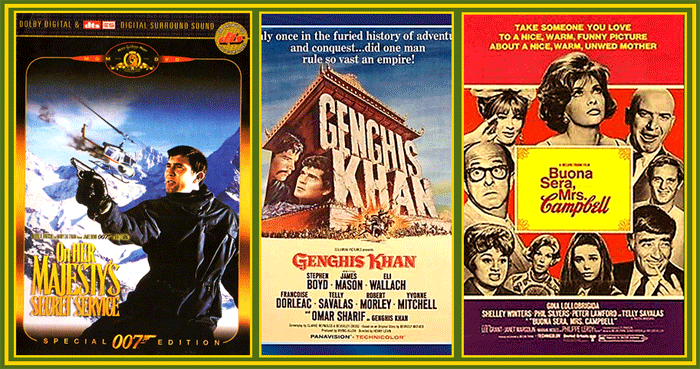
Telly had a memorable role as James Bond’s notorious arch-rival Ernest Stavro Blofeld in On Her Majesty’s Secret Service (D: Peter Hunt, 1969) in which stuntman Joe Powell nearly got killed doubling him in the bobsleigh in Switzerland. Two of his co-stars of The Greatest Story Ever Told, Donald Pleasance and Max von Sydow also played Blofeld in You Only Live Twice (D: Lewis Gilbert, 1967) and in Never Say Never Again (D: Irvin Kershner, 1983).

15

Of his bald head, he once said that “everyone’s born bald.” In spite that Telly was typecast as a villain for being entirely bald, audiences took him to their hearts – believing that in the baddie they saw onscreen rested a sweet nature. His strong features and ethnic look came handy for the role of Shan in Genghis Khan (D: Henry Levin, 1965).

16

The success of that film gave his career further fillip earning him roles in Buona Sera, Mrs. Campbell (D: Melvin Frank, 1968), The Assassination Bureau (D: Basil Dearden, 1969), Kelly’s Heroes (D: Brian G. Hutton, 1970); Pretty Maids All in a Row (D: Roger Vadim, 1971), etc.  For the title role of Pancho Villa (1972), the bald look was vindicated by the shaving of his head in prison during the opening sequence.

17

Since 1974, after a long separation Telly and Marilyn were divorced. According to the mini documentary “Telly Savalas: The Golden Greek”, he had met the beautiful Sally Adams while working on the movie, On Her Majesty’s Secret Service  (c). In 1973, Cojack with ‘c” hit the TV screens and his luck seems to improve.

18

Although the bald-headed, deep, gravel-voiced Telly had been acting since the late 1950s, real popularity came looking for him in the title role of the famous CBS TV series Kojak (October, 1973-April, 1978) which was a spun-off from the made-for-TV pilot, The Marcus-Nelson Murders (D: Joseph Sargent, First American Broadcast: March 8, 1973).

19

Few initial instalments showed him wade through a stereo-typed routine of law-and-order claptrap. But soon Kojak became a prime program as the series turned tough and reasonably true – taking on the look, sound, feel, taste, and smell of the New York crime investigations.

20

Working out of a Precinct of Manhattan, Telly’s Lieutenant Theo Kojak, in fabulous three-piece suit, displayed a more credible human being. Much of the vicious power and toughness Telly had displayed in his earlier villainous roles were there. But the exception was that, in his new persona as the stubborn and tenacious good guy Kojak with a deep concern for people and justice, his wrath was targeted against the crooks, spooks and killers. Audiences related to Kojak’s passionate belief in equality and fairness and his vehement opposition to police bureaucracy. Well, you know the rest.

21

While Telly reigned supreme in the role of the chrome-domed streetwise cop’s cop with a sweet tooth for sucking lollipops and a penchant to wisecrack snazzy lines, Telly soon became indelibly identified with the character of Kojak. “Telly and Kojak are one and the same,” Telly said in a TV interview, drawing a parallel between him and Kojak.

22

His love for the suckers, I mean, his serious attitude towards the lollipops, reportedly to replace Telly’s addiction for long thin cigars, was initially featured in Episode eight “Dark Sunday” of Kojak in December 1973. This addiction for suckers could have its origins in Toledo, Spain and to Italian director Mario Bava, the father of Italian horror films.

This concludes Part I.  Part II will follow. Jo

23

Notes:

  1. The spelling of first name is based on Certificate of Death: 39419004248 dt.22-1-1994 shown in a website although the name on his tombstone differs;
  2. The date is based on his death Certificate;
  3. Some sources maintain that Telly met Sally while working on the movie, The Dirty Dozen.
  4. This article owes its source to various newspapers, books, magazines, visual media, etc.
  5. Films forming part of the collection of Manningtree Archive are highlighted in bold.
  6. Most of the movies and books referred to in this article are available with amazon.com, amazon.co.uk and other leading dealers.
  7. DVD sleeves credits: amazon.com, en.wikipedia, imdb and from my private collection.
  8. This illustrated article is an affectionate nosegay to the movies and performers of the past. Please refer to “About” of my webpage for more details.

24

(©Joseph Sébastine/Manningtree Archive)