Viva Portugal: Castelo de São Jorge, Lisboa

Temptation came calling in the person of a TAP (Air Portugal) flight attendant with a face as soft as a powder puff. As our flight bumped high above the Bay of Biscay bound for Lisbon (Lisboa), the red wine she offered us to soothe our nerves was Portuguese, the name of which I forgot but according to her: “acclaimed by the American Global Traveler magazine to be among the best wines served on the wing.”

According to a young couple we had struck up acquaintance with us at London Heathrow, now seated close to us, our present airborne location is infamous for hurly burly air-pockets (similar to certain areas near Goa, India) but, nonetheless, it wasn’t bad after the wine. The young couple, Felipe, a Portuguese and his blonde British bride Sybil with Gok Wan eyeglasses, striped Breton top and skinny jeans, appeared so full of warmth and verve. Ever since my daughter started studying Fashion Design I had cultivated an eye for women’s fashion. We parted at Lisbon Portela Airport after exchanging contact details and handshakes. I would soon learn that this is a country where handshakes are exchanged at every encounter.

An hour earlier, when the Captain announced in the aircraft about adverse weather in Lisbon it should have told me something. It was raining cats and dogs when we touched down at the lovely, hilly Lisbon – the land of navigator Vasco da Gama who discovered a water route to India on May 20, 1498; land of Pedro Álvares Cabral who sighted the coast of Brazil in 1500, and of Ferdinand Magellan who set off on the first voyage around the world nineteen years later.

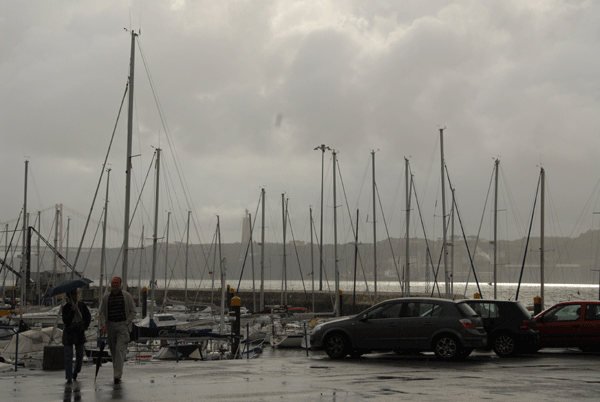
We couldn’t see anything through the lashing raindrops on the window panes of the taxi as we cruised north of Rossio through the 90mtr-wide Avenida da Liberdade (Liberty Avenue: Lisbon’s main boulevard built between 1879-1886 in the style of Avenue des Champs– Élysées in Paris). The sound of rain hitting the roof and jerk of the windshield wipers with a constant radius of curvature seems to set a perfect accompaniment to the drone of the car’s engine as we went around the Rotunda (roundabout), heading for our hotel.
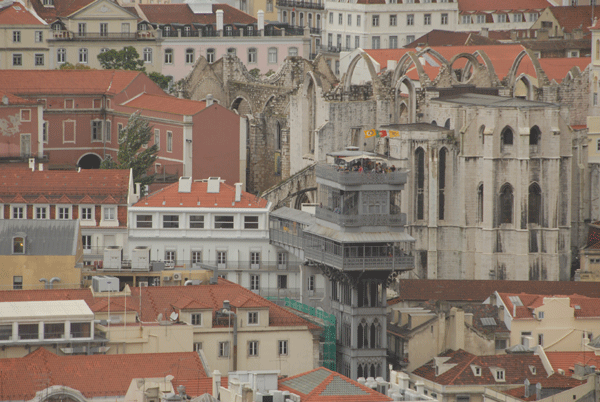
Lisbon is sometimes called “the white city” due to its unique clear light. Well, the following day was bright and clear in conformity to that dictum. As we drove past Praça Marquês de Pombal in a taxi on our way to Alfama, the old quarter, we were able to see the monument at its centre: a statue of Marquês de Pombal and a lion elevated above a gigantic column symbolizing power and strength. His eyes were focused towards downtown he had helped to rebuilt while the broken rocks and tidal waves depicted at the base of the column symbolized the ruinous effects of a past earthquake.
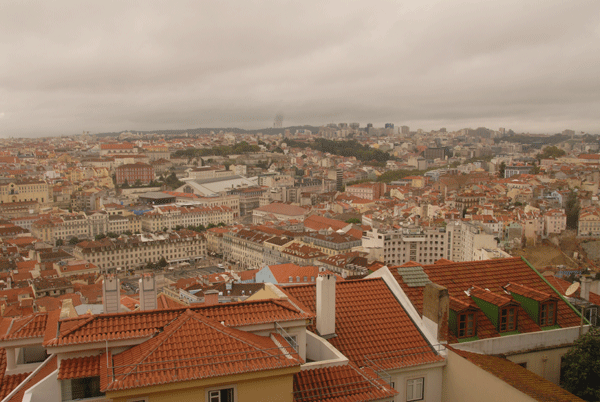
This being our first visit to Portugal, it had left a good impression on me that I would often enjoy thinking about those days. Even now, as I write this, I can still remember the taste and feel and smell of Portugal.
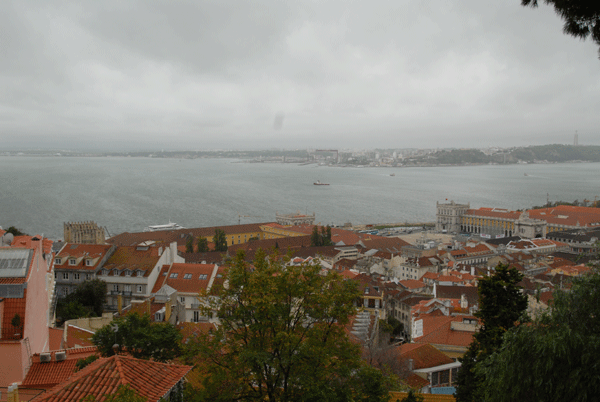
 

Portugal is located in the western periphery of Europe and edged by the Atlantic Ocean. It was once called “the land on the edge where land ends and sea begins”. Convinced that the “earth is flat with an edge, Strabo, a Greek geographer from the period of Christ who travelled extensively, believed that the low headland Sagres at the southwestern point of Portugal where the Atlantic and the Mediterranean meet, was the end of the earth beyond which existed a frightening void with all kinds of monsters and beasts, at the extreme rim of which, ultima thule, “the water cascaded away into the unknown”.
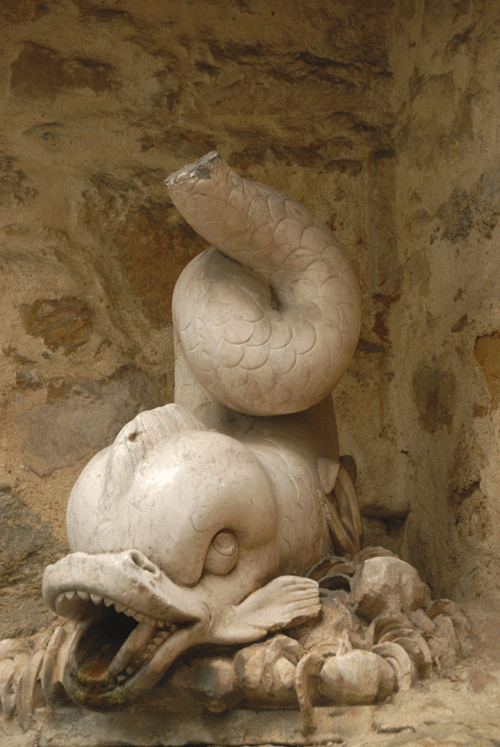
In reality, Portugal is a beautiful country of white sunny beaches, rolling hills and mountains, rivers, plantations of olive and cork and populated by a rich panorama of humanity. It’s a country with an abounding prehistoric culture. During the course of history, this beautiful land sprawling on the wide fertile valleys was swept over by a series of invaders: Phoenicians, Greeks, Carthaginians, and Romans who called it Felicitas-Julia Olisipo. Then came the barbarians like Alani, Vandals, Suevi, followed by the Visigoths until the African Moors barged into western Andalucía in 711 and overran Lisbon in 714. The Moors called it Al-Gharb or Al-Gharb Al-Andalus and held Lisbon for a long period during which it enjoyed relative growth and prosperity. At that point of time, the Christianity which was confined to the north of Minho waited for the right moment to launch the Reconquista which finally occurred at Covadonga in about 718. Gradually towns fell, one after the other, under their control: Porto (868), Coimbra (878) and by 955, the initial raid was attempted on Lisbon.

Afonso Henriques (1110-85), son of Henri of Burgundy and his wife Teresa, who had achieved a brilliant military victory against the moors in the Battle of Ourique in July 25, 1139 was bestowed the title of King of Portugal in 1143 following the Treaty of Zamora signed at the Cathedral of Zamora which recognized the independence of Portugal from the Kingdom of León. Being the valiant warrior he was, reinforced by the help of the Bishop of Braga, Dom Afonso enlisted the armies of the Second Crusade, consisting of English, French, Flemish and German volunteers who were on their way to Jerusalem but had to break their journey at the mouth of Rio Douro in Porto in mid June due to bad weather. Afonso captured Lisbon in October, 1147 after a 17-week siege (July 1 to Oct 25).

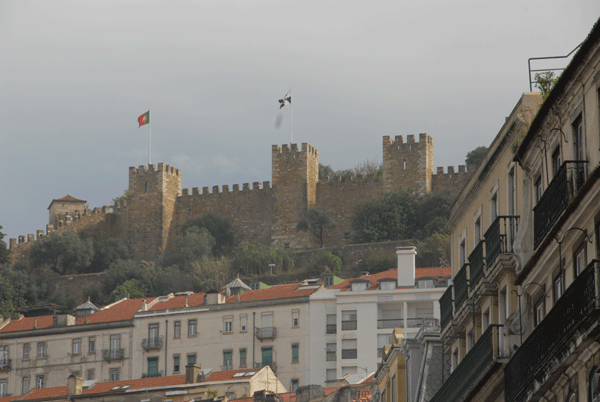
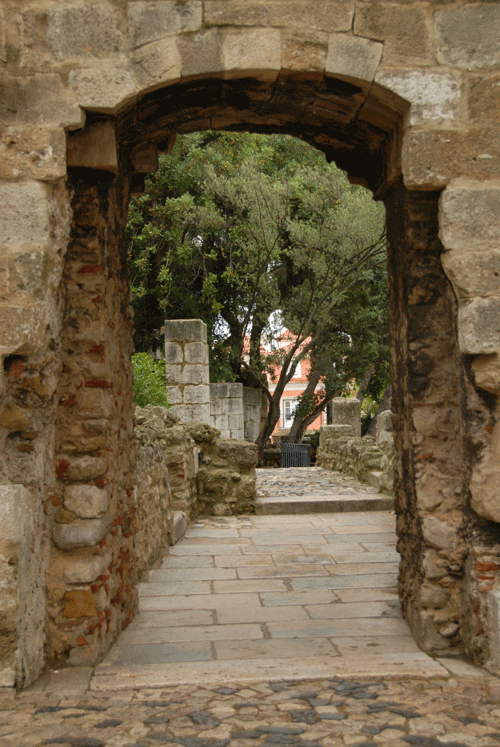
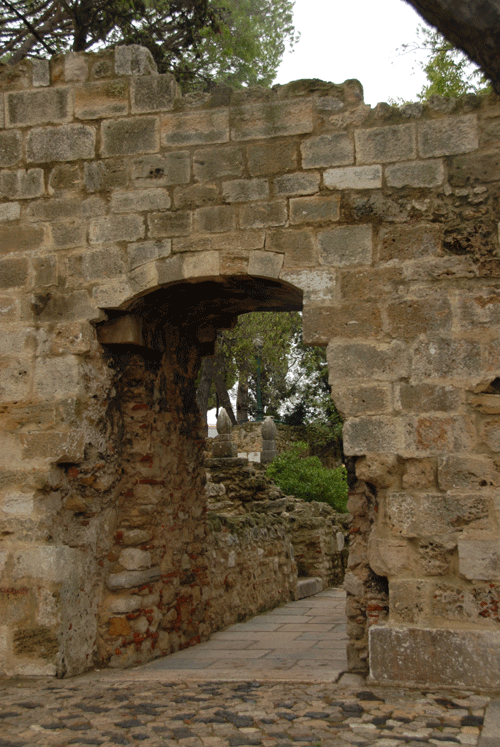
The successful capture of Lisbon blossomed the legend proclaiming the bravery of a Portuguese warrior named Martim Moniz who, having seen the Castelo gates being hastily pulled shut by the Moorish soldiers, lodged himself between the huge doors, sacrificing himself but keeping the city gates open for the conquering armies to capture Castelo de São Jorge which eventually led to the defeat of the Moors and the creation of the Kingdom of Portugal under the House of Burgundy. In Moniz’s honour, a gate in the castle, with his bust on its niche, is named “Porta de Martim Moniz”. This honour would become the precursor for numerous memorials in his name that would prop up in Lisbon.

Those of us who are curious to know of the legend of Dom Afonso Henriques would be interested in the “Crónica do rei D. Afonso Henriques” by Duarte Galvaõ (1435-1517), the original of which is kept at the Museu Condes de Castro Guimarães in Cascais.

The weather was pleasant enough for us to pull down the windowpanes of the taxi which facilitated some still camera-works for Manningtree Archive. All the while, the Spanish singer/actress Rocio Dúrcal (Oct 4, 1944-Mar 25, 2006) was singing on the Taxi’s CD player. Our cheerful taxi driver was glad to switch to a song I liked when I spoke of Rocio he apparently adored. Rocio’s “La gata bajo la lluvia” is what feelings sound like – particularly the duet version with Argentine jazz pianist Raúl Di Blasio – very haunting indeed!


Going up to the Castelo de São Jorge from Baixa by taxi or Remodelado tram or just walking, you have to pass through the narrow and steep winding streets and alleyways of the old labyrinthine district of Alfama, with numerous small wine bars and restaurants hither and thither. We had spent the first part of the day visiting Sé Patriarchal Cathedral (aka: Santa Maria Maior de Lisboa or Sé de Lisboa), the imposing and austere monument with its restored façade of military-style crenellations, built soon after the banishment of the Moors from Lisbon. Soon afterwards, we went over to the Igreja de Santo Antonio da Sé and the Museu Antóniano located a stone’s throw away to the right side of Sé.


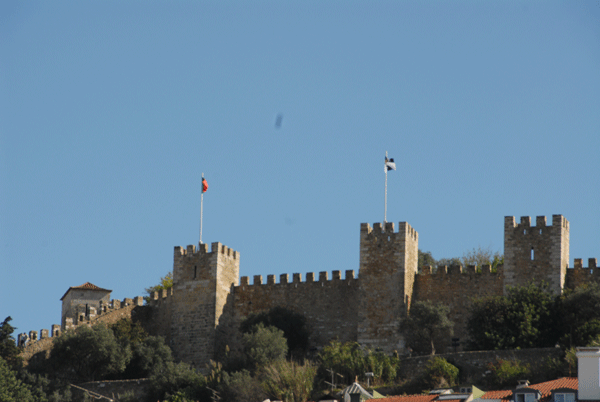
Hours later, we are up at Castelo de São Jorge, the nucleus of the medieval town. They say Lisbon comes from a Phoenician name which means “calm harbour”. Legend has it that this city located on the north-bank of the mighty Rio Tajo and perched on seven hills, similar to Istanbul (the city on the Seven Hills), was founded by Ulysses (Odysseus, the hero of Homer’s Odyssey). It became the capital of Portugal only by 1260 when the capital was shifted from Coimbra after the Moors were finally all-cleared.



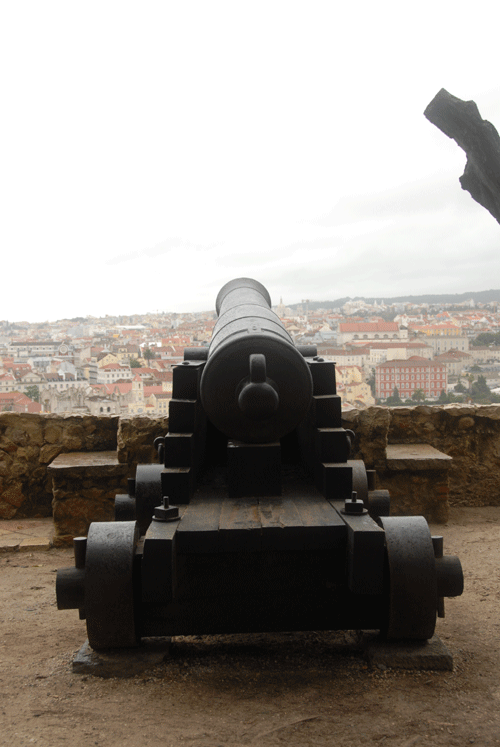
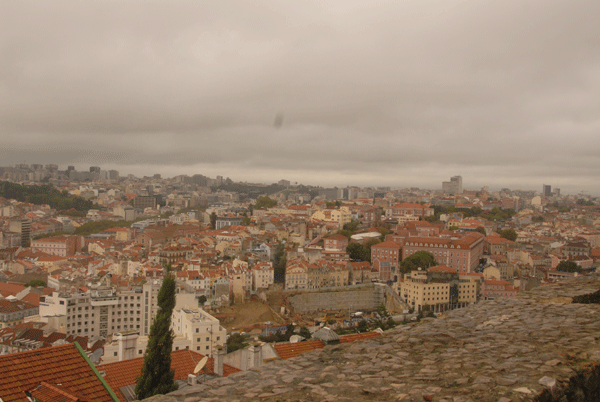
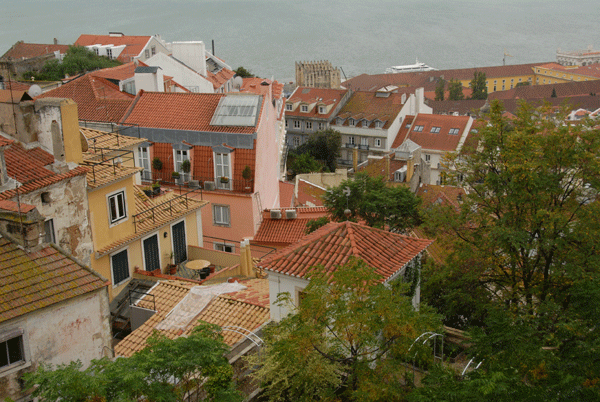
The View of Lisbon from different location from the ramparts of the Castelo, is magnificent. Down there, we could see Baxia, the lower quarter which is the heart of the city centre situated between the hills of old Moorish quarter of Alfama and Bairro Alto in the west. There lay before us a sea of old-world charm of red-tiled roofs, post-1755 architecture with a mixture of new ideas and styles. Looking at Rio Tejo, the largest river on the Iberian peninsula, up to Alcântara, we could see slow Transtejo ferries moving through the broad sweep of the river.


Further up to the north, soared the Ponte 25 de Abril, earlier known as Ponte de Salazar and inaugurated on August 6, 1966. No doubt, the castle’s vantage location 110 mtrs high on the most prominent hill had provided the ancient people with the utmost commanding position for several reasons.


The city you see down there is not in its original form but the one rebuilt following the devastating earthquake on the All Saint’s Day of 1755, five years after the catastrophe of the London earthquake. Given that the epicenter was at Oporto, in truth, the aftershocks were felt as far as Scotland, Sweden, Germany, Switzerland, Madrid, Morocco and even across the Atlantic. Although the Bairro Alta and Alfama were saved from much devastation, the loss of human life in Lisbon was higher than the Lisbon earthquake of January 26, 1531, so that corpses were taken out in barges to the mouth of Rio Tajo and sunk.


With massive international aid, Sebastião José de Carvalho e Melo, later the Marquês de Pombal, went to rebuilt the city according to a neo-classical plan that was geometrically and functionally sensible. But it is a matter of fact that a historic town centre was lost in that uncalled for disaster, breaking off the precious cultural bond that existed between the city and its inhabitants. Conversely, it gave birth to an architectural style known as “Pombaline”. To this end, broad throughfares were created, pavements were provided to the streets according to the new idea from London, places for pedestrians were marked, buildings went up with elegant facades, regular windows and stonework painted dark red, pink, or ochre.
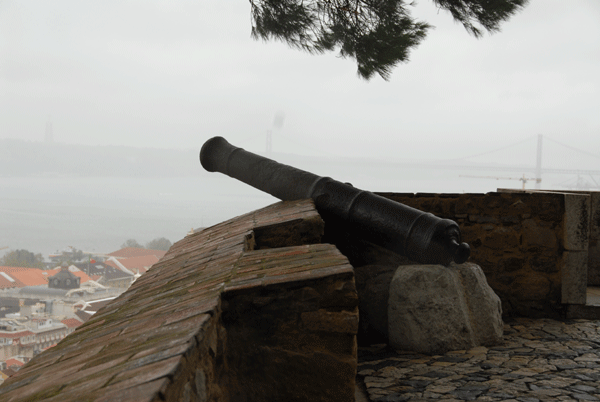
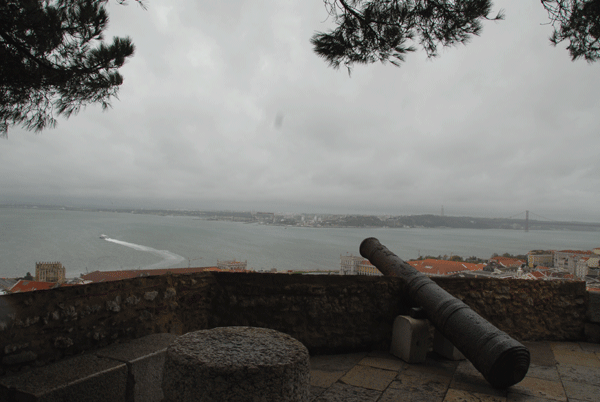


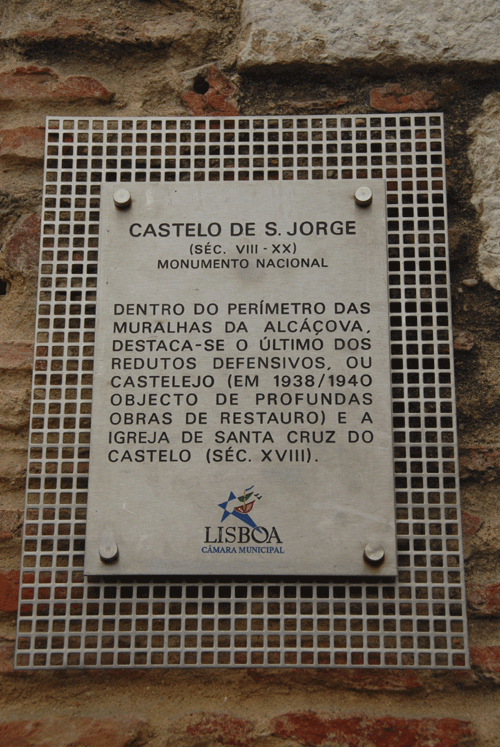
It is believed that Castelo de São Jorge was built in the middle of the eleventh century when the Moors were the rulers of Lisbon. However, scholars suggests the Castelo’s existence goes back to earlier Phoenician settlement and Roman oppidum long before the Moors came in and built their citadel and Casbah, adding further fortifications to its walls and towers.
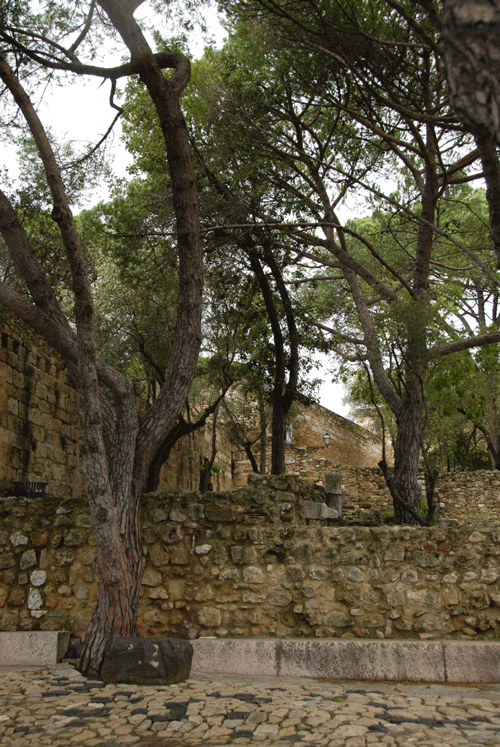


Bearing in mind the site’s natural suitability for defense and surveillance, it was originally built as garrison for the military troops and in case of siege, to function as a sanctuary for the monarchy who lived in the hilltop Paço Real da Alcáçova (citadel). Once the Moors were removed, the governance of the city was undertaken from the Castelo. In 1255, it was made the royal residence of Dom Afonso III (1248-1279), followed by Dom Dinis (1279-1325) who founded the University of Coimbra in 1290 and formed the Portuguese navy in 1317.

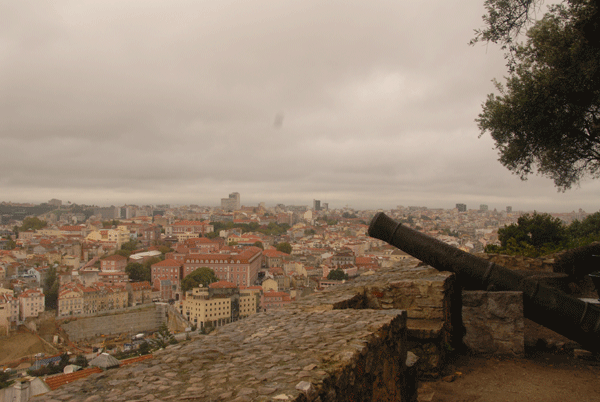


Since the fourteenth century, by order of Dom João 1 the Good (1358-1433), it is named Castelo de São Jorge, after the patron saint of the knights and the Crusades. It was here that Dom Manuel I (Emanuel – 1469-1521), whose reign is remembered for his persecutions of Jews and Muslims during 1496-98, accorded a grand welcome to Vasco da Gama on his triumphant return from India round the Cape in 1499. When Dom Manuel I shifted his residence to his new palace downtown in 1511, the castle functioned as a theatre, prison and arms depot. In the aftermath of the 1755 earthquake, it fell into a long period of decay. In 1938, during a period of economic revival and industrialization under Prime Minister António de Oliveira Salazar, it underwent a complete restoration to reinstate its military heritage. The medieval walls were rebuilt, gardens added and populated with the likes of peafowls.
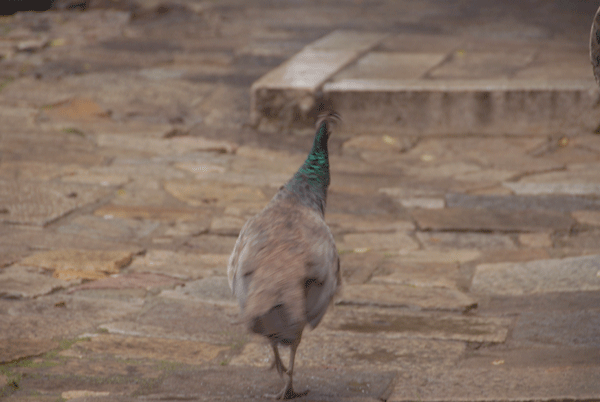
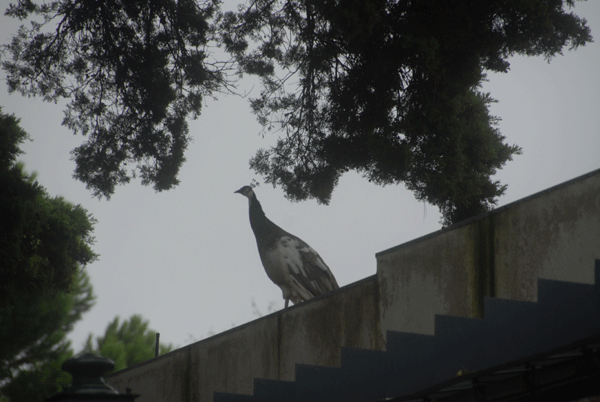


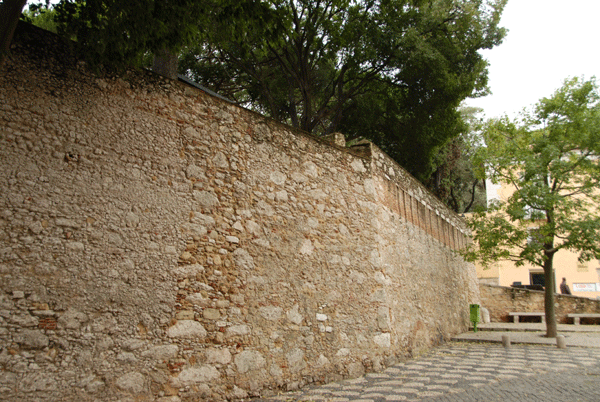
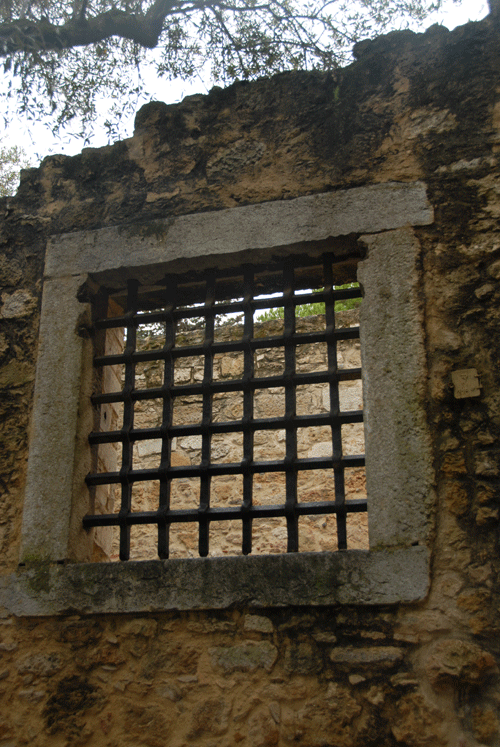
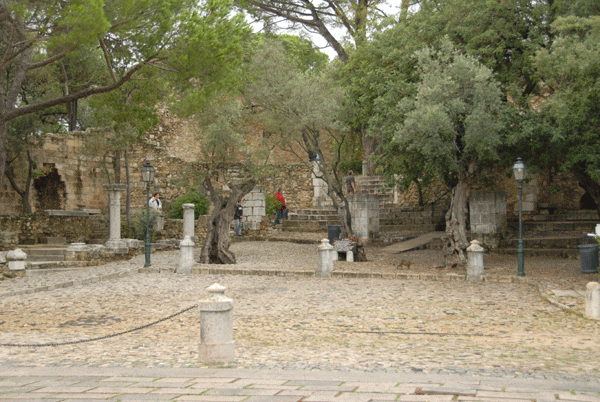
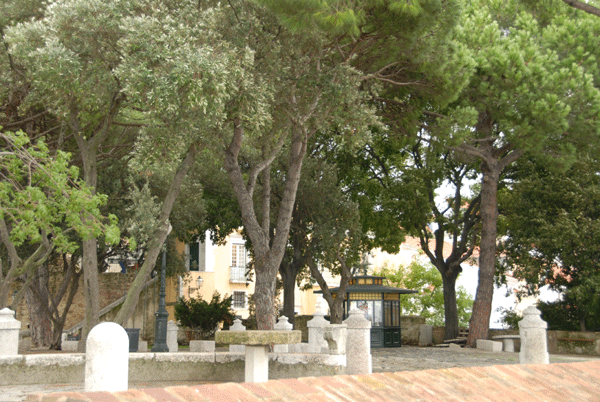
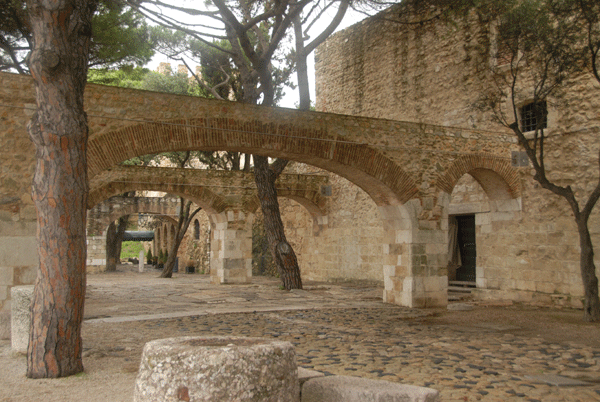
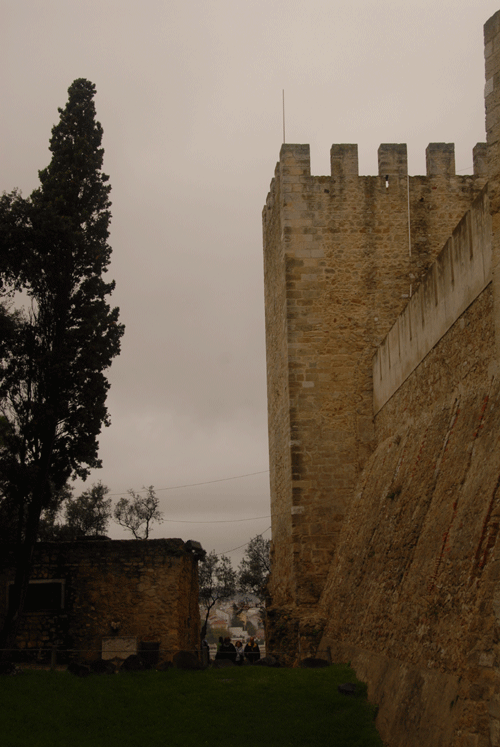
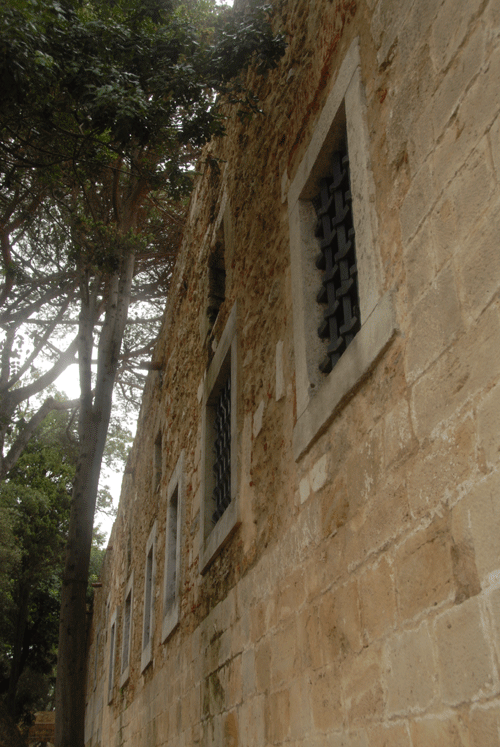
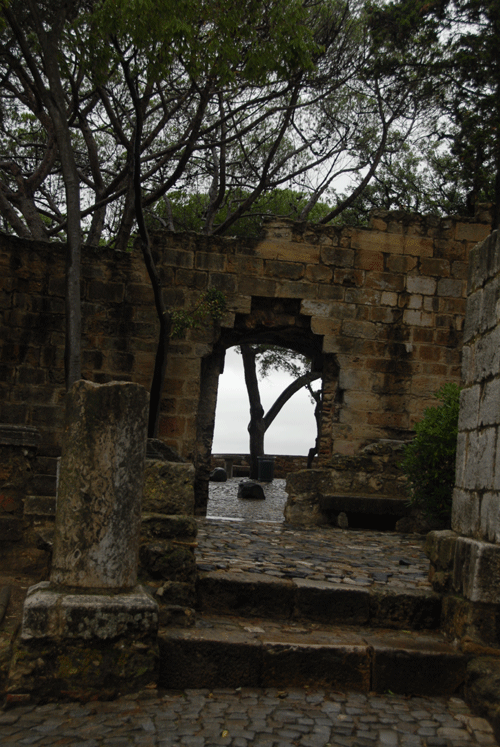
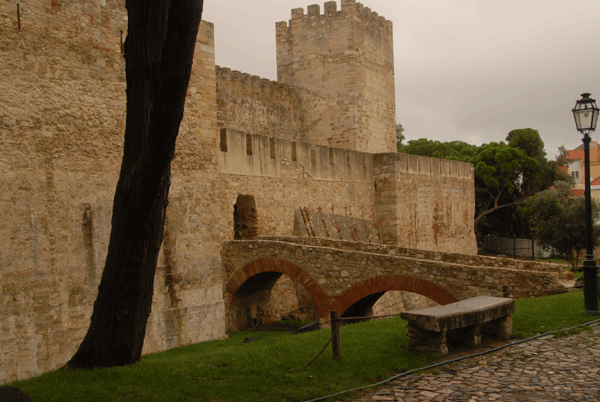
What remains now are eleven towers, the restored ruins of the palace and walls surrounding the compound, the shaded gardens, fountains, cafés and restaurants. While the numerous windows open to all parts of the city helped keep an eye on the city, its position on the highest hill prevented the attackers from approaching the castle from all sides. Representations from the developments in warfare achieved over the years can be noted on the Castelo’s features – the lookout posts (miradouro), the carved stone balconies, arrow slits, platforms on the rooftop for heavy artillery, protections to thwart anyone from clawing their way up the thick walls, the wider ramparts…. Even so, despite these thoughtful restorations, it now wore the look of a public park.


Having said that, I could not help thinking of its bygone glory. This is where the history of the city began. This is the castle on which the legend of knight Martim Moniz was made. These are the same great stones that Dom Afonso Henriques, the conqueror, had walked upon. As I stroll around, my mind reflected on how it must have been here during the Age of Exploration:  the soldiers sitting by the ramparts looking down at the city and at the busy waterfront full of ships and galleons, talking of the fabulous lands that lay to the East; the intense discussions before the fireplaces of the vaulted rooms of the Castelo as the noblemen of the monarchy shot the breeze about the land of spices or why spices are of importance since the crusades…..; of the legendry kingdom of Prester John, the richest monarch in the world….. The number of eyes that must have watched over the great caravels sailing from Belém through Rio Tejo bound for their maritime expeditions… to conquer new worlds….

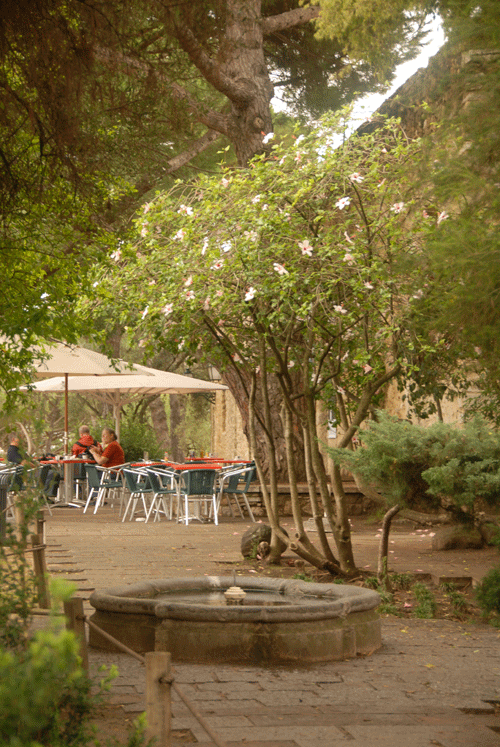
 

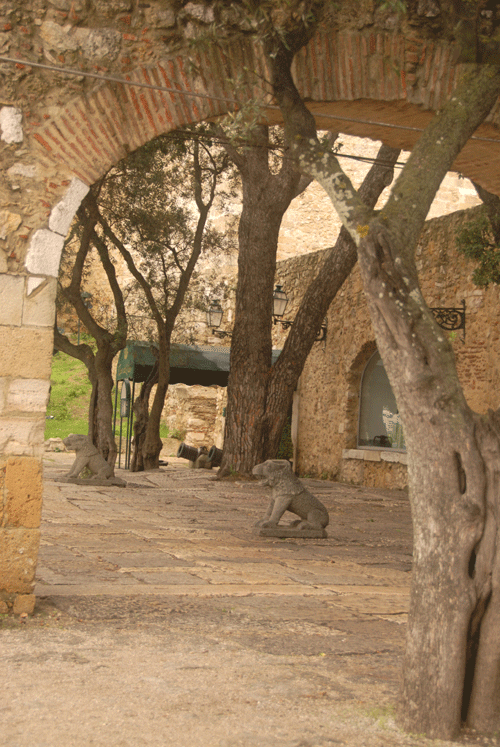
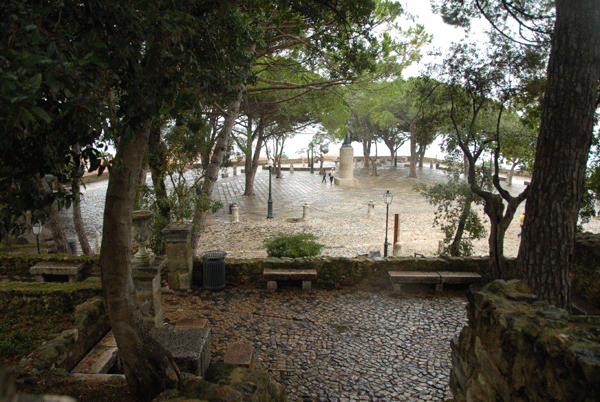
With entry restricted by fee, the Castelo is open to the public all 365 days of a year. It offers not only excellent views to different parts of the city but also the chance to return to the past. We can climb up the towers, especially Torre de Ulisses (Tower of Ulysses) near the rectangular Fortificacao to look through the Periscope for a 360° view of the city, check Porta da Traicão (Traitor’s Gate) – a secret door on the northern wall which allows secret entrance when needed, walk along the ramparts or the narrow, cobbled streets of Santa Cruz, or wander through or just sit under the shaded trees of the garden and watch the locals play backgammon or cards. You can also take a break at Café do Castelo or inside the vaulted room of restaurante Casa do Leão, which together with Núcleo Museológico, forms part of the ruins of the former Paço Real da Alcáçova (Royal Palace of the Alcáçova).
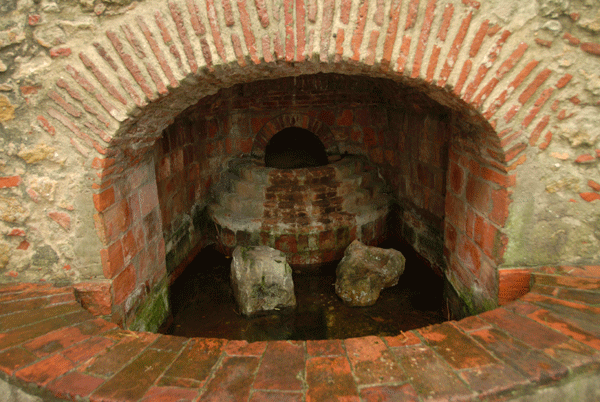
 

Then there are the main towers: Torre de Menagem (Tower of the Keep), Torre do Paço (Palace Tower), Torre da Cisterna (Tower of the Cistern) and the Torre de São Lourenço (Tower of St. Lawrence), etc.

If you would like to see the seventeenth century statue of São Jorge, it is revered inside Igreja de Santa Cruz do Castelo, the twelfth century church (built in place of a mosque inside the Castelo’s compound) where the children of the resident monarchs of the Paço Real da Alcáçova in the Castelo were traditionally baptized.

Periodically, the castle offers cultural and entertainment programs for the visitors: a multimedia exhibition called Olisiponia about the history of Lisbon; a costumed dance show “Danças para trés princesa”(Dances for Three Princesses); “Mistérios e mitos e lendas de Lisboa” (Mysteries, Myths and Legends of Lisbon); “Artes Circenses” (Circus Arts); “Artes Belicas no Castelo”, a show of dueling knights of the Middle Ages, etc.

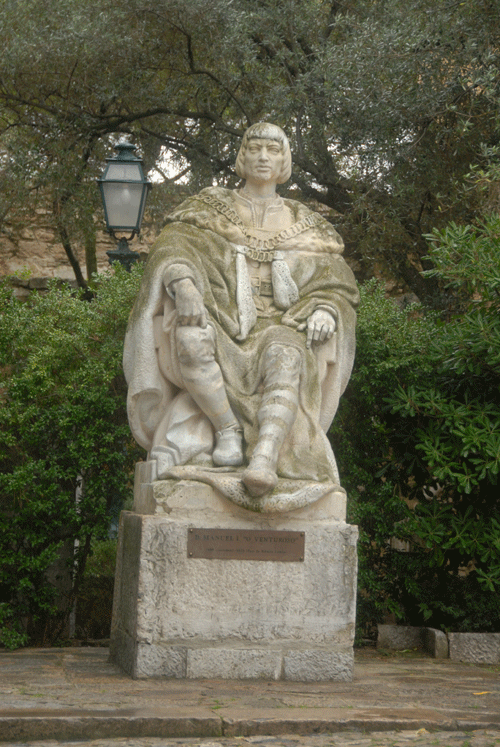
 

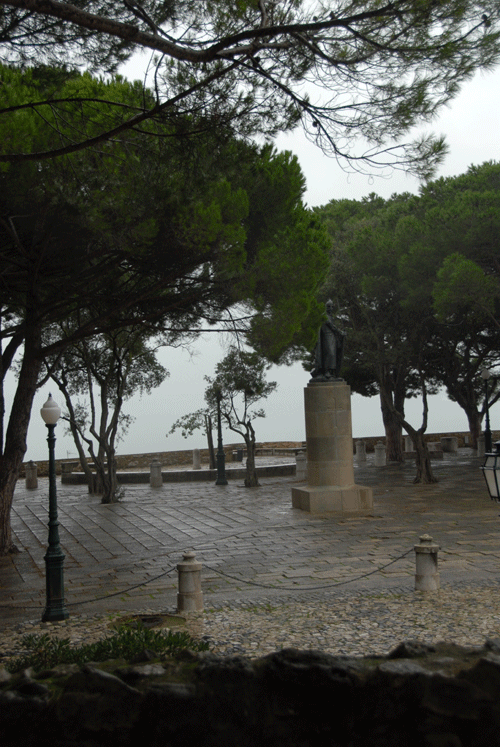
It had started to drizzle sometime back. We returned to the courtyard and the Observatory Terrace nearer to Porta de São Jorge, the front entrance (Saida). I turn around and look at the statue of Dom Afonso Henriques raised on stone, his hand holding the raised sword, standing so tall and proud. I can notice a faint smile playing on the lips of this valiant champion who became wiser by adversity and created a nation. At that moment, a quote from a poem (Before the Battle) by Irish poet Thomas Moore crossed my mind:


“But oh, how blest that hero’s sleep

O’er whom a wondering world shall weep!”

 The dusk is already starting to wear on. Looking out from the Observatory Terrace, we could see the Igreja and Monasterio de Sao Vicente de Fora to our left. Dedicated to São Vicente de Saragoça, the patron saint of Lisbon, it is built on the place where the German and Flemish crusaders camped to help Dom Afonso to capture Lisbon from the Moors in 1147. We will go there tomorrow.

As we walked out through the main gates into Rua do Caho da Feira, we could see a woman with a colourful silk scarf tied around her head sitting on the wooden garden bench under the shade of a tree. She was singing to the strums of a man playing a Portuguese twelve-stringed guitar. Another woman sat next to the man enjoying coffee and cakes with a certain passion. Beside her was an open leather bag stuffed with strings of spicy sausages and garlands of dried red chillies.
 

Every country has their culture – aspects that offer breathtaking insight into life, love, and literature. It is for us to make an effort to understand them and learn from them. No three guesses. You couldn’t miss the tones of her singing: Fado. Born of the troubadour ballads, it is Portugal’s bittersweet, disconsolate answer to the Blues, Tango and Flamenco. The fadisto appeared rather blasé about it, her melancholic tones meandering through soulful archaic phrases of lost loves and past glories.

Moments later, I learned that the song she manages to imbue with such a strong fado sensibility is “Ha festa na Mouraria” (There’s a festival in Mouraria). It is the one song most commonly associated with fado and immortalized by the legendary Fado singer Amália Rodrigues who helped to transform Fado into the style we know today. What a rightful song to hear at that moment about the rustic bairro overlooked by the Castelo de São Jorge where a procession was winding through its narrow streets.

As I tipped her, the man who played the guitar translated for me her comments in good English, “Señora Annalisa is the daughter of a nationalist and a beautiful gypsy woman. They were blessed with blue skies, green gardens and horses. Then he disappeared suddenly in 1967. Having led a hard life, her health is not good now. She has the spirit of Amália Rodrigues in her. She loves singing and has learned to live well for less. It’s God who let her embrace fado… when she sing fado, she is free of all pain.”
 

Why does a most enigmatic and indefinable of all forms of art called music cast a powerful effect on our minds and bodies? Is it that our feelings and emotions gain a structure and coherence from the configuration of music? Suddenly, another thought waltzed into my mind. Live Well for Less! Wait a minute – I have heard that slogan “Live Well for Less” somewhere before. It was while getting into the taxi when it suddenly dawned on me. Yes, that’s one of the slogans of the British retailers Sainsbury’s. Great! Until next time. Caio, Jo


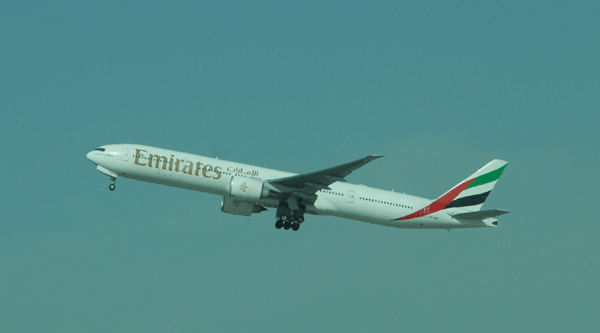
PS: Emirates Airlines operates direct flights to Lisbon from Dubai with suitable connections from Cochin.

(All Photos (including S George veccide il drago by Paris Bordon – from a reproduction in our house): © Joseph Sebastine-Carina Sebastine/Manningtree Archive).

(The three paintings: “Vasco da Gama Leaving Portugal” by John Henry Amshewit, “The Siege of Lisbon by D. Afonso Henriques” by Joaquim Rodrigues Braga and “Conquest of Lisbon” by Alfredo Roque Gameiro, are from Wikipedia: Public domain)
Lovely Blogger Award!

I have been nominated for the One Lovely Blog award by thehesoproject.wordpress.com – a beautiful blog where you can discover the world as seen by a keen eye and written them out with the inner beauty, wisdom and knowledge of a creative writer. Check it out!

The rules for this award are:

1. Thank and link back to the person that nominated you… thanks again to

thehesoproject.wordpress.com

2   Post the award picture in your post.

3.  Tell 7 things about yourself (I have taken the liberty to mention 10):

  • My passion is knowledge – reading, writing, music, movies and every day life assist me in the pursuit of knowledge.
  • I am self-conscious and hopelessly romantic.
  • I dislike when they call this State “God’s Country”, a phrase which I consider is disrespect to God.
  • I would love to have a dog – but couldn’t due to reasons stated in my blog of Oct 5: “Travel All-Inclusive: Tails of Affection”.
  • I adore the genius of Michelangelo.
  • I would like to travel more. It’s important to me.
  • Is it possible for me to own a home in London or Madrid? I would love that.
  • I think about my mistakes.
  • I still believe anything is possible if you believe in yourself.
  • The goodness of a person spreads in all direction. I would like to be kind whenever possible because it is always possible if you try.

4.  Nominate 10 other bloggers and notify them of the nomination. (You are supposed to nominate 15 bloggers. But I have limited this to 9 since I have not read that many blogs yet)

Here is my diverse list of nominations.  All are great sites and are worth a visit so check them out.

http://weinstein365.wordpress.com

http://elizabethre.wordpress.com/

http://thewhyaboutthis.com/

http://anyone4curryandotherthings.com/

http://faestwistandtango.wordpress.com/

http://lizziejoysphotosuite.com/

http://briefhiatus.wordpress.com/

http://furrylittlegnome.wordpress.com/

http://abcofspiritalk.wordpress.com/

Scoppio del Carro, Florence, Italy

For many years the enchanting land of Italy played host to us during our yearly visits. Such frequency is ample proof how irresistible the charm of “Bel paese” is to us. Italy perfectly fitted our idea of a beautiful panoramic tapestry running its length and width – endowed with all manners of fine features: nature, history, religion, tradition, arts, architecture, cultural heritage, romance, wine, cuisine and enthusiastic people. Giuseppe Verdi rightly praised it when he said: “You may have the universe if I may have Italy.”

But at these times, the mood is sombre. Italy is in the news for the wrong reasons – just as in the case of numerous countries. Many of us are on self-quarantine observing sanitised lifestyles, keeping social distancing day-to-day as precaution against a deadly virus hell-bent on wreaking havoc across the planet. The airports, railway stations, streets, stadiums, theatres, Malls, gridlocked traffic – all remain empty.

But what we see around us is love in action – the proclamation that the truest thing about us by this isolation is not our brokenness, but our belovedness. Our adherence to self-quarantine is the most remarkable act of human solidarity to conquer this daunting virus and it inspires me to remain confident of our people’s ability to rise to any challenge.

During this Eastertide when there is time for quiet reflection, I focus on our past visits abroad, especially to Italy when we had the pleasure to witness Scoppio del Carro at Florence during Pasqua 2012. The relevant post is reblogged below. Jo


Easter Sunday in Florence. The sky was overcast with dark clouds, as we walked up Via dei Servi, bound southwest towards Piazza del Duomo. Of all the beautiful names this city is called, especially Firenze as we call it with our Italian friends, there are also those who lovingly use its most beautiful form, Fiorenza, for it is still considered the flower of all Italian graces. As regards this write up, I would rather refer to it in its simplest form: Florence.

Only few meters ahead, beyond the curve of the street, stood the magnificent cathedral of Santa Maria della Fiore (Il Duomo) crowned with Filippo Brunelleschi’s soaring octagonal dome resting on a drum. It had rained during the early hours when we returned to our rented apartment in Via degli Alfani following the midnight Mass at this cathedral – something we had missed during the last couple of years due to unavoidable reasons. Indeed, as the Florentines say, an Easter Mass at Santa Maria della Fiore (Our Lady of The Flowers) is something not to be missed.

Nestled in the Apennines, in the center of the fertile region of Tuscany rests the noble city of le bella Firenze in a blaze of beauty. Lauded as the jewel of the Italian Renaissance, Florence, situated in a plain surrounded by hills and mountains, is adorned with piazzas, monuments, galleries, frescoes, priceless collection of art and literature, and enogastronomic tradition of Tuscany pioneered by the Etruscans.

Climb up to the northern hilltop retreat of Fiesole or to the Boboli Gardens (Giardini di Boboli) or Piazzale Michelangelo, one’s eyes can feast on the splendor of Florence – its monuments of history stretching before us with an airiness of ease and rightness: a jumble of red-tiled roofs and domes, Il Duomo and its magnificent Dome, the Basilica di San Lorenzo, the Basilica di Santa Maria Novella, the Basilica di Santa Croce, the square tower of Bargello, Palazzo Vecchio with its belfry,…… Pure architecture! And down there you can see River Arno, streaming peacefully between high embankments segmented by the bridges, of which, Ponte Vecchio, built by Giotto’s pupil Taddeo Gaddi in 1345, stands out conspicuously with its cluttered squares of goldsmiths’ shops.

When the tourist season starts, Florence, a prime holiday destination, becomes one big happy family. Despite their loss of privacy and quietness, the locals know, with a fairly good grace, that a tourist cannot help being a tourist – they have to see things, understand things, take photographs, enjoy the culture, the cuisine…..

Memories could get jammed with impressions from constant travel to various places – but Florence, like Rome, and Madrid, is unique for us. It has an energy peculiar to it. Each year we schedule to be in Florence for a certain period of time, to live amidst the Florentines, to enjoy the pleasures of art, the nature, the tranquility, and the marvelous food which reflects all the warmth, vitality and charm of Italy. We did the sights, walked everywhere – without the help of a cursory glance on the city map – and liked the idea that we are walking the very same ground as the various Medici, Giotto, Verrocchio, Donatello, da Vinci, Botticelli, Machiavelli, Galileo, …….. the one and only Michelangelo Buonarroti.


The beautiful Square where Il Duomo is situated, is divided into Piazza del Duomo (named after the cathedral) and Piazza San Giovanni (named after the Baptistery). Collectively called Piazza del Duomo, this area represents the religious center of Florence.  The Duomo’s construction had begun on September 8, 1296 based on a design by Arnolfo di Cambio. That day marked the Feast of the Nativity of the Blessed Virgin Mary. Andrea del Verrocchio completed the lantern in 1468 by topping it’s summit with “Palla del Verrocchio,” his modified design keeping line with the original plan of Brunelleschi – a man of extraordinary genius who made the octagonal Cupola (Il Cupolone) possible for the Florentines. Covered with pale grey, green and rose marble, Il Duomo is an imposing edifice, flanked by the tall Campanile with multi-coloured marbles which was designed by Giotto and completed by Taddeo Gaddi. It stands on the spot where the Church of Santa Reparata once stood about 1,7m below the present ground level.

As we walked across the harsh stones past Astor Café, we could hear the roar of the excited crowd assembled before the cathedral and near the Baptistery of San Giovanni (Battistero di San Giovanni), one of the oldest buildings in the city (which Dante once calledMy handsome San Giovanni”). Dedicated to the patron saint of Florence, the Baptistery is championed as a Roman temple to honour Mars in order to establish a line of continuity between Rome and Florence. How truly Dante wrote in Il Convivio: “Rome’s most beautiful and celebrated daughter, Florence.”

The colourful crowd gathered here from four quarters of the world was impatiently waiting for the procession to arrive and kick start the events leading to the “Scoppio del carro” (The Explosion of the Cart). As part of this event, a firework laden cart is brought before the cathedral in a colourful procession and it’s fireworks are set off following a religious ceremony. Of the many times we were in Florence, we had always missed this Florentine tradition held on every Easter Sunday.

The tradition of the Scoppio del Carro goes back to the period of the First Crusade (1096-1099) when its armies laid the long siege on the city of Jerusalem. These armies had initially encamped before the secured walls of the Holy City on June 7, 1099. As regards the heavily fortified walls, it was then found that only the south-west where the wall cuts across Mount Sion and along the length of the northern wall offered favourable positions to mount an attack against the defense of the Fatimid governor, Iftikhar ad-Dawla. Owing to the fierce defense put up by Iftikhar, the initial attempt resulted in failure.

The crusaders had to undertake massive preparations and gather necessary resources, built great wooden siege towers, before they were ready to launch the main attack on the night of July 13-14. All the same, it would be by midday of July 15, 1099 (Friday 22 sha’ban 492) when the wooden siege tower of the army, led by Frankish knight Godfrey of Bouillon (c. 1060-1100), Duke of Lower Lorraine and his brother Eustace, Count of Boulogne, was ideally positioned and the soldiers were able to climb onto the north wall (close to the present Gate of Flowers, Sha’ar Haprahim) and subsequently into the city, thus establishing the legend of Godfrey. Considered remarkably valiant in nature, Godfrey is acclaimed as one of the nine  exemplary heroes and role-models in the poem of the Middle Ages, Les neuf preux or The Nine Worthies (the others being Hector, Alexander, Julius Caesar, Joshua, King David, Judas Maccabeus, King Arthur, Charlemagne)

According to the Florentine tradition, soldier Pazzino of the Pazzi family (a prestigious family of influential Florentine bankers), was said to be the first among the soldiers to scale the walls of Jerusalem and raise the flag on July 15, 1099. For his bravery, Godfrey awarded Pazzino with three pieces of flint from the Tomb of Jesus Christ at the Holy Sepulchre.

Those three shards of flint were brought to Florence on July 16, 1101 by Pazzino himself. It was an occasion for great celebrations. When the Florentines started to venerate the flints, it affirmed great symbolic value to the city. The grateful public elevated Pazzino to an honoured place in the history of Florence. The flints were kept in safe custody by the Pazzi family in their Palazzo dei Pazzi and used by them to light the sacred fire (fuoco novella) during the advent of Easter. The sacred stones were handed over to the Church of Santa Maria Sopra Porta (Chiesa di Santa Maria Sopra a Porta later renamed as Chiesa di San Biagio) in 1785 but during May of the same year, it was shifted to the Church of Holy Apostles (Chiesa di Santi Apostoli) where it is presently kept at the bottom of the left nave in a tabernacle designed by Giovanni della Robbia.

The tradition associated with these three flints might have originated from a ceremony held by the Crusaders on the day of Holy Saturday at the Church of Resurrection (Chiesa della Resurrezione), following the liberation of Jerusalem, when they lit the holy fire as a symbol of purification.

In view of that, “holy fire” is lit from the sparks of these flints in Florence during Easter and these small torches (fecellina) were carried through the city of Florence by young men in procession and brought to the front of the Duomo. The event’s organisation and cost remained the responsibility of the Pazzi family until they fell into disgrace for hatching up conspiracy (1478-79) against the Medici in which Cosimo de’ Medici’s grandson, Lorenzo de’ Medici was wounded, but escaped into the safety of the Sacristy while his younger brother Giuliano de Medici was killed. This failed conspiracy by the Pazzi family was connived when Florence was not only at the height of its Renaissance glories but also a seed-bed for conspirators and of fierce feuding.

Scoppio del Carro, once known as “Carro de Pazzi,” was first recorded by Florentine banker/chronicler Giovanni Villani (died 1348) in the New Chronicles (Nuova Cronica) about the history of Florence. Through the course of years, the modus operandi of Scoppio del Carro had changed and it was during the reign of Pope Leon X (1513-1521), that an artificial dove with an olive branch in his beak became part of it to symbolize peace and understanding as a preamble to the procession which culminated in the burning of the cart. In previous times, Scoppio del Carro used to be held during the Midnight Mass on Holy Saturday. That was changed to noon on Easter Sunday for the benefit of the tourists.

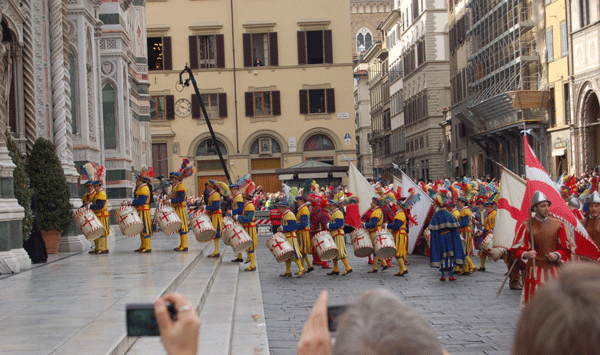
I could see many more people coming in droves to join the crowd already in the Piazza. After we had settled in the best vantage point available amongst the mass of crowd, it wasn’t long before the colourful procession lined up with the members of Bandierai degli Uffizi (official and historical flagwavers of Florence) waving bright coloured flags, musicians dressed in medieval costume and feathered caps, Entered the Piazza del Duomo from Via Roma. Behind them came civic authorities and descendants of distinguished families led by the Banner of the City of Florence.

To us, this procession looked somewhat similar to the traditional parade held as part of the annual celebration of La Festa di San Giovanni on June 24. Having started from Piazzale del Prato, the procession had moved through various pre-assigned points, meeting up with additional reinforcements on the way. A Finnish tourist with a glittering row of jewelry on his left ear told me that he had earlier witnessed a display of flag-bearers and musicians at Piazza della Repubblica also.


In a little while, Florentines dressed in red and white striped medieval costumes as soldiers lined up before the cathedral, with a formation of the musicians in red and white costumes to their right side. Another formation of musicians who were positioned near the Campanile cut a dash in yellow and blue costumes. The Piazza resonated with the sound of the drums and shouts of men and women in the procession in unison with the delightful crowd.

Once the members of Bandierai degli Uffizi converged on the area between the façade of the cathedral and the Baptistery, sporting a world of energy, they performed a display of “flag waving and throwing” to the rhythm of drums – rather reminiscent of a similar event we had seen at the Palio games held in Siena.


Following this, the 30-foot tall wooden chariot affectionately called il Brindellone (the present cart with wagging pennants was built by the Pazzi family in 1765) by the Florentines was hauled by four decorated oxen with gold-painted horns and hooves was positioned right before the main door of the cathedral.


The oxen were soon taken away and a wire was connected to il Brindellone which extended to the high altar inside the cathedral where a mechanical dove (Columbina) symbolizing the Holy Spirit is fitted on the wire by a team of pyrotechnicians. Before long, il Brindellone, already fitted with firing units, was ready for the final event. The crowd had grown still and silent when the distribution of the holy fire struck from the Jerusalem flints took place before the cathedral.

Once this ceremony is done, the clergy moved into the cathedral for the main ceremony. When the Gloria in Excelsis Deo was sung, the Metropolitan Archbishop of Florence lit a trigger that lit the fuse of the mechanical dove.


Promptly, Il Columbina rushed from the altar through the wire, went hissing past the great doors of the cathedral and hit il Brindellone, igniting the fuse of the explosive pyrotechnic device set inside it. Having accomplished this prearranged mission, the dove returned back to where it originated from. The seven bells of Giotto’s freestanding Campanile persistently rang forth happily, presenting us with their open mouths, swinging backwards and forwards, sounding how happy they were on this celebrated occasion. The successful return of the dove back to the altar without a hitch theoretically assured a boom-time harvest and prosperity for the city of Florence. It was strongly suggested that the dove failed in its mission in 1966 and Florence suffered from a flood on November 4 of that year.

Boom, boom! The Piazza reverberated with the deafening sound of the bursting fireworks and explosions. The next minutes were a bit of a blur. Il Brindellone disappeared from my view in a cloud of smoke and technicolour sparks, and almost immediately, the smell of gunpowder filled the air. Sometime ago, the heavens had opened and it had started to rain. Save for the protection from rain offered by few umbrellas which instantly went up, no one moved away from that packed crowd although some of those on the back pavement took refuge inside Café Monarico facing the Piazza.

The fire-show from the cart lasted for about twenty minutes, jetting fireworks into the sky in rapid succession, higher than the 84.7m high Campanile, creating a continuous flicker of radiating gold stars and raining down streams of sparks onto the Piazza, symbolically distributing the holy fire on the entire city of Florence. When the explosions finally died out and the silvery whiteness and smoke cleared, the rain had ceased. The grey sky had taken on a more cheerful countenance, as though the sun might step forward at any moment.

Yet another Scoppio del Carro has been concluded perfectly, bringing a cheerful finish to the year’s Lent. The crowd separated, scattered, having enjoyed the high moments of the sights and sound of the procession and the precision fireworks.

Food is an integral part of the celebrations. We could see lunch crowds starting to file into restaurants. By now we were footsore, and hungry. It is time to meet up with our reservation for the Easter Sunday lunch at Trattoria 4Leoni (The Four Lions) at Piazza della Passera – renowned for tasty, well-prepared food and excellent service. This is one of the restaurants we patronized with a certain pleasure. The last time we had been there, we had Bistecca alla Fiorentina, the Florentine specialty from Tuscan Chianina cattle and specially cut in a masterful way only Tuscan butchers seem to have perfected.

To celebrate Pasquetta, we had lamb, the symbol of Easter, for main course: Cosciotto d’agnello alle erbe aromatiche (Roast leg of lamb with aromatic herbs). It tasted delicious – the herbs tend to mellow and blend with the stronger taste of the lamb, and went well with a bottle of Terre di Franciacorta Rosso, the dry deep ruby red. Not a bad choice. Later that evening, we had a quite dinner and tipple few glasses at Il Porcospino, our usual trattoria, which Carina called Jo’s Place, near Cappelle Medice attached to Basilica di San Lorenzo.

The following day, we caught the train from Firenze Santa Maria Novella Station and whistled our way to Roma Termini, pleased that our Easter meal was a perfect ending to yet another delightful stay in the unique and ancient city of Florence. Till next time. Ciao, Jo.


(This article is dedicated to the memory of Lorenzo de’ Medici, Il Magnifico, who passed away in Florence on April 08, 1492)

(Photos: © JS-Carina-Bianca-Andrea/Manningtree Archive)

StarChoice 13: SADDLE THE WIND

 (Aka:“Lo sperone insanguinato”, “Más rápido que el viento”, “Libre comme le vent”, “Vom Teufel gerittenColour – 1958)

Freddie Mercury, the lead lyricist and vocalist of Queen once said, “When I’m dead, I want to be remembered as a musician of some worth and substance.” Today, October 18, I remember Hollywood actress Julie London, who took to heavenly abode in 2000 and rests in peace at Forest Lawn, Hollywood Hills, Los Angeles, California, I think of her not only as a beautiful actress but also as the girl with the “come hither” voice who was voted one of the top female vocalists of Billboards in 1955, 1956, and 1957.

Born on Sept 26, 1926 in Santa Clara, California, the gorgeous Julie (aka. Julie Peck) with flaxen hair and eyes as blue as the South Sea Lagoons, was discovered by talent agent Sue Carol, wife of actor Alan Ladd. She made her first appearance in Nabonga (1944) and would go on to capture the attention of movie audiences over a career spanning about 35 years – starring in movies and TV series such as “The Return of the Frontierman”, “Voice in the Mirror”, “Man of the West”, “Emergency!” . Always radiating charm and friendliness, Julie was once married to TV executive Jack (Dragnet) Webb and later to composer/Jazz musician/actor Bobby Troup. She had led an unscandalous life raising five children (Stacy, Lisa, Kelly, Jody and Reese) from both marriages.

When we think of great ballads and love songs by some of the finest singers of the 50s and 60s, the “Liberty Girl” Julie, with her husky, intimate and sexy voice, stands up to the likes of Dean Martin, Frank Sinatra, Peggy Lee, June Christy, etc, with songs such as “Cry Me A River”, “In The Middle of A Kiss”, “I’ll Remember April”, “My Heart Belongs To Daddy”, “Can’t Help Loving That Man”,… all those wonderful songs which came one after the other. Those songs with the musical accompaniment of Barney Kessel (guitar) and Ray Leatherwood (bass) exemplified the intimacy and warmth of Julie’s voice and style, appealing to a legion of music lovers, though she never felt her sensual voice special and always endeavored to demote her talent and professionalism.

Sometimes I’d like to saddle the wind

And ride to where you are.
We may meet in a valley or on a green hill.
Will I be yours? You know I will!…

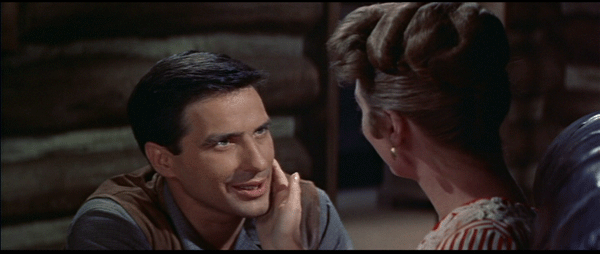
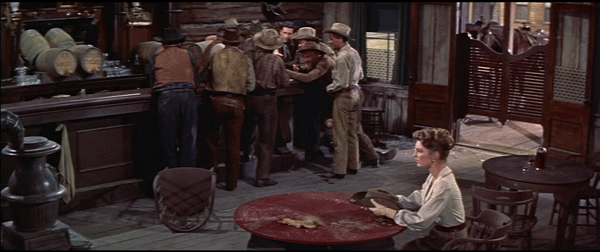
In particular, many would remember the above lyrics (written by Jay Livingston with his chief musical collaborator Ray Evens) as the title song of a western movie called “Saddle the Wind” in which Julie sang to the melody of Elmer Bernstein. She remains uncredited for that song in this  movie in which she had performed as the saloon singer Joan Blake.

A Metro-Goldwyn-Mayer production, directed by Robert Parrish (John Sturges who is said to have directed segments of the film is uncredited), “Saddle the Wind” is a western melodrama based on a screen story written by Thomas Thompson and adapted by Rod Serling (Novelist and Academy Award Screenwriter Daniel Fuchs’ (“Love Me or Leave Me”) contribution is uncredited).


Synopsis: A lush, picturesque western valley in the Colorado rockies (presented by cinematographer George J. Folsey in CinemaScope and Metrocolor) was shared by the Sinclairs of Double S Ranch and another cattle ranch owner Dennis Deneen, the undisputed law in that valley. Healthy and handsome Steve Sinclair is a man of rectitude and stability. Having retired from the life of a ruthless gunslinger, he had returned to the valley to settle down and lead a peaceful life on his ranch. Steve’s younger brother Tony, a charming but restless hot-blood, believed he’s the fastest draw in the town which inevitably sets off a series of tensions for Steve. Hopeful that he could lift his kid brother above the low height of the waist holster of his gun, Steve had tried to “bend that kid”. But despite his efforts to make the young extrovert, Tony was not cut that way – and would not accept anyone’s definition of his life. He would rather define his life himself.


One marked thing in Tony was that he adored his elder brother Steve, whom he considered numero uno. Steve has been his father and mother since the age of four. But that doesn’t mean Tony would be a kid brother much longer, rather a full-partner with a thirst for gun play – to make a name for himself. Things get trigger-happy complicated when gunfighter Larry Venables comes to the quiet community of ranchers seeking Steve, who is accused as the killer of Larry’s brother. Although Tony knew about Steve’s gunslinger days, he doesn’t believe that Steve is still a faster draw in protecting himself. As for Tony himself, he is of age and no one will bully him into silence.


On the home front a problem had started to brew when Tony returned after selling their herd at the market in Jewelton – with beautiful Joan whom he wished to marry. He had also brought a six-shooter which Steve didn’t approve of. It would soon dawn on Joan that Tony is not the kind of man she hoped to marry and start a new life with. Further problem presented itself when Yankee squatters Clay Ellison and family popped up in the valley, and asserted their right on a strip of land, pitting Tony against them to tragic consequences.

Keeping the film in the traditional pitch of the genre, director Robert Parrish obviously elected to illustrate the psychological aspects of the characters through visual communication, though Rod Serling’s colourful and exciting script revolves around a good measure of derisive and thoughtful dialogue. With seldom a dull moment to blur the sparkle, Parrish’s conscientious direction also brings out moments of inspiration by his ease and panache in handling both action and characterization ably assisted by assistant directors, Robert (Bob) Saunders & Mickey McCardle (uncredited).

Parrish (Bob Parris) who had won an Academy Award for film editing for Robert Rossen’s “Body and Soul” (1947), was known as a “nice gentleman” and never rose to the “front ranks” in Hollywood. A lover of big Macaws he kept with his wife Kathie, Parrish had directed “Fire Down Below” (1957) starring Rita Hayworth and Robert Mitchum, and went on to direct another western titled “The Wonderful Country” (1959) pairing Julie London with Robert Mitchum. In between those movies, he directed “Saddle the Wind” with the “good two shoes”: Robert Taylor and young dynamic John Cassavetes.

The performance of Robert Taylor gives the essential ruggedness to the role of Steve who, despite intense provocation, refused to revert to his past life of violence. The reason Robert Taylor came into “Saddle the Wind” has something to do with the state of M-G-M at that time. Trouble had started for M-G-M with the enactment of the government antitrust law allowing the cinemas to show any film they liked, unlike the earlier law which allowed them to show only material produced by their sponsoring studio. This change also altered the way films were produced, distributed and exhibited. As the studio system failed and the number of audience decreased, Hollywood’s output naturally dwindled. Meanwhile a change took place in the preference of the audience as the popularity of television captured them through cheaper imitations. The studio’s attempt to recover their position with smart moves such as releasing movies to television companies, or making sci-fi movies to cater to the increased number of teenage audience, did not bring a satisfactory profit. As a result, the studio was heading towards their first ever loss they will suffer in 1957, the year Louis B. Mayer, the legendary force behind M-G-M, died.

Determined as ever to get back into the top position and save themselves from the path towards the loss, they wisely turned to their brightest stars – the creations of the star-makers of M-G-M who exalted in their motto “….more stars than there are in heaven” (MGM publicity slogan coined by Howard Dietz). Like all major Hollywood studios, M-G-M was juggling around their contract performers, directors, writers and other technicians in different productions. They decided to use their leading stars more effectively to pull in the crowds.

By the early 1956, there were only few stars on long-term contracts with M-G-M: Robert Taylor, Leslie Caron, Elizabeth Taylor, Ava Gardner, Grace Kelly, Debbie Reynolds and Cyd Charisse of which Grace Patricia Kelly was getting ready to quit to prepare for her marriage to Prince Rainier III of Monaco, an event that would be called “the Wedding of the Century”. It was at this juncture that M-G-M decided to cast Robert Taylor, the most romantic reigning star of Metro whom Louis B. Mayer once told “the son I had always wanted”, as the leading man in “Saddle the Wind”, a decision that would prove right as the movie would become a box-office sensation. Ever subservient to Mayer who guided him for 17 years, Taylor never refused to star in a picture his father figure Mayer personally asked him to do.

Robert Taylor (1911-1969) (aka. Spangler Arlington Brugh) was a “punk kid” (according to Taylor himself) from Filley, Nebraska. When he joined with M-G-M and signed for a seven-year contract, he was the lowest-paid actor in the history of Hollywood with $35/- a week. Though he had acted in some memorable roles, it is “Magnificent Obsession” that would make him a prolific leading man. As he had turned to middle-age, Taylor’s boyish looks had turned sulkily handsome, sending aching shivers through the hearts of female viewers while his gay audience found his pretty boy looks fascinating.

Married to actress Barbara Stanwyck and later to Hamburg born German actress Ursula Theiss, he went through a string of romantic liaisons including actress Eleanor Parker but not as notorious as Frank Sinatra about whom his contemporary Dean Martin once remarked: “When Sinatra dies, they’re giving his zipper to the Smithsonian*.

In an era where all leading stars like Cary Grant, Tyrone Power and Robert Taylor had black hair, shining with brilliantine, many believed that it would be the durable and hardworking Taylor who would shoulder the mantle of Valentino but that honour would fall on Tyrone Power who would have a more meteoric streak of success than Taylor.

No sooner than Taylor finished Richard Thorpe’s “Tip on a Dead Jockey”, he (together with his wife Ursula Theiss) went to film location at Rosita (little rose in Spanish), a silver mining town founded in late 1872 (now a ghost town) in Custer County in Colorado, where “Saddle the Wind” will be shot through July 1957.


Julie London, looking younger than springtime, had arrived at the Colorado location with her daughter Stacy and fiancée Bobby Troup while the media was abuzz with speculation over the question if Julie really will be Troup’s altar candidate.


New York based method actor John Cassavetes (1929-89) who later became an experienced director, looks a bit odd in the western settings. Given that Taylor’s and Cassavetes’ acting styles provide an interesting contrast to the film, Cassavetes bequeath a human touch to the interesting role of Tony Sinclair who, despite his reckless ways, is still cared for by Steve.


British screen actor Donald Crisp (1880-1974) who performed in the role of Dennis Deneen, the undisputed law in the valley, had been working in Hollywood since 1906 with D.W. Griffith and had directed some silent movies, before he decided to become an actor in 1930.

RKO stock player “hellraiser” Charles McGraw, as Larry Venables, is aptly menacing as the gunslinger out to kill Steve but meets his fate from the bullet from Tony’s gun. Other supporting actors with familiar faces are:  Royal Dano, Richard Erdman, Douglas Spencer, Ray Teal, etc. All of the cast in the main roles, including those in main supporting roles, have provided commendable performances.

The film is produced by Armand Deutsch and the crew included: Film Editing: John McSweeney Jr.; Art Direction: William A. Horning & Malcolm Brown; Set Decoration: Henry Grace & Otto Siegal; Makeup: William Tuttle; Hair stylist: Sydney Guilaroff; Costumes: Helen Rose (for Julie London) and Stunts: Henry Wills & Jack N. Young.

The score for “Saddle the Wind” was originally provided by M-G-M’s staff composer/arranger Jeff Alexander (Jailhouse Rock). This score was not used when M-G-M subsequently subjected the movie to a number of post-production pickup shots and recuts. As a result, Elmer Bernstein’s (1922-2004) superior score was used for the movie. Bernstein had experimented in several genres such as: jazz (The Man with a Golden Arm), comedies (Airplane!), epics (The Ten Commandments), action (The Great Escape) and westerns, of which his score for “The Magnificent Seven” in 1960 would earn him his first “Western Heritage Award”. He would also receive several Academy Award Nominations for Best Original Score during his life time.


Even though the final climax set in the high country could have been improved, all the same, “Saddle the Wind” is an intelligent, well-written and well-acted movie that will keep your ears chasing the dialogue and keep you fervently involved in the colourfully portrayed story content. It is one of the worthwhile western entries of the 50s. Undeniably, this fatalistic oater is very much a picture of Robert Taylor and John Cassevetes since Julie London’s part, being auxiliary, is underdeveloped. Nevertheless, it offers a good opportunity to reminisce Julie in her youthful beauty and husky voice when she render that song two times in different styles.

Dearest one,my place in the sun
Is by your side, I know;
So if I could I’d saddle the wind.
Some starry night I’ll saddle the wind,
And straight to your arms I’ll go!…


There is something in that voice so sweet, the words so tender that it clings to us long after the DVD (available now with major dealers) is removed from the player….. like a memory of past happiness. Ciao, Jo


(*Read: ”The Fieldson Guide to American History for Cynical Beginners: Impractical Lessons for Everyday Life” by Jim Cullen – Page: 132)


(Text: © JS/Manningtree Archive)

StarChoice 12: The Wrath of God

(Aka: La ira de DiosZum Teufel mit Hosianna – La collera di Dio – La colère de DieuColour – 1972)

A woman’s dress should be like a barbed wire fence: serving its purpose without obstructing the view”. That is a quote attributed to Italian actress Sophia Loren. Anyhow, that citation does not categorically affect the Hollywood sex symbols of the Forties: Hedy Lamarr, Lana Turner, Betty Grable, Jane Russell, Gloria Grahame, Ava Gardner and Rita Hayworth. These exotic women were personification of beauty of that era and did not need nudity to further their glamour. However, by the mid-Fifties, theywere challenged by tough competition from another set of actresses who, though active and having a mind of their own, flaunted the “lady” look – a combination of beauty with breeding, elegance and a tinge of Hauteur. It was a challenge Hayworth took head on.

Rita Hayworth (born Margarita Carmen Cansino) was groomed by her first husband Edward C. Judson (1937-42). He willfully made her lose weight, change the colour of hair and presented her to Harry Cohn, the head of Columbia Studios. I have read in the autobiography of Debbie Reynolds, about how Cohn told aspiring actress Joan Perry who was signed to Columbia during the same time as Hayworth, that he is going to make Joan his wife and Hayworth a star.  Once a replacement for actress Dolores Del Rio, and often cast in tempestuous roles, Cohn’s intense promotions would broaden Hayworth’s horizon and uplift her to superstardom earning her the sensual label: Love Goddess.

Remember, remember, Rita Hayworth “hot babying” in Charles Vidor’s film noir “Gilda” (1946), while singing the sizzling “Put the Blame On Mame”(originally sung by Anita Ellis)? After her enormous success in the role of the ultimate femme fatale, she had commented “Every man I knew had fallen in love with Gilda and wakened with me”. From the popularity of “The Lady from Shanghai” (1947) made by her then husband Orson Welles (1943-48), she would be eventually idolized as Hollywood’s first Royal Princess when she married Prince Aly Khan (1949-53). She was simple, unsophisticated, coupled with an intense desire to please others. Then again, she would become notorious for her romantic relationships with the likes of Victor Mature, Gary Merrill, Anthony Quinn, David Niven, Howard Hughes, Porfirio Rubirosa…. Before long her life was riddled with personal problems, encouraging her to hit the bottle and propelled her sliding down the slippery path into the gray twilight of downfall. This was further instigated by Alzheimer’s disease, symptoms of which had surfaced in early 1970 but was not diagnosed until 1980.


Hayworth had finished acting in director William Grefe’s “The Naked Zoo” (1971) when her friend actor Robert Mitchum, with whom she had co-starred in “Fire Down Below” (1957), well aware of the pathetic condition of a star that once immortalized beauty and sensuality, suggested that Hayworth be cast in “The Wrath of God”. Though Mitchum was not aware of her undiagnosed sickness, director Ralph Nelson (1916-1987) wouldn’t have minded having the presence of “Rita Hayworth” to top up the appeal of his movie. Seeing that her house behind Beverly Hills hotel was rented out due to financial difficulties, Nelson had to locate her in a low-cost rented Brentwood home where the discussion of the movie script was held with her in the dark of the room. However, none of this would deter him from casting her in the movie.

Ralph (Leo) Nelson (“Requiem for a Heavyweight” (1962), “Lilies of the Field” (1963)) had a history of conceding to special factors for the betterment of his movies. Actress Candice Bergen’s memoirs touch upon an incident related to the pre-production of “Soldier Blue” (1970) directed by Nelson. In order to retain Bergen in the role of the strong-willed, busty and lusty Cresta (according to the script), Nelson had sought the help of make-up men to make flesh-coloured rubber breasts to glue onto Bergen’s bosom so that she could measure up to the physique of busty actresses like Jane Russell and Jayne Mansfield. Fortunately, in the last moment she was saved from frontal nudity due to modifications of the script.

While Nelson set about putting together the cast and crew for his movie, Mexican locations were considered appropriate allowing for the generous budget and the theme of the story that revolved around a Revolution. Mexico was not unfamiliar to Hayworth. At the age of fourteen she had gone there with her family to surmount the liquor law that prevented underage girls like her from employment in American nightclubs. Similarly, Nelson was also familiar with Mexico for having shot location scenes for “Soldier Blue” in which he was also a supporting actor. As for Robert Mitchum, it was not only one of his favourite locations for many films, but also a place where he used to take off with his friends for days of drinks and fun.

Co-produced by Metro-Goldwyn-Mayer with Cineman Films, Ltd and Rainbow Productions, Inc, “The Wrath of God” is based upon the novel by James Graham(pseudonym of prolific British novelist Harry Patterson who also wrote as Jack Higgins and Hugh Marlowe). It was written for the screen by Nelson.

As the story goes: The Mexican Revolution literally came to an end in 1920 when the one-armed revolutionary general Álvaro Obregón Salido was elected the president of Mexico, the first stable presidency since the beginning of the Revolution in 1910. However, Mexico would suffer another decade of violence and the story of “The Wrath of God” is set during November, 1922.

The movie opens in a Mexican town where executions of three counter-revolutionaries by the firing squad were taking place in the courtyard of the military barracks, while the townsfolk joyously celebrated the “Day of the Dead” (Día de los Muertos). Emmet Keogh, an Irish vagabond, impatiently waited before Hotel Casa Grande for the proceedings to finish. As the bodies were being cleared, he rushed over to the ticket counter in the railway station to book a ticket to anywhere there is peace. A toss from his coin settled the destination he would take  – up North!


Moments later, joyous for having obtained the ticket out of this hellhole, Keogh danced merrily down the cobblestoned streets with a fairy-tale charm. Meanwhile, melodious Latin American music played as accompaniment to the credits of the movie that flashed one after the other onscreen. Presently, he stumbled upon soldiers bringing up another three men into the courtyard in preparation for one more execution which has sadly become a regular affair here. He saw a black, dusty Mercedes car with hood down pull up before La Cabaña and a priest in a shovel hat and dirty Cassock step out of it. Inquisitive about other people’s affairs, Keogh went over to check the automobile. He was well pleased to strike up a match and help the priest light his long black cigarillo, an act that would institute an acquaintance between them.

Upon seeing the priest, all at once, one of the condemned men ran over and knelt before him. Keogh watched in amusement when the priest restrained a soldier who tried to interrupt and led the condemned man back to the line up in order to provide absolution to all the three men. Just before Keogh turned to leave, he saw the priest bless the three men after they were shot down.

Back in the patio of Keogh’s hotel, he was invited for drinks by Jennings, a fat jovial businessman who owned the hotel. Jennings was interested to persuade Keogh to wheel a truckload of good Scotch whisky about 100 miles north to Huila since his driver was shot dead that morning. The pay will be 200 dollars which Jennings promptly raised to 250 at the first sign of disinterest from Keogh who considered the job very risky. Given that Keogh appeared a trifle busy in getting out of this bloody country, Jennings dubious mind was already exploring ways to convince Keogh to shed his contagious enthusiasm and happily run his cargo up-country to meet his business obligations. His solution was simple: arrange with his mestizo to steal Keogh’s passport and other valuables while he took his bath. The plan went smoothly until Keogh, lying in the worn out bathtub filled with brownish water✺, caught the mestizo in the act. Stark naked and wet he was, giving chase to the thief, he shot at and wounded his leg though the culprit managed to escape into the crowd outside. It didn’t take long for him to realize that Jenning’s ploy had worked. To Jennings great relief, Keogh grudgingly agreed to transport the consignment for 500 dollars and the return of his valuables. Jennings was sure that they would get along famously.

Later, driving the truck-laden bootleg whisky down the rocky trail, Keogh was surprised to chance upon the priest standing next to his car parked by a rocky patch. Apparently, his car had a flat and hit the rock. Keogh was only happy to fix it for him and shortly they pushed the car off the rock, ready to roll. The priest happily introduced himself as Father Oliver Van Horne of the Boston Diocese, down here on a fund raising trip for the authorities back home. He shared the priest’s whisky and decided to meet up at the way-station in Huerta, some 40 miles away. It was there Keogh was supposed to coordinate with Gomez vis-à-vis the delivery of the cargo, which unbeknown to Keogh, was a consignment of rifles, pistols and grenades intended for the Counter-Revolutionary forces.

The night had worn on when Keogh’s delivery truck pulled into the courtyard of the way-station. He could hear the sound of laughter and someone merrily singing to the strums of guitar…“Humpa, humpa…..”✽Suddenly, he was accosted from the back by a stranger and was taken inside the inn. Luis Delgado, the singer and the leader of the rurales (the country police) assembled there, checked his papers and politely invited the señor for a drink. From Delgado, Keogh learned that Gomez of Huila to whom he is suppose to deliver Jenning’s letter has “committed suicide”, but Colonel Santilla, the leader of the Revolutionary Forces, would be interested in that letter.


All at once, the groups’ attention was diverted by a native Indian girl the rurales had found on the upper floor. Despite objections by Tacho, the frightened old man at the bar who claimed that she is dumb, the fascination for their object of amusement set off a string of merriment and abuse by the rurales led by Delgado which was ineffectually thwarted by the girl until Keogh interfered. But his challenge was short-lived, only long enough for the girl to move over to his side. Once again he was accosted from the back by yet another rurale. Keogh was soon roped and hung up on the wooden beam above. It was then the priest came in with his Gladstone bag, and put up one hell of a defense in a homicidal manner. God works in mysterious ways.


Violence resides every where in the world and arises at unexpected moments. Having decided to leave the place quickly to avoid soldiers who are sure to be informed by the sole survivor of the massacre who had escaped; it was decided to let Chela, the Indian girl, accompany them. She too was on the run and wanted to rejoin with her “aimara” (Aymara: an indigenous ethnic tribe) on the other side of the mountain. Tacho had confided to Keogh that Chela had stopped talking when she was a kid, when she witnessed her parents being killed.


Driving towards Huila up the bad roads running through the rugged range of mountains and waste land, they accidently stumbled upon an encampment of the Federal cavalry who eventually captured them after a breakneck chase. At this point, Van Horne and Keogh were provided with adequate torture by the lieutenant of the federales before, charged with the offense for dealing in arms with counter-revolutionaries, they were imprisoned in Col. Santilla’s prison in the small town of Hulia. In here, they would meet Jennings, already locked up and awaiting the firing squad. But Santilla, the military governor of the region, had other plans.


Given that Col. Santilla intended to prepare them for a mission he had in mind, the following day they were subjected to further humiliation before a mock-up firing squad, only to be saved in “the nick of time” by the Colonel who invited them to enjoy his hospitality. The Colonel’s knowledge about the “unholy trinity” he now held “in the hollow of his hands” was very creditable. Firstly, he knew that the totally corrupt Jennings, formerly Capt. Jennings, was censured by the British army for the misuse of regimental funds. Earlier he had assumed the role of Jameson, an informant for the Black and Tans (Irish: Dúchrónaigh) in Ireland, a paramilitary unit formed to suppress the Irish Republic Army but also attacked the civilian population.

While Emmet Keogh has a price on his head in Ireland for being a member of The Squad (a special intelligence unit created by Irishman Michael Collins, the originator of modern urban terrorism) and performed political assassinations; the good shepherd Padre Oliver Van Horne (a defrocked priest), is more interested in robbing banks, payrolls, rich. Curiously, he carries an automatic machine gun in one compartment of his Gladstone bag while the other section holds a princely treasure of 53,000/- American dollars in assorted currencies. Santilla had selected them for one particular reason: to kill a psychotic named Tomas de la Plata, who had created a reign of terror over Mojada and its inhabitants some 40 miles from his headquarters.

A deeply troubled man with a frenzied state of mind wrought from having to witness the atrocities committed to his family, De la Plata had banned the Catholic religion from his land. Jennings had more than a foggy idea about De la Plata due to business dealings done through agents, and only knew too well that he had been trying to raise money. De la Plata had been venturing to wheedle mining companies in the idea of working the old silver mine outside Mojada on a partnership basis. In consideration of that, Santilla had already written to him, on behalf of Jennings, informing that, being a representative of Herera Mining Company of British Honduras, Jennings would be arriving in Mojada tomorrow with two mining engineers to inspect the drift mine that hasn’t worked for years.

Most importantly, the people of Mojada are in desperate need of a priest since the last one sent by the church was hanged by De la Plata and the one before that was found wandering in the desert, stripped of his clothes, quite out of his mind. Van Horn will take with him the wooden statue of San Rafael de los Mineros, the patron saint of Mojada, which was rescued before De la Plata desecrated the church. Tomas de la Plata is a man who never allowed a challenge to his power to go unpunished, and his death will collapse his empire and free the people from repression. The remuneration for their work, if they survive, would be their lives and equal shares in 53,000 dollars in the priest’s bag.


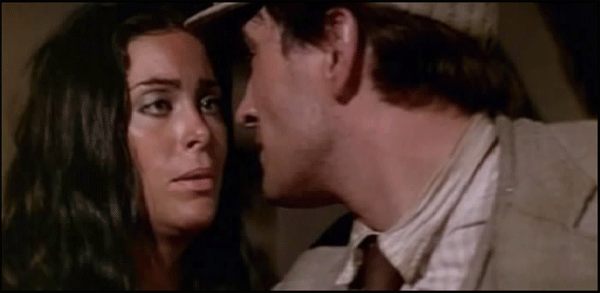
That night, Chela secretly met up with Keogh and placed a silver amulet around his neck, symbolically laying her claim on him as per the custom of her tribe. As Keogh was getting used to their passionate encounters, Chela was concerned of Keogh’s knack of running into trouble. Through her chieftain Nacho, she vainly tried to stop the stony Irishman from going to “a bad end”.

Three lives for one. But survival has become something of a habit for Keogh. He would be part of the unholy trinity going to Mojeda to kill Tomas de la Plata who hates the sight of priests……

Robert Charles Durman Mitchum (1917-1997) had tried his hand as an author, composer and singer before he became the No: 23rd greatest male American screen legends of all time – a position he earned by mainly starring in roles of anti-heroes. Even though Mitch got $150,000/- for his role in Joseph Losey’s “Secret Ceremony” (1968) in which he co-starred with Mia Farrow and the million-dollar star Elizabeth Taylor,  by the late sixties, his heroic style had started to take the plunge even though, now and then, he had portrayed good acting.


Mitch’s Van Horn is assertive, aggressive, yet tender and moral. A role initially offered to Trevor Howard, it is similar to the one Mitch had played as a preacher with a gun hidden in his Bible in the 1968 movie “Five Card Stud”. He not only sports a casual acting style (especially the scenes when he couldn’t resist playing the priest awaiting direct confrontation with De la Plata) and his trademark drooping, bedroom eyes but also carry a machine gun and a switchblade cross, that also contributes to the action scenes.


Rita Hayworth had to struggle in her role of Senora de la Plata, which is a variation from the characters in the novel. At the doorstep of Alzheimer’s disease, her face had turned into that of a matured woman who had gone through many hardships in her life. Supportive to Hayworth, Mitch had considered her casting as an opportunity to renew their friendship. When Hayworth strived to remember her lines, the crew believed her to be in a state of intoxication from alcohol intake, and they were helpful to her, especially hairstylist Lynn Del Kail. But none of that could assuage her memory lapses, or reading from large cue cards, which is common practice in Hollywood. Even experienced actors like Marlon Brando (maybe due to dyslexia) frequently used them, albeit director Bernardo Bertolucci refused to have it written on actress Maria Schneider’s back for Brando to read conveniently during filming of “Last Tango in Paris”.

At this point, with Hayworth frequently caught in the “drift”, nervous and phobic, even refusing to do normal things, eventually, certain scenes had to be either shot from behind her head or with doubles and piece it together effectively by editors J. Terry Williams, Richard Bracken, Albert Wilson. Unfortunately, Hayworth couldn’t help but to turn in a feeble performance that would be an unfortunate finale to a great career in Hollywood. Anyhow, the marigold will lose its yellow, spring will not last forever – that’s life.


American leading man Frank Langella, an experienced stage actor, carries out a commendable performance as Tomas de la Plata, the psychotic who hated priests. He came into feature movies with “Diary of a Mad Housewife” which earned him a nomination for 1970 Golden Globe Award for New Star of the Year (Male). He did two further movies (“The Twelve Chairs” and “The Deadly Trap”) before he was cast in “The Wrath of God”. The Bulky character actor Victor Buono, a good friend of Mitchum, stars as the white suited businessman Jennings.


Scottish born actor Ken Hutchison, a Robert de Niro look-alike, starred as Emmet Keogh, the Irish patriot who is loved by Chela. Keogh’s love for the native Indian girl reflects his inner desire to attain peace with Mother Earth and to mend his aimless life of violence. Wonderful actor that Hutchison was, his career reached nowhere due to his incoherent lifestyle. His reputation suffered when, the previous year, consequent to a heavy drinking bout with him, director Sam Peckinpah was hospitalized while filming the movie “Straw Dogs” (1971).

Sexy Paula Pritchett as Chela, the Indian girl who had not spoken for 20 years, will make you long to kiss the air near her cheeks. Apart from this film, Paula had acted in only two more films: “Chappaqua” (1966) and “Adrift” (1970) though she would be in popular media when her nude pictorials appeared in the July 1972 edition of the Playboy magazine.

Greek-Canadian stage actor John Colicos (1928-2000) as the cultured Col. Santilla displays an aura of importance about him. His performance effectively portray a man vested with immense power but was compelled to begrudge a civilian who inadmissibly brandishes enormous power. Colicos came over to regular movie acting with “Anne of the Thousand Days” (1970) which did not tap his potentiality.  Three of his movies released in 1971, including “Raid on Rommel”, would set the trend for his brief appearance as Col. Santilla.

The film also features a good number of Mexican actors, known to Nelson for their supporting roles in “Soldier Blue”. Associate producer William S. Gilmore. Jr was also the co-producer of “Soldier Blue” and “Flight of the Doves” The film’s cinematography (in Panavision and Metrocolor) is done by Alex Phillips Jr., son of Canadian cinematographer Alex Phillips who went to Mexico to shoot that country’s first sound film after working in Hollywood in the 20s. Phillips. Jr. learned his trade from being an assistant to his father, and would become the official photographer of Adolfo Lopez Mateos, the president of Mexico from 1958 to 1964. While Hollywood occasionally sought his services, Central American locations such as Mexico, Puerto Rico, Dominican Republic were his main field of operation. Being very active in his work, six of his films were released in 1972 itself including Sergio Olhovich’s “Queen Doll” (Muñeca reina) and his friend Sidney Poitier’s directorial début “Buck and the Preacher”. His classic camera work for Sam Peckinpah’s “Bring Me the Head of Alfredo Garcia” (1974) is a noteworthy contribution which elevated that film to a cult classic.

The interiors where shot at Estudios Churubusco Azteca in Mexico City, the venue forsome sequences of movies such as “Kings of the Sun” (1963), “Licence to Kill” (1989), etc. On location shooting was done in different places in Mexico: Cuernavaca, Morelos (“The Magnificent Seven” (1960), “The Butch Cassidy and Sundance Kid” (1969), “Clear and Present Danger” (1994)); Guanajuato (“Guns for San Sebastian” (1968)), Los Órganos and Taxco (Guerrero) and La Luz.

Western location shoots had a men’s club ambiance that offered opportunities to enact childhood games of Cowboys and Indians and their hell-fire tactics. These high-adventure westerns featured hard-drinking macho men with guns holstered at crouch level and the fastest draw always rode off triumphantly with the woman into the sunset. According to a biography of Mitchum, Ralph Nelson ran a loose ship as the production was plagued by trouble. Riddled with many problems, mainly rooted in the indulgence of hard-drinking and drugs, Nelson was in a terrible turmoil. Aside from Rita Hayworth, Victor Buono’s behaviour proved to be anomalous. But none of these were severe enough to grind the production to an indefinite halt caused by a freaky accident suffered by Ken Hutchison about one and half months into filming. His arm was cut open from elbow down to the wrist by some broken glass and he had to be hospitalized for an indefinite period throwing the production schedule into total disarray. The situation also brought in the control of the insurance company and took away the equilibrium of the movie which shows in the final product.

Notwithstanding the above issues, the movie features many exciting action scenes staged by action coordinator Everett Creach together with assistant directors, Mario Cisneros and Jerry Ziesmer. The panoramic scenes shown with sweeping helicopter shots that emphasize the expansive spaces of the Mexican sierra when the cavalry sped in hot pursuit of Van Horn, Keogh and Chela, as well as the final battle scenes are notable. The interiors festooned with local colour, by production designer John S. Poplin, Jr. and Set decorator William Kiernan, look genuine and impressive.

Argentinean composer Lalo Schifrin (“Kelly’s Heroes”, “Dirty Harry”), winner of five Grammys and twenty-two nominations was once the concert-master of the Philharmonic Orchestra of Buenos Aires at the Teatro Colon. Schifrin provides an admirable score evoking melodies of his Latin American background mixed with traditional Hispano-American regional forms and rhythms. It features an instrumental ensemble of quena (a rustic flute), charango (a five-stringed guitar), siku (Bolivian panpipes), piano/organ and a wide variety of regional percussion instruments. The action scenes are augmented with rousing score noteworthy for musical tones that would elevate Schiffrin’s future soundtrack for director Robert Clouse’s “Enter the Dragon” starring Bruce Lee and sexy Ahna Capri.

For the Requiem Mass scene, Schifrin had used excerpts from Ariel Ramirez’s “Misa Criolla”✣ with Liturgical texts adapted in Spanish. “Gloria” is the Argentine variety of the carnaval, which is one of the most widespread dances of the high plains of north-west Argentina, Bolivia, and Peru. “Molly Malone” (aka “Cockles and Mussels”, “In Dublin’s Fair City”), a popular Irish song which has become the unofficial anthem of Dublin City, is presented by Schifrin at the beginning of the movie:

In Dublin’s fair city, Where the girls are so pretty, I first set my eyes on sweet Molly Malone, As she wheeled her wheel-barrow, Through streets broad and narrow…….

Yet another folksong is featured for the rurales leader Luis Delgado at the way-station inn:

“Humpa, humpa… We like to kill each other, We love to hate our mother, But there is still my brother, He always wish to hop on, hop on – humpa, humpa..

My father was a midget, My mother was too tall, As far as I remember,…………humpa, humpa…”

Despite the flaws of the film, “The Wrath of God” is full of memorable moments and simple one-liners. It is all about the restoration of order and faith while focusing on power and powerlessness.

The film was released simultaneously with German director Werner Herzog’s cult film “Aguirre, the Wrath of God” starring Klaus Kinski. Nelson’s film may not be confused with the Italian-Spanish production “Wrath of God” (L’ira di Dio – 1968) by director Alberto Cardone (as Albert Cardiff) starring Montgomery Ford and Fernando Sancho.

(The sleeve of our copy of the novel “The Wrath of God” shown here is a Grafton 1972 edition)

(Ariel Ramirez’s “Misa Criolla” in our possession is a version by Spanish Catalan tenor José Carreras recorded in the Santuario de la Bien Aparecida, Cantabria, Spain in July 1987.The CD sleeve is shown above)

(This review is dedicated to director Quentin Tarantino for his relentless efforts to promote the movies of the past.)

(Text: © JS/Manningtree Archive)

Travel All-Inclusive: Tails of Affection

I remember reading somewhere that travel is more than the seeing of sights, it is a change that goes on in the ideas of living. During our visits to Continental Europe and England, apart from our interest in the scenery, cultures, architecture, food, etc…, our admiration and affection was often captured by a species that express more with the tail – the dogs and puppies. Like the monuments and the populace, you are sure to come across them, almost everywhere – once you care to look. If you sit in a public square or at the street-side table of a restaurant or simply walk down the street, you could observe their mannerisms, how they express their emotions with their eyes, ears, and tails, so direct and intense. How they raise their heads to the sea breezes; how they solicit touch by placing their paws on our arm; how they raise one ear to scan for sound….. How curious they live in the present and love to be forgiven.

Toledo, Spain

Social creatures they are, I have seen dogs pause next to one of their own kind as they pass each other on the pavement of the street. I have seen a friend’s dog in Milan switch into a celebratory dance at a set time when she knew that her master will take her out for her regular walk to the same spot every day. Throughout the ages, including mythology and folklore, mankind had rendered attachment to dogs as pets– guard dogs, guide dogs, show dogs…. dogs of every kind and the ties of affection provide a relationship that is full of rewards.

Our beloved HASSO, a real aristocrat in mannerism and stature

who went to “dog heaven” in December 2000

Although we are dog lovers and have had our own dogs, sadly, this privilege is denied to us for the choice of living in a high-rise building where the ground rules prohibit keeping dogs or cats. However, we make up for this by watching, touching or photographing them whenever we chance upon them while in Europe or England where dogs enjoy wide popularity (like in the United States) and take pleasure in their walks with their “best friend” – something which is rarely seen in public places in Cochin (though there are a good number of dog owners/lovers here) unless those roaming around branded as “stray dogs”.


Madrid                                                          London

We have heard wonderful stories about the single-minded devotion of dogs and I could go on writing about them, but I would rather leave you with some photographs of our “little buddies” taken during our trips. Enjoy. Ciao, Jo

Switzerland: Our cheeky little Axel, who was the clown of the family


Köln/Germany                              London


  London                                       Bangkok


London                                       Firenze


Padova/Italy                                  Köln


London                                    Firenze


Asia, Firenze                                         Padova


Switzerland                                        London


London


Rome                                        Firenze


London


London


Our Juno, Switzerland


Rome                                     Firenze


Firenze                                  Venice


Firenze


Firenze


Madrid


Madrid


Madrid


Madrid


Firenze

(Photos: © JS-CS/Manningtree Archive)

Viva Italia – 2: Santuario dell’ Arcella – Illustrious and Sublime

The Chinese have a saying: “Twenty cups of green tea a day saves from a bad day”. When that thought crossed my mind, I was sitting at a Trattoria in Padova, Italy with a cup of steaming green tea raised to my lips. No, I don’t care a great deal for green tea, but that was what I was having on that April day. The girl behind the bar-counter, with disarming warmth and beautiful smile was eyeing our table, silently urging us to finish our drinks in time for the taxi she had graciously booked for us and is expected to arrive at any moment. Italian drivers can get a bit impatient, at times. Having settled the check and ready to leave, we kept a cool face – after all, it is standard operating procedure among human beings to act as if everything is all right – all of the time.

Minutes later, we were driving past Padova railway station north-east bound towards Arcella on the other side. Having got down before the flower shop in front of the Il Santuario Antoniano dell”Arcella, we picked up a bunch of cream-tulips for our visit to the Santuario where Sant’ Antonio of Padova had died. I have a particular fondness for cream-coloured tulips which our jolly good flower-mart at Kensington High Street in London supplied us every time we happen to be there.


Quite oddly, we would have to settle for deep yellow-tulips when we reached Firenze the following week since the cream-coloured tulips were just not available, perhaps due to the Easter season.

The sight of the Santuario built with exposed bricks and stone decorations in harmony with the Romanesque and Gothic styles of the Veneto region has always sent my heart sailing. It is one of the places I loved to visit in Padova – so quiet, so cool, so inviting…, a place built up with the deepest patronage of the people of Padova. Undeniably, it is the devotion of simple people and patronage of the wealthy that has built most of the distinguished Christian shrines.


The Santuario, with its dignified interior featuring restrained neo-gothic style that resonate Italian and Franciscan influence, is situated on the site which was originally a Franciscan Monastery for the Poor Clares (Poor Ladies) founded by San Francesco d’Assisi in 1220 when he landed at Venice by the Spring or Summer and took a brief break at Padova on his return from Acre and the Holy Land. Some Franciscan chronicles push the year of founding the Santuario further ahead between 1225/1226 and also claim that it was established by Agnes of Assisi, St. Clare’s blood sister. Originally called Santa Maria de Cella (or de Arcella) which consisted of two separate convents: the monastery of Poor Clares; and a small friary of the “Friars Minor”, it will become famous as a place of worship for having witnessed the death of two saints: Sant’ Antonio (June 13, 1231) and Blessed Elena Enselmini (November 4, 1231/1242).

The present church built by Eugenio Maestri in 1895 on the site of the previous structures and enlarged by Nino Gallimberti in 1930 is the final version that derived from various reconstruction, restoration and modification through the course of its history. A later addition, the tall bell tower designed by Agostino Miozzo and inaugurated in 1922, holds the 6m tall statue of Sant’ Antonio (by Veronese sculptor Silvio Righetti) on its apex.


The Santuario escaped from fire during the winter of 1442-43 when its archive was totally destroyed obliterating valuable records. It was converted to a hospital when the Plague (Black Death) hit Padova in the fourteenth century and during 1509, it housed the headquarters of Emperor Maximilian I of Hapsburg (1459 – 1519) when he besieged Padova. While 90 percent of the Arcella area was destroyed by bombs during World War II, the present church escaped from destruction, together with the original cell in which Antonio died. Like Portiuncula (Porziuncola) within the Basilica di Santa Maria degli Angeli in Assisi, the cell, called La Cella del Transito(the Cell of Transition), was incorporated to the Santuario during 1670-75 and now forms part of the center altar. Over the centuries, its spiritual appeal has grown and numerous Paduan families choose the Santuario for their place of burial.

After the Lent of 1231, Antonio who was staying at Camposampiero fell grievously sick, afflicted with dropsy. He opted to return back to the small church of Santa Maria Mater Domini and the convent founded by him in Padova in 1227 or 1229 since according to his will, he desired to be buried there. When the ox-cart carrying Antonio drew closer to Arcella on its way to Padova, his physical condition had worsened and the friars were constrained to take him to a small cell in the friary of the Franciscans attached to the convent of the Poor Clares just outside the city walls. It was in this cell that Antonio had his Sacrament of Reconciliation/Extreme Unctionand sang his favourite hymn glorifying the Virgin Mary (O Gloriosa Domina) which was followed by recital of the seven penitential Psalms before the holy man breathed his last at the sunset of June 13, 1231.


The life-size reclining statue inside la cappella del Transito nel santuario dell’Arcella depicts Sant’ Antonio at his death. This statue was sculptured in 1808 by Rinaldo de Rinaldi, one of A. Canova’s pupils and does not represent a truthful resemblance to the saint’s physical appearance sketched out from his skeleton in 1981 by the scientists from the fields of anthropology, anatomy, reconstruction of tissue and plastic moulding. As a reminder of the events of the life of Sant’ Antonio and of his final arrival from Camposanpiero, a historical reenactment of his death is held here in period costumes by the evening of June 12 every year.

Inside the Santuario to the left side lies the uncorrupted body of Blessed Elena (Helena) Enselmini (Elsimi), displayed in a glass and silver reliquary. Born in 1208 (1207?) to the noble family of Enselmini in Padova, she was brought up with the supreme religious principles and untainted ideals of virtue. Named after Flavia Julia Helena, the innkeeper’s daughter who became the mother of Emperor Constantine whom the Christians venerate as Empress St. Helen, at her very young age itself, touched by the examples of absolute poverty and zealous acts of charity of San Francesco, Elena, like St. Clare, wanted to follow the way San Francesco had chosen to imitate Jesus, his source of spiritual inspiration. Having opted to live in the harsh rules of Poor Clares which offered her a life of silence, prayer, fasting, extreme poverty and manual labour, she received the habit of a Poor Clare sister, according to a fresco, from San Francesco himself.

While living in holy obedience at the monastery dell’Arcella, then reputed to be the fourth foundation of the “Order of Poor Clares” in addition to Assisi, Firenze and Faenza, Elena was also fortunate to have met Sant’ Antonio with whom she developed a holy friendship.

Following the death of San Francesco on October 3, 1226, Antonio had returned to Italy in 1227 and was elected ministro provinciale of the Franciscan Order for the Province of Emilia-Romagna, a position he held from 1227 to 1230. Having taken up his last permanent residence at the convent of Santa Maria Mater Domini in Padova in 1228, his periodical visits to Santuario dell”Arcella, provided the great theologian with opportunities to pass on his fruits of experience to Elena, bestowing her with theological education and moral perfection. At the age of eighteen, Elena had turned lame, blind, dumb and later bedridden until her death on November 4, 1231.

The date of “November 4, 1231” provided by me here is based on a placard displayed in front of the chapel of the Blessed Elena inside the Santuario which is founded on a eulogy on parchment discovered in her coffin. Incidentally, there exists a mix-up in the date of expiry of Elena Enselmini of Arcella since some writings stipulate it as November 4, 1242. Whatever authentic documents that would have confirmed the actual date were amongst the records lost during the fire in the winter of 1442-43.

According to The Franciscan Book of Saints, by Marion Alphonse Habig (Publisher: Franciscan Herald Press (1959), Elena is remembered for her patience with the sick and the treatment of many ailments and credited with visions of purgatory. During her lifetime, the sisters had recorded many of her revelations, and after her death, numerous miracles began to occur on behalf of those who had sought her intercession. As per the initiative of San Gregorio Barbarigo, the then Bishop of Padova, she was beatified by Pope Innocent XII on October 29, 1695.

Reminiscent of her own earthly life which had been fraught with difficulties, the mortal remains of Blessed Elena went through many re-interments. During the siege of Padova in 1509 when the Poor Clares moved to Borgo Ognissanti in Firenze (painter Sandro Botticelli (aka. Alessandro Filipepi) would be buried there in 1510 near his beloved Simonetta Vespucci, popularly believed to be the model for the personification of sexual beauty in “The Birth of Venus”) they took the urn containing the sacred body of Elena with them and later to other sister-convents until in 1810, when the convent was closed due to Napoleonic suppressions, the relic was translated to the Basilica di Sant’ Antonio. She was finally interned in the Santuario dell”Arcella on May 5, 1957. In 2007, the clarissa Francescana’s 50th Anniversary of burial was commemorated. The Santuario once dedicated to Virign Mary, is finally re-dedicated to Beata Elena Enselmini and the road outside it is also named after her.

According to contemporary sources, Bernardino Ramazzini (1633-1714), the great physician from Carpi in the province of Modena in Italy (the founder of occupational medicine and the first professor of practical medicine of the University of Padova), is said to be buried there. Recognised as a doctor in attendance to the nuns of the Santuario, he is the author of “De Morbis Artificum Diatriba” (Diseases of Workers). Ramazzini’s burial in the Santuario is disputed from 1914 onwards since the skeleton believed to be of Ramazzini (81 at the time of his death) in the unmarked tomb was identified to be of a 60-year old abbot of the convent. It is presumed that the actual remains of Ramazzini were lost when the tomb was opened in 1852 and bones removed to facilitate reinforcement and restoration of the Santuario and the oratory. While it is claimed that the remains were returned to the tomb and was properly sealed before the Santuario was consecrated in 1852 and dedicated to San Francesco di Sales, a further study in 2002 revealed that one of the remains of the four individuals found in the tomb, according to carbon dating, is that of Ramazzini.


Basilica di Sant’ Antonio                    Basilica di Santa Giustina

Whereas Basilica di Sant’ Antonio is the primary pilgrimage destination in Padova, Basilica di Santa Giustina and Santuario dell”Arcella also form part of a trivium. Saints and mystics were not born saints. They have attained a life of perfection through prayer, meditation and benevolence.

Life improves if you look on the bright side. As you step into these sacred places with a calm self and clear conscience, chances are that your instincts could feel the saints take over the guidance, and if you care to listen closer, you could hear them whisper, imparting their thoughts and inspiration to you, to renew your spirit and uplift the general outlook – something your heart and soul will never regret.


Novitiate’s Cloister of the convent attached to Basilica di Sant’ Antonio

As the taxi took us back to Hotel Casa del Pellegrino near Basilica di Sant’ Antonio, the driver expressed his happiness to us for having visited the Santuario which he often frequented, definitely on his birthday, every year. Like his moving taxi, belief follows a path of least resistance! Ciao, Jo


(Photos: © JS-CS/Manningtree Archive.)

Viva Britannia – 3: Leicester Square, Londres

Happiness is where we find it. When you travel abroad to different cities, you look for attractions which are unique to that place, part of what provides character to it. During our days in London, life moves pretty quick. You would miss it if you don’t stop and look around once in a while. The way forward is to think things through, endeavour to search and seek – measure and weigh those missing links such as, a series of right things that was not yet done; the places that we have failed to visit ….. so many worlds and everything in between. Open Sesame! The most glorious fact in my experience is that the right links which belong in our cycle of life will eventually come to us and stay.


Of all the places of interest we have visited in London, the global city of finance, one Public Square had evaded our attention –a missing link. Then one day, after a late breakfast at The Old Swan Restaurant in Kensington Church Street, Notting Hill, it rolled out exactly as it needs to – we went to a cinema house in that picturesque and historic place – Leicester Square, our missing element.

Located in The West End within the City of Westminster, Leicester Square, part of which was once known as Leicester Field, is adorned with a small English garden, surrounded by Victorian-style black railings, and festooned with mature trees, plants and full length statues of William Shakespeare (situated in the central concourse) symbolizing the Square’s connection with the theatre, and of the comic actor Sir Charles Spencer “Charlie” Chaplin (1889-1977) with his trademark bowler hat and walking stick touching a rose pinned to the lapel of his coat.

The garden also hosts four marble busts on granite plinths of artist William Hogarth (1697-1764) by J. Denham; scientist Sir Isaac Newton (1642-1727) by Calder Marshall; portrait painter Sir Joshua Reynolds (1723-1792the first president of the Royal Academy of Arts) by H. Weekes and Scottish Scientist John Hunter (1728-1793the father of scientific surgery) by T. Woolner. The inscription on the white marble pedestal of the “Stratford” statue of the Bard and Fountain by G. Fontana rightly proclaims “This enclosure was purchased, laid out and decorated as a garden by Albert Grant Esq. M.P. and conveyed by him on the 2nd July 1874 to the Metropolitan Board of Works to be preserved for ever for the free use and enjoyment of the public.”

North from Trafalgar Square and east of Piccadilly Circus, the Square, which can be accessed on foot in less than five minutes from Leicester Square Tube Station, is named after English diplomat Robert Sidney (1595-1677), 2nd Earl of Leicester (Fourth Creation) who, in 1630 had the mental alacrity to acquire four acres of land in St. Martin’s Field and built Leicester House (demolished in c. 1791-2) on the site of the Swiss Centre. Though the Earl was busy serving as ambassador in Denmark and later in France from 1632 to 1641, he agreed with the Privy Council of King Charles I to provide St. Martin’s parishioners with a tree planted public area around which grand houses eventually sprouted up.

When this public garden, the launching point that set off the Square on its long path to popularity, fell into poor repair, it was purchased by Baron Albert Grant (born Abraham Gottheimer – 1831-1899) and the deeds were gifted to the Metropolitan Board of Works on July 2, 1874.

Grant commissioned architect James Knowles (who designed the Aldworth house of poet Alfred, Lord Tennyson) to lay out the garden and provision to position the statue of the Bard. The Square has had other plusses and minuses. During the Edwardian era when many areas in London became famous as places of public entertainment as theatre and musical hall culture blossomed, Leicester Square, which was long renowned as haunts of prostitutes and Turkish baths, also became prominent for its show-business institutions. The Alhambra was then the most popular music hall there, catering to the lower classes with acts ranging from singing to magic. The downfall of the already loss-making music halls came with the increasing popularity of radio and cinema.


Nick named Theatre Land, the Square’s movie houses Vue Cinema, Empire (also house “The Casino at the Empire”) and Odeon Leicester Square with its looming tower, regularly hosts red-carpet European premieres of movies (limited to the invitees or ticket winners of competitions). These cinema houses offer large variety of movie options including impressive facilities (fitted with Infra Red Hearing Systems compatible with most hearing aids) that reflects in the ticket prices, though there are half-price ticket booths, too. Here you may catch a glimpse of the famous and glamorous stars to the like of Brad Pitt, Kristen Stewart, Leonardo diCaprio, Bérénice Marlohe, Katherine Heigl, Daniel Craig….. treading the red carpet as they promote their movies and often indulge in posing for photographs or sign autographs.


An added attraction is that the pavement around the Square is embedded with bronze hand-casts of prominent screen actors, studio emblems, etc made as part of the celebrations during British Film Year 1985, etc. Leicester Square has provided us with many wonderful opportunities to enjoy movies and also, owing to my wife’s fondness for steaks, we could drop in at the Angus Steak House in the Square, as well – “Ok, I will have what she has.”


The restaurants and pubs dotted around the Square offer many options to suit all tastes and budgets for “eating out”. There is Chiquito (Mexican) Restaurant, TGI Friday’s, “Bella Italia” serving Italian cuisine and fast-food joints like McDonalds and Burger King.

For enthusiasts of Gelato there is Häagen-Dazs, and also “Rendezvous”, a popular spot offering a super range of Gelato, Sorbets and Yogurt in exciting flavours inspired by Italy. Not far away is another landmark, The Radisson Blu Edwardian Hampshire Hotel. Many souvenir shops thrive through sales around the vicinity and you can watch the world sail past or the street painters at their work earning the admiration and possible sale from a passerby. During the night, the Square becomes a hubble bubble of lights and activity.

London, whose histories focus on a legion of monuments, public centers, roads and squares, the essence of the city’s soul, has always been in a state of transformation, though there is a shortage of space. On the strength of the London 2012 Olympic Games and the Queen’s Diamond Jubilee celebrations – occasions for grand manifestation of patriotic fervor when throngs of extra tourists were expected to enjoy the dynamo of enthusiasm and energy of the West End, this green jewel in the center of London also underwent a massive 18-month renovation project initiated by the City of Westminster which commenced in December 2010 at a cost of £15.5 million.


Back in 2008, the Swiss Glockenspiel, (an astronomical clock and a procession of 23 farmers herding their cows to Alpine pasture, installed in the Square in 1985 as a gift to the City of Westminster on its 400th anniversary by Switzerland and Liechtenstein as a token of centuries of friendship), was demolished to redevelop the land where the Swiss centre was situated. Redesigned by Swiss artists and rebuilt by clockmaker Smith of Derby with the combination of traditional elements and new wireless technology, the musical clock with new music was reinstalled on November 28, 2011 on a 10m (32 ft) high free-standing steel structure sponsored by the Swiss Tourism Office featuring 11 moving wooden figures representing traditional farmers forming part of a rotating Swiss Alpine backdrop beneath 27 bells. (Read the book “’A Curios Colony’: Leicester Square and the Swiss” by Peter Barber which portrays the deep-rooted connections between the Swiss émigrés and the area around the Square.)


On May 23, 2012, the Mayor of London Boris Johnson, his eyes probably set on No: 10, re-launched the Square/garden terming it “an urban oasis” in a lively ceremony inside a make-shift stage, just in time for the May 31st premiere of Ridley Scott’s “Prometheus” starring Noomi Rapace and Charlize Theron.


As we look through the handprints of the actors on the pavement, a medium through which people could experience a bit of movie history, certainly we will find many missing names of stars including that of Daniel Craig. It occurred to me that, with the year 2012 commemorating the London Olympic Games, the Queen’s Diamond Jubilee, Eon Productions’ 50 years of James Bond celebrations and release of the 23rd Bond series at cinemas in the Square, with the best will in the world, it would be a grand gesture to endorse the hand-prints of Daniel Craig to cut a dash with the other A-List celebrities on the pavement which would provide a new feature of fame to the intimacy of this beautiful Square. Perhaps some can live without Craig’s handprint, but there are also some who don’t want to…. Maybe the point is that it was always so.


The greatest gift of the garden is the restoration of the five senses,” wrote Hanna Rion ver Beck (1875-1924). Promoted as “Your Square, Your Choice!” the revamped Square has a water feature that jets recycled water two meters high into the air. Perhaps influenced by minimalism, the aide-mémoire busts of Hogarth, Newton, Reynolds and Hunter that have stood at the four corners of the Square were removed during the renovation as they were “fairly weather-beaten and fragile” may be reinstated or housed in museums or libraries. Nothing is more real than nothing. However, it’s comforting to learn that the removed bronze statue of Chaplin which consecrates the Square to cinema and theatre will be returned, cleaned and repaired. As the Square entered its new phase, a friend is enthusiastic about the outcome of the renovation observes that the levels of popular fascination for the gated Square is in “good form”, both relatively and absolutely.


In the stylish and coherent new look designed by architects Burns & Nice, the Square is bordered by polished stainless steel railings and hedge plants (for colour and form all year round), and, the pathways to demarcate the spaces within the re-landscaped gardens, adorned with the natural flair of trees and ornamental plants, are ingeniously paved with granite blocks. It is also surrounded by a white (to reflects light and colour) granite ribbon seating arrangement (with special coating to deter chewing gum) which runs undulating around the Square where you can sit and get revitalized –think happy thoughts, cajole stressed spirits. This ribbon seating could be ideal for drunks to rest their feet and nurse their stupor (inexpensive and pragmatic) considering that, according to a book, the British allegedly drink more than any other people in the Western world unless they are Keralites who soak in it.


If you note your diary for a visit to Leicester Square for its restaurants or bars or casino or for diverse entertainments, be sure to mark the garden for relaxation or for a meander on the lawns. No, the Seed Fairy doesn’t live in it. It’s just a special English garden, simple but vibrant – that merits a visit. Ciao, Jo

(PS. Photos of Italian food/ice cream for representation purpose only)


(Photos: © JS-CS/Manningtree Archive)

StarChoice 11: The JOURNEY

The JOURNEY 

(Aka: Le Voyage / Rojo Atardecer / Il Viaggio / Die Reise – Colour – 1959)

Lady Diana Ashmore is in a dilemma. It’s November 1956. She and Henry Flemyng, her wounded Hungarian companion, together with a group of 12 multinational passengers are stranded at the Budapest Ferihegy Repülőtér (Budapest Ferihegy Airport) southeast of Budapest, the capital of Hungary. So begins the movie “The Journey”, an Alby picture released through Metro Goldwyn Mayer and produced and directed by Anatole Litvak.

Based on a screenplay by Hungarian-born playwright George Tabori (Alfred Hitchcock’sI Confess”) the film is set during the tragic days of the Hungarian uprising which was sparked off from a student demonstration organized in Budapest on October 23, 1956 to protest against the then government and its dependence on Soviet tutelage. The march to the Parliament Square, joined by thousands, turned violent when a group of students entered the Radio Budapest building to broadcast their “points”. To contain the protest, they were subsequently fired upon by the State Security Police (AVH) – the starting point of the firing is disputed.


Everyone saw the uprising through their own circumstances. As the fury and flame of the revolt spread across Hungary, the government fell and subsequently the Soviet forces moved in on the pretext to protect the withdrawing Soviet troops but, in truth, were to quash the revolution which resulted in a great amount of bloodshed and flow of refugees fleeing the country. (Read “That Day in Budapest, October 23, 1956 by Tibor Meray (translated by Charles Lam Markmann) and “Soviet Military Intervention in Hungary, 1956” edited by Jenő Györkei, Miklós Horváth for a detailed account including the aftermath of the Hungarian Uprising.)

As anarchy spread across the country and the civilian population felt menaced by the restrictions, all exit borders were closed by the government and Soviet military power. While the air force jets set vigil overhead, the civilian aircrafts are being cleared from the Ferihegy airfield.

The foreigners were waiting in the airport lounge for the last two days to catch the westbound NKM flight 306 which was deferred repeatedly. Since all civilian flights out of Budapest have been suspended, it was great relief for them when the NKM agreed to provide them safe conduct through bus to the western frontier to Vienna in Austria. It’s only a 250 km drive from Budapest.

Television Journalist Hugh Deverill who knew Lady Diana from his association with her husband Cecil was inquisitive of her presence in a country going through a rocky patch. She tried to satisfy his curiosity by explaining that she’s visiting some friends on vacation. Having worn the mantle of responsibility for the group, Deverill’s mind was a tad clouded at Diana’s superficial quibble that she had met Flemyng while sitting next to him in the bus. As the fourteen passengers were taken from the airport in a bus, Flemyng was very careful to distance Diana away from him and resorted to the back seat of the bus while Diana sat in the front with Deverill. Heading for the direction of Győr past the River Danube, they passed through snow-laden streets littered with rubble and remnants of bloodshed and destruction, of despair and violence – soldiers, tanks, armed cars, anguished men carrying heavy coffins ….

Given that Deverill was still persistent enough to find out the real reason for her presence in Budapest, Diana warily divulged to him that she and Cecil had separated and he is getting married the following month during Christmas. Having once been stopped by the Soviet soldiers to tally their head count with their permit papers with the bus driver, they were permitted to resume their journey but only to be stopped once again, some 3 km to Mosan, by armed freedom fighters in order to screen the travelers to locate their opponents. Before they were allowed to continue with their journey, Eva, a freedom fighter let it be known to them that they are determined to fight for the freedom of their country even if it has to be fought with stones.

Trouble awaited them at on arrival at Mosán (Moson), a hotbed of Soviet military presence, situated by the lake in Győr-Moson-Sopron County where they were diverted to the office of the Soviet Border Commandant in the center of the town. Here they get their first view of a batch of freedom fighters under arrest being loaded onto a military truck to be taken away for detention and possible execution while the townsfolk, saddened to find their men blooded or dead, broke into a poignant song accompanied by the toll of the church bell – an eerie scene similar to the execution scene in “The Five Man Army” (See my review of August 30: StarChoice 10).

The Resident Soviet Commandant, Major Surov, was a man of politeness but firm authority. The travel papers issued to them that morning are no longer valid and they must obtain a special exit permit from the Soviet Headquarters for which their passports are to be forwarded to the HQ in Győr. They can opt for accommodation in a hotel across the Square or can return to Budapest. Of course, they are not under arrest, but they are refrained from making civilian telephone calls, and any written complaints will be acceptable. As the passengers firmly, but politely, wheedled the Major for permission to resume their journey past the Austro-Hungarian border, the eyes of the Major couldn’t fail to notice the poise and class of Lady Diana Ashmore who would, from that moment onwards, start playing on his emotional heart strings. Once the group was led to the hotel, Major Surov would have a change of mind and would lock the entire passports inside the drawer of his desk for a reason strictly secret.

Rather proud of his place, the caretaker of Abbotta hotel, Mr. Csepege accommodates them as best as he could in his “very famous, very small” hotel. The hot dinner will be served at 8 pm and hot water will be available only on Sundays. No sooner the travelers had settled down, there was murmur among them about Flemyng. They have noticed something fishy about him. Later, while Diana was tending to his wound in the privacy of his room, their love for each other was mirrored in a kiss, letting out their anguish of not having seen each other for the past five years.

During dinner that night, the travelers shared the table with Major Surov and his two subservient officers while the orchestra played sweet gypsy music. Ahead of Surov’s arrival, they have heard Mr. Csepege tell Deverill that the Major is a “very good Russian. drinks like a fish, sing like devil, brains like a knife. Only trouble won’t take bribes. Stayed in this country two years….. Men like him so much, they give him horse. Women – they give him something else…

Having tucked Flemyng into bed, Diana joined the group at the table in time. Even though their conversation was occasionally disrupted by the distant sound of gunfire between the freedom fighters and soldiers, Surov was nonetheless very talkative. He had picked up his efficiency in English during the brief time he served with the Soviet Military Mission in Canada just after the war. He had come all the way from Stalingrad to Budapest to help free this people. Surov had felt happy to find the group well-informed, worldly people, unlike the people that surrounded him in this primitive town, unlike the fairy-tale charms of that Hungarian lass Borbala (Barbara von Nady) who lusted after him. As he kept on with his chatter, the travelers were beginning to figure him out. Having caught her instincts lingering around this exotic, authoritative Russian, Diana realized that, deep down, Major Surov was a sensitive, lonely man, highly charged with energy but trapped in the isolation of this border town, under constant threat from the militancy of the freedom fighters.

Curious of the absence of the mysterious Flemyng hibernating in his room, Surov had already started entertaining doubts about this naturalized British citizen, supposedly born in Vienna on May 24, 1914, who appeared to be very sick. Later on, confronted by Deverill in the solitude of the hotel’s kitchen, Diana cleared his doubt about her relationship with Flemyng. A problem shared will diminish the burden on her shoulder. Yes, it was more personal. Flemyng is not British, but Hungarian. He is Paul Kedes, a biologist who finished his education in America during the war. She had fallen in love with him in England but realizing the oddity of the situation, she had wanted to end their relationship. However while she was out at Nassau with Cecil, Paul had left England for Hungary where he did well for quite sometime until his arrest in December 1952 for some ridiculous spy charges. The evidence to support that allegation was a letter he wrote to a friend in England asking about Lady Ashmore. Having undergone tremendous torture in the prison, he was finally freed ten days ago by some of his old students. The wound sustained by him in a street battle would not be a hindrance to her determination to get him across the border and for that, if necessary, she would steal, lie and kill.

Though Deverill understood Diana’s correlation to her injured Hungarian paramour, the other travelers were alarmed by his presence and were divided in their opinion about disclosing his identity to the Major – yet they refrain from betraying him in spite that a new order had been issued that day against concealing weapons and suspicious persons. Even one of Flemyng’s roommates categorically refused to disclose his identity even though if Paul is discovered, everyone’s life would be in danger.

According to the formalities, forms have to be filled individually by each traveler to avail the exit permit. When Surov appeared skeptical about the absence of Flemyng, with civility and nervousness, Diana advocates filling in the form for Fleming even though it had to be personally filled in by him. When the Major reminded her that she would possibly run into trouble if she makes a mistake, Surov was amused to hear the English woman reply that if the Major would help her to fill out the form, she would feel safer. Having lived the last two years in this lackluster atmosphere, Diana was like a fresh breath of air to the Soviet Major.

While she filled in the form for Flemyng inside the Major’s office, Surov pointed out that Flemyng’s passport does not possess any entry or exit stamps as if he just appeared in Budapest one day out from nowhere. Diana counters with the riposte that Flemyng had lost his passport and had obtained a fresh one. Surely, new passports do not usually have old stamps on them, not in England, at least. At that point, having been distracted by the poignant song accompanying a funeral procession (of a freedom fighter killed last night) in the street below, the Major allows Diana to rejoin with her group. Unfortunately, Major Surov was not ready to allow Flemyng to rest. He decides to pay him a visit.

Diana and Flemyng were naturally taken aback with Surov’s visit to Fleming’s room. But before she opened the door to let Surov in, Flemyng had the presence of mind to swiftly conceal his pistol under his pillow. Diana was a bit troubled at being sent off downstairs to deliver the forms to the sergeant, but once she had gone, Surov got down to the task of questioning Flemyng. Unexpectedly, when Flemyng doubled over from the shooting pain from his wound, Major Surov was helpful in assisting him to get the glass of water. While positioning him against the pillow, Surov’s eyes caught sight of the Russian gun behind the pillow which he instantly slipped into his pocket and moved off as Diana returned to the room. Contented of having unmasked the truth, Surov cleared off from the room. It took only a moment for Diana and Flemyng to realize that their gun had gone missing……  Their fate almost sealed, they have to get out of there right now….

Being producer and director of this movie, Anatole (Tola) Litvak must have carried two heads on his neck when he decided to bring this romantic adventure to the screen, a kind of modernized “Casablanca”, the filming of which began just a year after the Hungarian Uprising of 1956, on location at the Austro-Hungarian border thus ensuring an authentic feel of the locale, its people, and the atmosphere during that violent period. Litvak had earned his reputation by being dominant in films in Germany and France before coming over to Hollywood in 1937. A sweet man born in Russia, he had always preferred working in Europe, mainly movies set in Paris featuring popular stars. In truth, while filming author Alfred Hayes’ “The Girl on the Via Flaminia” originally set in Italy, he had changed the locale to Paris due to his preference for the French capital (and also changed the book’s title to “Act of Love” (Un acte d’amour) for the movie).

In the late 1950s, everything about Yul Brynner commanded attention. Not counting the various intriguing versions of Brynner’s mysterious background alleging his origins to Switzerland and Russia which he himself had campaigned for; Brynner’s physique, Eurasian facial features, his panther-like walk, even the number of packets of black Sobranie cigarettes he smoked a day, was reported. He projected an image that was larger than life.

Tola had worked with Yul Brynner in “Anastasia” (1956), a fictional story about a con artist who trains a woman (Ingrid Bergman) to impersonate the Grand Duchess Anastasia Nikolaevna, the youngest daughter of Tsar Nicholas II of Russia and his wife Alexandra Fyodorovna. The film had struck box-office gold. In 1958, Tola and Sophie, his young wife, were very close with Brynner and they more often discussed matters in Russian, French and English. Therefore, it’s no surprise that Tola and Brynner jointly formed Alby Productions (Anatole Litvak Brynner Yul) that would produce “The Journey” in which Brynner will be cast in a role which is a variation from the virile, masculine and often sinister characters he frequently portrayed. Furthermore, there is the interesting and exciting love angle between Yul Brynner and Deborah Kerr that was not much improvised upon in their earlier hit together “The King and I” (1956). In this re-union (a big attraction for the audience) as star-crossed lover, Tola will include “the Kiss!” – so mystically perfect and denied in their earlier film. Indeed, the film is carried forward by the brilliant acting style of Kerr and Brynner who were at one stage, according to rumours, running an affair between them.

After completing “The Sound and the Fury” in autumn 1957, Brynner went to Vienna in early 1958 to perform in “The Journey”. Though he had worn a hairpiece for his part in “The Sound and the Fury”, he glorified baldness. While he was in Vienna, the Newsweek magazine brought out an article titled “Yul Brynner – Golden Egghead” focusing on his trademark baldness which he had sported to great sexual effect in movies such as “The Ten Commandments”, “The King and I” and “The Brother’s Karamazov”. He considered baldness his biggest asset that differentiated him from the other biggest actors of 1958: Jerry Lewis, Rock Hudson, James Stewart, Glenn Ford, William Holden, Marlon Brando and of course, Frank Sinatra. As envisaged by Tola, Brynner with his gallant and indomitable spirit played the role of Major Surov with such piercing honesty, displaying the essential authority and loveable charm of the Soviet Major who believed in the rationalization of the Soviet occupation and, in tandem, coming across so realistic in his portrayal of his sad and solitary existence with quite dignity. The film did not offer any opportunity for Brynner to appear masculine and erotic with his shirt off or to flex his muscles in scenes of combat; yet, he was hurt during the time of shooting for a reason altogether different. An entry in IMDB maintain that Brynner’s hand was cut by a former lover who tracked him to Vienna during filming and this wound was evidently not shown onscreen.

The filming of “The Journey” took place from March to May, though, according to a memoir of actor Eli Wallach, husband of Anne Jackson, Anne would be called back from the U.S.A to Europe by Tola to re-shoot some close-up shots a few months after she gave birth to a beautiful girl, Katherine Beatrice, in mid-July, 1958. Brynner would return to America by summer of 1958 to prepare to act in Anthony Quinn’s directorial debut “The Buccaneer” slated for shooting during the autumn of that year, a movie, according to The Hollywood Reporter, which was supposed to have been directed by Brynner as part of his intention to venture into movies as a director and investor.

The cool and serene natured Scottish-born actress Deborah Kerr (Deborah Jane Kerr-Trimmer) had been on a slow path to restore her prim image earned by acting in well-bred roles. Interestingly, to enjoy a sexier ingenuity, she had attempted to knock off her well-bred “English Virgin” typecast by agreeing for “the throes of passion on the beach” in director Fred Zinnemann’s “From Here to Eternity” (1953) depicting Karen Holmes’ sexually ravenous affair with Sgt. Milton Warden, played by Burt Lancaster with whom Kerr was reportedly romantically involved at that time.

The previous year Kerr was nominated for Academy Awards for Best Actress for John Huston’s “Heaven Knows, Mr. Allison” in which she had worn a nun’s habit for the role of Sister Angela. For the part of the alert and intelligent Lady Diana Ashmore, the cinematic quintessence of the English Rose, Kerr who received credit above Brynner, was dressed up in winter clothes, woolen hat, coiffure hair, adorned with gold wristwatch, pearls around her neck unlike the champagne satin ball gown costumes she wore in “The King and I”.

Curiously, running parallel to the film’s story, she had drifted apart from her husband Anthony Charles Bartley, and was living in Klosters, Switzerland at that time with many illustrious neighbours from music, theatre, literature and films such as David Niven, James Mason, The Burtons, William Holden, Yul Brynner, etc enjoying “On the Rocks”s scenic beauty, climate and tax benefits. It was on the set of “The Journey” that Kerr fell in love with the German-born novelist/scriptwriter Peter Viertel, who did additional work on the script of this film.

The subtle and cagey performance of Kerr, especially during scenes when she fills in the form for Flemyng, the advancement to the final kiss, comes across charmingly well to match the cultivated and at times facetious acting style of Brynner. At the same time, Brynner’s effective portrayal of Surov’s despair at being hated by the Hungarians which will act as a catalyst in channeling his warmth towards the travelers and lead to a built up


of passion for Diana, whose conscience was concurrently lingering around the aura of excitement that exuded from him – his magnetism and piercing eyes, and culminate in the final release of their erotic charge with a kiss which was in some measure resultant of a casual encouragement to Diana by the American Margie Rhinelander gently nudging her to give Major Surov what he wants, are aspects efficiently characterized by Tola, beautifully photographed by British Cinematographer Jack Hildyard (The Bridge on the River Kwai (1957)) and edited by Dorothy Spencer.


Jason Robards. Jr’s debut in this movie in the role of Henry Flemyng/Paul Kedes established his onscreen presence though his scenes are at times a bit monotonous. Curiously, according to an autobiography of actress Lauren “Baby” Bacall, the widow of Humphrey Bogart, little did Bogart-look-alike Robards knew that within three years he will be back in Vienna to marry Bacall and would unfortunately meet up with rejection from the Austrian authorities due to short of proper documents to perform the marriage.

Portly British stage/film actor and playwright Robert Morley does justice to the role of Hugh Deverill, the group’s spokesman, prudently buoyant enough to stay out of arguments though, concurrently, he would stall the group’s worry for their safety due to the presence of Diana’s companion.

Theatre talent Anne Jackson’s Margie appeared wiser to the ways of men, and much more pragmatic than Diana Ashmore. But for Jackson, her stay in Vienna for the shooting was very eventful as she was pregnant (like her character) with her third child and had to wear an inflatable belt to hide her growing tummy which the technicians skillfully ensured to maintain the same size throughout the filming. At one stage, to offer her the much needed love and care, her husband Eli Wallach flew in from America with their two children and nanny. The svelte French actress Anouk Aimée (Françoise Sorya Dreyfus) in the role of Eva has less screen time though her photogenic qualities are rightly used in the few scenes she is in. Although Aimée will finally get her chance to present her acting talents in Fellini’s “La dolce vita” (1960), and in Jacques Demy’s “Lola” (Donna di vita – 1961), her greatest success will come with her role in Claude Lelouch’s “Un Homme et une femme” (1966).

Like “Where Eagles Dare” and most war films of the period, the title credits are shown in deep red letters. The art direction by Werner and Isabella Schlichting that convincingly depicted the period details, especially the town square, the interiors of the hotel, the East European market place, the Mátyás Pince tavern, some of which were authentically set up in Wien Film Studios in Vienna, heightened the mood of the film. The little wine-cellar tavern where Surov takes Diana from the market place carries the name of the real Mátyás Pince beer house in Budapest opened in 1904 by Mátyás Borostyánkői.


Notable French Composer Georges Auric (“Roman Holiday”, “Bonjour Tristesse”) who would become the general administrator of the Paris de Opéra and Opéra-Comique from 1962 onwards, has provided the delightful music score with components simple in melody, sometimes slightly archaic. Auric is famous for his compositions that ranged widely from full orchestral pieces to songs, always providing smart, exciting and colourful music with influences of Igor Stravinsky and Erik Satie.  Auric would work on the music score for Litvak’s “Goodbye Again” (1961) based on Françoise Sagan’s novel “Aimez-vous Brahms” set in Paris starring Ingrid Bergman and Anthony Perkins.

Even though it’s tad unmerited to moderate the role of a dutiful Soviet Major to go soft and romantic over a passing woman and also extend leniency towards the freedom fighters which will certainly invite the wrath of discipline on him, nevertheless, Litvak’s “The Journey” is well directed, structured and intelligent like most of his movies and with the performance of a sterling cast led by Deborah Kerr and Yul Brynner, nothing can be short of the film’s success which over the years has proven true.


(This review is dedicated to Barbara von Nady (pic above left) whose final appearance marked this movie and also to the memory of Yul Brynner and Deborah Kerr. JS)     **     (Text: © JS/Manningtree Archive)