Bruce Lee – Chop, Kick and Valour

B1

This day, July 20, marks the 43rd year since American martial arts actor Bruce Lee bid adios to the world. His meteoric rise to become one of the major movie phenomena of the 70s showed its first glowing signs with the release of Kung Fu actioner, The Big Boss (US: Fists of Fury, Dir: Lo Wei, 1971), a huge commercial success for Hong Kong’s Golden Harvest Productions. The film was followed-up with Lo Wei’s Fist of Fury (The Iron Hand, US: The Chinese Connection, 1972).

B2

Riding on the success of the above two ‘chop socky’ films and by then considered as the Numero Uno Kung Fu star, Bruce Lee himself directed The Way of the Dragon, (US: Return of the Dragon, 1973) – shot in Italy.

B3

However, Lee’s popularity would hit sky high and elevate him to cult status only after the release of the mind-boggling actioner, Enter the Dragon (The Deadly Three, Dir: Robert Clouse, 1973), his last completed film, in which he directed the stunt sequences and acted as the main protagonist, amongst an all-star cast of karate champions who gathered for a quadrennial Karate championship contest on a Chinese island which is the sinister fortress hideout of the evil Han.

B4

Unfortunately, having not seen the final product which he had been eagerly waiting to see on its United States premier in August, Lee died on July 20, 1973 at the age of 32 at Kowloon Tong. At that time he was working on the movie, Game of Death.

B5

The prime factor for the growth of interest in the Asian martial arts and Hong Kong movies in international box-office is attributed to this first Chinese superstar of Hollywood with his undeniable charming screen charisma. Born to a Hong Kong family in Chinatown in San Francisco on November 27, 1940, he was given the Americanised-name Bruce Lee by a hospital nurse.

At the age of six, Lee made his appearance in the Hong Kong movie, The Beginning of a Boy. As he went on to appear in twenty movies, he also took up studies in martial arts from the age of 13, in the process developing his own form of attacking style in karate, Jeet Kune Do, based on street fighting techniques.

B6

By the late 50s, back from Kowloon to United States for his higher studies, he appeared in supporting roles (1966-1967) in the TV series The Green Hornet as well as in Batman, etc. He was cast in director Paul Bogart’s Marlowe (1969), a slick update of author Raymond Chandler’s The Little Sister with actor James Garner in the role of the private eye Philip Marlowe. This movie, in which Lee’s character (also stunt supervisor) reduces Marlowe’s office to rubble, was his American début. By then, this muscular young man had become popular in the Far East film circles, eventually paving the way to showcase his brilliance in the martial arts tournament in Enter the Dragon.

B7

Enter the Dragon, which has endured all these years, also featured many other martial arts experts: John Saxon (Long time student of oriental martial arts of karate and tai chi chuan); Jim Kelly (the 1971 International Middleweight Karate Champion); Robert ‘Bob’ Wall (1970 United States Professional Karate Champion); Peter Archer (1971 Commonwealth Karate Champion); Yang Sze (Bolo Yeung) (South-East Asian Shotokan Karate Champion), and Angela Mao Ying (Black Belt Hapkido Champion of Okinawa), etc. An Uncut version of Enter the Dragon issued later features interviews, comments about incidents on the set and more footage unseen in the original released version.

B8

Enter the Dragon was Hollywood’s first major involvement in a movie rooted in the Martial Arts scene and no doubt, it was Bruce Lee’s international popularity and his niceties of the martial arts that made the rebirth of these Asian arts worldwide possible. Until next time, Jo

B9

Notes:

  1. Movies referred to in this article are available with amazon.com, amazon.co.uk and other leading dealers.
  2. DVD sleeves credits: Wikipedia, amazon.com, and from my private collection.
  3. The illustrated scenes are from the movie: Enter the Dragon.
  4. This article is an affectionate nosegay to movies of the past. Please refer to “About” of my webpage for more details.

B10

(©Joseph Sébastine/Manningtree Archive)

The Most Worthy of Love

01

When she brought out the last pearl

She emptied her body like an oyster

02

On this day June 17, 385 years ago, large populace of India joined their emperor and the royal family to mourn the untimely death of Arjumand Banu Begum, popularly known as Mumtaz Mahal, the 38-year old favourite second wife of Mughal Emperor Shah Jahan.

03

Famed as much for her charity as for her beauty, Mumtaz (The Chosen One of the Palace), was pregnant with her fourteenth child (daughter named Gauhara Begum) when she succumbed to death in childbirth in 1631, leaving her husband heartbroken.

04

Just as he had promised to her dying prayers, Shah Jahan erected Taj Mahal, the mausoleum of unsurpassed splendour and flawless symmetry on the right bank of the River Yamuna at Agra. In memory of Mumtaz Mahal, Taj Mahal was so named from an abbreviation of her name.

05

Built of milk-white marble, rose sandstone and studded with precious jewels, the Taj Mahal remains the pride of India from Shah Jahan’s day. I have walked in and around it on five different occasions and I always loved its grand sight – it’s magnificence as it looms proudly within a large interconnected complex of gardens and buildings. Until next time. Jo

06

How shall I understand the magic of Love the Juggler?

For he made thy beauty enter at that small gate the pupil of my eye,

And now – and now my heart cannot contain it!” – medieval Indian poet Faizi

07

(©Joseph Sébastine/Manningtree Archive)

#Years50

01

The year 1966 – that’s nearly fifty long years of history trailing backwards to it from 2016. For those who have some kind of origins rooted in 1966, the present year would have diverse meanings and values. 2016 would mark the 50th wedding anniversary for some couples; while for few others, it would be the golden jubilee year of their company’s establishment, or to many, it could be a rite of passage into 50 – the latter being the case of a friend who invited us to his milestone birthday bash few months ago.

02When that occasion arrived, it turned out to be a lovely time for us to relax and spent some time together with likeminded people – lots of good talk, good food, good drinks, good fun and a speech by the host. The truth is that, on occasions like this, we often swipe our past at the gate and it opens. Then we get back in and out comes thoughts constantly recurring to our friends and events of our early life – in the context of the present occasion, it was how it had all started for our friend in the summer of half a century ago and came up to the time he dipped his toes in the big 5-0, the youth of senior age.

We are the sum of the experiences in our lives. Looking back on his journey from the distance of fifty years, our friend went through a recap of his ups and downs, gains and losses, drawing cameos of his life. Unlike this occasion, I had been to parties where, like an overwound toy that would not stop until its winding is completely unfurled, the host went on and on with narration about himself to make too big a meal of it.

03In the end, the summary of our friend’s reminisce sketched the figure of a man with the good sense to confine his ambition to the safer and less contentious way of living – adhering to his belief that all things would come into being, blossom and ripen at the appointed time.

The party had gone with a swing. Back home that same night I had settled in the comfort of our living room while the music of Giacomo Puccini let loose its energy and passion from the music player. With our life-long fascination for the creative genius of Giuseppe Verdi and Puccini, no wonder our hearts lingers in nineteenth-century Italy for good musical experience.

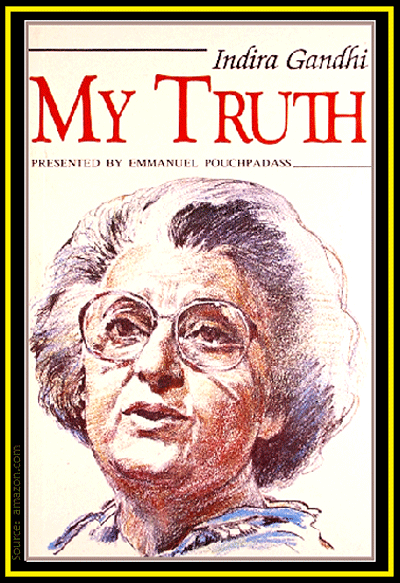
With the happenings of the day still fresh in mind, my attention had wandered to my IPad to google the events of 1966. In history’s roll, 1966 was a conspicuous year. However politically neutral I could be, I could note that, drawing a contrast to the outcome of the present local election, 50 years ago there were celebratory moments for some when on January 24, 1966, Indira Gandhi made her debut entry as the Prime Minister of India owing to the untimely death of the incumbent Indian Prime Minister Lal Bahadur Shastri in Tashkant in Soviet Central Asia on January 11, 1966. Customarily, Mrs. Gandhi’s intellectual-looking face had then dominated the covers of many Indian and some foreign publications. The 5ft. 2in. petite 48 year-old with Nehru elegance and style had certainly reached high places for someone who had once said, “At the age of four, my favourite game was to stand on a table and make thundering political speeches to the servants.”

04

05Another popular face of that year was of the international fashion icon Twiggy (Lesley Lawson, née Hornby). At just seventeen years old, having been voted British Woman of The Year, she was named the Face of ’66 by the Daily Express. In time, her androgynous look splashed across not only on glossy publications, but also on display boards, garments, etc.

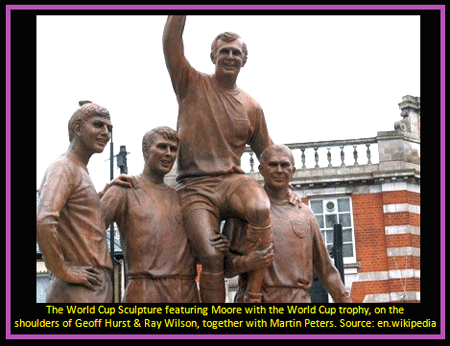
Concurrently, British bands like The Beatles dominated the world of popular music while England, beating West Germany 4-2 after extra time at Wembley Stadium in London on 30 July 1966, took home the 1966 FIFA World Cup.

Citing the flash trends of that fab year, if vinyl was the most “in” fabric worn by the young go-go set in Paris, in Britain, besides zippy Mini cars, hemlines of the trendy Mini Skirts progressively climbed upward to the level where some designs had the hem exposing more acreage of leggy delights as popularity for minis grew amongst those who like a mini to be a mini, successfully pushing the squabbles over longhair out of the headlines. At the same time, in the United States, a mandatory health warning appeared on the face of all packaging of cigarettes: “Caution : Cigarette Smoking May Be Hazardous To Your Health”.

06

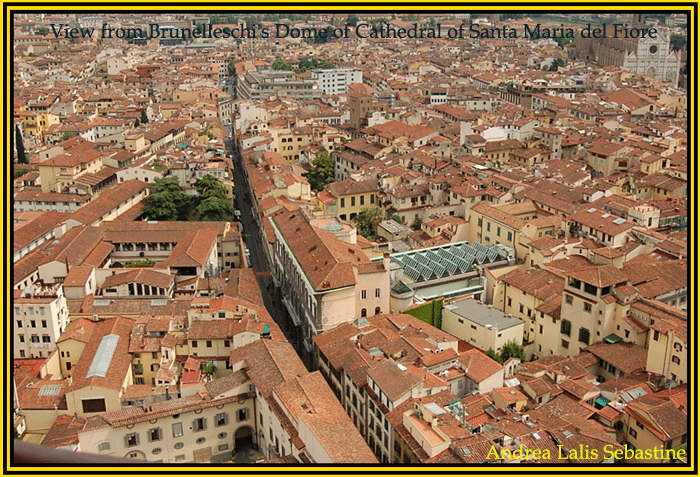
I would not miss out on the disasters that occurred later during that year. Before dawn on November 4, 1966, whipped by gale winds and rainstorms, disaster struck Florence (Firenze), Italy, the city for art lovers and one of our favourite haunts for many years. The rising muddy water of River Arno overflowed into the city flooding it to a maximum depth of 20ft, killing many, leaving thousands homeless and damaging not less than 14,000 works of fine art masterpieces and countless historic books, manuscripts and antiques housed at various locations in bella Firenze. At Galleria dell’Accademia, the “David” of Michelangelo tilted on its pedestal owing to buckling of the wet floor.

07

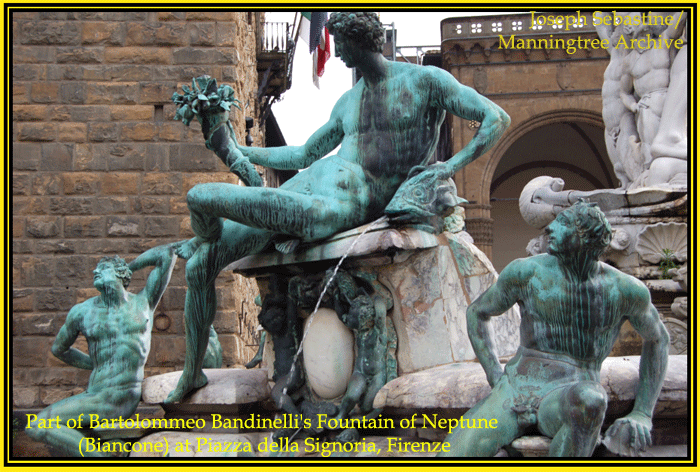
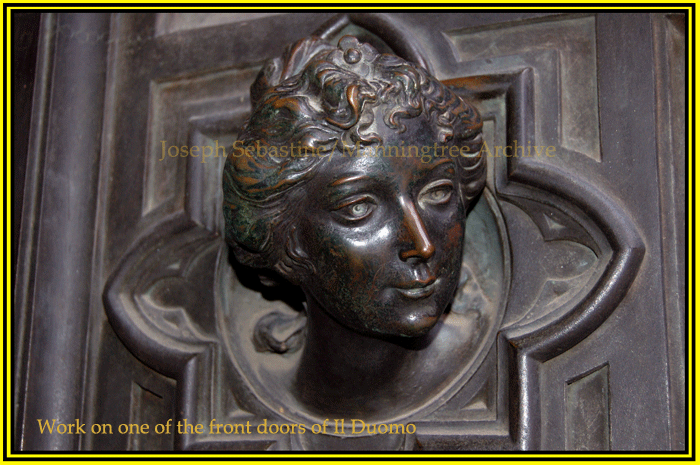
Just to think of the green and white marble Il Duomo (Cathedral of Santa Maria del Fiore), Giotto’s belltower (Campanile) and the Baptistery of San Giovanni in the Piazza del Duomo, the Cappelle Medicee e Chiesa di San Lorenzo, the Bargello (Palazzo del Bargello), the piazza and cloisters at Santa Croce, the Piazza della Signoria, the Galleria degli Uffizi, Palazzo Vecchio – all standing waist deep in soiled water with flotsam, oil drums, roofbeams, toys, trees from the diluvio….had brought sadness to our minds whenever we are there.

08

A similar catastrophe had struck Venice on the same day as La Serenissima flooded as the level of the lagoon rose about 6ft 5in above its normal level.

09

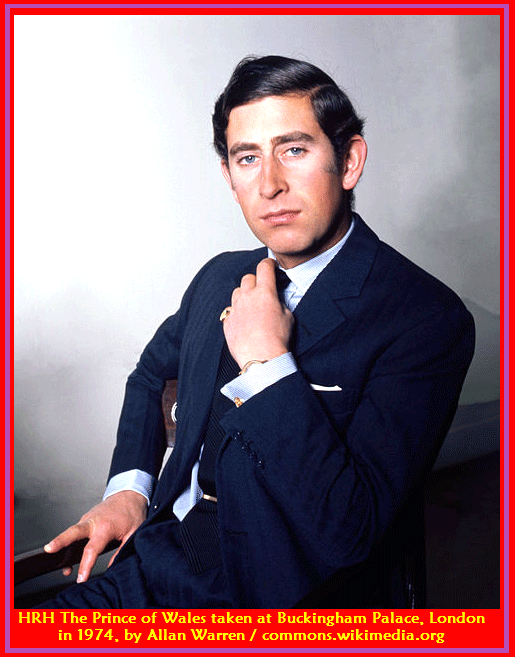
As Florence gradually came out of isolation and, light, food, and water reinstated with the calm and courage of the Tuscan people and other relief workers, a cause for further joy also came about in England ten days later. On Monday, November 14th, Prince Charles, still a school boy, officially came of age on his 18th birthday.

10

This enabled him to apply for a driver’s license, or to drink legally in a pub and to draw an income considerably larger than his classmates or teachers. But more importantly, it was the age at which the Prince of Wales, next in line for the British throne, became eligible to assume the throne and rule without a regent. The first joyful cheer to that rang out fifty years ago.

Until next time. Jo

11

 (©Joseph Sébastine/Manningtree Archive)

Remembering a Maestro of Cinema

Sat1

Sat2

Notes:
1) DVD/Blu-ray of the movies referred to in this article is available with amazon.com, amazon.co.uk and other leading dealers.
2) DVD sleeves/posters credits: Wikipedia, amazon, and from my private collection.
3) This illustrated post is an affectionate nosegay to the personality and movies referred therein. Please check “About” of my webpage for more details.

(©Joseph Sébastine/Manningtree Archive)

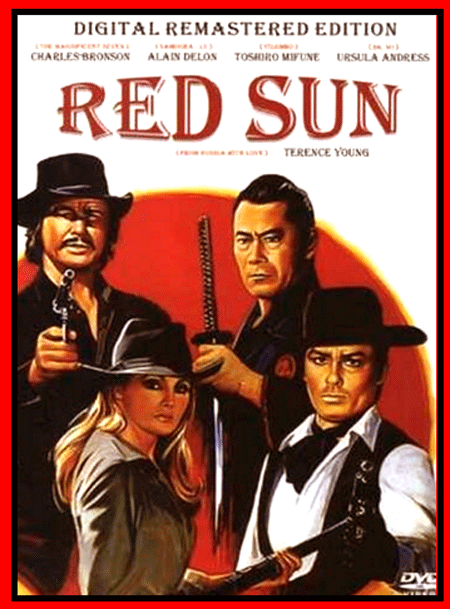
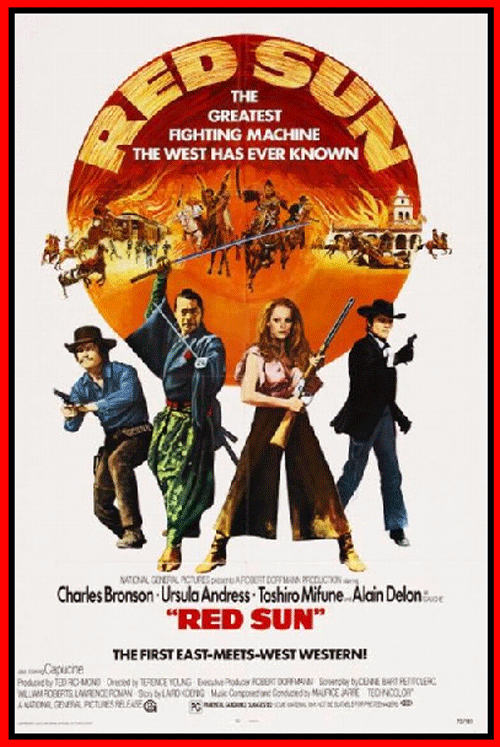
Red Sun (Soleil rouge – StarChoice.26)


Header-SC1

0 1

This second post concludes my preceding article of March 29, 2016: The Galloping Riders of Almería

0 2

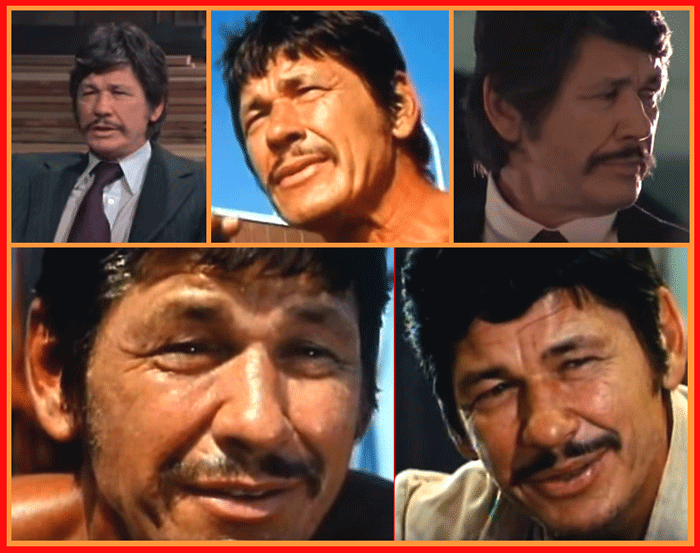
By early 1970s, Charles Bronson’s charm had transcended the borders of Europe and invaded far of corners of Asia. Movies such as The Magnificent Seven, The Great Escape, The Dirty Dozen and Once Upon A Time In The West have all contributed their magic for the popularity of Bronson. No sooner, large billboards of the craggy-faced, toughly built Bronson appeared in strategic locations in Japan where he was elevated as the quintessential ‘Western Man.’

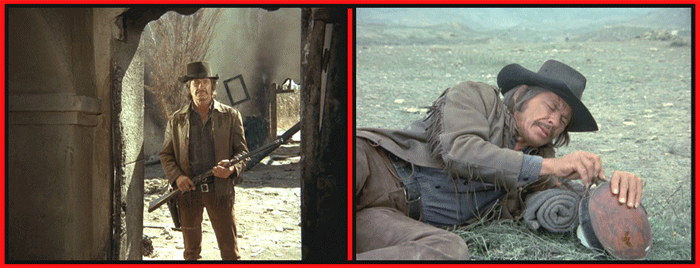
His aura of toughness and animal magnetism even earned him an appearance in the Japanese television commercial for Mandom, proclaiming a new toiletry brand for men. The ad-film was created by none other than the Japanese filmmaker Nobuhiko Obayashi, known for his surreal visual style. As for Bronson’s film career, there was no dearth in films for he was already in talks with filmmakers about a project called Red Sun.
0 4

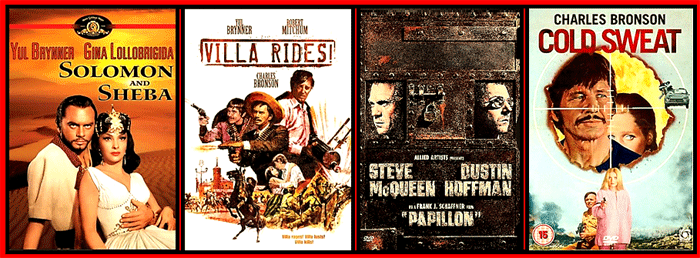
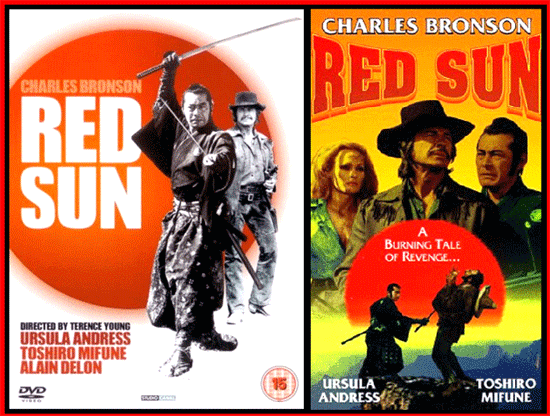
According to a book on Charles Bronson, the script for Red Sun was already available – having been passed around the major studios since 1966 when, based on an idea outlined on fifteen-pages, veteran producer Ted Richmond (Solomon and Sheba, Villa Rides!, Papillon) obtained the consent of Toshirô Mifune to star in it.
0 5

Owing to unenthusiastic response to get the film off the ground in Hollywood, Richmond associated with producer Robert Dorfmann (Le Cercle Rouge, Cold Sweat, Papillon) in Europe who signed Bronson and Delon. The choice was easier since the two stars had not only starred in their earlier projects, their commercial appeal made it possible to secure financing. The result was a co-production, between Les Films Corona, France; Oceania Produzioni Internazionali Cinematografiche (Oceania Films), Roma/Italy; Producciones Balcázar S.A., Spain, – an arrangement, besides other benefits, assured distribution in three markets.
0 6

They also roped in Terence Young to direct the movie. Young has proven his flair in directorial skills through a wide range of genre including peplum and war films since his directorial debut in 1948.
0 7

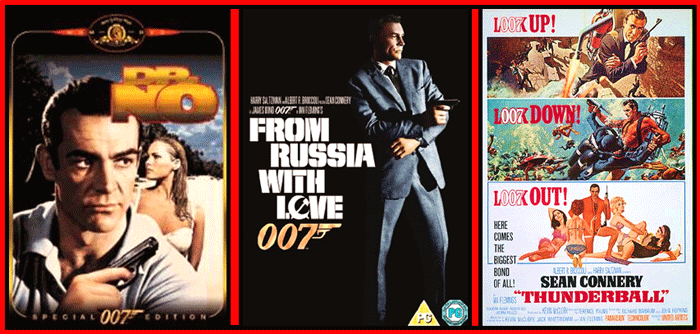
International in scope as the stylish action director of three of the first four James Bond films, Dr No (1962), From Russia With Love (1963), and Thunderball (1965), Young himself was then ranked a colourful character – consistent to the image of the British secret service agent James Bond’s taste for fine wine, expensive clothes and beautiful women.
0 8

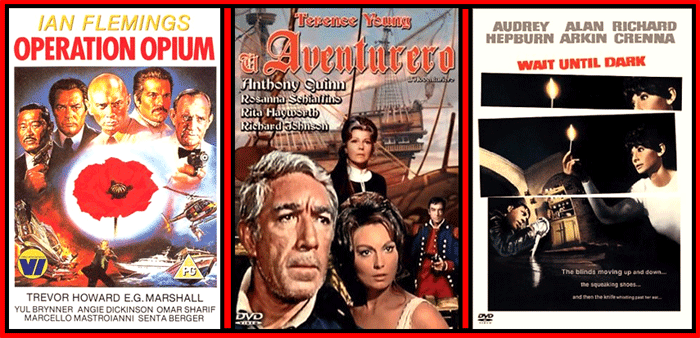
Ever since his departure from the James Bond series, Young was engaged in direction of The Poppy is Also a Flower (Operation Opium, 1966), L’Avventuriero (The Rover, 1967), Wait Until Dark (1967), Mayerling (1968), and Cold Sweat (1970), the first of three movies that Terence Young would make with Charles Bronson.
0 9

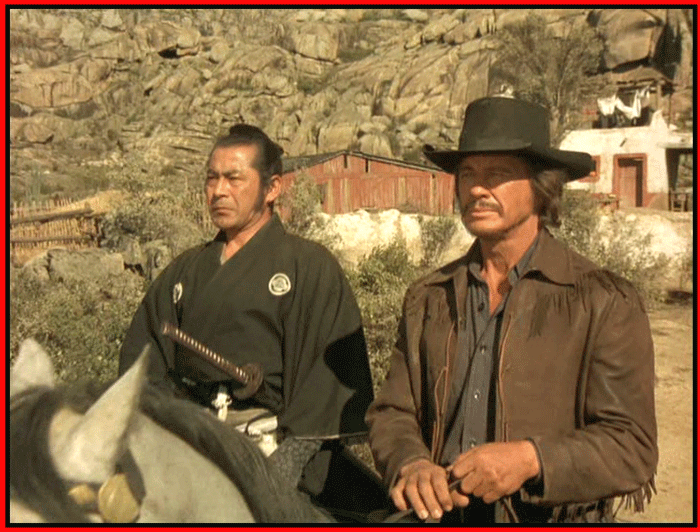
Red Sun was shot during the first half of 1971. Chosen as a stand-in for the American Southwest are the atmospheric mountains, virgin grounds, stark terrain and delicious climate of Spanish Almeria’s El Cabo de Gata (Cape Agate), Tabernas and Cortijo de la Sartenilla as well as the area between La Pedriza de Manzanares El Real and La Calahorra, effectively cutting the production cost.
0 10

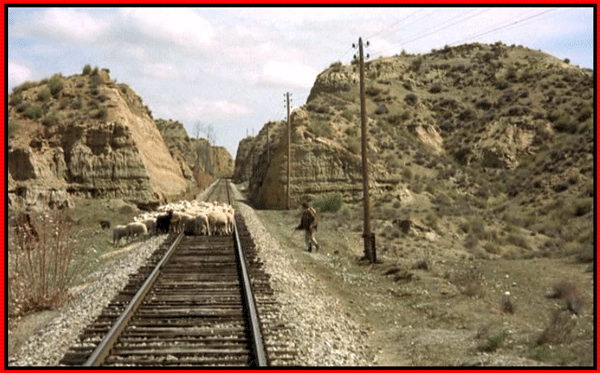
Some of these places, studded with agave plants and other desert succulents, flat-roofed whitewashed houses and abandoned/renovated farmsteads, were familiar to Bronson for having worked there recently in earlier production of Sergio Leone.
0 11

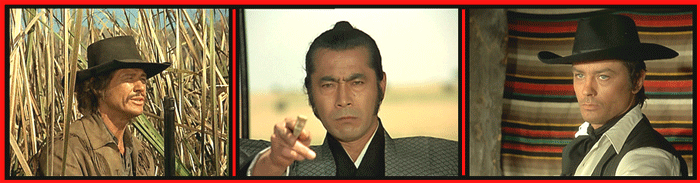
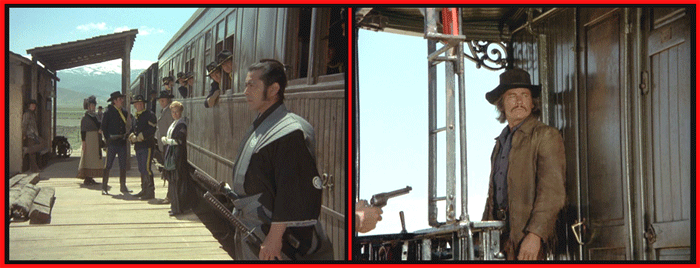
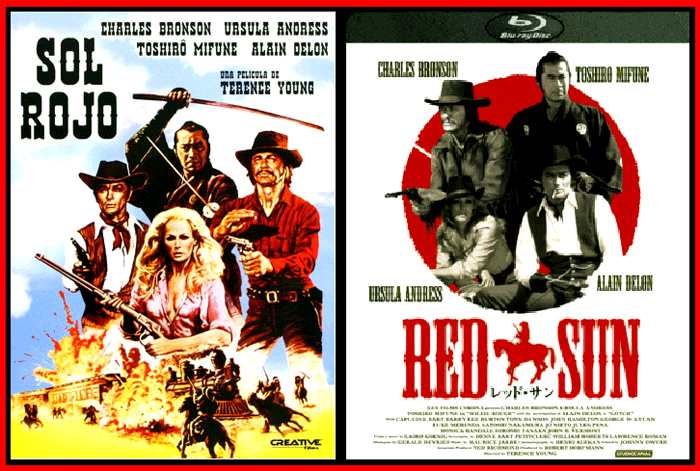
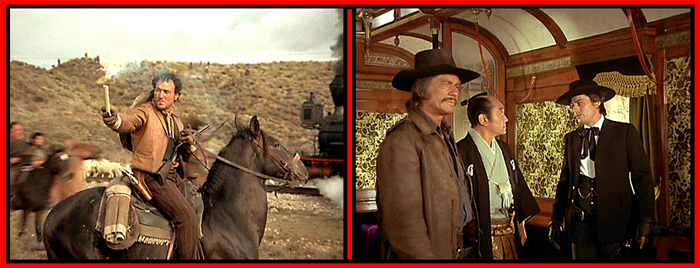
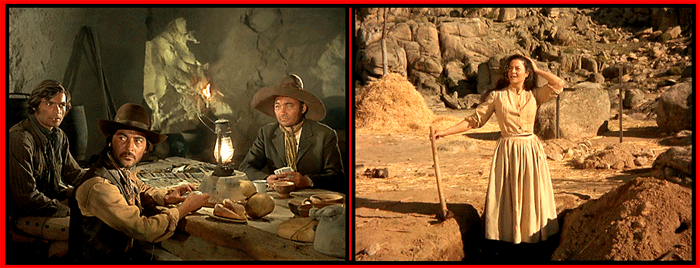
Set in the 1870s, Red Sun opens with the arrival of prairie rider Link Stuart (Charles Bronson) at a deserted railway station from where he boards a mail train bound for Washington. Besides the civilian passengers and the US soldiers protecting the gold and other valuables on the train, a delegation led by the Japanese ambassador to the United States occupied a private car.
0 12

During the reign of the 121st emperor of Japan, Emperor Kōmei-tennō (July 22, 1831 to January 30, 1867), Japan had begun its transformation into a modern industrial power following the arrival of US Commodore Matthew Calbraith Perry and his “Black Ships” on July 8, 1853 on a mission to force the opening of Japanese ports to American trade, through the use of gunboat diplomacy if necessary. Within the next decade, the drive for modernization resulted in the opening of Japan’s doors to the rest of the world.
0 13

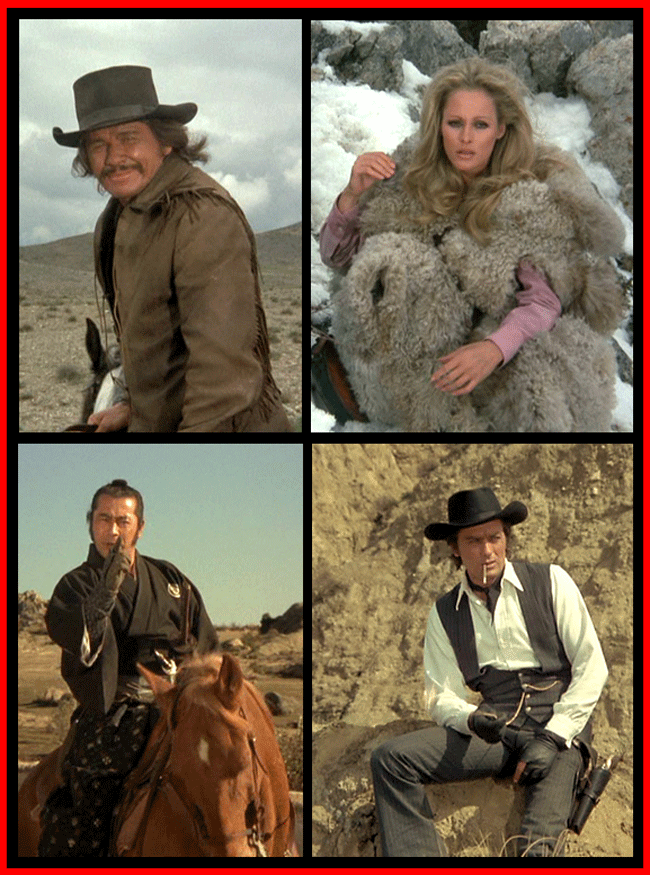
Ten years later, as the movie goes, Sakaguchi, Lord of Bizen and the first Japanese ambassador to the United States by authority from the Emperor, had arrived in San Francisco after a long and perilous voyage by sea. Even though his safe arrival to Washington is guaranteed by the US government, anticipating dangers on their way, the entourage rightfully consisted of two samurais to protect their liege lord – one being Kuroda Jubie (Toshirô Mifune) (1) to whom loyalty and death is part of his air and sea and earth.

0 14

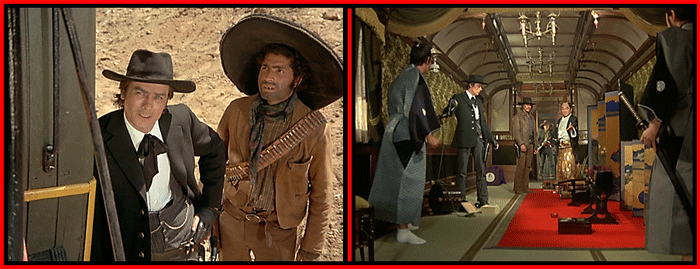
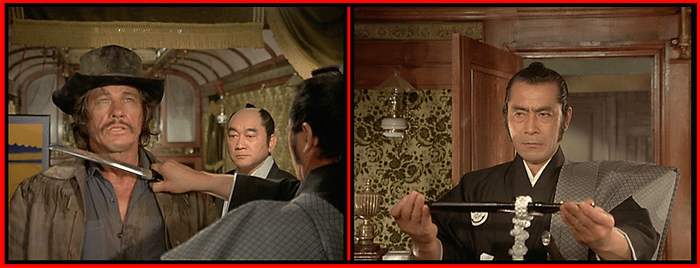
Once the train had chugged out of the station, its control was forcefully taken over by the bandit group belonging to Link and co-leader Frenchman Gauche (Alain Delon) who soon set to rob the train of its valuables. Having sent off all civilian passengers by foot, Link and Gauche barge into the private car of the Japanese entourage and steal their money while the two samurai stay meek at the ambassador’s instance.
0 15

It was after Link had left the car with the money when Gauche’s attention was drawn to a precious Mikado katana, a gold embossed sword, the Japanese was carrying for presenting to the 18th U.S. president, Ulysses S. Grant. Gauche forcefully steals it after killing one of the samurai (Hiroshi Tanaka) who aggressively opposed him. With his mission successfully completed, Gauche double-crosses his partner Link (who was promised 1/3rd of the loot) by throwing dynamite at him. Believing Link to be dead, Gauche and his henchmen ride off with the spoils.
0 16

Link was fortunate to survive the attempt on his life and was discovered by Kuroda by the railroad track. Regaining consciousness, Link was compelled by the Japanese ambassador to accompany samurai Kuroda to track down Gauche and retrieve the sword. Kuroda will attain this within seven days maintaining the code of morals and manners of the Bushidō (the way of the warrior) (2) and if he failed, carry out seppuku (belly-cut) or hara-kiri, the Japanese ritual suicide reserved for samurai.
0 17

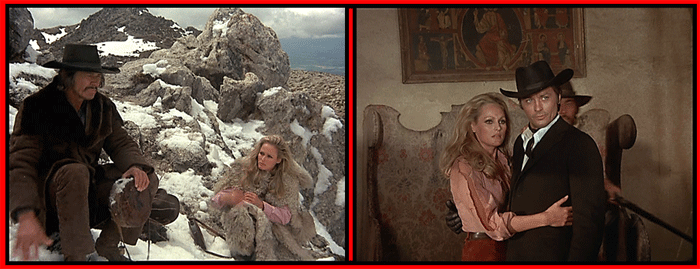
Although Link reluctantly agreed to this he was troubled by the samurai’s intention to kill Gauche in a bloody reprisal as soon as he retrieved the sword. This would not leave Link enough time to catch Gauche alive, and obtain the loot ($400,000/-, give or take a dollar!) from the train robbery. For purpose of expediency, Link must elude Kuroda and go after Gauche alone. The journey that follows is a concoction of action, humour, nudity, betrayal, revenge and restitution of honour.
0 18

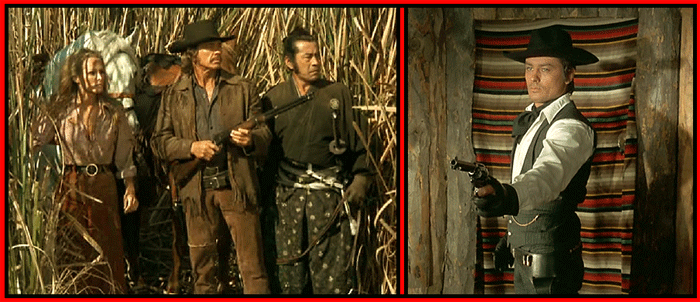
A French/Italian/Spanish production, the film was a hit in Europe and Asia while in the USA the regular critics were unkind to it which the filmgoers mostly discarded. An uncomplicated action director, Terence Young keeps the movie at a semi-brisk pace sprinkled with humour and brings the story to a dramatic climax amidst the reed thickets, shot in Venta Nueva, Adra, Spain.
0 19

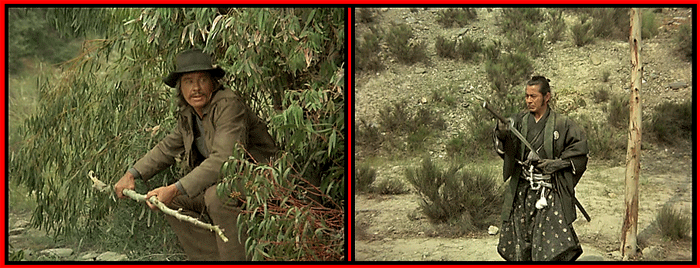
Red Sun contains the three situations essential to every western: isolation, violence and law. Kuroda, a man of dignity and honour, but quick and deadly as a rattle snake, is an isolated man in the West in his pursuit to retrieve the stolen sword and protect the honour. He was forced to associate with the outlaw Link into a path of violence, taking the law and justice into his own hands, hardly concerned whether he may die doing it or not.
0 20

Since most of the action takes place while Link and Kuroda are on the trail of the sword, director Young gives more emphasis to the interaction between the always very meticulous Bronson and much-focused Mifune – the events depicted in the movie leading to the point where Kuroda brings respect in Link for the strict bushido code which Kuroda adhered to, whereas Link manages to convince the revenge-minded Japanese to restrain from killing Gauche until Link could learn of the location where Gauche has hidden the loot. The script also briefly offers Kuroda, who generally dominates Link, an opportunity to speak of the disappearing values of the samurai as his countrymen no longer value the customs of old.
0 21

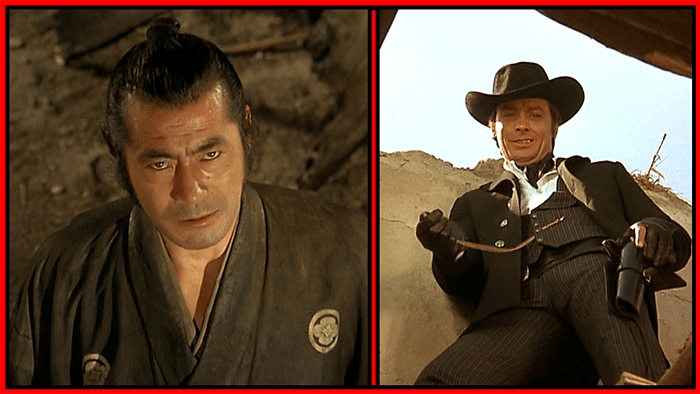
The two foreigners, Kuroda and Gauche, in the western settings of the movie contrasts dramatically: Mifune’s Kuroda representing the good and the gallant, while French actor Alain Delon’s Gotch ‘Gauche‘ Kink epitomises the bad and the ruthless; and within the limited but fairly meaty sequences of Gauche, the story maze clearly defines his debauchery, grounds for Kuroda to exact lethal vengeance. Relevant to Delon’s then public image as a “toughie” off screen, he comes across effectively as crafty and aggressive – and then again, there is always the visually interesting aspect – his pretty-boy good looks.
0 22

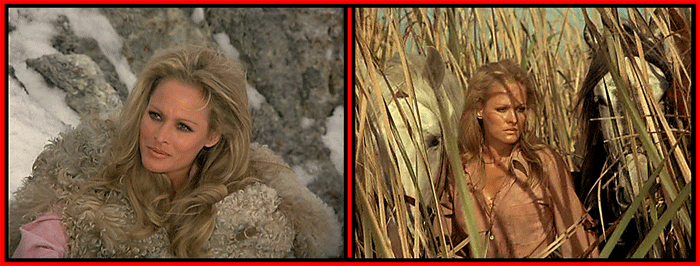
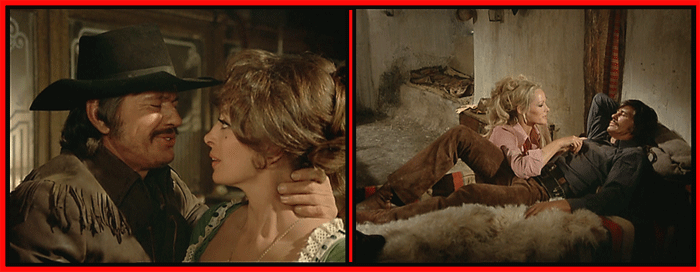
Statuesque Swiss-German actress Ursula Andress, who received second billing in the movie credits, is the foul-mouthed prostitute Christine who is the connection with Gauche whilst in love with Link. Red Sun displays her in a parody of scenes: in partial nakedness, as a helpless hostage of outlaws, as a victim of refined Indian torture, etc.
0 23

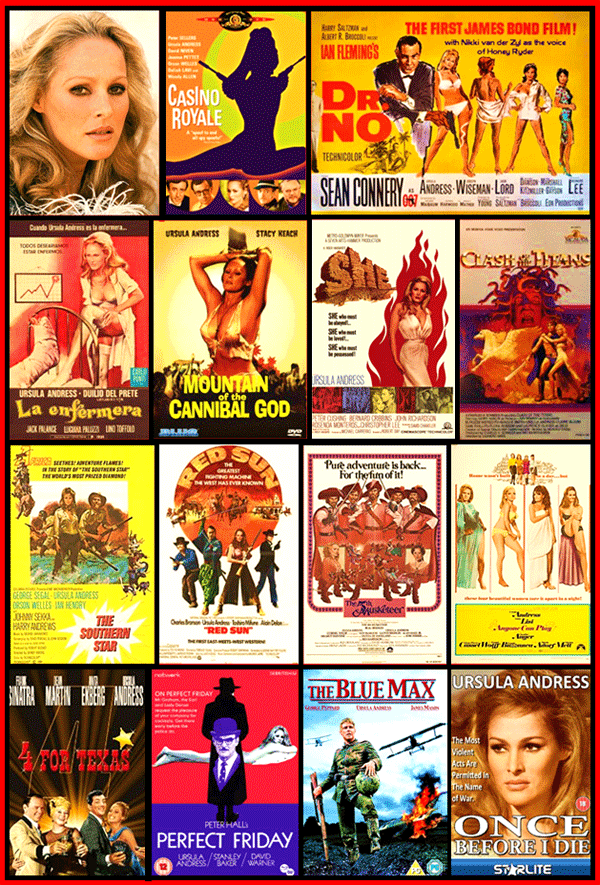
Although Andress has donned roles in Le Avventure di Giacomo Casanova/Sins of Casanova (1955), What’s New Pussycat? (1965), The Blue Max (1966), Anyone Can Play (1968), etc, it is her smouldering screen appearance as Honey Ryder in Dr. No (1962) that she is much remembered for, although she also appeared as Vesper Lynd in the satirical James Bond spoof Casino Royale (1967), a role turned down by Joan Collins, Elizabeth Taylor, Shirley MacLaine and the patrician French actress Capucine (The Pink Panther, ‘What’s New, Pussycat?).
0 24

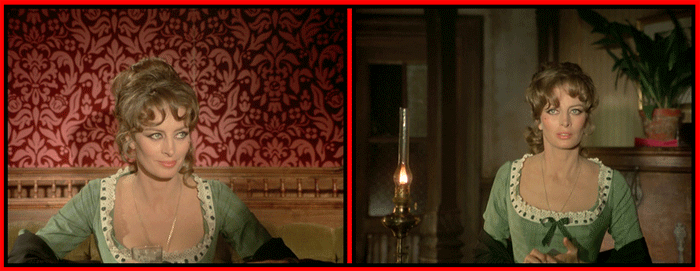
As it turned out, Capucine (Kap-u-SEEN), whose original name is Germaine Hélène Irène Lefebvre but changed it in honour of France’s nasturtium, co-starred with Andress in the role of Pepita in Red Sun.
0 25

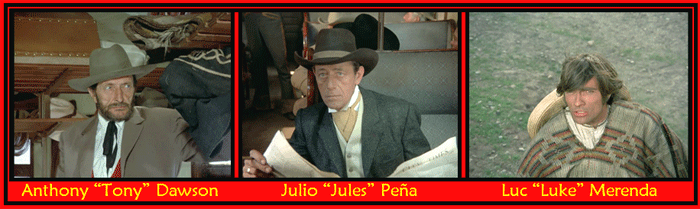
In the supporting role as Hyatt is Scottish actor Anthony “Tony” Dawson – a regular in Terence Young productions and often cast in a variety of villainous roles in the 1950s and 1960s including movies such as Alfred Hithcock’s Dial M for Murder (1954) and Dr. No.(3)
0 26

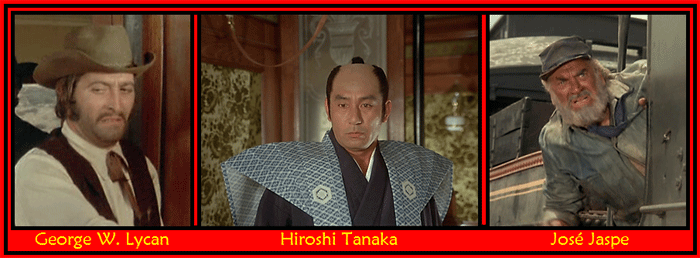
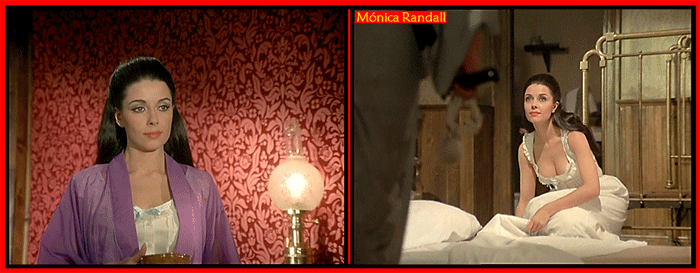
Other members of supporting cast: young French actor Luc “Luke” Merenda (Chato), Hungarian dancer/circus artist Bart Barry/ Bernabé Barta Barry (Paco), Lee Brown/Guido Lollobrigida (cousin of actress Gina Lollobrigida) (Mace), John Hamilton/Gianni Medici (Miguel), George W. Lycan (Sheriff Stone), Hiroshi Tanaka (Second samurai), Canada born Satoshi (Tetsu) Nakamura (Japanese Ambassador), Jo “José” Nieto (murdered Mexican farmer), Spanish actor Julio “Jules” Peña (Peppie, train passenger with newspaper), beautiful Spanish rose Mónica Randall/Aurora Julià Sarasa (Maria), John B, Vermont, plus a whole team of stuntmen (4).
0 27

Original Music by French composer/conductor Maurice Jarre (Maurice-Alexis Jarre) is an interesting mixture of Anglo/Japanese themes. The brilliant Eastmancolor cinematography owes to Henri Alekan of Roman Holiday (1953) fame.
0 28

The script adapted by Denne Bart Petitclere/William Roberts/Lawrence Roman is based on the story by American author Laird Koenig, famous for his novel, The Little Girl Who Lives Down the Lane (1974). Further crew consists of: Gerald Devriès (dialogue); Johnny Dwyre (Film Editing); Enrique “Henry” Alarcón (Set Decoration); Tony Pueo (Costume Design): Alberto de Rossi (Make-up); Karl Baumgartner (Special effects).
0 29

Released in 1971, Red Sun  is also known as: Sole rosso (Italy), Sol rojo (Spain), Rivalen unter roter Sonne (Germany), Sol vermelho (Portugal), Monomahia ston kokkino ilio (Greece), The Magnificient Three (Philippines)
0 30

Red Sun has its moments of fun and rough spots besides providing the opportunity to see Bronson/Andress/Mifune/Delon coming together in a pleasing blend of their American/Swiss/Japanese/French charm, embellished by the direction of Britain’s Terence Young. Until next time. Jo
0 31

Notes:

  • Toshirô Mifune’s character in Hell in the Pacific is called Tsuruhiko Kuroda.
  • The eight virtues typified by the Bushidō code: Righteousness; Courage; Benevolence; Respect; Sincerity, Honour, Loyalty, Self-Control.
  • According to a film trivia, it is Dawson’s hands we see stroking a white cat in the scenes depicting Bond’s arch-nemesis Ernst Stavro Blofeld in From Russia with Love and Thunderball.
  • One of Hollywood’s top gun coaches and fast-drawing experts, chickasaw Indian Rodd Redwing died on May 29, 1971 following a heart-attack aboard the flight while returning home from Spain after work on Red Sun.
  • Books, DVD/Blu-ray of the books/movies referred to in this article are available with amazon.com, amazon.co.uk and other leading dealers.
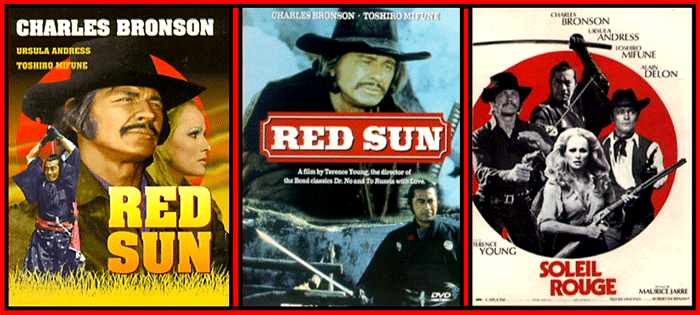
  • DVD sleeves/posters credits: Wikipedia, amazon, and from my private collection.
  • This illustrated article is an affectionate nosegay to the movie reviewed above. Please refer to “About” of my webpage for more details.
  • In memory of French actress/model Capucine (January 6, 1933 – March 17, 1990)
0 32

(©Joseph Sébastine/Manningtree Archive)

The Galloping Riders of Almería

b1

International superstardom finally started to cast its glare on American actor Charles Bronson in the late sixties – essentially since his appearance as the half-breed gunslinger l’uomo dell ‘armonica in Sergio Leone’s spaghetti Western “Once Upon a time in the West” (C’era una volt ail west, 1968). In the mind of filmgoers, the gristly face of Bronson with his sleepy eyes and drooping moustache had become distinguished as an image of a ‘tender tough guy’ with an explosive air of elemental violence about him, drawing audiences to his movies shown across Europe over to Asia. The Italians nick-named this stone-faced and powerful personality, their “Il Brutto” – The Ugly One.

b2

While Bronson’s films never received wide release across America where he remained an unknown actor, his leading parts were confined to European products such as Guns for San Sebastian (1967), Farewell Friend (Adieu I’Ami, 1968), Villa Rides (1968), etc.

b3

Born to Lithuanian parents settled in the bleak mining town of Ehrenfeld (known locally as Scooptown), Pennsylvania, USA, “Shulty” (nickname of Bronson as a boy) was initially a coal miner who led a life full of deprivation. Charlie served the army from early 1943 to early 1946, following which he went on to do short stints as bricklayer, waiter, baker’s helper, etc before venturing into the theatre where his face and figure could draw only bit-parts of heavies and ethnics.

b4

Without any film-acting experience other than a year of learning at the Pasadena Playhouse, he had headed for Hollywood where, from his film debut in You’re in the Navy Now (initial title: U.S.S. Teakettle, 1951) till director Robert Aldrich’s Apache (1954), he was known as Charles Buchinsky, his birth name. With Drum Beat (1954) he changed his name to Bronson after the Bronson Gate at Hollywood’s Paramount Studios which derived its name from Bronson Street in Los Angeles.

b5

Having met actress Jill “Dorothy” Ireland in Bavaria, Germany, in 1962 during the filming of The Great Escape (then married to Welsh actor David McCalum whom she divorced in 1967), Bronson (divorced from his first wife Harriet Tendler in 1965) and Jill married in October 1968, which was few months after Bronson left Hollywood for Europe where he travelled from 1969 to 1973, making various movies.

b6

He soon fitted himself into a world infested with immigrant western actors such as Steve Reeves, Clint Eastwood, Cameron Mitchell, Lee Van Cleef, Eli Wallach, Van Heflin, John Ireland, Ty Hardin, Woody Strode, Rod Steiger, Jack Palance, etc, who had taken trek to Europe to join the European actors (most of them given Western-sounding names) to star in Peplums as well as in Euro-Westerns mostly shot in Almería which provided a perfect match for the deserts of Arizona.

b7

b8

Impressed by Bronson’s performance in Machine-Gun Kelly (1958), French actor Alain Delon had by then developed an interest to work with him. Conveyed to Bronson through French producer Serge Silberman while Bronson was on location in Spain (at El Casar de Talamanca, Guadalajara, Castilla-La Mancha for director Buzz Kulik’s “Villa Rides”), the outcome was Bronson in the role of Franz Propp in Adieu I’Ami (Farewell Friend/Honor Among Thieves).

b9

When the film came out, his pairing with Delon earned them lavish praises from the critics, spiralling progress in Bronson’s career through a series of European productions including director Richard Donner’s Twinky (Lola/Statutory Affair, 1970) and French director René Clément’s chilling suspense piece Le Passager de la pluie (Rider on the Rain, 1970), the role in which, according to a book, had come seeking Bronson with a bit of urging of Alain Delon.

b10

In the late 1960s, with the sensuality of facial features that made Alain Delon a beautiful leading man still intact, Delon retained his physical presence and stylish, enigmatic look in domestic productions such as The Girl on a Motorcycle (1968), La Piscine (1969), Le Clan des Siciliens (The Sicilian Clan, 1969), Borsalino (1970), etc.

b11

Earlier in 1966, he had acted as a hitman clad in a trenchcoat and sporting a felt-hat in French director Jean-Pierre Melville’s cult classic Le Samouraï (The Samurai, 1967) which had kindled his interest in Japan where he had recently earned a large number of fans and commercial success that extended not only to his iconic status, his screen muscularity and sex appeal, but even to the sunglasses branded with his name. According to IMDB, at that time, Delon even kept a samurai blade hanging on the wall of his bedroom.

b12

Producing films since the 1970s under the name of his own production company, Adel Productions, and in a position to attract investment from across Europe and USA, Delon was then very active in filmdom and given the scale of his popularity as a global style icon, no doubt he would have gladly welcomed any interesting story angles of diverse genre to revamp his image, including a proper role where elements of Japanese culture are interestingly featured.

b13

The box-office success in Japan of more than a dozen films that director Akira Kurosawa made between 1950 and 1965 and other elements of Japanese film culture were already fanning their influence on the American filmdom. Kurosawa’s “Rashomon” (1950) came out as “The Outrage” (1964), “The Magnificent Seven” (1960) was based on “Seven Samurai”, while “A Fistful of Dollars” (1964) which invented the spaghetti Western was inspired by “Yojimbo” (1961) (1).

b14

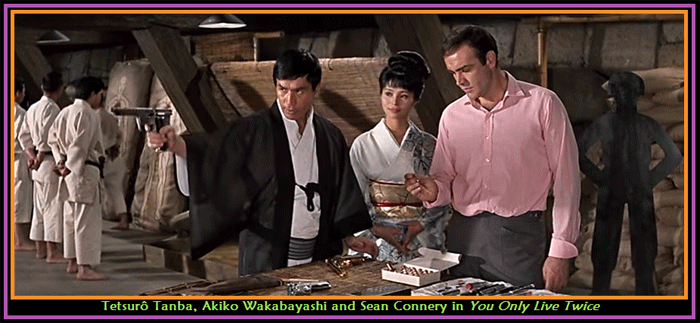
Simultaneously, “You Only Live Twice” (1967), the fourth James Bond starring Sean Connery, predominantly set in Japan, featured prominent roles for Japanese actors Tetsurô Tanba, Akiko Wakabayashi and Mie Hama. Director Richard Fleischer’s “Tora, Tora, Tora” (1970) about the Pearl Harbour attack featured a fusion of West-Orient actors and crew and Kurosawa was originally slated to direct the Japanese half of the film which did not materialised due to technical issues.

The West had also taken note of Toshirô “The Wolf/The Shogun” Mifune’s strong, monolithic screen presence. Mifune had built his career on several wonderful classics of Kurosawa which included Rashomon (1950), Seven Samurai (1954), Throne of Blood (1957), Yojimbo (1961), Red Beard (1965), and The Hidden Fortress (1958), which was Kurosawa’s personal favourite.

b15

The power of Mifune’s screen presence engendered the strength of character through silence, together with quick and deadly dynamism in action sequences. In “Something Like An Autobiography” Kurosawa wrote that, in Mifune he had come across “a kind of talent he had never encountered before in the Japanese film world.”

b16

Toshirô Mifune, himself a producer on several samurai films, was no stranger to roles in Hollywood products. Referred to as Japan’s John Wayne, he had appeared in Grand Prix (1966) and later with Lee Marvin in director John Boorman’s Hell in the Pacific (1968), a World War II drama of two adversaries, an American pilot and a marooned Japanese navy captain Tsuruhiko Kuroda, on a small uninhabited island in the Pacific Ocean. The film offered good contrast in acting styles of Marvin and Mifune (both actually served in the Pacific during World War II) as the two men of opposing countries who cease their animalistic confrontation and come to terms with peace and cooperation in order to survive.

b17

It was during this period that the American producer Ted Richmond decided to create a Shogun-type Western, with a fusion of Japanese folk legends. Jo                 (To be continued)

b18

Notes:

  • According to A New Guide to Italian Cinema, Leon has insisted that the source of A Fistful of Dollars is a play by Carlo Goldoni Arleccchino il servitor di due parroni/The Servant with Two Masters (1745)
  • Books, DVD/Blu-ray of the books/movies referred to in this article are available with amazon.com, amazon.co.uk and other leading dealers.
  • DVD sleeves credits: Wikipedia, amazon.co.uk, and from my private collection.
  • This illustrated article is an affectionate nosegay to movies of the past. Please refer to “About” of my webpage for more details.

b19

(©Joseph Sébastine/Manningtree Archive)

The Kaleidoscope of Hoof Prints

b1

(This follows my article The Ballad of JEANETTE and MICHEL  of March 2, 2016)

If there are phrases on my tongue which connote the blessings that can unwittingly come in many disguises to the gentle-natured donkey, it is those plans and purpose which chanced upon as revealed in some events of “The Bible”. With Palm Sunday (March 20, 2016) followed by Easter (March 27, 2016) coming up, bringing in a time when it is not unusual for people to be religious in thoughts, I take a little liberty to reflect on those events.

b2

Animals like sheep, camel, donkey, have afforded their presence to many episodes of the Bible. Indeed there are momentous occasions when the donkey was part of events that were important junctures in the life of Jesus Christ.

b3

The ass of Palestine and the Bible has been identified as the Nubian wild ass of Egypt. This common beast of burden, used for agricultural work and also for riding, is not in the East by any means a despised or a despicable animal – but considered part of a moderate household. Whole families rode him, shared food with him, and sometimes allowed him to stay in a section of the room with the family.

b4

Visitation: It is related that Mary, pregnant with Jesus, used a donkey when she set out on her journey for her ‘Visitation’ to congratulate cousin Elizabeth who was pregnant with the child who would one day become known as John the Baptist. According to tradition, that donkey had travelled about seventy miles from Nazareth over hills and through valleys to the little town in the Judaean hills where Elizabeth and her husband, priest Zachary dwelt. Considering that the feast of the Annunciation of the Birth of Jesus is held on March 25th, this journey could probably have occurred during the last days of March or early April when the rainy season was just over. Although Joseph is not named in this journey, it is unlikely that Mary would have ventured on a long and arduous journey alone and abode with Elizabeth for about three months before she rode back to her home in Nazareth. Besides, it was customary to have a driver for the donkey, when women rode on them.

b5

To Bethlehem: The initial scenes of William Wyler’s biblical epic movie “Ben-Hur” (1959) portrays Joseph, a village carpenter, leading a meek donkey by the bridle, on which sat his pregnant wife Mary covered with a long cloak, during their journey from Nazareth to Bethlehem in Judea to enrol their names in a census which had been ordered by Caesar Augustus. The vague details of that journey of about seventy miles could be visualised as five days of privation, fatigue and discomfort through an uncomfortable path in the winter chill of December. A book on the Virgin Mary names this donkey as “Eleabthona”, but we could only wonder if it was the same animal which had previously been similarly used when Mary went on her “Visitation” to Elizabeth.

b6

To Jerusalem: Whichever donkey it was, that animal had the opportunity to be closer to the newly born Jesus in the stable outside Bethlehem. Besides, amongst the few other domesticated animals present there, he was the one who would render service as the mode of transport to Joseph’s family when, at the age of forty days, the infant Jesus was taken to Jerusalem for presentation in the Temple and return.

b7

To Egypt: Sometime thereafter, warned of an imminent danger to the child, the family hastily embarked on a journey in the middle of the night, with Mary and the child riding the donkey, as they rushed out of the territory of King Herod to retire into Egypt. With the winter still persisting, that journey of ten days covering about two hundred miles via the city of Pelusium (modern Tell el-Farama) was not without difficulties and dangers arising from cold, wet and stormy weather, lack of shelter over their heads, less water, attack by robbers and wild beasts, proceeding partially through the shifting sands of the desert as far as the land of Gessen, where they resided (1). Not until had King Herod died in the spring of 4 BC, did they retire to the early home of Joseph and Mary at Nazareth of Galilee.

b8

Soon after, the donkey of those journeys slips into obscurity even though according to a recorded event of Jesus’ youth, at the age of twelve, Jesus was taken on a long journey to Jerusalem to attend the Passover before returning to Nazareth when the service of a donkey would have been required.

b9

It is widely held that the dark line down a donkey’s back and across the forequarters in the shape of a Latin cross denotes the heritage of that race from the day one of their forebears carried Jesus on its back during His triumphal entry into Jerusalem which is commemorated as the first Palm Sunday (Dominica in ramis Palmarum), and marks the beginning of what is technically called Passion Week.

b10

To Jerusalem: According to the Gospels, Jesus, having come to the little village of Bethphage (Beitphage) on the summit of the Mount of Olives sent two disciples into the village to fetch an ass and a colt they would find tied there. Having brought the animals, they cast their garments upon the ass and made Jesus sit thereon. (2) The animal carried Jesus, sitting meek and gentle on its back, as it treaded over the olive palm fronds strewn over the garments laid on the path, amidst the joy and singing of a multitude of accompanying people wielding branches of palm trees as a testimony of honour and respect.

At that time Jerusalem was surrounded with fertile fields and trees, and on the southern slope of Olivet, where they were passing, date-bearing palm trees grew in great abundance. The Palm has been in all times and places the emblem of victory and its reward and it was the custom to carry and wave palm-branches as a sign of joy and victory.

b11

At length, the donkey carried Jesus down the hill, passed between the walls of Gethsemane and the Garden of Olives, crossed the Cedron valley (Kidron), through the road leading up to St. Stephen’s Gate (Lions’ Gate), and entered the Temple through the Golden Gate with its beautiful pillars. This occasion, commemorated on Palm Sunday with a Procession of Palms was customary in Jerusalem as early as 386 when it was first mentioned, and was adopted in the west by the seventh century as attested to by Isidore of Seville, who died in 636.

b12

Until the Reformation in the Middle Ages, the event was remembered in a folklorised ritual on Palm Sunday (Palmsonntag) in some southern German speaking regions when, in addition to the tradition of the blessing of palms (Palmbüscheln), a procession known as “Palmesel” (Palm Sunday donkey) was held when a statue of Jesus mounted on a wooden effigy of an ass fixed on a wheeled wooden bier was taken round the streets spread with clothes and strewed with palm branches. To mark this joyous occasion, people sang hymns and waved fronds of palm or of some other similar tree, while at some places bouquets of flowers attached to boughs of trees were sometimes carried in the procession calling it the Easter of Flowers.

The ass was not forgotten either. A book on ecclesiastical architecture relates an old tradition that “the ass on which Christ made His entry into Jerusalem left Judea immediately after the Crucifixion, and passing over the sea dry-shod to Rhodes, Cyprus, Malta, Sicily, and Aquileia, finally reached Verona, where it lived to a very old age. After its death its bones were collected and deposited in the belly of the wooden ass of Santa Maria in Organo, which was made as a memorial of it and its exact image.”

b13

Just as that event at Jerusalem made them an object of peculiar reverence to the early Christians, the cross on its back inspired belief that children suffering from whooping cough will be cured if they are made to sit on the mark and the donkey walked in a circle nine times.

It is interesting to think, with what different sentiments one regards the donkey at different periods. The poor quadruped which tradition says earned its reputation for stupidity in the Garden of Eden when it could not remember its name when God asked it, is actually, as one of my friends wrote, a poorly understood animal.

b14

Ass, when properly kept, is a handsome animal – much stronger in proportion, and much more hardy than the horse. The positive efforts of institutions such as Kölner Zoo in Germany, The Donkey Sanctuary in Devon, England, etc, very much help the welfare of the docile and friendly donkey to save them from becoming snapshots of a bygone era. Let us be glad that they are there and keep alive the age old tradition that to see a donkey will bring one the good luck. Until next time, Ciao, Jo

b15

Notes:

  1. According to some publications, the particular place where Joseph settled in Egypt is probably Metaryieh, near On/Heliopolis, about two hours distance north-east of Cairo.
  2. A Franciscan church, built on the foundation of an ancient shrine, stands to commemorate the place where Christ mounted the ass, contains a stone traditionally identified as used by Jesus to mount the ass for the journey to Jerusalem.
  3. Thanks to: Mr. Bernd Marcordes, Kurator, AG Zoologischer Garten Köln, Germany for the picture of Michel and Jeanette; to Ms. Pippa Helock of The Donkey Sanctuary, Devon for the picture “Looking Handsome”; and to Stefan Ahrens of Bistum Regensburg, Germany for the four pictures.
  4. Print and visual versions of “Ben-Hur” is available with amazon.com, amazon.co.uk and other leading dealers.

b16

Joseph Sébastine/Manningtree Archive)

The Ballad of JEANETTE and MICHEL

Poor little foal of an oppressed race!

I love the languid patience of thy face:

And oft with gentle hand I give thee bread,

And clap thy ragged coat, and pat thy head.” – Coleridge

s1

The German TV channel Deutsche Welle (DW) currently hosts weekly episodes of Tierisch Kölsch (Zoogeschichten/Zoo stories). Each episode features moments from the lives of many animals, reptiles, birds, and amphibians of Kölner Zoo (Cologne Zoo) in Germany – and is highly rated for being quite interesting, educational and inspiring. Amongst the inhabitants in that controlled environment are a couple of hairy Poitou donkeys (Poitou-Esel in German) tenderly looked after by the Tierpfleger (animal-carers) of the Kölner Zoo.

s2The Poitou donkeys (Poitou ass/Poitevin donkey/Baudet du Poitou), the breed from the Poitou region of France are notable for a number of unique characteristics. The two tenderfoots were brought to the Kölner Zoo: the female and smaller Jeanette, born in 2007, originated from the Heidelberg Zoo; the stallion Michel was brought over from Wilhelma (Der Zoologische-Botanische Garten) Stuttgart where he was born in 2013. Contrary to our know-how, the way by which Jeanette and Michel responded to the kindness, words, strokes and reassurances of the Tierpfleger specialized in equine behaviour was amazing.

Here we live in a place where animals of that species cannot be easily seen. Looking back I could remember having first seen them a long, long time ago when one of the Circus shows came to our city. But then, the couple of weak donkeys that the Circus paraded with colourful ribands tied to the stump of their tails were unexciting elements to cast a spell over our attention amidst a group of more fascinating animals attached to that Circus.

That was a time when traveling entertainers could be found on the pavements of Cochin: sword swallowers, acrobats, singing groups, snake charmers, … Bar a few, all seem to have disappeared like most of the birds that flew over Cochin before the city set on the path of development. Once upon a time, you could see huge light-coloured oxen with enormous horns pulling covered carts through the streets, bringing in heavy loads of trade ware for merchants at the Broadway. You could find them resting in an area behind the back wall of the Police camp near the market bridge leading to the Broadway.

s3

You could see cows, goats, cats, dogs, hen, duck, frogs everywhere while pigeons, sparrows, crows, butterflies, etc, flew around freely. How wonderful it felt to hear the chirping of the swallows and the song of the lark; to look up and see the eagles soaring in circles overhead, not far away. Now, most of them have relocated to the ecologically sensitive area of Mangalavanam Bird Sanctuary or away to the hilly areas in the suburbs – with no chance to restore them to their old habitats. The stray dogs seem to have taken over to atone for their absence. Occasionally one could even see the odd elephants being taken somewhere. As for us, fortunately, we have a couple of purple-rumped Sunbirds (Leptocoma zeylonica) nesting by the air-ducts near the window-sunshade outside our dining room – their incessant happy chirping would gather momentum whenever our presence is known to them – joyous as though some little breeze had made their hearts light.

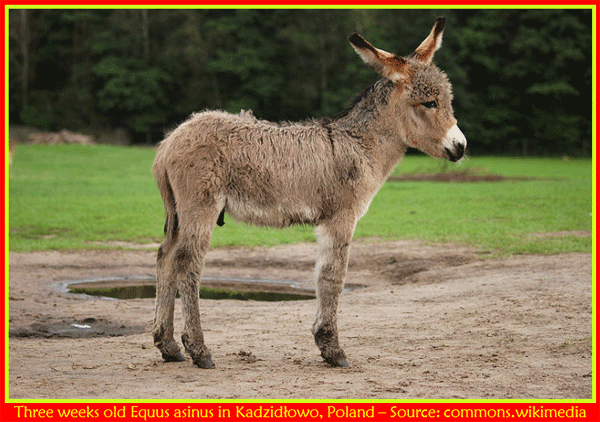
s4 Donkey, the animal that was once part of the drawing periods of our beginners’ classes at school together with rabbit, elephant, cow, birds, swan, etc and always present in the illustration books of alphabets to represent “D” is also known under the scientific name of Equus Asinus. If names are anything to go by, they are also called a moke, a burro, a cuddy. Always part of many legends and jokes, like many animals, the donkey was even regarded by the ancient Egyptians both as a god and a devil.

s5As an avid traveller, I have seen them labouring in the agriculture and laundry sectors, and pulling carts in various parts of India. Browsing the web, I had seen them on building sites or at brick kilns of some countries where they are engaged to work long hours to transport heavy load of bricks to and from the firing ovens.

In different cities of Yemen, there are quite a few of them used as pack animals, but not quite as much as I have seen in different parts of Europe where you could find them in all shapes, sizes, colours and coat texture.

The smaller types with woollier coats I saw in the London Zoo (reputedly the donkeys came to England with the Romans during their invasion of Britain under Emperor Claudius in 43 AD) is believed to have ancestors who were exported to the United States (along with mules) by settlers who would later venture to improve the situation in the U S with good quality Spanish and Maltese stock.

The ancestors of donkey stock in Europe owe their settlement in Europe to the Romans while some might have entered through the close accessibility of Spain to Northern Africa. Crete, where Europe, North Africa and Middle East intersect in sea communication, could have had some linkage to the Europe-bound Roman cargos which also included donkeys. But, whatever the reason could be, the island of Chrysi of Crete is known as Gaidouronisi (Donkey) Island”.

s6

No sooner they were put to use as pack-asses or harnessed four-abreast to draw wagons, they spread throughout the Mediterranean islands where wine was produced, owing to their reliability, narrowness and delicacy of surefooted steps to till the land between the rows of vines on steeply terraced hillsides. While many of them found usage as working animals in French vineyards in the harvest of grapes, in Spain, they also became popular in tourism, festivals, pilgrimages and agriculture.

s7

Patient, sure-footed and persistent, not only the army found them useful, they are used for riding, for carrying passengers and luggage, to work in agriculture and farms, to carry water, maize, construction materials, crush sugarcane, pull giant hamster wheel to draw water from a well, recyclable rubbish materials, trekking, etc.. Beginning from a time when the ancients had only their own muscle power and that of their donkeys and oxen, the efforts of donkeys can be traced through the construction sites of the great pyramids, Basilica di San Pietro, Taj Mahal, Suez Canal, Panama Canal, etc.

s8

Some also developed an appetite for donkey meat which was one of the reasons they were initially domesticated by mankind counting also the facts that they are easy to control, eat less than a horse and live longer to about 40 years. I remember an old story about a couple of successful/unsuccessful Iberians engaged in the manufacture of chicken sausages. When the impoverished manufacturer was baffled about how the prosperous one sold his chicken sausages cheap and still made profit, he was secretly advised by the prosperous one to add donkey meat to chicken at 50-50 ratio as dead donkey meat came cheap. Yet, the impoverished one was appalled that he could not generate profit even after mixing the meat half-and-half with the chicken. He had done precisely as he was advised and certainly, their sausages were of same length and thickness. The mystery is soon unravelled. Well, the prosperous one did not mean to mix the meats half-and-half. He meant 50-50 – one donkey to one chicken. The penny has dropped.s9

Save for turning up on dinner plates and in salami, donkey milk, in which Egyptian Queen Cleopatra reputedly bathed, was also used as an infant feed replacement and supposedly good for premature babies, delicate children, people with asthma, eczema and psoriasis.

According to recent reports, the donkey population in India has suffered the highest downfall among all livestock during the last many years. Proper donkey care education, creating specialists in equine behavioural problems, availability of barns and bales of haylage, proper usage of their manure to produce compost, are major aspects for the welfare improvements of these gentle-natured creatures. Equally vital are the conservation of indigenous breeds of donkeys by perfecting artificial insemination and embryo transfer technology and ensure their genetic purity. Simultaneously, to learn patience to cope with their stubbornness and stupidity that can also be interpreted as part of donkey’s intelligent and naturally cautious attitude for not being pushed into situations of danger.

s10

Of some of the other common problems of donkeys I have heard of are the long hours they are made to work in soaring temperatures without adequate food, water and rest; the poor quality of saddles and bridles ignoring safety guidelines which could risk the rider as well; deficiency of support to donkey sanctuaries and donkey owners; lack of adoption opportunities; dietary issues; bad breath; skin problems; eye infections; blindness; and abandonment.

s11

Abandonment is a misfortune always facing pets. Many years ago I had come across donkeys, some stray, amidst the throngs of people in the dusty streets of the valley town before one heads through the magnificent groves of tall slender areca nut palms for the Ghat road in Tamil Nadu which twists and climbs through the fertile valleys and tree-cladded mountains and slopes of the Nilgiris to Ooty (Ootacumund/Udhagamandalam), the Queen of the Blue Mountains. I am not particularly sentimental about places just because they are familiar, but Ooty is a place of many memories. Stray or not – those donkeys  occasionally found luck with food from the hand outs of locals or by their owners, but are generally left alone to find a living on their own. I have not seen anyone brutalize or abuse these dear creatures although there were stories of how they frequently suffered from the hasty temper of their masters. At any rate, I had seen them resting by the road side, or standing in the middle of the intersection or even right in the middle of the road, deaf as a post – from time to time shaking their ears or tail – sometimes looking almost divine but mostly with a brooding look on their face. Very rarely have I found them nickering for joy.

s12

For the locals in the vicinity, these less sociable animals than horses are just a regular sight (1), their braying adding a steady undertone of sound though, at times, they are subjected to a good bray which they find a misfortune to hear at close range. But for the travellers and tourists passing through the valley, uninterested in the sights of the street cows, the sight of donkeys kindled curiosity, prompting some to convulse with laughter: “Oh, a donkey!” which often drew their accompanying kids to curiously gaze at them through the windows of their vehicles for a fine pastime.

The locals normally ignored with disgust anyone who mocked the donkeys. That is something old-fashioned they have learned from the donkey’s modesty to shut out the flattering comments which occasionally reached its over-sized ears. Probably being mocked at is a cross of misfortune they are always bound to carry – indeed, like the cross on their shoulders. (Continued in my next post) Jo

s13

Notes:

  1. The last time I passed through that valley by sunset, none of the donkeys were there.
  2. The pictures of Jeanette and Michel are courtesy of Mr. Bernd Marcordes, Kurator, Aktiengesellschaft Zoologischer Garten Köln, Germany
  3. Many thanks to Ms. Pippa Hockin of The Donkey Sanctuary, Devon, England for sharing the picture “Grazing” featured in this post.

s14

(© Joseph Sébastine/Manningtree Archive)