Tag Archive | Anthony Quayle

Irène Papas for Remembrance

Everyone in your life will have a last day with you and you don’t even know when it will be…

In 1973, Irène Papas acted in the Biblical TV miniseries Moses the Lawgiver (Moses, 1974). A co-production of Sir Lew Grade’s British ATV-ITC consortium and Italy’s RAI (Radiotelevisione Italiana) Television, it was made at a cost of about $6 million.

This episodic biopic of the Old Testament Hebrew prophet and lawgiver Moses (Hebrew: Môsheh – c. 12th century BC) (1), well-written by British novelist Anthony Burgess (A Clockwork Orange) along with Vittorio Bonicelli and its director Gianfranco de Bosio, starts with the rescue of infant Moses while afloat on the Nile, by Princess Bithia (meaning: daughter of God), one of Pharaoh’s daughters.

The familiar story then chronicles the period Moses was brought up in the corrupt brilliance of the Pharaoh’s Court; his eventual encounter with the voice of the Lord in the Burning Bush; the Exodus when Moses led the people of Israel from slavery to freedom out of Egypt by way of Sinai; the iconic event when Moses received the tablets of the Ten Commandments from Yahweh (Jehovah) on Mount Sinai; and Moses’ death after setting his eyes on the Promised Land.

Zipporah (Sephora, meaning little bird), Irène’s character in this Teleplay series, is one of seven daughters of Jethro (Raguel/Reuel), a priest of the Midianite tribes, that Moses married and adapted to a quiet life of a shepherd. As I write this, I could particularly recall that scene when Moses bids goodbye to wife Zipporah and his son, before he returned to lead his people from bondage in Egypt.

Fifty-nine year old Burt Lancaster dominates the role of the title character with supporting turns by Anthony Quayle (Aaron), Ingrid Thulin (Miriam), Marina Berti (Eliseba), Mariangela Melato (The Princess Bithia), Laurent Terzieff (Pharaoh Mernefta), etc. Burt’s son by Norma Anderson, 25 year old William “Bill” Lancaster was tasked with the role of young Moses. Under director Gianfranco De Bosio, the filming which started in August 1973 at Rome’s Cinecittà Studio went on to continue on location in Israel which was briefly interrupted by the outbreak of Yom Kippur War, the 1973 Arab-Israeli War fought from 06 to 25 October and ended in an Israeli victory. After the war, some of the cast and crew returned to Israel from Rome and the shooting resumed.

It took a total of six months for entire filming to complete and the theatrical version of Moses the Lawgivercame out in March 1976. As part of the production crew was Mario Bava, a visionary always worth watching, who provided the special effects. The music was composed and orchestrated by Ennio Morricone with additional music, songs and dances by Dov Seltzer.

The two movies of director Moustapha Akkad in which Irène Papas starred are epics in scale, set in highly traditional cultures. Irène took on the role of Hind bint Utbah, wife of Abou Sufyan in The Message (Mohammad, Messenger of God/Al Risalah, 1976). Take note of Irène’s introductory scene in which she walks in the market with a gypsy swing of her hips.

Shot in Panavision on location in Morocco and Libya by Jack Hildyard, the spectacular film about the birth of the Muslim religion was filmed devoutly and with sensitivity by Syrian-American film producer/director Moustapha Akkad. The screenplay by H.A.L. Craig written from the point of view of Mohammed’s uncle Hamza, imparted more emphasis to action than religious angles. Anthony Quinn turns in a powerful, screen-filling performance as Hamza struggling to win religious freedom for Mohammad.

According to title credits, the film’s accuracy and fidelity have been approved by scholars and historians of Islam. In addition, as per Islamic tradition, the impersonation of the Prophet offends against the spirituality of Mohammad’s message, hence, the person of Mohammed is never shown although the audience see the world through his eyes as he sits high in the saddle of his camel as it strides into Mecca. The holiest shrine, Kaaba, was recreated for the film.

The Message was made in two versions with almost separate casts: one in English with well-known actors (3); and the other version in Arabic with actors of the same rank in the Egyptian/Syrian film world. Michael Ansara, Johnny Sekka, Michael Forest co-starred in the English version. Music was composed and conducted by Maurice Jarre.

Iphigenia (Ifigeneia, 1977), a stunning film interpretation of Iphigenia in Aulis by Euripides produced by Greek Film Center recounts the Greek legend of Agamemnon’s attempt to sacrifice his young first-born daughter Iphigenia on the altar of Artemis to obtain a fair wind for one thousand ships and also as atonement for having offended Artemis by killing her favourite stag. As Agamemnon prepares to sacrifice his daughter, Artemis at the last moment snatched her from the altar and carried her to heaven.

Billed as Eirini Papa in Iphigenia, Irène chewed the scenery as Clytemnestra, the faithless wife of Agamemnon and wounded mother. Directed by Michael Cacoyannis with eye-popping visuals by Giorgos Arvanitis, Irène’s principal scene-partners in Iphigenia included: Kostas Kazakos as Agamemnon, leader of the Greeks at the siege of Troy; young Tatiana Papamoskou/Papamoschou in an impressive performance as Iphigenia, daughter of Agamemnon and Clytemnestra; and Panos Mihalopoulos as Achilles, the hero of the Iliad, who, in this movie, is to be a match for Iphigenia. The film featured powerful music score by Mikis Theodorakis.

Iphigenia played at Cannes and Chicago International Film Festivals in 1977, and it won Best Film and Best Actress (Tatiana Papamoschou) awards at 1977 Thessaloniki Film Festival. Nothing was too great or too small to escape Cacoyannîs’ attention.

In an interview, Cacoyannîs once commented about Irène’s portrayal of Clytemnestra – that he “had identified Clytemnestra with her (Irène) before I made the film. She wasn’t really cast, she was part of the decision to make the him. I’d had no other image of Clytemnestra in my head. It’s that extraordinary physique of hers, and the power that goes with it. When Irène cracks, it’s like a stone that cracks. There is no sentimental self-pity. Her cries are not hysterical; they are defiant cries against the order of things….”

Although Iphigenia (Greece) was nominated for Oscar for the Best Foreign Language Film in the 50th Academy Awards 1978, it lost out to Israeli film director Moshé Mizrahi’s Madame Rosa (La vie devant soi, 1977, France) starring Simone Signoret and Samy Ben-Youb. At that time Irène was in the middle of a lawsuit initiated by her against the producers of The Greek Tycoon (1978) which starred Anthony Quinn and Jacqueline Bisset, and directed by J. Lee Thompson of The Guns of Navarone.

As per reports, initially, Irène was cast in The Greek Tycoon for a fee of US$55,000/- and she had kept herself free for its filming while the preproduction period stretched to a year during which her name was extensively used to attract investors to the movie. But when the production finally started rolling in the summer of 1977, another actress took over and portrayed the role meant for Irène. A book relates that her lawsuit for the contract amount was settled out of court. During this time, the dark-haired beautiful Irène was seeing Greek actor Nikos Verlekis, her young boyfriend.

Irène Papas was cast as Simonetta Palazzi in American writer Sidney Sheldon’s Bloodline (1979). With Terence Young of James Bond movies holding its directorial reins, this thriller told the story of Heiress Elizabeth Roffe (Audrey Hepburn). Neither daft bairn nor a silly-headed lassie, the protagonist Elizabeth was the smart head of the large Zurich-based Roffe & Sons Pharmaceuticals conglomerate who, mind now, finds her life endangered after inheriting the firm. Rated for graphic sex scenes, the movie is a tossed salad of international talent viz. Ben Gazzara, James Mason, Omar Sharif, Romy Schneider, Michelle Phillips, Claudia Mori, Beatrice Straight, Gert Fröbe, Wolfgang Preiss, etc. Music was by Ennio Morricone.

Irène took the role of Mabrouka in the historical epic, Lion of the Desert (El león del desierto, 1981) which recounts the last years of the real-life Omar Mukhtar (Anthony Quinn), the leader of Libyan rebels who resisted Italian rule and Mussolini’s forays into Libya between 1911 and 1931 to create a new Roman Empire.

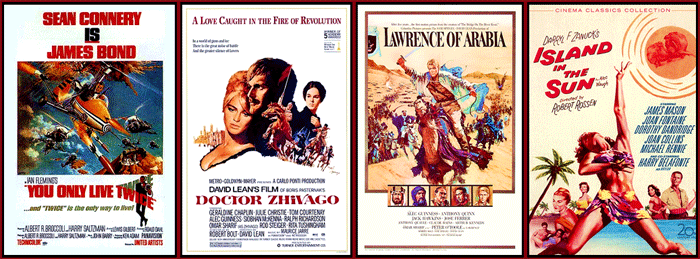
A Libyan-British production directed by Moustapha Akkad (who began his cinema career as director Sam Peckinpah’s production assistant), and filmed by Cinematographer Jack Hildyard in Libya, it was funded by the assassinated Libyan leader Muammar Gaddafi (1942-2011).

Besides the talents of Quinn and Irène, the film also featured an impressive star-cast of Oliver Reed, John Gielgud, Raf Vallone, with Rod Steiger as Benito Mussolini (2). Maurice Jarre (Doctor Zhivago; Jesus of Nazareth) wrote the music score. Out of the three costume designers who did noteworthy costumes for this movie, it was Orietta Nasalli-Rocca who costumed Anthony Quinn as Pope in English director Michael Anderson’s The Shoes of the Fisherman (1968) based on novel by Morris L. West.

Eréndira, released in 1983, featured a cruel fable involving a wealthy but tyrannical grandmother Amadis who loses everything owing to a fire accidently set by her sleepwalking granddaughter Eréndira, an innocent, obedient maiden. To recoup Amadis’ losses worth over $1 million, she forced Eréndira to sell her virginity to the highest bidder in Mexico. The casting is exemplary. Irène Papas surpasses herself as Grandmother Amadis and Cláudia Ohana as heroine Eréndira, while Michael Lonsdale, Oliver Wehe, co-starred in this disturbing black comedy directed by Ruy Guerra. The screenplay is by Colombian novelist Gabriel García Márquez (4) from two of his own stories.

In The Assisi Underground (1985), Irène is the courageous Madre Maria Giuseppina Biviglia (1897-1991), the Mother Abbess of Monastero di San Quirico (le Clarisse, the cloistered Poor Clares), Assisi. It is adapted from the 1978 book, The Assisi Underground: The Priests Who Rescued Jews as told by Padre Rufino Niccacci to Alexander Ramati who also directed the movie. The film depicts true events occurred in 1943-44 during WW2 when Catholics in Assisi, Italy, gave refuge to Italian Jews in the city’s Franciscan monastery/convent, from Nazi Anti-Semitism. This Menahem Golan/Yoram Globus-The Cannon Group production co-stars: Ben Cross, James Mason, Maximilian Schell, etc.  

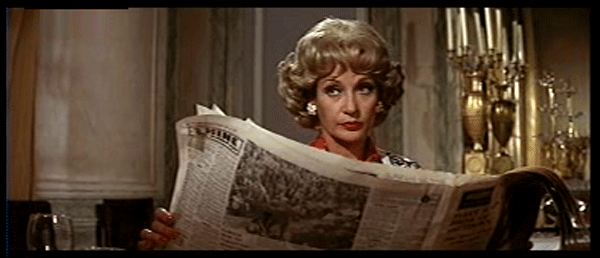
The Assisi Underground is the second collaboration of Irène with director Alexander Ramati. Nearly two decades ago, Irène starred as Ajmi in the Spanish-American production, The Desperate Ones (1967). This chase melodrama was scripted and directed by Alexander Ramati based on his novel, Beyond the Mountains, the title by which The Desperate Ones is sometimes known.

As the story goes, two Polish brothers, imprisoned in a Siberian labour camp escape and heads for Uzbekistan in Asiatic Russia where they contact smugglers who will guide them over the mountainous border to Afghanistan. During their onward progress, their various encounters include the suspicious head (Theodore Bikel) of the local N.K.V.D; a stunning blonde beauty Marusia (Maria Perschy); their benefactor’s wife Ajmi (Irène Papas), etc. Maximilian Schell, Raf Vallone, Fernando Rey, etc, co-starred. Despite the film’s exotic settings, costumes of Asian Russia and the impressive line-up of stars, adverse elements such as faulty scripting, uninspired direction, and soporific editing, badly affected the film’s success.

Irène portrayed the role of Penelope in the romantic comedy, High Season (1987) about a talented British photographer named Katherine residing in Rhodes, Greece and her involvement with obnoxious tourists, a spy, smugglers, etc. The film, with brief nudity and adult themes, marked the directorial debut of Clare Peploe (once married to Italian filmmaker Bernardo Bertolucci) and starred Jacqueline Bisset, James Fox, Kenneth Branagh, among others.

The year 1990 marked the release of TV movie, Un Bambino di Nome Gesù (A Child Called Jesus), directed by Franco Rossi. This life of Jesus is an Act of Faith. It compels attention and interest as an attempt to figure out Jesus’ missing years from age 3 to 12. Besides Irène in the role of old Maria, the film centred on Matteo Bellina as Jesus, María del Carmen San Martin as Maria and Bekim Fehmiu as Joseph. Vittorio Bonicelli co-wrote the script of Un Bambino di Nome Gesù which was mainly filmed in Yugoslavia.

Italian TV audiences may recall Yugoslavian actor Bekim Fehmiu (who flaunted shades of Porfirio Rubirosa in Harold Robbins’ The Adventurers) in the role of Ulysse (Ulysses/Odysseus), the wisest of the heroes, and Irène Papas as his faithful wife Pénélope (5) in Dino De Laurentiis production of the 1968 RAI TV Series, Odissea (L’Odyssée/Odyssey), based on Homer’s epic poem. This Teleplay featured an impressive array of popular beauties namely, Marina Berti (Arété), Marcella Valeri (Euryclée), Scilla Gabel (Hélène), Barbara Gregorini/Barbara Bach (Nausicaa), Juliette Mayniel (Circé), Kira (Kyra) Bester (Calypso), Michèle Breton (Athéna), Stefanella Giovannini (Cassandre), etc.

According to Messaggero Veneto, Irène’s last feature film was Portuguese director Manoel de Oliveira’s Um Filme Falado (A Talking Film) released in 2003. However, Ecuba, an Italian language film jointly directed by Giuliana Berlinguer and Irène Papas, was released subsequently in 2004.

Many lives progress in a more or less predictable path. Irène Papas’ journey has been different. Irène was never supposed to be what she became. Should her parents have succeeded to convince her to study architecture; her life would have been different. We all have our stories. The celebrity status of Irène Papas survives and prospers because the world still believes in the mystique of this austerely beautiful stage/movie/TV actress/singer for her talent and versatility. Theatregoers were equally impressed by her repertoire – by the wealth of her stage productions – adaptations and revivals. There really was something for everyone’s appetite. Like Irène, there were not many all-rounders who could sing, dance and act. She was one such trailblazer.

On 07 August 1998, Irène presented her first musical stage show as director of “Apocalipsis, voz de mujer” (Apocalypse, Woman’s Voice) at the International Music Festival at Castell de Peralada, Girona, Spain. Written by Greek author Yorgos Jimonás, the theme of this liturgical scenic act was reflection on the Mediterranean cultural tradition and the history of religions based on Apocalypse of St. John. The event was attended by Queen Sofía of Spain, her exiled brother Constantine II (1940-2023, former King of the Hellenes) and his Queen Anne-Marie of Denmark, Princess Irene (Queen Sofía’s younger sister), and other eminent dignitaries.

In 2018, there were media reports that Irène had been suffering from Alzheimer’s at least since 2013. For this reason she was not seen in public for some time. As her condition worsened with the passing of time, on one occasion, Constantine II, expressed his wish to visit Irène, who, I understand, was a close friend of the Royal family and also a board member of the Anna-Maria Foundation as of 2003. Such sociable visits had to be put on hold amidst fears that Irène might be unable to recognize visitors due to her illness.

Having been established herself securely in the popular imagination, and upon the strength of her national identity, Irène Papas was undoubtedly a source of admiration and inspiration to Greeks. The media wrote about her years in home care at her niece’s residence in Kifissia, a well-to-do green oasis in the northern shadow of Athens. Then again, nothing stays the same forever for there was sadness as the Alzheimer’s intensified towards the end of her life. Her last few years were spent in Chiliomodi, the place she always wanted everyone to remember she originated.

As the autumn of 2022 drifted into Greece and the nature gradually started to change the make-up, it was all suddenly over. Sadly, Irène Papas passed away on Wednesday, September 14, 2022 at the age of 93. Following a well-attended religious service at the Holy Church of Agios Georgios in Chiliomodi, Irène was buried in the village cemetery, next to her beloved parents. Death is emptiness. Antío, agápití mou Eiríni (6).        – All for now, Jo  

    Notes:

  1. The story of the Hebrew patriarch starring Charlton Heston as Moses is told in The Ten Commandments, the 1956 remake of director Cecil B. DeMille’s 1923 silent version of the story of Exodus. Read the book: Moses The Lawgiver by Thomas Keneally;
  2. This is the second time Rod Steiger portrayed Benito Mussolini. The first appearance was in the Italian war film, The Last Four Days (Mussolini Ultimo Atto/Last Days of Mussolini (1977)) co-starring Franco Nero and Irish-Italian beauty Lisa Gastoni;
  3. In March 1977, showings of this film were cancelled when a Muslim sect took nearly 150 people hostage in Washington, D.C. For more details on this hostage crisis: American Caliph by Shahan Mufti;  
  4. Gabriel García Márquez (1927-2014) was awarded the Noble Prize for Literature in 1982. Erendira was remade as Erendira Ikikunari (2008)
  5. Iliad, the epic poem attributed to Greek poet Homer, that master of energy of expression and fertility of invention, who lived in 8th century BC, recount the fall of Troy. Odysseus/Ulysses is a mythical king of Ithaca and one of the leading chieftains of the Greeks. He is the hero of Homer’s epic poem, Odyssey and therein he is depicted as wise, eloquent, and full of artifices. Penelope, the daughter of Icarius and Periboea of Sparta, is, according to Homer, the chaste and faithful wife of Odysseus, a model of all the domestic virtues. Some writers allege her being the reverse.
  6. Goodbye, my dear Irène.
  7. Due to constraints of space, the data compiled had to be chopped to keep the full text at a manageable size. I regret what has been left out and mean no disrespect to the subject of this 6-part episodic tribute. Irène Papas appeared in over 85 movies. The summary of movies stated herein relate only to those movies which are part of my collection;
  8. Up to now, the sources of reference for this concluding part of the tribute to Irène Papas are archives of the past including printed publications and visual media. DVD/Blu-ray of most of the movies mentioned in this write-up is available with some leading dealers.
  9. DVD sleeves/images shown here are only for promotional purpose. Source: Wikipedia, amazon.com, imdb, and from DVD sleeves.
  10. This illustrated article is an affectionate nosegay to the actress and movies referred above. Please refer to “About” of my webpage for more details.

 (© Joseph Sébastine/Manningtree Archive)

Irène Papas – The Fabulous Greek

My mind, sound by nature, was my teacher. I need no more.

I offered my husband a silent tongue and gentle looks.

I knew when to have my way and when to let him have his.

– Euripides The Women of Troy (642-651)

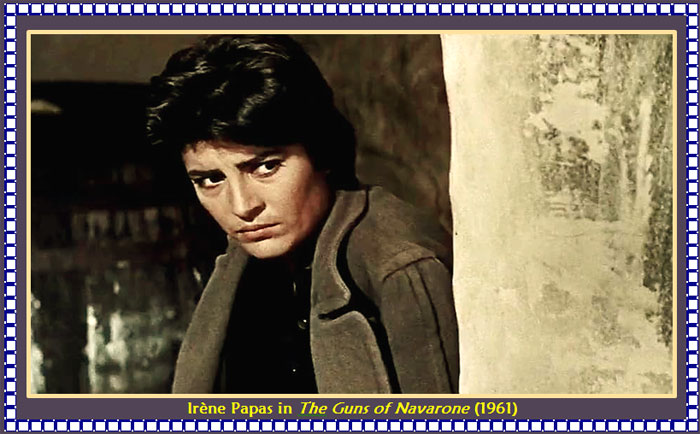
Irène Papas was finally placed under the direction of the Bristol-born filmmaker J. Lee Thompson (1914-2002) to play the role of Maria Pappadimos in The Guns of Navarone (1961). Her role is of a hardened Greek partisan fighter who develops a liking for fiery Andrea, a character played by Anthony Quinn in this film about a Nazi big-gun stronghold overlooking the Mediterranean.

American film producer and scriptwriter Carl Foreman’s The Guns of Navarone was a motion picture “event.” Being the first of Alistair MacLean’s pulsating novels to be turned into a movie, it’s a high-powered action movie by Highroad Films, an Anglo-American firm (1). Magnificently filmed in Cinemascope and Eastmancolor by Pathe, and set in 1943 during WW2, it dealt with Allied commandos and Greek resistance fighters assigned to destroy two huge newly-designed radar-controlled guns on the German-held Aegean Sea island of Navarone. These guns prevented the vital Aegean Sea channel from being used by the Allies in World War II.

Director J. Lee Thompson, who was a last minute replacement of Alexander “Sandy” Mackendrick (1912-1993), was by that time one of the most flamboyant writer-producer-directors, with Ice Cold in Alex (Desert Attack, 1958), North West Frontier (Flame Over India) and Tiger Bay (both in 1959) to his credit to which, he would later on add a string of noteworthy movies such as Cape Fear, Taras Bulba (both in 1962), Kings of the Sun (1963), Mackenna’s Gold (1969), etc.

Irène was to be part of an impressive stellar cast who have carved a prominent niche for themselves in the motion-picture world: Gregory Peck, David Niven, Anthony Quinn, Stanley Baker, Anthony Quayle, James Robertson Justice, Richard Harris, Bryan Forbes, etc. For the required amount of feminine appeal, besides Irène, Gia Scala portrayed Anna, another fighter.

James Darren (who sadly passed away at the age of 88 on September 02, 2024) played Spyros Pappadimos, a Greek-American boy skilled with a machine gun, who also performs a Greek folk song called “Yassu (Wedding Song)” in the movie.

Even though Cypress and Yugoslavia were initially considered for production possibilities, the final choice for on-location shoot fell on the Island of Rhodes, in the heart of the Aegean Sea. It’s not that the choice for filming the motion picture of this dimension didn’t face any difficulties in Greece. During that time, the local processing of the film was unpredictable; and the local sound systems were based on 17 ½ mm. tape, rather than the 35 the crew were used to. The only projection facilities that could be used were in a large hall at the local police station. The acoustics defied anyone to understand the dialogue. Then again, undeniably, the people were warm and hospitable, and willing to do superhuman feats in order to please. The government, the airlines, the hotels, etc, all contributed more in the way of service, material and personnel.

In mid-1960, as part of promotion of the movie, a stalagmite (an incrustation formed on the floor of a cavern) from the Luray Caverns of Virginia was despatched to Greece where it was swapped with a stalagmite from the Petralona Caverns of Greece and sent to Luray. These stalagmites were officially exchanged in Greece between Gregory Peck and Irène Papas.

In the course of almost seven months of shooting in Greece and England, the final stage of filming was completed in the studio in England – in one of the largest outdoor sets which took five months to construct using tubular steel, timber and about 14 miles of cable. Set-making has always been a big part of a film’s budget but it goes in phases. More than 160 workmen on a seven-day-a-week basis were involved. The outcome was the enormous guns and cave fortress towering over 140 feet into the air and stretched over an area of almost two acres, to represent the German-occupied base on the Greek island. Despite the collapse of this fantastically expensive set at Shepperton Studios as well as the continuously mounting budget, the filming had a wrap by mid-October 1960.

The movie turned out to be a blockbuster hit and not only racked up in box-office grosses but wide acclaim including royal treatment around Europe via galas before crowned heads. Special showings were attended by late Queen Elizabeth II and Prince Philip of Great Britain; Princess Grace and Prince Rainier III of Monaco; then newly-wed King Baudouin and his Queen Fabiola of Belgium; and the King Paul and Queen Frederica of Greece. King Paul conferred the Order of Phoenix and rank of Brigadier of the Greek Army on Carl Foreman for his services to Greece through the filming of The Guns of Navarone. The film netted 1962 Academy Award nominations which included Best Motion Picture, Best Directing, Best Writing (Screenplay – based on material from another medium), Best Music (Music Score of a Dramatic or Comedy Picture), Best Film Editing, etc., and the film won for Best Special Effects in the 34th Academy Awards.

Sometime earlier Irène Papas top-lined in the title role of director Georges Tzavellas’ Antigone (Antigoni, 1961) – a B/W movie (with English subtitles) of such profound dimension that it helped fortify Irène’s reputation as a fine interpreter of Greek classics on movies.

The screenplay by Tzavellas was adapted in its classical form from Sophocles’ poetic parable of the Greek tragedy of Oedipus, King of Thebes though with a modernized Greek text in the name of poetic licence. Set in the ancient Greek city of Thebes, Irène’s dramatic beauty dominates as Antigone who is condemned to death for defying King Creon by burying her two brothers killed in a quarrel over their succession to the throne of Thebes.

The shooting schedule at Alfa Studios, Athens, stretched to 58 days and the production cost ran in excess of $200,000/- which was believed to be a record high for a film made by the Greek film industry at that time. The production, which regrettably suffered delays, was carried out by Greek talent throughout; also featuring Greek performers: Manos Katrakis, Maro Kontou, Nikos Kazis, Ilia Aibikou as Eurydice, etc. Part of the cast were soldiers and horsemen of the Royal Greek Guard and Army and 500 actors of the Greek theatre and cinema. Arghyris Kounadis provided the music score.

While Antigone movie project was initiated by a Connecticut exhibitor through his Norma Film Productions, he had every expectation that the movie will eventually earn a profit due to its special qualities in relation to the cultural heritage of Greece. As a matter of fact, all the financial backing was made by American investors of Greek descent from “outside the industry” who were motivated by a pride in their Greek heritage and a desire to dispel the notion that Greece exports nothing but restaurateurs. Furthermore, this Greek heritage lining the theme of the movie was a profitable aspect the filmmakers believed helped Antigone in its promotion for its distribution to schools, colleges, libraries, cinema clubs, etc.

Distinguished productions of the classic Greek tragedies dealing with highly charged subjects as revenge, retribution and matricide, are rare owing to elevation of concept and nobility of performance. As the title character in Finos Films’ Electra (Elektra/Ilektra, 1962), the Greek classical tragedy of yore, Irène Papas finally got the chance to show off her acting chops.

As the story goes, Electra is the daughter of King Agamemnon (Theodore Demetriou) and Clytemnestra (Aleka Katselli). Upon his victorious return from the Trojan War, Agamemnon was killed during his bath by his wife Clytemnestra and her paramour Ægisthus (Fivos Razi/aka. Phoebus Rhazis), while the children Orestes (Petros Ampelas) and Electra (Elsie Pittas) waited outside. Following the murder, the boy Orestes is taken away to safety outside of the country by an old retainer whilst his sister Electra remained at the palace a virtual prisoner. In the euphoria of victory, Clytemnestra and Ægisthus married and at a subsequent time, Electra was married off to a poor farmer who respected her.

It was not until years later Orestes (Giannis Fertis) returned with a friend, and the siblings united. They plot to avenge their father Agamemnon whose murder had taken place following his return from Troy with his lover, Cassandra, one of the 50 children of King Priam of Troy and his principal wife Hecuba. In due course, Orestes killed Ægisthus during a celebration. Orestes also gained the support of the followers of the dead king whose valour was imprinted on their minds. However, Electra (Papas) urges her older brother Orestes to kill their mother Clytemnestra as well. Her contention was vengeance for the murder of their father. Orestes duly complies with Electra’s wishes. Be that as it may, shocked by the killing of Clytemnestra, the great majority of followers of the brother and sister turned against them and drove them away from the land.

Written and directed by Michael Cacoyannîs based on Euripides trilogy (The Trojan Women, 1971 and Iphigenia, 1976 followed) this United Artists’ movie version contained murder, adultery, vengeance and matricide. Purportedly made for a budget of about US$70,000/-, Electra which received plenty of art house attention in theatres world over, was shot on location in Mycenae and Argos in Greece with excellent direction, production values including dramatically powerful score by quite musically knowledgeable left-wing composer Mikis Theodorakis. The visual beauty of cinematography was by English cameraman Walter Lassally who will be back in Greece couple of years later to lens there another Greek feature, Zorba the Greek, under direction of Michael Cacoyannîs. According to Walter Lassally, Cacoyannîs pre-planned his scenes down to the last detail although he didn’t actually make sketches and his scripts were written in shots, not in scenes.

Irène’s noble beauty, facial features and performance as Electra were so appropriate that a writer once quoted in a magazine feature: “What a superb face Papas has for Greek tragedy. She is, almost, for Michael Cacoyannîs what Liv Ullmann is for Ingmar Bergman.” The admirable hairdo Irène featured in Electra was specifically created under the inspiration of Cacoyannîs which Irène retained long enough to sport at the Festival de Cannes in May 1962.

In fact, UA took precautions to ensure that no one confuses their Electra at the 15th Cannes Film Festival 1962, with the Greek-sponsored Electra, which was a filmed version of the Greek National Theatre presentation of the Sophocles version staged at the ancient Theatre of Epidaurus. Importantly, the UA version, a prize-winner of Best Cinematic Transposition (as best play-based film) is by Euripides.

Around that time, the German-born Austrian actor Karlheinz Böhm (1928-2014) planned to write and direct a modern version of Electra, set in post-war Germany with all contemporary fads and fashions, to be called “Trial of Orestes”. However, that project did not materialize. In early 1964, Electra won the Best Foreign Picture Award at the annual Cleveland Critics’ Circle prize luncheon while Irène Papas took honours as Best Foreign Language Actress.   Jo                                 

Notes:

  1. Something like 80% of the film’s budget was spent in sterling which qualified the film for the Eady Plan/Fund, a British film aid scheme which was, at that time, the envy of most other European film producing nations. The Eady Fund, which gets its income from a slice of box-office takings, is divvied out to producers of British Quota pictures. Anyone who makes a film in the UK can qualify for this aid, provided that the Quota laws are observed and that the film is made by a British company. The side-effect of this measure was an increase in the number of films Hollywood made in England. For instance, $1,000,000 plus went from the Eady kitty to The Guns of Navarone. The Eady Plan, named after British diplomat Sir Wilfred Griffin Eady, was terminated in 1985;
  2. Up to now, the sources of reference for this tribute (in 6 parts) to Irène Papas are archives of the past including printed publications and visual media. DVD/Blu-ray of most of the movies mentioned in this write-up is available with some leading dealers.
  3. DVD sleeves/images shown here are only for promotional purpose. Source: Wikipedia, amazon.com, imdb, and from DVD sleeves.
  4. This illustrated article is an affectionate nosegay to the movies referred above. Please refer to “About” of my webpage for more details.

(© Joseph Sébastine/Manningtree Archive)

Anne of the Thousand Days

Manningtree Archive has its own story – of memories one has of the past which reflect in the private collection its title implies – a non-profit library stacked with books, movies and music. Looking at it in the right way one can see that this collection is like an ever-growing garden, no doubt. Here below is a promo write-up presenting one of the movies in our collection.

Anne of the Thousand Days

(1969, Panavision-Technicolor, Hal Wallis Production/Universal Pictures)

Produced by veteran producer Hal B. Wallis (Becket, True Grit, Casablanca, Little Caesar) and directed by Charles Jarrott, this engrossing costumer with authentic sets explores the life and times of King Henry VIII. and his pursuit and conquest of the beautiful Anne Boleyn that changed the course of English history.

Adapted by Richard Sokolove from the play by Maxwell Anderson, the events, though in-accurate, are set in one of the great eras of English history – and include the tragic day of Tuesday, 19th of May 1536 when hapless Anne was beheaded by the black-masked French executioner’s sword on Tower Green in the Tower of London. She is a prisoner of history and the facts of that history are now widely known.

 Hal Wallis, a giant in the film industry, was always deeply interested in English history. In 1964, his stunning historical spectacle Becket was released – superbly acted by the million-dollar piece of talents Richard Burton (as Archbishop of Canterbury Thomas à Becket) and Peter O’Toole (as King Henry II.) and helmed by director Peter Glenville. Becket was a moneyspinner. According to Wallis, it was during the filming of Becket when Burton showed his interest in filming Anne of the Thousand Days and wanted Wallis to buy the play for him. At length, this was duly done surpassing incidental issues regarding the play’s rights.

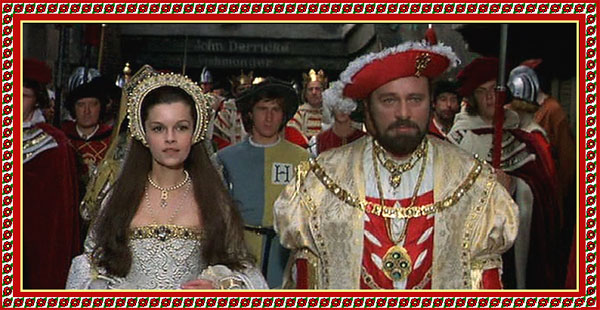
In a role originally offered to Buenos Aires-born actress Olivia Hussey (Romeo and Juliet, 1968), the young French-Canadian actress Geneviève Bujold shines as Anne Boleyn, the winsome young Maid of Honour who danced into Henry VIII’s line of vision and eventually became the second of his succession of wives, fostered by Cardinal Thomas Wolsey.

Hailing from Montreal, Quebec, Canada, the convent-educated Bujold had appeared in Montreal’s theatre productions and in films such as director René Bonniére’s Amanita Pestilens (1962), La Fleur de l’Age ou les Adolescentes/Adolescents (1964), before she was chosen in Europe by French director Alain Resnais to play in La Guerre est finie/ The War Is Over (1966) opposite Yves Montand and Ingrid Thulin. This was followed by Le Roi de Coeur/King of Hearts (1966) and Le Voleur/The Thief of Paris (1967). However, her only successful performance during that time came in the title role of Isabel (1968) which was written, produced and directed by her then husband Paul Almond. In their 28th September 1970 cover story on Bujold, Time magazine called Isabel a success d’estime.

Hal Wallis who screened movies in his private screening room at home in search of new talents was impressed by the sensitivity, warmth and youthful maturity of Bujold’s performance in Isabel for which she won the Canadian Film Award for Best Performance by a Lead Actress. He has now found his Anne Boleyn and words were pledged to Bujold.

Richard Burton who held approval rights over his co-star, also found her acceptable. Burton’s position garnered all respect. Bujold reminded him of “the late and lamented Vivien Leigh.” Burton insisted that Bujold, whom he nicknamed “Gin”, must be given ‘star’ treatment as he did himself. This didn’t digest well with wife Elizabeth Taylor who haunted the set to keep an eye on them.

Producer Elliott Kastner (Where Eagles Dare, 1968) had earlier sought Liz Taylor to do a film at the same time as Richard Burton did Anne of the Thousand Days. During the early pre-production stages a problem arose – a sense of onrushing doom for the movie. Indeed, it was the role of ravishing Anne Boleyn which Liz wanted to play.

Hal Wallis took Liz’s request with gloomy silence of disapproval. She has already  sailed past her prime to play the beautiful and coquettish young Anne. According to Wallis, Burton who was there chipped in and skilfully let the steam off: “Sorry, luv. You’re too long in the tooth.”

References to Anne’s appearance from all that I have read indicate that, besides her tall stature and classical oval shaped face with a deceptively prim mouth, the other notable feature of this refreshingly witty conversationalist was her expressive dark eyes and a wealth of black hair.

When the film was released, Bujold’s success in the role of Anne was so pronounced that it earned her the Golden Globe for Best Performance by an Actress in a Motion Picture – Drama, turning her into an overnight sensation in Hollywood. Some critics hailed her as the new Hepburn.

With many royal roles gracing his acting career, playing royalty was nothing new to Richard Burton. Seeking a powerful screen performance, Burton donned the part of Tudor King Henry VIII. (Reign: 1509-1547) – that finest dressed sovereign with a beard of gold, gigantic appetites and a will of iron who desperately desired to swiftly divorce Katherine of Aragon, his queen of nearly 2 ½ decades, to hastily wed the dazzling Anne Boleyn although her elder sister Mary Boleyn’s improper familiarities with Henry VIII. were hardly a secret in a close court where it is hard to keep secrets.

With this role, Burton entered the realm of actors who has portrayed the controversial Tudor monarch marvellously interpreted previously by Charles Laughton in the sweeping biographical movie, The Private Life of Henry VIII. (1933, D: Alexander Korda).

Greek actress Irene Papas is the richly apparelled, Queen Katherine of Aragon, daughter of King Ferdinand II of Aragon and Queen Isabella of Castile who proffered royal support to Christopher Columbus in his expeditions. Papas came across perfectly as a queen lovely in person and in mind – truly gentle and feminine in her manners as Katherine of Aragon is reputed for.

The Toronto-born Shakespearean actor John Colicos as the villainous Thomas Cromwell and one of Britain’s most brilliant character actors Michael Hordern as Anne’s father Sir Thomas Boleyn; give noteworthy performances in their pivotal roles.

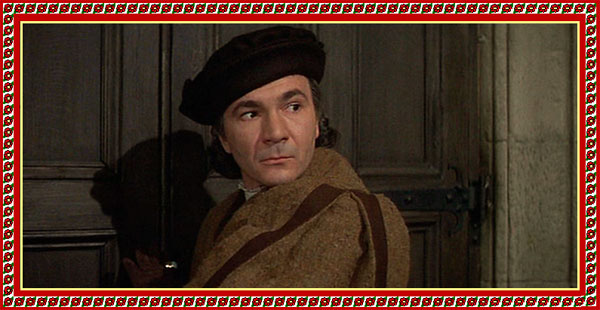
Apparelled all in red is Anthony Quayle as the skilled diplomat Cardinal Thomas Wolsey. During his earlier stage career, Quayle had tackled the title role in director Tyrone Guthrie’s theatre production of Henry VIII at Stratford-on-Avon. In that fine performance, Quayle’s Henry, with short red hair, was a very political king, strong and vigorous with a lust for life. Soon after watching the play in 1950, His Majesty King George VI. (r.1936-1952), who was with Queen Elizabeth, had gone to the dressing-room and congratulated Quayle on his splendid performance. Adding to Quayle’s favourite part of his growing resume, this portrayal as Cardinal Wolsey in Anne of the Thousand Days won him the nomination for the Best Performance by an Actor in a Supporting Role category in the 42nd Academy Awards 1970.

Others in the supporting roles are:

Joseph O’Conor (Bishop John Fisher),

Peter Jeffrey (Thomas Howard, 3rd Duke of Norfolk),

director Jarrott’s then wife Katharine Blake (Elizabeth Boleyn),

Valerie Gearon (Mary Boleyn),

William Squire (Sir Thomas More),

Terence Wilton (Lord Henry Algernon Percy, heir to the Earl of Northumberland who offered Anne Boleyn his hand and heart);

Lesley Paterson (Jane Seymour);

Nicola Pagett (Princess Mary);

Amanda Jane Smythe (Baby Elizabeth), et al et al.

At the insistence of Richard Burton, Liz made a surprise (un-credited) appearance in a bit role as a masked lady with low-cut gown in a scene featuring Katherine of Aragon being interrupted while praying in Greenwich Chapel. A report indicates that Liz Taylor purportedly received pay of $35 for the afternoon’s work. Un-credited bit roles feature Liz’s daughter, Liza Todd and Burton’s daughter, Kate.

Crew includes:

Bridget Boland and John Hale (Screenplay);

Georges Delerue (Music Composer);

Arthur Ibbetson B.S.C. (Cinematography);

Maurice Carter (Production Design);

Lionel Couch (Art Direction);

Margaret Furse (Costume Design);

Mary Skeaping (Choreography);

Richard Marden (Editor) and others.

Made at Penshurst Place, Hever Castle (Kent) and Shepperton Studios outside London, the film, sprouting from a script of 144 pages long, brims with excitement, pageantry and scenery reflecting the Tudor love of music, dancing, gardens and flowers. At that juncture when the filming was being completed, the whole world was abuzz over the landing of astronauts Neil Armstrong and Edwin “Buzz” Aldrin on the moon on 20th July 1969.

Anne of the Thousand Days was qualified for ten Academy Award nominations. Margaret Furse (Becket, The Lion in Winter) was the winner of Oscar for Best Costume Design. Her richly superb costumes were patterned after the famous portraits by German painter Hans Holbein the Younger whilst the period costumes and footwear were prepared by London firms: Bermans and Frederick Freed, respectively. The other Golden Globe awards honouring the film came for the categories: Best Motion Picture – Drama; Best Director; Best Screenplay.

Anne of the Thousand Days was selected by Her Majesty Queen Elizabeth II for the Royal Film Performance and shown at the Odeon Leicester Square, London on 01 February 1970. Prominent among the dignitaries presented to Her Majesty on that unique Annual event for charity was the film’s producer Hal B. Wallis, wife/actress Martha Hyer and Geneviève Bujold (clad in a long white gown with a white cape worn over it). She was escorted by director/husband Paul Almond. By and largest, a well-made movie. Jo

Notes:

  • Some delightful remembrance of King Henry VIII in our collection: The Sword and the Rose (1953, James Robertson Justice), A Man for All Seasons (1966, Robert Shaw); Henry VIII and His Six Wives (1972, Keith Michell), The Prince and the Pauper/Crossed Swords (1977, Charlton Heston); Henry VIII (2003 TV series, Ray Winstone); The Other Boleyn Girl (2008, Eric Bana).
  • DVD/Blu-ray of the movies referred to in this article are available with leading dealers.
  • Image source: Wikipedia, amazon, Pinterest, and from my private collection.
  • This illustrated article is an affectionate nosegay to the movie reviewed above. Please refer to “About” of my webpage for more details.

(© Joseph Sébastine/Manningtree Archive)

StarChoice 22: THE TAMARIND SEED

THE TAMARIND SEED  (1974)

1 2While in Bangkok recently, I once hopped over to the enormous Saphan Khao Fruit Market, mainly to take some photographs of the Dragon Fruit (Gao Mung Gorn) and other exotic and unfamiliar fruits you will come across in Bangkok. Now Saphan Khao Market is a fruit lovers’ paradise where most fruit-lovers can come across their requirements. Having feasted on a delicious breakfast with cheeses, cold meats, small bowl of salads and an assortment of wheat breads, and a hassle-free taxi ride from our hotel in the infamous morning traffic of Bangkok, we were not in a hurry to leave this market.   Amongst the huge crowd of customers on that day was a group of tourists from Singapore tasting and buying a fruit called “Makham wan” (Scientific name: Tamarindus indica), a sweeter variety of tamarind available in Thailand which is generally eaten fresh after peeling, while it can also be boiled in water to make a refreshing fruit drink. Native to tropical Africa and widely grown in India, the long, bean-like pods containing sweet and sour pulp of the tamarind fruit and shiny Spanish mahogany-coloured seeds is not alien to us as it forms part of the culinary usage in this part of the world just as in Latin American countries. 3 Next to the Singaporeans savouring the tamarind fruit (Puli, in Malayalam), I could see a tall plastic container with holes around its lower rim, positioned by the drainage to the side of the stall, where customers could discard the tamarind seeds and pod shells and its strings. Those holes acted as lower outlets for the dirty water to flow out when the water tap above the container is occasionally opened to cleanse the contents in it. Considering the numerous nutritional and health benefits of these seeds and pods, they were eventually collected and transported elsewhere for processing. The seeds are also a popular snack amongst the rural population as an emergency appetizer. Due to its medicinal qualities, they are roasted, soaked and eaten whole to expel intestinal parasites or added with other ingredients to make substitute for coffee. I was told that the extract of the seeds is also used in eye drops for dry eyes while these seeds are also powdered and used as starch in the textile industry. 4 At that moment, I was reminded of a curious legend told in the 1974 Blake Edwards’ film “The Tamarind Seed” in which the seeds play a pivotal role in the culmination of the love affair between the characters played by Julie Andrews and Omar “Cairo Fred” Sharif. As the legend of The Tamarind Seed goes: “A slave on Hayward’s plantation, St. Peter, accused of stealing a sheep, was hanged from a Tamarind tree. He protested his innocence, saying that the tree would vindicate him. Since then the Tamarind tree has born a seed in the shape of a man’s head.” 5 Although we longed to see that film once again, our copy was in our library in India. I stored the thought away for fulfilment at a later date. That later date turned up only after I learned of the sad demise of its male star in the central role. 6 Blake Edwards (born William Blake Crump), as we know was originally a writer and actor before he turned director of movies under the titles: Breakfast at Tiffany’s (1961); Days of Wine and Roses (1962); What Did You Do in the War, Daddy? (1966); 10 (1979), S.O.B. (1981); Victor Victoria (1982); The Pink Panther series; etc. 7 8He is also the director of Darling Lili and The Tamarind Seed, which was the second of seven films made with Julie Andrews (born Julia Elizabeth Wells) by Blake Edwards since his marriage to her in November, 1969.   The first film, Darling Lili (1970) featured Andrews as a World War I spy against the English posing as a London music hall performer who turns a dance performance into a striptease. The film failed to generate audience interest at its release but the role of Lili Smith transformed Julie Andrews as sexy from the sweetened screen image she earned from the title role (her film debut) in Mary Poppins (1964, D: Robert Stevenson). 9 The second film, The Tamarind Seed was based on the 1971 book by Evelyn Anthony, faithfully adopted for the screen by Blake Edwards, effecting modifications on the geographical details of the romantic storyline from Washington, D.C/New York to Paris/London and supplementing with scenes such as the action sequence at the London Heathrow Airport. The Tamarind Seed featured a contemporary love story with spy elements of the Cold War. 10 Now in this review of The Tamarind Seed, we are talking here about a time when KGB, Lubyanka prison, Iron Curtain were constant reminders of dread. The attractive British widow of the movie, Judith Farrow (Julie Andrews) whose husband had died in a car crash, is on holiday in Barbados to find herself after failure of a six-month affair with a married British group-Captain Richard Paterson. 11 The small hilly island of Barbados, shaped like a loin pork chop, with its large sugar cane plantations, elegant resorts, hotels, many miles of silky white beaches, and, of course, sun, has been the most favoured travel destination for sun-seekers for several centuries. Here, by sheer coincidence, Judith is strangely drawn to a tall, dark, ‘very kind, knowledgeable and generous man” called Feodor Sverdlov (Omar Sharif) staying in a neighbouring villa, here on vacation “to get away from people”. 12 No sooner their friendship became known in official channels, their activities were closely monitored. What on earth is she doing with a Russian spy? From Judith, Feodor learned that she is a personal assistant to a man called Sam Neilson of the Home Office in London. Feodor let her know that he is employed as a military attaché at the Soviet embassy in Paris. During the time they have been seeing each other, they had developed simple, satisfying routines: two dinners, an early morning swim, a dinner at the Colony Club and sparkling conversations. While on a visit to the Bridgetown museum, they came across “The Legend of the Tamarind Seed” and a seed in the shape of a man’s head. Impressed by the legend, she wished she would find such a tamarind seed. 13 Ever since they met, Feodor had been full of life, energy, and mischief and let her know of his desire for her. Although she found him affectionate and harmless, she was always thinking defensively. All the same, she told him about her failed affair with Captain Paterson, a mistake she admitted to Feodor later. Feodor too was not far behind in telling her about his unhappy marriage to a woman back home, who is a very good judge of everything and knows exactly what is right and what is not right. He didn’t find it a great mistake in letting her know that he did not feel anything for the socialist revolution anymore. The following day, as Judith wanted, they went looking for the tamarind tree at Hayward’s plantation. 14 Later, en route to London, Judith’s flight was over the Atlantic Ocean when she found a tamarind seed, in the shape of a human head, in an envelope given to her by Feodor when he bid goodbye at the hotel. She was happy so now had her tamarind seed. 15 In Paris, Judith was interrogated by Jack Loder (Anthony Quayle), the British Intelligence officer located at the Paris embassy, which Judith found irritating, but felt helpless. 16 Her friendship with Feodor has put her in a cloud of suspicion and she is considered a security risk. Questions were raised at her. Was their meeting really accidental? Why did this man choose Judith out of the whole island? Was Feodor trying to recruit Judith as spy? The way Judith was, she would be a brilliant gift to them. Anyhow, Loder would take the issue in stride and directed her to inform him of any specific developments. Jack Loder had other worries, too. He worked in a world of political loyalty, betrayal, murder and professionalism. He had discovered that an unknown Soviet spy under the code name “Blue” existed within the British government. 17 Arriving back in his Paris office, Feodor spoke of his friendship at Barbados with his Russian boss, General Golitsyn (Oscar Homolka). The General, who listened with perceptible interest, was led to believe that the woman in question has a very confidential job at the Home Office in London and could be very useful. Feodor also suggested that he could recruit Judith. In fact, Feodor secretly believed that this ploy would enable him to meet Judith again, the inspiration and object of his love, and he can continue with the affair blossomed at Barbados. 18 In time Judith met up with Feodor for a dinner and let him know about Loder’s interrogation. Feodor advised her to “try to tell the truth as long as possible, that way when time has changed and you have to lie, there is a great chance that you will be believed.” Although in the beginning Judith was wary of starting a new relationship, things are different now. Later, based on warning from Judith, Feodor decided against returning to Russia but elected to seek political asylum in Canada with the help of Captain Paterson and Jack Loder. Feodor will not go empty handed to Canada. In exchange to set up home there with the usual guarantees, Feodor will be a very worthy acquisition to Britain. His offer to the British would be magnificent: the identity of the unknown British traitor “Blue”. For that prize, he knew Loder would plan everything for Feodor down to a “T”. 19 Subsequently, Feodor stole an ultra-secret file from the Soviet embassy for the British intelligence – an action which would set off the bulls and bears of the good old days of the Cold War lashing out dangerous repercussions in the lives of Judith and Feodor. 20 As the character of actor Donald Sutherland spoke in the 2003 version of the movie, The Italian Job: ‘There are two kinds of thieves in this world: the ones who steal to enrich their lives, and the ones who steal to define their lives.’ Well, Feodor’s reason is obvious. 21 Produced by Ken Wales with music by John Barry, the American-Britsh romantic drama, rated PG, has an impressive line-up of crew: Ernest Walter (Editor – The Shoes of the Fisherman (1968)); Harry Pottle (Art Direction – You Only Live Twice (1967)); Maurice Binder (Main title designer – earlier James Bond movies); John Briggs (wardrobe supervisor – Isadora (1968)) and Academy Award-winning cameraman Freddie Young (Doctor Zhivago/Lawrence of Arabia). Young had worked in Barbados earlier for the 1957 film Island in the Sun (Dir: Robert Rossen) 22 British-born Julie Andrews in the role of the British Home Office functionary has the role tailor-cut for her. Julie is always worth looking although in this movie she does not wholly delve beneath the surface of her character. Julie Andrews’ clothes in this film are by Christian Dior and co-ordinated by Emma Porteus. 23 With his dark Egyptian features and smouldering eyes, Omar Sharif (born Michel Demetri Shalhoub) as the Russian spy lover displays a masterly flair in liveliness and chivalry, and, of course, very persisting with his wanting for Judith ever since he met her. Sharif was a very popular heart-throb during this period with a string of romances and a steady row of films prior to The Tamarind Seed: The Last Valley (Dir: James Clavell), The Horsemen (Dir: John Frankenheimer) and The Burglers  (Le casse, Dir: Henri Verneuil). 24 In 1973 when he appeared as Le capitaine Nemo in six episodes of the TV-Mini-Series L’île mystérieuse, he had purchased a huge mansion on the Spanish island of Lanzarote (in the Canary islands off the coast of West Africa), calling it Casa Omar Sharif. In May, 1973, The Tamarind Seed started initial filming at locations at Barbados’ west and east coasts before the unit shifted to London for further filming. Meanwhile, in early June, Omar Sharif won The Ladbroke World Master Bridge Championship, when he beat the former champion Latvia-born Boris Schapiro in London. 25 Under Blake Edward’s intelligent and sophisticated direction, the film also features an impressive line-up of supporting cast: Anthony Quayle; Oscar Homolka (Final film); Irish actor Daniel O’Herlihy (Fergus Stephenson, the British minister in Paris); David Baron (Richard Paterson); Celia Bannerman (Rachel Paterson); Bryan Marshall (George MacLeod); live up to the roles of their characters. Also in the supporting role is English actress Sylvia Syms (Sylvia May Laura Syms OBE) as the unhappy diplomatic wife Margaret Stephenson with desire for unholy carnal pleasures and an energizing passion for dominance. Syms, who would act as Queen Elizabeth the Queen Mother in The Queen (2006, Dir: Stephen Frears), earned a BAFTA nomination for The Tamarind Seed. 26 Other members of cast: Roger Dann (Colonel Moreau); Sharon Duce (Sandy Mitchell); George Mikell (Major Stukalov); Kate O’Mara (Anna Skriabina); Constantin de Goguel (Dimitri Memenov); Alexei Jawdokimov (Igor Kalinin); Janet Henfrey (Embassy Section Head); John Sullivan (1st KGB Agent); Terence Plummer (2nd KGB Agent); Leslie Crawford (3rd KGB Agent). The film is also known under the titles: La semilla del tamarindo (Spain); Il seme del tamarindo (Italy); A Semente de Tamarindo (Portugal); Die Frucht des Tropenbaumes (West Germany); Sementes de Tamarindo (Brazil). The Soundtracks are: a) “Play It Again” sung by Wilma Reading (uncredited) – Music (John Barry), Lyrics (Don Black) and b) “Man with a Monkey” Music (Sam Fonteyn). 27 The Tamarind Seed was filmed through facilities of Samuelson Film Service Ltd, London. Besides locations at Eaton Square, Belgravia, I remember having read somewhere that more location shooting was facilitated at the London Zoo, at scriptwriter George Axelrod’s house in Mayfair district and at a Jazz Club. In Paris apart from Champs-Élysées, and other streets, locations included France-Amériques, Orly Airport, etc. 28 The film never fully explores the attractions of Barbados which retains its Old World charm which is British. On a historical note, this is the place where George Washington brought his brother, Lawrence, in 1751 to recuperate from tuberculosis (now known as the George Washington House) – the only land outside North America Washington ever set foot. Apart from the scenic beauty of the sandy beaches and the horizon, people lazing under coconut palms, parts of cultivated countryside, and interior of the museum, hotels, etc, the heritage monuments and picturesque sights of the island are not shown – such as the bronze statue of Admiral Lord Nelson (erected on 22 March 1813) at Trafalgar Square (renamed National Heroes Square) in the picturesque capital city of Bridgetown, which is older than the Lord’s statue in London. 29 With a good script, charming performances, haunting score, this is a lovely movie for those who love ingenious espionage thrillers and mature romance – a mellow way to end the day. Jo. 30 Notes: 1.. The DVDs of the movies referred in this article are available with main dealers such as amazon.com, TCM Shop, etc.

2.. This illustrated article is meant for the promotion of this movie. Please refer to “About” of my webpage for more details. 31

3.. The book Judith is reading when she first met Feodor is a hardback edition of Kingsley Amis novel The Riverside Villas Murder, published in 1973 (read elsewhere that this dust jacket was designed by illustrator and children’s author Ian Beck.)

4.. Darling Lili gathered Academy Award nominations for Best Original or Adaptation Score and Best Original Song (Whistling Away the Dark – sung by Julie Andrews) for Henry Mancini (music) and Johnny Mercer (lyrics); and for Best Costume Design for Jack Bear and Donald Brooks.

5.. Evelyn Bridget Patricia Ward-Thomas (pseudonym: Evelyn Anthony, Anthony Evelyn, Eve Stephens) born on July 3, 1928, and convent educated, wrote ten successful romance/historical novels before turning to genres: Mystery/Crime/Suspense. She lives in Essex, England.

6.. Those of you who liked the novel “The Tamarind Seed” may like to check Evelyn Anthony’s “The Defector” for their similarities. Further books by Evelyn Anthony currently in Manningtree Archive:  32 33 34 35 7.. Sharif divorce his wife, Egyptian film and television actress and producer Faten Hamama in 1974, the year this movie was released (Faten Hamama died on January 17, 2015 at the same age Omar Sharif will join his former wife at the grave in less than six months later.)

8.. Julie Andrews is the second Julie to become Sharif’s heroine following Julie Christie of Doctor Zhivago. Julie Newmar was his co-star in Mackenna’s Gold.

9.. The movie’s links to month of July: Author Evelyn Anthony was born on July 3 (1928); Director Blake Edwards born on July 26 (1922); Omar Sharif died on July 10 (2015).

10.. This article is in memory of Omar Sharif – May his soul rest in peace. 36

(© Joseph Sebastine/Manningtree Archive)