Archives

The Florentine Mystique

Continuation of: The Greek Connection

Wherever you go, there you are – Confucius

Mindful walking during daytime is a pursuit we engage in whilst we are in Firenze. Such legwork on days of less tourist frenzy not only helps to face fewer hustle and gearbox but also inspires to look around through the eyes of Love. Getting out and about here would reward one the opportunity to reflect on the barometers of a community that was fashioned by this architecture of mediaeval characteristics – originated from the various strange phases of Florentine history.

Unlike passeggiata, the Italian tradition of taking an after-sumptuous-meal leisurely stroll for fun, socializing or for health reasons, an observant visitor on easy-going walks around the streets and piazzas of this City of Flowers proffer a distinctive Italian atmosphere and colour.

Since olden Italy was divided into small States and constantly at war with each other.  On that note, the dwellings of great families were generally composed of a double wall of strong stone masonry to turn them into strongholds. And so, some of the greatest architectural achievements in Firenze of that period were houses so outsize they were considered as palaces.

The mediaeval characteristics are much evident in Firenze’s piazzas, courtyards, gardens, open arcades, etc. Distinctive features of the buildings reveal deep-set windows protected by heavy iron grills, arches, porches, and curves that express feeling in design.

While the roof line below the terracotta is adorned with heavy, ornamental cornice, the walls are divided into sections with vertical pilasters and horizontal strips of mouldings. The street front has the popular round-headed windows while the ground floor windows, smaller in size, are appropriately defended with barred grills.

In the photographic viewpoint, there are fabulous shots of varied angles all around which includes after-rain puddle reflections and curious modern day sights.

There are numerous Tuscan Romanesque arches, frescoes on the walls, decorative street lamps, old horse tethering wrought iron rings on the walls, bas-reliefs on lintels, iron holders on the walls for torches to illuminate the street, etc (1).

In the architectural point-of-view, the kind of marbles, including Carrara marble, and other materials for construction and architectural adornment used all around here are of varying characteristics.

Of the two main types of sandstones, pietra forte, the fine-grained, brownish-yellow sandstone of considerable resilience is the primary material and used widely as well as in the construction of prominent edifices such as Basilica di Santa Croce, Palazzo Pitti, Santa Maria Novella, Palazzo Vecchio, etc.

At Cattedrale di Santa Maria del Fiore, pull focus and take another look up at the Cupola of Filippo Brunelleschi (1379-1446). Pietra serena, the silvery grey sandstone much favoured by Brunelleschi, is used widely there – particularly at the three girdling belts of the Cupola.

All this may seem rather nostalgic pictorials of old architecture and ornate details and may seem looking backwards. Better still, we understand Città di Firenze clearer as our perspectives evolve to the realisation that the splendour and flair of the past goes with you at every step in Firenze, which the illustrious Dante Alighieri praised as ‘La bellissima e famosissima figlia di Roma’ (3).

Follow on: M as in Michelangelo

Notes:

  1. Some of the cast iron piazza/park bench supports, lamp-posts, sewer covers, are still marked with Fonderia delle Cure – Giovanni Berta in Firenze (likewise in Rome), relates to the earlier century.
  2. Pietra serena: Mainly used as ornamental, art, architectural decorations, etc, pietra serena or pietra di macigno is an elegant variety of calcareous sandstone composed of sedimentary layers of different colour. Because of its good mechanical strength it is used also at Cappella dei Pazzi and Cappelle Medicee. The archives of the Opera del Duomo will be of much use to those interested more on this subject.
  3. La bellissima e famosissima figlia di Roma: Beautiful and famous daughter of Rome.

(© Joseph Sébastine/Manningtree Archive)

The Greek Connection

Continuation of: A Procession of One

Each day is a little bit of history – José Saramago

Firenze, the name Florentines love to call their city in Italian is used by us only during our visits and in our writings. Like the ancient Florentines did, between my wife and I, we call it in its older and most beautiful form: FIORENZA, because she flourished exceedingly and was the Flower of all Italian graces. Fiorenza has music to it for those who listen in the pleasantness of old tradition. 

The imposing sculpture of Baccio Bandinelli’s Hercules and Cacus at Piazza della Signoria depicts Hercules holding the hair of Cacus, the giant kneeling in defeat before him, while he held a club in his right hand, the famous weapon he had cut for himself in the forest of Nemea.

I have always looked at this Renaissance sculpture in a wholesome way – certainly not in awe of it. Short of any pretention as a scientific expert on Arts or scholarly expert of Greek antiquity, I prefer to merit it as nothing less than an admirable work although it can be said that the artist’s projection of strength is mere bulk.

Conversely, in what I have scrutinized and thought of this sculpture aside from the comments and reactions of its onlookers I came across at the Piazza della Signoria, one can hardly disregard the many serious, biased, cultivated kind of art-writings from Giorgio Vasari (1511-1574) and Benvenuto Cellini (1500-71) down to our modern day scientific art critics which strengthen one’s conviction that the sculpture lacked that exceptional magnetism that could turn the heads of onlookers and fixate their attention on it. 

Although Hercules clad in the skin of the Nemean lion is a popular image; he is often represented naked as he is portrayed here by Bandinelli: a powerful upper body with rigid set of shoulders, short necked, head smaller in proportion to full muscular limbs, a curling beard which does not mar the serious expression from the general area of his face. One could note a similarity of those features on sculptor Giambologna’s (Giovanni da Bologna, ca. 1529-1608) Hercules slaying the Centaur Nessus (1599) displayed few feet away under the right-hand arch of the noble Loggia dei Lanzi (1).

Installed as a pendent to Michelangelo’s biblical hero David (popularly called Il Giganté), the naked Hercules parallels the stark nakedness of David who stood with his body’s weight resting on right leg, his gaze divulging an inner anticipation for the next course of action to take. Taken together, the nudity depicted here bespoke of the period when nude studies of male figures was the norm for gods, heroes and even renowned mortals.

Very early on, nude and partially nude artworks based on antique characters have shown their presence in Italy. It took wider popularity with the rediscovery of art of ancient Greece and Rome. In effect, the Greek sculptors’ main interest was to portray man at his idealized best since man was particularly considered as the noblest measure of all things to them – undifferentiated from the gods they conceived in man’s likeness. The representation of Gods, warriors and mortals in heroic nudity was the sculptors’ open admiration for the perfectly formed male body which is hardly a sensual aspect in the society of a time where athletes openly workout in scant clothes for events like Olympics.

Hercules being a favourite hero and symbol of the Florentine Republic, it’s hardly surprising to come across many such representations in Firenze. One cannot ignore the Trecento Florentine Seal which bore the image of Hercules since about 1281, as a testimony to the familiarity of Hercules in the Florentine culture.

Since we usually rent apartments for our Florentine visits in the vicinity of Piazza del Duomo or in the area between Il Duomo and Piazza S. Marco, we cannot avoid touching upon Piazza del Duomo almost every day of our stay in Firenze.

The group of ecclesiastical buildings which form the center of Firenze comprise of Cattedrale di Santa Maria del Fiore (Il Duomo); the octagonal Baptistery (Battistero di San Giovanni) (2) and Campanile di Giotto (belfry tower).

Il Duomo was named Santa Maria del Fiore in reference to the lily (the emblem of Virgin Mary) in the red shield of the Republic, which indicates the tradition that Firenze was founded in a field of flowers. This edifice was built on the site of the cathedral dedicated to S. Reparata who, at the tender age of 12, had undergone martyrdom in Cappadocia during the persecution of Roman Emperor Decius in 3rd century AD. From 680 to 1298, she was the primary patroness of Firenze, following which the city was placed under the tutelage of Virgin Mary and S. John the Baptist. According to a legend, Santa Reparata itself was erected on the ground occupied by the parish church of San Salvador. Subsequently, when Santa Reparata was raised as the parish church, the Baptistery became pro tempore the Cathedral for a few years.

At Piazza di S. Giovanni, it’s delightful to remember Lorenzo Ghiberti’s (1378-1455) artistic works on the gilded doors of the Baptistery situated across from Il Duomo. Ghiberti most likely cast it in a process the French called, encirage, using the same enormous furnace in his workshop in Via Sant’Egidio, nearly opposite Santa Maria Nuova, where he had created the Northern Gates. Taking in the astonishing beauty of these celebrated doors of the Eastern Gates, Michelangelo once praised them as fit to be “the Gates of Paradise.”

On the southern side of the Baptistery was a representation of Hercules amongst the eight depictions of virtues belonging to the 28 gilded bronze reliefs on Andrea Pisano’s (ca. 1270-1348/9) bronze door, probably the earliest in Firenze (3). Another representation from the workshop of Andrea Pisano is the relief of Hercules and Cacus (Lower register No 2: Social Justice) on the eastern side of the Campanile di Giotto which supposedly occupy the site of a small oratory of S. Zenobius, the first bishop of Firenze. 

Follow-on: The Florentine Mystique

Notes:

  1. Loggia de’ Lanzi is so called from the Swiss lancers who were placed here by Grand Duke Cosimo I.
  2. Although the date of Baptistery is lost in uncertainty, legend has it that theedificewas supposedly erected in 589 by German-born Theodelinda (Theudolinde, 570-627), daughter of King Garibald of Bavaria and queen of the Lombards who was devoted to the Christian faith of the Catholics. In about 1229, works under Jacopo de’ Lapi took place to level the ground around Baptistery and replace the old brick pavement with stone. A book relates the occasion as: “At that time the Baptistery stood at a higher elevation than afterwards, and at the base were steps. Around the building were ranged Roman sarcophagi, which were used by Florentine families of distinction for internment, as well as for monuments, when the entire Piazza between the Cathedral and Baptistery constituted the cemetery of Florence.”
  3. Since December 2019, all three sets of bronze and gold doors of the Baptistery are displayed next to one another at the Sala del Paradiso of the Museo dell’Opera di Santa Maria del Fiore after completion of the restoration project began in 1978 by the Opificio delle Pietre Dure in Firenze.

 (© Joseph Sébastine/Manningtree Archive)

A Procession of One

Continuation of: Distant Fire, Delightful Gleams

There are certain things in life one feels to be good and beautiful and must hunger after them. Throughout the 15th century Italy (1), it had become fashionable for men of wealth, influence and of the church to decorate their premises with fine arts of those derived from the classical Greco-Roman cultural heritage – collections primarily of Greek art from finds in mainland Italy and Sicily.

It is no small matter how much the architectural and artistic achievements of the ancient Greeks have set its effects on the Western culture in general. The renewed interest in the classical past and in the grammar of Greek architecture came not only with the progress in trade and banking activities of both Venetian and Genoese families in the Aegean, but also from the steadily growing awareness and appreciation in Western Europe for Greek literature. While, amongst other aspects, this was fostered by the printing of Greek type initiated by Aldus Manutius (ca. 1449-1515) in Venice’s Sant’Agostino neighbourhood, it also spearheaded an increase in the influx of visiting scholars between Western Europe and the Greek lands.

The taste for art collecting per se aroused far reaching expectations for a brilliant coterie of sculptors, painters, and goldsmiths which occasioned burgeoning of an imposing series of reproductions of Greco-Roman art, etc.

On an equal par with Genoa, Milan and Venice in northern Italy, Firenze of that time was one of the richest, liveliest regions of varied economic activity. Primarily a manufacturing centre with booming export trades, its principal foundation of wealth lay in the cloth industry. Furthermore, the Medici Bank which ranked as the biggest and most respected financial magnets of Europe was a prestigious laurel to Firenze’s singular privilege as the top most banking centre.

Mindful of the historical personalities of the wealthy merchant families of Firenze, foremost amongst men from the long line of bourgeois Mediceans includes: Cosimo de’ Medici (Cosimo di Giovanni de’ Medici/Cosimo the Elder (Pater Patriae, 1389-1464), his grandsons: Lorenzo de’ Medici (Lorenzo il Magnifico, 1449-92), Giuliano de’ Medici (1453-1478) (see profile pictures on the title card (2)), and counting two of their family popes: Pope Leo X (Giovanni di Lorenzo de’ Medici, 1475-1521, pope from 1513), and Pope Clement VII (Giulio di Giuliano de’ Medici, 1478-1534, pope from 1523). As Mediceans, theirs was a procession of one – all too princely a Medici to neglect their great patronage for all kinds of arts and science. 

Essentially, the Medici transformed art’s status to “fine arts”. There is some modern-day appraisal that this view could be a myth created by the Medici themselves. Then again, to appreciate the many-sided aspects that could outshine this view, of course, one should go to Tuscany and Italy on the whole. Where better to do it than there?

The Medici’s endeavours helped to remove the impediment on opportunities at hand for their contemporary sculptors, painters, architects, and thereby enriched their earnings, career success and recognition. Above all, they paved the way for most of the artisans to demonstrate their brilliant talents and expressions through so many artistic treasures of the Renaissance. One such personage was Baccio Bandinelli (Bartolommeo di Michelangelo Bandinelli/Brandini, 1493–1560).

Baccio Bandinelli was one amongst the most favoured by the House of Medici which included the great maestro Michelangelo (Michelagniolo di Lodovico Buonarroti (1475-1564), Donatello (Donato di Niccolo di Betto Bardi, ca. 1386-1466), Bertoldo di Giovanni (ca. 1440-1491), Giuliano da Sangallo (Giuliano Giamberti, 1443-1516), Sandro Botticelli (Alessandro di Mariano Filipepi, Ca. 1444-1510), Leonardo da Vinci (1452-1519) amongst others.

Being one of Firenze’s principal mannerist sculptors, it was Baccio Bandinelli who created the sculpture: Hercules and Cacus(1525-34) which stands guard on a pedestal on the right side of the portal of Palazzo Vecchio while, a marble replica of Michelangelo’s David (1501-04) (3) stood in pride of place on the other side along the old Ringhiera (4).

Follow-on: “The Greek Connection” (Part 3)

  1. The term Italy in this write up refer to the country as a whole since Italy finally became a unified nation-state only in 1871;
  2. Picture credits of Title header: Source: commons.wikimedia.org: From left:

1) Ritratto di Cosimo il Vecchio – Portrait of Cosimo de’ Medici the Elder by Jacopo Pontormo (1494–1557) – Galleria degli Uffizi, Firenze;

2) Ritratto di Lorenzo Il Magnifico Portrait of Lorenzo de’ Medici by Giorgio Vasari  (1511–1574) – at Galleria degli Uffizi, Firenze; 

3) Portrait of Giuliano de’ Medici by Sandro Botticelli (1445–1510) – at Accademia di Belle Arti G. Carrara, Bergamo

3) This substitute of Michelangelo’s David was created by sculptor Luigi Arrighetti (1858-1938) with Saul Fanfani (1856-1919) and installed here in June 1910. The original David (installed in May 1504) was removed in 1873 to the shelter of Galleria dell’Accademia Firenze to avoid further weathering and damage. A bronze cast of David by Clement Papi (1803-75), can be seen at Piazzale Michelangelo, Firenze, where it was on view from September 13, 1875

4) Only the remnants of the original Ringhiera of the 14th century remains after its removal in 1812.

(© Joseph Sébastine/Manningtree Archive)

Distant Fire, Delightful Gleams

I have come where I have long desired to be…. – Charles V

Within the wide Piazza della Signoria and its Loggia dei Lanzi (1), the open-air museum on the southern side, there are many sculptural art from a time when Arts enjoyed extensive prosperity in Firenze (Florence), Italy.

This area was frequently bustling with activity before the outbreak of Covid-19 pandemic took over globally and triggered significant precautionary restrictions such as traveller mobility, health-related formalities, border closures, travel bans, etc.

As in the case of Italy, the world’s fifth-most visited destination, the crisis inflicted a heavy toll on its tourism, plunging it into the worst recession since World War II. But the recent popular expression, “Even George Clooney doesn’t come anymore with this pandemic,” is now giving way to optimism among the population as there are efforts to reopen the country to tourism from June forward owing to the progressive easing of restrictions and the awaited EUDCC (EU Digital COVID Certificate) Gateway for safe movement between countries.

Being constant visitors, Firenze is always linked to our minds with summer and sunshine. When the blue Tuscan sky is magically clear or whenever we do not entertain any intention to swap Firenze (its palaces, monuments, galleries and piazzas, etc) for a full-field investigation of the towns and cities nestling in the hillsides of Tuscany, this here is one of the places where we often spent time during the Florentine leg of our visits.

A certain pleasing ambiance prevails at this sprawling Piazza with its public-space displays which are more conducive to us for serious reflection than just to sit elsewhere in Firenze and people-watch – even though, at times, with the pleasure of listening through earphones to the delightful masters of Italian opera: Gaetano Donizetti (1797–1848), Vincenzo Bellini (1801-35), Giuseppe Verdi (1813–1901), or Giacomo Puccini (1858 –1924), in their home settings.

Compared to the public squares of Firenze such as Piazza del Duomo, Piazza Santa Croce, Piazza della Repubblica, the show-place of Firenze is Piazza della Signoria. This is reputedly the place where almost all the Florentine history probably has passed.

Adding to its plus side are all those strenuous sculptures executed with the most delicate mastery, as well as the great “Neptune” fountain (Fontana del Nettuno/il Biancone) of Bartolommeo Ammanati (1511-92). In many instances, it leaves distinct impressions and memories on the visitors.

During high tide of visitors in the Piazza, few may fail to notice an inscribed circular plaque on the pearl grey Pietra Serena (2) paved pavement which marks the spot of the Cimento di Fuoco, the ordeal of fire on May 23rd, 1498 when Girolamo Savonarola (1452-98) was hanged and burned.

Before the Loggia became a day-to-day controlled area for certain hours following an episode of vandalism to the marble statue of Pio Fedi’s “The Rape of Polyxena” (3), we used to sit on the left stone-terrace that runs between the two Corinthian columns, closer to the lion by F. Vacca (4), one of the two colossal marble Medici lions which flank the entrance of the Loggia.

The imposing Palazzo Vecchio loomed to our right. Its principal doorway with an overhead decorative fronton is conspicuous in the center of the two “termini” posts, which formerly served as supports to the chain to bar the entrance.

From where we sat, it was easier to clearly admire the topic of my present write-up located on our right side of Palazzo’s entrance: the white marble sculpture of the most celebrated of all the heroes of antiquity in the Renaissance’s colourless view of the Classical nude: Hercules.

Continued in Part 2: “A Procession of One

Notes:

  1. The loggia was variously known as Loggia dei Priori, Loggia della Signoria, Loggia dei Lanzi, Loggia di Orcagna, D’Orcagna – not necessarily in this order. By Benci di Cione and Simone di Francesco Talenti, the Loggia (1376-82) was originally designed to shelter the Signoria from adverse weather conditions during civil and religious ceremonies or to accommodate the Priori for their convocations of the people. In contemporary times, it suits as a venue for Live Orchestra concerts, etc.
  2. Pietra Serena: Sandstone typical of Florentine Renaissance architecture and building mainly extracted from the hills of Settignano and Gonfolina area/Lastra a Signa, in the northeast and in the west of Firenze.
  3. Pio Fedi’s “The Rape of Polyxena” (1865/6) depicts Achilles receiving Trojan princess Polyxena when she offered herself for the return of her brother Hector’s body. Having secured Polyxena in his left arm, Achilles’ sword is raised to beat Queen Hecuba, who is desperately trying to protect her daughter. The dead person under Achilles’ feet is the corpse of Prince Hector.
  4. The right lion is of Grecian origin brought from Rome together with the 6 antique sculptures placed against the inner wall.
  5. This is for Carina, my travel companion and wife, who understands perfectly what ‘dedication’ means.

(© Joseph Sébastine/Manningtree Archive)

The Grand Entrance

Soon it will be “Goodbye 2010s” to an eventful decade and on its wake will resonate “Hello 2020s” in spirits of fresh-found confidence. Despite the anticipations of the prospect of a flourishing brand new year, considering the shifts in attitudes, fixation on praising excess, awful incidents emerging around the world, etc, one can’t help feeling a quiver of anxiety about what have the wheels of fate in store. As the years roll by with an almost frightening rapidity in a fusion of happiness, apprehensions and solidities, experiences prove that there are instances when one could not help feeling like a hooked fish on the time’s line.

Now as we hold up five fingers, four, three, two …. to signify the final-run-down to the Christmas day, the tale of Christmas miracle cannot be aptly told without music. This time around, in our mind’s eye, we go to Salzburg – to that gem of the Austrian Alps of castles, fortresses, churches, museums, parks, and, of course, nature.

Some years ago, we had the pleasure to drive around and savour the enchantment of Austria. Vienna hosted us as the base of our domicile for this visit. A clear rival to Paris in the superiority and variety of its architectural decorations and every style of art, Vienna proffered us a good stroke of fun with the fortunate presence of our friends.

As I wrote in earlier posts, we drove or foot-marched over much of the city to set our sights on the fave haunts of the locals and also on out-of-the-way tourist spots not counting the 18th-century Schönbrunn Palace, the Museums, Wiener Staatsoper, the Burgtheater, Stephansdom, Café Sacher Wien and other coffee spots where no one knows how to make bad coffee.

Hoping to get some more inspiration and to make good of the plentiful time at our disposal, we had jumped in with both feet and visited places as far as Graz, Salzburg, and their vicinities. Without a glitch, those days were mostly bright and of clear blue sky. All the way the only shadow cast was from the trees.

Our trip to Graz was covered in the car and company of my old business friend in Vienna from my days in the Middle East. At Salzburg, we were driven around by Herr Rupert, a gentlemanly fellow who only wanted to please as he took us around. Rupert, as we know, is the name of the patron saint of Salzburg who founded the Abbey of St. Peter’s beneath the sheltering cliffside of Mount Mönchsberg in the center of the Old City. With musical luminaries as talented as Wolfgang Amadeus Mozart and Herbert von Karajan gracing the annals of the city, the delight of music is so divine and tangible in the air.

Now back to Christmas – a little more than 200 years ago, Josef Mohr (1792-1848), an assistant priest in the sacristan of Oberndorf bei Salzburg wrote a new poem of Christmas flavour at his first parish in Mariapfarr, the village of his father where Josef had cut his teeth as a priest at a young age in 1815.

Although limited to a year, Josef’s clerical term out at Mariapfarr was in 1816 when Prince Klemens von Metternich (1773–1859), the Chancellor of Austria, won repossession of the Province of Salzburg for Austria from the Bavarian crown. The following year, Josef was appointed as curate to Oberndorf, about twenty km from Salzburg. It was a village of boatmen, wooden and stone houses located on the Austrian bank on the serpentine bend of the River Salzach (Salt River/Igonta). Originally a Roman settlement, Oberndorf was mentioned in the Salzburg chronicles as early as 1050.

It is said that a clergyman sees you at your best, a lawyer at your worst and a doctor as you really are. Having taken up residency in Oberndorf, Josef conducted his priesthood which enriched the life of that parish.

During the morning of the day Josef had written the poem, he was with his closest friend Franz “Franzl” Xaver Gruber (1787-1863), a village schoolmaster, song writer and church organist. Josef was attending a celebration in the school house of Franz in the village of Arnsdorf when they realised that there was no really great Christmas song. The Christmas is already right at their doorstep.

And so, the poem Josef wrote celebrates the greatest birthday of all time – illumines the holy night and the birth of a baby in a stable at Bethlehem long time ago. It held the vision of a baby so little and soft – pure as a white flame. Having grown up close to River Salzach, no doubt, Josef must be inspired by the legend of the statue “The Enthroned Madonna with Child” (about 1500) which is believed to be a work of miracles and supposedly washed ashore by the ice-drift in the River Salzach.

At Josef’s instance, Franz who lived in Arnsdorf and performed in the post of organist at Oberndorf since 1816, soon composed tune to accompany the poem in German verses which was named the “Stille Nacht, heilige Nacht” (Silent Night). A task he accomplished creditably, Franz’s composition, said to be done during the afternoon of November 24, 1818, was goodness set to music and his idea of perfection lauded the dictum that a good melody must be rooted in the nature of the human voice.


The song was performed publically for the first time during the Christmas Midnight Mass of 1818 at St. Nikola parish church at Oberndorf – just a stone’s throw away from the serpentine bend of River Salzach. The working partnership of Josef and Franz was extremely successful – an alliance that would subsequently unite their names famously for all time. Rendering the song as a duet in the plain rural dignity of that church, curate Josef sang the melody and played the guitar while composer Franz sang the bass. It was complemented by chorus of the resident choir. Undoubtedly, Josef and Franz didn’t want to face less than perfection in their song and it made a remarkable effect on the congregation of parishioners of that great Midnight Mass.

In such ready expertness, “Stille Nacht, heilige Nacht” had to be first played to guitar accompaniment because the works of the church organ on which it was to be played at the church service was damaged useless probably by the gnawing mice and river flooding. Even though under normal circumstances guitar was not a medium in vogue acceptable to play a German song in the church service, the guitar had become a favoured medium since by that period the six-string guitar had replaced the lute completely and was of greater prominence on the European concert stages.

The work of Josef and Franz more or less would have been confined to the repertory of that parish and slipped into obscurity had it not been for Karl Mauracher, an organ builder, a one-off who came to repair the damaged organ. He took an interest in the song and sought a copy of its text and music to take along with him to his village in beautiful Tyrol in Western Austria which attracts many tourists.

No sooner had they heard the version of the song from the organ builder, the Strasser Quartette, famous for their beautiful singing of Tyrolese mountain songs, was won over by the full zenith of its charm. At length, they added it to their repertoire and performed widely on their concert tours as “The Tyrolian Song” due to its place of birth. It was often considered a folk song but without any known authorship of its poet or musical composer.

Although the Rainers, another singing group had taken “Stille Nacht, heilige Nacht” into their shows as early as 1819, it was later sung by the Strasser Quartette before the congregation at the great cathedral of Leipzig, Germany. The song remained unprinted until 1840. Some attributed its melody to Johann Michael Haydn (1737–1806) until the Royal Court musicians in Berlin, in their wisdom, enquired with the Abbey of St. Peter’s (Stift Sankt Peter) in Salzburg about the origin of the Christmas song “Silent Night”, believed to be by Michael Haydn of that Abbey. Through Franz’s son, this inquiry reached the ears of Franz who was then still alive while Josef had since deceased. It was nearing the end of 1854 when Franz set his claim to Berlin and soon after received credit for his creation.

In 1854, the “romanticist on the throne” Emperor Friedrich Wilhelm IV of Prussia (Reign: 1840-1861), whose beautiful Queen consort Elisabeth (Elise) Ludovika of Bavaria who had been brought up in the Roman Catholic faith, took great interest in “Stille Nacht, heilige Nacht” following its performance before him by the Berlin Church Choir. He delightfully ordered it be given first place in all Christmas programmes. Curiously, he was the first Emperor of Prussia to enter a Roman Catholic place of worship when, back in 1844, he attended the celebrations marking the completion of the Cologne Cathedral (Kölner Dom). From that distance of time, trooping ahead past events like its performance during the World War I front-line during the Christmas Truce, until today, “Stille Nacht, heilige Nacht” was on a moving treadmill fuelled year on and on by popularity – casting a celestial spell upon all Christendom and in a multitude of directions.

During an interview in the early last century, the grandson of Franz produced a copy of the manuscript of “Silent Night” in his possession which he claimed to be a copy made by Franz Gruber in 1836. The original is no longer in existence. It was the oldest known copy and contained the original stanzas penned by Josef for which voices and instruments were arranged.

Presently, the Stille Nacht Kapelle, the memorial chapel blessed in 1937, stands on the site of the old St. Nikola Church which disappeared with time – perhaps consequent to the deadly maelstrom of floods of River Salzach in 1899 when most of the river-side houses were carried away. The year 1899 may be remembered by movie lovers as the year of birth of American actor Humphrey “Bogie” Bogart. He was a Christmas baby born on December 25th. The image of the old chapel can be seen, among other works, on the brochure of Stille Nacht Kapelle and as chocolate-box scenes.

The carols we always associate with Christmas are of very old religious lyric and musical idea. The combination of singing and dancing carols is undated since it existed among people from time immemorial. As one could think of the Christian tradition of the joyful hymn of praise “Gloria in excelsis Deo” the angels sung to the Shepherds, appreciating the Nativity story in a stirring age in our history, the popular mind could also reflect on the soft lullaby of the Nazarene maiden Mary as she lulls her new-born babe to sleep in a manger of that hamlet called Bethlehem (according to a book, the name Bethlehem signifies the “House of Bread“).

Fashions have changed – tastes have altered – the carols may go in and out of favour. Then again, together with the seasonal favourites “O Come All Ye Faithful / Adeste Fideles,” “Hark! The Herald Angels Sing”, the jubilant “Joy to the World”, etc, the soulful Christmas carol “Silent Night” has always sweetened the joyous effect in our home during the Christmas Eve.

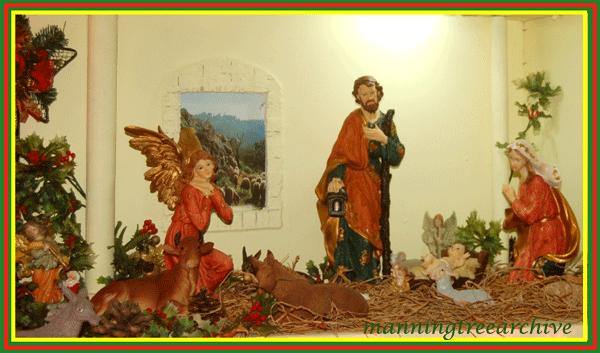
As Christmastime shows up annually, we have had our moments in the festivities, feasting and jollities that goes along with it. In common parlance, the Christmas favourite lists: the living room dressed in the house’s finest, the Nativity crib, a brightly decorated tree to glisten and gleam with baubles, tinsel and fairy lights, the mistletoe, the Christmas stockings and gifts, the brass and silver brightly polished, the holiday table laden for sumptuous feast fit for a gastrophile at heart, the seasonal melodies like the “Stille Nacht, heilige Nacht,” to moon and swoon, to talk over old and new times with near and dear. All those Christmas traditions are perfect and nice to hold on to – and meaningful, too.

The concept of the illuminated Christmas trees in legends of Germany relates to the heathen belief that the new life energy developed after midwinter by all trees and sprigs should be taken into homes to radiate its power among all those who live there. Delightfully, there are other things also not to lose sight of – mind you, to ensure a certain period to reminisce and meditate about all things that one builds too high in one’s mind and to thank for our many blessings.

At this time, Christmas would seem funny here without snow. But we would overlook that – for it has always been so. Then again, certainly there will be melodies inspired by my wife from our collection of her native Weihnachtslieder to ensure this Christmastime will be one of enchantment.

A Merry Christmas full of Joy and Cheer

Jo & Carina

(©Joseph Sébastine/Manningtree Archive)

Christmas Always Comes Up Trumps

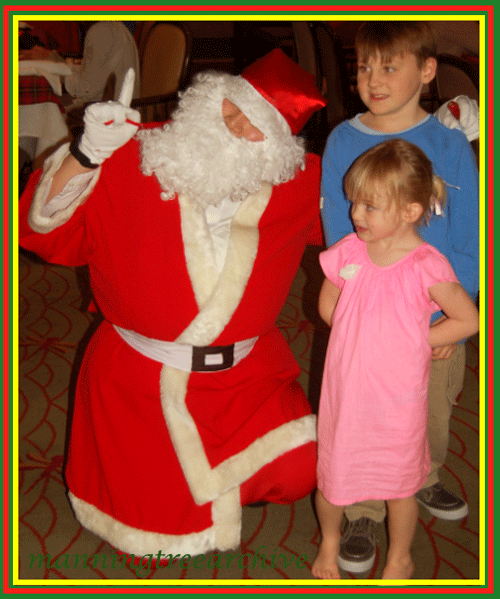
Christmas is different from what it was more than 100 years ago… yet it is much the same. At length, Christmas celebrations have become more and more elaborate – hiked up by the gravitational pull of commercialisation that might even lead us to believe that Walt Disney invented Santa Claus.

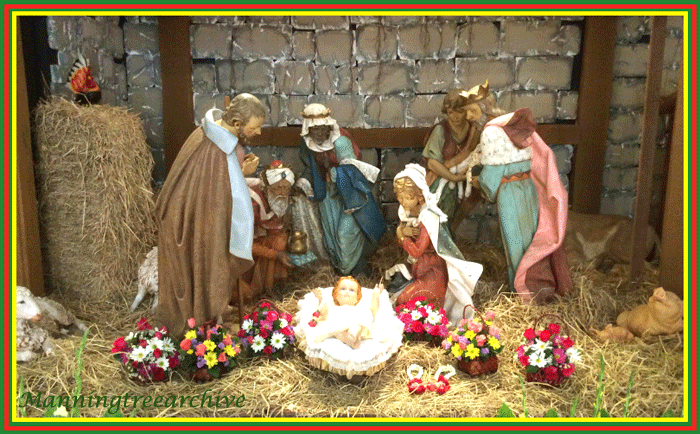
But the traditional oldies are there to fall back on: the Christmas Eve, the traditional Holy Mass, shining stars, cribs in Nativity scene, Christmas trees, angels, decorations, greenery, fairy lights winking and blinking, carols, songs, dances, gifts, wining and dining, stuffed poultry and plum pudding, white-iced cakes, Christmas & New Year greeting cards…..and then there are the candles calling attention to the legend of medieval times when lighted candles were placed in windows as a welcome to the Christ child, to show that there was a place in the home for Him.

As I wrote in my previous posts, I have had many Christmas memories from my childhood and one of my few flights of fancy is to allow them to flood me every now and then – especially during Christmas time. They are like Christmas decorations saved from Christmas to Christmas, and more added each year.

The joy of those carefree Christmases! Still and all, Christmas was something inside me – a singing in my heart. As if Mr. Charles Dickens might call at any time, our ritual of Christmas does not change. Each year there is much the same routine. The excitement spread over weeks as the star is hung, the crib is made, the Christmas tree erected hung with baubles and other decorations, and friends and relatives came in to visit.

The clever old Santa, with rhythmic, booming sounds and a certain sense of dignity will show up in the evenings without his sleigh, his eyes, exuding geniality and delight, peeping through the eye holes on his mask. He was accompanied by dancers and singers few of whom can’t carry a tune in a steam shovel. It’s all very Christmassy.

One of the neighbours of our traditional house was a family with three men good with their hands and easy-to-make notions. They are linked in my mind with stars and cribs. Two-to-three weeks leading to Christmas Day, these men and some of their friends, real no-nonsense workers, devoted their afternoons to create very low-cost and small-scaled Christmas trimmings for selling locally.

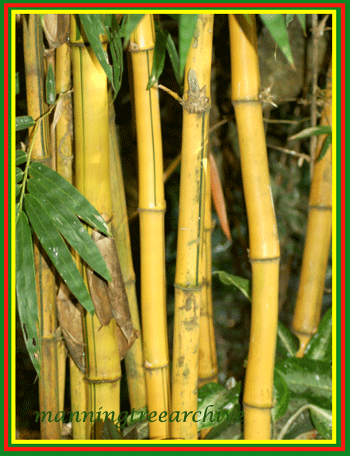
As it drew near to Christmas and there was no school to worry about, I sometimes went over to watch them create stars and cribs using bamboo. Their vibes was so grand that they could all laugh at the same things. Once the bamboo was cut vertically into sticks of required lengths, both surfaces are buffed finely to obtain smooth texture before they are tied into shapes of stars and cribs. The roof of cribs was thatched with hay.

Most of their exquisite works, some even varnished for glossy look,  are sold at Michael’s shop at the junction by our street and in the evenings people oh’d and ah’d looking up at the cribs and lighted stars on display for sale.

One of the most amusing was a wonderful Christmas in the 70s when our family made a beautiful Christmas tree. It stands out most vividly in my mind. Approximately 6ft. tall, it was bedecked with all the delicate sparkle associated with Christmas decorations. Given that the pine and fir (species grown as fresh Christmas trees in Europe and elsewhere) were not readily available potted at that time, a similar species (possibly, Araucaria Heterophylla) was acquired.

Set upright in base made of wooden pieces, the plant was decorated with gold and copper paper, gold and red ribbons, sequins, bugle beads, gold streamers, crepe paper strings, cardboard cylinders, fairy lights, etc., to create that jingle-bells effect. Copper and gold was kept as colour scheme to indicate the sparkle of the festive occasion. Few years saw us using a tree with branches cleared off its leaves as a substitute when the right plant was unavailable. Always the charming note is that the decorated Christmas tree, ablaze with tiny lights, represents the spirituality of Christmas.

The matter of substitute mentioned above brings to my mind the letter of a woman published in an old magazine about her great-grandmother who was a colonist passenger in a ship from Europe bound for Australia more than 160 years ago. As the narration goes, everyone was looking forward to spend Christmas in the new land and ladle great helpings of Aussie hospitality.

But, sweet suffering grief, on the Christmas Eve all were disheartened to learn that the ship was still hundreds of miles away which meant – no Christmas tree. Then again, did anyone there hear the angels in Heaven sing? When the children gathered in the saloon for their gifts, they were surprised to find a little tree with real leaves.

Assuming that the ship will be delayed and Christmas would be spent at sea, the ship’s carpenter had made the tree. Upon sailing from Cape Town, he had sowed parsley seeds in a box filled with sand (from ship’s ballast) and sawdust. Having kept out of reach of salt spray, the crew took turns to water it using their daily allowance of drinking water. As Christmas neared, the parsley had grown luxuriantly. From the firewood the carpenter carved out the stem and the branches on which the parsley leaves were tied. The tree was adorned with tiny candles, tinsel ornaments and white sugar for ‘snow’. A Christmas tree was born!

True to the Christmas ideal, how wonderful the ship’s carpenter had made his finest effort and shared his decorated Christmas tree to swell the hearts of strangers and friends. Indeed, Christmas, just as it always does, triumph after all. Merry Christmas, Jo

(©Joseph Sébastine/Manningtree Archive)

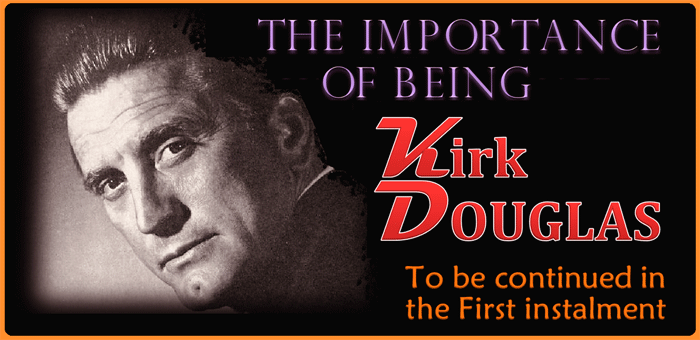
The Importance of Being Kirk DOUGLAS

I think of my life like a stone thrown into a calm pool.”

                                – Kirk Douglas, The Ragman’s Son

This tribute to Hollywood actor Kirk Douglas is truly accidental than most of my posts, in the sense that this never followed the carefully visualised course I planned at its inception – which was to create a 1,200-word write-up. But as my research evolved over the last many months, I chanced upon a profusion of representational materials about Kirk that my endeavour to piece together the salient landmarks in his life finally brimmed to the expanse of dimension you will come across in the text below.

Kirk Douglas is one of the last remaining great male movie stars of the studio era, even though certain cinematic greats like Clint Eastwood who came close behind Kirk cannot be ignored. Back in the good old days when movies had little competition and the moviegoers were devoted and regular, Kirk emerged from obscurity to turn into an established star on the strength of combining toughness with an acute intelligence in his choice and interpretation of the parts he played. Amongst the many directors he had the privilege to work with are the best of the crop such as Joseph L. Mankiewicz, William Wyler, Billy Wilder, Vincente Minnelli, John Sturges, John Huston, Burt Kennedy, etc.

As with all stars, the glamour and publicity surrounding Kirk is part of his work and charisma. Kirk Douglas once wrote, “When you become a movie star, you create an image for the public.” This perfectly complemented the dialogue Kirk’s character Jonathan Shields spoke to Georgia Lorrison (Lana Turner) in a scene in The Bad and the Beautiful (1952), “When you’re on the screen, no matter who you’re with, or what you’re doing, the audience is looking at you. That’s star quality.”

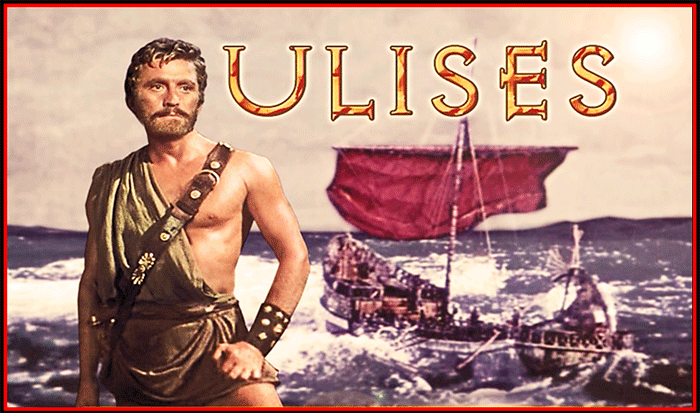
Kirk Douglas came into my life when I first saw a movie during its re-run in a local theatre two decades after its release. I could recall it as Ulysses (1954). Watching it, Kirk had come across to me as a versatile star – vibrant, handsome, virile – all rolled into one. In those teenage days, I was taken by the ease and punch of his portrayal in the title role, and since then, whenever possible, I had tried to follow his career which, over the years, grew in stature gaining brilliant achievements.

Now, how many millions around the world have seen Kirk’s movies? How many were liked or disliked or earned moviegoers to his films owing to Kirk’s acting and/or celebrity factor? What screen or personal stories perpetuated his legend in the public’s mind?

Many years ago, a magazine featured an interview with one of Kirk’s secretaries of the late 1960s. She fondly remembered him as “a very demanding person to work for, and works at a frantic pace himself. He has many businesses apart from films…. He is a very nice person…. I found him very attractive and virile – a real man’s man.”

Think of it. There is a tremendous amount of the past in all our presents. I have not met Kirk personally. Although I would love to, it is most unlikely that I will ever meet him. But I have always nurtured that curiosity to find out specifically how Kirk earned the reputation of a self-made man, a legendary hardworking American stage/screen actor, producer, director, author, millionaire, humanitarian, philanthropist, art collector, winner of awards/honours for achievements both on and off screen, and a family man with a beautiful wife called Anne Buydens sheltered in a solid marriage now nearing its 64th year on May 29th.

My growing film archive of about 6,500 movies gives primacy to films released up to early 1980s – most of which are now historic milestones of the movie industry. Thus far, it contains almost three dozen movies featuring Kirk Douglas. No doubt, that three dozen would be much lesser compared to the numerous hardbound volumes of scripts of all of Kirk’s movies which, according to Kirk’s memoirs, are arranged in chronological order on the top shelf at his house.

Likewise, I feel lucky that I was born during a period when I could enjoy those just-released films on a large theatre screen – maybe with a lesser quality presentation, but enough to be content in those happy days. And at the close of the movie, to walk out into the Lobby amidst the excited, arguing, impressed viewers. It’s no fun if one happens to see those movies now on TV – greatly edited and, like in our part of the world, interrupted by numerous (but necessary) persistent and disparate commercials that pounce on your senses like rapid gunfire from an AK47; or shown either during the work days or too late into the night.

At length, this compilation is derived from a trail of information that lay scattered in innumerable books, magazines, media interviews, movie documentaries or whatever sources I could possibly access – to all of which this write-up is thankfully and humbly indebted. This is neither a scholarly compilation of biographical data nor could it be free of possible errors – mainly whereas the schedule of production of movies is subject to re-takes, fillers, etc. This is just my personal attempt to recapture the great events, and some minor ones, of Kirk’s life – primarily up to the period before early 1980s.

To minimalize the content, some finer details about Kirk and his movies, readily available in numerous books, websites, visual media, etc., are left out. Keeping in par with the good old times Kirk’s films captured, I must honestly add that, the theory I have adopted for this write-up is to overlook any broken fence and admire the flowers in the garden. As you read further on, I hope you will chance upon the many pleasant factors that inspired me to write about – Mister Kirk Douglas.

(The First instalment of this series follows)

Jo

Notes:

  • DVD/Blu-ray of the movies referred above is available with leading dealers.
  • Picture credits: Please refer to “About” of my web page for more details.
  • It would be factual to endorse that the year-long delay in my posts occasioned from a string of turbulence of personal nature that thrashed on the cruising path of my life during the last so many months and yet, the ducks are not in a row. I dedicate this tribute with love and gratitude to: 1) Renate Elisabeth (Carina), my wife and oracle of love for her support, wisdom and unfailing vigilance; and to 2) Carolyn Page, the sweet spot who fondly lit a fire under you-know-where to turn the heat on me to accelerate the publishing of this post.

(© Joseph Sébastine/Manningtree Archive)


Staying Power of “The Horsemen”

Concluding installment of the two-part serial: “Catch-as-Catch Can”

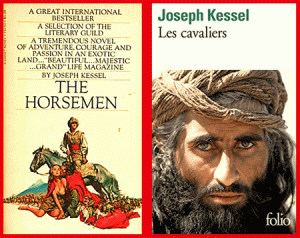
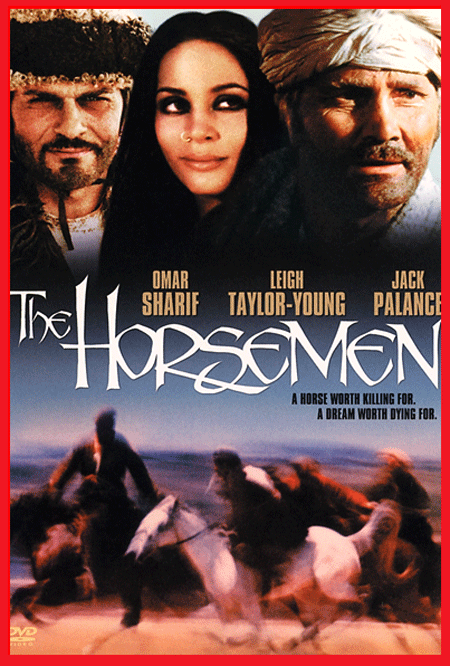
In my mind’s eye, artist Said Atabekov’s solo show reminded me of “The Horsemen” (Les Cavaliers), the 1967 best-selling novel written by the French writer Joseph Kessel (1898-1979). Enriched by the extraordinary gifts of characterisation and narrative of Kessel, it was the kind of book that cast a spell over the reader, and when you finished it, the experience preys on your mind to think back over the whole plot and rediscover the many priceless pearls from a bygone era which are littered in it.

The Horsemen told the gutsy saga, in contemporary setting, of family conflict between Uraz, a proud and ambitious Afghan horse rider and Tursen, his father, the Master of the Horse at the stables of the regal Osman Bey and the bravest Buzkashi chapandaz of the time, renowned for his highest degree of horsemanship, physical strength, courage and competitive spirit.

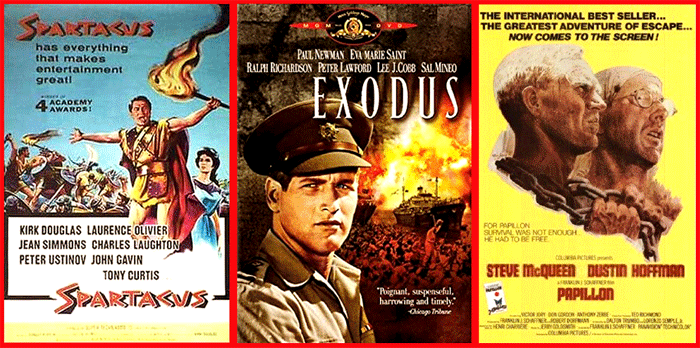
By the time producer/writer Edward Lewis and his constant film collaborator, director John Frankenheimer decided to turn The Horsemen into a movie (the films rights of which they had purchased jointly), two of Kessel’s novels were already lauded as popular films: The Lion (1962, D: Jack Cardiff) which is a marital drama of an American lawyer who goes to Africa to deal with his child and animal interest; and Belle de Jour (1967, D: Luis Buñuel), a fascinating fact and fantasy tale of a surgeon’s wife who took a liking to afternoon work in a brothel.Lewis and Frankenheimer contracted with Colorado born screenwriter (James) Dalton Trumbo’s (1905-1976, Spartacus, Exodus, Papillon), to adapt Kessel’s book. Joseph Kessel, who considered Trumbo in the first rank of screenwriters, was delighted by the news. According to a book on Dalton Trumbo, they agreed to pay him $125,000 for the completed script and another $125,000 in ten equal instalments.
Although Lewis questioned Trumbo’s depiction of the lead character’s motivations, Frankenheimer found the finished script “perceptive” and “damned good.” However, when made into an old-fashioned action-adventure movie of the same title, the studio executives demanded that the rough cut be reduced from slightly over three hours to two hours.

A co-production of John Frankenheimer Productions and Edward Lewis Productions, Inc. with the cooperation of Afghan Films, Colombia Pictures released The Horsemen in mid-1971, the year the studio turned to look back rather than forward – releasing movies such as Nicholas and Alexandrea (D: Franklin Schaffner), The Last Picture Show (D: Peter Bogdanovich), 10 Rillington Place (D: Richard Fleischer), The Anderson Tapes (D: Sidney Lumet), etc.

Similar to film directors such as Arthur Penn, Delbert Mann, Marty Ritt, Franklin Schaffner, Sidney Lumet and George Roy Hill, director John Frankenheimer (1930-2002), took the road out from television to Hollywood, where, retaining only the most useful elements of his earlier style, he became one of the most versatile directors in the American cinema.
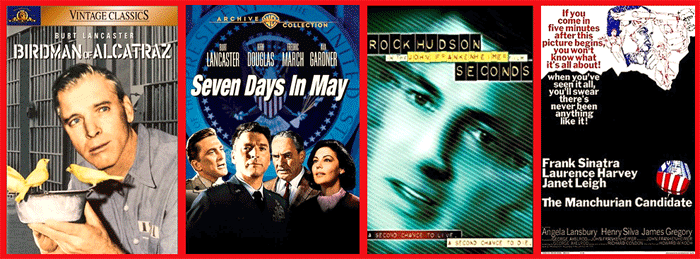
He made dramatic hits such as Birdman of Alcatraz (1962), Seven Days in May (1964), Seconds (1966), although the movie that catapulted his name to fame was the satirically angled political thriller, The Manchurian Candidate (1962). A demanding director, whose hallmark was working well with most actors, Frankenheimer’s work projected a fascination with the mechanics of visual story telling.
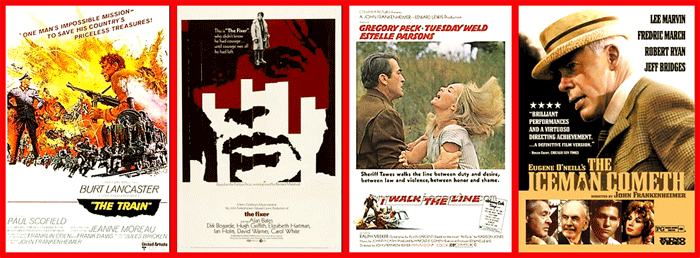
A reporter once noted in a newspaper: “You won’t find much romance or many complex leading ladies in a Frankenheimer film: For the most part his characters are men, real men, fighting each other or some outside force trying to destroy a way of life. His films are known for their biting look at this country’s political and social times.”

Director Frankenheimer’s flair in games and sports were evident in his Grand Prix (1966) and The Gypsy Moths (1969). The Horsemen (Cavalieri Selvaggi), made just before Frankenheimer’s career went into sharp decline in the 1970s, was the first film ever made in Afghanistan during a period when it was a popular destination all the year round for Western tourists to enjoy its rugged mountains and valued relics of ancient civilisation.
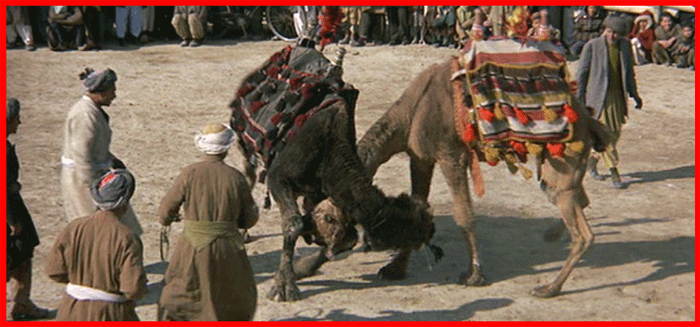
The production received plentiful cooperation from the government – and according to a magazine article, the authorities even allowed Frankenheimer to bring in a helicopter to shoot aerial scenes.
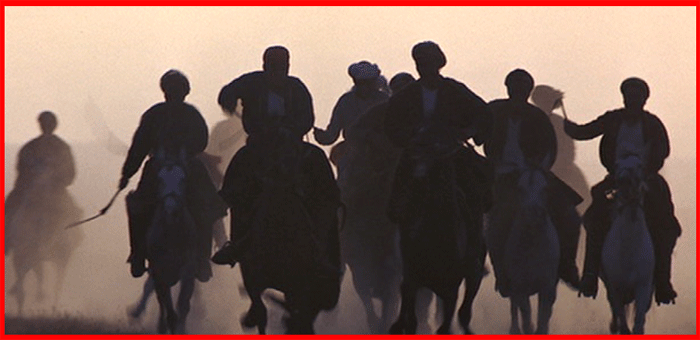
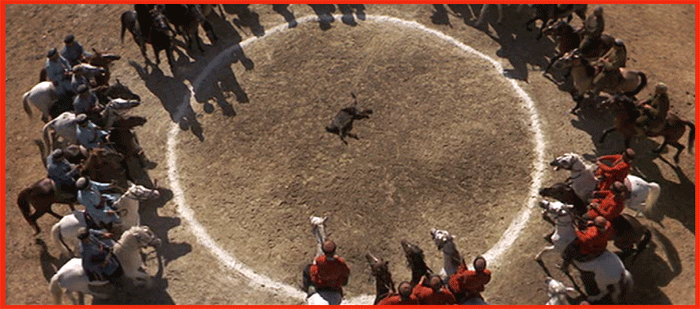
The film featured a spectacular tale of human drama giving emphasis to the skill, violence, and great courage of man-and-horse rivalries played out in the ancient equestrian tradition of buzkashi, an amalgamation of dirty polo and open rioting which brings to one’s mind the legends of the Golden Horde of the times of Mongol king Genghis Khan, whose warriors slipped into enemy camps and without dismounting from their horses, swooped up goats, sheep, etc., and rode away undetected with their pillage.
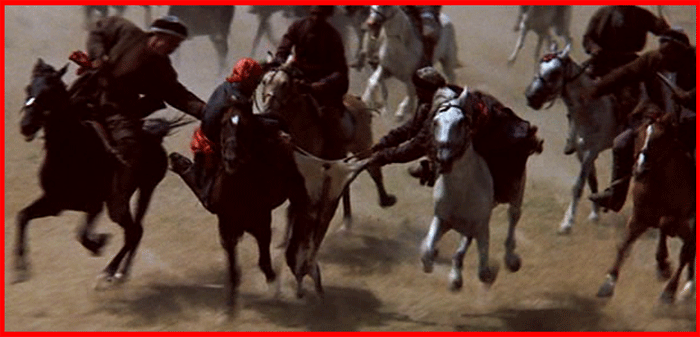
Having realised that he could no longer play in buzkashi, the valiant chapandaz (specialist buzkashi rider) Tursen’s (Jack Palance) mind was clouded over by his son Uraz’s (Omar Sharif) youth and prowess. For Uraz, like his father before him, is reputedly the greatest chapandaz in the three provinces of Meymaneh, Mazar-e Sharif and Qataghan.
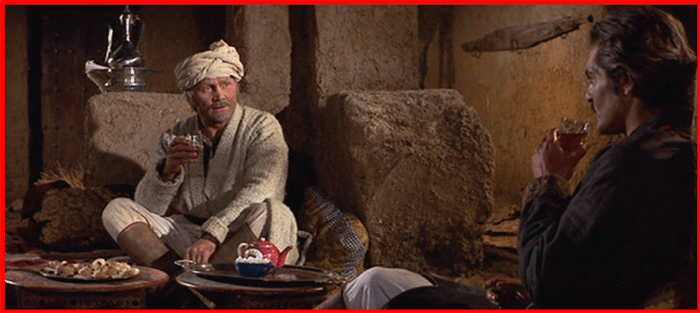
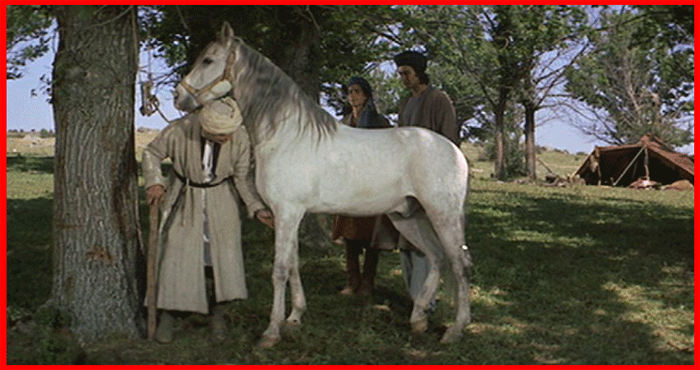
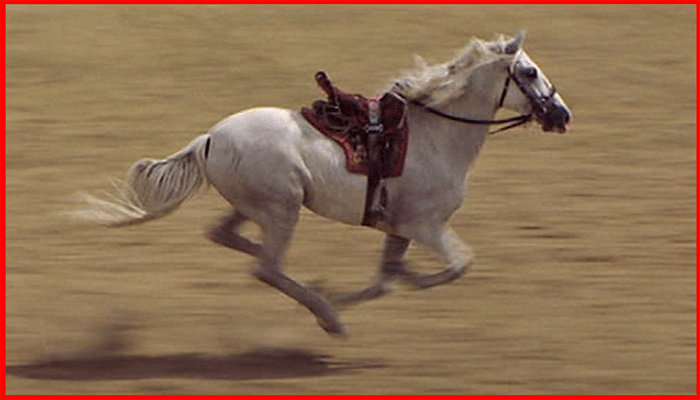
To prove his machismo and to challenge the code of behaviour by which he had been raised, as well as to please his imperious father who refused to give up the values and beliefs of his native land and had chosen Uraz to ride on the newest and finest purebred stallion, Jahil, Uraz had decided to compete in the king’s Royal Buzkashi tournament on the field of Bagrami in Kabul. Winning the game would ensure that Tursen would deed Jahil to Uraz – which was Tursen’s challenge to secure Uraz’s victory in the Buzkashi competition (1).
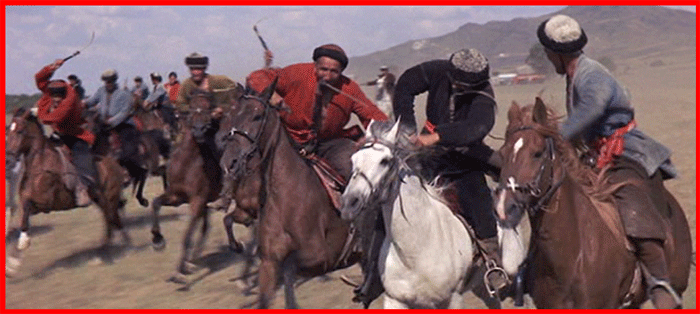
The game featured in the movie, where the horseman with the carcass is fair game for an all-out assault, was played at its roughest when the leather whips were applied with devastating effect on challenging riders.

Although Uraz’s boldness and fierce competitive spirit was evident throughout the game, in an unfortunate incident during the game after he had grabbed the carcass off the ground, Uraz fell and broke a leg. But then, in the last moment, his colleague Salih had leapt onto Jahil to win the tournament for their Meymaneh clan.
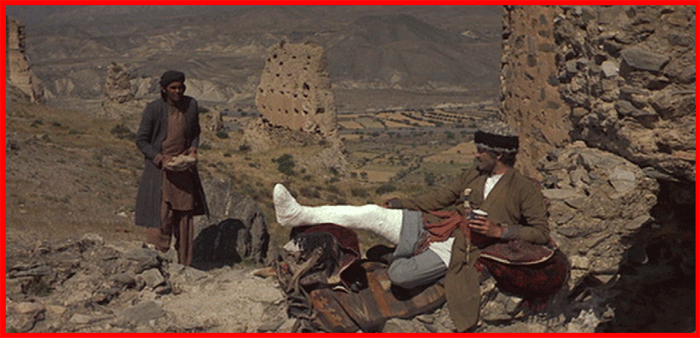
Later, escaping from the hospital where he was admitted, Uraz was forced to journey back home to the province of Meymaneh to face his father. Disgraced and humiliated in failing to measure up to his father, Uraz imposed severe ordeals on himself – eventually suffering terrible tribulations from the amputation of one of his legs infected with gangrene. Accompanying him through the treacherous old Bamian Road across the mountains were his faithful syce Mukhi (David de Keyser, uncredited) and a crafty nomad woman called Zareh/Zereh (Leigh Taylor-Young sporting a new gold nose ring) with her greedy eyes set on to acquire Jahil.
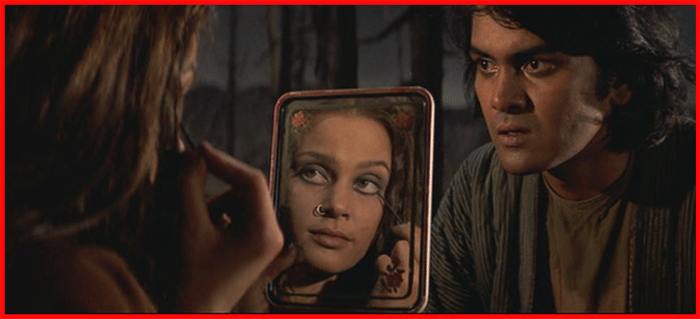
Having allowed to join Uraz in his journey  as Mukhi’s woman and having seen Uraz sick and weak, Zareh’s mind was devious to realise how a good buzkashi horse like Jahil would play for as long as twenty years and would bring glory and wealth to her. Encouraged by the knowledge that the prize-horse Jahil’s ownership would pass on to Mukhi upon Uraz’s death, Zareh took upon herself to convince Mukhi that they could go to the land of Hazarajat and make a fortune by racing the swiftest Jahil in the great annual fair.

As Uraz progressed on his passage home with his animal powers of endurance and survival, it didn’t take long before Zareh found out that, although Uraz liked women, he liked horses even better.

The great old film stars are everlasting. They live on in the hearts of all who have adored their looks and performances, and anytime is a good time to view their films repeatedly.

Star of Doctor Zhivago (1965, D: David Lean) and Funny Girl (1968, D: William Wyler), the dark-eyed Omar Sharif (1932-2015, born: Maechel Shalhoud in Alexandria of Syrian-Lebanese descent) whom actor Peter O’Toole irreverently dubbed “Cairo Fred”, needs no introduction. Following his dramatic entrance from the sands of the Sahara into screen stardom in the opening scene of Lawrence of Arabia (1962, D: David Lean), the flamboyant American actor became a whirlwind which brought him adulation, riches and hearts of millions of female movie lovers in particular. He frequently appeared in dashing leading man roles, relishing the honour of being a social idol, a superstar and a worthy successor to Rudolph Valentino.
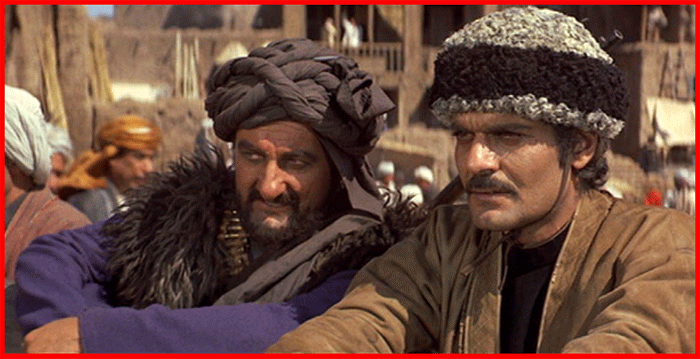
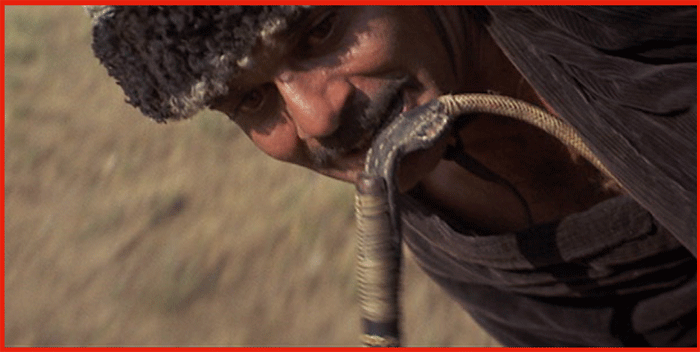
The Memoirs of Roger Vadim quotes Omar Sharif as “a charming man and exciting friend, but he had a very particular style with women. In spite of the passionate lover that he played on the screen, he was rarely romantic.”  Sharif had remarked during the filming of The Horsemen that he welcomed the opportunity to play a straight role. It  is a provocative film role in which he shared something in common with the character of Uraz – the ambitious chapandaz dressed in a thick caftan and high-heeled boots, leather whip gripped between his teeth, his head adorned with a hat lined with astrakhan fur and the emblem of a chapandaz fixed on it.
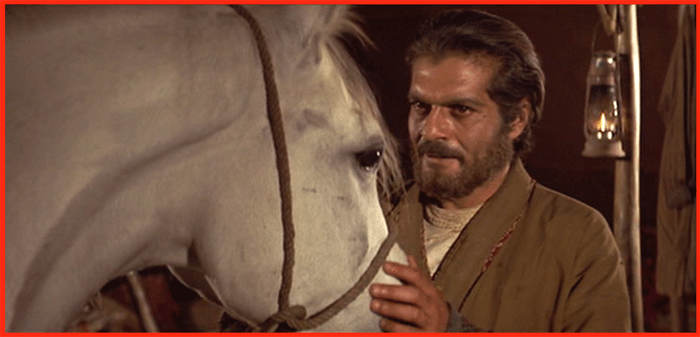
As a racehorse owner and breeder himself who, during that time, paid US$50,000 to send his mares to America to mate with wonder horse, Canadian-bred Nijinsky, (about which he was asked to narrate a French documentary in 1970,) Sharif did not shirk some tough riding in The Horsemen – at times holding the reins in one hand and the sand-stuffed, 120lb. carcass of a goat in the other, sequences which were added in Spain.

During production, he spoke of his understanding of horses. At the age of four he had begun by riding on tourist horses trotting around the pyramids: “It’s not all that difficult, really… I have ridden horses since I was a child in Cairo and I can hang on to a horse.” Then again, Sharif who had brought along an American masseur to Afghanistan to ease his muscle strains from the game, was, on tricky bits, obliged to indorse assistance of a double for some of his buzkashi riding scenes.

According to an article, the required footage for the film was canned by Frankenheimer by making the teams play every day for 30 straight days. Just like artist Said Atabekov, director Frankenheimer with his Polaroid would, at times, shoot interesting pictures of the men and horses in action. To complement the game scenes shot at Aranjuez in Spain, about ten chapandaz (including leading buzkashi riders, Jalal and Habib, who had tremendous riding and game-time experience in buzkashi) were flown from Afghanistan for filming a third of the movie over a parched Spanish playing-field. A Spanish army helicopter was also engaged for this.For the role of Tursen, the filmmakers wanted a star with enough physical presence and regional look to match Sharif. Movie audiences have seen Omar Sharif and Jack Palance together in Che! (1969, D: Richard Fleischer) although they were criticised as miscast in the roles of Che Guevara and Fidel Castro. Maybe the filmmakers had hoped to derive a better result from this combination from their roles as Uraz and Tursen.
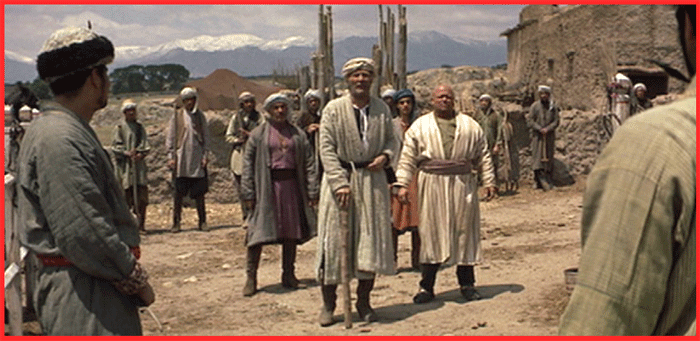
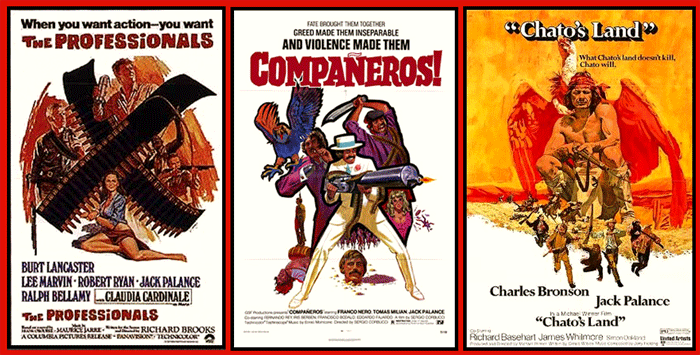
The hard, villainous skull-faced one-time boxer Palance was the heaviest Heavy Hollywood knew in the old days before he deserted Hollywood for Europe. The lantern-faced Palance chews the scenery as a “mean as dirt” gunslinger imported by cattle interests to confront former gunfighter Alan Ladd in Shane (1953, D: George Stevens), Paramount’s splendid outdoor drama of the Old West.Moviegoers may also remember him as a disillusioned film star in The Big Knife (1955, D: Robert Aldrich) and in a good number of films made in Europe such as: The Mongols (1961, D: Andre de Toth/Riccardo Freda), Barabbas (1962, D: Richard Fleischer), The Professionals (1966, D: Richard Brooks), Justine: Le Disavventure della Virtu (1968, D: Jess Franco), Vamos a Matar, Companeros! (1970, D: Sergio Corbucci), Chato’s Land (1971, D: Michael Winner), etc.According to a biography of actress Joan Crawford, during filming of the solid suspense thriller, Sudden Fear (1952, D: David Miller), Crawford was disturbed by Palance’s “moodiness and particular techniques, such as racing around the studio stage to incite his emotion.” Quite possibly, Palance, in his first starring role and an actor whom Crawford once fired, was nervous and apprehensive about acting as the new husband of Crawford, the legendary star who had shared screen space with biggest film icons such as Clark Gable, Spencer Tracy, Gary Cooper, Robert Taylor, etc. In The Horsemen, one will find Palance mellowed, put on weight and smiles as if he meant it.Beautifully filmed in Eastmancolor and Panavision (2) in Afghanistan and Spain, Cinematographer Claude Renoir brilliantly succeeds in recapturing the look and feel of the period. The original cinematographer James Wong Howe (nicknamed Low Key Hoe) who had worked on many Frankenheimer movies was replaced.According to the book The Great Moviemakers of Hollywood’s Golden Age, Howe admits having worked two or three weeks on his last picture, The Horsemen, but left over a disagreement with director Frankenheimer for refusing to use a particular lens rented for the movie. (3)
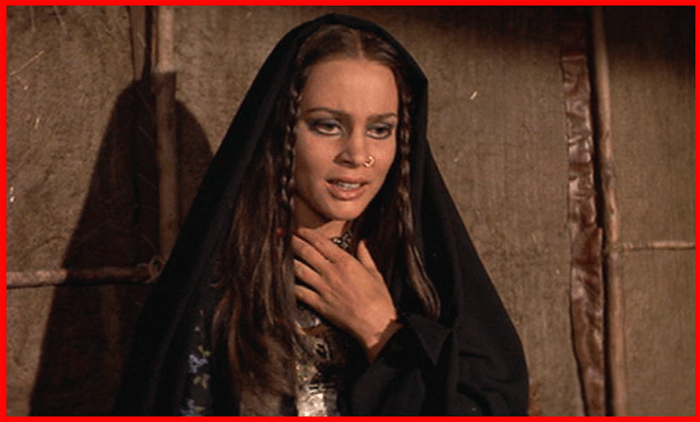
The 23-year old, fresh-faced, Leigh Taylor-Young, when contracted to play the leading lady role in The Horsemen, which took about two and a half years to make, had a repertoire of film appearances credited to her career.

Debuting in the Broadway play Three Bags Full (1966)  under the name Leigh Taylor-Young, she progressed with appearance in the TV soap opera Peyton Place, following which she went on to make five major motion pictures in a row.The Horsemen also features: British general purpose actor Peter Jeffrey (Hayatal), George Murcell (Mizrah), bald-headed Viennese character actor Eric Pohlmann (Merchant of Kandahar), Vernon Dobtcheff (Zam Hajji), Saeed Jaffrey (District Chief), John Ruddock (Scribe), Mark Colleano (Rahim), Salmaan Peer (Salih), Aziz Resh, Leon Lissek, and Vida St. Romaine as the Gypsy woman. Some websites identify actor Srinanda De in the role of Mukhi.
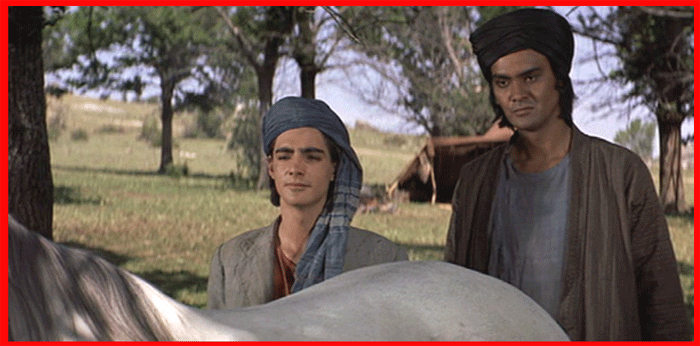
The crew also consists of: Costume designer: Jacqueline Moreau; Production Designer: Pierre Louis Thevenet; Music composed and conducted by: Georges Delerue.

Following the filming, director John Frankenheimer had joined Harold F. Kress to edit the film in Paris and also devoted part of the nights attending cooking classes for three months at Le Cordon Bleu which was followed by a tour of Europe studying the great chefs. Undeniably, the film’s production had occasioned a learning experience for Frankenheimer in the traditional game of buzkashi which inspired in him the thought of holding buzkashi tournaments in the USA.
As for Sharif, whose interests thrived on bridge games, globe-trotting, dating girls and owning horses, among others, his movie days in Afghanistan acquired him a new buddy to share his Rolls-Royce and his new Penthouse overlooking the Bois de Boulogne in Paris: a majestic Afghan hound named Baz (Bazo), a gift from the King of Afghanistan (4).

Until next time, Jo
PS: This here Second installment of the two-part serial “Catch-as-Catch Can” would have appeared earlier, had I been able to go ahead with my scheduled visit to Dubai in April-May for research work for that post. Unfortunately, I had to forego that trip and sustain subsequent delay due to urgent engagements.

Notes:

  • Please refer to the first part: “Catch-as-Catch Can” for more details on Buzkashi.
  • The film’s Trailer states “Super Panavision
  • For the benefit of minimal content in this post, many finer details re. the production of this film, readily available in numerous websites, books, etc, is not incorporated.
  • A chapter in “No Better Friend: Celebrities and the Dogs They Love,” by Elke Gazzara features an interesting narration about how the last king of Afghanistan, Muhammad Zahir Shah (1914-2007; Reign: 1933-1973) presented one-year old Bazo to Sharif, through his emissary, while Sharif was already inside the aircraft waiting to take off to Paris after having spent more than five months location shoot there for The Horsemen.
  • Books, DVD/Blu-ray of the movies referred to in this article are available with amazon.com, amazon.co.uk and other leading dealers.
  • DVD sleeves/posters credits: Wikipedia, amazon, imdb and from my private collection.
  • This illustrated article is an affectionate nosegay to the movie reviewed above. Please refer to “About” of my webpage for more details.
  • In memory of John Frankenheimer who died on July 06, 15 years ago.
(© Joseph Sébastine/Manningtree Archive)