Archives

NOTRE DAME WILL STAND

0

“The Gothic of Verona is far nobler than that of Venice;

and that of Florence nobler than that of Verona.

… that of Notre Dame of Paris is the noblest of all.”

  • The Seven Lamps of Architecture by John Ruskin

1

The day was bright and filled with leisure hours. We would not have wished to be anywhere else in the world on that day but in the grand Cathédrale of Notre-Dame in Paris, the capital of elegance and art. With the presence of our daughter Bianca, the last few days had swiftly accelerated and rolled away quickly. She was absolutely vibrant. Having visited the central landmarks and point of identification, viz., the Eiffel Tower, Arc de Triomphe and the Avenue des Champs-Élysées, Sacré-Cœur, The Louvre and Mona Lisa, all of which has been absorbed into the tradition of Paris, we had decided to take her to other blessedly French places not to be missed including Palais Garnier (Opéra de Paris). She had done her homework and knew there was far more colour and nerve in Paris.

2

Long before all the above landmarks came into existence and well before the city came to be known as Paris, “Lutetia” (Lutetium) as it was known during the Late Empire, was centred on a small island in the shape of a cradle in the Seine called Île de la Cité, the heart of the city. Years later, it was here on the pavement in the great plaza called Parvis Notre-Dame – Place Jean-Paul II (1) before Notre-Dame de Paris that the official centre of Paris was landmarked with a bronze star on an embedded plaque – proclaiming the central place of Notre-Dame in the country’s life.

3

This bronze star, (placed by André Jules Michelin), is the point-zero (Point-Zéro des routes de France) for measuring distances from Paris. The local tip-off is that: a) if you stand on the bronze plate, you will return to Paris; b) your love will last forever, if you stand on it with your lover and share a kiss. No reward for guessing what I have often done there.

4

I know, so much has been written and said about Notre Dame. But, until last time I was here, I never thought that Notre-Dame de Paris is best seen from behind the flying buttresses at the east end. This time around, having reached the area via Quai Saint-Michel, we had crossed the Petit Pont (Little Bridge, erected in 1853) and entered the Parvis (square) which now dwarfs the apocalyptic west façade with its great area. The Parvis was indeed much smaller before Georges-Eugène Haussmann (1809-1891), while remodelling Paris for Napoleon III in the nineteenth century, cleared the structures which clustered before the cathedral and enlarged the Parvis, adding different features to it.

5

The Parvis was crowded with people – we could pick up the scent of liveliness in the air. Moving past the Crypte Archéologique du Parvis de Notre-Dame, we came across the high stone base bearing “Charlemagne et Ses Leudes”, the imposing bronze equestrian statue of Emperor Charlemagne accompanied by his leudes: Roland and Olivier. It was sculpted by brothers Louis and Charles Rochet in time for the L’Exposition universelle de 1878 (third Paris World’s Fair – open to the public: May 20 to November 10, 1878). Since its erection in the square, it not only has outlived the threat of displacement but also has remained a mute spectator at the area which has played a vital part in so much of France’s history.

6

If one would track the olden times back from the time of Charlemagne to the origins of Paris, we would find that it was the military importance of Île de la Cité which had motivated the Romans to build the city of Lutetia where there was a small settlement of Gallic tribe of merchants and fishermen called Parisii. Given that the spot was already hallowed by a Druid shrine, no wonder a place of worship for Jupiter came up – the remains of this altar will be mentioned below.

The Roman occupation had ushered in Christendom and from the wreck of the Roman shrine rose a cathedral – just like many mediaeval churches of Western Europe which claim a pre-Christian origin. In his book about Paris, author A.J.C Hare relates that a church dedicated to Saint-Étienne (St. Stephen) was built on the islet about the year 375. (The website of Notre Dame states: This cathedral dedicated to Saint Stephen was very large. Its western façade located about forty metres west of the current façade of Notre-Dame – which is where we are presently sitting now.) Adjacent to Saint-Étienne, an edifice far more rich and beautiful was built in 528 and dedicated to the Virgin Mary (Notre-Dame II), the substructions of which were found during excavation of the Parvis during the 19th century. Notre-Dame II had subsequently assumed a pre-eminence among the churches and for the faithful, became the center of the Christian cult.

7

During the three hundred years between 1050 and 1350, 80 cathedrals, 500 large churches and hundreds of small parish churches were built in France alone which reflected the wealth and variety of the country’s history and architecture. It has also been regarded as the most typical expression of medieval civilization. It was a period when the country’s faith was humble, her love a mounting flame. Following the construction of the abbey of St. Denis (now Basilique cathédrale de Saint-Denis) on the grave of Saint Denis north of Paris in 1144, there was strong plea for a cathedral much longer and upward looking than Saint-Étienne’s in Île de la Cité, – a cathedral worthy of the great demographic expansion and economic dynamism of Paris. With the low hills region such as Butte Saint-Jacques, nearby Bagneux, Arcueil, and Montrouge dispersed with great beds of granite and limestone, there was hardly any shortage for building materials. Without totally destroying the existing two churches, Maurice de Sully (elected bishop of Paris on October 12, 1160 – died in 1196) commenced to build a new edifice on the same site. It is generally held that Pope Alexander III laid its foundation stone in 1163.

8 Prior to the start of the work, the Rue Neuve-Notre Dame was created to make it easier to bring the masonry. With the center of worship shifted to the nave of the older Notre-Dame II, the foundations of the new cathedral were dug thirty feet deep and filled with the hard stone of Montrouge on which the enormous weight would rest. The construction was done by professional workers organized in accordance with the traditions and rules of the guilds, and the powerful Chapter of Notre-Dame.  The underlying efficiency of the work done is that the vault webs of Notre-Dame are only 6 inches in thickness and they have held steadfast for 850 years!

The chancel was built first so that the church could function. The choir’s high altar was consecrated in 1182. The nave (with the exception of the extreme west end) was realised about the year 1195 (the year Santo Antônio de Pádua was born in Lisbon.) Under Eudes de Sully (died 1208), the successor of Maurice, the work on the west façade which begun in 1202 was completed to the base of the gallery by 1223. The galerie des rois (the Gallery of Kings) was completed under Guillaume de Seignelay (1219-1224).  The twin towers (without the spires) were realised by 1235. A transept was not in the original plan, but a short one was inserted before the nave was laid down. Saint Thomas Aquinas (1225-1274) was in Paris during the time the transept was being built. After visiting the chapel of the Virgin behind the choir in 1323, French philosopher, theologian Johannes de Janduno wrote, “On entering one feels as if ravished to heaven, and ushered into one of the most beautiful chambers of paradise.” Although the cathedral was never completed consistent to the plan of the original designers, when the work was finally realised circa 1345, the edifice presented an irregular alignment due to interruptions in its construction.

9

God must have danced around me when I was born – for as it turned out, I have been generously blessed with occasions to travel far and wide – and most importantly in the presence of wonderful persons. For the past few days, Carina was having fun naming to me the various trees adorning Paris: the Linden- and Horse chestnut trees along the Seine; Honey Locust, Mimosa, Empress, Cherry…… and many others including the London Plane by the Avenue des Champs Élysées. That was hardly a fortuitous coincidence, but in lieu of the movie locations of Roman Holiday (1953, William Wyler) which I pointed out to her in Rome on a spring-like day – few of which she knew!

My theory/schedules of longer periods of stay and repeated visits to a given place has aided my endeavours for in-the-field study of important subjects augmented with the minute details of history and architecture available in various writings. The day before, Carina brought me a book from a little shop across from our hotel, which I had been looking to buy for a long time. Everything comes to he who waits. This book to which the quote on the header relates, had given me the right disposition to write this article. But for me, to be in the presence of a cathedral of religious, cultural and architectural significance such as Cathédrale Notre Dame de Paris is good fodder in that respect.

We have now moved closer to the cathedral. From where we sat, we could clearly view the features of the major divisions of the west façade crowned by two towers. Dissimilar in size, the towers rose from a parapet or pierced cornice which surmounts an open arcaded screen of gigantic proportions. The spires for the two towers of Notre Dame, originally planned by the builders, were never made.

10

At the top of the towers are open arcades and small turrets where the staircases end. The panoramic view of Paris from up there is also complimented by the full structural beauty of the cathedral – its grand arrangement of flying buttresses, the great roof ridge, fléche (built in 1859-60 since the ancient fléche was destroyed in 1787), the circular chevet, the host of statues, gargoyles and other sculptured ornaments.

11

Atop the south tower, one can see the great bell or bourdon of the cathedral which was re-foundered and re-baptized “Emmanuel” (Emmanuel-Louise-Thérèse) in 1686 in honour of Louis XIV, and Marie-Thérèse of Austria. According to a book by Esther Singleton, it was originally named “Jacqueline“ in honour of Jacqueline de la Grange, the wife of Jean de Montaigu (about 1349 – 1409) who had presented the bell in 1400 (very interesting – must read up this history). You could listen to the sound of Emmanuel, topping over the other bells, in Youtube videos featuring liturgical ceremonies of the cathedral.

12

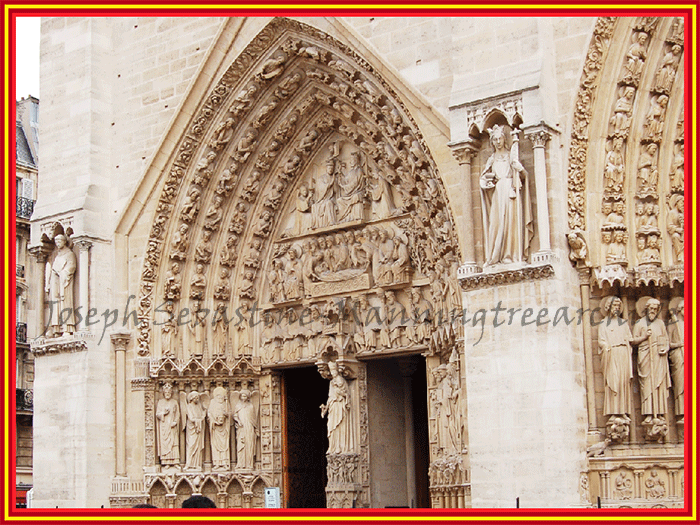
Under the division containing the wheel window is the Gallery of (28) Kings running across the entire façade. The figures we see now are restorations. Directly below, on ground level, are the three great portals – all asymmetrical in height and width and in sculptural subjects.

13

Le Portail du Jugement – Central doorway

The Portal of the Last Judgment (Le Portail du Jugement) occupies the central doorway with The Portal of the Virgin (Le Portail de la Vierge) on the left, and commemorating the Blessed Virgin’s mother is The Portal of Saint Anne (Le Portail Sainte-Anne) to the right which is a composite work carved during Maurice’s time (between 1160-1170) but was set up only after Eudes de Sully took over the work of the west façade.
14

Le Portail de la Vierge – Left doorway

15

Le Portail Sainte-Anne – Right doorway

It was outside on the porch of the cathedral, in front of the “architectural glory of France”, that the marriage of King Henri of Navarre with Marguerite de Valois took place on August 18, 1572, owing that the King was a Huguenot at that time. In May 1625, the marriage of Charles I of England to the French princess Henrietta Maria (youngest daughter of King Henri IV of France and Marie de Medici) took place by proxy with the west façade as the backdrop (2)(3) (4),

16

Dedicated to the Virgin Mary (Notre-Dame), the edifice was subjected to reckless mutilation between 1699 and 1753 when the Cloister, the stalls of the sixteenth century, the old high altar, many sepulchral monuments, and stained glass were destroyed – yet, considering the vicissitudes through which the cathedral has passed, it’s a blessing that so much remained unaltered in contour and general effect and also much of original sculpture has been preserved. While the mid-19th century restorer, Eugéne Emmanuel Viollet-le-Duc has outshot the others in proving his efficiency for all of the present state of skilful restorations of Notre-Dame which included aesthetic and structural improvements; at any rate, Bishop Maurice de Sully, the ancient designers and premier massons (5) of the cathedral have ensured that everything was essentially arranged to concentrate the eye on the chief altar, and to provide dignity to its position.

17

18Ever since the consecration of its main altar in 1182, the cathedral with its vast open space to accommodate the ever-numerous believers has served the religious services and frequent synods. I read somewhere that St. Dominic preached there. The new-born heir was blessed at its altar. Emperors were crowned there. Standing before the altar of the cathedral on December 2, 1804, Napoleon Bonaparte took the crown from Pope Pius VII (1742 -1823) and crowned himself. For being the venue, it was decorated for spectacular royal marriages like the fairy-tale wedding of Emperor Louis-Napoléon Bonaparte (Napoleon III) and Empress Eugenie (Spanish Eugénie du Derje de Montijo, Comtesse de Teba) in January, 1853, Little more than 100 years later, Princess Françoise of Bourbon-Parma married Prince Edouard de Lobkowicz there in January, 1960.

Prior to ceremonial interment of Saint Louis (Louis IX (1214 – 1270) at St. Denis, his body (having undergone the process known as mos Teutonicus) lay in state at Notre Dame – a custom followed for many French monarchs and princes. In October 1895, the cathedral was the venue for the State funeral of French chemist and microbiologist Louis Pasteur (reinterred at the Institut Pasteur). When Gen. Charles de Gaulle died in 1970, it was in Notre Dame de Paris, (the very place where gunshots were fired at him in August 1944), where the heads of nations gathered for a Requiem Mass on the day the funeral was held at his home village, Colombey-les-Deus-Églises where he was laid to rest by the grave of his daughter Anna.

19Bound in the developments of the times, Notre Dame de Paris had also served as a meeting place for trade unions, dormitory for the homeless, location for movies, while its nave was once used to store wine casks. According to media reports, in May 2013, a French historian pulled out a shotgun and shot himself dead in the cathedral.

Periodical repairs and modifications were done to redress the wear and tear it suffered by time, climate, intolerance and ignorance. In their book, authors Jean-Benit Nadeau and Julie Barlow wrote that by the middle of the 19th century, the cathedral had fallen into such neglect that authorities considered demolishing it and using the stones to build bridges. The restoration of the cathedral finally came when the government of King Louis-Philippe I (1773 – 1850) decided to counter the concerns with remedial measures.

Ever since our arrival, we had noticed that the porch of the cathedral was swarming with visitors of all shades and shapes. Right now, the line-up of people under the southern door: Portail de Sainte-Anne or St. Marcel, has swelled. It was time for us to join the queue.

Merci et au revoir. Jo

(End of Part One)

20

Notes:

  • Named in September 2006 in honour of the pope who had died in 2005;
  • Charles I of England and Princess Henrietta Maria were married in person at St. Augustine’s Church, Canterbury, Kent in June 1625.
  • According to the website of Notre Dame de Paris, although masses, vespers and the sacrament of reconciliation are celebrated every day of the year, since the cathedral is no longer a parish, baptisms, marriages and funerals are no longer held there;
  • Currently, outdoor wedding ceremony packages are available for couples wanting a symbolic wedding ceremony or symbolic renewal of vows held at major Paris landmarks and in the vicinity of Place Jean-Paul II or at its fringes with Notre Dame Cathedral as backdrop. Of course, I mention here only about symbolic ceremonies.
  • Name of the first master of the work is unknown although, according to a book, a “Richard the Mason” witnessed a cathedral document in 1164.
  • I am indebted to many publications dating from the late 19th century onwards, for useful background data;
  • This article is dedicated to all the brave soldiers of India, the fallen and the living, for their courage and dedication in protecting our country from the menace lurking at our frontier.

21

(©Joseph Sébastine/Manningtree Archive)

The Most Worthy of Love

01

When she brought out the last pearl

She emptied her body like an oyster

02

On this day June 17, 385 years ago, large populace of India joined their emperor and the royal family to mourn the untimely death of Arjumand Banu Begum, popularly known as Mumtaz Mahal, the 38-year old favourite second wife of Mughal Emperor Shah Jahan.

03

Famed as much for her charity as for her beauty, Mumtaz (The Chosen One of the Palace), was pregnant with her fourteenth child (daughter named Gauhara Begum) when she succumbed to death in childbirth in 1631, leaving her husband heartbroken.

04

Just as he had promised to her dying prayers, Shah Jahan erected Taj Mahal, the mausoleum of unsurpassed splendour and flawless symmetry on the right bank of the River Yamuna at Agra. In memory of Mumtaz Mahal, Taj Mahal was so named from an abbreviation of her name.

05

Built of milk-white marble, rose sandstone and studded with precious jewels, the Taj Mahal remains the pride of India from Shah Jahan’s day. I have walked in and around it on five different occasions and I always loved its grand sight – it’s magnificence as it looms proudly within a large interconnected complex of gardens and buildings. Until next time. Jo

06

How shall I understand the magic of Love the Juggler?

For he made thy beauty enter at that small gate the pupil of my eye,

And now – and now my heart cannot contain it!” – medieval Indian poet Faizi

07

(©Joseph Sébastine/Manningtree Archive)

#Years50

01

The year 1966 – that’s nearly fifty long years of history trailing backwards to it from 2016. For those who have some kind of origins rooted in 1966, the present year would have diverse meanings and values. 2016 would mark the 50th wedding anniversary for some couples; while for few others, it would be the golden jubilee year of their company’s establishment, or to many, it could be a rite of passage into 50 – the latter being the case of a friend who invited us to his milestone birthday bash few months ago.

02When that occasion arrived, it turned out to be a lovely time for us to relax and spent some time together with likeminded people – lots of good talk, good food, good drinks, good fun and a speech by the host. The truth is that, on occasions like this, we often swipe our past at the gate and it opens. Then we get back in and out comes thoughts constantly recurring to our friends and events of our early life – in the context of the present occasion, it was how it had all started for our friend in the summer of half a century ago and came up to the time he dipped his toes in the big 5-0, the youth of senior age.

We are the sum of the experiences in our lives. Looking back on his journey from the distance of fifty years, our friend went through a recap of his ups and downs, gains and losses, drawing cameos of his life. Unlike this occasion, I had been to parties where, like an overwound toy that would not stop until its winding is completely unfurled, the host went on and on with narration about himself to make too big a meal of it.

03In the end, the summary of our friend’s reminisce sketched the figure of a man with the good sense to confine his ambition to the safer and less contentious way of living – adhering to his belief that all things would come into being, blossom and ripen at the appointed time.

The party had gone with a swing. Back home that same night I had settled in the comfort of our living room while the music of Giacomo Puccini let loose its energy and passion from the music player. With our life-long fascination for the creative genius of Giuseppe Verdi and Puccini, no wonder our hearts lingers in nineteenth-century Italy for good musical experience.

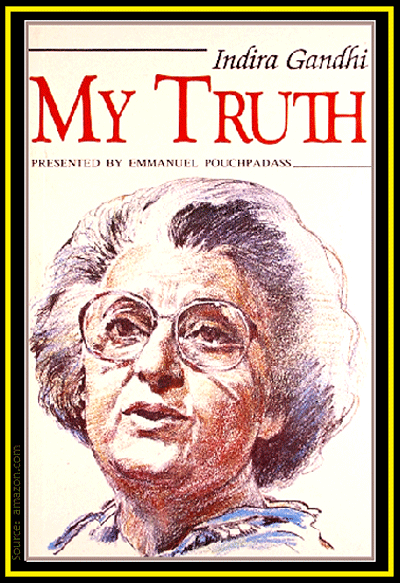
With the happenings of the day still fresh in mind, my attention had wandered to my IPad to google the events of 1966. In history’s roll, 1966 was a conspicuous year. However politically neutral I could be, I could note that, drawing a contrast to the outcome of the present local election, 50 years ago there were celebratory moments for some when on January 24, 1966, Indira Gandhi made her debut entry as the Prime Minister of India owing to the untimely death of the incumbent Indian Prime Minister Lal Bahadur Shastri in Tashkant in Soviet Central Asia on January 11, 1966. Customarily, Mrs. Gandhi’s intellectual-looking face had then dominated the covers of many Indian and some foreign publications. The 5ft. 2in. petite 48 year-old with Nehru elegance and style had certainly reached high places for someone who had once said, “At the age of four, my favourite game was to stand on a table and make thundering political speeches to the servants.”

04

05Another popular face of that year was of the international fashion icon Twiggy (Lesley Lawson, née Hornby). At just seventeen years old, having been voted British Woman of The Year, she was named the Face of ’66 by the Daily Express. In time, her androgynous look splashed across not only on glossy publications, but also on display boards, garments, etc.

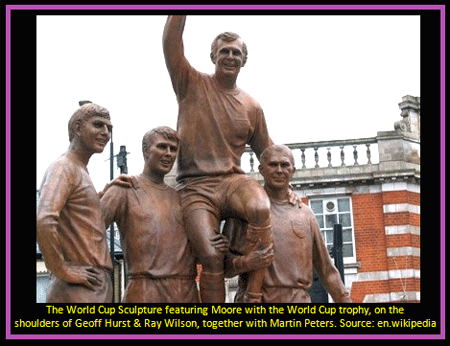
Concurrently, British bands like The Beatles dominated the world of popular music while England, beating West Germany 4-2 after extra time at Wembley Stadium in London on 30 July 1966, took home the 1966 FIFA World Cup.

Citing the flash trends of that fab year, if vinyl was the most “in” fabric worn by the young go-go set in Paris, in Britain, besides zippy Mini cars, hemlines of the trendy Mini Skirts progressively climbed upward to the level where some designs had the hem exposing more acreage of leggy delights as popularity for minis grew amongst those who like a mini to be a mini, successfully pushing the squabbles over longhair out of the headlines. At the same time, in the United States, a mandatory health warning appeared on the face of all packaging of cigarettes: “Caution : Cigarette Smoking May Be Hazardous To Your Health”.

06

I would not miss out on the disasters that occurred later during that year. Before dawn on November 4, 1966, whipped by gale winds and rainstorms, disaster struck Florence (Firenze), Italy, the city for art lovers and one of our favourite haunts for many years. The rising muddy water of River Arno overflowed into the city flooding it to a maximum depth of 20ft, killing many, leaving thousands homeless and damaging not less than 14,000 works of fine art masterpieces and countless historic books, manuscripts and antiques housed at various locations in bella Firenze. At Galleria dell’Accademia, the “David” of Michelangelo tilted on its pedestal owing to buckling of the wet floor.

07

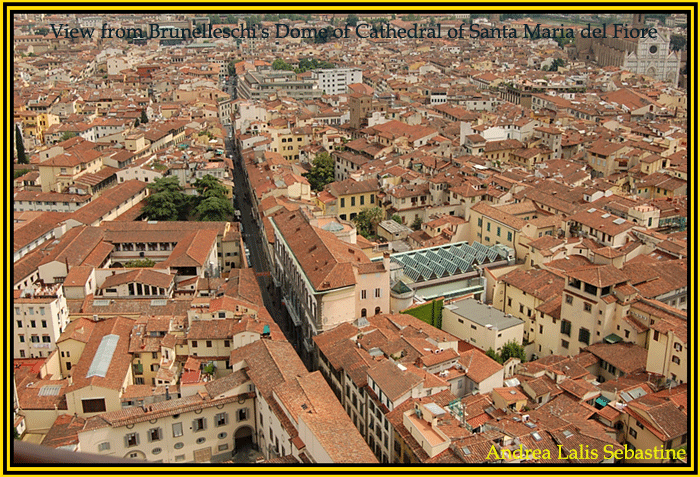
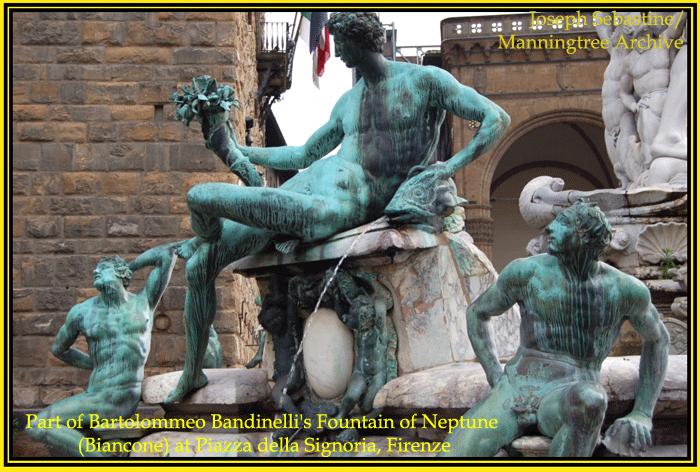
Just to think of the green and white marble Il Duomo (Cathedral of Santa Maria del Fiore), Giotto’s belltower (Campanile) and the Baptistery of San Giovanni in the Piazza del Duomo, the Cappelle Medicee e Chiesa di San Lorenzo, the Bargello (Palazzo del Bargello), the piazza and cloisters at Santa Croce, the Piazza della Signoria, the Galleria degli Uffizi, Palazzo Vecchio – all standing waist deep in soiled water with flotsam, oil drums, roofbeams, toys, trees from the diluvio….had brought sadness to our minds whenever we are there.

08

A similar catastrophe had struck Venice on the same day as La Serenissima flooded as the level of the lagoon rose about 6ft 5in above its normal level.

09

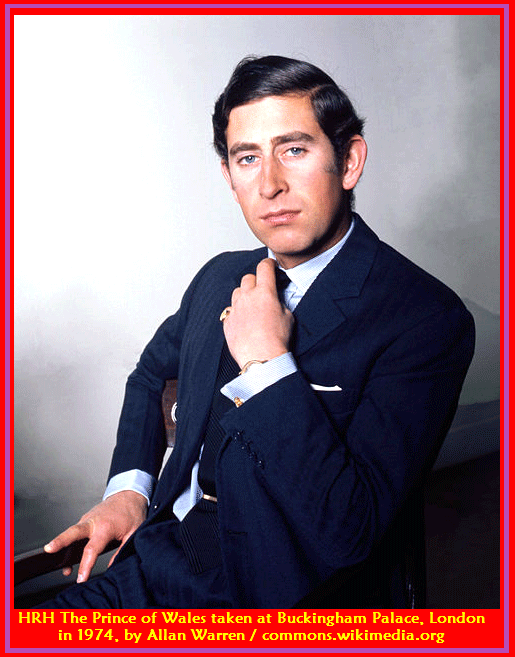
As Florence gradually came out of isolation and, light, food, and water reinstated with the calm and courage of the Tuscan people and other relief workers, a cause for further joy also came about in England ten days later. On Monday, November 14th, Prince Charles, still a school boy, officially came of age on his 18th birthday.

10

This enabled him to apply for a driver’s license, or to drink legally in a pub and to draw an income considerably larger than his classmates or teachers. But more importantly, it was the age at which the Prince of Wales, next in line for the British throne, became eligible to assume the throne and rule without a regent. The first joyful cheer to that rang out fifty years ago.

Until next time. Jo

11

 (©Joseph Sébastine/Manningtree Archive)

The Kaleidoscope of Hoof Prints

b1

(This follows my article The Ballad of JEANETTE and MICHEL  of March 2, 2016)

If there are phrases on my tongue which connote the blessings that can unwittingly come in many disguises to the gentle-natured donkey, it is those plans and purpose which chanced upon as revealed in some events of “The Bible”. With Palm Sunday (March 20, 2016) followed by Easter (March 27, 2016) coming up, bringing in a time when it is not unusual for people to be religious in thoughts, I take a little liberty to reflect on those events.

b2

Animals like sheep, camel, donkey, have afforded their presence to many episodes of the Bible. Indeed there are momentous occasions when the donkey was part of events that were important junctures in the life of Jesus Christ.

b3

The ass of Palestine and the Bible has been identified as the Nubian wild ass of Egypt. This common beast of burden, used for agricultural work and also for riding, is not in the East by any means a despised or a despicable animal – but considered part of a moderate household. Whole families rode him, shared food with him, and sometimes allowed him to stay in a section of the room with the family.

b4

Visitation: It is related that Mary, pregnant with Jesus, used a donkey when she set out on her journey for her ‘Visitation’ to congratulate cousin Elizabeth who was pregnant with the child who would one day become known as John the Baptist. According to tradition, that donkey had travelled about seventy miles from Nazareth over hills and through valleys to the little town in the Judaean hills where Elizabeth and her husband, priest Zachary dwelt. Considering that the feast of the Annunciation of the Birth of Jesus is held on March 25th, this journey could probably have occurred during the last days of March or early April when the rainy season was just over. Although Joseph is not named in this journey, it is unlikely that Mary would have ventured on a long and arduous journey alone and abode with Elizabeth for about three months before she rode back to her home in Nazareth. Besides, it was customary to have a driver for the donkey, when women rode on them.

b5

To Bethlehem: The initial scenes of William Wyler’s biblical epic movie “Ben-Hur” (1959) portrays Joseph, a village carpenter, leading a meek donkey by the bridle, on which sat his pregnant wife Mary covered with a long cloak, during their journey from Nazareth to Bethlehem in Judea to enrol their names in a census which had been ordered by Caesar Augustus. The vague details of that journey of about seventy miles could be visualised as five days of privation, fatigue and discomfort through an uncomfortable path in the winter chill of December. A book on the Virgin Mary names this donkey as “Eleabthona”, but we could only wonder if it was the same animal which had previously been similarly used when Mary went on her “Visitation” to Elizabeth.

b6

To Jerusalem: Whichever donkey it was, that animal had the opportunity to be closer to the newly born Jesus in the stable outside Bethlehem. Besides, amongst the few other domesticated animals present there, he was the one who would render service as the mode of transport to Joseph’s family when, at the age of forty days, the infant Jesus was taken to Jerusalem for presentation in the Temple and return.

b7

To Egypt: Sometime thereafter, warned of an imminent danger to the child, the family hastily embarked on a journey in the middle of the night, with Mary and the child riding the donkey, as they rushed out of the territory of King Herod to retire into Egypt. With the winter still persisting, that journey of ten days covering about two hundred miles via the city of Pelusium (modern Tell el-Farama) was not without difficulties and dangers arising from cold, wet and stormy weather, lack of shelter over their heads, less water, attack by robbers and wild beasts, proceeding partially through the shifting sands of the desert as far as the land of Gessen, where they resided (1). Not until had King Herod died in the spring of 4 BC, did they retire to the early home of Joseph and Mary at Nazareth of Galilee.

b8

Soon after, the donkey of those journeys slips into obscurity even though according to a recorded event of Jesus’ youth, at the age of twelve, Jesus was taken on a long journey to Jerusalem to attend the Passover before returning to Nazareth when the service of a donkey would have been required.

b9

It is widely held that the dark line down a donkey’s back and across the forequarters in the shape of a Latin cross denotes the heritage of that race from the day one of their forebears carried Jesus on its back during His triumphal entry into Jerusalem which is commemorated as the first Palm Sunday (Dominica in ramis Palmarum), and marks the beginning of what is technically called Passion Week.

b10

To Jerusalem: According to the Gospels, Jesus, having come to the little village of Bethphage (Beitphage) on the summit of the Mount of Olives sent two disciples into the village to fetch an ass and a colt they would find tied there. Having brought the animals, they cast their garments upon the ass and made Jesus sit thereon. (2) The animal carried Jesus, sitting meek and gentle on its back, as it treaded over the olive palm fronds strewn over the garments laid on the path, amidst the joy and singing of a multitude of accompanying people wielding branches of palm trees as a testimony of honour and respect.

At that time Jerusalem was surrounded with fertile fields and trees, and on the southern slope of Olivet, where they were passing, date-bearing palm trees grew in great abundance. The Palm has been in all times and places the emblem of victory and its reward and it was the custom to carry and wave palm-branches as a sign of joy and victory.

b11

At length, the donkey carried Jesus down the hill, passed between the walls of Gethsemane and the Garden of Olives, crossed the Cedron valley (Kidron), through the road leading up to St. Stephen’s Gate (Lions’ Gate), and entered the Temple through the Golden Gate with its beautiful pillars. This occasion, commemorated on Palm Sunday with a Procession of Palms was customary in Jerusalem as early as 386 when it was first mentioned, and was adopted in the west by the seventh century as attested to by Isidore of Seville, who died in 636.

b12

Until the Reformation in the Middle Ages, the event was remembered in a folklorised ritual on Palm Sunday (Palmsonntag) in some southern German speaking regions when, in addition to the tradition of the blessing of palms (Palmbüscheln), a procession known as “Palmesel” (Palm Sunday donkey) was held when a statue of Jesus mounted on a wooden effigy of an ass fixed on a wheeled wooden bier was taken round the streets spread with clothes and strewed with palm branches. To mark this joyous occasion, people sang hymns and waved fronds of palm or of some other similar tree, while at some places bouquets of flowers attached to boughs of trees were sometimes carried in the procession calling it the Easter of Flowers.

The ass was not forgotten either. A book on ecclesiastical architecture relates an old tradition that “the ass on which Christ made His entry into Jerusalem left Judea immediately after the Crucifixion, and passing over the sea dry-shod to Rhodes, Cyprus, Malta, Sicily, and Aquileia, finally reached Verona, where it lived to a very old age. After its death its bones were collected and deposited in the belly of the wooden ass of Santa Maria in Organo, which was made as a memorial of it and its exact image.”

b13

Just as that event at Jerusalem made them an object of peculiar reverence to the early Christians, the cross on its back inspired belief that children suffering from whooping cough will be cured if they are made to sit on the mark and the donkey walked in a circle nine times.

It is interesting to think, with what different sentiments one regards the donkey at different periods. The poor quadruped which tradition says earned its reputation for stupidity in the Garden of Eden when it could not remember its name when God asked it, is actually, as one of my friends wrote, a poorly understood animal.

b14

Ass, when properly kept, is a handsome animal – much stronger in proportion, and much more hardy than the horse. The positive efforts of institutions such as Kölner Zoo in Germany, The Donkey Sanctuary in Devon, England, etc, very much help the welfare of the docile and friendly donkey to save them from becoming snapshots of a bygone era. Let us be glad that they are there and keep alive the age old tradition that to see a donkey will bring one the good luck. Until next time, Ciao, Jo

b15

Notes:

  1. According to some publications, the particular place where Joseph settled in Egypt is probably Metaryieh, near On/Heliopolis, about two hours distance north-east of Cairo.
  2. A Franciscan church, built on the foundation of an ancient shrine, stands to commemorate the place where Christ mounted the ass, contains a stone traditionally identified as used by Jesus to mount the ass for the journey to Jerusalem.
  3. Thanks to: Mr. Bernd Marcordes, Kurator, AG Zoologischer Garten Köln, Germany for the picture of Michel and Jeanette; to Ms. Pippa Helock of The Donkey Sanctuary, Devon for the picture “Looking Handsome”; and to Stefan Ahrens of Bistum Regensburg, Germany for the four pictures.
  4. Print and visual versions of “Ben-Hur” is available with amazon.com, amazon.co.uk and other leading dealers.

b16

Joseph Sébastine/Manningtree Archive)

The Roots and Wings of Valentine

1

Halloween, Thanksgiving, Christmas and New Year – the holidays of the short evenings are over. The spring vegetables are slowly entering the markets. Given that love is the keynote of that sweetest day of February when moments are made into memories, shops have displayed pretty favours for exchange between lovers and couples to mark the Valentine’s Day. As usual, a good number of high-flying hotels will be a much sought after destination on the 14th of this month for the lovers and couples out for a memorable candlelit evening of gastronomy, drinks, music, romance and to feel like a million dollars.

2Where we live, distinctive venues for such occasions are many and more are sprouting up every other month. Ecstatic to get it going, the dining tables there will be prettily decorated with fresh flowers, ferns, bisque cupids, candles, tableware, in addition to scattered red rose petals over the table cloth where a wide range of delicacies will be served with emphasis on its appearance since eye has much to do with the flavour of all food. Some even have in-house Mehndi artists or caricaturist to enhance the romantic ambiance.

The succulent specialities on offer in many restaurants, especially on occasions of festivities, present an extensive spread of seafood, meat and vegetarian delicacies and gorgeous after-food deserts very much compatible to all those gourmets. There, only few of the dishes need any explanation. From past experiences, the cuisine for the V-Day could include freshly shucked oysters, poached lobsters with dill and limoncello cream sauce, river Prawn Saganaki, baked fish, Beef Stroganoff, Braised Balsamic Chicken, Porcini Pork Tenderloin, Broccoli Quinoa Casserole, asparagus salad, etc, incorporating many of the general favourites of authentic regional Indian favourites cooked to perfection by chefs and their skilful teams playing cupids at the live stations. Be it ever so humble, praise for their delicious food never misses to light up their eyes as if they had won the lottery.

3

The objective is to make the Valentine’s Day the sweetest and memorable day of the year – touchingly sentimental, fun and ethical for those who wish to share their love and affection towards one another. In a time when affection and meaningful human communication takes a back seat as most eyes are buried in Smartphones, iPads, or other distractions, occasions like the V-Day reminds us to show that we love.

4

The tradition of the Festival of Love probably owes its origins to one of the pagan Roman festivals, Lupercalia, the festival of fertility which was celebrated in mid-February in ancient Rome. As part of its ritual, two young boys of patrician families dressed in goatskins, daub their faces with the blood of sacrificed goat and dog, and during a traditional course whipped maidens with stripes of leather as they passed. Expressing joy and happiness, such lashes were appreciated reckoning they would miraculously prevent or cure infertility. Somewhere between belief and doubt lies the faith.

5

After Christianity became more prevalent in Rome, the festival became associated with St. Valentine (1) a Christian priest and physician in Rome who was martyred on February 14, c. 269 AD (on the eve of Lupercalia) for being an advocate for the cause of peace and love. The book “Saint Valentine” by Robert Sabuda relates the story about how Valentine restored the blindness of a young girl with his deep faith and healing skills.

The custom of sending Valentines stems from a medieval belief that birds began to pair on the day Valentine was beheaded under the cruel Roman Emperor Claudius II Gothicus (Marcus Aurelius Valerius Claudius/Claudius the Goth, 268 to 270) who succumbed to plague in 270 AD. Amongst the customs that continued was the opportunity to choose a sweetheart or Valentine and letters or tokens can be sent secretly to the object of affection as a declaration of romantic love.

6

The rejuvenation of this event, after a slack in popularity but persisting through writings including those of Geoffrey Chaucer (c. 1345-1400) and William Shakespeare (1564-1616), could be attributed to the innumerable cards, books, poems, songs, stage presentations and films that flourished since the eighteenth century onwards. Nevertheless, it is always those couples entwined in their genuine love for each other, blessedly always much abundant in the world, who have kept this tradition of love alive and blooming. Some of the legends and stories of love that sparkled as jewels through the timeline of our world has inspired millions and has undoubtedly caught the imagination of the world.

7

I can think of many love deities and personalities in every culture dedicated to different fervours of love: Egyptian divinities Osiris and Isis; Roman Jupiter and Juno (Greek Zeus and Hera); Solomon and Sheba; Pharaoh Amenhotep IV (Akhenaten) and Queen Nefertiti; Orpheus and Eurydice; Queen Cleopatra and Mark Antony; Justinian and Theodora; Lancelot and Guinevere; Layla and Majnun; Shah Jahan and Mumtaz Mahal; Salim (Emperor Jahangir) and Anarkali (Nadira Begum or Sharf-un-Nissa);

8

Queen Victoria and Prince Albert; Napoleon and Joséphine de Beauharnais; Jean-Paul Sartre and Simone de Beauvoir; Romeo and Juliet; Tristan and Isolde; Robin Hood and Maid Marian; Tarzan and Jane. I do not exclude  those stars of the film world who, at certain times, had become real life romantic characters they played on screen (2):

9

Mary Pickford and Douglas Fairbanks; Ingrid Bergman and Roberto Rossellini; Sir Laurence Olivier and Vivien Leigh; Katherine Hepburn and Spencer Tracy; Clark Gable and Carole Lombard; Rita Hayworth and Orson Welles; Humphrey Bogart and Lauren Bacall; Richard Burton and Elizabeth Taylor; etc… the love is always in the air and for many of them sometimes everything falls together.

10

Of the many customs built around this festival of love, few old customs like the artistic Victorian cards have sadly disappeared while more formal ways of messaging through emails or SMS or that great equalizer called WhatsApp have taken over in popularity.

11Then again, besides the enthusiasm of some couples, the reason Valentine’s Day has garnered more popularity today is due to the print and visual media and to the efforts of the corporate/marketing strategists striving to make it a gross consumer fest.

If the customary choices of the old school fancied Valentine cards, books, tokens, boxes of Belgian chocolates or selected kinds of gifts, and even considered a hug as a great gift; the preferences has presently progressed to all things high-flying – the posh sort – choices big and small, often putting some aficionados under “wallet” pressure – choices such as couture labels, a Visconti pen, a Supreme Goldstriker iPhone with the highest GB, a gorgeous clutch bag, a beautiful sparkling necklace, amazing Stuart Weitzman shoes, vintage boots, a Patek Philippe or Breitling wristwatch, luxury fragrances, a Lamborghini Veneno car, a holiday in The Bahamas, diamonds, secret tattoos, belly button ring, …. the list has become endless to maximize the vibes… The choice is ours.

Nevertheless, fresh flowers have always remained one of the popular gifts.

12

To give fresh flowers – those embodiments of perfect beauty – to a sweetheart….. what gift could honestly be nicer and special? They even leave their fragrance on the hand that bestows them.

13

When young mortal Adonis of Greek mythology lost his life owing to a wound he received from a boar during a chase, Aphrodite (Venus to the Romans), the goddess of love and beauty and the love of his life, found solace from her deep grief in the beautiful Anemone flower which sprung from his blood (or from her tears), until the gods of the lower world favoured her by allowing Adonis to spend six months of every year on earth with Aphrodite. And it is from Aphrodite’s son Eros (Cupid/Amor) that V-Day earned the grace of Cupid, the god of love – a wanton boy with arrows in a golden quiver, who is related to a thousand tricks and cruel sports – the most potent being the pierce from his golden arrow that would kindle love in the stricken heart.

14

When my wife first came to meet me, she brought along an enormous bunch of fresh ivory coloured tulips in a box all the way from England, carefully looked after by the cabin crew of British Airways. Truly a heart of gold she has. She had specifically chosen that spring flower due to my ardent “tulipomania”. Of course, one’s own preferred choice would be different. A friend’s wife preferred velvety red roses from her husband since it’s the symbol of happy and passionate love, while another friend suggested that, if possible, we bring garden daisies to cheer his hospitalised wife when we visited her.

15Somewhere along the way, love has taken its place in the age-old form of art that associate flowers with different meanings. Floriography signifies the name of the language of flowers as practiced in traditional cultures in many parts of the world. The Japanese call it Hanakotoba.

As ivory coloured tulips will always be the symbol of true love for me, the symbolism and hidden meaning of those flowers that express love and affection, subject to change with various combination (3), is generally regarded as: Apple Blossom (Good fortune) – Balsam (Ardent love) – Jasmine (Grace and Elegance) – Lavender (Devotion) – Lilac (First Emotions of Love) – Orchid (Fertility, love and Beauty) – Red Tulip (Declaration of Love) – Sunflower (Adoration) – Violet (Faithfulness), Hibiscus (Sacred Love and Beauty)….

16

Amongst the vast array of flowers lingers the “Forget-Me-Nots”, the lover’s flower. The legend has it that a valiant German knight slipped and fell into water when stooping to gallantly pick up some beautiful blue flowers growing in the water which his paramour wanted him to get for her. Before he finally sank under the water, he threw the flowers at his love and implored her to “Vergiß mein nicht” (Forget Me Not). It was the voice of genuine love that was calling out, to remind, “I will be always with you. I will love you just as you are.”   

Amore!   If love is the key to our hearts, no doubt, then the heaven is within us. Ciao, Jo

17

Notes:

  • According to the Roman Martyrology, two persons under the name of Valentine were martyred on February 14, c. 269. One was St. Valentine who was buried on the Flaminian Way where a basilica was erected in 350. Another Valentine was the bishop of Interamna (Terni) about 104 kms from Rome, beheaded there by order of Placidus, prefect of Interamna. Many scholars believe that these two persons are the same.
  • The book Saint Valentine by Robert Sabuda and DVDs of the movies of the stars referred above are available with reputed dealers.

18

 (©Joseph Sébastine/Manningtree Archive)

Flutter by, Melodic Butterflies

1

There’s a song in the air !

        There’s a star in the sky !

2

I have always found music delightful for relaxation. Lately I had been listening to music either streamed or downloaded from the web where we could find any kind of music we wish for. Unlike the effort to flip through our musical collections of vinyl albums, CDs, cassettes and videos for enjoying music in the conventional way, one needs only to flick some icons on the web, and the music comes pouring into the room. But how can I resist from admitting that I like music on physical formats, especially the tangible experience of holding a vinyl album and admiring the big cover art while it plays with the pops and cracks and imperfections of an old gramophone record.

3

A week ago we were sorting out the Christmas albums in the storage shelf where they were waiting for the right time to arrive when we would let them play their joyful melodies – to experience the pleasure they would bring us.

4

Waiting for Christmas! The instance reminded me of an old adage which relates that “a test for true love is a rose which has been picked on Midsummers’ Day and put away until Christmas. If it is found still fresh at Christmas, the love of the girl who plucked it and her beau will run true and flourish.” – the kind of love where the boy will kneel down and tell her that she is the sweetest, most charming and ravishing girl in the world and that he would be unable to live one more second without her! I personally know of instances like this.

5

But vis-à-vis our present subject, the fact remains that listening to greater part of carols and Christmas songs surely create an effect we aspire to in our house.

6

Christmas time is a warm and nostalgic time of a year – and Christmas, winter’s merriest tale, is all about the birth of Jesus Christ and cannot be rightly told without music. As it happens, throughout the festive season and often beyond – while we set up the Christmas tree and the Christmas crib, or hang up the stockings and decorations, or prepare the feast, or merry-make in the festive gathering, we play them as background music just for the warmth and joy of those seasonal melodies.

7

8

Those are classical instrumentations by Tchaikovsky, Vivaldi, Bach, Handel, Beethoven, etc, or sung by choirs, or carol singers or by Earl Grant, Ray Conniff, Harry Belafonte, Nat King Cole, Brenda Lee, Nina Simone, Pierino Ronald “Perry” Como, Frank Sinatra, Judy Collins, Tom Jones, Fernand Gignac, Nana Mouskouri, Celine Dion, Muriel J, Jose Feliciano, Ajejandro Sanz, Andrea Bocelli, Dame Kiri Te Kanawa, Rod Stewart, Boney M and many others.

9

Behind those songs were the lyrical and musical talents of folk singers, monks, the clergy, literary and musical luminaries.

10

In the movies “The Alamo” (1960), “To Kill a Mocking Bird” (1962), “In the Heat of the Night” (1967), the viewer might have noticed a versatile actor named Jester Hairston who was also a songwriter/composer/conductor and singer. In 1956, Hairston wrote fresh lyrics for an earlier song he had written titled “He Pone and Chocolate Tea” and attuned in calypso rhythm but was never recorded in that form.

11

The song with the new lyrics, later characterised as a Christmas carol, was titled “Mary’s Boy Child” and the world first heard of it when Harry Belafonte released it through his album “An Evening with Belafonte” (1956).

12

The song was subsequently recorded by music artists such as Jim Reeves, Tom Jones, Andy Williams, Anne Murray, Dame Kiri Te Kanawa, including a version in 1978 by Boney M which is still popular like most of the Boney M songs released when they were in the prime of their time.

13

Christmas carols lend an air to this festive season and over the years have spawned a variety of classics to make good cheer. In England of the olden days, groups went on “Wassailing” for “luck-visits” from house to house at Christmas time – singing carols and sharing the contents of their wassail bowls for which they expected to be rewarded with gifts, food and drinks.

14

15They were considered to be the forerunners of modern day carol singers. This practise later evolved into modified versions. Then again, what is true in England is also true in Italy and in our Cochin, or everywhere.

And so, wassailing was enacted in our Cochin also when numerous groups dressed in character of Santa Claus and shepherds and shepherdesses in knee-length, floating skirts as dancers, together with their entourage of singers and musicians. They visited houses, predominantly in Fort Cochin and the coastal belt, to entertain during Christmas time.

Although this practise is slowly dying down, few groups are still active during the Christmas season. The songs which maintain great popularity in their street collection lists are “Jingle Bells”, and “Santa Claus Is Comin’ to Town” which tells of the approach of Santa Claus and his pack of reindeers.

16

These songs are nice accompaniments to dancing and rather similar to renditions such as “Rudolph The Red-nosed Reindeer”, “I’ve Got My Love to Keep Me Warm”, “Rockin’ Around the Christmas Tree”, etc.

17

19

20Interspersed in their collection are popular songs from movies or simultaneously, versions in local language which some enlightened ones find not ‘hip’ and very un-English without some English terms peppered in it. But if there is one carol that is generally heard here throughout the Christmas time is the English version of “Silent Night” (Stille Nacht), a reverential rendition written in German in 1816 by Friar Joseph Mohr of Austria with music added to it by Franz Xaver Gruber in 1818.

This is said to be one of the main songs (and also ‘Adeste Fideles’) the German and the English soldiers jointly sung on the first Christmas of the First World War, in 1914 when, in a spontaneous and unofficial Christmas truce, their guns fell silent for a brief period and they emerged out of their trenches into no-man’s land in a number of places along the Western Front: to exchange gifts, cigarettes and joyously sing carols and songs to commemorate the birth of baby Jesus. They knew that the war was going to last a long time and many would not live through for another Christmas Day or even see their wives back home knitting socks for the soldiers at the Front.

21

This chivalry between enemies in the military air to uphold the Christmas spirit is depicted in the films: “Joyeux Noël” (Merry Christmas – 2005/French); Oh, What a Lovely War (1969/UK) (1)

22

23

Many a Christmas carols and songs have played at the chords of the human heart with its angelic fingers: “The Twelve Days of Christmas” covers the 12 days starting with Christmas Day till 6th January (Epiphany); “Hark! The Herald Angels Sing”; “O Little Town of Bethlehem”; “In The Bleak Mid-winter”; “Joy to the World”; “We Wish You a Merry Christmas”, “Away in a Manger”; “Ding Dong! Merrily on High”; “Adeste Fideles/O Come All Ye Faithful”; “In Excelsis Gloria”, and many many more. Some of these titles are highlighted here.

24

The most ancient carols known to us date from the Middle Ages. Historians contend that the word “Carol” passed from French into the English language in about 1300 and was associated with words, music and dance. Books of carols were cried about the streets of Paris as early as the thirteenth century.

25

These carols shadow forth the true spirit of miracle plays, religious spectacles, and old religious legends. In most cases, they were by and large in Latin which was the medium for prayers and chants in the churches in those days. Latin being unversed to most common men of Italy, San Francesco di Assisi presented the carols in his native language – supported by theatrics.

26

From there it gathered popularity, and despite occasional hindrances (such as the temporary abolition of Christmas in England in the 17th century), it survived through transitory periods spanning the medieval, the renaissance (rise of music printing and of vocal music performed with instruments), the baroque (invention of opera), the rococo (rise of comic opera and the symphony), the classicism (flowering of instrumental music), the romanticism (rise of the conductor and the golden age of the piano), the post-romanticism (dominance of mammoth orchestra), up to our time. In 1918, carols received the biggest boost when the “Festival of Nine Lessons and Carols”, a Christmas Eve service which includes carols and readings from the Bible, were adopted by King’s College Cambridge.

27

People vary greatly in their way of responding to music. Tastes have altered. Then again, there is great proliferation of Christmas carols and songs, owing to the creative flair of many contemporary musicians who retain its originality.

28

As for us, we treasure each Christmas of our years gone past – its virtues of humility, generosity and love. We admire the splendour of its true traditions: the birth of baby Jesus, the Christmas tree, the Christmas crib, the star, the old decorations of rosemary and bays, the holly and the ivy, the poinsettias (Flores de Noche Buena/Flowers of the Holy Night), the Mistletoe, the greeting cards, exchange of gifts, the banquet which includes plum pottage, minced pies, roast beef, Christmas ale, and of course, Santa Claus, dancing and singing….

29

Although the Christmas festive season will come only once a year, our steadfast delight in the Christmas carols and songs ensure that those cherished melodies flutter around in our house, like butterflies, whatever the season may be. Enjoy your Christmas holidays! Ho! Ho! Ho!! Jo

30

Notes:

  • Christmas Truce: In books: Silent Night: The Story of the World War I Christmas Truce by Stanley Weintraub; Truce: The Day the Soldiers Stopped Fighting by Jim Murphy, etc. It is also the theme of Sainsbury’s official Christmas 2014 Advertisement
  • DVD/Blu-ray of the movies referred above is available with main dealers of movies.
  • This is dedicated to Pope-emeritus Benedict XVI who received Doctorates honoris causa on 04 July 2015 for five contributions to knowledge and culture – which includes his great respect for the musical tradition of the Church and his remarkable sensitivity to the music of faith. May he enjoy blessings of good health.

31

 (©Joseph Sébastine/Manningtree Archive)

32

SURVIVING WITH DIGNITY

1

The joy of Christmas is nearer, drawing in a beehive of activities allied to it. The Christian Churches here, as in all parts of the world, are livened up for the yearly holy event marking the birth of baby Jesus, followed by the close of another year. Most educational institutions are on preparatory mode for holding mid-term exams prior to the culmination of the vacation season.

2

Plans are being made for annual vacations, or joyous activities, or gourmet feasts, or family get-togethers. Banking on the commercial value of the holiday season, the hospitality industry and other retailing sectors including big Malls are once again out with window decorations, dangling fantasies and other crowd-tickler marketing gimmicks through the media, web and signposts.

3

One is baffled and bewildered by the choice of innovative merchandize, latest tech trends, etc, available.  “Happy Shopping Holidays” – three charming words dominate this period to augment the marketing campaigns.

4

A special event at all times to me, Christmas, like Easter, has a considerable period of preparation. The Gospel of St. Matthew relates so briefly about preparations that had taken place some 2020 years ago when, three wise men, proficient in astronomy and astrology, turned their heads up to gaze at a brilliant star that would set them on a journey. Theirs was a spiritual desire to find and adore a new-born child – to lay their gifts contained in caskets of odoriferous wood at the child’s tiny feet – gifts of pure gold (asserting the kingship of Christ), frankincense (Christ’s divinity) and myrrh (that He was man, and doomed to death).

5

Their long and perilous journey through “field and fountain, moor and mountain, following yonder star” culminated in success when they found the new-born Jesus not in the stable, as usually depicted in the scene by artists, but in a roofed house where the three holy ones were temporarily lodged. These three wise men (or kings) would be the first to acknowledge Christ.

6

These wise men, assumed to be three given that three gifts were given in homage of Christ’s birth, are identified by various names, but generally known as Balthazar, Melchior and C(G)aspar since the ninth century (1). Believed to be Babylonian names, according to an old valuable book about Virgin Mary, they probably hail from the city of Séleucide which was the abode of the most celebrated astronomers of antiquity (2).

7

The Bible also relates to another journey during that period, taken place hundreds of miles away from the path the Magi would travel. Carpenter Joseph of Nazareth in Galilee accompanied by his wife Mary was on their way to Bethlehem of Judea, to register their names and pay tribute-money owing to the Roman Census of population and landed possessions.

8

Besides his beloved pregnant wife riding on a donkey, Joseph, humble, modest and retiring, was devoid of possession of anything of great value except for few clothes and the usual provisions for their painful journey of possibly five days. Their basket made of palm leaves could have included dates, figs, raisins, thin cakes of barley meal, earthen vessel to hold water, and the most precious swaddling-bands Mary’s hands had prepared to envelop her child. The census, made in the late autumn or early winter when agricultural work had ceased, might have attracted great concourse of people to the region that accommodation in cells of caravansaries in Bethlehem were unavailable.

9

Whatever the reason, upon their arrival at Bethlehem, Joseph and Mary sought shelter in a stable in the interior of a little cavern located in the suburbs which served as a stable and sometimes as refuge for the shepherds in cold and stormy nights. In there, after a good lengthy time following the hour of the Nativity, the new-born infant was adored by the shepherds as the Christkindl lay in a manger, wrapped in swaddling clothes.

11

12The adoration of the shepherds and the Magi is depicted in several movies. One of the realistic among them appears in the initial scenes of director William Wyler’s cinematic triumph, Ben-Hur (1959), its devotional ambiance enhanced by the Academy Award winning music score of Miklós Rózsa (1907-1995). Watching Wyler’s “Ben-Hur” is an enjoyable and rewarding experience. Its grandeur and spectacle, colourful characters, richness of its screenplay, excellent direction, fantastic production values, the realistic action sequence of the chariot race, the many visual symbolic threads woven into the story such as water accentuated as an agent of renewal, the dramatic effect emphasized without showing Christ’s face, the transition from full orchestra to organ during the sequences in which Christ appears, and most importantly, its story about a rich man passing through the eye of the needle, had caught up my imagination that “Ben-Hur” rates the highest number of times I have seen a movie.

13

The little figurines of the Magi from the story of the Adoration of the Biblical Magi, part of the ensemble of the Christmas crib-set in our house, were objects of marvel in my childhood. Their crowned figures clad in embroidered robes featured all the paraphernalia and pomp of royalty; their camels decked with ornamental bridles and saddles, the mysterious gifts in their hands, were all sprigs of fascination. Their images got better and fine-looking as we purchased better crib-sets over the years – from Austria, Italy and Bangkok.

14

The custom of exchanging gifts could date back to the three wise men. As some stories go: in olden times on Christmas Eve, children used to place shoes filled with oats outside their huts for the camels of the Magi which they hoped would be miraculously replaced with gifts.

15

16

The closest I got to the physical entity of the three wise men was when we stood before the gilded and decorated triple Sarcophagus traditionally believed to contain the relics of the Magi at the Shrine of the Three Holy Kings (Dreikönigsschrein) behind the high altar of Cologne Cathedral (Der Kölner Dom) in Germany.

17

Those relics were transferred from the church of St. Eustorgius in Milan on 23rd July 1164 by the powerful imperial chancellor, Rainald von Dassel (later Archbishop of Cologne) (3) having received them from the Holy Roman Emperor Frederick I (Barbarossa).

18

Sometime after her arrival in the Holy Land around December 326/January 327 A.D., Helena (Flavia Iulia Helena Augusta/St. Helena – 248/9-329?), the mother of Emperor Constantine and discoverer of the True Cross, had discovered the bones of the Magi while searching for relics and building churches in honour of the life of Jesus. Chroniclers contend that she transferred the relics to Constantinople and later, Bishop Eustorgius, a native of Constantinople, was allowed by Emperor Constans (Flavius Iulius Constans Augustus – from 337 to 350) to transfer them to Milan in 343/44. The relics eventually became the most remarkable medieval cults to royalty.

19

The magi, a popular subject of tapestry, are patrons of travellers and pilgrims. In addition to the above three places, I have visited other centres where Christian reliquaries are kept, but a visit to one in Greece connected to the Magi remains yet to be realised. The Holy Monastery of Agiou Pavlou (Saint Paul’s) in Mount Athos houses, among many other relics, some cases containing gold, frankincense and myrrh, believed to be the gifts the Magi brought to baby Jesus. The authenticity of some of the relics could be doubtful but such vestiges play an important role as catalysts in connecting us to the history and legends of our illustrious past.

20

21Christmas, celebrated everywhere, is particularly enjoyable at some places where it exudes a whole lot of charm to enjoy it the most. We have spent Christmas Day and New Year’s Day in different countries. Those special days made good memories for us – just like some days bearing special names are auspicious for many: Thanksgiving Day, Republic Day, Independence Day, May Day, Father’s Day, Mother’s Day, Patriots’ Day, Valentine’s Day, Friendship Day, Day of Tiger, of Elephant, etc….. All this is very well.

Then again, woven into the fabric of the year are ill-fated days from history lesson: 9/11 (World Trade Center attack), 26/11 (Mumbai attack), 13/11 (Paris attack), ……. – named after disastrous events that have spawned sadness in us and bruised our pride, occasioned by malicious minds hell-bent on executing everything violent in excess. The world witnessed outpour of grief when innocent and helpless people lost their lives recently owing to brutal violence.

Even so, pain nourishes courage. The global goodwill resonated in displays of solidarity, judiciousness and calm wisdom when the Eiffel Tower, Paris; San Francisco City Hall; Tower Bridge, the London Eye, the National Portrait Gallery in Trafalgar Square, Wembley Stadium in London; Brandenbourg Gate in Berlin; Christ the Redeemer statue in Rio de Janeiro; the CN Tower in Toronto; Burj Khalifa in Dubai; Tokyo Tower; Sydney Opera House; etc, showcased colours of blue, white and red. Vive la France!

22

Naturally, we bank on a sense of order and peace around us and we wish our lives to measure up to our hopes. There is nothing so precious and nothing more important than peace, though throughout history it has often been taken for granted until it’s too late. The past high degree of violence and unpredictability, offensive to our good spirits, had markedly dampened this holiday cheer. Recently there was news about tourists being selective on places to go for a safe and peaceful vacation.

23

24

25

26As for us raring to go, despite the weather, we could opt for Christmas time in Italy even though we would be doing only a repeat of what we have done there many times over the years. There would be the traditional outdoor Christmas markets in Florence, Verona, Venice, Rome, …. On Christmas Eve, we could attend the Papal Mass by Papa Francesco at the Basilica Papale di San Pietro in Vaticano and admire the huge Christmas tree and the life-sized Nativity scene in Piazza San Pietro; or at the Cattedrale di Santa Maria del Fiore (Duomo di Firenze); or at Basilica di San Marco, Venezia and watch the gondola arrive with Babbo Natale (Father Christmas) to distribute goodies, before sitting down for dinner and Bellini at Cipriani’s Harry’s Bar; or at Basilica di Sant’Antonio di Padova where we have wonderful friends amongst the Franciscan friars of the Basilica, etc.

Besides England, France, Germany, Austria, Switzerland, Spain, Portugal, all wonderful places where we have enjoyed the local culture, Madrid (Spain) would garner our priority due to the wonderful ensemble of jolly good friends we have there. Alternatively, should we look at the East, we could always opt for Thailand, Singapore – or within good old India.

27

28

Now with the three wise women  in my life, my wife and two daughters, here – it’s ample reason to take the pleasure of this season in the comfort of our sweet home. There won’t be snow here. But, never mind – the carollers and Santa Claus will come, maybe even Santa Mama.  Peaceful Cochin and Fort Cochin will be decked with lights and stars – with the brightest most cheerful displays. Impersonations of the three wise men may appear in the yearly Carnival on the first of the New Year. Listen closely and we may hear Santa Claus cracking up with laughter in helplessness – at the seasonal hike in retail prices. I think there was never a sad Christmas time in Fort Cochin except maybe in 1524 when a period of mourning was observed owing to the death of Portuguese explorer Vasco da Gama at Fort Cochin on Christmas Eve.

29

Out of the many boxes resting in our storeroom for the past eleven months would spring beautiful stars, lights and ornaments to deck up our Christmas tree and adorn strategic places in our house. A beautiful floral table centrepiece will be made. My wife, very skilful with dazzling décor ideas, characteristic of her German origin, will once again ensure that all is done.

30

31As for the creation of the Christmas crib, I believe I still have the inspiration from the creative astute shown by San Francesco di Assisi when he, with the permission of Pope Honorius III, recreated the Nativity scene (Presepio) for “the babe of Bethlehem” at the village of Greccio in Provincia di Rieti, Italy during the Christmas of 1223. Then again, the most inspiring of all this would be the message of Christmas – summarized in three magical words: “Kindness, Love, Peace”.

Not outdated or irrelevant, those sweet meditations of a mature faith appear relevant, especially in these times of adversity, to “survive with dignity”. Jo

Notes:

  • In art, so far as is known, the name of the three wise men appears for the first time in a relief sculpture on the lintel of the central portal above the main door at Chiesa di Sant’Andrea, the oldest surviving church in Pistoia, Tuscany. Created by Magister Gruamonte and his brother Adeodatus, it dates to 1166 – about 29 years prior to the birth of St. Anthony of Padova.
  • The three wise men were said to have come from the kingdoms of Tarshish, Sheba and Seba – three of the many places proposed as their countries of origin.
  • In “The War of Frederick I. against the Communes of Lombardy”, Rainald is named as Reinhardt.
  • The DVD/Blu-ray of “Ben-Hur” (1959) referred in this article, is available with main dealers of movies. Please refer to “About” of my webpage for more details.
  • This article is in memory of Michael and Gertrud Schüller, (late) parents of Carina, who would have loved to spend this Christmas here with us. May their souls rest in peace.

32

33

(© Joseph Sebastine/Manningtree Archive)

ORDER A GOOD CHEER

1

ORDER A GOOD CHEER

The secret is out. One of my friends, Chef Rasheed Abdulkhader who often surprised us with his mastery in culinary flairs is soon to retire after few decades with the Taj Group of Hotels, one of the top hospitality groups in India, where he had worked up the ladder to become one of the top Executive Chefs of this Group.

40

Over the years, Chef Rasheed’s passion and dedication had gotten him to a position where he could deal with the meals of the prominent and reputed guests from different parts of the world – the sheer brilliance of his culinary delights thus earning him the adulation of many. Each of his dishes stood up for itself for its excellence, freshness, taste and simplicity. The culinary menu of many of our own parties were overseen by him and it will be sad to see this shining personality with a never-fading smile take an exit due to “getting on in years.”

2

Now first things first. In the olden days, the chef (then locally known as “Kokki” or cook) didn’t triumph in popularity or acquired the kind  of glamour they have today. Back then, a thought about that leader of the kitchen rarely crossed one’s mind when you dined in a hotel. Like the cook in an upscale restaurant or in a smaller establishment like a toddy shop, you are only aware they are there.

In the context of my childhood, they made their personal appearance in your life whenever they were hired to cook for occasions such as a marriage in your house when, following the religious ceremony, a wholesome feast (vivahasadya) of time-honoured family recipes (generally unaltered over the years) were reproduced authentically (keeping the taste firmly on the original version), and served inside the house or in a fabricated marquee (pandal) within the residential compound, enhancing the intensely close-knit personal atmosphere.

4

It was an occasion when all the near and dear ones were invited with true open-handedness. And, no doubt,they might all come and attend the feast to celebrate the occasion.

5

The cook turns up some days earlier to list the items to be procured for his work and his work will commence mostly by the morning of the previous day of the wedding since there would be dinner to be served on the eve of the wedding day.  The cooking will continue overnight in a temporary outdoor cook-house till the lunch is served following the wedding ceremony.

6

Besides couple of his assistants/washers-up, help in the shapes of scores of relatives and neighbours turns up to assist in the progress of the cook’s work and other arrangements. Many would fondly recall the smell of burning wood hanging in the air or hear the sound from the bubbling pans.

7

8

In those times, the caterers with table-ready food service and event managers and pretentious food were unheard of. Relatives and friends had time for manual help and there were collective participation in arrangements: the pandal was erected with sturdy bamboo poles roofed with tarpaulin and decorated with white-painted bamboo trellis panels fencing all around it. Paper decorations adorn the white cloth covering the ceiling.

9

The hired trestle tables dressed with plain white cloth (without drape or box-pleat or petticoat) were arranged on the ground covered with tarpaulin. The cooking pots and pans, serving dishes, china, cutlery, moveable water-tank, chairs and even petro-max for artificial emergency lighting were hired.

10

Besides ensuring that cultural traditions survive, thoughtful planning by the elders eliminated potential faults. It was a time when family and friends conscripted as servers of food. There was a personal touch everywhere. Everyone participated – ate, drank and later, merrily went away.

11

The cook was generously paid and sent away happily and that was the last time you saw him until another occasion turns up when he is needed or you may see him working at another function. Those were simple and affordable, and joyous occasions. Time passed.

38

12

Then came the time when the pomp and middle-persons took over such ceremonies and put a high price tag to everything – well before the specialised food shops appeared throughout the length of the State. Soon common Italian words like Spaghetti Pomodoro, tiramisu, etc were no longer a novelty locally. The haute cuisine is here!

13

14Cookery books have come a long way from “The Forme of Cury” (Form of Cooking), the earliest surviving mediaeval cookery guide written by the Chef Maister Cokes (Chief Master Cooks) of young King Richard II of England (Richard of Bordeaux, 6 January 1367 – c. 14 February 1400) in about 1390. Apart from the masses of books and DVDs on cookery, with the advent of TV channels, radio and web shows, movies, foodie bloggers, culinary schools, etc, food and cooking has become two of the most common subjects around, especially on the web – rapidly commercialised and glamourised.

16

Concurrently, it also brings about a healthy breeding ground not only for the qualified and dedicated chefs, but also, truth be told, for persons with the slightest inclination in cooking or scant knowledge in qualities of the cooking ingredients or dietary criteria, to gallop their way to recognition on the back of knowledge acquired from cookery books or shows or experience gained through apprenticeship as kitchen assistants or diploma in culinary education in tutorials.

17

My paternal grandmother Anna never used a recipe in all her life but the heady aroma from her kitchen could lure a fully fed child back to the dining table. I often try my hand in the cooking department – but mind you, not as a hobby cook who ventures into the home kitchen to tackle culinary talents in the mid-afternoon of a Sunday.

19

The upshot of a popular chef is that apart from gaining wealth and fame, their perks could include opportunities to bring out cookery books/DVDs or conduct personal cookery classes/workshops, etc.

20

The hostess of a TV cookery show once commented, ‘My Domestic chores? I am all behind like a cow’s tail. Where would I find time to cook when my daily schedule is tightly fitted around films lined up for shooting and other public appearances to be made? How do I keep up with it all day?’ The show is just a piece of cake for her. Owing to her profession, she is unfazed by the lights, camera and cables.

21

It is implied that she just needs to turn up in the TV Studio for the shooting of the Cookery episode, gets beautifully attired (in most cases chef’s uniform is avoided), decked with gold ornaments, hair let loose rather than tucked under a Chef’s cap or headscarf. The emphasis is on glamour.

22

23

Good cookery shows do not just happen. Unlike most of today’s presenters who try to put in 100% data of their own for each episode, some amateur celebrity presenters in “cooking partnership” with the studios just follow the script guidelines for the Cookery episode, researched and provided to them by the TV Studio writers for study and possible input. These writers often think visually. They push for the big goal: the show must be exciting and full of drama to hold the audience and entice potential sponsors.

24

At the studio, where the presenter is already well acquainted with the many cookware and other aids at hand, he/she just needs to make a mental run-through of the episode, make mental notes for the occasional change of pace if the script calls for it before the final shooting which would be suitably edited later. As the shoot progresses, it would likely trigger impulsive, spur-of-the-moment ideas in the presenter to suit the characterisation being projected. They needn’t be afraid to try something new. After all, it is said that amateurs built the ark. If you enjoy yourself, so will others. That’s the long and short of it.

25

Being cheerful and unflustered from the curtain-raiser down to the end of the presentation, they are programmed to come across as culinary specialists, inspired by a deep love of home life, and smitten with the nostalgia of home-cooked cuisine of their childhood. If there is a guest for the show, their pleasing disposition is highlighted through chats with him/her who, in most cases, would be another popular personality who himself gets a shot to showcase himself with a song or dance or other gimmickry – all part of the ingredients of the cookery show.

26

27

Currently, there are some truly amazing cookery programmes dominating the airwaves. To watch the shows of learned and talented chefs, including Michelin Star Chefs, Nutritionists, Hotel Management professionals, wellness experts, expressing valid ideas and tips for healthy and tasty food is always a pleasure and benefits us to learn and discover aspects of cookery, new recipes or smarten up the known ones.

28

In fact, we watch the German show “Lafer! Lichter! Lecker!” hosted by Chef Johann Lafer and Horst Lichter. At other times, we enjoy MasterChef Australia, a reputed show co-hosted by Chefs Gary Mehigan and George Calombaris, and food critic Matt Preston where the emphasis, besides good cooking, is on drama and competitiveness within a limited time.

29

Our intense travel has brought us in contact with many top chef de cuisines in different countries. They have ensured that our appetites are in safe hands. Their skill and enthusiasm in their respective specialties are quite amazing.

30

39

Some of them also possess that special gift of “blessed hand” known locally as “Kaipunyam”. Chef Stefan Trepp of Mandarin Oriental Hotel, Bangkok and Chef Joseph of Grand Hotel, Cochin are the owners of such brilliance. Chef Ken Murphy, Chef Nicolas Bourel, ……. it is impossible to name here all of them known to us. Of course, I do not leave out Carina’s skill in German cooking.

31

Traditional cuisine of different countries has grown through little change over the years. In Kerala, keeping in line with the massive promotion of tourism, there is a renaissance of traditional dishes. The set-up of the recipes and the vocabulary of cooking sessions remain almost unchanged down to that most commonly and frequently used word in cookery: “….a little bit of …….”

32

However, with the growing popular interest in good food, cooking is a process of evolution – subject to amalgamation of spices with different ingredients; mixing of flavours and culture like Chinese/Italian, Indian/Thai, etc.

33

41

Imagination is the highest kite that can fly. Like Chef Rasheed whose thirst for knowledge and willingness to experiment with new ideas had driven him forward, a dedicated chef knows that his/her profession also calls for a very imaginative level of creativity and do-ability.

34

During a dinner party we attended in Milan, the guests stayed longer than the proper time. The hostess, a French aristocrat known for her elegance and imagination where hospitality is concerned, was not at all disconcerted. She had a huge dish of Spaghetti Bolognese ready, specially prepared earlier envisaging such a circumstance. When everyone cheered her for her surprise dish, she happily let out her plans for her next party. “Now let me tell you about that other dish I am going to cook next time. What about Saltimbocca?” There you go! I was nailed. Everyone is entitled to hope. Until next time. Jo

35

Picture above: Rose of Melon with Capocollo, a speciality of Trattoria Ristorante Il Porcospino, at Piazza di Madonna degli Aldobrandini in Florence, Italy. Owned by our dear friends, Il Porcospino is worth visiting for its fine cuisine.

36

Notes:

Many thanks to friends Ms. Suparat Phumrattanaprapin, Ms. Clarissa Lo Cascio and Chef Rasheed Abdulkhader for their hands on support to illustrate this article with their pictures.

37

(©Joseph Sébastine/Manningtree Archive)


StarChoice 23: MRS. ‘ARRIS GOES TO PARIS

a1 a2The day was wet and windy when we learned that an unexpected restriction was rightly slapped on visitors’ entry to the top of Gustave Eiffel’s Tower, the emblem of Paris. For Bianca, a first-time visitor to Paris at that time, the spectacular view from the third inner platform at 276m had to be compensated with a panoramic view from the second inner platform (115m) of the Eiffel Tower which was overcrowded with visitors despite the chilly wind. The night before from the window of our hotel rooms, we had seen the tower fizzes with champagne sparkle (336 600-W projector sodium lamps and 20,000 bulbs for the Sparkling Tower) periodically from sundown to the early hour while the old moon gleamed over it. Why does Paris hold a special place in many hearts? Most visually recognisable in Europe, the city’s beauty is undeniable. From where my wife Carina, Bianca and I stood on the second platform, not in the very distance was the Arc de Triomphe. Our eyes shifted from the Arc and trailed over the tree-lined straight boulevard of the Avenue des Champs-Élysées with its lovely sense of space now obstructed from view by the masses of buildings, to Le Grand Palais with its iron and glass domes. a3 a5Scanning past the city’s oldest monument, Obélisque de Luxor in the vast Place de la Concorde; and the splendid Jardin des Tuileries, we can’t miss architect I M Pei’s pyramid and that honourable house of La Gioconda, Le Musée du Louvre, where I have spent many many days over many years discovering the magnificent genius of our gifted ancestors, each object d’art systematically displayed for global citizens. Further to our right on the eastern half of the natural island, Île de la Cité in the Seine, loomed the 90m Gothic spire of Cathédrale Notre Dame de Paris, beyond which is Gare de Paris-Bercy from where we would catch the night train to Milan four days later. Gazing at the distance to the left, our eyes fell on the dome of that neo-Romanesque-Byzantine edifice, Sacré-Cœur (Sacred Heart) Basilica on the Montmartre (Mount of Martyrs) hill where we had chosen our hotel for this time to explore the life in Montmartre. Each arrondissement of this legendary metropolis is self-contained for necessities, its treasures, and its secrets. All life is here – in Paris. a6 a4Bianca, our eldest daughter, with her imminent degree in Fashion Design on her mind, had her thinking caps on for ideas and inspirations of the French fashion: Chanel, Dior, Vuitton, Yves Saint Laurent,… – all the more reason, this is the age where luxury fashion endeavours to be more accessible to the public. Her eyes were now busy trying to locate the Christian Dior Couture building on Avenue Montaigne which she finally found straight ahead of us, few blocks up the Pont de l’Alma Tunnel where Princess Diana with two others was killed in a car crash on the night of 31 August, 1997. Well, Dior would be our next destination for the day, the first of the haute-couture houses she intended to trail to “catch the fresh French fashion touch.” True to the word: Fashion is followed! a7

Mrs. ‘Arris Goes to Paris   (1992)

Interestingly, renowned American novelist Paul Gallico (Paul William Gallico – July 26, 1897 – July 15, 1976) in his beautiful short novel, Mrs. Harris Goes to Paris, published in 1958, tells the story about a widowed English working class woman’s visit to Paris to buy a beautiful dress. This book forms part of the four “Mrs. Harris” books Gallico wrote, viz., Mrs. Harris Goes to New York (1959), Mrs. Harris Goes to Parliament (1965, aka: Mrs Harris, M. P), and Mrs. Harris Goes to Moscow (1974). Adapted as a TV play with some alterations by John Hawkesworth, “Mrs. ‘Arris Goes to Paris” was filmed on locations in London, Paris and Budapest. a8 Synopsis: It was the London of 1953. Our protagonist, Mrs. Ada Harris, the charwoman somewhere in her late 50s or early 60s, led a regular-as-clockwork life in Battersea cleaning homes of well-to-dos living in and on the fringes of fashionable Eaton Square and Belgravia – 10 hours a day – 5 ½ days a Week. One morning after she had reported for work at the luxurious home of Lord and Lady Dent, one of her rich clients, Ada was sent to her Ladyship’s bedroom to collect some letters. There, Ada saw an invitation to Lord and Lady Dent to attend Her Majesty’s Coronation Ball at Buckingham Palace on Friday, 5th June 1953. It was then she saw two lovely gowns hanging by the wardrobe – one red and the other in pale blue. Ada had never seen anything so beautiful in her whole life. a9 When Lady Dent found Ada admiring her pale blue gown, she informed Ada that they are from Dior in Paris and the pale blue gown cost a pricey 450 guineas, an astronomical sum in 1953. Lady Dent plans to wear one of the gowns to the Coronation Ball. When Ada was given the chance to select one of the gowns for Lady Dent to wear for the Ball, the blue gown was Ada’s choice since she thought that the pale blue was the best for the Palace. Besides, they say Her Majesty liked pale colours. Lady Dent was apparently impressed by Ada’s selection. a10 In next to no time, Ada was besotted by the desire to own a similar Dior gown, but the cost, of course, was beyond her financial capacity. Having played in the weekly football Pool, Ada won 174 pounds 6 shillings and 4 pence – not much – but it was a good start for her to edge closer to owning a Dior dress. Mrs. Butterfield, her Cockney neighbour and close friend in the same profession was taken aback by Ada’s new interest in getting dressed up. She was all questions: from where will Ada find that kind of money with her low salary? Where will Ada wear the gown after all? Play dress-up in the attic? Ada had her reasons: they may only be charwomen – but they certainly can have their dreams – there is no law against that. As with everything in life, money buys quality. She would work hard enough. She is going to get a Dior gown. Seriously! a11 As a Chinese proverb goes, “To get through the hardest journey we need take only one step at a time, but we must keep on stepping”. She “scrimped and saved and slaved” with unwavering determination for three long years until she possessed just sufficient money to see her through her travel to Paris and return, plus the cost to acquire the gown. Perfect! a12 The year would be about 1956 by now when Ada, upon arrival in Paris, was confronted by the reality that obtaining an original couture creation from Christian Dior’s Salon is a challenging task. Then again, at the House of Christian Dior in the Avenue Montaigne, she was lucky enough to have met Mme Colbert, the Chief Vendeuse of Dior who was at that time in the middle of organising a Collection to be shown to a selected audience that afternoon where the guest of honour will be Her Royal Highness Princess Margaret, famed for her love for Christian Dior’s creations in the 1950s. a13 a14 As it turned out, with Mme Colbert’s help, Ada ended up sitting in the front row of the show next to a Ministre, Marquis Hippolite, who would soon become fascinated by her charming personality. a15 In a little while, as the Dior show proceeded with the display of magnificent haute couture creations, a young model named Natasha appeared dressed in a most gorgeous dress no: 89 “Temptation” which was the dream of Mrs. Ada Harris. Overwhelmed with admiration for that soft-pink gown, Ada’s incessant clapping was disdainfully stared at by the room full of high-society women in their aura of riches, getting their fashion fix here. a16 Following the show, Mme Colbert was delighted to accept Mrs. Harris’ booking for the gown “Temptation” at the cost of 437,000 francs (£450). Arrangements were swiftly made with the head dressmaker, Monsieur Marcel and his assistant Mme. Claudine who agreed they would spin into overdrive to get her dress done within a week. a17 Accommodation was arranged quickly for Ada’s one-week stay in Paris. However, to get Ada measured and fitted, it was found necessary to evade an antagonist in the form of the pompous director of the House of Dior, Monsieur Armont, who appeared to be an expert in brewing up anxiety in the salon. Mrs. Harris had never thought of that possibility. a18 And so, Ada slips under the protective umbrella of the triad: Mme Colbert, M Marcel and Mme Claudine. Keep the fingers crossed – everything comes to the one who waits. a19 Ada’s forced and unforeseen stay in Paris was not in vain. By the time the week has come to a full circle, she had sown the magical seeds of sure-fire success all around her: to put a bachelor’s house tidier; to bring together two lovers; mend the stormy time between the Marquis, his daughter Mme Louise and granddaughter Claire; and arranged a much needed letter for Mme Colbert from Le General de Gaulle conferring the Order of Croix de Guerre with palm  posthumously on her husband M Michelle Colbert, a member of La Résistance Française who was shot dead 12 years ago during the German occupation of France. a20 As luck would have it, not only M Michelle’s name will be inscribed in the book of the Heroes of the Resistance, but Mme Colbert will also be given the Médaille de la Résistance from the General himself. Wonderful! a21 In spite of this, M Armont still persisted on her neck. However, as in all stories trailing the legend of Cinderella, Ada Harris’ had her saving grace in a friendship to help her through her hurdles and finally finger-point M Armont as the bad leaf on the lettuce. Friendship isn’t a big thing – it is a million little things. a22 Mrs. ‘Arris Goes to Paris is a Canada-United Kingdom-Hungary co-production, and filmed with the production assistance of Air France and Christian Dior. It was produced by Susan Cavan and Andras Hamori and directed by Anthony Shaw (the first son of Angela Lansbury and Peter Shaw). a23 The ensemble of crew consists of: Stanley Myers (music); Laszlo George (Director of Photography); Sidney Wolinsky (Film Editing); Roger Murray-Leach (Production Design); Jane Robinson (Costume Design); Tamas Hornyanszky (Art Director), Virginia Gallico (Creative Consultant), etc. a24 One of the seasoned pros of the past, the performance of British actress Angela Lansbury, CBE (born on 16 October, 1925 in London) as Mrs. Ada Harris, a honest, working-class widow without children, is heart-warming. Out on a long-distance adventure, Angela’s Ada is a delight to watch as she braves the hurdles on the Parisian scenery. a25 Daughter of Irish stage/screen actress Moyna MacGill, and granddaughter of George Lansbury, the British Labour Party leader, the Strawberry blonde Angela had her screen debut in the role of the sly maid in Gaslight (D: George Cukor, 1944) which earned her nomination for Academy Award for best Supporting actress. MGM soon regarded her as a rising young star. Although she had to content with supporting roles owing that she was considered not pretty enough to be a leading lady, film after film she lured the limelight away from the top-billed stars of her movies. a26 Early in her career, she appeared in the post-war colour remake of the costume drama The Three Musketeers (D: George Sidney, 1948) in which Angela portrayed the role of Queen Ann. Next, I saw her in the biblical tale Samson and Delilah (D: Cecil B. DeMille, 1949) as the Philistine Semadar who was romanced by Victor Mature’s young Danite Samson. a27 a28She favoured her appearance in a string of movies: The Red Danube (D: George Sidney, 1949), The Purple Mask (D: Bruce Humberstone, 1955), All Fall Down (D: John Frankenheimer, 1961), The Manchurian Candidate (D: John Frankenheimer, 1962), Harlow (D: Gordon Douglas, 1965), etc. Success in movies drove her further to establish careers on stage and in television shows. She appeared in the long-run stage musical hit Mame (Jerry Herman); in TV productions including Murder, She Wrote, launched in 1984; in the musical Sweeney Todd (D: Stephen Sondheim); in Barry Sandler’s adaptation of Agatha Christie’s Miss Marple mystery The Mirror Crack’d (D: Guy Hamilton, 1980), etc. It is Angela’s sweet singing voice that we hear when the housekeeper Mrs. Potts sings in Beauty and the Beast (D: Garry Trounsdale & Kirk Wise, 1991) in the scene where the Beast romances Belle with dinner and a dance. a29 a30Egyptian actor Omar Sharif (born Michael Shalhoub) was already a Romantic/sex symbol of the Egyptian cinema before he rose to international stardom with his role as the fierce tribesman in Lawrence of Arabia (D: David Lean, 1962). While Mrs. ‘Arris Goes to Paris was preparing for production, Sharif was already working in Continental Europe acting in two films by French director Henri Verneuil: Mayrig (1991, and later, a TV play in 1993), 588 Rue Paradis (1992), and in Italian director Duccio Tessari’s Beyond Justice (1992). Omar Sharif was contracted as a guest star to portray the wealthy and charming Ministre, Le Marquis Hippolite de Chassagne. Sharif’s physical presence gave character of Marquis more than the film could have acquired from the script alone. a31 a32Diana Rigg (born Enid Diana Elizabeth Rigg in Doncaster, England) is the Tracy (Contessa Teresa di Vicenzo) of On Her Majesty’s Secret Service (Peter Hunt, 1969), the only woman 007 James Bond married. Dame Diana had already established her reputation in Shakespeare plays before international fame came her way for her role as the secret agent Emma Peel in the TV series The Avengers (1961–1969). The performance of Diana Rigg was first-rate as the brainy and fair Mme Colbert who tries to assert her authority as the in-charge of the sales in the House of Dior, and lock horns with M Armont who threw his weight around and refused to let Mrs. Harris, a commoner, have the gown. a33 a34 Montréal, Québec, Canada actor Lothaire Bluteau (Jesus of Montreal, 1989) is the dignified André Fauvel, the Dior accountant who was shy to reveal his fancy for model Natasha but thought that she deserved better than a “pen-pusher” like him. a35 A talented British actor, whenever John Savident (A Clockwork Orange, 1971) appears as the assertive and aggressive M Armont, it is like watching a snake come out of a basket. a36 Lila Kaye (An American Werewolf in London, 1981) acts as Mrs. Butterfield with the cockney dialect matching Mrs. Harris’, which is at its most distinctive during their journey to their workplaces by the doubledecker London bus no: 19 to Victoria. a37 a38 In her screen debut role, Winnipeg Manitoba, Canada-born Tamara Gorski (Murder at 1600, 1997) is exquisite as the small, fair-haired young Dior model Natasha Petitpierre, truly blessed with the loveliest of natures and the sweetest smile in that part of Paris. a39 Also on the supporting cast are: William Armstrong (M. Marcel), Barbara Barnes (Mme. Claudine), Tamsin Olivier (Mme. Louise), Trudy Weiss, Jenö Pataky, Jason Carter, Alex Knight, György Emõd, Mel Martin, Toby Whithouse, David Sterne, Anna Safranek, Ottó Szokolay, Tibor Medveczky, Kieron Jecchinis, Fruzsina Radnai, amongst others. a40 The film rightly features the period-details of the fairy-tale storyline: the white horse-driven van of Lambs Farm Dairy delivering milk in silver-topped bottles; the street-cleaner with his pulling cart; the old Harrods delivery van; the style of dressing, etc. a41 a42 Complemented by the melodious music of Stanley Myers, Mrs. ‘Arris Goes to Paris, with competent cast of actors and some interesting plot twists, is a nice and gentle family film,  that lifts our hearts with a positive assurance that things can turn up right if you set your mind to it. Watch it if you can – there is nothing wrong in having a little fantasy now and then to lift the spirits. Jo. a43 Notes: 1.. This illustrated article is an affectionate nosegay to the movie reviewed above. Please refer to “About” of my webpage for more details. 2.. The DVDs of the movies referred above are available with main dealers such as amazon.com, TCM Shop, etc. 3.. The novel “Mrs. Harris Goes to Paris” (original UK title: Flowers for Mrs. Harris) by Paul Gallico is available with leading book dealers. a44

(©Joseph Sébastine/Manningtree Archive)

On the Path of Il Poverello

How we remember, what we remember, and why we remember form the most personal map of our individuality

– writer Christina Baldwin

Pope-1Today March 13, 2014 marks the First Anniversary of the papacy of Pope Francis. Looking back, it brings to mind that Wednesday night of March 13, 2013 when the conclave of 115 cardinal-electors of the Roman Catholic church, gathered inside the Sistine Chapel, elected Cardinal Jorge Mario Bergoglio, (born December 17, 1936) the archbishop of Buenos Aires as the 266th pontiff, due to the resignation of Pope Benedict XVI on February 28, 2013.

Pope-2We were watching the late night news when the TV Station cut into this news and shifted the focus onto the central balcony called “Loggia della Benedizion” above the main entrance on the façade of the Basilica di San Pietro in Vaticano, from where Cardinal Protodeacon (for the 2013 conclave) Jean-Louis Pierre Tauran would proclaim the newly elected Pope. Soon the announcement came:

Pope-3

  • * Annuntio vobis gaudium magnum; Habemus Papam: 
  • Eminentissimum ac Reverendissimum Dominum,
  • Dominum Georgium Marium
  • Sanctae Romanae Ecclesiae Cardinalem Bergoglio
  • qui sibi nomen imposuit Franciscum

Pope-4WhoBergoglio? As the world waited, the man in white robe finally made his first appearance before the rain-soaked crowds in the vast Piazza San Pietro, to give his solemn blessing “Urbi et Orbi”. Following the prayer for Pope Emeritus, Benedict XVI, the new Vicar of Peter from almost “the end of the world“, asked the faithful to pray to the Lord that he be blessed by Him – so that he may proceed with the mission as the Lord would wish. The crowd prayed, cheered and waved flags: Francesco! Francesco! A man clad in midnight-blue coveralls, with a look of happiness etched on his face, shouted: Viva il Papa! Viva il Papa!“. The journey Jorge Mario Bergoglio was destined to take has begun.

Pope-5A year has now passed and during this period the bespectacled Holy Father’s days were a continuous thread of revelation about himself; about his thinking on a variety of issues: religion, politics, global issues, lifestyle, … As his pontificate acquired a definite shape, he reasserted himself as a man who had let the potent power of simplicity work in his life – a man who radiated love and charm and concern for the common man.

Pope-6The Argentinian-born Pope who took the name of San Francesco de Assisi, Il Poverello (the little poor one), is currently on a Lenten spiritual of preaching and prayer at a spiritual retreat in the town of Ariccia, in the Alban Hills about 15 miles outside the Vaticano.

Pope-7At this time, in the run-up to the Supreme Pontiff’s first Easter, I could envisage the long days ahead of him in the journey of fraternity, of love, of trust; and his efforts to promote, safeguard and symbolize the unity of the church. May he receive the benefit of our prayers to remain admirably robust and our wishes that all his days will be lit with the brightness of God whom he represents. Jo

Pope-8 Benedict-(2005)* Note: English text of the announcement: “I announce to you, news of great joy: We have a Pope! The most eminent and most reverend Lord, Lord Jorge Cardinal of the Holy Roman Church Bergoglio, Who takes for himself the name of Francis.”

Pope-9

  • Photo credits (from top):
  • 1.. The marble bas-relief “Delivery of the Keys” (Consegna delle chiavi) by Ambrogio Bonvicino (1552-1622) put up in 1614 just below the central balcony called “Loggia della Benedizion” (Loggia of the Benedictions) (May 19, 2010 – Photo by Andrea Lalis Sebastine)
  • 2.. Pope Benedict XVI at Piazza San Pietro. (October 22, 2008, Manningtree Archive)
  • 3.. Basilica di San Pietro, Vaticano (October 22, 2008 – Photo by Bianca Celine Diane)
  • 4.. Pope Francis
  • 5.. March 13, 2013: Pope Francis just after his election at the central balcony of St. Peter’s Basilica (author: Tenan – Source: http://en.wikipedia.org)
  • 6.. San Francesco d’Assisi – painting by Cimabue (part of Frescoes in the Church of San Francesco, Assisi) – (Source: commons.wikimedia.org)
  • 7.. Pope Francis (Source: en.wikinews.org)
  • 8.. Pope Benedict XVI at his window on the third floor of the papal apartments facing Piazza San Pietro. (March, 2005, Manningtree Archive)
  • 9.. Pope Benedict XVI during his weekly general audience in Piazza San Pietro (October 22, 2008 – Photo by Bianca Celine Diane)
  • 10.. Architectural elements on the façade belltowers of Basilica di San Pietro. The Saints on both sides of one of the clocks (designed by Giuseppe Valadier) are S. Thaddeus and S. Matthew (April, 2012, Manningtree Archive)

Pope-10

(© Manningtree Archive)