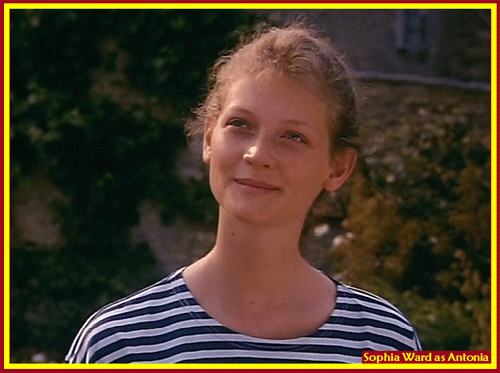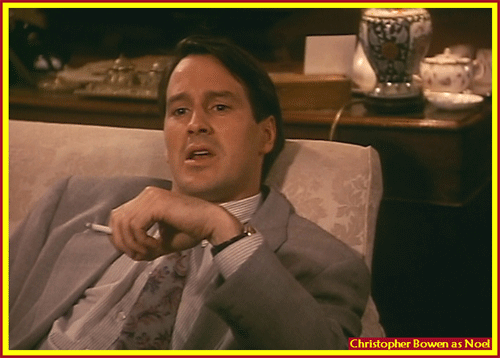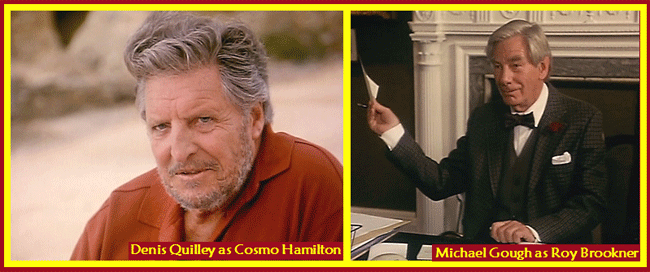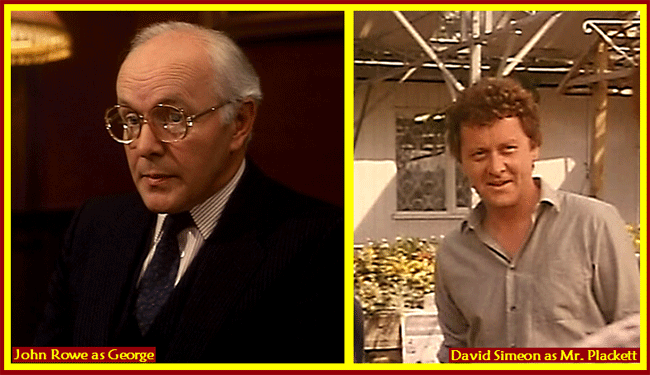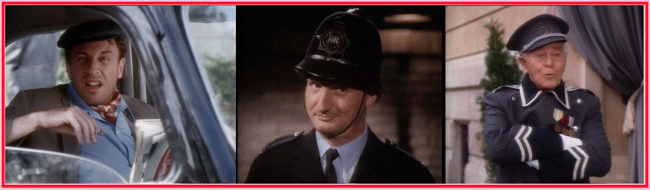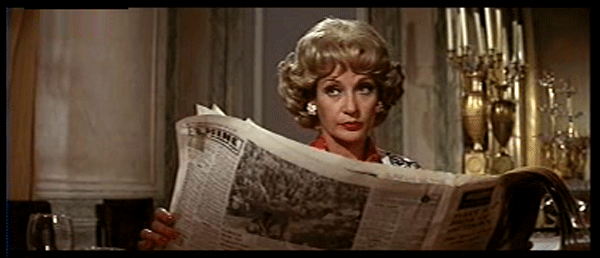
Dracula, Prince of Darkness (StarChoice: 25)

Header-SC1

b1

The sun is down, darkness covers the land – and Dracula lives!”

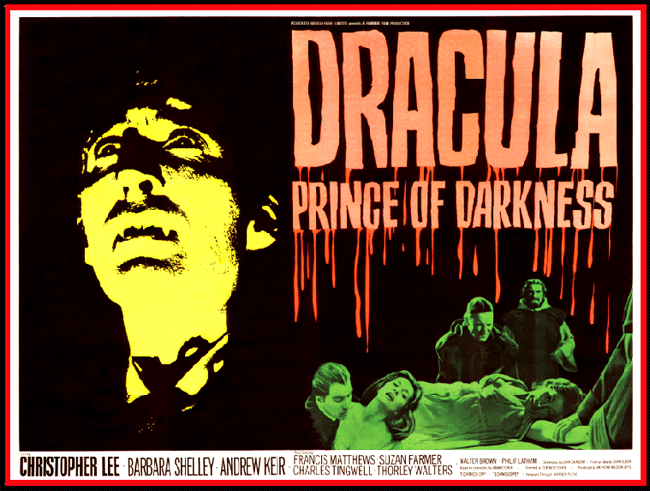
January 9th, 2016 marked the 50th anniversary of the initial release (UK) of Hammer Films’ Dracula, Prince of Darkness”, the second instalment in their colourful Dracula series with Christopher Lee in the title role.
b2

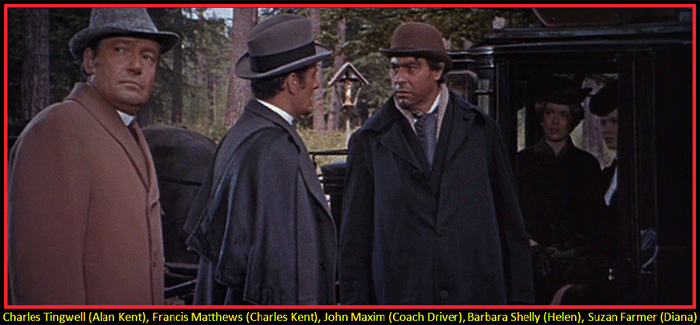
Produced by Anthony Nelson Keys (1911 – 1985) at an estimated budget of £100,000 (according to imdb)(1) and presented by Seven Arts and Hammer Films, the story centers around two couples finding shelter in the night in a dark and mysterious castle situated in the forest outside the village of Carlsbad. They had been traveling through the Carpathian Mountains of central Europe for climbings and sightseeings, and were forced out of their hired horse-carriage at the crossroads of a mountain track by their coach driver terrified at the approach of the sunset.
b3

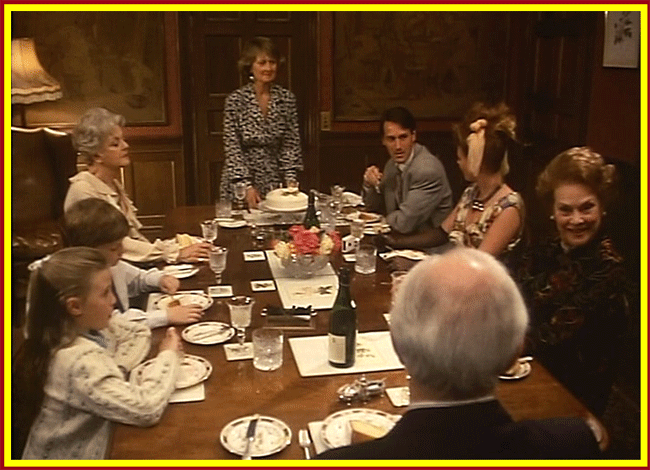
Taken to the castle by a mysterious driverless coach and having arrived at the very plaace which was the subject of a cautionary advice of a Father Sandor for them to stay away from it, they were surprised at the hospitality extended to them by the sinister Klove, the manservant of the lord of the castle, Count Dracula, who apologised for the absence of his master since he was dead for the past ten years. A crackling fire burns in the grate, dinner table set for four created the impression that they were expected. Indeed Klove’s master had left instructions that the castle should always be ready to receive guests… The couples drank a toast to the master of the castle: “To Count Dracula!”.  

b4

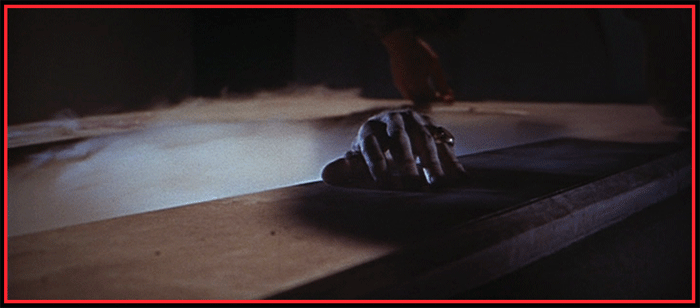
As if he was convinced that the new arrivals would spend the night in the castle, the mysterious Klove had already prepared their rooms, had their luggage secretly brought in from the carriage and placed neatly at the foot of the beds before he had gone to greet them. Once the couples had retired to their respective rooms following their dinner, sometime soon in the dead of night, the occasion appeared auspicious to Klove to set out to implement his plan. Many years ago, he had faithfully collected the clothes, signet ring, dust, etc, of Dracula after his master’s body had disintegrated into a pile of human dust. The set of scenes that would unfurl during that night in the underground vault depicted the resurrection of Dracula – by intermixing Dracula’s bodily grey ash with the blood flowing from the corpse of Alan Kent suspended on a rope above the sarcophagus. And therein, blood fired the ashes and Dracula, the Lord of the Darkness, fully restored, rose to go about his single-minded pursuit of blood and ghastly deeds!
b5

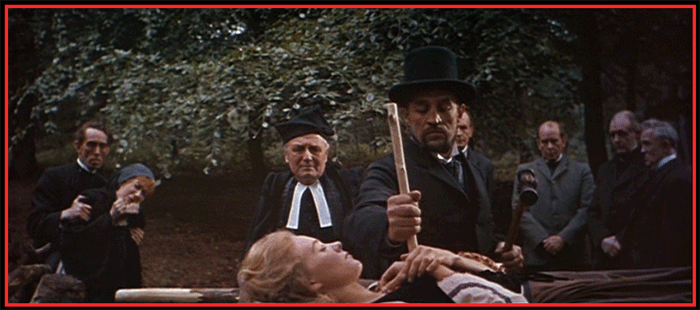
When Welsh scriptwriter Jimmy Sangster was assigned to re-write the old script (The Revenge of Dracula), by prolific screenwriter Anthony Hinds, based on characters created by novelist Bram Stoker, none of them had known that the incongruity of the final product would allow them to attach only their noms de plume, to it, viz., John Sansom and John Elder respectively. In his late thirties, Sangster kept abreast of the pulse of Hammer’s target audiences. He would spend four decades at Hammer, in the capacity of production manager, scriptwriter, producer and director.
b6

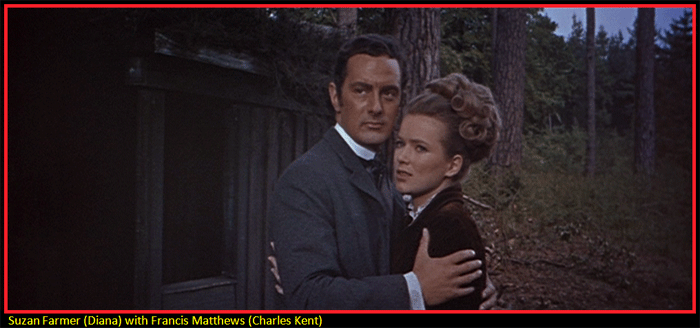
Sangster was then known for brilliant ideas and sudden shocks which, as a rule, he sprinkled into the storylines of scripts; often linking the ideas to traditions related to vampires however minor they are – as, in “Dracula, Prince of Darkness”, when Charles and Diana escape from Dracula’s castle, he leaves Diana near a hut at the crossroads before returning to the castle. It was deemed that she would be safer there from vampires. I would have imagined such a scene is in tune with the European tradition that if a suspected vampire if killed or buried at a crossroads, he will be unable to rise again.
b7

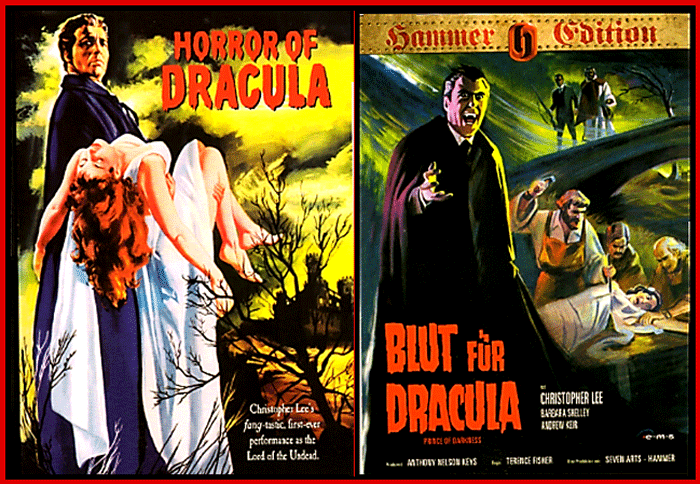
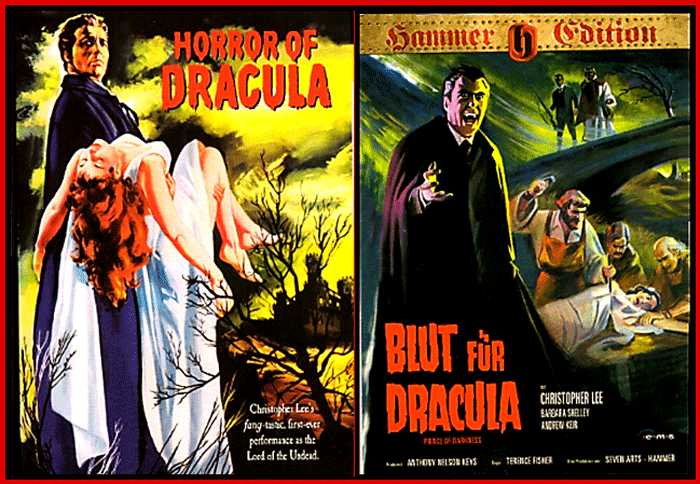
As for the resurrection of the Count for this sequel, a convincing method was drawn up to use blood as the ingredient since the Count was destroyed into a pile of dust in Hammer’s “Dracula” (1958, U.S. title: Horror of Dracula), the first Dracula film in colour with thrilling visual treats of vampire violence, blood and sexuality. This method of resurrection with blood would be repeatedly used by Hammer to revive the Count in their subsequent Dracula films.

b8

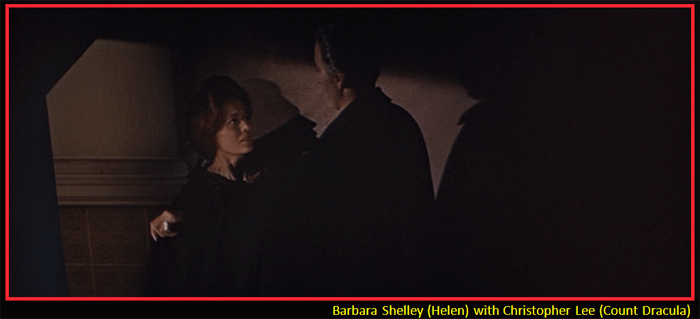
Christopher Lee as the pale-looking Count Dracula topping gray streaked hair with a widow’s peak and eyebrows that join across, appears around 46 minutes (based on DVD edition of 86 minutes. Theatrical duration is 90 minutes.) into “Dracula, Prince of Darkness” (DPOD), clad in his long black cloak (now lined with blood-red lining), at times, with red contact lenses that covered the whole ball of the eyes, except for the cornea and iris, and of course, with the trademark pair of canine fangs intact (“long, but not too long, sharp but not sabre-toothed”, as a writer wrote). The Count’s character traits of commanding manner, fit constitution, cold austerity, penetrating eyes, icy sadism, tremendous ferocity, fiendish snarls and charismatic sex appeal are all there but short of dialogue to which Jimmy Sangster later claimed that the script was written without any lines for the Count. Alternate opinions to the contrary exists, including Lee’s own assertion in an autobiography that he did not use the dialogue as it was impossible for anybody to write convincing lines for him. Lee is reputed to have read Stoker’s “Dracula” many times over and over and, given the opportunity, always ventured to provide his personal view of its interpretation. There is another reference in a book which relates that when Lee finally consented to star as Dracula in 1965 he had become an expensive commodity and his services were being charged on a daily basis which resulted in his scenes being brief and without dialogue. Anyhow, short of dialogue, Dracula hissed and snarled and menaced in the movie, emphasising the vampiristic elements of Dracula.
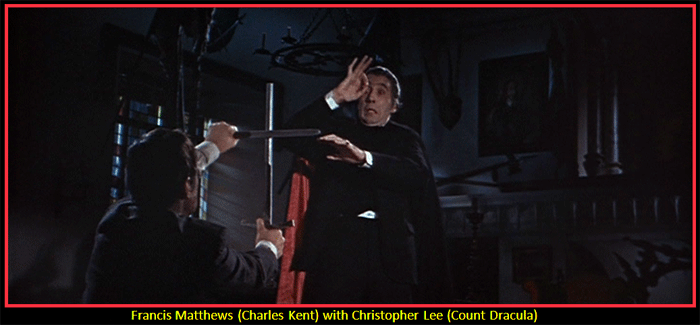
b9

For Hammer, Lee’s mere appearance as the good-looking Count Dracula was enough to click the box-office and create fans for Hammer which had increased ever since the 6’ 5” Lee first appeared as a silhouette before he came out of the shadows and glided down the long baronial stairs of his castle and introduced himself as “Count Dracula” in Hammer’s “Dracula” (HOD).
b10

Following Lee’s marriage to the Danish model and painter Birgit (Gitte) Kroencke in 1961, the couple had moved to Switzerland. Hammer was happy to see Lee move back to England in 1965, and agree to appear in “DPOD” since afraid of being typecast as the Count, he had refrained from starring as Dracula for nearly seven years, venturing into other films, which had pushed Hammer to bring out different vampires as antagonists, viz., blonde-haired Baron Meinster (David Peel) in “Brides of Dracula” (1960) (2) and Doctor Ravna (Noel Willman) in “Kiss of the Vampire” (1963) while retaining Dracula for enactment by Christopher Lee whenever he is ready. Although Lee went on to become admired as an actor of vast experience and wide-ranging acting talents, like Sean Connery got docketed to James Bond, Lee’s career was always popularly tagged with the “old toothy”, and had gained him great financial success and international stardom.
b11`

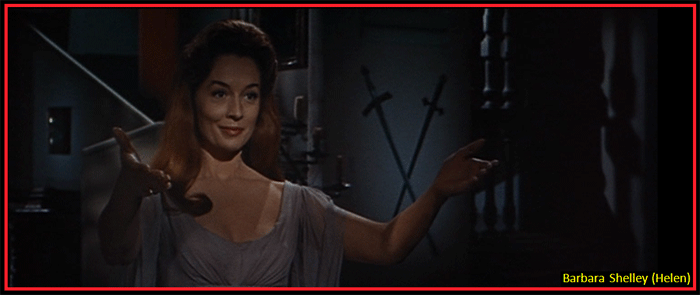
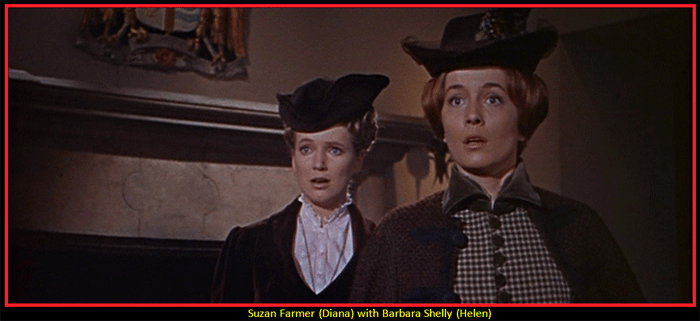
Barbara Shelly, the auburn-haired English beauty with her bewitching brown eyes, makes a very exciting vampire in “DPOD”, her initial style of attire of the Victorian wife Helen giving way for a seductive outfit when, in the dark of the night, the process of her initiation into the realm of vampires gets underway. Director Terence Fisher had rightly divulged Shelly’s capacity to aptly showcase the mannerisms of the spitfire vampire she had turned into, quite contrasting to her initial portrayal of the shrewish wife who seemed strangely fearful of something bad she had sensed present in the castle in which they had taken shelter.

b12

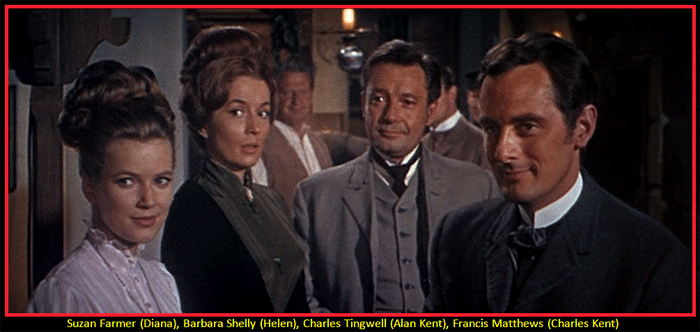
Lovely blonde Suzan Farmer appears as Diana Kent, the brave wife of Charles, notable for her liveliness and attitude to take things as they come. It was Diana who had the presence of mind to initially grab the gun and shoot at Dracula on the frozen moat which led to the discovery that running water is a deterrent for him – a realization that would add to an earlier instance when she accidently discovered that the crucifix on the chain around her neck could stop the evil although, at a later scene, under the demonic influence of Dracula, she would submissively take the crucifix off her neck and stand unprotected before Dracula ready to oblige to his demand to taste the blood flowing from his chest.

b13 -Horror-of-Dracula

Peter Cushing, who first appeared in the title role of Hammer’s “The Curse of Frankenstein” (1957), shot to international stardom as the indomitable vampire-killer Dr. (Prof.) Abraham Van Helsing in “Dracula”, a role which represented the force of goodness, making him an integral part of the Dracula cycle and a perfectly matched team with Christopher Lee. I have read somewhere that it was Cushing’s idea to make Van Helsing run along the refectory table and hold Dracula back with the glare from two metal candlesticks used for a cross until the Count desiccated into a heap of dust in the closing scenes of “Dracula”. According to one of Peter Cushing’s memoirs, when Anthony Hinds found that Cushing could not appear in “DPOD” due to contractual commitments, Hinds had obtained his consent to use the ending scenes of “Dracula” as opening scenes of “DPOD” for which Cushing was subsequently remunerated by Hammer Films.

b14

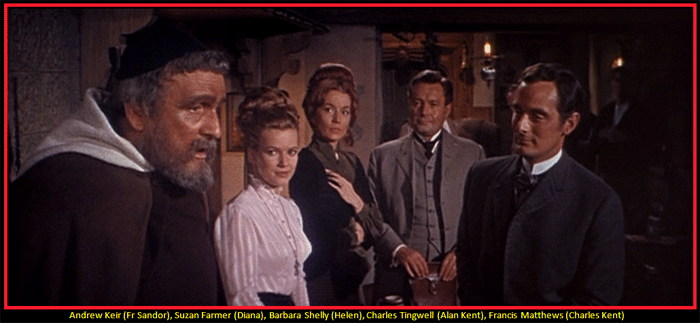
DPOD” featured a new adversary for Dracula, Father Sandor (Andrew Keir), the Abbot of Kleinberg who, on his way to Kleinberg, accidently meets the four English travellers at the wayside inn and warns them to avoid travel to Carlsbad or stay clear of the nearby castle which the couples disregarded opting to keep up with their schedule only to meet with dire consequences. British TV actor Philip Latham, who had earlier appeared in Hammer’s 1964 films “The Devil-Ship Pirates” and “The Secret of Blood Island”, comes across very effectively as Klove, the quiet and sinister manservant of Count Dracula – soberly clad in black, devoid of gesticulations – a tool of the forces of evil.
b15

b16 Terry-FisherAustralian born British television heart-throb Charles Tingwell (Alan Kent), and television star Francis Matthews (Charles Kent) appear as brothers and husbands of the visiting English ladies. The cast also includes: Thorley Walters (monastery calligrapher Ludwig), Walter Brown (Brother Mark), George Woodbridge (Landlord), Jack Lambert (Brother Peter), Philip Ray (Priest), Joyce Hemson (Mother), John Maxim (Coach Driver), etc.

DPOD” tenders some excellent visual treats under the directional chores of Terence “Terry” Fisher (1904 – 1980). Starting as a clapper boy in the film industry at the age of 28, his first directorial assignment was “The Last Page” (aka. Man Bait, 1952, based on a 1946 play by James Hadley Chase) from where he rose up to become one of the best known directors to work for Hammer and one of the virtuosos behind the success of their films like “The Curse of Frankenstein” (1957), “Dracula” (1958), “The Revenge of Frankenstein” (1958), “The Mummy” (1959), “The Phantom of the Opera” (1962), etc.

b17

Consistent with Hammer’s reputation of using the major chunk of a film’s scanty budget on its production design, sets, models, costumes, photography, editing for stunning visual impact, “DPOD” has impressive sets and lavish-looking production values. It was from the brilliant talent of Bernard Robinson, the Set Designer for Hammer’s first two Dracula films that earned Hammer their signature looks for stunning backdrops and sets of the Dracula movies. Although in this official sequel, the story of “DPOD” takes place ten years after the end of the first movie and supposedly happens in the same castle of “Dracula“, Robinson’s ingenuity shows through in the difference of the interiors and exterior of the sets of Castle Dracula, everything dusted and polished. The coffins used for Dracula and Diana in the film have gold covered hinges to contradict with the old custom of Transylvanian coffin-makers using silver nails as a protection against vampires.

b18

Entirely shot in Technicolor  from April 26 through June 4, 1965 at Bray Studios, Down Place, Oakley Green (Berkshire); and on locations at Black Park in Slough, Iver Heath (Buckinghamshire); and St Michael’s Church, Bray, Berkshire, England, the crew consists of: James Bernard (Music), Michael Reed (Director of photography), Chris Barnes (Film Editing), Don Mingaye (Art Direction), Roy Ashton (Makeup), Frieda Steiger (Hair stylist), Rosemary Burrows (Wardrobe), Bowie Films Ltd (Special effects), among others.

b19

The special effects team of Les Bowie did not have to deal with “Kensington Gore”, the fake theatrical blood (stage blood) manufactured in England, since both the final scenes of “Dracula” and “DPOD” are devoid of blood,  though there is massive amount of fake blood shown during the resurrection of Dracula in “DPOD

b20

According to a magazine, for the complex shooting of scenes depicting the final destruction of Dracula, Bowie’s team had tried many techniques to get the scene right: they tried real blocks of ice in a swimming pool for few close shots; wax moulds at another time as it floats on the water; and for the final shots, a circular section of plaster mounted on pivots. At the same time, Christopher Lee has written in a book that he slid down a piece of wood on a hinge, painted white to look like ice.
b21

Part of the many trivia is about an incident while shooting the last scenes when one of the contact lenses of Lee fell onto the salt-covered wooden board (made to look as block of ice) which was retrieved and re-fixed to his eye without properly cleaning off the salt causing acute agony to Lee. An unfortunate incident would have intervened the production and turn fatal for Eddie Powell, Lee’s stunt double and husband of wardrobe mistress Rosemary Burrows, when he was trapped in the freezing waters of the castle moat during enactment of the scene when Dracula finally sank through the layer of ice into the water, but was rescued in time from drowning. However, as the story goes, Dracula will lay trapped in that icy grave until Hammer decided to allow him to be resurrected in 1968 in “Dracula Has Risen from the Grave”, ironically, with the blood of a wounded priest.

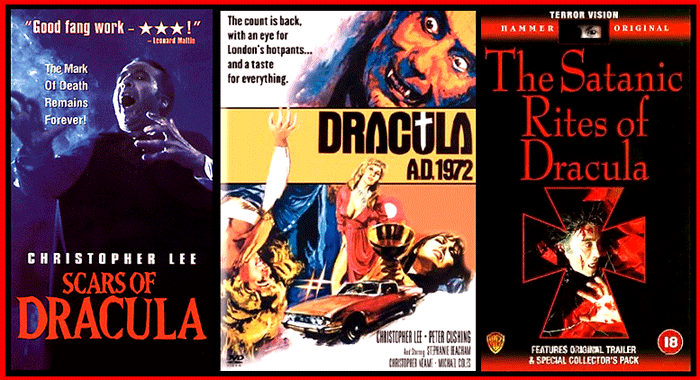
Besides “Dracula Has Risen from the Grave”, Hammer Films’ Dracula series continued featuring Christopher Lee in the role of the Count in “Taste the Blood of Dracula” (1970), “Scars of Dracula” (1970), “Dracula A.D. 1972” (1972), and finally in “The Satanic Rites of Dracula” (1973).

b22

It is undisputed that so many old manor houses in England have their ghost story. The legends of vampires (Vukodlak for Serbians/Murony to Wallachians) have always been there and will survive and flourish on print and visual entertainment in future also. As the viewers, we enjoy the choice to discern whether they are good, bad or indifferent for us – or for horrorsceptics to reassert their sense of rational control. When Hammer Films were first shown, they were sometimes reckoned as objects of derision and censure in some quarters. Now they are treated as classics of their kind. Since 2012, starting with “Dracula Prince of Darkness”, Hammer’s classic library of films are being restored/re-mastered into HD for Blu-ray and future media formats under the restoration project initiated by StudioCanal in coordination with major studios.

I have enjoyed some of those movies on several occasions, including “Dracula, Prince of Darkness” – and although sadly Christopher Lee and Peter Cushing are no more, I would imagine many would have gladly watched another Hammer movie in which Lee reprised the role of Dracula in the period and Gothic ambiance of Stoker’s novel. No doubt, Hammer Films, at its finest, were truly distinctive.  Jo
b23

Notes:

  1. The budget is projected as £220,000 by BFI screenonline.
  2. For more on “Brides of Dracula”, please refer to my reviews of May 10 & 14, 2013
  3. Dracula, Prince of Darkness” was initially released as double bill with Hammer’s “The Plague of the Zombies
  4. Books, DVD/Blu-ray of the books/movies referred to in this article are available with amazon.com, amazon.co.uk and other leading dealers.
  5. DVD sleeves credits: Wikipedia, amazon.co.uk, and from my private collection.
  6. This illustrated article is an affectionate nosegay to the movie reviewed above. Please refer to “About” of my webpage for more details.
  7. This is in memory of director Terence Fisher who was born on 23rd of February. May his soul rest in peace.
b24

(©Joseph Sébastine/Manningtree Archive)
Hammer – H as in Horror

b1

British actor Christopher Lee is no more, but the nocturnal Transylvanian character he immortalised in Hammer Films’ Dracula series is very much alive and baring fangs at the discerning viewers. For centuries, folklores of blood-drinking vampires and other supernatural characters were tales of enduring fascination, dark passion, belief and fear.

b2

For most people, the name Transylvania conjures up haunted castles and vampires; and maintain some understanding about the characteristics of a vampire: that the vampire’s power ceases at the coming of the day; that they feed on human blood and their bite could transform the victim into a new vampire, that the objects for protection against them is a Christian cross, garlic, running water, etc.

b3

Such tales of uncanny, having echoed throughout Europe down centuries, may have now died down, their existence judged improbable in the modern view. Yet, what is the truth behind the legends of the undead? Are they alive and immortal only as products of fertile imaginations, dreams and fantasies? Anyhow, potential immortality is considered a salient feature of the vampire.

b7


b5

b6The evil title character of the gothic horror novel, “Dracula” (published in June 1897) written by Irish writer Bram (Abraham) Stoker (Nov 8, 1847 – Apr 20, 1912) has been linked to Vlad Ţepeş (Vlad Tsepesh/Vlad Dracul/Vlad the Impaler, 1431 – 1476) (1), a flesh-and-blood prince who launched the Romanian resistance against Ottoman expansion in the 15th century.

Of the qualities attributed to Prince Vlad are his practice of impaling enemies on stakes in that age of brutality; his heroism in defending his country against the Ottoman invasion, but nowhere there is evidence proving him as a vampire.

b4

b8

The review that would follow this frontrunner post is just my humble tribute to a movie from the very-British Hammer Films, a trailblazer for the genres of horror and suspense during the 1950s and ’60s.

b9

Most of the films of Hammer had triggered the adrenalin of millions of audiences across the world with their quality entertainment primarily produced at a splendid private residence called Down Place, in Bray, Berkshire, England where, it is claimed, there existed a resident ghost known as “The Blue Lady”. Charming!

b10

b11

Hammer had all the ingredients in place to reincarnate the monster of Frankenstein, Count Dracula, Baron Meinster, Countess Dracula …. – mostly 85-minutes spine-chilling storylines of hauntings, spirits, exorcisms, poltergeists, banshees, consistent with the rules of folklore and legends, oral or written, prolific to Ireland, Scotland, Eastern Europe, India, etc.

b12

b13

However true they are, I do not have any personal experiences to believe or disbelieve those beyond the grave incarnations. But while watching a Hammer horror movie, when I see a door open without a human hand on the knob, or hear the light or heavy sound of footsteps in the corridor when no one is supposed to be there, or see the face of someone who had been buried the other day calling through the open window in the dead of the night, I guess I like to have a sense of fearlessness. One thing is certain, I doubt I would ever want to run into any one of those undead creatures, especially Count Dracula, “the most evil and terrible creature who ever set his seal on civilisation.”

(Review in my next post)   Jo

b14

Notes:

  1. For more on the origins of Vlad Ţepeş: Dracula, Prince of Many Faces: His Life and His Times by Radu R. Florescu & Raymond T. McNally
  2. Books, DVD/Blu-ray of the books/movies referred to in this article are available with amazon.com, amazon.co.uk and other leading dealers.
  3. DVD sleeves credits: Wikipedia, amazon.co.uk, and from my private collection.
  4. This illustrated article is an affectionate nosegay to Hammer Films. Please refer to “About” of my webpage for more details.

b15

(©Joseph Sébastine/Manningtree Archive)

The Roots and Wings of Valentine

1

Halloween, Thanksgiving, Christmas and New Year – the holidays of the short evenings are over. The spring vegetables are slowly entering the markets. Given that love is the keynote of that sweetest day of February when moments are made into memories, shops have displayed pretty favours for exchange between lovers and couples to mark the Valentine’s Day. As usual, a good number of high-flying hotels will be a much sought after destination on the 14th of this month for the lovers and couples out for a memorable candlelit evening of gastronomy, drinks, music, romance and to feel like a million dollars.

2Where we live, distinctive venues for such occasions are many and more are sprouting up every other month. Ecstatic to get it going, the dining tables there will be prettily decorated with fresh flowers, ferns, bisque cupids, candles, tableware, in addition to scattered red rose petals over the table cloth where a wide range of delicacies will be served with emphasis on its appearance since eye has much to do with the flavour of all food. Some even have in-house Mehndi artists or caricaturist to enhance the romantic ambiance.

The succulent specialities on offer in many restaurants, especially on occasions of festivities, present an extensive spread of seafood, meat and vegetarian delicacies and gorgeous after-food deserts very much compatible to all those gourmets. There, only few of the dishes need any explanation. From past experiences, the cuisine for the V-Day could include freshly shucked oysters, poached lobsters with dill and limoncello cream sauce, river Prawn Saganaki, baked fish, Beef Stroganoff, Braised Balsamic Chicken, Porcini Pork Tenderloin, Broccoli Quinoa Casserole, asparagus salad, etc, incorporating many of the general favourites of authentic regional Indian favourites cooked to perfection by chefs and their skilful teams playing cupids at the live stations. Be it ever so humble, praise for their delicious food never misses to light up their eyes as if they had won the lottery.

3

The objective is to make the Valentine’s Day the sweetest and memorable day of the year – touchingly sentimental, fun and ethical for those who wish to share their love and affection towards one another. In a time when affection and meaningful human communication takes a back seat as most eyes are buried in Smartphones, iPads, or other distractions, occasions like the V-Day reminds us to show that we love.

4

The tradition of the Festival of Love probably owes its origins to one of the pagan Roman festivals, Lupercalia, the festival of fertility which was celebrated in mid-February in ancient Rome. As part of its ritual, two young boys of patrician families dressed in goatskins, daub their faces with the blood of sacrificed goat and dog, and during a traditional course whipped maidens with stripes of leather as they passed. Expressing joy and happiness, such lashes were appreciated reckoning they would miraculously prevent or cure infertility. Somewhere between belief and doubt lies the faith.

5

After Christianity became more prevalent in Rome, the festival became associated with St. Valentine (1) a Christian priest and physician in Rome who was martyred on February 14, c. 269 AD (on the eve of Lupercalia) for being an advocate for the cause of peace and love. The book “Saint Valentine” by Robert Sabuda relates the story about how Valentine restored the blindness of a young girl with his deep faith and healing skills.

The custom of sending Valentines stems from a medieval belief that birds began to pair on the day Valentine was beheaded under the cruel Roman Emperor Claudius II Gothicus (Marcus Aurelius Valerius Claudius/Claudius the Goth, 268 to 270) who succumbed to plague in 270 AD. Amongst the customs that continued was the opportunity to choose a sweetheart or Valentine and letters or tokens can be sent secretly to the object of affection as a declaration of romantic love.

6

The rejuvenation of this event, after a slack in popularity but persisting through writings including those of Geoffrey Chaucer (c. 1345-1400) and William Shakespeare (1564-1616), could be attributed to the innumerable cards, books, poems, songs, stage presentations and films that flourished since the eighteenth century onwards. Nevertheless, it is always those couples entwined in their genuine love for each other, blessedly always much abundant in the world, who have kept this tradition of love alive and blooming. Some of the legends and stories of love that sparkled as jewels through the timeline of our world has inspired millions and has undoubtedly caught the imagination of the world.

7

I can think of many love deities and personalities in every culture dedicated to different fervours of love: Egyptian divinities Osiris and Isis; Roman Jupiter and Juno (Greek Zeus and Hera); Solomon and Sheba; Pharaoh Amenhotep IV (Akhenaten) and Queen Nefertiti; Orpheus and Eurydice; Queen Cleopatra and Mark Antony; Justinian and Theodora; Lancelot and Guinevere; Layla and Majnun; Shah Jahan and Mumtaz Mahal; Salim (Emperor Jahangir) and Anarkali (Nadira Begum or Sharf-un-Nissa);

8

Queen Victoria and Prince Albert; Napoleon and Joséphine de Beauharnais; Jean-Paul Sartre and Simone de Beauvoir; Romeo and Juliet; Tristan and Isolde; Robin Hood and Maid Marian; Tarzan and Jane. I do not exclude  those stars of the film world who, at certain times, had become real life romantic characters they played on screen (2):

9

Mary Pickford and Douglas Fairbanks; Ingrid Bergman and Roberto Rossellini; Sir Laurence Olivier and Vivien Leigh; Katherine Hepburn and Spencer Tracy; Clark Gable and Carole Lombard; Rita Hayworth and Orson Welles; Humphrey Bogart and Lauren Bacall; Richard Burton and Elizabeth Taylor; etc… the love is always in the air and for many of them sometimes everything falls together.

10

Of the many customs built around this festival of love, few old customs like the artistic Victorian cards have sadly disappeared while more formal ways of messaging through emails or SMS or that great equalizer called WhatsApp have taken over in popularity.

11Then again, besides the enthusiasm of some couples, the reason Valentine’s Day has garnered more popularity today is due to the print and visual media and to the efforts of the corporate/marketing strategists striving to make it a gross consumer fest.

If the customary choices of the old school fancied Valentine cards, books, tokens, boxes of Belgian chocolates or selected kinds of gifts, and even considered a hug as a great gift; the preferences has presently progressed to all things high-flying – the posh sort – choices big and small, often putting some aficionados under “wallet” pressure – choices such as couture labels, a Visconti pen, a Supreme Goldstriker iPhone with the highest GB, a gorgeous clutch bag, a beautiful sparkling necklace, amazing Stuart Weitzman shoes, vintage boots, a Patek Philippe or Breitling wristwatch, luxury fragrances, a Lamborghini Veneno car, a holiday in The Bahamas, diamonds, secret tattoos, belly button ring, …. the list has become endless to maximize the vibes… The choice is ours.

Nevertheless, fresh flowers have always remained one of the popular gifts.

12

To give fresh flowers – those embodiments of perfect beauty – to a sweetheart….. what gift could honestly be nicer and special? They even leave their fragrance on the hand that bestows them.

13

When young mortal Adonis of Greek mythology lost his life owing to a wound he received from a boar during a chase, Aphrodite (Venus to the Romans), the goddess of love and beauty and the love of his life, found solace from her deep grief in the beautiful Anemone flower which sprung from his blood (or from her tears), until the gods of the lower world favoured her by allowing Adonis to spend six months of every year on earth with Aphrodite. And it is from Aphrodite’s son Eros (Cupid/Amor) that V-Day earned the grace of Cupid, the god of love – a wanton boy with arrows in a golden quiver, who is related to a thousand tricks and cruel sports – the most potent being the pierce from his golden arrow that would kindle love in the stricken heart.

14

When my wife first came to meet me, she brought along an enormous bunch of fresh ivory coloured tulips in a box all the way from England, carefully looked after by the cabin crew of British Airways. Truly a heart of gold she has. She had specifically chosen that spring flower due to my ardent “tulipomania”. Of course, one’s own preferred choice would be different. A friend’s wife preferred velvety red roses from her husband since it’s the symbol of happy and passionate love, while another friend suggested that, if possible, we bring garden daisies to cheer his hospitalised wife when we visited her.

15Somewhere along the way, love has taken its place in the age-old form of art that associate flowers with different meanings. Floriography signifies the name of the language of flowers as practiced in traditional cultures in many parts of the world. The Japanese call it Hanakotoba.

As ivory coloured tulips will always be the symbol of true love for me, the symbolism and hidden meaning of those flowers that express love and affection, subject to change with various combination (3), is generally regarded as: Apple Blossom (Good fortune) – Balsam (Ardent love) – Jasmine (Grace and Elegance) – Lavender (Devotion) – Lilac (First Emotions of Love) – Orchid (Fertility, love and Beauty) – Red Tulip (Declaration of Love) – Sunflower (Adoration) – Violet (Faithfulness), Hibiscus (Sacred Love and Beauty)….

16

Amongst the vast array of flowers lingers the “Forget-Me-Nots”, the lover’s flower. The legend has it that a valiant German knight slipped and fell into water when stooping to gallantly pick up some beautiful blue flowers growing in the water which his paramour wanted him to get for her. Before he finally sank under the water, he threw the flowers at his love and implored her to “Vergiß mein nicht” (Forget Me Not). It was the voice of genuine love that was calling out, to remind, “I will be always with you. I will love you just as you are.”   

Amore!   If love is the key to our hearts, no doubt, then the heaven is within us. Ciao, Jo

17

Notes:

  • According to the Roman Martyrology, two persons under the name of Valentine were martyred on February 14, c. 269. One was St. Valentine who was buried on the Flaminian Way where a basilica was erected in 350. Another Valentine was the bishop of Interamna (Terni) about 104 kms from Rome, beheaded there by order of Placidus, prefect of Interamna. Many scholars believe that these two persons are the same.
  • The book Saint Valentine by Robert Sabuda and DVDs of the movies of the stars referred above are available with reputed dealers.

18

 (©Joseph Sébastine/Manningtree Archive)

StarChoice 24: The Shell Seekers

Header-SC1

1

“Life is so extraordinary. Wonderful surprises are just around t

he most unexpected corners.”

This quote appeared on the Facebook page of a friend just in time for Christmas of last year. The quote from Winter Solstice by British author Rosamunde Pilcher was familiar to me from one of the only two books by her I have read in early March 2001 while in Rome. The part-time Receptionist of my hotel, an American student in Rome, had just finished reading it and lent it to me to keep me “company”.

2

Set in the north of Scotland, Winter Solstice tells the story of Elfrida Phipps. Single and in her 60s, she had retired with her canine companion “dog size” Horace to Dibton in pretty Hampshire, England after a long career on the stage. Though this delightful novel of people who converge to form an unlikely family; of loss and the healing power of love, was a best seller; unlike the 1989 TV movie adaptation of her 1987 novel The Shell Seekers, (the only other novel of Ms. Pilcher I have read), the TV movie adaptation of Winter Solstice (2003) starring Sinéad Cusack, Geraldine Chaplin and Jean Simmons did not conjure up much inspired reviews.

3

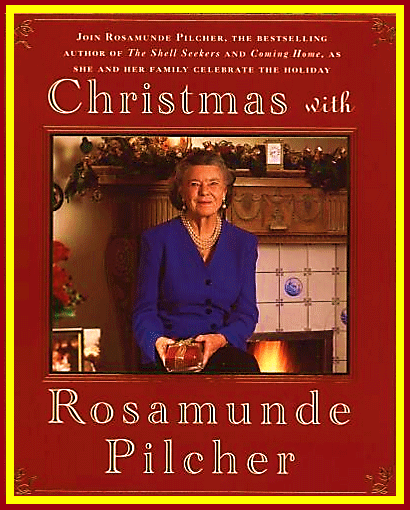
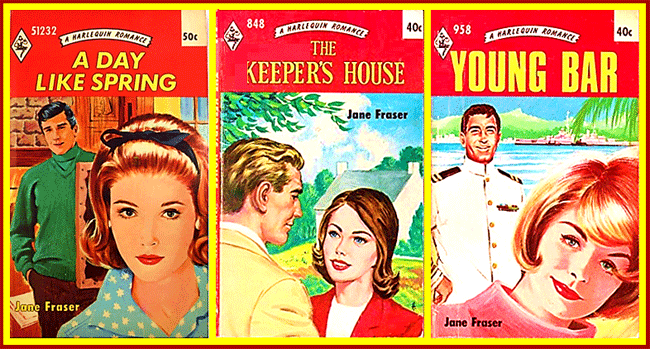
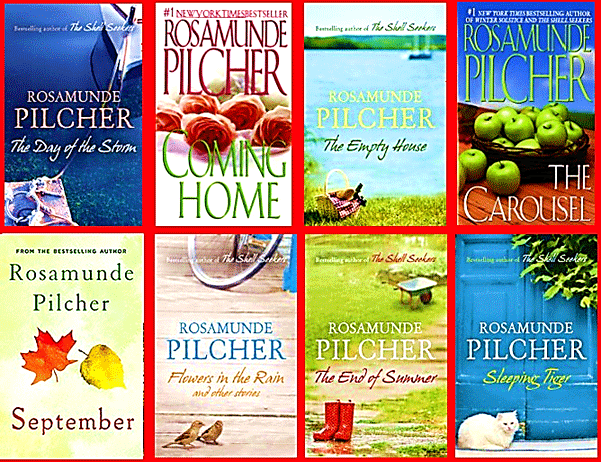
Author Rosamunde Pilcher OBE (née Scott) was born to Helen and British commander Charles Scott on 22 September 1924 in Lelant, Cornwall, England. After World War II during which she was on active service as a member of the WRNS (Women’s Royal Naval Service), she married Graham Hope Pilcher in 1946 and moved to Dundee, Scotland, where she raised two daughters and two sons. It was here she took up writing in order to earn a living. Setting off as an author of Mills and Boon romances, she wrote under the pseudonym Jane Fraser: (Half-Way To The Moon (1949), Dangerous Intruder (1951), A Day Like Spring (1953), A Family Affair (1958), The Keeper’s House (1963), A Long Way from Home (1963), Young Bar (1965), etc).

4

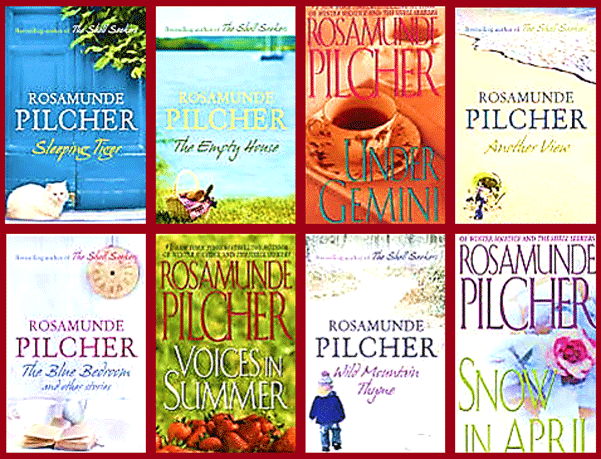
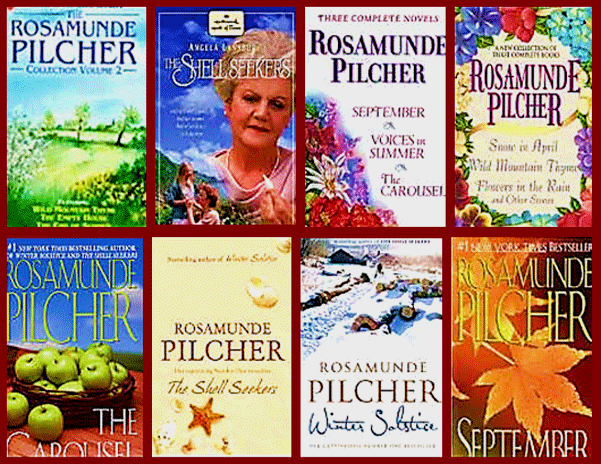
Having switched her pseudonym to her married name Rosamunde Pilcher in 1955, her breakthrough into the more lucrative American fiction market in the 1970s gave a much needed transformation to her career and the birth of nearly 30 novels, the front sleeves of some of which are pictured here.

5

6

While many of her stories are set in the land of her childhood and featured characters so very human, they also presented culinary recipes and tips for gardening. “The Shell Seekers”, Ms. Pilcher’s 13th novel and international breakthrough, had topped the New York Times best-seller list for 30 consecutive weeks and was nominated by the British public in 2003 as one of the top 100 novels in the BBC’s Big Read.

7

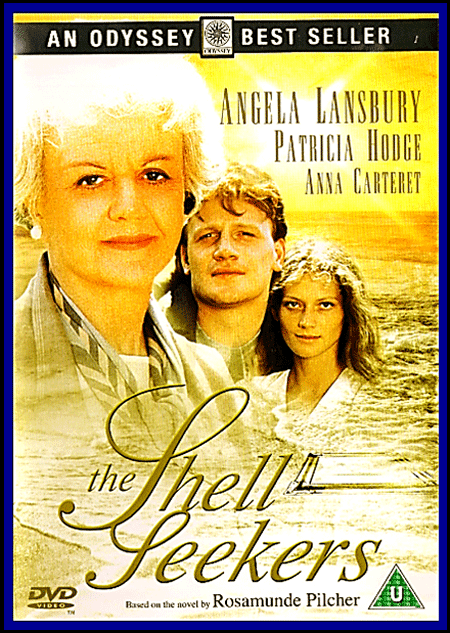
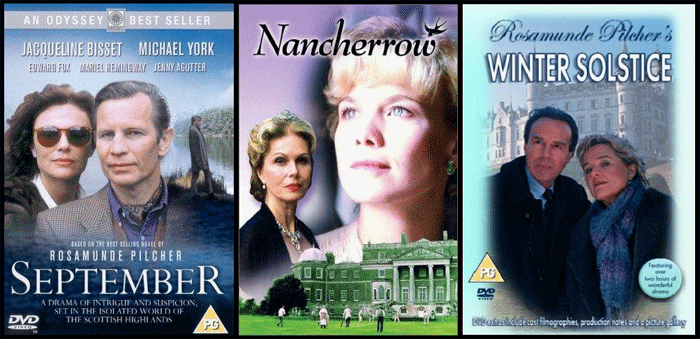
In the Introduction to the Tenth-Anniversary Edition of “The Shell Seekers”, Ms. Pilcher wrote that the ideas for this “big fat novel for women” took shape when she saw a programme on television entitled “Painting the Warmth of the Sun” – about the painters of West Penwith, in Cornwall, some of whom she had known. Of the many Pilcher movie adaptations in my movie collection, viz., September (1996), Nancherrow (1999), Winter Solstice (2003), etc, the one I preferred most was her poignant family saga The Shell Seekers (1989).

8

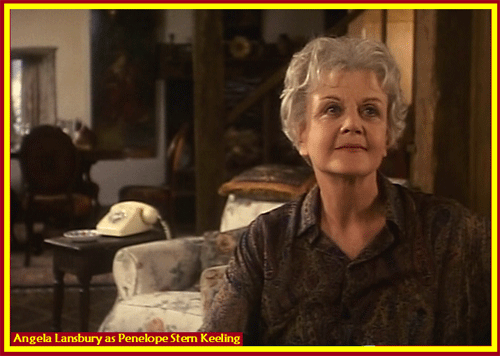
Filmed entirely on location on the beautiful island of Ibiza (Islas Baleares, Spain), Cornwall, Lee International Studios, Shepperton, England and the picturesque villages of the Cotswolds, “The Shell Seekers” is the story of Penelope Stern Keeling and “the disastrous effect that the prospect of an inheritance, worldly goods and money, can have on a perfectly normal family.”

9

This typical English poignant family drama opens with Penelope, age 63, recuperating in a hospital bed from a mild heart attack. No sooner we take in the scene, she discharges herself from the hospital where she was supposed to stay at least a week and heads for her little cottage called Podmore’s Thatch in the village of Temple Pudley. Happy to be back home, she was absolutely determined to get down to make her garden into something special that year.

10

However, Penelope’s departure from the hospital against the doctor’s wishes was nothing short of concern and displeasure to her children owing to their concern for her living alone at her little cottage.

11

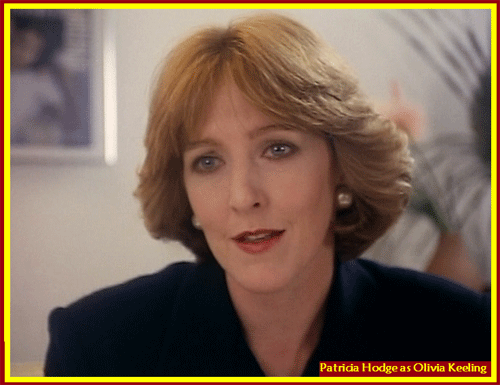
Progressively, the film moves ahead to reveal the passions, tragedies, and secrets, her bohemian childhood at Cornwall with her painter father and French mother years and years ago, her loveless marriage during the World War II with Ambrose Keeling; her forsaken love affair with Richard Lomax, an American friend of her father; down to the troubled relationship with her three children, Nancy, Noel and Olivia, she had failed to bring up a little better.

12

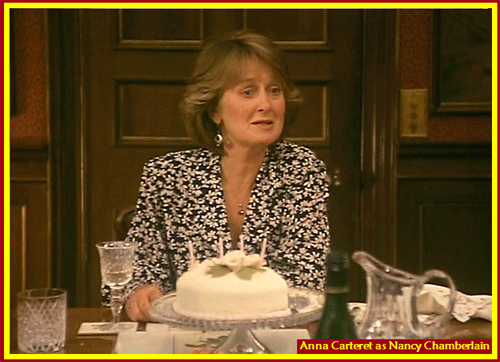
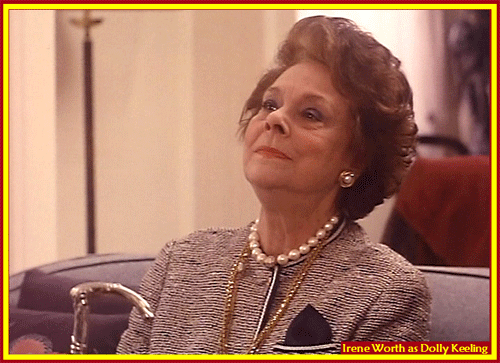
  1. Nancy Chamberlain: Penelope’s tiresome social-climbing first born, who liked to think that she was responsible for her mother. Brought up in London and indulged in fantasies nurtured by the romance novels of Barbara Cartland and Georgette Heyer which she devoured, she presently lived in an old Georgian vicarage at Bamworth, Gloucestershire, trapped in a miserable marriage with George, and overshadowed by Dolly Keeling, an unsolicited alley who is her father’s sister, the one who disliked Penelope and sought every opportunity to belittle her.
  2. Noel Keeling: The young and handsome, materialistic and self-centred son, obsessed with his desire to become a commodity broker.

13

  1. Olivia Keeling: A cool-headed, compassionate woman in love and living in Ibiza with a divorced Italian called Cosmo Hamilton and his teenage daughter Antonia. She was desperate to secure a career as a Managing Editor of a magazine, a position for which she had worked for quite some years. Liked by matriarch Penelope, she is the only one of Penelope’s children truly concerned of her Mumma’s health and knew her closely down to the point that Mozart’s “Eine Kleine Nacht Musik” was her Mumma’s favourite.

14

When Nancy and Noel learned that one of the landscape paintings of their long-dead grandfather Lawrence Stern (1870-1945) had fetched £200,000/- in an auction triggering a flurry of renewed popularity in his paintings, the event set Penelope’s life on a course of discoveries about the hidden sides to her children’s ugly personalities and family devotions.

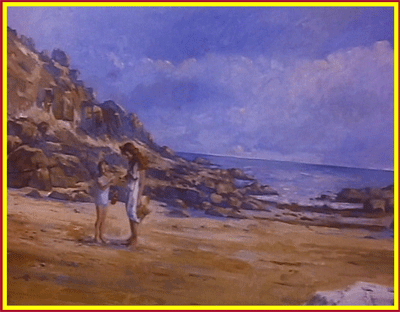
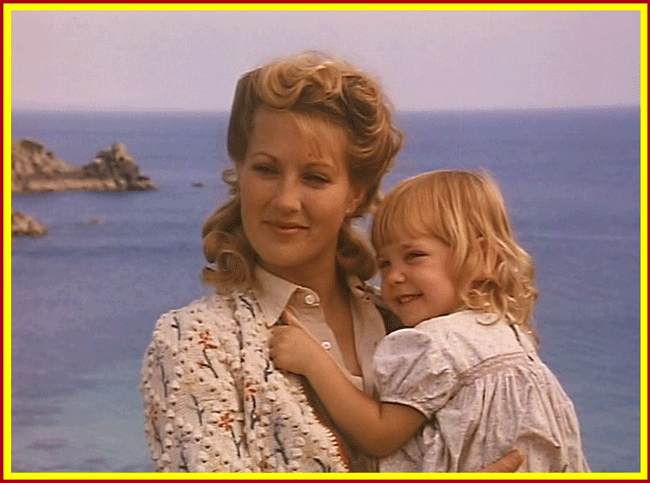
15Nancy and Noel were quick to figure out the fortune that could be earned from the sale of Stern’s last painting “The Shell Seekers”, which their mother owned and considered her prized possession, although Noel had till then thought of it as old fashioned. Symbolizing Penelope’s unconventional life, Stern’s painting featured his wife Sophie Stern (1906-1943) and their child Penelope happily playing on the beach.

Nancy’s first ploy was to incite her mother to sell the masterpiece which hung on the wall of her little cottage and to use the money mainly for her mother’s well-being and care, She lauded about all the good things that the money could bring Penelope: she could have a gardener; a housekeeper; a nurse…. Simultaneously, Nancy and Noel’s necessities, which were also of a higher nature and could not be attained with their present financial resources, can be appropriately resolved.

16

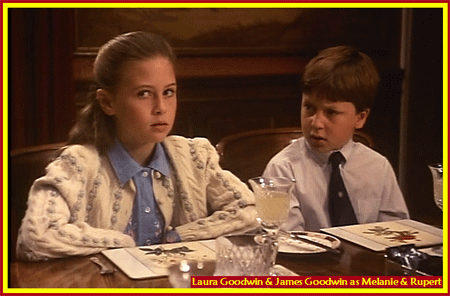
  1. For Nancy the simple has become obsolete and the complex more attractive. Nancy was prodded with monetary issues such as: money to pay the school fees of her two children Melanie (age 14) and Rupert (age 11) to attend expensive boarding schools; to purchase new clothes for Melanie; funds for George’s club fees which were already late, etc. Allowing that Penelope could unload some money from the painting on Nancy, all these could be dealt with to her satisfaction;
  2. Noel could use the money to keep up his extravagant lifestyle which he was now striving to achieve from a tiny apartment in a superior location of the town. It would still remain a distant dream for him unless he could obtain his share of inheritance which would enable him to leave his low-income job and become a commodity broker. He would also buy a bigger Flat from where he could work, break into certain highflying circles and entertain them.

17

Like Penelope, Olivia was unmotivated to cash in on her inheritance. She loved her mother and admired her non-judgmental attitude. Penelope knew it all. For her, the painting and some sketches are mainly all that’s left of her father. If an occasion arises for her to sell the painting, she will only chose at her own choice. However, she cannot sit on the fence undecided. The emphasis on monetary affairs had left her bruised, but much wiser. She devised a scheme which she believed would not only be important to her but would also be best for her children and could pave way for peace amongst them. The first step toward creating an improved future is developing the ability to envision it. At the outset, she would go to Cornwall. You simply cannot do away with the past.

18

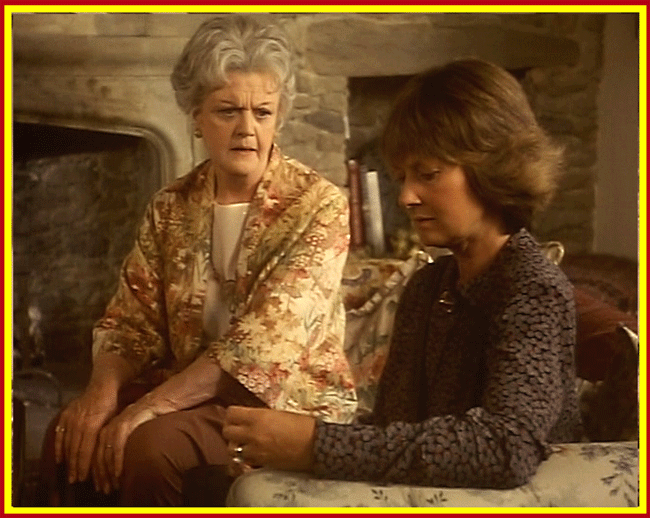
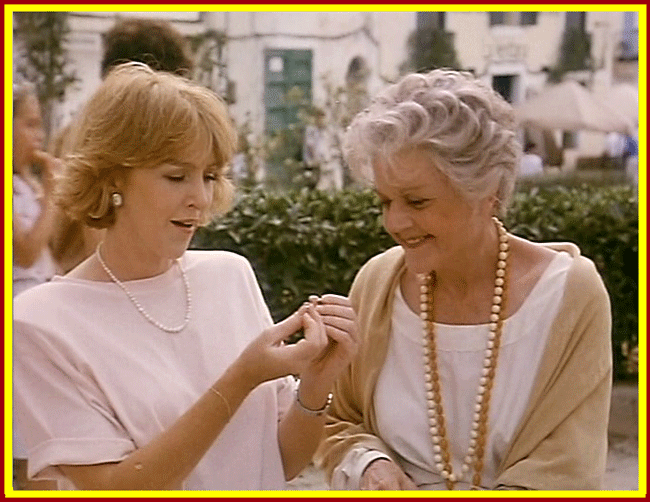
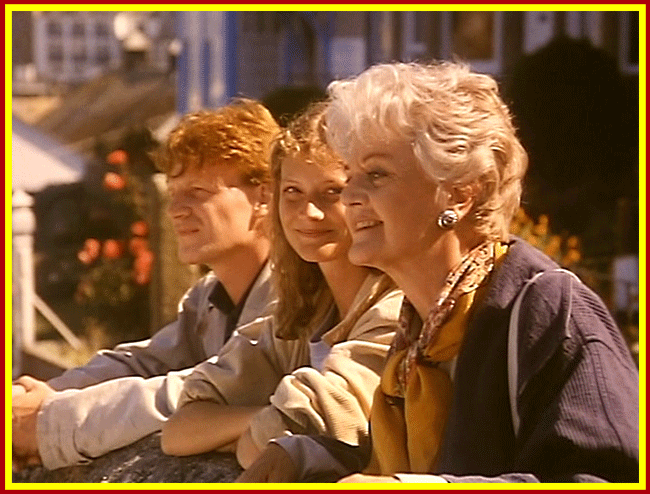
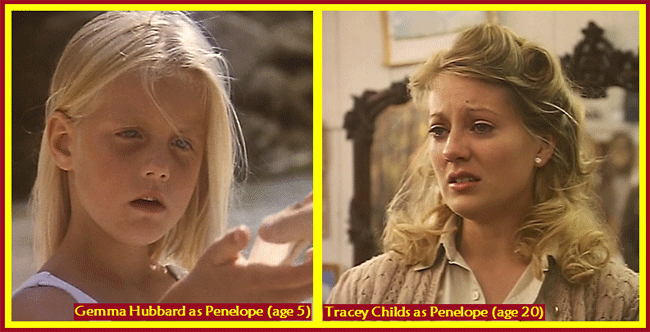
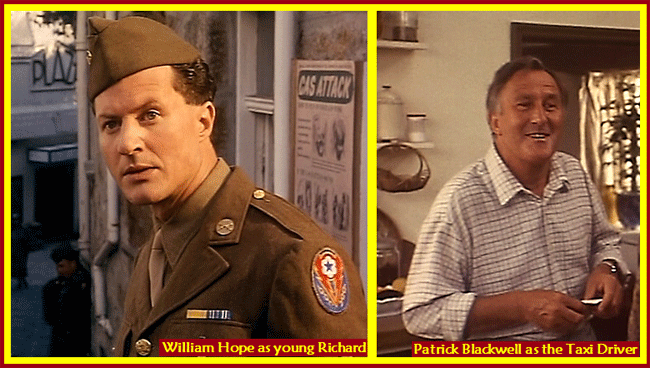
A Central Film production for Central Television in association with Marian Rees Associates, Inc, The Shell Seekers was produced by Anne Hopkins and directed by the BAFTA Award-winning, Lucknow, (Uttar Pradesh, India) born Waris Hussein (“Henry VIII and His Six Wives” (1972), “Edward And Mrs Simpson” (1978)). It is adapted from the novel for the TV by John Pielmeir, the winner of the Humanitas Prize for “Choices Of the Heart”, and features the following:

19

20

21

22

23

24

25

26

27

28

29

30

31

32

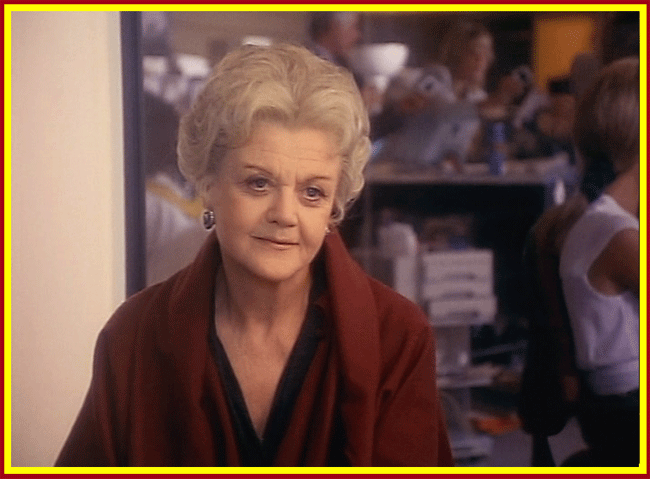
Production crew: James di Pasquale (Music), Fred A. Chulack (Editor), Jane Martin (Production Designer); Brian West (Director of Photography); Judy Moorcroft (Costume designer); Ann Brodie/Magdalen Gaffney (Make-up); Paul le Blac (Ms.Lansbury’s Hair & Wig Design).

33

Many of Rosamunde Pilcher’s novels were made as long-running series of television adaptations (“Die andere Frau”, “Federn im Wind”) in Germany and were shot on location in Cornwall and other parts of England. It is an undeniable fact that her novels have given a much needed fillip to the tourism in Cornwall as tourists flock there to enjoy a first-hand experience of Ms. Pilcher’s world in Cornwall where good things happen to good people.

34

What a happy woman I am, living in a garden, with books, babies, birds and flowers, and plenty of leisure to enjoy them. Sometimes I feel as if I were blest above all my fellows in being able to find happiness so easily,” Ms Pilcher wrote in The Shell Seekers. Plain and simple – if you like happily ever after movies that warm the heart, The Shell Seekers is a gift for you. So long for now, Jo

35

Notes:

  • To honour the 90th birthday (22 September 2014) of Rosamunde Pilcher, a Cornwall Art Exhibition titled “THE SHELL SEEKERS” was organised by Seventh Wave Gallery, UK featuring 30 Cornish Artists showcasing 60 pieces of original artwork at The Castle, Bude, Cornwall from 11 September to 4 October 2014.

36

  • The Shell Seekers was adapted for the stage in 2006 by husband-wife team Terence Brady and Charlotte Mary Thérèse Bingham.
  • Another TV adaptation of The Shell Seekers directed by Piers Haggard appeared in 2006 starring Vanessa Redgrave, Prunella Scales and Victoria Hamilton.
  • Books/Audio books, DVD/Blu-ray of the books/movies referred to in this article are available with http://www.amazon.com, http://www.amazon.co.uk and other leading dealers.
  • This illustrated article is an affectionate nosegay to the movie reviewed above. Please refer to “About” of my webpage for more details.

37

The disease of indifference toward others arises when

each person thinks only of himself, and loses the sincerity

and warmth of personal relationships.” Papa Francesco

(©Joseph Sébastine/Manningtree Archive)

Flutter by, Melodic Butterflies

1

There’s a song in the air !

        There’s a star in the sky !

2

I have always found music delightful for relaxation. Lately I had been listening to music either streamed or downloaded from the web where we could find any kind of music we wish for. Unlike the effort to flip through our musical collections of vinyl albums, CDs, cassettes and videos for enjoying music in the conventional way, one needs only to flick some icons on the web, and the music comes pouring into the room. But how can I resist from admitting that I like music on physical formats, especially the tangible experience of holding a vinyl album and admiring the big cover art while it plays with the pops and cracks and imperfections of an old gramophone record.

3

A week ago we were sorting out the Christmas albums in the storage shelf where they were waiting for the right time to arrive when we would let them play their joyful melodies – to experience the pleasure they would bring us.

4

Waiting for Christmas! The instance reminded me of an old adage which relates that “a test for true love is a rose which has been picked on Midsummers’ Day and put away until Christmas. If it is found still fresh at Christmas, the love of the girl who plucked it and her beau will run true and flourish.” – the kind of love where the boy will kneel down and tell her that she is the sweetest, most charming and ravishing girl in the world and that he would be unable to live one more second without her! I personally know of instances like this.

5

But vis-à-vis our present subject, the fact remains that listening to greater part of carols and Christmas songs surely create an effect we aspire to in our house.

6

Christmas time is a warm and nostalgic time of a year – and Christmas, winter’s merriest tale, is all about the birth of Jesus Christ and cannot be rightly told without music. As it happens, throughout the festive season and often beyond – while we set up the Christmas tree and the Christmas crib, or hang up the stockings and decorations, or prepare the feast, or merry-make in the festive gathering, we play them as background music just for the warmth and joy of those seasonal melodies.

7

8

Those are classical instrumentations by Tchaikovsky, Vivaldi, Bach, Handel, Beethoven, etc, or sung by choirs, or carol singers or by Earl Grant, Ray Conniff, Harry Belafonte, Nat King Cole, Brenda Lee, Nina Simone, Pierino Ronald “Perry” Como, Frank Sinatra, Judy Collins, Tom Jones, Fernand Gignac, Nana Mouskouri, Celine Dion, Muriel J, Jose Feliciano, Ajejandro Sanz, Andrea Bocelli, Dame Kiri Te Kanawa, Rod Stewart, Boney M and many others.

9

Behind those songs were the lyrical and musical talents of folk singers, monks, the clergy, literary and musical luminaries.

10

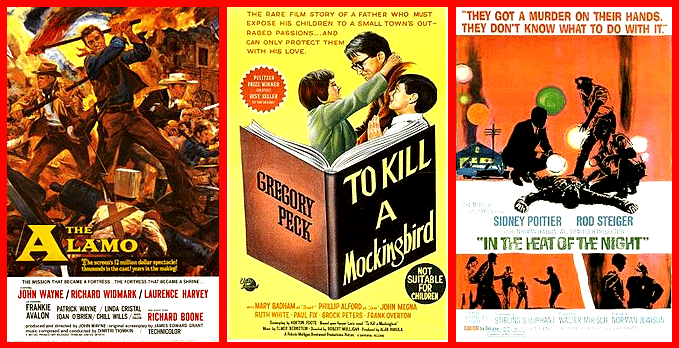
In the movies “The Alamo” (1960), “To Kill a Mocking Bird” (1962), “In the Heat of the Night” (1967), the viewer might have noticed a versatile actor named Jester Hairston who was also a songwriter/composer/conductor and singer. In 1956, Hairston wrote fresh lyrics for an earlier song he had written titled “He Pone and Chocolate Tea” and attuned in calypso rhythm but was never recorded in that form.

11

The song with the new lyrics, later characterised as a Christmas carol, was titled “Mary’s Boy Child” and the world first heard of it when Harry Belafonte released it through his album “An Evening with Belafonte” (1956).

12

The song was subsequently recorded by music artists such as Jim Reeves, Tom Jones, Andy Williams, Anne Murray, Dame Kiri Te Kanawa, including a version in 1978 by Boney M which is still popular like most of the Boney M songs released when they were in the prime of their time.

13

Christmas carols lend an air to this festive season and over the years have spawned a variety of classics to make good cheer. In England of the olden days, groups went on “Wassailing” for “luck-visits” from house to house at Christmas time – singing carols and sharing the contents of their wassail bowls for which they expected to be rewarded with gifts, food and drinks.

14

15They were considered to be the forerunners of modern day carol singers. This practise later evolved into modified versions. Then again, what is true in England is also true in Italy and in our Cochin, or everywhere.

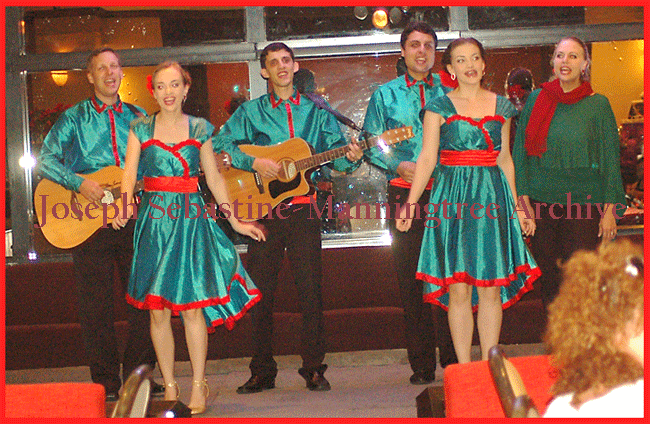
And so, wassailing was enacted in our Cochin also when numerous groups dressed in character of Santa Claus and shepherds and shepherdesses in knee-length, floating skirts as dancers, together with their entourage of singers and musicians. They visited houses, predominantly in Fort Cochin and the coastal belt, to entertain during Christmas time.

Although this practise is slowly dying down, few groups are still active during the Christmas season. The songs which maintain great popularity in their street collection lists are “Jingle Bells”, and “Santa Claus Is Comin’ to Town” which tells of the approach of Santa Claus and his pack of reindeers.

16

These songs are nice accompaniments to dancing and rather similar to renditions such as “Rudolph The Red-nosed Reindeer”, “I’ve Got My Love to Keep Me Warm”, “Rockin’ Around the Christmas Tree”, etc.

17

19

20Interspersed in their collection are popular songs from movies or simultaneously, versions in local language which some enlightened ones find not ‘hip’ and very un-English without some English terms peppered in it. But if there is one carol that is generally heard here throughout the Christmas time is the English version of “Silent Night” (Stille Nacht), a reverential rendition written in German in 1816 by Friar Joseph Mohr of Austria with music added to it by Franz Xaver Gruber in 1818.

This is said to be one of the main songs (and also ‘Adeste Fideles’) the German and the English soldiers jointly sung on the first Christmas of the First World War, in 1914 when, in a spontaneous and unofficial Christmas truce, their guns fell silent for a brief period and they emerged out of their trenches into no-man’s land in a number of places along the Western Front: to exchange gifts, cigarettes and joyously sing carols and songs to commemorate the birth of baby Jesus. They knew that the war was going to last a long time and many would not live through for another Christmas Day or even see their wives back home knitting socks for the soldiers at the Front.

21

This chivalry between enemies in the military air to uphold the Christmas spirit is depicted in the films: “Joyeux Noël” (Merry Christmas – 2005/French); Oh, What a Lovely War (1969/UK) (1)

22

23

Many a Christmas carols and songs have played at the chords of the human heart with its angelic fingers: “The Twelve Days of Christmas” covers the 12 days starting with Christmas Day till 6th January (Epiphany); “Hark! The Herald Angels Sing”; “O Little Town of Bethlehem”; “In The Bleak Mid-winter”; “Joy to the World”; “We Wish You a Merry Christmas”, “Away in a Manger”; “Ding Dong! Merrily on High”; “Adeste Fideles/O Come All Ye Faithful”; “In Excelsis Gloria”, and many many more. Some of these titles are highlighted here.

24

The most ancient carols known to us date from the Middle Ages. Historians contend that the word “Carol” passed from French into the English language in about 1300 and was associated with words, music and dance. Books of carols were cried about the streets of Paris as early as the thirteenth century.

25

These carols shadow forth the true spirit of miracle plays, religious spectacles, and old religious legends. In most cases, they were by and large in Latin which was the medium for prayers and chants in the churches in those days. Latin being unversed to most common men of Italy, San Francesco di Assisi presented the carols in his native language – supported by theatrics.

26

From there it gathered popularity, and despite occasional hindrances (such as the temporary abolition of Christmas in England in the 17th century), it survived through transitory periods spanning the medieval, the renaissance (rise of music printing and of vocal music performed with instruments), the baroque (invention of opera), the rococo (rise of comic opera and the symphony), the classicism (flowering of instrumental music), the romanticism (rise of the conductor and the golden age of the piano), the post-romanticism (dominance of mammoth orchestra), up to our time. In 1918, carols received the biggest boost when the “Festival of Nine Lessons and Carols”, a Christmas Eve service which includes carols and readings from the Bible, were adopted by King’s College Cambridge.

27

People vary greatly in their way of responding to music. Tastes have altered. Then again, there is great proliferation of Christmas carols and songs, owing to the creative flair of many contemporary musicians who retain its originality.

28

As for us, we treasure each Christmas of our years gone past – its virtues of humility, generosity and love. We admire the splendour of its true traditions: the birth of baby Jesus, the Christmas tree, the Christmas crib, the star, the old decorations of rosemary and bays, the holly and the ivy, the poinsettias (Flores de Noche Buena/Flowers of the Holy Night), the Mistletoe, the greeting cards, exchange of gifts, the banquet which includes plum pottage, minced pies, roast beef, Christmas ale, and of course, Santa Claus, dancing and singing….

29

Although the Christmas festive season will come only once a year, our steadfast delight in the Christmas carols and songs ensure that those cherished melodies flutter around in our house, like butterflies, whatever the season may be. Enjoy your Christmas holidays! Ho! Ho! Ho!! Jo

30

Notes:

  • Christmas Truce: In books: Silent Night: The Story of the World War I Christmas Truce by Stanley Weintraub; Truce: The Day the Soldiers Stopped Fighting by Jim Murphy, etc. It is also the theme of Sainsbury’s official Christmas 2014 Advertisement
  • DVD/Blu-ray of the movies referred above is available with main dealers of movies.
  • This is dedicated to Pope-emeritus Benedict XVI who received Doctorates honoris causa on 04 July 2015 for five contributions to knowledge and culture – which includes his great respect for the musical tradition of the Church and his remarkable sensitivity to the music of faith. May he enjoy blessings of good health.

31

 (©Joseph Sébastine/Manningtree Archive)

32

SURVIVING WITH DIGNITY

1

The joy of Christmas is nearer, drawing in a beehive of activities allied to it. The Christian Churches here, as in all parts of the world, are livened up for the yearly holy event marking the birth of baby Jesus, followed by the close of another year. Most educational institutions are on preparatory mode for holding mid-term exams prior to the culmination of the vacation season.

2

Plans are being made for annual vacations, or joyous activities, or gourmet feasts, or family get-togethers. Banking on the commercial value of the holiday season, the hospitality industry and other retailing sectors including big Malls are once again out with window decorations, dangling fantasies and other crowd-tickler marketing gimmicks through the media, web and signposts.

3

One is baffled and bewildered by the choice of innovative merchandize, latest tech trends, etc, available.  “Happy Shopping Holidays” – three charming words dominate this period to augment the marketing campaigns.

4

A special event at all times to me, Christmas, like Easter, has a considerable period of preparation. The Gospel of St. Matthew relates so briefly about preparations that had taken place some 2020 years ago when, three wise men, proficient in astronomy and astrology, turned their heads up to gaze at a brilliant star that would set them on a journey. Theirs was a spiritual desire to find and adore a new-born child – to lay their gifts contained in caskets of odoriferous wood at the child’s tiny feet – gifts of pure gold (asserting the kingship of Christ), frankincense (Christ’s divinity) and myrrh (that He was man, and doomed to death).

5

Their long and perilous journey through “field and fountain, moor and mountain, following yonder star” culminated in success when they found the new-born Jesus not in the stable, as usually depicted in the scene by artists, but in a roofed house where the three holy ones were temporarily lodged. These three wise men (or kings) would be the first to acknowledge Christ.

6

These wise men, assumed to be three given that three gifts were given in homage of Christ’s birth, are identified by various names, but generally known as Balthazar, Melchior and C(G)aspar since the ninth century (1). Believed to be Babylonian names, according to an old valuable book about Virgin Mary, they probably hail from the city of Séleucide which was the abode of the most celebrated astronomers of antiquity (2).

7

The Bible also relates to another journey during that period, taken place hundreds of miles away from the path the Magi would travel. Carpenter Joseph of Nazareth in Galilee accompanied by his wife Mary was on their way to Bethlehem of Judea, to register their names and pay tribute-money owing to the Roman Census of population and landed possessions.

8

Besides his beloved pregnant wife riding on a donkey, Joseph, humble, modest and retiring, was devoid of possession of anything of great value except for few clothes and the usual provisions for their painful journey of possibly five days. Their basket made of palm leaves could have included dates, figs, raisins, thin cakes of barley meal, earthen vessel to hold water, and the most precious swaddling-bands Mary’s hands had prepared to envelop her child. The census, made in the late autumn or early winter when agricultural work had ceased, might have attracted great concourse of people to the region that accommodation in cells of caravansaries in Bethlehem were unavailable.

9

Whatever the reason, upon their arrival at Bethlehem, Joseph and Mary sought shelter in a stable in the interior of a little cavern located in the suburbs which served as a stable and sometimes as refuge for the shepherds in cold and stormy nights. In there, after a good lengthy time following the hour of the Nativity, the new-born infant was adored by the shepherds as the Christkindl lay in a manger, wrapped in swaddling clothes.

11

12The adoration of the shepherds and the Magi is depicted in several movies. One of the realistic among them appears in the initial scenes of director William Wyler’s cinematic triumph, Ben-Hur (1959), its devotional ambiance enhanced by the Academy Award winning music score of Miklós Rózsa (1907-1995). Watching Wyler’s “Ben-Hur” is an enjoyable and rewarding experience. Its grandeur and spectacle, colourful characters, richness of its screenplay, excellent direction, fantastic production values, the realistic action sequence of the chariot race, the many visual symbolic threads woven into the story such as water accentuated as an agent of renewal, the dramatic effect emphasized without showing Christ’s face, the transition from full orchestra to organ during the sequences in which Christ appears, and most importantly, its story about a rich man passing through the eye of the needle, had caught up my imagination that “Ben-Hur” rates the highest number of times I have seen a movie.

13

The little figurines of the Magi from the story of the Adoration of the Biblical Magi, part of the ensemble of the Christmas crib-set in our house, were objects of marvel in my childhood. Their crowned figures clad in embroidered robes featured all the paraphernalia and pomp of royalty; their camels decked with ornamental bridles and saddles, the mysterious gifts in their hands, were all sprigs of fascination. Their images got better and fine-looking as we purchased better crib-sets over the years – from Austria, Italy and Bangkok.

14

The custom of exchanging gifts could date back to the three wise men. As some stories go: in olden times on Christmas Eve, children used to place shoes filled with oats outside their huts for the camels of the Magi which they hoped would be miraculously replaced with gifts.

15

16

The closest I got to the physical entity of the three wise men was when we stood before the gilded and decorated triple Sarcophagus traditionally believed to contain the relics of the Magi at the Shrine of the Three Holy Kings (Dreikönigsschrein) behind the high altar of Cologne Cathedral (Der Kölner Dom) in Germany.

17

Those relics were transferred from the church of St. Eustorgius in Milan on 23rd July 1164 by the powerful imperial chancellor, Rainald von Dassel (later Archbishop of Cologne) (3) having received them from the Holy Roman Emperor Frederick I (Barbarossa).

18

Sometime after her arrival in the Holy Land around December 326/January 327 A.D., Helena (Flavia Iulia Helena Augusta/St. Helena – 248/9-329?), the mother of Emperor Constantine and discoverer of the True Cross, had discovered the bones of the Magi while searching for relics and building churches in honour of the life of Jesus. Chroniclers contend that she transferred the relics to Constantinople and later, Bishop Eustorgius, a native of Constantinople, was allowed by Emperor Constans (Flavius Iulius Constans Augustus – from 337 to 350) to transfer them to Milan in 343/44. The relics eventually became the most remarkable medieval cults to royalty.

19

The magi, a popular subject of tapestry, are patrons of travellers and pilgrims. In addition to the above three places, I have visited other centres where Christian reliquaries are kept, but a visit to one in Greece connected to the Magi remains yet to be realised. The Holy Monastery of Agiou Pavlou (Saint Paul’s) in Mount Athos houses, among many other relics, some cases containing gold, frankincense and myrrh, believed to be the gifts the Magi brought to baby Jesus. The authenticity of some of the relics could be doubtful but such vestiges play an important role as catalysts in connecting us to the history and legends of our illustrious past.

20

21Christmas, celebrated everywhere, is particularly enjoyable at some places where it exudes a whole lot of charm to enjoy it the most. We have spent Christmas Day and New Year’s Day in different countries. Those special days made good memories for us – just like some days bearing special names are auspicious for many: Thanksgiving Day, Republic Day, Independence Day, May Day, Father’s Day, Mother’s Day, Patriots’ Day, Valentine’s Day, Friendship Day, Day of Tiger, of Elephant, etc….. All this is very well.

Then again, woven into the fabric of the year are ill-fated days from history lesson: 9/11 (World Trade Center attack), 26/11 (Mumbai attack), 13/11 (Paris attack), ……. – named after disastrous events that have spawned sadness in us and bruised our pride, occasioned by malicious minds hell-bent on executing everything violent in excess. The world witnessed outpour of grief when innocent and helpless people lost their lives recently owing to brutal violence.

Even so, pain nourishes courage. The global goodwill resonated in displays of solidarity, judiciousness and calm wisdom when the Eiffel Tower, Paris; San Francisco City Hall; Tower Bridge, the London Eye, the National Portrait Gallery in Trafalgar Square, Wembley Stadium in London; Brandenbourg Gate in Berlin; Christ the Redeemer statue in Rio de Janeiro; the CN Tower in Toronto; Burj Khalifa in Dubai; Tokyo Tower; Sydney Opera House; etc, showcased colours of blue, white and red. Vive la France!

22

Naturally, we bank on a sense of order and peace around us and we wish our lives to measure up to our hopes. There is nothing so precious and nothing more important than peace, though throughout history it has often been taken for granted until it’s too late. The past high degree of violence and unpredictability, offensive to our good spirits, had markedly dampened this holiday cheer. Recently there was news about tourists being selective on places to go for a safe and peaceful vacation.

23

24

25

26As for us raring to go, despite the weather, we could opt for Christmas time in Italy even though we would be doing only a repeat of what we have done there many times over the years. There would be the traditional outdoor Christmas markets in Florence, Verona, Venice, Rome, …. On Christmas Eve, we could attend the Papal Mass by Papa Francesco at the Basilica Papale di San Pietro in Vaticano and admire the huge Christmas tree and the life-sized Nativity scene in Piazza San Pietro; or at the Cattedrale di Santa Maria del Fiore (Duomo di Firenze); or at Basilica di San Marco, Venezia and watch the gondola arrive with Babbo Natale (Father Christmas) to distribute goodies, before sitting down for dinner and Bellini at Cipriani’s Harry’s Bar; or at Basilica di Sant’Antonio di Padova where we have wonderful friends amongst the Franciscan friars of the Basilica, etc.

Besides England, France, Germany, Austria, Switzerland, Spain, Portugal, all wonderful places where we have enjoyed the local culture, Madrid (Spain) would garner our priority due to the wonderful ensemble of jolly good friends we have there. Alternatively, should we look at the East, we could always opt for Thailand, Singapore – or within good old India.

27

28

Now with the three wise women  in my life, my wife and two daughters, here – it’s ample reason to take the pleasure of this season in the comfort of our sweet home. There won’t be snow here. But, never mind – the carollers and Santa Claus will come, maybe even Santa Mama.  Peaceful Cochin and Fort Cochin will be decked with lights and stars – with the brightest most cheerful displays. Impersonations of the three wise men may appear in the yearly Carnival on the first of the New Year. Listen closely and we may hear Santa Claus cracking up with laughter in helplessness – at the seasonal hike in retail prices. I think there was never a sad Christmas time in Fort Cochin except maybe in 1524 when a period of mourning was observed owing to the death of Portuguese explorer Vasco da Gama at Fort Cochin on Christmas Eve.

29

Out of the many boxes resting in our storeroom for the past eleven months would spring beautiful stars, lights and ornaments to deck up our Christmas tree and adorn strategic places in our house. A beautiful floral table centrepiece will be made. My wife, very skilful with dazzling décor ideas, characteristic of her German origin, will once again ensure that all is done.

30

31As for the creation of the Christmas crib, I believe I still have the inspiration from the creative astute shown by San Francesco di Assisi when he, with the permission of Pope Honorius III, recreated the Nativity scene (Presepio) for “the babe of Bethlehem” at the village of Greccio in Provincia di Rieti, Italy during the Christmas of 1223. Then again, the most inspiring of all this would be the message of Christmas – summarized in three magical words: “Kindness, Love, Peace”.

Not outdated or irrelevant, those sweet meditations of a mature faith appear relevant, especially in these times of adversity, to “survive with dignity”. Jo

Notes:

  • In art, so far as is known, the name of the three wise men appears for the first time in a relief sculpture on the lintel of the central portal above the main door at Chiesa di Sant’Andrea, the oldest surviving church in Pistoia, Tuscany. Created by Magister Gruamonte and his brother Adeodatus, it dates to 1166 – about 29 years prior to the birth of St. Anthony of Padova.
  • The three wise men were said to have come from the kingdoms of Tarshish, Sheba and Seba – three of the many places proposed as their countries of origin.
  • In “The War of Frederick I. against the Communes of Lombardy”, Rainald is named as Reinhardt.
  • The DVD/Blu-ray of “Ben-Hur” (1959) referred in this article, is available with main dealers of movies. Please refer to “About” of my webpage for more details.
  • This article is in memory of Michael and Gertrud Schüller, (late) parents of Carina, who would have loved to spend this Christmas here with us. May their souls rest in peace.

32

33

(© Joseph Sebastine/Manningtree Archive)

ORDER A GOOD CHEER

1

ORDER A GOOD CHEER

The secret is out. One of my friends, Chef Rasheed Abdulkhader who often surprised us with his mastery in culinary flairs is soon to retire after few decades with the Taj Group of Hotels, one of the top hospitality groups in India, where he had worked up the ladder to become one of the top Executive Chefs of this Group.

40

Over the years, Chef Rasheed’s passion and dedication had gotten him to a position where he could deal with the meals of the prominent and reputed guests from different parts of the world – the sheer brilliance of his culinary delights thus earning him the adulation of many. Each of his dishes stood up for itself for its excellence, freshness, taste and simplicity. The culinary menu of many of our own parties were overseen by him and it will be sad to see this shining personality with a never-fading smile take an exit due to “getting on in years.”

2

Now first things first. In the olden days, the chef (then locally known as “Kokki” or cook) didn’t triumph in popularity or acquired the kind  of glamour they have today. Back then, a thought about that leader of the kitchen rarely crossed one’s mind when you dined in a hotel. Like the cook in an upscale restaurant or in a smaller establishment like a toddy shop, you are only aware they are there.

In the context of my childhood, they made their personal appearance in your life whenever they were hired to cook for occasions such as a marriage in your house when, following the religious ceremony, a wholesome feast (vivahasadya) of time-honoured family recipes (generally unaltered over the years) were reproduced authentically (keeping the taste firmly on the original version), and served inside the house or in a fabricated marquee (pandal) within the residential compound, enhancing the intensely close-knit personal atmosphere.

4

It was an occasion when all the near and dear ones were invited with true open-handedness. And, no doubt,they might all come and attend the feast to celebrate the occasion.

5

The cook turns up some days earlier to list the items to be procured for his work and his work will commence mostly by the morning of the previous day of the wedding since there would be dinner to be served on the eve of the wedding day.  The cooking will continue overnight in a temporary outdoor cook-house till the lunch is served following the wedding ceremony.

6

Besides couple of his assistants/washers-up, help in the shapes of scores of relatives and neighbours turns up to assist in the progress of the cook’s work and other arrangements. Many would fondly recall the smell of burning wood hanging in the air or hear the sound from the bubbling pans.

7

8

In those times, the caterers with table-ready food service and event managers and pretentious food were unheard of. Relatives and friends had time for manual help and there were collective participation in arrangements: the pandal was erected with sturdy bamboo poles roofed with tarpaulin and decorated with white-painted bamboo trellis panels fencing all around it. Paper decorations adorn the white cloth covering the ceiling.

9

The hired trestle tables dressed with plain white cloth (without drape or box-pleat or petticoat) were arranged on the ground covered with tarpaulin. The cooking pots and pans, serving dishes, china, cutlery, moveable water-tank, chairs and even petro-max for artificial emergency lighting were hired.

10

Besides ensuring that cultural traditions survive, thoughtful planning by the elders eliminated potential faults. It was a time when family and friends conscripted as servers of food. There was a personal touch everywhere. Everyone participated – ate, drank and later, merrily went away.

11

The cook was generously paid and sent away happily and that was the last time you saw him until another occasion turns up when he is needed or you may see him working at another function. Those were simple and affordable, and joyous occasions. Time passed.

38

12

Then came the time when the pomp and middle-persons took over such ceremonies and put a high price tag to everything – well before the specialised food shops appeared throughout the length of the State. Soon common Italian words like Spaghetti Pomodoro, tiramisu, etc were no longer a novelty locally. The haute cuisine is here!

13

14Cookery books have come a long way from “The Forme of Cury” (Form of Cooking), the earliest surviving mediaeval cookery guide written by the Chef Maister Cokes (Chief Master Cooks) of young King Richard II of England (Richard of Bordeaux, 6 January 1367 – c. 14 February 1400) in about 1390. Apart from the masses of books and DVDs on cookery, with the advent of TV channels, radio and web shows, movies, foodie bloggers, culinary schools, etc, food and cooking has become two of the most common subjects around, especially on the web – rapidly commercialised and glamourised.

16

Concurrently, it also brings about a healthy breeding ground not only for the qualified and dedicated chefs, but also, truth be told, for persons with the slightest inclination in cooking or scant knowledge in qualities of the cooking ingredients or dietary criteria, to gallop their way to recognition on the back of knowledge acquired from cookery books or shows or experience gained through apprenticeship as kitchen assistants or diploma in culinary education in tutorials.

17

My paternal grandmother Anna never used a recipe in all her life but the heady aroma from her kitchen could lure a fully fed child back to the dining table. I often try my hand in the cooking department – but mind you, not as a hobby cook who ventures into the home kitchen to tackle culinary talents in the mid-afternoon of a Sunday.

19

The upshot of a popular chef is that apart from gaining wealth and fame, their perks could include opportunities to bring out cookery books/DVDs or conduct personal cookery classes/workshops, etc.

20

The hostess of a TV cookery show once commented, ‘My Domestic chores? I am all behind like a cow’s tail. Where would I find time to cook when my daily schedule is tightly fitted around films lined up for shooting and other public appearances to be made? How do I keep up with it all day?’ The show is just a piece of cake for her. Owing to her profession, she is unfazed by the lights, camera and cables.

21

It is implied that she just needs to turn up in the TV Studio for the shooting of the Cookery episode, gets beautifully attired (in most cases chef’s uniform is avoided), decked with gold ornaments, hair let loose rather than tucked under a Chef’s cap or headscarf. The emphasis is on glamour.

22

23

Good cookery shows do not just happen. Unlike most of today’s presenters who try to put in 100% data of their own for each episode, some amateur celebrity presenters in “cooking partnership” with the studios just follow the script guidelines for the Cookery episode, researched and provided to them by the TV Studio writers for study and possible input. These writers often think visually. They push for the big goal: the show must be exciting and full of drama to hold the audience and entice potential sponsors.

24

At the studio, where the presenter is already well acquainted with the many cookware and other aids at hand, he/she just needs to make a mental run-through of the episode, make mental notes for the occasional change of pace if the script calls for it before the final shooting which would be suitably edited later. As the shoot progresses, it would likely trigger impulsive, spur-of-the-moment ideas in the presenter to suit the characterisation being projected. They needn’t be afraid to try something new. After all, it is said that amateurs built the ark. If you enjoy yourself, so will others. That’s the long and short of it.

25

Being cheerful and unflustered from the curtain-raiser down to the end of the presentation, they are programmed to come across as culinary specialists, inspired by a deep love of home life, and smitten with the nostalgia of home-cooked cuisine of their childhood. If there is a guest for the show, their pleasing disposition is highlighted through chats with him/her who, in most cases, would be another popular personality who himself gets a shot to showcase himself with a song or dance or other gimmickry – all part of the ingredients of the cookery show.

26

27

Currently, there are some truly amazing cookery programmes dominating the airwaves. To watch the shows of learned and talented chefs, including Michelin Star Chefs, Nutritionists, Hotel Management professionals, wellness experts, expressing valid ideas and tips for healthy and tasty food is always a pleasure and benefits us to learn and discover aspects of cookery, new recipes or smarten up the known ones.

28

In fact, we watch the German show “Lafer! Lichter! Lecker!” hosted by Chef Johann Lafer and Horst Lichter. At other times, we enjoy MasterChef Australia, a reputed show co-hosted by Chefs Gary Mehigan and George Calombaris, and food critic Matt Preston where the emphasis, besides good cooking, is on drama and competitiveness within a limited time.

29

Our intense travel has brought us in contact with many top chef de cuisines in different countries. They have ensured that our appetites are in safe hands. Their skill and enthusiasm in their respective specialties are quite amazing.

30

39

Some of them also possess that special gift of “blessed hand” known locally as “Kaipunyam”. Chef Stefan Trepp of Mandarin Oriental Hotel, Bangkok and Chef Joseph of Grand Hotel, Cochin are the owners of such brilliance. Chef Ken Murphy, Chef Nicolas Bourel, ……. it is impossible to name here all of them known to us. Of course, I do not leave out Carina’s skill in German cooking.

31

Traditional cuisine of different countries has grown through little change over the years. In Kerala, keeping in line with the massive promotion of tourism, there is a renaissance of traditional dishes. The set-up of the recipes and the vocabulary of cooking sessions remain almost unchanged down to that most commonly and frequently used word in cookery: “….a little bit of …….”

32

However, with the growing popular interest in good food, cooking is a process of evolution – subject to amalgamation of spices with different ingredients; mixing of flavours and culture like Chinese/Italian, Indian/Thai, etc.

33

41

Imagination is the highest kite that can fly. Like Chef Rasheed whose thirst for knowledge and willingness to experiment with new ideas had driven him forward, a dedicated chef knows that his/her profession also calls for a very imaginative level of creativity and do-ability.

34

During a dinner party we attended in Milan, the guests stayed longer than the proper time. The hostess, a French aristocrat known for her elegance and imagination where hospitality is concerned, was not at all disconcerted. She had a huge dish of Spaghetti Bolognese ready, specially prepared earlier envisaging such a circumstance. When everyone cheered her for her surprise dish, she happily let out her plans for her next party. “Now let me tell you about that other dish I am going to cook next time. What about Saltimbocca?” There you go! I was nailed. Everyone is entitled to hope. Until next time. Jo

35

Picture above: Rose of Melon with Capocollo, a speciality of Trattoria Ristorante Il Porcospino, at Piazza di Madonna degli Aldobrandini in Florence, Italy. Owned by our dear friends, Il Porcospino is worth visiting for its fine cuisine.

36

Notes:

Many thanks to friends Ms. Suparat Phumrattanaprapin, Ms. Clarissa Lo Cascio and Chef Rasheed Abdulkhader for their hands on support to illustrate this article with their pictures.

37

(©Joseph Sébastine/Manningtree Archive)


StarChoice 23: MRS. ‘ARRIS GOES TO PARIS

a1 a2The day was wet and windy when we learned that an unexpected restriction was rightly slapped on visitors’ entry to the top of Gustave Eiffel’s Tower, the emblem of Paris. For Bianca, a first-time visitor to Paris at that time, the spectacular view from the third inner platform at 276m had to be compensated with a panoramic view from the second inner platform (115m) of the Eiffel Tower which was overcrowded with visitors despite the chilly wind. The night before from the window of our hotel rooms, we had seen the tower fizzes with champagne sparkle (336 600-W projector sodium lamps and 20,000 bulbs for the Sparkling Tower) periodically from sundown to the early hour while the old moon gleamed over it. Why does Paris hold a special place in many hearts? Most visually recognisable in Europe, the city’s beauty is undeniable. From where my wife Carina, Bianca and I stood on the second platform, not in the very distance was the Arc de Triomphe. Our eyes shifted from the Arc and trailed over the tree-lined straight boulevard of the Avenue des Champs-Élysées with its lovely sense of space now obstructed from view by the masses of buildings, to Le Grand Palais with its iron and glass domes. a3 a5Scanning past the city’s oldest monument, Obélisque de Luxor in the vast Place de la Concorde; and the splendid Jardin des Tuileries, we can’t miss architect I M Pei’s pyramid and that honourable house of La Gioconda, Le Musée du Louvre, where I have spent many many days over many years discovering the magnificent genius of our gifted ancestors, each object d’art systematically displayed for global citizens. Further to our right on the eastern half of the natural island, Île de la Cité in the Seine, loomed the 90m Gothic spire of Cathédrale Notre Dame de Paris, beyond which is Gare de Paris-Bercy from where we would catch the night train to Milan four days later. Gazing at the distance to the left, our eyes fell on the dome of that neo-Romanesque-Byzantine edifice, Sacré-Cœur (Sacred Heart) Basilica on the Montmartre (Mount of Martyrs) hill where we had chosen our hotel for this time to explore the life in Montmartre. Each arrondissement of this legendary metropolis is self-contained for necessities, its treasures, and its secrets. All life is here – in Paris. a6 a4Bianca, our eldest daughter, with her imminent degree in Fashion Design on her mind, had her thinking caps on for ideas and inspirations of the French fashion: Chanel, Dior, Vuitton, Yves Saint Laurent,… – all the more reason, this is the age where luxury fashion endeavours to be more accessible to the public. Her eyes were now busy trying to locate the Christian Dior Couture building on Avenue Montaigne which she finally found straight ahead of us, few blocks up the Pont de l’Alma Tunnel where Princess Diana with two others was killed in a car crash on the night of 31 August, 1997. Well, Dior would be our next destination for the day, the first of the haute-couture houses she intended to trail to “catch the fresh French fashion touch.” True to the word: Fashion is followed! a7

Mrs. ‘Arris Goes to Paris   (1992)

Interestingly, renowned American novelist Paul Gallico (Paul William Gallico – July 26, 1897 – July 15, 1976) in his beautiful short novel, Mrs. Harris Goes to Paris, published in 1958, tells the story about a widowed English working class woman’s visit to Paris to buy a beautiful dress. This book forms part of the four “Mrs. Harris” books Gallico wrote, viz., Mrs. Harris Goes to New York (1959), Mrs. Harris Goes to Parliament (1965, aka: Mrs Harris, M. P), and Mrs. Harris Goes to Moscow (1974). Adapted as a TV play with some alterations by John Hawkesworth, “Mrs. ‘Arris Goes to Paris” was filmed on locations in London, Paris and Budapest. a8 Synopsis: It was the London of 1953. Our protagonist, Mrs. Ada Harris, the charwoman somewhere in her late 50s or early 60s, led a regular-as-clockwork life in Battersea cleaning homes of well-to-dos living in and on the fringes of fashionable Eaton Square and Belgravia – 10 hours a day – 5 ½ days a Week. One morning after she had reported for work at the luxurious home of Lord and Lady Dent, one of her rich clients, Ada was sent to her Ladyship’s bedroom to collect some letters. There, Ada saw an invitation to Lord and Lady Dent to attend Her Majesty’s Coronation Ball at Buckingham Palace on Friday, 5th June 1953. It was then she saw two lovely gowns hanging by the wardrobe – one red and the other in pale blue. Ada had never seen anything so beautiful in her whole life. a9 When Lady Dent found Ada admiring her pale blue gown, she informed Ada that they are from Dior in Paris and the pale blue gown cost a pricey 450 guineas, an astronomical sum in 1953. Lady Dent plans to wear one of the gowns to the Coronation Ball. When Ada was given the chance to select one of the gowns for Lady Dent to wear for the Ball, the blue gown was Ada’s choice since she thought that the pale blue was the best for the Palace. Besides, they say Her Majesty liked pale colours. Lady Dent was apparently impressed by Ada’s selection. a10 In next to no time, Ada was besotted by the desire to own a similar Dior gown, but the cost, of course, was beyond her financial capacity. Having played in the weekly football Pool, Ada won 174 pounds 6 shillings and 4 pence – not much – but it was a good start for her to edge closer to owning a Dior dress. Mrs. Butterfield, her Cockney neighbour and close friend in the same profession was taken aback by Ada’s new interest in getting dressed up. She was all questions: from where will Ada find that kind of money with her low salary? Where will Ada wear the gown after all? Play dress-up in the attic? Ada had her reasons: they may only be charwomen – but they certainly can have their dreams – there is no law against that. As with everything in life, money buys quality. She would work hard enough. She is going to get a Dior gown. Seriously! a11 As a Chinese proverb goes, “To get through the hardest journey we need take only one step at a time, but we must keep on stepping”. She “scrimped and saved and slaved” with unwavering determination for three long years until she possessed just sufficient money to see her through her travel to Paris and return, plus the cost to acquire the gown. Perfect! a12 The year would be about 1956 by now when Ada, upon arrival in Paris, was confronted by the reality that obtaining an original couture creation from Christian Dior’s Salon is a challenging task. Then again, at the House of Christian Dior in the Avenue Montaigne, she was lucky enough to have met Mme Colbert, the Chief Vendeuse of Dior who was at that time in the middle of organising a Collection to be shown to a selected audience that afternoon where the guest of honour will be Her Royal Highness Princess Margaret, famed for her love for Christian Dior’s creations in the 1950s. a13 a14 As it turned out, with Mme Colbert’s help, Ada ended up sitting in the front row of the show next to a Ministre, Marquis Hippolite, who would soon become fascinated by her charming personality. a15 In a little while, as the Dior show proceeded with the display of magnificent haute couture creations, a young model named Natasha appeared dressed in a most gorgeous dress no: 89 “Temptation” which was the dream of Mrs. Ada Harris. Overwhelmed with admiration for that soft-pink gown, Ada’s incessant clapping was disdainfully stared at by the room full of high-society women in their aura of riches, getting their fashion fix here. a16 Following the show, Mme Colbert was delighted to accept Mrs. Harris’ booking for the gown “Temptation” at the cost of 437,000 francs (£450). Arrangements were swiftly made with the head dressmaker, Monsieur Marcel and his assistant Mme. Claudine who agreed they would spin into overdrive to get her dress done within a week. a17 Accommodation was arranged quickly for Ada’s one-week stay in Paris. However, to get Ada measured and fitted, it was found necessary to evade an antagonist in the form of the pompous director of the House of Dior, Monsieur Armont, who appeared to be an expert in brewing up anxiety in the salon. Mrs. Harris had never thought of that possibility. a18 And so, Ada slips under the protective umbrella of the triad: Mme Colbert, M Marcel and Mme Claudine. Keep the fingers crossed – everything comes to the one who waits. a19 Ada’s forced and unforeseen stay in Paris was not in vain. By the time the week has come to a full circle, she had sown the magical seeds of sure-fire success all around her: to put a bachelor’s house tidier; to bring together two lovers; mend the stormy time between the Marquis, his daughter Mme Louise and granddaughter Claire; and arranged a much needed letter for Mme Colbert from Le General de Gaulle conferring the Order of Croix de Guerre with palm  posthumously on her husband M Michelle Colbert, a member of La Résistance Française who was shot dead 12 years ago during the German occupation of France. a20 As luck would have it, not only M Michelle’s name will be inscribed in the book of the Heroes of the Resistance, but Mme Colbert will also be given the Médaille de la Résistance from the General himself. Wonderful! a21 In spite of this, M Armont still persisted on her neck. However, as in all stories trailing the legend of Cinderella, Ada Harris’ had her saving grace in a friendship to help her through her hurdles and finally finger-point M Armont as the bad leaf on the lettuce. Friendship isn’t a big thing – it is a million little things. a22 Mrs. ‘Arris Goes to Paris is a Canada-United Kingdom-Hungary co-production, and filmed with the production assistance of Air France and Christian Dior. It was produced by Susan Cavan and Andras Hamori and directed by Anthony Shaw (the first son of Angela Lansbury and Peter Shaw). a23 The ensemble of crew consists of: Stanley Myers (music); Laszlo George (Director of Photography); Sidney Wolinsky (Film Editing); Roger Murray-Leach (Production Design); Jane Robinson (Costume Design); Tamas Hornyanszky (Art Director), Virginia Gallico (Creative Consultant), etc. a24 One of the seasoned pros of the past, the performance of British actress Angela Lansbury, CBE (born on 16 October, 1925 in London) as Mrs. Ada Harris, a honest, working-class widow without children, is heart-warming. Out on a long-distance adventure, Angela’s Ada is a delight to watch as she braves the hurdles on the Parisian scenery. a25 Daughter of Irish stage/screen actress Moyna MacGill, and granddaughter of George Lansbury, the British Labour Party leader, the Strawberry blonde Angela had her screen debut in the role of the sly maid in Gaslight (D: George Cukor, 1944) which earned her nomination for Academy Award for best Supporting actress. MGM soon regarded her as a rising young star. Although she had to content with supporting roles owing that she was considered not pretty enough to be a leading lady, film after film she lured the limelight away from the top-billed stars of her movies. a26 Early in her career, she appeared in the post-war colour remake of the costume drama The Three Musketeers (D: George Sidney, 1948) in which Angela portrayed the role of Queen Ann. Next, I saw her in the biblical tale Samson and Delilah (D: Cecil B. DeMille, 1949) as the Philistine Semadar who was romanced by Victor Mature’s young Danite Samson. a27 a28She favoured her appearance in a string of movies: The Red Danube (D: George Sidney, 1949), The Purple Mask (D: Bruce Humberstone, 1955), All Fall Down (D: John Frankenheimer, 1961), The Manchurian Candidate (D: John Frankenheimer, 1962), Harlow (D: Gordon Douglas, 1965), etc. Success in movies drove her further to establish careers on stage and in television shows. She appeared in the long-run stage musical hit Mame (Jerry Herman); in TV productions including Murder, She Wrote, launched in 1984; in the musical Sweeney Todd (D: Stephen Sondheim); in Barry Sandler’s adaptation of Agatha Christie’s Miss Marple mystery The Mirror Crack’d (D: Guy Hamilton, 1980), etc. It is Angela’s sweet singing voice that we hear when the housekeeper Mrs. Potts sings in Beauty and the Beast (D: Garry Trounsdale & Kirk Wise, 1991) in the scene where the Beast romances Belle with dinner and a dance. a29 a30Egyptian actor Omar Sharif (born Michael Shalhoub) was already a Romantic/sex symbol of the Egyptian cinema before he rose to international stardom with his role as the fierce tribesman in Lawrence of Arabia (D: David Lean, 1962). While Mrs. ‘Arris Goes to Paris was preparing for production, Sharif was already working in Continental Europe acting in two films by French director Henri Verneuil: Mayrig (1991, and later, a TV play in 1993), 588 Rue Paradis (1992), and in Italian director Duccio Tessari’s Beyond Justice (1992). Omar Sharif was contracted as a guest star to portray the wealthy and charming Ministre, Le Marquis Hippolite de Chassagne. Sharif’s physical presence gave character of Marquis more than the film could have acquired from the script alone. a31 a32Diana Rigg (born Enid Diana Elizabeth Rigg in Doncaster, England) is the Tracy (Contessa Teresa di Vicenzo) of On Her Majesty’s Secret Service (Peter Hunt, 1969), the only woman 007 James Bond married. Dame Diana had already established her reputation in Shakespeare plays before international fame came her way for her role as the secret agent Emma Peel in the TV series The Avengers (1961–1969). The performance of Diana Rigg was first-rate as the brainy and fair Mme Colbert who tries to assert her authority as the in-charge of the sales in the House of Dior, and lock horns with M Armont who threw his weight around and refused to let Mrs. Harris, a commoner, have the gown. a33 a34 Montréal, Québec, Canada actor Lothaire Bluteau (Jesus of Montreal, 1989) is the dignified André Fauvel, the Dior accountant who was shy to reveal his fancy for model Natasha but thought that she deserved better than a “pen-pusher” like him. a35 A talented British actor, whenever John Savident (A Clockwork Orange, 1971) appears as the assertive and aggressive M Armont, it is like watching a snake come out of a basket. a36 Lila Kaye (An American Werewolf in London, 1981) acts as Mrs. Butterfield with the cockney dialect matching Mrs. Harris’, which is at its most distinctive during their journey to their workplaces by the doubledecker London bus no: 19 to Victoria. a37 a38 In her screen debut role, Winnipeg Manitoba, Canada-born Tamara Gorski (Murder at 1600, 1997) is exquisite as the small, fair-haired young Dior model Natasha Petitpierre, truly blessed with the loveliest of natures and the sweetest smile in that part of Paris. a39 Also on the supporting cast are: William Armstrong (M. Marcel), Barbara Barnes (Mme. Claudine), Tamsin Olivier (Mme. Louise), Trudy Weiss, Jenö Pataky, Jason Carter, Alex Knight, György Emõd, Mel Martin, Toby Whithouse, David Sterne, Anna Safranek, Ottó Szokolay, Tibor Medveczky, Kieron Jecchinis, Fruzsina Radnai, amongst others. a40 The film rightly features the period-details of the fairy-tale storyline: the white horse-driven van of Lambs Farm Dairy delivering milk in silver-topped bottles; the street-cleaner with his pulling cart; the old Harrods delivery van; the style of dressing, etc. a41 a42 Complemented by the melodious music of Stanley Myers, Mrs. ‘Arris Goes to Paris, with competent cast of actors and some interesting plot twists, is a nice and gentle family film,  that lifts our hearts with a positive assurance that things can turn up right if you set your mind to it. Watch it if you can – there is nothing wrong in having a little fantasy now and then to lift the spirits. Jo. a43 Notes: 1.. This illustrated article is an affectionate nosegay to the movie reviewed above. Please refer to “About” of my webpage for more details. 2.. The DVDs of the movies referred above are available with main dealers such as amazon.com, TCM Shop, etc. 3.. The novel “Mrs. Harris Goes to Paris” (original UK title: Flowers for Mrs. Harris) by Paul Gallico is available with leading book dealers. a44

(©Joseph Sébastine/Manningtree Archive)

StarChoice 22: THE TAMARIND SEED

THE TAMARIND SEED  (1974)

1 2While in Bangkok recently, I once hopped over to the enormous Saphan Khao Fruit Market, mainly to take some photographs of the Dragon Fruit (Gao Mung Gorn) and other exotic and unfamiliar fruits you will come across in Bangkok. Now Saphan Khao Market is a fruit lovers’ paradise where most fruit-lovers can come across their requirements. Having feasted on a delicious breakfast with cheeses, cold meats, small bowl of salads and an assortment of wheat breads, and a hassle-free taxi ride from our hotel in the infamous morning traffic of Bangkok, we were not in a hurry to leave this market.   Amongst the huge crowd of customers on that day was a group of tourists from Singapore tasting and buying a fruit called “Makham wan” (Scientific name: Tamarindus indica), a sweeter variety of tamarind available in Thailand which is generally eaten fresh after peeling, while it can also be boiled in water to make a refreshing fruit drink. Native to tropical Africa and widely grown in India, the long, bean-like pods containing sweet and sour pulp of the tamarind fruit and shiny Spanish mahogany-coloured seeds is not alien to us as it forms part of the culinary usage in this part of the world just as in Latin American countries. 3 Next to the Singaporeans savouring the tamarind fruit (Puli, in Malayalam), I could see a tall plastic container with holes around its lower rim, positioned by the drainage to the side of the stall, where customers could discard the tamarind seeds and pod shells and its strings. Those holes acted as lower outlets for the dirty water to flow out when the water tap above the container is occasionally opened to cleanse the contents in it. Considering the numerous nutritional and health benefits of these seeds and pods, they were eventually collected and transported elsewhere for processing. The seeds are also a popular snack amongst the rural population as an emergency appetizer. Due to its medicinal qualities, they are roasted, soaked and eaten whole to expel intestinal parasites or added with other ingredients to make substitute for coffee. I was told that the extract of the seeds is also used in eye drops for dry eyes while these seeds are also powdered and used as starch in the textile industry. 4 At that moment, I was reminded of a curious legend told in the 1974 Blake Edwards’ film “The Tamarind Seed” in which the seeds play a pivotal role in the culmination of the love affair between the characters played by Julie Andrews and Omar “Cairo Fred” Sharif. As the legend of The Tamarind Seed goes: “A slave on Hayward’s plantation, St. Peter, accused of stealing a sheep, was hanged from a Tamarind tree. He protested his innocence, saying that the tree would vindicate him. Since then the Tamarind tree has born a seed in the shape of a man’s head.” 5 Although we longed to see that film once again, our copy was in our library in India. I stored the thought away for fulfilment at a later date. That later date turned up only after I learned of the sad demise of its male star in the central role. 6 Blake Edwards (born William Blake Crump), as we know was originally a writer and actor before he turned director of movies under the titles: Breakfast at Tiffany’s (1961); Days of Wine and Roses (1962); What Did You Do in the War, Daddy? (1966); 10 (1979), S.O.B. (1981); Victor Victoria (1982); The Pink Panther series; etc. 7 8He is also the director of Darling Lili and The Tamarind Seed, which was the second of seven films made with Julie Andrews (born Julia Elizabeth Wells) by Blake Edwards since his marriage to her in November, 1969.   The first film, Darling Lili (1970) featured Andrews as a World War I spy against the English posing as a London music hall performer who turns a dance performance into a striptease. The film failed to generate audience interest at its release but the role of Lili Smith transformed Julie Andrews as sexy from the sweetened screen image she earned from the title role (her film debut) in Mary Poppins (1964, D: Robert Stevenson). 9 The second film, The Tamarind Seed was based on the 1971 book by Evelyn Anthony, faithfully adopted for the screen by Blake Edwards, effecting modifications on the geographical details of the romantic storyline from Washington, D.C/New York to Paris/London and supplementing with scenes such as the action sequence at the London Heathrow Airport. The Tamarind Seed featured a contemporary love story with spy elements of the Cold War. 10 Now in this review of The Tamarind Seed, we are talking here about a time when KGB, Lubyanka prison, Iron Curtain were constant reminders of dread. The attractive British widow of the movie, Judith Farrow (Julie Andrews) whose husband had died in a car crash, is on holiday in Barbados to find herself after failure of a six-month affair with a married British group-Captain Richard Paterson. 11 The small hilly island of Barbados, shaped like a loin pork chop, with its large sugar cane plantations, elegant resorts, hotels, many miles of silky white beaches, and, of course, sun, has been the most favoured travel destination for sun-seekers for several centuries. Here, by sheer coincidence, Judith is strangely drawn to a tall, dark, ‘very kind, knowledgeable and generous man” called Feodor Sverdlov (Omar Sharif) staying in a neighbouring villa, here on vacation “to get away from people”. 12 No sooner their friendship became known in official channels, their activities were closely monitored. What on earth is she doing with a Russian spy? From Judith, Feodor learned that she is a personal assistant to a man called Sam Neilson of the Home Office in London. Feodor let her know that he is employed as a military attaché at the Soviet embassy in Paris. During the time they have been seeing each other, they had developed simple, satisfying routines: two dinners, an early morning swim, a dinner at the Colony Club and sparkling conversations. While on a visit to the Bridgetown museum, they came across “The Legend of the Tamarind Seed” and a seed in the shape of a man’s head. Impressed by the legend, she wished she would find such a tamarind seed. 13 Ever since they met, Feodor had been full of life, energy, and mischief and let her know of his desire for her. Although she found him affectionate and harmless, she was always thinking defensively. All the same, she told him about her failed affair with Captain Paterson, a mistake she admitted to Feodor later. Feodor too was not far behind in telling her about his unhappy marriage to a woman back home, who is a very good judge of everything and knows exactly what is right and what is not right. He didn’t find it a great mistake in letting her know that he did not feel anything for the socialist revolution anymore. The following day, as Judith wanted, they went looking for the tamarind tree at Hayward’s plantation. 14 Later, en route to London, Judith’s flight was over the Atlantic Ocean when she found a tamarind seed, in the shape of a human head, in an envelope given to her by Feodor when he bid goodbye at the hotel. She was happy so now had her tamarind seed. 15 In Paris, Judith was interrogated by Jack Loder (Anthony Quayle), the British Intelligence officer located at the Paris embassy, which Judith found irritating, but felt helpless. 16 Her friendship with Feodor has put her in a cloud of suspicion and she is considered a security risk. Questions were raised at her. Was their meeting really accidental? Why did this man choose Judith out of the whole island? Was Feodor trying to recruit Judith as spy? The way Judith was, she would be a brilliant gift to them. Anyhow, Loder would take the issue in stride and directed her to inform him of any specific developments. Jack Loder had other worries, too. He worked in a world of political loyalty, betrayal, murder and professionalism. He had discovered that an unknown Soviet spy under the code name “Blue” existed within the British government. 17 Arriving back in his Paris office, Feodor spoke of his friendship at Barbados with his Russian boss, General Golitsyn (Oscar Homolka). The General, who listened with perceptible interest, was led to believe that the woman in question has a very confidential job at the Home Office in London and could be very useful. Feodor also suggested that he could recruit Judith. In fact, Feodor secretly believed that this ploy would enable him to meet Judith again, the inspiration and object of his love, and he can continue with the affair blossomed at Barbados. 18 In time Judith met up with Feodor for a dinner and let him know about Loder’s interrogation. Feodor advised her to “try to tell the truth as long as possible, that way when time has changed and you have to lie, there is a great chance that you will be believed.” Although in the beginning Judith was wary of starting a new relationship, things are different now. Later, based on warning from Judith, Feodor decided against returning to Russia but elected to seek political asylum in Canada with the help of Captain Paterson and Jack Loder. Feodor will not go empty handed to Canada. In exchange to set up home there with the usual guarantees, Feodor will be a very worthy acquisition to Britain. His offer to the British would be magnificent: the identity of the unknown British traitor “Blue”. For that prize, he knew Loder would plan everything for Feodor down to a “T”. 19 Subsequently, Feodor stole an ultra-secret file from the Soviet embassy for the British intelligence – an action which would set off the bulls and bears of the good old days of the Cold War lashing out dangerous repercussions in the lives of Judith and Feodor. 20 As the character of actor Donald Sutherland spoke in the 2003 version of the movie, The Italian Job: ‘There are two kinds of thieves in this world: the ones who steal to enrich their lives, and the ones who steal to define their lives.’ Well, Feodor’s reason is obvious. 21 Produced by Ken Wales with music by John Barry, the American-Britsh romantic drama, rated PG, has an impressive line-up of crew: Ernest Walter (Editor – The Shoes of the Fisherman (1968)); Harry Pottle (Art Direction – You Only Live Twice (1967)); Maurice Binder (Main title designer – earlier James Bond movies); John Briggs (wardrobe supervisor – Isadora (1968)) and Academy Award-winning cameraman Freddie Young (Doctor Zhivago/Lawrence of Arabia). Young had worked in Barbados earlier for the 1957 film Island in the Sun (Dir: Robert Rossen) 22 British-born Julie Andrews in the role of the British Home Office functionary has the role tailor-cut for her. Julie is always worth looking although in this movie she does not wholly delve beneath the surface of her character. Julie Andrews’ clothes in this film are by Christian Dior and co-ordinated by Emma Porteus. 23 With his dark Egyptian features and smouldering eyes, Omar Sharif (born Michel Demetri Shalhoub) as the Russian spy lover displays a masterly flair in liveliness and chivalry, and, of course, very persisting with his wanting for Judith ever since he met her. Sharif was a very popular heart-throb during this period with a string of romances and a steady row of films prior to The Tamarind Seed: The Last Valley (Dir: James Clavell), The Horsemen (Dir: John Frankenheimer) and The Burglers  (Le casse, Dir: Henri Verneuil). 24 In 1973 when he appeared as Le capitaine Nemo in six episodes of the TV-Mini-Series L’île mystérieuse, he had purchased a huge mansion on the Spanish island of Lanzarote (in the Canary islands off the coast of West Africa), calling it Casa Omar Sharif. In May, 1973, The Tamarind Seed started initial filming at locations at Barbados’ west and east coasts before the unit shifted to London for further filming. Meanwhile, in early June, Omar Sharif won The Ladbroke World Master Bridge Championship, when he beat the former champion Latvia-born Boris Schapiro in London. 25 Under Blake Edward’s intelligent and sophisticated direction, the film also features an impressive line-up of supporting cast: Anthony Quayle; Oscar Homolka (Final film); Irish actor Daniel O’Herlihy (Fergus Stephenson, the British minister in Paris); David Baron (Richard Paterson); Celia Bannerman (Rachel Paterson); Bryan Marshall (George MacLeod); live up to the roles of their characters. Also in the supporting role is English actress Sylvia Syms (Sylvia May Laura Syms OBE) as the unhappy diplomatic wife Margaret Stephenson with desire for unholy carnal pleasures and an energizing passion for dominance. Syms, who would act as Queen Elizabeth the Queen Mother in The Queen (2006, Dir: Stephen Frears), earned a BAFTA nomination for The Tamarind Seed. 26 Other members of cast: Roger Dann (Colonel Moreau); Sharon Duce (Sandy Mitchell); George Mikell (Major Stukalov); Kate O’Mara (Anna Skriabina); Constantin de Goguel (Dimitri Memenov); Alexei Jawdokimov (Igor Kalinin); Janet Henfrey (Embassy Section Head); John Sullivan (1st KGB Agent); Terence Plummer (2nd KGB Agent); Leslie Crawford (3rd KGB Agent). The film is also known under the titles: La semilla del tamarindo (Spain); Il seme del tamarindo (Italy); A Semente de Tamarindo (Portugal); Die Frucht des Tropenbaumes (West Germany); Sementes de Tamarindo (Brazil). The Soundtracks are: a) “Play It Again” sung by Wilma Reading (uncredited) – Music (John Barry), Lyrics (Don Black) and b) “Man with a Monkey” Music (Sam Fonteyn). 27 The Tamarind Seed was filmed through facilities of Samuelson Film Service Ltd, London. Besides locations at Eaton Square, Belgravia, I remember having read somewhere that more location shooting was facilitated at the London Zoo, at scriptwriter George Axelrod’s house in Mayfair district and at a Jazz Club. In Paris apart from Champs-Élysées, and other streets, locations included France-Amériques, Orly Airport, etc. 28 The film never fully explores the attractions of Barbados which retains its Old World charm which is British. On a historical note, this is the place where George Washington brought his brother, Lawrence, in 1751 to recuperate from tuberculosis (now known as the George Washington House) – the only land outside North America Washington ever set foot. Apart from the scenic beauty of the sandy beaches and the horizon, people lazing under coconut palms, parts of cultivated countryside, and interior of the museum, hotels, etc, the heritage monuments and picturesque sights of the island are not shown – such as the bronze statue of Admiral Lord Nelson (erected on 22 March 1813) at Trafalgar Square (renamed National Heroes Square) in the picturesque capital city of Bridgetown, which is older than the Lord’s statue in London. 29 With a good script, charming performances, haunting score, this is a lovely movie for those who love ingenious espionage thrillers and mature romance – a mellow way to end the day. Jo. 30 Notes: 1.. The DVDs of the movies referred in this article are available with main dealers such as amazon.com, TCM Shop, etc.
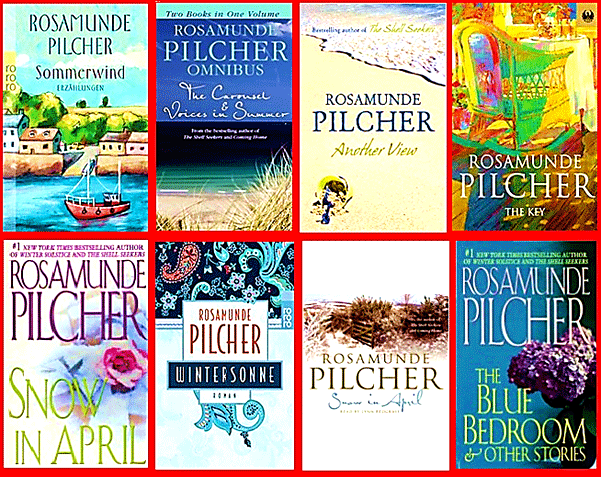
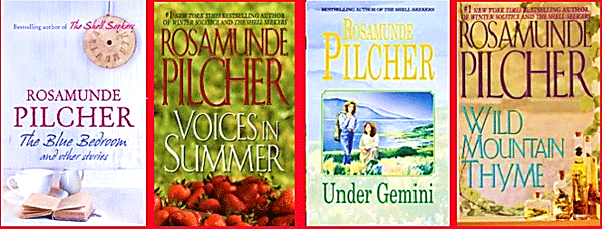
2.. This illustrated article is meant for the promotion of this movie. Please refer to “About” of my webpage for more details. 31

3.. The book Judith is reading when she first met Feodor is a hardback edition of Kingsley Amis novel The Riverside Villas Murder, published in 1973 (read elsewhere that this dust jacket was designed by illustrator and children’s author Ian Beck.)

4.. Darling Lili gathered Academy Award nominations for Best Original or Adaptation Score and Best Original Song (Whistling Away the Dark – sung by Julie Andrews) for Henry Mancini (music) and Johnny Mercer (lyrics); and for Best Costume Design for Jack Bear and Donald Brooks.

5.. Evelyn Bridget Patricia Ward-Thomas (pseudonym: Evelyn Anthony, Anthony Evelyn, Eve Stephens) born on July 3, 1928, and convent educated, wrote ten successful romance/historical novels before turning to genres: Mystery/Crime/Suspense. She lives in Essex, England.

6.. Those of you who liked the novel “The Tamarind Seed” may like to check Evelyn Anthony’s “The Defector” for their similarities. Further books by Evelyn Anthony currently in Manningtree Archive:  32 33 34 35 7.. Sharif divorce his wife, Egyptian film and television actress and producer Faten Hamama in 1974, the year this movie was released (Faten Hamama died on January 17, 2015 at the same age Omar Sharif will join his former wife at the grave in less than six months later.)

8.. Julie Andrews is the second Julie to become Sharif’s heroine following Julie Christie of Doctor Zhivago. Julie Newmar was his co-star in Mackenna’s Gold.

9.. The movie’s links to month of July: Author Evelyn Anthony was born on July 3 (1928); Director Blake Edwards born on July 26 (1922); Omar Sharif died on July 10 (2015).

10.. This article is in memory of Omar Sharif – May his soul rest in peace. 36

(© Joseph Sebastine/Manningtree Archive)